•     By Michael Borella —

    USPTO SealThe U.S. Patent and Trademark Office (USPTO) wasted no time providing guidance to its examining corps regarding the recent Supreme Court decision in Alice Corp. v. CLS Bank International.  Just one week after the Justices struck down all of Alice's method, device, and system claims as being patent-ineligible under 35 U.S.C. § 101, the USPTO has published a memorandum with its preliminary examination instructions.

    As an initial matter, the memorandum makes it clear that the decision "neither creates a per se excluded category of subject matter, such as software or business methods, nor imposes any special requirements for eligibility of software or business methods."  Instead, examiners are now to apply the framework set forth in Mayo Collaborative Services v. Prometheus Laboratories, Inc., "to analyze all claims directed to laws of nature, natural phenomena, and abstract ideas for subject matter eligibility under 35 U.S.C. § 101."

    This unifies the analysis in two ways.  First, the same standard is applied to claims with abstract ideas and laws of nature.  Previously, the former was evaluated under Bilski and the latter under Mayo.  Second, the same standard is to be used for all statutory classes of claims, not just method claims.  Before CLS Bank, it wasn't clear that the holdings of Bilski, Mayo, and their § 101 predecessors impacted more than just method claims.

    The memorandum reiterates the two-part Mayo test with examples.  For the first prong, "determine whether the claim is directed to an abstract idea," the memorandum indicates that abstract ideas include:

    • Fundamental economic practices;
    • Certain methods of organizing human activities;
    • An idea of itself; and,
    • Mathematical relationships / formulas.

    Such an abstract idea would then be further considered under the second prong, "determine whether any element, or combination of elements, in the claim is sufficient to ensure that the claim amounts to significantly more than the abstract idea itself."  Examples of types of limitations that may lift the claim up to meet the § 101 bar include:

    • Improvements to another technology or technical fields;
    • Improvements to the functioning of the computer itself; and
    • Meaningful limitations beyond generally linking the use of an abstract idea to a particular technological environment.

    Claims that do not include such limitations should be rejected as being directed to non-statutory subject matter.  Of note is that the USPTO does not address whether prior art should be used to establish that an abstract idea is "fundamental" or to determine that an addition limitation is more than routine or conventional.

    This brief memorandum provides a glimpse of the immediate impact of CLS Bank in the USPTO — applicants are likely to have software and business method claims scrutinized carefully in light of these guidelines.  For applications already under examination, an applicant's options may be limited.

    However, for new applications, the USPTO has provided something of a roadmap with which one can try to avoid CLS Bank rejections.  To the extent possible, draft claims to avoid reciting any of the examples of abstract ideas given above.  If that is not possible, include limitations that clearly demonstrate how the claimed invention improves a technological process, device or system.  Doing so may result in more focused claims, but this approach may be necessary to avoid § 101 roadblocks during prosecution.

  •         By Sherri Oslick —

    Gavel About Court Report:  Each week we will report briefly on recently filed biotech and pharma cases.

    Cephalon Inc. v. Actavis Laboratories FL Inc. et al.
    1:14-cv-00776; filed June 19, 2014 in the District Court of Delaware

    • Plaintiff:  Cephalon Inc.
    • Defendants:  Actavis Laboratories FL Inc.; Actavis Inc.; Actavis Pharma Inc.; Watson Laboratories Inc.

    Infringement of U.S. Patent Nos. 6,200,604 ("Sublingual Buccal Effervescent," issued March 13, 2001), 6,974,590 (same title, issued December 13, 2005), and 8,119,158 ("Effervescent Oral Fentanyl Dosage Form and Methods of Administering Fentanyl," issued February 21, 2012) following a Paragraph IV certification as part of Actavis’ filing of an ANDA to manufacture a generic version of Cephalon's Fentora® (fentanyl citrate buccal tablets, used to treat breakthrough pain in adult patients with cancer).  View the complaint here.

    Novartis AG et al. v. Glenmark Pharmaceuticals Ltd. et al.
    1:14-cv-00771; filed June 18, 2014 in the District Court of Delaware

    • Plaintiffs:  Novartis AG; Novartis Pharmaceuticals Corp.
    • Defendants:  Glenmark Pharmaceuticals Ltd.; Glenmark Generics Ltd.; Glenmark Generics Inc.

    Infringement of U.S. Patent Nos. 6,025,391 ("Enteric-Coated Pharmaceutical Compositions of Mycophenolate," issued February 15, 2000), 6,172,107 ("Entric-Coated Pharmaceutical Compositions," issued January 9, 2001), and 6,306,900 (same title, issued October 23, 2001) following a Paragraph IV certification as part of Glenmark’s filing of an ANDA to manufacture a generic version of Novartis' Myfortic® (mycophenolate sodium, used for the prophylaxis or prevention of organ rejection in patients receiving allogeneic renal transplants, administered in combination with cyclosporine and corticosteroids).  View the complaint here.

    Merck Sharp & Dohme Corp. v. Fresenius Kabi USA, LLC
    3:14-cv-03917; filed June 18, 2014 in the District Court of New Jersey

    Infringement of U.S. Patent No. 5,691,336 ("Morpholine Compounds Are Prodrugs Useful As Tachykinin Receptor Antagonists," issued November 25, 1997) following a Paragraph IV certification as part of Fresenius’ filing of an ANDA to manufacture a generic version of Merck's Emend® (fosaprepitant dimeglumine for injection, used in the prevention of acute and delayed nausea and vomiting associated with initial and repeat courses of highly emetogenic cancer chemotherapy including high-dose cisplatin, and to prevent nausea and vomiting associated with initial and repeat courses of moderately emetogenic cancer chemotherapy).  View the complaint here.

    Amarin Pharma, Inc. et al. v. Andrx Labs, LLC et al.
    3:14-cv-03924; filed June 18, 2014 in the District Court of New Jersey

    • Plaintiffs: Amarin Pharma, Inc.; Amarin Pharmaceuticals Ireland Ltd.
    • Defendants: Andrx Labs, LLC; Andrx Corporation; Actavis, Inc.

    Infringement of U.S. Patent Nos. 8,293,728 ("Methods of Treating Hypertriglyceridemia," issued October 23, 2012), 8,318,715 (same title, issued November 27, 2012), 8,357,677 (same title, issued January 22, 2013), 8,367,652 (same title, issued February 5, 2013), 8,377,920 (same title, issued February 19, 2013), 8,399,446 (same title, issued March 19, 2013), 8,415,335 (same title, issued April 9, 2013), 8,426,399 (same title, issued April 23, 2013), 8,431,560 (same title, issued April 30, 2013), 8,440,650 (same title, issued May 14, 2013), 8,501,225 ("Stable Pharmaceutical Composition and Methods of Using Same," issued August 6, 2013), 8,518,929 ("Methods of Treating Hypertriglyceridemia," issued August 27, 2013), 8,524,698 (same title, issued September 3, 2013), 8,546,372 (same title, issued October 1, 2013), 8,551,521 ("Stable Pharmaceutical Composition and Methods of Using Same," issued October 8, 2013), and 8,617,594 (same title, issued December 31, 2013) following a Paragraph IV certification as part of Andrx’s filing of an ANDA to manufacture a generic version of Amarin's Vascepa® (icosapent ethyl, used as an adjunct to diet to reduce triglyceride levels in adult patients with severe hypertriglyceridemia).  View the complaint here.

    Spectrum Pharmaceuticals, Inc. et al. v. Ben Venue Laboratories, Inc.
    2:14-cv-00980; filed June 18, 2014 in the District Court of Nevada

    • Plaintiffs:  Spectrum Pharmaceuticals, Inc.; University of Strathclyde
    • Defendant:  Ben Venue Laboratories, Inc.

    Infringement of U.S. Patent No. 6,500,829 ("Substantially Pure Diastereoisomers of Tetrahydrofolate Derivatives," issued December 31, 2002) following a Paragraph IV certification as part of Ben Venue’s filing of an ANDA to manufacture a generic version of Spectrum's Fusilev® (levoleucovorin, used to treat advanced metastatic colorectal cancer).  View the complaint here.

    Vanda Pharmaceuticals Inc. v. Roxane Laboratories Inc.
    1:14-cv-00757; filed June 16, 2014 in the District Court of Delaware

    Infringement of U.S. Patent No. 8,586,610 (“Methods for the Administration of Iloperidone,” issued November 19, 2013) in conjunction with Roxane's filing of an ANDA to manufacture a generic version of Novartis' Fanapt® (iloperidone, used for the acute treatment of adults with schizophrenia).  View the complaint here.

    ALZA Corp. et al. v. Sandoz Inc.
    1:14-cv-03838; filed June 16, 2014 in the District Court of New Jersey

    • Plaintiffs:  ALZA Corp.; Janssen Pharmaceuticals Inc.
    • Defendant:  Sandoz Inc.

    ALZA Corp. et al. v. Sandoz Inc.
    1:14-cv-00744; filed June 13, 2014 in the District Court of Delaware

    • Plaintiffs:  ALZA Corp.; Janssen Pharmaceuticals Inc.
    • Defendant:  Sandoz Inc.

    The complaints in these cases are substantially identical.  Infringement of U.S. Patent Nos. 8,163,798 ("Methods and Devices for Providing Prolonged Drug Therapy," issued April 24, 2012) 8,629,179 (same title, issued January 14, 2014) following a Paragraph IV certification as part of Sandoz’s filing of an ANDA to manufacture a generic version of Alza's Concerta® (methylphenidate hydrochloride, used to treat attention deficit hyperactivity disorder).  View the Delaware complaint here.

    University of Utah Research Foundation et al. v. Pathway Genomics
    2:14-cv-00442; filed June 13, 2014 in the District Court of Utah

    • Plaintiffs:  University of Utah Research Foundation; Trustees of the University of Pennsylvania; HSC Research and Development Limited Partnership; Endorecherche; Myriad Genetics
    • Defendant:  Pathway Genomics

    Infringement of U.S. Patent Nos. 5,709,999 ("Linked Breast and Ovarian Cancer Susceptibility Gene," issued January 20, 1998), 5,747,282 ("17Q-Linked Breast and Ovarian Cancer Susceptibility Gene," issued May 5, 1998), 5,753,441 (same title, issued May 19, 1998), 5,837,492 ("Chromosome 13-Linked Breast Cancer Susceptibility Gene," issued November 17, 1998), 6,033,857 (same title, issued March 7, 2000), 6,051,379 ("Cancer susceptibility mutations of BRCA2," issued April 18, 2000), 6,951,721 ("Method for determining the haplotype of a human BRCA1 gene," issued October 5, 2005), 7,250,497 ("Large deletions in human BRCA1 gene and use thereof," issued July 31, 2007), 7,470,510 ("Methods for Diagnosing Cancer and Determining a Susceptibility for Developing Cancer," issued December 30, 2008), 7,622,258 ("Screening Methods and Sequences Relating Thereto," issued November 24, 2009), 7,838,237 (same title, issued November 23, 2010), 7,670,776 ("MYH Gene Variants and Use Thereof," issued March 2, 2010), 7,563,571 (same title, issued July 21, 2009), based on Pathway Genomic’s manufacture, sale, and offer for sale of its BRCATrue and ColoTrue products and services.  View the complaint here.

    University of Utah Research Foundation et al. v. Counsyl
    2:14-cv-00443; filed June 13, 2014 in the District Court of Utah

    • Plaintiffs:  University of Utah Research Foundation; Trustees of the University of Pennsylvania; HSC Research and Development Limited Partnership; Endorecherche; Myriad Genetics
    • Defendant:  Counsyl

    Infringement of U.S. Patent Nos. 5,747,282 ("17Q-Linked Breast and Ovarian Cancer Susceptibility Gene," issued May 5, 1998), 5,753,441 (same title, issued May 19, 1998), 6,033,857(same title, issued March 7, 2000), 6,051,379 ("Cancer susceptibility mutations of BRCA2," issued April 18, 2000), 6,951,721 ("Method for determining the haplotype of a human BRCA1 gene," issued October 5, 2005), and 7,250,497 ("Large deletions in human BRCA1 gene and use thereof," issued July 31, 2007) based on Counsyl’s Inherited Cancer Screen, Inherited Cancer Screen, Counsyl Inherited Jewish Screen, Comprehensive BRCA Test, and BRCA1/2 Sequencing Test offerings.  View the complaint here.


    Vivus, Inc. v. Actavis Laboratories FL, Inc. et al.
    2:14-cv-03786; filed June 12, 2014 in the District Court of New Jersey

    • Plaintiff: Vivus, Inc.
    • Defendants: Actavis Laboratories FL, Inc.; Actavis, Inc.; Actavis PLC

    Infringement of U.S. Patent Nos. 7,056,890 (“Combination Therapy for Effecting Weight Loss and Treating Obesity, issued June 6, 2006), 7,553,818 (same title, issued June 30, 2009), 7,659,256 (same title, issued February 9, 2010), 7,674,776 (same title, issued March 9, 2010), 8,580,298 (“Low Dose Topiramate/Phentermine Composition and Methods of Use Thereof,” issued November 12, 2013), and 8,580,299 (“Escalating Dosing Regimen for Effecting Weight Loss and Treating Obesity,” issued November 12, 2013) following a Paragraph IV certification as part of Actavis’ filing of an ANDA to manufacture a generic version of Vivus’ Qsymia® (phentermine and topiramate extended-release capsules, used as an adjunct to a reduced-calorie diet and increased physical activity for chronic weight management).  View the complaint here.

  • Post-Grant Patent Challenges and Biosimilar Regulatory Pathways

    By Andrew Williams —

    BIO International ConventionThe 2014 BIO International Convention has already begun in San Diego, but most of the sessions and forums get underway beginning on Tuesday, June 24, 2014.  Patent Docs has been highlighting a few sessions or other opportunities, in thematic fashion, to help you navigate your way through the convention.  For example, today, we focus on issues surrounding post-grant challenges of patents, both in the U.S. and Europe, and on the issues surrounding the regulatory approval of biosimilars.  Of course, Patent Docs authors and contributors will be present at BIO as part of the MBHB contingent, and Patent Docs readers are encouraged to stop by the MBHB booth to discuss these sessions (or whatever other topic is of interest to you) (#1337).

    Today we highlight two distinct topics that may be of interest to readers of this blog.  The first involves the ability to challenge issued patents at the U.S. Patent Office or EPO instead of in the court system.  Many detractors of the U.S. patent system have blamed the Patent Office for issuing too many vague or allegedly invalid patents.  The AIA set up new and improved mechanisms allowing potential or alleged infringers to request another look by the Office.  Of course, EPO has already had a lot of experience with opposition proceedings.  A couple of panels will look at the challenges and considerations involving these mechanisms.  The second topic does not necessarily implicate intellectual property, but patent attorneys are certainly paying close attention to regulatory approval pathways for biosimilars.  All eyes have been focused on the FDA, but so far the mechanisms established for the approval of biosimiars have not been sufficiently utilized.  It is therefore useful to look at the scientific and regulatory issues faced by countries outside the U.S.

    With regard to post-grant challenges, we first note that Donald Zuhn of Patent Docs fame will be moderating a panel on opposition proceedings at the European Patent Office on Wednesday, June 25, at 4:15 PM to 5:15 PM.  The title of this session is "'Chairman, That Patent Should be Revoked!' — Join the EPO Opposition Mock Workshop and Help Argue the Case."  As the name suggests, representatives of the EPO are scheduled to conduct a realistic opposition proceeding to decide the fate of a contested illustrative patent.  Both the proprietor and defendant will be represented by European patent attorneys, but attendees are invited to join either party and help debate the case.  The session promises to elucidate how opposition proceedings are conducted within the EPO, explore how the validity of patents are determined, and compare the differences with comparable proceedings in the U.S.  The speakers for this session are Siobhán Yeats, Director of Biotechnology at the European Patent Office; Reuben Jacob, partner at RGC Jenkins & Co.; and Aylsa Williams, Partner at D Young & Co LLP.

    In addition to hearing the comparisons between the EPO and US systems in the previous session, attendees will also be able to hear an in-depth presentation on post-issuance challenges at the United States Patent Office.  On Wednesday, June 25, at 10:15 AM to 11:30 AM, the Intellectual Property track will be feature "Navigating Patent Challenges Under the America Invents Act."  Biotechnology and pharmaceutical companies are not immune to such challenges, so it is important to understand the intricacies of these relevantly new procedures.  Moreover, the Federal Circuit's Fresenius v. Baxter International decision has made the timing of such a challenge an important consideration.  Of course, which process is used and how it is defended can affect not only whether suitable patent protection can be maintained, but can limit or expand defenses available either in court or at the Office.  This session will assess the risks and benefits associated with the available actions for challenging patent validity at the Office, in the courts, and at the International Trade Commission.  The speakers for this session will be Lead Administrative Patent Judge Michael Tierney, Patent Trial and Appeal Board; Judge Dana Sabraw, U.S. District Court for the Southern District of California; and Cliff Ford, Executive Director and Senior Patent Counsel at Isis Pharmaceuticals, Inc.  The session will be moderated by Meaghan Kent from Venable LLP.

    With regard to the two sessions we are highlighting with regard to the regulation of biosimilars, unfortunately their times overlap (likely because they are in different tracks/forums).  First, the Regulatory Review & Approval track will present "Ensuring the Safety and Commercial Success of Biosimilars in the United States" on Tuesday at 1:45 PM to 2:45 PM.  The description of the session notes that there is a debate over what approach the FDA and the industry should take to ensure patient safety on one hand, and promoting market competition and continued biomedical innovation on the other.  The session promises to explore several critical issues related to safety, naming and traceability, substitution, product drift, and comparability and similarity.  There will be a focus on the lessons learned from Europe in the launch of the new class of biosimilar monoclonal antibodies.  With regard to issues of naming products, the "unknown" differences between an approved treatment with known process histories and a new product being studied for biosimilarity will be discussed.  The speakers for the session are Marcia Horn, President and CEO of ICAN (the International Cancer Advocacy Network), Phillip Schneider, Associate Dean and Professor at the University of Arizona College of Pharmacy; and Robert Yapundich, Board Certified Neurologist with the Neurology Associates, P.A.

    At about the same (1:30 PM to 3:30 PM on June 24), the Emerging Opportunities in Global Markets Forum will present "Biosimilars Regulations: A Perspective from Influential Global Regulators."  This session will feature regulatory agency officials from around the globe to discuss both scientific and regulatory issues for biosimilars, especially with regard to the WHO draft guidelines.  For example, the discussion of approval requirements will address clinical trials, extrapolation of data, and immunogenicity, among other topics.  The session promises to also address issues surrounding naming, labeling, and pharmacovigilance.  The panel will include Lic. Mikel Arriola, Commissioner at COFEPRIS; and Dirceu Barbano, President of ANVISA; and will be moderated by Christian Lopez-Silva, Partner with Baker & McKenzie, S.C. in Mexico.

    We look forward to seeing you at BIO 2014!

  • BIO and Leaders in the IP Community

    By Andrew Williams —

    BIO International ConventionThe 2014 BIO International Convention begins this week in San Diego.  If you are planning on attending, you probably already know that the amount of information and opportunities available at BIO can be daunting.  Therefore, Patent Docs has been highlighting a few sessions or other opportunities, in thematic fashion, to help you navigate your way through the convention.  For example, today, we focus on presentations by influential leaders in the Intellectual Property Community.  Of course, Patent Docs authors and contributors will be present at BIO as part of the MBHB contingent, and Patent Docs readers are encouraged to stop by the MBHB booth to discuss these sessions (or whatever other topic is of interest to you) (#1337).

    In the United States, two of the entities that have the most impact on U.S. patent practice are the United States Patent and Trademark Office and the United States Court of Appeals for the Federal Circuit.  And, on the global scale, it can be argued that no organization has more impact on international patent practice than the World Intellectual Property Organization ("WIPO").  Impressively, BIO will feature at least three current or recent leaders of these three organizations.  Therefore, attendees will be able to gain insight from the individuals that play (or have played) a major role in each of these three organizations.

    First on our list, Judge Randall R. Rader of the Federal Circuit will be providing his view from the bench on recent developments in biotech patent law in the courts and in Congress.  This session will be on Wednesday, June 25, from 8:30 AM to 9:00 AM for the Intellectual Property track.  Judge Rader recently stepped down from his position as Chief Judge, and was succeeded by now Chief Judge Sharon Prost.  Moreover, five days after his presentation at BIO, on June 30, Judge Rader will be retiring from the court.  The title of his presentation is aptly named "Welcome and Farewell — Judge Randall R. Rader."  Judge Rader has also been outspoken on the issue of using § 285 fee-shifting as a mechanism for federal courts to combat patent trolls.  It will be interesting to see what he has to say on the recent legislative efforts aimed at the same goal.  Along those lines, there will be a separate session later that day at 1:45 PM to 2:45 PM on these Congressional efforts.  The title of that session will be "As if AIA Hasn't Brought Enough Change — Patent Litigation Reform is Looming in the US."

    Next up, literally, Acting Director Michelle Lee will participate in a session immediately following Judge Rader, from 9:00 AM to 10:00 AM, June 25, entitled "View from the USPTO — Address by Acting Director Michelle Lee and Discussion of the Myriad-Mayo Guidelines."  Anyone following this blog knows how controversial those guidelines have been, so it will be interesting to hear the perspective of the acting director herself on the issue.  With her will be two additional representatives from the patent office, June Cohan, Legal Advisor, and Andrew Hirshfeld, Deputy Commissioner for Patent Examination Policy.  They promise to provide the latest thinking on the examination guidelines, and take questions and feedback from the audience.  The period for submitting comments to the Office on these guidelines is still open, and in fact has been extended to July 31, 2014.  Those attendees interested in this topic might also be interested in the session "Patent Eligibility from the Trenches: Practical Implications of the Supreme Court's Mayo and Myriad Decisions" on June 25, from 3:00 PM to 4:00 PM.  The panel for this session includes former Acting Director of the USPTO Teresa Stanek Rea.

    Finally (or should we say initially?), Director General Francis Gurry of WIPO will be kicking off the Intellectual Property track on Tuesday, June 24, from 2:15 PM to 2:45 PM.  The Director General will be discussing WIPO activities and their impact on the biotechnology sector.  Just last month, the member states of WIPO appointed Director General Gurry by consensus to a second six-year term of office.  Immediately preceding this presentation, there will be an Intellectual Property Meetup in the "IP Social Spot" from 1:30 PM to 2:15 PM.  This Meetup will provide intellectual property professionals to mingle and kick-off the track.

    Be on the look-out for the next installment of BIO 2014 previews in the next few days.

  • BIO International Convention copyThe Biotechnology Industry Organization (BIO) is holding its annual BIO International Convention this week in San Diego, CA.  Founded in 1993, BIO is a nonprofit association seeking supportive biotechnology policies on behalf of more than 1,100 biotechnology companies, academic institutions, state biotechnology centers, and related organizations across the United States and in more than 30 other nations.

    Patent-Docs-Logo_no_subtitleAs part of the Convention, more than 1,700 biotech companies, organizations, and institutions are expected to participate in the BIO Exhibition.  Patent Docs Donald Zuhn, Kevin Noonan, Andrew Williams, Sherri Oslick, Michael Greenfield, Josh Bosman, Josh Rich, James DeGiulio, and Nate Chongsiriwatana will also be attending BIO as part of the MBHB contingent, and will be participating in BIO's blogger network throughout the week.  Patent Docs readers who may be attending BIO this week are encouraged to stop by booth #1337 to meet the Docs, at the times indicated below, and talk a little biotech patent law.

    Tuesday, June 24

    9:30 am – 12:00 pm — Andrew Williams, Josh Rich, James DeGiulio, and Nate Chongsiriwatana
    12:00 – 2:30 pm — Donald Zuhn, Sherri Oslick, and Michael Greenfield
    2:30 – 5:30 pm — Sherri Oslick, James DeGiulio, and Nate Chongsiriwatana

    Wednesday, June 25

    9:30 am – 12:00 pm — Michael Greenfield, Josh Bosman, and Josh Rich
    12:00 – 2:30 pm — Sherri Oslick, James DeGiulio, and Nate Chongsiriwatana
    2:30 – 5:30 pm — Josh Bosman and James DeGiulio

    Thursday, June 26


    9:30 am – 12:00 pm — Donald Zuhn, Andrew Williams, Michael Greenfield, and Josh Bosman
    12:00 – 2:30 pm — James DeGiulio

    BIO - Good Times on Tap 2011In addition, most of the Docs will be attending the MBHB reception at Dublin Square Irish Pub & Grill in San Diego's downtown Gaslamp Quarter on Tuesday, June 24 from 8:00 pm to 1:00 am.  Additional information about the reception, including invitations for the event, can be picked up at the MBHB booth on Tuesday.

  • CalendarJune 23-26, 2014 – BIO International Convention (Biotechnology Industry Organization) – San Diego, CA

    June 25-26, 2014 – International Forum on Pharma Patent Extensions*** (C5) – London, England

    June 27, 2014 – "Navigating the Patent Trial and Appeal Board Post-Grant Minefield" (American Bar Association Section of Intellectual Property Law) – 1:00 to 2:30 pm (ET).

    June 30, 2014 – "Drafting Patent Claims After In re Packard: Navigating the New PTO Regime for Evaluating Indefiniteness" (Strafford) – 1:00 to 2:30 pm (EDT)

    July 9, 2014 – "Nautilus and Limelight: The Supreme Court Keeps Chipping Away at Patentees" (McDonnell Boehnen Hulbert & Berghoff LLP) – 10:00 to 11:15 am (CT)

    July 9-11, 2014 – Fundamentals of Patent Prosecution 2014: A Boot Camp for Claim Drafting & Amendment Writing (Practising Law Institute) – San Francisco, CA

    July 20-22, 2014 – 2014 Annual Meeting & Conference (National Association of Patent Practitioners) – Alexandria, Virginia.

    August 13-15, 2014 – Advanced Patent Law Seminars (Chisum Patent Academy) - Seattle, WA

    August 18-20, 2014 – Advanced Patent Law Seminars (Chisum Patent Academy) - Seattle, WA

    ***Patent Docs is a media partner of this conference or CLE

  • ABAThe American Bar Association (ABA) Section of Intellectual Property Law will be offering a live webinar entitled "Navigating the Patent Trial and Appeal Board Post-Grant Minefield" on June 27, 2014 from 1:00 to 2:30 pm (ET).  Cory C. Bell of Finnegan will moderate a panel consisting of Erika H. Arner of Finnegan; Samir N. Pandya, Senior IP Counsel for SAP AG; and Kirupa Pushparaj, IP Counsel for Square, Inc.  The panel will discuss the biggest mistakes petitioners and patent owners make, including:

    • Why so many petitions are being bounced?
    • What the PTAB looks for in a complete rejection?
    • Getting the PTAB to change their mind after institution.

    The registration fee for the webcast is $150 for members and $195 for the general public.  Those interested in registering for the webinar, can do so here.

  • By Michael Borella —

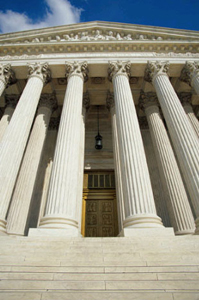
    Supreme Court Building #1There's an old saying that "bad facts make bad law," acknowledging that a court's decision regarding an extreme case can result in law that poorly serves less extreme cases.  The Supreme Court's recent trio of 35 U.S.C. § 101 decisions, Bilski v. Kappos, Mayo Collaborative Services v. Prometheus Laboratories, Inc., and today's unanimous Alice Corp. v. CLS Bank Int'l each involved claims that were probably too broad for their own good.  But instead of directly challenging the novelty or non-obviousness of these claims, the patent-eligibility of the claims were the core of the respective disputes.  As a result, the lines between §§ 101, 102, and 103 have become blurred, and the Court still hasn't clarified what makes a claim too abstract to be patent-eligible despite using this doctrine to strike down claims in all three cases.  Thus, the impact of CLS Bank on less extreme cases — those with more focused claims for instance — remains to be seen.

    As noted in an earlier overview article by Kevin Noonan, the Court did not bar software or business method patents per se.  This case, however, continues the trend of two other patent cases decided this term, Limelight Networks, Inc. v. Akamai Technologies, Inc. and Nautilus, Inc. v. Biosig Instruments, Inc., in which the Court has placed further limits on the scope of patent protection.  Consequently, the Court has introduced new avenues for challenging the validity of patents.

    The following is a collection of initial thoughts regarding the CLS Bank decision and its impact on software and business method practice.

    • The Court declined to clearly define the term "abstract idea."  It stated that "we need not labor to delimit the precise contours of the 'abstract ideas' category in this case."  Instead, the Justices relied on the conceptual similarity between Alice's claims and those found patent-ineligible in Bilski.  Alice argued that abstract ideas must exist apart from any human interaction (e.g., an equation would be an abstract idea, but a process involving human activity would not).  The Court would hear nothing of this, couching the abstract claims of Bilski as "a method of organizing human activity."

    • In Bilski, the Court held that "while the machine-or-transformation test has always been a 'useful and important clue,' it has never been the 'sole test' for determining patentability."  In this case, Alice's computer-readable media and system claims were struck down under § 101, despite reciting general-purpose computer components.  Thus, it appears that to pass the machine-or-transformation test, claims must be tied to a particular machine and not just a generic computer.

    • To that point, the Court has taken a rather dim view of the ability of general purpose computing to lift an otherwise abstract idea above the § 101 bar.  For instance, the Court stated that "method claims, which merely require generic computer implementation, fail to transform [an] abstract idea into a patent-eligible invention," "[t]he fact that a computer necessarily exist[s] in the physical, rather than purely conceptual, realm is beside the point," "each step [of Alice's claims] does no more than require a generic computer to perform generic computer functions," and "nearly every computer will include a 'communications controller' and 'data storage unit' capable of performing the basic calculation, storage, and transmission functions required by the method claims."  It is now abundantly clear that recitation of generic computer structure will not save a claim that is drawn to an abstract idea.

    • 1980's Diamond v. Diehr noted that "[t]he question therefore of whether a particular invention is novel is wholly apart from whether the invention falls into a category of statutory subject matter."  After today, it appears as if novelty (or lack thereof) can play a major role in determining whether claims are statutory under § 101.  In finding Alice's claims drawn to the abstract idea of "intermediated settlement," the Court cited several references (some of which might not qualify as prior art under §§ 102 or 103) to establish that such undertakings were "fundamental economic practice long prevalent in our system of commerce."  Similarly, when considering the impact of the recited (or stipulated) computer implementation, the Court stated that "all of these computer functions are well-understood, routine, conventional activities previously known to the industry."

    • Justice Breyer's two step test for § 101 worthiness introduced in Mayo was thought by some to be an aberration or a temporary departure from the Court's previous holdings.  Others criticized it as being subjective and too difficult to apply in practice — the test certainly divided the Federal Circuit judges.  With the Justices relying on the test, it is now evident that the Mayo framework was no passing fad.

    • The first prong of the Mayo test is to "identify the abstract idea represented in the claim."  In doing so, the Court did not focus on the language of the claims, but instead focused on a summary of the claimed invention.  But almost any invention can be made to look abstract or conventional through summarization, or by downplaying certain aspects of the claim.

    • The second prong of the Mayo test is to determine whether a claim directed to an abstract idea recites "an element or combination of elements that is sufficient to ensure that the patent in practice amounts to significantly more than a patent upon the ineligible concept itself."  But we have little guidance as to what "significantly more" entails.  In the last 40 years, the only example of a claim meeting the § 101 bar in the Supreme Court is that of Diehr.

    • The Court seems to use the word "technological" as something of a synonym for "physical."  Thus, novel and non-obvious algorithmic improvements might not be patent-eligible unless they are integrated somehow with a physical process.  For instance, the Court wrote that "the claims in Diehr were patent eligible because they improved an existing technological process, not because they were implemented on a computer."  This fixation on physicality may demonstrate an underlying predisposition against software, which is technology that operates in a mostly unseen fashion.

    Alice's claims could have, and probably should have, been attacked as being anticipated or obvious.  After all, this decision relies on the existence of prior art that could have been used for such a purpose.  Instead, the Court has fully opened the § 101 Pandora's Box that it peeked into with Mayo.

  • Alice Corp. v. CLS Bank International (2014)

    By Kevin E. Noonan —

    Supreme Court Building #2This morning, in Alice Corp. v. CLS Bank, the Supreme affirmed the Federal Circuit's per curiam opinion in CLS Bank v. Alice Corp. in a unanimous opinion by Justice Thomas with a concurring opinion by Justice Sotomayor joined by Justices Breyer and Ginsberg.  The decision appears to be an incremental one, insofar as it does not strike down all software patents and is crafted as an application of the Court's earlier precedent, particularly Bilski v. Kappos and Mayo Collaborative Serv. v. Prometheus Labs.

    The decision affirms patent ineligibility for the method claims (directed, according to the Court, to methods for implementing an intermediated settlement that are well-known in the art), system claims involving implementation of the method using a general purpose computer and computer code for directing a general purpose computer to implement the method.  From the opinion, it is clear that the Court is still striving for balance between tying up fundamental building blocks that would inhibit innovation while not swallowing patent law whole because everything ultimately is based on an abstract idea, law of nature or natural phenomenon:

    We have "repeatedly emphasized this . . . concern that patent law not inhibit further discovery by improperly tying up the future use of " these  building  blocks of human ingenuity" [quoting O'Reilly v. Morse as cited in Mayo].  "At the same time, we tread carefully in construing this exclusionary principle lest it swallow all of patent law" because "[a]t some level, "all inventions . . . embody, use, reflect, rest upon, or apply laws of  nature, natural phenomena, or  abstract ideas" [citing Mayo].

    Accordingly, in applying the §101 exception, we must distinguish between patents that claim the "'buildin[g] block[s]'" of human ingenuity and those that integrate the building blocks into something more, thereby "transform[ing]" them into a patent-eligible invention.  The former "would risk disproportionately tying up the use of the underlying" ideas and are therefore ineligible for patent protection.  The latter pose no comparable risk of pre-emption, and therefore remain eligible for the monopoly granted under our patent laws" [citing liberally from the Mayo opinion].

    The Court considers the Mayo opinion to have provided the framework for performing the patent-eligibility analysis:

    First, we determine whether the claims at issue are directed to one of those patent-ineligible concepts.  If so, we then ask, "[w]hat else is there in the claims before us?"  To answer that question, we consider the elements of each claim both individually and "as an ordered combination" to determine whether the additional elements "transform the nature of the claim" into a patent-eligible application.  We have described step two of this analysis as a search for an " 'inventive concept'" — i.e., an element or combination of elements that is "sufficient to ensure that the patent in practice amounts to significantly more than a patent upon the [ineligible concept] itself."

    The Court also considers its jurisprudence from Gottschalk v. Benson, through Parker v. Flook, Bilski and to Mayo to be consistent in both the underlying principles and how the analysis should be done.  The opinion distinguishes its seemingly contrary decision in Diamond v. Diehr in a way that may be useful in making decisions regarding what is patent-eligible subject matter (and how it should be claimed):  "In other words, the claims in Diehr were patent eligible because they improved an existing technological process, not be­cause they were implemented on a computer" (emphasis added).  And, in a footnote, the Court declares that its Mayo analysis is consistent with the patent law principle that the claims should be considered as a whole because the Mayo decision instructs a court to consider the elements of the claim at issue both individually and as a whole.

    The Court's opinion expressly ties its decision here to the decision in Bilski, based on the perceived similarity between attempts in each case to preempt a preexisting human activity (hedging in Bislki, intermediated settlement here) as being abstract ideas (and once again conflating Section 101 with Sections 102 and 103), the Court stating that "[i]t is enough to recognize that there is no meaningful distinc­tion between the concept of risk hedging in Bilski and the concept of intermediated settlement at issue here.  Both are squarely within the realm of 'abstract ideas' as we have used that term."  And after a brief discussion of the Court's understanding of how a conventional general purpose computer works, the Court opines that how the computer implements the claimed (and ineligible) method is not "enough" to render the system claims patent eligible because said implementation is entirely conventional.

    The Court's opinion also provides guidance on how it will determine what is "enough" that must be added to an abstract idea, law of nature or natural phenomenon to render a claim encompassing these categories to be patent-eligible, based on the rubric that there must be something in the claimed invention that improves existing technology:

    The method claims do not, for example, purport to improve the functioning of the computer itself.  ("There is no specific or limiting recitation of . . . improved computer technology . . . "); Brief for United States as Amicus Curiae 28–30.  Nor do they effect an improvement in any other technology or technical field.  Instead, the claims at issue amount to "nothing significantly more" than an instruction to apply the ab­stract idea of intermediated settlement using some un­specified, generic computer.  Under our precedents, that is not "enough" to transform an abstract idea into a patent-eligible invention [citations omitted].

    The system and computer-readable medium claims stand and fall with the method claims:

    Put another way, the system claims are no different from the method claims in substance.  The method claims recite the abstract idea implemented on a generic computer; the system claims recite a handful of generic computer components configured to implement the same idea.  This Court has long "warn[ed] . . . against" interpreting §101 in ways that make patent eligibility 'depend simply on the draftsman's art.'"

    The Court's decision is entirely consistent with its disinclination to enunciate broad proscriptions against patenting particular areas of technology, as evidenced by its decisions in Bilski (which did not rule all business method claims to be patent-ineligible), Association for Molecular Pathologists v. Myriad Genetics (which was limited to rendering genomic DNA patent-ineligible but did not disturb patent-eligibility for cDNA, and contained express proscriptions against reading the decision to encompass methods or other applications of the knowledge of the BRCA genes, despite the PTO's recent Guidelines that appear to ignore these proscriptions) and even Bowman v. Monsanto, which cautioned against interpreting the Court's decision in that case to apply to all "self-replicating technologies."

    Justice Sotomayor's concurring opinion is brief and to the effect that the Justice believes business method patents to be patent ineligible per se because they do not fall within the ambit of a "process" under the Patent Act.  Justices Breyer and Ginsberg join her here, as they did in Justice Stevens' concurring opinion in Bilski.  The other Justices apparently are not yet ready to make all business method claims ineligible for patenting, provided that they satisfy the rule reiterated here that there must be something that improves existing technology or otherwise does not merely adapt methods for controlling human activity for implementation by a computer.

  • Although the EPC does not specifically prohibit double patenting, that is the grant of two patents to the same applicant for the same invention, it is generally accepted that two patents cannot be granted to the same applicant for the same subject matter.  However, what is meant by "the same subject matter" has in the past caused some confusion as it too is not defined by the EPC.  A recent case before the Technical Board of Appeal (T 1780/12) has shed some light on its meaning.

    The Case

    University of TexasThe Board of Regents of the University of Texas (UTS) applied for two patents, EP1 and EP2.  EP2 was filed as a divisional of EP1 and was subsequently given the same filing date as EP1.

    Both EP1 and EP2 related to the use of antibodies to aminophospholipids for cancer treatment.

    The claims of EP1 were "Swiss-type claims" which are a form of purpose-limited process claim usually set out in the form "Use of X for the manufacture of a medicament for the treatment of Y"

    The divisional application was filed after EPC2000 came into effect.  EPC2000 allows for compounds which are useful in a method of treatment by therapy to be drafted as purpose limited product claims.  The claims of EP2 contained such claims in the form "X for use in the treatment of Y".

    EP1 was granted before EP2 and this forced the EPO to consider whether it could grant EP2 due to the restriction on double patenting.  The EPO refused EP2 on the grounds of double patenting which prompted an appeal from UTS.  The appeal focused on whether the EPO had neglected to focus on the scope of the claims and had focused too intensely on the language of the claims.

    The Appeal

    The Technical Board of Appeal (TBA) overturned the decision of the EPO.

    The TBA first considered what is meant by the term "subject matter" in the context of double patenting.  The TBA held that the subject matter of a claim was determined by two aspects, the category of the claim and its features.  Using this analysis, the TBA arrived at the conclusion that EP1 and EP2 related to the same invention.  However, for EP1 and EP2 to claim the same subject matter, and therefore fall foul of the objection, it was held that it was not enough for EP1 and EP2 to relate to the same invention.

    The TBA held that the questions of what is the "claimed subject matter" in the context of double patenting is to be determined by the scope of protection afforded by the claims.  In agreement with another Board of Appeal in T 1391/07, the TBA held that double patenting could only arise where EP1 and EP2 related to notionally the same scope of protection.  Double patenting does not arise if the scope of protection conferred by the claims of EP1 and EP2 overlap only partially.

    The claims of EP1 were purpose-limited process claims and the claims of EP2 were purpose-limited product claims.  It is well accepted that a claim to a process confers less protection than that of a product claim.  The scope of the claims of EP1 and EP2 were therefore different and so could not be seen to confer notionally the same scope of protection.

    Comment

    Whether double patenting is an issue is not merely an assessment of the category of conflicting claims but rather their features and claim scope.

    Practically, to avoid double patenting, it is not sufficient merely to consider the wording of the claims and to arrive at a conclusion about protection based upon that wording, but to interpret the wording to arrive at a sensible picture of the scope of protection that is being sought.  This assessment ought to be carried out at the time of filing a divisional application since it may be difficult to significantly change the scope of the claims of a divisional application later.

    This report comes from European Patent Attorneys at WP Thompson & Co., 55 Drury Lane, London UK.  Further details and commentary can be obtained from Gill Smaggasgale, a partner at the firm.