• By Michael Greenfield —

    In a not particularly well-written opinion that breaks no new ground, the Federal Circuit considered a consolidated appeal of two patents directed to methods of promoting hair growth, including, in particular, eyelash hair growth using compounds and analogs that were previously known for their utility in treating glaucoma.

    AllerganAllergan had asserted its 7,351,404 patent (the '404 patent) and Duke asserted its 7,388,029 patent (the '029 patent) after Apotex filed an ANDA for a generic version of Allergan's Latisse®, an ophthalmic solution comprising bimatoprost (a prostaglandin F-2-alpha ("PGF") analog) as the active ingredient.  The District Court had held the asserted patents were not invalid and were infringed, but in an opinion issued June 10, 2014, a split panel vacated and reversed.  The appeal included an issue of claim construction, the Court once again delving the depths of the meaning of the word "and," as well as issues of anticipation and obviousness.

    The two patents claimed uses of PGF analogs for promoting hair growth, generally, and eyelashes, in particular.  The work that led to Duke's '029 patent arose from research into the effects of a wide range of prostaglandins on mice.  The inventors discovered that PGF analogs specific for the FP receptor promoted growth of longer and thicker hair, and they filed the application directed to a method of treating hair loss.

    The subject matter of the '404 patent arose from clinical studies of the glaucoma drug Lumigan® (identical to Allergan's Latisse®).  The inventors observed that glaucoma patients treated with Lumigan® spontaneously grew longer and thicker eyelash hair.  They filed their patent application directed to treatment of eyelash hair loss through topical administration of the PGF analog bimatoprost.

    Claim construction

    The claim construction issue involved the meaning of the '029 patent's claims to methods of "treating hair loss."  The parties agreed that the term was to be construed as expressly defined in the specification:  "'Treating hair loss' includes arresting hair loss or reversing hair loss, or both, and promoting hair growth."  Apotex contended that the use of the conjunction "and" in the definition of "treating hair loss" required both (a) arresting or reversing hair loss and (b) promoting hair growth, whereas Allergan contended that term required only (a) arresting or reversing hair loss or (b) promoting hair growth.  Under Apotex's construction, its generic version of Latisse® would not infringe the claims because Latisse® lengthened, thickened, and darkened existing healthy hair (which they contended meant only promoting hair growth) but did not arrest or reverse hair loss.

    By contrast, Allergan contended, and the District Court agreed, that by use of the word "includes" in the definition of "treating hair loss," the patentee plainly meant to encompass any one or more of preventing hair loss, arresting hair loss, and promoting hair growth but not necessarily all simultaneously.  This interpretation was further bolstered by examples in the specification demonstrating several aspects of hair growth promotion without accompanying arresting or preventing hair loss.  The panel affirmed the District Court's decision.

    The '029 patent

    Anticipation

    Apotex contended that two prior art publications anticipated the '029 patent:

    (1) Johnstone PCT/US98/02289 application ("Johnstone")

    Johnstone disclosed methods of stimulating hair growth using analogs of PGF,
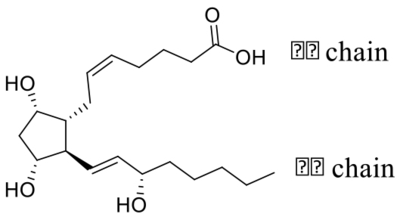
    Image 1
    in which the α-chain was of the form

    Image 2
    The '029 patent claims expressly disclaimed the Johnstone compounds, but Apotex asserted that Johnstone anticipated nevertheless because Johnstone stated that α-chain could be unsaturated (as shown above) or saturated (i.e., wherein the double bond shown above is a single bond).  So, Apotex argued that because the '029 patent claims also encompassed the use of PGF analogs in which the α-chain was saturated (the saturated compounds not having been disclaimed), Johnstone anticipated.

    But the District Court agreed with Duke that Johnstone was insufficiently specific with respect to PGF analogs with saturated α-chains.  The District Court held that in view of the state of the art, the ordinary artisan would not have read Johnstone as disclosing the single-bonded structures because the evidence showed that such structures would not have been thought to have a therapeutic effect because they would selectively bind the FP receptor.  The District Court further noted the examiner's statement that Johnstone "lacks motivation to modify the prostaglandins taught therein in order to obtain the presently claimed prostaglandins."

    Another argument (that wasn't made) might have been that Johnstone failed to expressly teach any particular compound that anticipated the asserted claims but, instead, taught a genus of compounds in which the members of the genus were not so few that the ordinary artisan could have immediately envisioned them.  Indeed, the dissent, which agreed with the majority on this issue, noted that Jonstone's teachings amounted to a laundry list comprising thousands or even millions of variations.

    Following its reasoning, the Federal Circuit panel held that the District Court's reasoning was not clearly erroneous.

    (2) The '819 patent

    The '819 patent (an Allergan patent) taught a method of treating glaucoma comprising administering selective PGF analogs (including bimatoprost).  Although the '819 patent was silent with respect to any sort of hair growth, hair loss, or topical administration, the issue was whether the '819 patent nevertheless anticipated the claims as inherently teaching the treatment of hair loss.

    To cut to the chase, the District Court held that the evidence demonstrated that although it was possible that administration of eye drops according to the '819 patent could have resulted in transfer of some liquid to the adjacent eyelid skin, such transfer would not necessarily occur.  Therefore, because an inherent limitation must necessarily be present to anticipate, the '819 did not anticipate the '029 claims.

    Obviousness

    The District Court held that the '029 claims were not invalid as obvious over the combination of Johnstone and the '819 patent because, the Court reasoned, the ordinary artisan wouldn't have combined the teachings of the two.  Although the compounds of the two patents shared the unsaturated α-chain and the were effective in treating glaucoma, the compounds of the '819 patent comprised terminal amide groups on the α-chain (e.g., bimatoprost, which has a terminal ethyl amide moiety) whereas Johnstone's compounds comprised an ester or carboxylic acid at that position.  And, furthermore, the '819 compounds were thought to bind to a receptor other than the FP receptor.

    The majority disagreed, noting that the '029 patent claims were not limited to compounds having an α-chain amide moiety but included compounds having a variety of moieties at the terminal position of the α-chain, including esters and carboxylic acids.  The majority found this problematic because for patentability purposes inventors had relied on the fact that the amide-containing PGF analogs bind to a variant of the FP receptor.  But ester- and carboxylic acid-containing PGF analogs within the scope of the claims do not, and the majority faulted the District Court for not considering the issue of obviousness with respect to the full scope of the claims.  Similarly, the majority faulted the District Court for not considering the secondary indicia of obviousness (unexpected results) for the full scope of the claims.

    And the majority further criticized the District Court for overlooking teachings in Johnstone, which was "replete" with references to the advantages of PGF compounds (including those with carboxylic acid and ester moieties) failing within the scope of the '029 patent claims, including specific guidance as to the parameters that would lead to a reasonable expectation of success.

    The majority concluded that Johnstone provided adequate teachings in conjunction with the '819 patent to guide the ordinary artisan to the claimed methods with a reasonable expectation of success.  Therefore, the District Court's finding that the '029 patent claims were non-obvious was vacated and reversed.

    The '404 patent

    One issue that arose with respect to the '404 was the date of invention, important for determining whether certain Brandt publications were prior art.  In brief, the Federal Circuit reversed the lower court's finding with respect to the date of invention because the panel found that none of the documentary evidence was directed to the claimed invention, i.e., topical application of bimatoprost.  Rather, the only evidence of conception was the oral testimony of a co-inventor, which the panel essentially dismissed outright.

    Allergan further argued that even neglecting the date of invention, the Brandt publications were not "by another" because it represented the inventors' own work.  In particular, Allergan argued that one of the co-inventors directed the clinical trials whose results were reported in the Brandt publications and, therefore, the Brandt publications represented the inventors' work.

    Although the issue may have not been timely presented, the panel nevertheless held that Allergan's argument was unavailing.  The panel noted that the co-inventor at issue was an author of one Brandt paper but not another.  Furthermore, there was insufficient evidence presented to establish that the co-inventor was responsible for directing production of the contents of the Brandt publications.  Accordingly, the panel held that the Brandt publications were prior art to the '404 patent.

    Noting that the Brandt publications disclosed a substantial rate of eyelash hair growth as a side effect of using bimatoprost in eyedrops, and coupled with Johnstone's teaching that eye drops containing latanoprost (another PGF analog) promote eyelash hair growth when making topical contact with the eyelid, the panel held that the ordinary artisan would have had substantial motivation to follow Johnstone and use topical application of bimatoprost to grow eyelash hair and the Brandt publications provided a reasonable expectation of success.  Accordingly, the panel held that the claims were obvious.

    The Dissent

    The dissent joined the majority in all respects except for obviousness of the '029 patent, agreeing with the District Court and Examiner that Johnstone's teachings were too vague and equivocal.  In particular, the dissent thought Johnstone's teaching concerning the saturated α-chain of the PGF analogs was merely one item "serve[d] up [in] a menu of seemingly unlimited possibilities" that would cover "almost any conceivable prostaglandin," failing to provide sufficient "blaze marks" to the claimed invention.  The dissent asserted that Johnstone's teachings regarding a saturated α-chain, rather than directing the ordinary artisan to a finite number of identified, predictable solutions, "proposes hundreds of thousands, or even millions, of variations on the alpha chain."

    And the dissent further believed that the majority erred in minimizing the undisputed evidence that the field of hair growth was "unpredictable and mysterious."

    Allergan, Inc. v. Apotex, Inc. (Fed. Cir. 2014)
    Panel: Chief Judge Prost and Circuit Judges Reyna and Chen
    Opinion by Chief Judge Prost; dissenting opinion by Circuit Judge Chen

  • By Kevin E. Noonan —

    Ferring PharmaceuticalsIn the second of a pair of decisions issued last Friday, styled Ferring B.V. v. Watson Laboratories, Inc., the Federal Circuit affirmed a finding by the District Court that the generic ANDA challenger had not shown the asserted claims of the patents-in-suit were obvious, but reversed the District Court's finding of infringemnent.

    The case involved a generic form of Lysteda® (trans-4-(aminomethyl)cyclohexanecarboxylic acid, also called tranexemic acid), used to treat heavy menstrual bleeding.  The drug was known in the prior art, but was also known to be associated with dosage-dependent gastrointestinal side effects.  The Orange Book-listed patents-in-suit, U.S. Patent 7,947,739, 8,022,106, and 8,273,795, were directed to "modified release" formulations; claim 1 of the '739 patent is representative (according to the Court):

    1.  A tranexamic acid tablet formulation, comprising:
        tranexamic acid or a pharmaceutically acceptable salt thereof; and
        a modified release material, wherein the modified release material comprises a polymer selected from the group consisting of hydroxyalkylcelluloses, alkylcelluloses, cellulose ethers, partial esters thereof, and mixtures thereof;
        wherein the modified release material is present in the formulation in an amount from about 10% to about 35% by weight of the formulation;
        wherein the formulation provides an in-vitro dissolution release rate of the tranexamic acid or pharmaceutically acceptable salt thereof, when measured by the USP 27 Apparatus Type II Paddle Method @ 50 RPM in 900 ml water at 37±0.5ºC., of less than about 70% by weight tranexamic acid or pharmaceutically acceptable salt thereof released at about 45 minutes, and about 100% by weight tranexamic acid or pharmaceutically acceptable salt thereof released by about 120 minutes; and
        wherein each tablet of the formulation provides a dose of about 650 mg of tranexamic acid.

    Watson PharmaceuticalsAs discussed in the opinion, it was "undisputed" that the branded drug is encompassed within the claims of the patents-in-suit.  Also relevant to the Court's opinion, defendant Watson's ANDA was approved and Watson launched "at risk" of a finding of willful infringement (despite this opportunity, Ferring did not move to enjoin the putatively infringing sales).

    The District Court construed two claim terms:  a single term in the claims, concerning the meaning of the word "about" as used in the claim limitation "less than about [%] by weight," which the District Court held to mean "approximately"; and the phrase "modified release material," which was construed to mean "a material that modifies the release of the active pharmaceutical ingredient [in water]."

    The District Court held, and the Federal Circuit affirmed, that the claims were not obvious because the cited prior art taught dosages of the drug no greater than 500mg, and the evidence of dose-dependent gastrointestinal side effects would have suggested to the skilled worker that lower rather than higher dosages were indicated.  Regarding infringement, the District Court considered evidence of dissolution rates from uncoated cores of drug and modified release material, as well as commercial tablets, and assessed infringement under § 271(a) as well as § 271(e)(2), in view of Watson's "at risk" sales.  As in its companion case, the District Court suggested that changes in Watson's formulation (here, the hardness of the coatings used) would avoid infringement, and as in the companion case Watson complied by amending its ANDA to incorporate the "softer" coating.  However, in this case the District Court entered judgment against Watson and imposed an injunction against further "making, using, selling or offering to sell" Watson's commercial product.

    The Federal Circuit's opinion was penned by Judge Lourie, joined by Judges Dyk and Reyna.  In the opinion, the Court states that that it will not "disturb" the District Court's claim construction (which neither party challenged on appeal).  Regarding obviousness, the panel held that the cited prior art "neither set forth the limitations required by the asserted claims, nor provided any reason or motivation to combine those teachings to derive the claimed formulations with specific dissolution profiles."  Specifically, like the District Court the panel found that the prior art taught formulations of 500mg tranexemic acid, and disclosed dose-dependent gastrointestinal side effects.  The art did not disclose or suggest the specific modified release polymers used in Ferring's patented formulations or the amounts to use, and amounted to merely a series of generic teachings that tranexemic acid can be formulated with any of a number of excipients including modified release materials.  Also, the Federal Circuit discerned no teaching in the art of the "critical dissolution limitations" recited in many of the claims.  Finally, the opinion referenced a showing of secondary considerations (long-felt and unmet need, as well as the evidence that Ferring's drug received "Fast Track" consideration by the FDA) that supported the District Court's non-obvious determination.

    The opinion reviewed District Court's infringement determinations under both § 271(e)(2) and § 271(a).  With regard to § 271(e)(2) as the basis for the District Court's finding of infringement, the Federal Circuit opined that filing an ANDA was merely a device to establish jurisdiction, and that Ferring had the burden to show that the generic product described in the ANDA would be infringing.  In some instances the ANDA is enough, the Court stated, but when it is not sufficient then evidence (such as "biobatch" data on the generic product) can be used to establish infringement.  In this case, the ANDA did not resolve the question, and the Federal Circuit disagreed that Ferring had proven that the generic product would infringe.  Lack of evidence in the ANDA (with regard to dissolution characteristics of the generic formulation) is not enough ("silence does not answer the question of infringement") and the Federal Circuit held that the District Court erred by accepting evidence from the uncoated cores; according to the opinion, Watson was given FDA approval to market the "final, coated commercial tranexamic acid tablets" and that was the accused infringing article whose dissolution properties had to fall within the scope of Ferring's claims.  The Federal Circuit held that the evidence failed to establish that any of the claims of the patents-in-suit were infringed by the commercial embodiment Watson was authorized by the FDA to market and thus reversed.

    The Court also addressed the application of the claim element "modified release material," which the District Court had construed to mean "a material that modifies the release of the active pharmaceutical ingredient."  Saying that it would not disturb this construction, the opinion asserted that "just because a certain material can modify release of the active pharmaceutical ingredient tranexamic acid, does not necessarily mean that it actually does" (emphasis in opinion).  Thus, the Federal Circuit required evidence to establish that Watson's accused infringing formulation satisfied this claim element, and found that Ferring had failed to adduce any such evidence at trial.  This failure further supported the panel decision reversing the District Court's finding of infringement.

    Again as in its companion decision, the panel awarded costs to Watson, without explanation.

    Ferring B.V. v. Watson Laboratories, Inc. (II) (Fed. Cir. 2014)
    Panel: Circuit Judges Lourie, Dyk, and Reyna
    Opinion by Circuit Judge Lourie

  •         By Sherri Oslick —

    Gavel About Court Report:  Each week we will report briefly on recently filed biotech and pharma cases.

    AstraZeneca AB v. Watson Laboratories Inc. et al.
    1:14-cv-01051; filed August 15, 2014 in the District Court of Delaware

    • Plaintiff:  AstraZeneca AB
    • Defendants:  Watson Laboratories Inc.; Actavis Inc.; Actavis LLC

    Infringement of U.S. Patent No. RE44,186 ("Cyclopropyl-Fused Pyrrolidine-Based Inhibitors of Dipeptidyl Peptidase IV and Method," issued April 30, 2013) following a Paragraph IV certification as part of Watson's filing of an ANDA to manufacture a generic version of AstraZeneca's Onglyza® (saxagliptin hydrochloride, used as an adjunct to diet and exercise to improve glycemic control in adults with type 2 diabetes mellitus).  View the complaint here.

    Novartis Pharmaceuticals Corp. et al. v. Breckenridge Pharmaceutical, Inc.
    9:14-cv-81067; filed August 15, 2014 in the Southern District of Florida

    • Plaintiffs:  Novartis Pharmaceuticals Corp.; Novartis AG
    • Defendant:  Breckenridge Pharmaceutical, Inc.

    Novartis Pharmaceuticals Corporation et al. v. Breckenridge Pharmaceutical Inc.
    1:14-cv-01043; filed August 13, 2014 in the District Court of Delaware

    • Plaintiffs:  Novartis Pharmaceuticals Corp.; Novartis AG
    • Defendant:  Breckenridge Pharmaceutical Inc.

    The complaints in these cases are substantially identical.  Infringement of U.S. Patent Nos. 5,665,772 ("O-alkylated Rapamycin Derivatives and Their Use, Particularly as Immunosuppressants," issued September 9, 1997), 6,004,973 ("Pharmaceutical Compositions Comprising Rafamycin Coprecipitates," issued December 21, 1999), 6,239,124 ("Pharmaceutical Compositions for the Treatment of Transplant Rejection or Autoimmune or Inflammatory Conditions Comprising Cyclosporin A and 40-0-(2-hydroxyethyl)-rapamycin," issued May 29, 2001), and 6,455,518 ("Pharmaceutical Compositions for the Treatment of Transplant Rejection, Autoimmune or Inflammatory Conditions Comprising Cyclosporin A and 40-O-(2-hydroxyethyl)-rapamycin," issued September 24, 2002) following a Paragraph IV certification as part of Ben Venue's filing of an ANDA to manufacture a generic version of Novartis' Zortress® (everolimus, used for the prophylaxis of organ rejection in adult patients at low-moderate immunologic risk receiving a kidney transplant, and for the prophylaxis of allograft rejection in adult patients receiving a liver transplant).  View the Delaware complaint here.

    Cephalon Inc. v. Ben Venue Laboratories Inc. et al.
    1:14-cv-01045; filed August 13, 2014 in the District Court of Delaware

    • Plaintiff:  Cephalon Inc.
    • Defendants:  Ben Venue Laboratories Inc.; Hikma Pharmaceuticals PLC; West-Ward Pharmaceutical Corp.

    Infringement of U.S. Patent Nos. 8,791,270 ("Bendamustine Pharmaceutical _Compositions," issued July 29, 2014), 8,445,524 ("Solid Forms of Bendamustine Hydrochloride," issued May 21, 2013), 8,436,190 ("Bendamustine Pharmaceutical Compositions," issued May 7, 2013), and 8,609,863 ("Bendamustine Pharmaceutical Compositions," issued December 17, 2013) following a Paragraph IV certification as part of Ben Venue's filing of an ANDA to manufacture a generic version of Cephalon's Treanda® (bendamustine hydrochloride, used to treat chronic lymphocytic leukemia and non-Hodgkin's lymphoma).  View the complaint here.

    Dow Pharmaceutical Sciences, Inc. et al. v. Taro Pharmaceuticals U.S.A., Inc. et al.
    2:14-cv-05079; filed August 13, 2014 in the District Court of New Jersey

    • Plaintiffs:  Dow Pharmaceutical Sciences, Inc.; Valeant Pharmaceuticals North America LLC
    • Defendants:  Taro Pharmaceuticals U.S.A., Inc.; Taro Pharmaceutical Industries Ltd.

    Infringement of U.S. Patent No. 8,288,434 ("Topical Pharmaceutical Formulations Containing a Low Concentration of Benzoyl Peroxide in Suspension in Water and a Water-Miscible Organic Solvent," issued October 16, 2012) and 8,663,699 ("Topical Pharmaceutical Formulations Containing a Low Concentration of Benzoyl Peroxide in Suspension in Water and a Water-Miscible Organic Solvent," issued March 4, 2014) following a Paragraph IV certification as part of Taro's filing of an ANDA to manufacture a generic version of Dow's Acanya® (clindamycin phosphate and benzoyl peroxide gel, 1.2%/2.5%, used to treat acne).  View the complaint here.


    Janssen Products, L.P. et al. v. Cipla Ltd. et al.
    2:14-cv-05093; filed August 13, 2014 in the District Court of New Jersey

    • Plaintiffs:  Janssen Products, L.P.; Janssen R&D Ireland
    • Defendants:  Cipla Ltd.; Cipla USA, Inc.

    Infringement of U.S. Patent Nos. 7,700,645 ("Pseudopolymorphic Forms of a HIV Protease Inhibitor," issued April 20, 2010), 7,126,015 ("Method for the Preparation of Hexahydro-furo-[2,3-b]furan-3-ol," issued October 24, 2006), 7,595,408 ("Methods for the Preparation of (3R,3aS,6aR)hexahydro-furo[2,3-b]furan-3-ol," issued September 29, 2009), and 8,518,987 ("Pseudopolymorphic Forms of a HIV Protease Inhibitor," issued August 27, 2013) following a Paragraph IV certification as part of Cipla's filing of an ANDA to manufacture a generic version of Janssen's Prezista® (darunavir, used to treat human immunodeficiency virus (HIV-1) infection).  View the complaint here.

    UCB, Inc. v. Yeda Research and Development Co. Ltd.
    1:14-cv-01038; filed August 13, 2014 in the Eastern District of Virginia

    Declaratory judgment invalidity, unenforceability, and non-infringement of U.S. Patent No. 6,090,923 ("Murine Monoclonal Antibody Binding TNFα," issued July 18, 2000) based on UCB's manufacture and sale of its Cimzia® product (certolizumab pegol, used to treat Crohn's disease, rheumatoid arthritis, psoriatic arthritis, and ankylosing spondylitis).  View the complaint here.

    Cephalon Inc. v. Eagle Pharmaceuticals Inc.
    1:14-cv-01042; filed August 12, 2014 in the District Court of Delaware

    Infringement of U.S. Patent No. 8,791,270 ("Bendamustine Pharmaceutical Compositions," issued July 29, 2014) in conjunction with Eagle's filing of an NDA (under § 505(b)(2) of the Food, Drug and Cosmetic Act) to manufacture a generic version of Cephalon's Treanda® (bendamustine hydrochloride, used to treat chronic lymphocytic leukemia and non-Hodgkin's lymphoma).  View the complaint here.

  • CalendarSeptember 4, 2014 – "Patents and Export Control Compliance: Managing Risk and Avoiding Unintentional Violations — Minimizing Export Control Liability in Patent Application Preparation, Development and Analysis of Innovation, and Licensing" (Strafford) – 1:00 to 2:30 pm (EDT)

    September 7-9, 2014 – 42nd Annual Meeting (Intellectual Property Owners Association) – Vancouver, Canada

    September 11, 2014 – "Post-AIA Section 102 and Prior Art: Navigating the Expanded Scope of Prior Art and AIA Exceptions" (Strafford) – 1:00 to 2:30 pm (EDT)

    September 11-12, 2014 - Advanced Patent Prosecution Workshop 2014: Claim Drafting & Amendment Writing (Practising Law Institute) – Chicago, IL

    September 16, 2014 – "Section 103 and Obviousness: Capitalizing on CCPA and Early Federal Circuit Precedent — Strategies for Withstanding Obviousness Rejections and Attacks on Patent Validity and Patentability" (Strafford) – 1:00 to 2:30 pm (EDT)

    September 18-19, 2014 – FDA Boot Camp (American Conference Institute) – Boston, MA

    September 25, 2014 – "Charting New Territory: Prosecution and Diligence Strategies in the Wake of the AIA" (American Bar Association Center for Professional Development and Section of Intellectual Property Law) – 1:00 to 2:30 pm (ET)

    September 26, 2014 – IP & Diagnostics Symposium (Biotechnology Industry Organization) – Alexandria, VA

    September 30, 2014 – 2014 Intellectual Property Continuing Legal Education Seminar (DuPont and Widener University School of Law) – Wilmington, DE

    September 30 – October 1, 2014 – Paragraph IV Disputes Master Symposium (American Conference Institute) – Chicago, IL

    October 2, 2014 – "USPTO Guidance for Determining Subject Matter Eligibility In View of U.S. Supreme Court's Mayo and Myriad Decisions" (McDonnell Boehnen Hulbert & Berghoff LLP) – 10:00 to 11:15 am (CT)

    October 2, 2014 – "Conflicts in Patent Prosecution: Minimizing Risks of Malpractice Liability and Ethics Sanctions" (Strafford) – 1:00 to 2:30 pm (EDT)

    October 20-22, 2014 – Business of Biosimilars (Institute for International Research) – Boston, MA

    October 29-30, 2014 - Congress on PIV Litigation (Momentum) – Philadelphia, PA

    ***Patent Docs is a media partner of this conference or CLE

  • Biotechnology Industry Organization (BIO)The Biotechnology Industry Organization (BIO) will be holding its second annual IP & Diagnostics Symposium from 8:15 am to 2:30 pm on September 26, 2014 at the Hilton Alexandria Old Town Hotel in Alexandria, VA.  The Symposium will review the current patent law landscape and evaluate the impact on both the genetic diagnostics and biopharmaceutical sectors.  The program will review IP issues for diagnostics and companion diagnostics, and explore new collaborations and regulatory developments.  In hosting the event, BIO aims to inform industry and government alike on how to move the science forward in the current climate.  The Symposium will offer the following presentations and sessions:

    • Session 1 — Squaring the Circle: Obtaining Patents That Are Valid, Commercially Meaningful, and Enforceable — Patent Docs author Donald Zuhn of McDonnell Boehnen Hulbert & Berghoff LLP will moderate a panel including June Cohan, Legal Advisor, Office of Patent Legal Administration, U.S. Patent & Trademark Office; Sherry Knowles, Knowles IP Strategies (former Senior Vice President and Chief Patent Counsel at GlaxoSmithKline); and Patent Docs author Kevin Noonan of McDonnell Boehnen Hulbert & Berghoff LLP (session sponsored by McDonnell Boehnen Hulbert & Berghoff LLP).

    • Session 2 — Recent Patent Litigation & Disputes — Jennifer L. Fox of Brinks Hofer Gilson & Lione will moderate a panel including Andrew Shyjan, Corporate Counsel of MedImmune.

    • Session 3 — Is there a New Frontier in University/Industry and Industry/Industry Collaborations? — Warren Woessner of Schwegman, Lundberg & Woessner, P.A. will moderate a panel including Leslie Fischer, Sr. Patent Attorney at Novartis Pharmaceuticals Corp.; Rodney Sparks, Sr. Biotechnology Patent Counsel for the University of Virginia Licensing & Ventures Group; and David Hoffman, Sr. Corporate Counsel, IP & Transactions, Genomic Health, Inc.

    Session 4 (Working Luncheon) — Potential Impacts of Regulatory Changes — Phoebe Mounts of Morgan, Lewis & Bockius, LLP will moderate a panel including Scott McGoohan, Vice President, Reimbursement & Scientific Affairs, American Clinical Laboratory Association; and Alberto Gutierrez, Director of the Office of In Vitro Diagnostics and Radiological Health, Food & Drug Administration.

    An agenda for the Symposium, including a list of speakers, moderators, and panelists can be obtained here.

    Although there is no registration fee for the Symposium, space is limited and attendees must register for the program.  A registration form can be obtained here.

  • ABAThe American Bar Association (ABA) Center for Professional Development and Section of Intellectual Property Law will be offering a live webinar entitled "Charting New Territory: Prosecution and Diligence Strategies in the Wake of the AIA" on September 25, 2014 from 1:00 to 2:30 pm (ET).  Nicholas Mattingly of Mattingly & Malur, PC will moderate a panel consisting of Alexander Franco, Cory Clifford Bell, and Jameson Quinn-Houng Ma.  The panel will discuss the following topics:

    • Transitioning U.S. patent laws from a first-to-invent regime to a first-inventor-to-file regime;
    • How the changes to Section 102 have affected the scope of prior art available against patent applications; and
    • The effect these changes have on proceedings at the USPTO, and on opinion and due diligence practice.

    The registration fee for the webcast is $150 for members and $195 for the general public.  Those interested in registering for the webinar, can do so here.

  • Boston SkylineThe Institute for International Research (IIR) will be holding its 15th Annual Business of Biosimilars conference from October 20-22, 2014 in Boston, MA.  The conference will offer presentations on the following topics:

    Pre-Conference Day — October 20:

    • Around the World in 1 Day: Emerging Markets Pre-Conference Summit
    • Women Leaders in Pharma Dinner

    Main Conference Day One — October 21:

    • The Continuing Shakedown of Biosimilar Developers
    • Looking at the Commercial Realities of the Biosimilar Market (panel)
    • Business Opportunities in the US Market
    • Understanding the Global Payer & Reimbursement Landscape
    • Global Harmonization of Biosimilar Regulatory Pathways
    • Takeaways on High Profile Court Cases (panel)
    • Legal and IP Landscape for 2014 and Beyond
    • News from the EU over the past 12 Months: Any Changes in European Biosimilar Guidelines, Approvals, and Perceptions?
    • From the First European Biosimilar Epoetin Alfa Product to Third Wave Biosimilars — Experience Gained From Establishing Successful Development Organizations for Global Quality Biosimilars (case study)
    • Partnership Spotlight: Penetrating Emerging Markets Hand in Hand (case study)

    Main Conference Day Two — October 22:

    • Expert Opinions: Biosimilar Policies & Adoption (panel)
    • Hit the Nail on the Head: Creating an Optimal Development Plan (case study)
    • Alternatives to the "Abbreviated" Biosimilar Pathway: Full Applications in Biobetters
    • "How to Play": Commercialization Strategy to Maximize Uptake and Market Potential

    IIRThe agenda for the conference can be found here.  A complete brochure for this conference, including an agenda, list of speakers, descriptions of the scheduled presentations, and registration information can be downloaded here.

    The registration fee for this conference is $2,295 (conference only) or $2,895 (conference and workshop).  Those registering before September 12, 2014 will receive a $200 discount.  Those interested in registering for the conference can do so here.

    Patent Docs is a media partner of the Business of Biosimilars conference.

  • By Kevin E. Noonan —

    Ferring PharmaceuticalsIn the first of a pair of decisions issued last Friday, Ferring B.V. v. Watson Laboratories, Inc., the Federal Circuit affirmed a finding by the District Court that a generic company could moot ANDA litigation by amending its application to exclude practice of an infringing article.

    The case involved a generic form of Lysteda® (trans-4-(aminomethyl)cyclohexanecarboxylic acid, also called tranexemic acid), used to treat heavy menstrual bleeding.  The drug was known in the prior art, but was also known to be associated with dosage-dependent gastrointestinal side effects.  The Orange Book-listed patents-in-suit, U.S. Patent Nos. 7,947,739, 8,022,106, and 8,273,795, were directed to "modified release" formulations; claim 1 of the '106 patent is representative (according to the Court):

    1.  A tranexamic acid oral dosage form comprising:
        tranexamic acid or a pharmaceutically acceptable salt thereof; and
        a modified release material . . . ;
        wherein the modified release material is present in the formulation in an amount from about 10% to about 35% by weight [i.e., "wt%"] of the formulation;
        wherein said dosage form provides an in-vitro dissolution release rate of the tranexamic acid or pharmaceutically acceptable salt thereof, when measured by a USP 27 Apparatus Type II Paddle Method @ 50 RPM in 900 ml water at 37±0.5°C., of less than about 40% tranexamic acid or pharmaceutically acceptable salt thereof released at about 15 minutes, less than about 70% by weight tranexamic acid or pharmaceutically acceptable salt thereof released at about 45 minutes and not less than about 50% by weight of said tranexamic acid or pharmaceutically acceptable salt thereof released by about 90 minutes; and
        wherein each tranexamic acid oral dosage form provides a dose of about 650 mg tranexamic acid.

    As discussed in the opinion, this formulation was intended to "match" the release rate of the drug with the drug uptake rate in vivo, thus reducing the adverse gastrointestinal side effects.

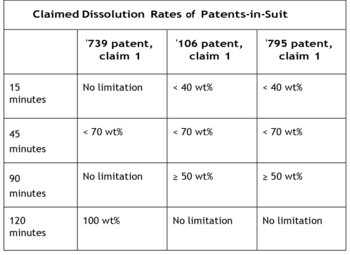
    The opinion set forth the following table, showing the dissolution characteristics of the various formulations and the presence of each limitation in the broadest independent claim in each of the patents in suit; the opinion states that these characteristics are dispositive with regard to whether defendant Apotex's generic formulation infringes:

    Table
    With regard to these characteristics, Apotex's original ANDA filing specified formulations wherein at least 80% of tranexamic acid would dissolve in 60 min.

    The District Court construed a single term in the claims, concerning the meaning of the word "about" as used in the claim limitation "less than about [%] by weight" (emphasis in opinion).  Both parties argued that the term "demarcate[d] particular numerical ranges," with Ferring contending that the word meant "within 10% [i.e., 'about 70%' means 63-77%]" and Apotex maintaining that it meant "within 5% [i.e., 'about 70% means 66.5-73.5%].  The District Court disagreed with both parties, construing the word to mean "approximately."

    The experimental data adduced at trial from Apotex's "biobatches" showed that the generic formulation did not fall within either percentage range, but the District Court decided that that because Apotex's (original) ANDA did not specify the dissolution rate "the ANDA permitted Apotex to sell an infringing product" and "permitted [Apotex] to violate the patent," relying on its interpretation of Sunovion Pharmaceuticals, Inc. v. Teva Pharmaceuticals, Inc., 731 F.3d 1271 (Fed. Cir. 2013).  In view of this determination, Apotex agreed that it would amend its ANDA to specify that its formulations would have a dissolution profile of "not less than 75 percent by weight of the tranexamic acid was released at 45 minutes."  Apotex further made representations to Ferring, the District Court, and the FDA that it would not market a generic version of the branded drug having a different dissolution profile without informing Ferring, the District Court, and the FDA of the change.  The District Court then dismissed the lawsuit based on these changes and representations.

    The Federal Circuit affirmed, in an opinion by Judge Dyk joined by Judges Lourie and Reyna.  The opinion reviewed the judgment of non-infringement under both the original and amended ANDA.  With regard to the original ANDA, the Court held that the District Court erred in determining that the failure to specify a dissolution profile in the first ANDA and had misinterpreted the Court's Sunovion decision.  Specifically, the panel disagreed with Ferring and the District Court that the Federal Circuit's Sunovion opinion was controlling, because the facts here are not the same as the facts in Sunovion.  In that case, the Court stated, "the ANDA specified an infringing product," and that the ANDA applicant could not avoid infringement by "certifying that it would not infringe, overriding the language of its own ANDA."  Here, the ANDA was silent regarding the characteristics that would establish infringement and thus did not specify an infringing product.  Under these circumstances, the panel identified the correct precedent that governs to be Glaxo, Inc. v. Novopharm, Ltd., 110 F.3d 1562, 1570 (Fed. Cir.1997).  The panels reasoning was based on who bears the burden of establishing infringement, the Federal Circuit disagreeing with Ferring, who argued that Apotex was bound to show that its product does not infringe (because whether or not it infringed was not specified in the ANDA).  On the contrary, the Court ruled that the burden is on Ferring.  And here, the evidence was that the Apotex product (from "bio-batch data") showed the Apotex product does not infringe.  While this parsing of the evidentiary burdens is consistent with (but not dependent on) the Supreme Court's recent decision in Medtronic v. Mirowski, these circumstances may impose upon Ferring an on-going duty to monitor Apotex's marketed product that is an added burden.

    With regard to infringement in view of the later amendments to Apotex's ANDA, the Federal Circuit reviewed the District Court's claim construction regarding the meaning of the word "about."  If Ferring's construction is correct then the amended ANDA could infringe (because the "less than 75%" limitation falls within the +/- 10% interpretation espoused by Ferring (i.e., 70% is within the 63-77% range), while if Apotex's construction is adopted then its generic formulation would not (75% is not within the range of 66.5-73.5%).  The Federal Circuit rejected the factual grounds (the U.S. Phamracopeia) asserted by Ferring for construing "about" to implicate its 10% variance in the specified about.  Finding that the meaning of the word "about" was not defined in the specification, the Federal Circuit held that the District Court correctly construed the word "about" according to its ordinary and customary meaning to be "approximately," citing Merck & Co., Inc. v. Teva Pharms. USA, Inc., 395 F.3d 1364, 1369–70 (Fed. Cir. 2005) for that proposition.  Using this construction, the Court further found that Ferring did not bear its burden of showing infringement ("Ferring, the party with the burden of proof on infringement, [produced no] evidence that the 2014 ANDA infringed by proposing a 75 percent by weight dissolution rate, under the district court's claim construction").

    Finally, the opinion addressed Ferring's contention that under § 271(e)(4)(A), the District Court was compelled to order a change in the Apotex ANDA effective date, based on a finding of infringement under the terms of the ANDA as originally filed.  The Federal Circuit rejected this proposition, finding that a district court should evaluate infringement by filing an ANDA on the basis of the originally filed ANDA and any amendments or other changes submitted to the FDA, citing Bayer AG v. Elan Pharmaceutical Research Corp., 212 F.3d 1241 (Fed. Cir. 2000).  While the opinion recognizes that whether an amendment to an ANDA is considered is within the sound discretion of the district court, "guided by principles of fairness and prejudice to the patent-holder," the statute does not require resetting the ANDA filing date automatically with the filing of an amendment.  Here, the District Court's refusal to reset was not an abuse of discretion according to the Court.

    The Court also ordered costs to Apotex, suggesting that the panel did not believe that this was a sufficiently close case that justified Ferring's appeal.

    Ferring B.V. v. Watson Laboratories, Inc. (I) (Fed. Cir. 2014)
    Panel:  Circuit Judges Lourie, Dyk, and Reuna
    Opinion by Circuit Judge Dyk

  • By Michael Borella —

    Planet BingoPlanet Bingo is the assignee of U.S. Patent Nos. 6,398,646 and 6,656,045, both directed to computer-implemented methods and systems for managing bingo games.  Planet Bingo filed an infringement action in the United States District Court for the Western District of Michigan, alleging that VKGS infringed both patents.  The District Court granted VKGS's motion for summary judgment of non-infringement, on the grounds that the asserted claims fail to meet the patentable subject matter requirements of 35 U.S.C. § 101.

    Applying the plurality holding from the Federal Circuit's en banc decision in CLS Bank v. Alice Corp., the District Court found that the use of a computer in the method claims "adds nothing more than the ability to manage Bingo more efficiently," and that "the limitations of the system claims are the same as the limitations of the method claims that failed to result in an inventive concept."  The District Court further determined that the system claims employ a computer "only for its most basic functions," including "storing numbers, assigning identifiers, allowing for basic inputs and outputs, printing of a receipt, displaying of numbers, and/or matching for verification."

    Planet Bingo appealed.  The Federal Circuit panel of Judges Taranto, Bryson, and Hughes heard the case and affirmed.

    An exemplary claim of the '646 patent recites:

    1.  A system for managing a game of Bingo which comprises:
        (a) a computer with a central processing unit (CPU) and with a memory and with a printer connected to the CPU;
        (b) an input and output terminal connected to the CPU and memory of the computer; and
        (c) a program in the computer enabling:
            (i) input of at least two sets of Bingo numbers which are preselected by a player to be played in at least one selected game of Bingo in a future period of time;
            (ii) storage of the sets of Bingo numbers which are preselected by the player as a group in the memory of the computer;
            (iii) assignment by the computer of a player identifier unique to the player for the group having the sets of Bingo numbers which are preselected by the player wherein the player identifier is assigned to the group for multiple sessions of Bingo;
            (iv) retrieval of the group using the player identifier;
            (v) selection from the group by the player of at least one of the sets of Bingo numbers preselected by the player and stored in the memory of the computer as the group for play in a selected game of Bingo in a specific session of Bingo wherein a number of sets of Bingo numbers selected for play in the selected game of Bingo is less than a total number of sets of Bingo numbers in the group;
            (vi) addition by the computer of a control number for each set of Bingo numbers selected for play in the selected game of Bingo;
            (vii) output of a receipt with the control number, the set of Bingo numbers which is preselected and selected by the player, a price for the set of Bingo numbers which is preselected, a date of the game of Bingo and optionally a computer identification number; and
            (viii) output for verification of a winning set of Bingo numbers by means of the control number which is input into the computer by a manager of the game of Bingo.

    Writing for a unanimous panel, Judge Hughes applied the two prong test from the recent Supreme Court Alice Corp. v. CLS Bank opinion to determine the patent-eligibility of the claims.  First, he found that the claims were directed to the abstract idea of "managing a game of Bingo."  In supporting this point, Judge Hughes noted that Planet Bingo's invention was similar to the methods of organizing human activity that were found to be abstract ideas in CLS Bank as well as Bilski v. Kappos.

    Video KingWith respect to the second prong of the test, Judge Hughes noted that the claims require physical components including "a computer with a central processing unit," "a memory," "an input and output terminal," "a printer," and so on.  However, one of the outcomes of CLS Bank is that implementing an abstract idea on generic computer hardware "cannot impart patent-eligibility."  Consequently, Judge Hughes found that the claims lacked an inventive concept that would transform them into a patent-eligible application of the incorporated abstract idea.

    Given the Supreme Court's patent-eligibility test in CLS Bank, as well as the nature of Planet Bingo's claim language, this conclusion is not surprising.  Unfortunately, the panel doesn't provide any further insight into the nature of an "abstract idea" or an "inventive concept."

    Nonetheless, in an interesting side-issue, Judge Hughes wrote that "[t]he district court correctly concluded that managing the game of bingo consists solely of mental steps which can be carried out by a human using pen and paper."  Thus, like the claims in Gottschalk v. Benson, the steps could be performed by "existing computers long in use" as well as mentally.

    Planet Bingo argued that "in real world use, literally thousands, if not millions of preselected Bingo numbers are handled by the claimed computer program," thus rendering the invention impossible to be carried out manually.  However, as pointed out by Judge Hughes, the claims do not require this volume of transactions.  Instead, the claims require at most "two sets of bingo numbers" and "a player."  He wrote "[w]e need not, and do not, address whether a claimed invention requiring many transactions might tip the scales of patent eligibility, as the claims fall far short of capturing an invention that necessarily handles thousands, if not millions of bingo numbers or players."

    So, the Federal Circuit appears to be leaving open an avenue of establishing the patent-eligibility of computer-implemented claims directed to an abstract idea — so long as those claims recite a volume of transactions or processing that would be impossible or impractical for a human to perform mentally or on paper.  But how would one claim such an invention?  Merely adding a limitation along the lines of, e.g., "wherein at least 100,000 transactions are processed" might not be enough.  In addition to such language, the patentee would likely have to explain in the patent's specification what types of results are possible to obtain using at least 100,000 transactions that might not be obtainable without computer implementation.  Or, that these results can be obtained in a time frame that is required from a user experience point of view (e.g., the 5 or fewer seconds that a web page takes to load), but cannot be performed manually in anywhere near that time frame.  In another possible angle, the patentee could potentially establish, preferably in claim language, that the computer-implemented invention has an accuracy that is superior to any known manual or automated technique for solving the same problem, and that this accuracy allows the invention to be applied in new ways.

    As far as I know, these types of arguments have never been addressed by the Federal Circuit.  Given Judge Hughes' treatment of this issue, however, it may just be a matter of time before such an issue is brought before the Court.

    Planet Bingo, LLC v. VKGS LLC (Fed. Cir. 2014)
    Nonprecedential disposition
    Panel: Circuit Judges Taranto, Bryson, and Hughes
    Opinion by Circuit Judge Hughes

  • By Paul Cole* —

    Introduction

    USPTO Building FacadeIt is strongly arguable that insofar as the USPTO's  Myriad-Mayo Guidance[1] dismisses as non-eligible newly isolated substances (including small molecules), nucleotide sequences and microorganisms having new utility (US parlance) or producing new technical effects (European parlance) it is in conflict with the Agreement on Trade-Related Aspects of Intellectual Property Rights (TRIPS)[2].

    It is unsurprising that only 10 of the 83 comments published to date on the USPTO website[3] cover this issue.  It is taken for granted within the profession that officially-issued regulations and guidelines will have been checked for compliance prior to issue.  The mind-set of most prosecution or litigation attorneys therefore treats such compliance as a background issue for which an independent check is not normally needed.  Also, some organizations and companies have been unwilling to allege TRIPS non-compliance in deference to the USPTO and to the Government.  But silence about objectively plausible non-compliance arguments once they have been identified falls into the Emperor's New Clothes fallacy, delays necessary remedial action, and does the USPTO no service.

    Nine of the relevant comments assert non-compliance either directly or implicitly within the broader topic of international harmonisation.  Only the Australian commentator Luigi Palombi[4] asserts compliance based on his 2005 PhD thesis entitled "The Patenting of Biological Materials in the context of TRIPS"[5].  However, his brief comment to USPTO takes no account of subsequent developments including the opinion of the Federal Court of Australia in Cancer Voices Australia v Myriad Genetics[6].

    Policy considerations underlying the Guidance

    Those IP organizations and associations that provided relevant comments viewed the Guidance as a serious setback to harmonization.  The position of the American Bar Association (ABA)[7] typifies comments made by the International Bioindustry Association[8] (representing member associations in Canada, Europe, Japan and the US), AIPPI Japan[9], The International Federation of Intellectual Property Attorneys (FICPI)[10], and the Chartered Institute of Patent Attorneys (CIPA)[11]:

    The United States and specifically the USPTO should remain a strong advocate for TRIPS.  The U.S. would not take lightly a member state carving out certain technology from the patent eligibility requirements of Article 27, and therefore the USPTO should reflect carefully on whether the Guidance as written will result in an invention or a category of inventions being declared ineligible for patent protection inconsistently with the letter and principles of TRIPS.  The IPL Section respectfully submits that it remains important that the USPTO continues to lead by example in following the letter and principles embodied in TRIPS and narrowly apply Myriad and Mayo to do so.

    Damage created by the Guidance is summarised by the International Bioindustry Associations:

    The U.S. Government, together with the governments of EU member states, Japan, Korea, Australia and other major U.S. trading partners have been making efforts over a considerable period of time to encourage more harmonization and the adoption of more uniform and consistent rules relating to intellectual property and, in particular, patents.  Progress, although slow, has been significant.  Such efforts have borne fruit through increased membership and use of the Patent Co-operation Treaty, the adoption of the Patent Formalities Treaty and Patent Law Treaty, and in the extension of WTO rules to intellectual property.  Currently, in negotiations that are taking place, U.S. negotiators are hoping that other countries will sacrifice tradition for uniformity, for example by considering the adoption of harmonized grace periods for inventor disclosures.  The effect of an unnecessarily broad interpretation of the Supreme Court's decisions such as is proposed under the new Guidance will be a serious setback to such efforts and to progress in achieving further steps on the road to harmonization and the benefits that this would bring to many countries, but in particular, to the United States.

    Compatibility with TRIPS

    Simon Elliott[12] of Foley and Lardner argues that the USPTO must not interpret 35 USC § 101 in a manner that violates TRIPS.  He traces the requirement to avoid conflict with treaty obligations to observations of Chief Justice Marshall 210 years ago in Murray v. The Charming Betsy that "an Act of Congress ought never to be construed to violate the law of nations if any other possible construction remains."  He goes on to explain that decisions giving deference to agency interpretation of statutes have less force because the USPTO has no substantive rule-making authority, and that such decisions do not support giving deference to USPTO Guidance that has a general and substantive impact across a broad swath of patent applications.

    The International Bioindustry Associations set out their views on the Guidance in generalised but nevertheless forthright terms:

    By subjecting such inventions to a heightened patentability analysis, the Guidance conspicuously departs from internationally accepted standards of patent-eligibility.  Many valuable inventions that would be patentable in the patent offices of the U.S.'s major trading partners will nevertheless be rejected in the USPTO because they fail to pass an extrastatutory "significant differences" test that has no equivalent in the patent laws of other industrialized countries.  Doing so creates a deep disparity in substantive patent law whereby whole categories of socially beneficial inventions would face obstacles to patent protection in the United States but remain patentable among its major trading partners, with attendant harmful effects on the flow of investment, trade, and cross-border transfer of innovation.

    The ABA argues that "as written the Guidance and the exclusions for patent eligibility under TRIPS do not appear to be consistent".  FICPI takes that position, as also do Joe Liebeschuetz and Joe Storella commenting as individuals.  Cole and Roberts[13] argue that any  administrative or judicial interpretation of the provisions of any statute, including 35 USC § 101, which places the US in a position where it does not meet the obligations of an international agreement by which it is bound is prima facie incorrect and requires reconsideration, and further that:

    These considerations seem particularly compelling in relation to the Supreme Court opinions mainly relied on for the extended interpretation applied in the Guidance.  Those opinions include Hartranft v. Wiegmann, 121 U. S. 609, 615, 7 S. Ct. 1240, 30 L. Ed. 1012 (1887), Funk Brothers Seed Co. v. Kalo Inoculant Co., 333 U.S. 127, 131 (1948) and Diamond v. Chakrabarty, 447 U.S. 303 (1980).  Those opinions were well known to and understood by the US Government, the USPTO and US patent attorneys at the time when the TRIPS Agreement was negotiated.  The US Government would not have negotiated that Agreement if there was at the time any reasonable ground for belief that US domestic law was inconsistent with the terms being negotiated.  There is no basis in law or in logic for assuming that the rulings in those long-established opinions have changed between the time when the TRIPS Agreement was negotiated and now.

    The conflicting examples

    The eligibility of isolated natural products, including small molecules, lies at the heart of the Guidance.  It is strongly arguable that each of the examples listed below gives rise to potential conflict with TRIPS.

    Example B concerns purified amazonic acid, a hypothetical cancer-fighting chemical extracted from the leaves of the Amazonian cherry tree.  It is not made clear whether it is a small molecule or, for example, a protein.  The relevant degree of purity is not made clear, and as pointed by the Coalition for 21st Century Medicine[14], the wording could cover purities too low to produce a desired therapeutic effect.  The alternative rapamycin-based example given by Cole[15] includes a claim specifying that antibiotic as a colourless crystalline compound of defined melting point.

    Example A concerns a stable energy-generating plasmid which provides a hydrocarbon degradative pathway.  This wording is unrepresentative because, as pointed out in recent comments by the Coalition for 21st Century Medicine the claim encompasses, as one of its distinct embodiments, a natural plasmid sitting in a natural bacterium.  More typical is the claim suggested by Cole which is directed to a plasmid isolated from the organism in which it occurs in nature and which is divisible into particular fragments by named restriction enzymes.

    Example E recites a pair of primers, the first having the sequence of SEQ ID NO: 1 and the second having the sequence of SEQ ID NO: 2.  Eligibility of a primer pair under US law is considered by the Coalition for 21st Century Medicine at pages 30-31 of their comments.  They aver that there is no clear natural product against which to compare the claimed pair of primers, that the term " a pair of primers" implies that the two primers are designed as a coordinated pair of molecules capable of catalyzing a polymerase chain reaction and thus does not encompass just any two random oligonucleotides, and that they have new utility insofar as that they can prime a DNA polymerase chain reaction, working in a coordinated interactive way to amplify a specific sequence of interest.  An admission in oral argument in Myriad that no ruling concerning the use of a DNA probe or primer was necessary is reproduced at page 32 of their comments.

    Example D concerns a composition of matter, and in this instance the claim in Funk Brothers v Kalo, directed to an inoculant for leguminous plants comprising a plurality of selected mutually non-inhibitive strains of different species of bacteria of the genus Rhizobium, said strains being unaffected by each other in respect to their ability to fix nitrogen in the leguminous plant for which they are specific.  The Guidance takes the position that because the bacteria are structurally identical to naturally occurring bacteria, they are not markedly different and hence ineligible.  A similar position was taken in the recent Federal Circuit opinion in Roslin[16].

    Comments supporting conflict

    Examples A, B, and D and the quoted passage from Roslin markedly differ from the EPO Examination Guidelines at G II, 3.1 which it is submitted encapsulates the law and practice that is applicable in most industrialised countries:

    To find a previously unrecognised substance occurring in nature is also mere discovery and therefore unpatentable.  However, if a substance found in nature can be shown to produce a technical effect, it may be patentable.  An example of such a case is that of a substance occurring in nature which is found to have an antibiotic effect.  In addition, if a microorganism is discovered to exist in nature and to produce an antibiotic, the microorganism itself may also be patentable as one aspect of the invention.  Similarly, a gene which is discovered to exist in nature may be patentable if a technical effect is revealed, e.g. its use in making a certain polypeptide or in gene therapy.

    Insofar as the Guidance is narrower and excludes isolated naturally occurring substances from protection it is difficult to avoid the conclusion that such technology has been arbitrarily carved out from the eligibility requirements of a.27 in conflict with TRIPS.

    For biotechnological inventions, Cole and Roberts point out that Exclusions are covered by Articles 27.2 and 27.3 of TRIPS.  They cover the protection of ordre public or morality, protection of human or plant life or health and avoidance of serious prejudice to the environment.  They also cover diagnostic, therapeutic and surgical methods for the treatment of humans or animals and essentially biological processes for the production of plants and animals.  No other exclusions are provided for.  In particular there is no provision for excluding natural products or processes involving natural products or 'laws of nature'.  They go on to argue that:

    The scope of Article 27 is demonstrated by EU Directive 98/44/EC on the legal protection of biotechnological inventions.  This was drafted inter alia to be compliant with the TRIPS Agreement to which it makes no less than five specific references.  Article 1 of the Directive requires that member states shall protect biotechnological inventions under national patent law and is without prejudice to the implicitly over-riding obligations under the TRIPS Agreement.  Article 3.3 provides that biological material which is isolated from its natural environment or produced by means of a technical process may be the subject of an invention even if it previously occurred in nature.  Article 5.2 provides that an element isolated from the human body or otherwise produced by means of a technical process, including the sequence or partial sequence of a gene, may constitute a patentable invention, even if the structure of that element is identical to that of a natural element.  That is subject to the provisions of Article 5.3 that the industrial application of a sequence or a partial sequence of a gene (i.e. its utility) must be disclosed in the patent application.  We submit that the Directive accurately reflects the requirements of the TRIPS agreement, and that national law providing any lesser eligibility falls short of compliance with that Agreement.

    Cole and Roberts express particular concern about coverage in the Guidance of naturally occurring microorganisms and about the exclusion expressed in the Roslin opinion:

    Article 27.3 specifically provides that microorganisms and microbiological processes shall be patent-eligible.  Any prohibition by the USPTO or the US courts on the grant of patents for newly isolated strains of bacteria or other microorganisms having new utility amounts to discrimination as to field of technology contrary to Articles 27.1 and 27.3 of the TRIPS Agreement.  Example D of the guidance and the recent Federal Circuit opinion in In re Roslin Institute place the US outside the scope of that Article because they purport to exclude naturally occurring microorganisms from eligibility.  Example D identifies naturally occurring bacterial strains as falling within judicial exceptions and hence ineligible under §101.  The same position is taken by the Federal Circuit in Roslin:

    "Even before the Supreme Court's recent decision in Association for Molecular Pathology v. Myriad Genetics, Inc., 133 S. Ct. 2107 (2013), the Court's opinions in Chakrabarty and Funk Bros. Seed Co. v. Kalo Inoculant Co., 333 U.S. 127 (1948), made clear that naturally occurring organisms are not patentable."

     . . . we dispute the proposition that any of the three cited cases resulted in the holding attributed to them even under US domestic law.  As Chakrabarty made clear, patents for naturally occurring organisms were granted routinely by the USPTO — at least since 1873 when Louis Pasteur obtained US Patent 141072 directed to: "Yeast, free from organic germs of disease, as an article of manufacture" — and continued to grant such patents at least up to 1970.  The EPO routinely grants patents for strains of naturally occurring bacteria.  So should the USPTO.

    Comments denying conflict

    A contrary view is expressed by Luigi Palombi who practiced patent law in Australia between 1982 and 1987 and was much involved in litigation concerning gene-related patents.  In his 2005 PhD thesis he argued that a device that he called "isolation contrivance" had been developed by the patent community to categorise "isolated" biological materials as "inventions".  He avers that the EU directive conflicts with the provisions of TRIPS, and supports that proposition with reference to decisions of the UK courts in Genentech v Wellcome (tPA) [1987] R.P.C 553, [1989] R.P.C. 147-205, Kirin-Amgen v Hoechst Marion Roussel Ltd [2005] R.P.C. 169 (erythropoietin), and Chiron Corporation and Others v Murex Diagnostics Ltd and Others (No 12) [1996] R.P.C. 535.

    An Australian answer

    A more balanced Australian view would have covered the opinion in Cancer Voices Australia v Myriad in which the court denied that the opinion of Lord Hoffmann in Kirin-Amgen was authority for the proposition that an isolated protein was inherently not patent-eligible and reaffirmed that a product that consists of an artificially created state of affairs which has economic significance will constitute a "manner of manufacture".  Because essentially the same issues arose before the US Supreme Court and the reasoning is helpful to understanding the holding of Justice Thomas, the Court's reasoning is set out at length below:

    Whether or not a composition of matter (including a micro-organism) is a "manner of manufacture" must be decided in accordance with the principles set out in the NRDC case.  It follows (leaving aside any relevant statutory exception) that a composition of matter may constitute patentable subject matter if it consists of an artificial state of affairs, that has some discernible effect, and that is of utility in a field of economic endeavour . . . .

    In the context of biological material, an artificial state of affairs may manifest itself in different ways. The physical properties of the naturally occurring material may have changed as a result of it having been isolated.  But even if the physical properties of the material have not changed, the removal of the material from its natural environment and its separation from other cellular components may still give rise to what might reasonably be described as an artificial state of affairs.

    In my opinion the patentability of the isolated nucleic acids referred to in the disputed claims does not turn upon what changes have been made to the chemical composition of such substances as a result of them having been isolated.  In particular, the question of whether these substances constitute patentable subject matter does not depend upon the type of chemical bond that may have been broken in the process of isolating them.  It is inevitable that some bonds will be broken in the course of isolating nucleic acids, but it is not apparent from the evidence that these will necessarily include covalent bonds.  As I have already explained, the disputed claims do not require that the isolated nucleic acids they describe differ from those found in the cell in this or any other respect so far as their chemical composition is concerned.

    Accordingly, the issue in this case turns upon whether an isolated nucleic acid, which may be assumed to have precisely the same chemical composition and structure as that found in the cells of some human beings, constitutes an artificial state of affairs in the sense those words should be understood in the present context.  There are three considerations which lead me to think that it does.

    First, in explaining the concept of manner of manufacture as one involving the creation of an artificial state of affairs, it is apparent that the High Court in NRDC was deliberate in its use of very expansive language.  Not only did the High Court emphasise the "broad sweep" of the concept involved, it also made clear that metaphorical analysis may not be helpful in determining whether or not something constitutes patentable subject matter.

    Secondly, in the absence of human intervention, naturally occurring nucleic acid does not exist outside the cell, and "isolated" nucleic acid does not exist inside the cell.  Isolated nucleic acid is the product of human intervention involving the extraction and purification of the nucleic acid found in the cell.  Extraction of nucleic acid requires human intervention that necessarily results in the rupture of the cell membrane and the physical destruction of the cell itself.  And purification of the extracted nucleic acid requires human intervention that results in the removal of other materials which were also originally present in the cell.  It is only after both these steps are performed that the extracted and purified product may be properly described as "isolated" in the sense that word is used in the disputed claims.

    Thirdly, as Dann's Patent demonstrates, the isolation of a particular micro-organism may require immense research and intellectual effort.  In that case, it was only as a result of an intensive research effort that the isolated micro-organism in question could be made available for use in the manufacture of the new antibiotic.  It was fortuitous for the patentee that it was its employees who were first to isolate the new micro-organism and first to deploy it in the manufacture of the new drug.  That will not always be so.  It would lead to very odd results if a person whose skill and effort culminated in the isolation of a micro-organism (a fortiori, an isolated DNA sequence) could not be independently rewarded by the grant of a patent because the isolated micro-organism, no matter how practically useful or economically significant, was held to be inherently non-patentable.  In my view it would be a mistake, and inconsistent with the purposes of the Act, not to give full effect in such situations to the broad language used by the High Court in NRDC.

    Concluding remarks

    It will be apparent that the overwhelming majority of the relevant comments identifies concern about TRIPS conflict, although detail from more of the commentators with reference to the specific examples in the Guidance would have been helpful.  The dissenting comment is valuable not only in drawing attention to the older case law but also in prompting renewed attention to the observations in Cancer Voices which it is submitted are of great wisdom and insight.  An artificial state of affairs that has some discernible effect and that is of utility in a field of economic endeavour is along the same lines as Hartranft/Chakrabarty in the US and would not be a bad starting point for revision of the Guidance.

    * Mr. Cole is a European Patent Attorney and Partner with Lucas & Co. in Warlingham, Surrey, UK and Visiting Professor at Bournemouth University.