• By Michael Borella —

    Copyright Office SealOn March 16, the Copyright Office published guidance in the Federal Register relating to works produced at least in part by generative artificial intelligence (AI).  This is the latest in a series of policy decisions and statements that the Office has made to applicants attempting to register such works.

    While AI has been a viable technology for decades, improvements in computer processing and storage capabilities of the last 15 years have enabled the rise of machine learning, a branch of AI in which a computer system can be trained on a large amount of data in order to "learn" underlying patterns within.  In many cases, these patterns are too subtle for a human to notice or require analysis of a massive data set in order to be perceived.  As an example, spam filters often use trained machine learning models to classify email messages as either spam or not spam.

    But generative AI takes machine learning to a whole new level.  In 2022, sophisticated generative AI tools were released to the public for the first time.  Rather than considering an observation of data and classifying it in some fashion, generative AI models can create new observations — particularly images (DALL-E 2, Stable Diffusion, and Midjourney) and text (ChatGPT) — from a user's textual prompt.

    The results can be simultaneously remarkable, startling, and disturbing.  But since the models were trained on existing works found on the Internet, they may exhibit some (or many) similarities with these previous works.  Thus, one issue is whether the output of generative AI is a derivative work or infringes upon the rights of a previous author.

    The purpose of this guidance, however, is to inform the public about the Office's current policy regarding "whether the material [the generative AI models] produce is protected by copyright, whether works consisting of both human-authored and AI-generated material may be registered, and what information should be provided to the Office by applicants seeking to register them."

    At one end of the spectrum, the Office has a long-held position that copyright can only be used to protect the products of human creativity.  Therefore, when presented in 2018 with an application for an image that was described as ''autonomously created by a computer algorithm running on a machine," the Office denied registration to the work as lacking a human author.  Last year, the Office initially registered a graphic novel in which the images were generated using Midjourney and then combined with human-authored text, but recently modified the registration to indicate "that the individual images themselves could not be protected by copyright."

    The guidance adds some color to the Office's decision making process regarding the human authorship question.  Particularly, the Office states:

    In the case of works containing AI-generated material, the Office will consider whether the AI contributions are the result of ''mechanical reproduction'' or instead of an author's ''own original mental conception, to which [the author] gave visible form.''  The answer will depend on the circumstances, particularly how the AI tool operates and how it was used to create the final work.  This is necessarily a case-by-case inquiry.

    As an example, if the human merely provided a prompt to the generative AI model and then the model goes on to produce "complex written, visual, or musical works in response," then the ''traditional elements of authorship are determined and executed by the technology—not the human user."  In that context, the Office notes that "prompts function more like instructions to a commissioned artist" who then makes the artistic decisions.

    But the Office recognizes that there can be a threshold amount of human creativity within a work that also contains the output of a generative AI model such that the work as a whole or parts thereof are registerable.  The Office provides examples such as where "a human may select or arrange AI-generated material in a sufficiently creative way" or that "an artist may modify material originally generated by AI technology to such a degree that the modifications meet the standard for copyright protection."  Nonetheless, in these hybrid cases the copyright protection will only extent to the human-authored aspects.

    With these principles in place, the Office goes on to provide procedural guidance to applicants seeking to register hybrid human / AI works.  Notably, they must "identify the author(s) and provide a brief statement . . . that describes the authorship that was contributed by a human."  For a work that "creatively arranges the human and non-human content," the applicant must "describe human-authored content created by the author and describe AI content generated by artificial intelligence."  Alternatively, the applicant can "provide a general statement that a work contains AI-generated material."  Then, the "Office will contact the applicant when the claim is reviewed and determine how to proceed."

    For existing applications that do not adhere to these guidelines, the Office requires that the applicants "contact the Copyright Office's Public Information Office and report that their application omitted the fact that the work contained AI-generated material."  This will be considered by the examiner when considering the application.

    To correct an existing registration, the applicant must submit a supplementary registration that describes "the original material that the human author contributed" and "disclaim the AI-generated material."  The Office will issue a supplementary registration certificate if there is sufficient human authorship.

    If an applicant fails to update such applications and registrations, the registrations may be cancelled.  Likewise, a court can disregard a registration if it was obtained through deceiving the Office regarding aspects of its authorship.

    Generative AI has proven to be a technologically and socially disruptive paradigm.  Individuals, businesses, and governments will likely be wrestling with its implications for years to come.  In the mean time, it is good to see the Copyright Office being proactive regarding hybrid authorship rather than letting these issues be addressed piecemeal in the courts.  Like many issues in copyright, the authorship inquiry is likely to be highly fact-sensitive and subject to few clear lines of demarcation.

  • CalendarApril 18, 2023 – "Will SCOTUS Take a Second Arthrex Challenge? Are There Any Limits on USPTO Director Delegation of Duties?" (IPWatchdog and Triangle IP) – 12:00 pm (ET)

    April 18, 2023 – "Due Diligence Trends" (Wolters Kluwer) – 1:00 pm (ET)

    April 18 2023 – "Current Global IP Issues Through the Lens of IPO's Special 301 Comments" (The Intellectual Property Owners Association) – 2:00 pm to 3:00 pm (ET)

  • IPWatchdogIPWatchdog and Triangle IP will be offering a webinar entitled "Will SCOTUS Take a Second Arthrex Challenge? Are There Any Limits on USPTO Director Delegation of Duties?" on April 18, 2023 at 12:00 pm (ET).  Robert Kry of MoloLamken LLP, who represented Arthrex; Joseph Matal of Haynes and Boone, LLP, who previously "performed the duties and functions" of the Director at the USPTO, and Gene Quinn of IPWatchdog, Inc. will discuss whether the Supreme Court will or should grant certiorari to decide whether the Federal Circuit's decision, in Arthrex II, holding that the Commissioner who was then "performing the functions and duties" of the Director by delegation violates the Appointments Clause, the FVRA, or the Constitution's separation of powers.  The panel will also tackle the fundamental question underpinning the Federal Circuit’s Arthrex II decision, namely the proper interpretation of the Federal Vacancies Reform Act (FVRA), whether all of the USPTO Director's functions and duties are delegable, and whether it was a "red herring" to compare the Supreme Court's Arthrex analysis to the signing of patents by those who were not legally "Acting Director" but were nevertheless vested with the powers of Director.

    There is no registration fee for this webinar.  However, those interested in registering for the webinar, should do so here.

  • Wolters KluwerWolters Kluwer will be offering a free webinar on "Due Diligence Trends," on April 18, 2023 at 1:00 pm (ET).  Barbara M. Goodstein of Mayer Brown, Shane Hanna of Parsons Behle & Latimer, Dan Lias of CT Corporation, and Bart D. Wall of Bryan Cave Leighton Paisner will delve into key trends and case law that are impacting due diligence in 2023.

    Those interested in registering for the webinar can do so here.

  • IPO #2The Intellectual Property Owners Association (IPO) will offer a one-hour webinar entitled "Current Global IP Issues Through the Lens of IPO's Special 301 Comments," on April 18 2023 from 2:00 pm to 3:00 pm (ET).  Steve W. Bauer, Retired, Medtronic, Inc.; Dean Harts of 3M Innovative Properties Co.; Sharon Reiche of Pfizer Inc.; and Bill Warren of Eversheds Sutherland, who were involved in the preparation of IPO's comments, will cover issues such as trade secret protection, counterfeiting, compulsory licenses, issues in IP enforcement, genetic resources and an overview of developments at multilateral organizations.

    There is no registration fee for the webinar.  However, those interested in attending the webinar should register here.

  • By Kevin E. Noonan –
    Federal Circuit Seal"This application claims priority to [properly identified earlier-filed application, the disclosure of which is expressly incorporated herein in its entirety" is a phrase commonly found in patents and patent applications as an attempt to bolster disclosure without burdening the specification unnecessarily.  Like many (most) stratagems, use of this phrase can give rise to unexpected (and unwanted) implications, as was noted in a Federal Circuit opinion affirming a decision by the Patent Trial and Appeal Board in inter partes review proceedings instituted at the behest of challenger ModernaTX that invalidated all claims of the challenged patent owned by Arbutus in Arbutus Biopharma Corp. v. ModernaTx, Inc.

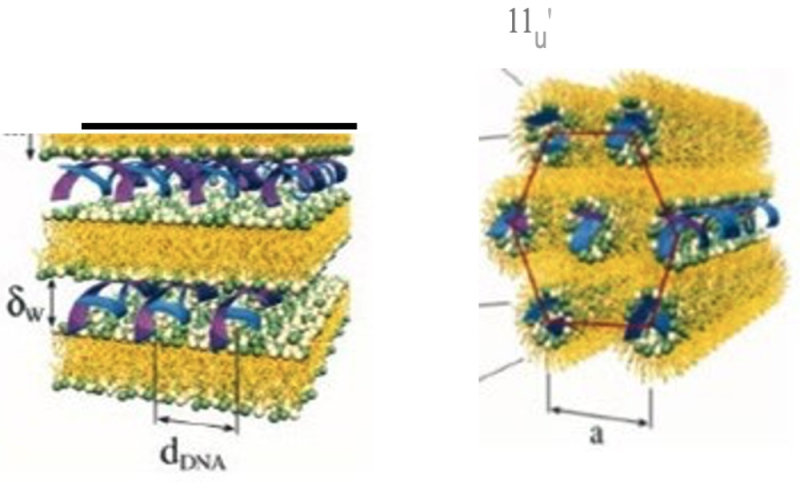
    The subject matter of the challenged patent, No. 9,404,127, was stable nucleic acid lipid particles ("SNALP") that occur in two morphologies:2023-04-13 Image
    wherein the structure illustrated on the left is "lamellar" and the structure illustrated on the right is "non-lamellar"; the '127 patent claims are directed to the non-lamellar form.  This "morphology limitation" is dependent upon how the SNALP is made, which is in turn dependent upon the lipids used in making the SNALP and the process used.  With regard to the process SNALPS can be made by a Stepwise Dilution Method (SDM) or a Direct Dilution Method (DDM) and the formulations can have five different ratios for the composite lipids, with 1:62 and 1:57 being those relevant to the claims at issue and referring to a conjugated lipid and a cationic lipid, respectively.  Independent claim 1 was reproduced in the opinion as being representative:

    1.  A composition comprising:
        a plurality of nucleic acid-lipid particles, wherein each particle in the plurality of particles comprises:
            (a) a nucleic acid;
            (b) a cationic lipid;
            (c) a non-cationic lipid; and
            (d) a conjugated lipid that inhibits aggregation of particles, wherein at least about 95% of the     particles in the plurality of particles have a non-lamellar morphology (with this limitation being     the morphology limitation).

    The '127 patent issued from an application filed on March 9, 2015 that claimed priority to a provisional application filed on June 30, 2010 (making June 30, 2009 the critical date for novelty-destroying prior art).  The '127 patent incorporated by reference published U.S. Patent Application Publication Nos. 2007/0042031 ("the '031 application, for disclosure of DDM) and 2004/0142025 (for SDM and apparatuses therefor), these publications being indisputably in the prior art at the '127 patent's earliest claimed priority date.

    The PTAB held all claims of the challenged '127 patent to be invalid as being anticipated by U.S. Patent No. 8,058,069 ("the '069 patent"), which was filed on April 15, 2009 and claimed priority to a provisional application filed one year earlier (the Federal Circuit noting that the '127 patent did not claim priority to the '069 patent, even though these patents are commonly owned by Arbutus).  The basis for this decision was that the Board found that both patents:

    [A]re directed to the same purpose (providing SNALP, methods of making and delivering SNALP); disclose at least the 1:57 and 1:62 formulations; explain that SNALP can be formed by any method in the art including direct dilution, and direct the reader to rely on the '031 publication for details on using DDM.

    The '069 patent incorporated by reference several other patents that the Board held disclosed "several of the same disclosures and experiments" set forth in the '127 patent.

    The Board's decision focused on the claim 1(d) element (the morphology limitation) and whether it was inherently disclosed in the '069 patent.  The basis for Moderna's assertion of inherent anticipation was that the non-lamellar structure arose as a consequence of the composition of the SNALP and the method (DDM) used to produce it which the Board found convincing (despite expert testimony based on experimental evidence to the contrary), and Arbutus's concession that the specification of a continuation of the '069 patent disclosed the morphology limitation.  Accordingly, the Board held all claims of the '127 patent to be invalid for anticipation.  This appeal followed.

    The Federal Circuit affirmed in an opinion by Judge Reyna, joined by Judges Schall and Chen.  With regard to the question of incorporation by reference, the panel cited its precedent that "[w]hen a reference or material from various documents is incorporated, they are 'effectively part of the host document as if [they] were explicitly contained therein,'" Advanced Display Sys., Inc. v. Kent State Univ., 212 F.3d 1272, 1282 (Fed. Cir. 2000). The panel, like the Board, rejected Arbutus's arguments that the DDM process comprised "many parameters that could be varied" based on Arbutus's expert's concession that the '435 patent (a continuation of the '069 patent) also disclosed the morphology limitation.  In the circumstances before the Court, "the disclosure of the '069 patent and its incorporated references sufficiently demonstrate to a person skilled in the art how to make and use the claimed compositions, processed by DDM, that results in the Morphology Limitation."  The evidence before the Board satisfied the legal requirement for inherent anticipation that production of the claimed SNALPs was a "natural result flowing from" the disclosure in the prior art under SmithKline Beecham Corp. v. Apotex Corp., 403 F.3d 1331, 1343–44 (Fed. Cir. 2005).  Here, the panel asserts that "the '127 and '069 patents disclose the same formulations with 'almost identical wording,'" ("[t]he specificity of the disclosure in the '069 patent is the same as in the '127 patent") including the 1:57 and 1:62 formulation ratios (and that the other ratios disclosed and claimed in the '127 specification could be substituted without impacting the morphology limitation according to Arbutus's expert.  Both the '127 and '069 patents reference the '031 application for disclosure of the DDM method for producing SNALPs having the claimed morphology limitation with the challenged '127 patent incorporating by reference the '031 disclosure, which supported the Board's conclusion that the '127 patent discloses this method the same way it was disclosed in the prior art '031 application.  The opinion concludes that because the panel found no error in the factual question of whether the prior art taught "the same formulations and the same DDM" disclosed and claimed in the '127 patent the challenged claims were anticipated by the art and invalid.

    With regard to dependent claims directed to forms of the claimed SNALPs comprising mRNA (claim 3) or "fully encapsulated" nucleic acids (claim 8) were disclosed as formulations in the prior art.  The Court found SNALPs having specific three-dimensional structures (claim 9) to recite inherent properties of the SNALPs produced according to the cited art.  And regarding claims to percent ranges for the lipid components of the claimed SNALPs (claims 10-12), the Court relied on its precedent that "[w]hen a patent claims a chemical composition in terms of ranges and a single prior art reference discloses a composition that falls within each of the ranges, the range is anticipated, citing Titanium Metals Corp. of Am. v. Banner, 778 F.2d 775, 782 (Fed. Cir. 1985).  This disclosure arose in the cited prior art by incorporation by reference of U.S. Patent Application Publication No. 2006/0083780 (the "'780 publication"), U.S. Patent Application Publication No. 2004/0142025 (the "'025 publication"), and U.S. Patent No. 5,885,613 (the "'613 patent").

    While not dispositive, this decision is relevant to the on-going disputes between owners of lipid nanoparticle IP and vaccine makers over COVID 19 and other mRNA-based vaccines against other diseases (see "Pfizer and BioNTech Sued for Patent Infringement over mRNA Vaccine").

    Arbutus Biopharma Corp. v. ModernaTx, Inc. (Fed. Cir. 2023)
    Panel: Circuit Judges Reyna, Schall, and Chen
    Opinion by Circuit Judge Reyna

  • By Michael Borella —

    Years ago, I was a proud parent when my children were invited to participate in an honors math program at their grade school.  But this initial delight turned to confusion, and eventually frustration.

    As just one example of why I was less than pleased with our school's pedagogy, one very highly emphasized part of the curriculum required that the kids memorize as many digits of pi as they could, with the minimum being 25.  Sure, they also learned how pi defined the ratio of a circle's circumference to its diameter and how to use it in simple algebra, but this memorization task was the focus of the unit, with the child who memorized the most digits (130 one year) winning special accolades.

    To me, this assignment missed the point.  Pi is a critical value in many aspects of science and engineering, and can be taught directly or indirectly in a number of compelling and fun ways involving wheels, pizza, spirographs, and so on.  And its importance in aviation and communications can at least be mentioned.

    But the focus was on committing those 25-plus digits to memory and being able to recite them on demand.  When I pointed out to the teachers that maybe — just maybe — this was not the best way to prepare children to have an appreciation for STEM fields, they looked at me like I was from another planet.  The curriculum was designed around what was easy to test (can the kid produce the 25 digits when asked?) rather than the harder-to-evaluate skills (does the kid know how and when to use pi to solve problems?) that are actually important when using math in the real world.[1] 

    Thus, when the news broke that OpenAI's GPT-4 large language model passed the uniform bar exam at the 90th percentile, I was less than impressed.  In fact, this outcome is completely unremarkable given that it was trained on billions of units of human text.

    The bar exam is a memorization exam.  Aspiring lawyers typically spend 10-12 weeks taking a bar exam review course, which involves committing massive amounts of legal rules and principles to memory, as well as learning how to write essays in a formulaic fashion (IRAC).  Then you sit for two days of testing in which you regurgitate as much as you can.  If you manage to score highly enough, you pass and become a licensed attorney.

    During the summer that I spent preparing, I remember at one point mentioning in frustration to my study partner that what the bar exam is actually testing is how much pain one is willing to accept to be a lawyer, and that rapping us across the knuckles a few times with a ruler would probably have the same effect.  Indeed, I know of individuals who graduated law school in the top ten percent of their class (in terms of GPA), failed the exam on their first try, later passed, and went on to be excellent attorneys.  Clearly, these folks were bright, but when speaking to them they attributed their failure (which was quite the source of shame) on not studying hard enough during bar review.  Let that sink in — top law students can fail to be licensed because they do not learn the mechanical proclivities of one specific exam.

    A recent paper from Professor Daniel Katz evaluates GPT-4's bar exam performance and states that "These findings document not just the rapid and remarkable advance of large language model performance generally, but also the potential for such models to support the delivery of legal services in society."[2]  The key word in this sentence is "potential" but even so this statement is misleading.

    GPT-4 scoring well on the bar exam is not because AI is achieving human levels of intelligence.  It is because the bar exam tests a human's ability to perform like a robot.  Missing from the bar exam are tests of executive function (e.g., staying organized, keeping to deadlines), soft skills (e.g., client interaction and counseling, interpersonal competencies), and law firm operation (e.g., finance, marketing, managing groups, how to be a good employer), all of which are more relevant to a lawyer's success than their ability to stuff facts into their brains.

    Indeed, it is now widely accepted that GPA is much more predictive of a student's ultimate success than standardized test scores.  This is because maintaining a high GPA requires more than the raw cognitive ability to do well on memorization-based exams — the aforementioned executive functioning and soft skills play a significant role.  Intellectual ability is important, but so is emotional intelligence.

    Turning to patent law, there might be one multiple choice question out of 200 addressing intellectual property on the typical year's bar exam.  So for us patent attorneys, the bar exam is measuring our ability to regurgitate law that we are unlikely to ever apply in practice.  To that point, the USPTO requires that we pass a separate patent bar exam.  Admittedly, it is also memorization-based, but at least it is open book.

    So, to the extent that Professor Katz is implying that GPT-4 or any other of the current generation of large language models can perform significant legal tasks, I have to disagree.  Large language models are tools that lawyers can employ, not unlike search engines or Wikipedia.  They may be able to carry out certain first-level research functions in place of a junior associate.  But when it comes to crafting creative legal strategies that guide clients through complex transactions, they are still far from the mark.

    Nonetheless, the strong performance of GPT-4 on memorization-based exams provides us with a golden opportunity to re-evaluate how we teach both children and law students.  If the goal is to turn out humans with skills that can be easily replaced by automation, then maintaining the status quo will get us there.  But we would be much better off by recognizing and embracing large language models, while remaining cognizant of their strengths and weaknesses.  Integrating these tools into a broad-spectrum education system with a flexible curriculum is much more likely to produce graduates who can adapt to the changing needs of the legal profession, or any other field for that matter.

    The modern education system is still based too much on a paradigm established in the 1800s, one in which an instructor lectures and the students passively receive their lessons.  Given that large language models can outperform most humans in these scenarios, we need to seriously consider changing the system to meet the demands of 21st century life.

    And for anyone who absolutely needs to know the first 25 digits of pi, don't worry because GPT has you covered:  "The first 25 digits of pi (π) are:  3.14159265358979323846264.  Note that pi is an irrational number, meaning that its decimal representation goes on infinitely without repeating."  Or, it almost has you covered, as the 25th digit is missing from its output.

    [1] To get a sense of how prevalent issues like this are in education, 60 years ago Nobel laureate physicist Richard Feynman was asked to help the state of California select math textbooks for its schools.  He wrote about the process, which is both humorous and disheartening.  From what I have seen, today’s textbooks are better than they were back then but still leave plenty of room for improvement . . . such as justifying why one needs a textbook, period.

    [2] Katz, Daniel Martin and Bommarito, Michael James and Gao, Shang and Arredondo, Pablo, GPT-4 Passes the Bar Exam (March 15, 2023).  Available at SSRN:  https://ssrn.com/abstract=4389233 or http://dx.doi.org/10.2139/ssrn.4389233.

  • By Aaron Gin —

    Supreme Court Building #2Dr. Stephen Thaler, Ph.D., a computer scientist and inventor, has petitioned the Supreme Court of the United States to consider the question of whether the Patent Act restricts the definition of an "inventor" to human beings.  The petition represents an opportunity for the Court to clarify whether an artificial intelligence (AI) can be an inventor under U.S. patent law.

    The primary reasons provided by Thaler for the Court to grant certiorari include:  1) describing a conflict between the lower court decisions and the text of the Patent Act; 2) pointing out conflicts with prior Supreme Court jurisprudence; and 3) a policy argument highlighting the importance of patentability of AI-generated inventions in the U.S. and worldwide.

    Thaler is the creator of DABUS (Device for the Autonomous Bootstrapping of Unified Sentience), which is a combination of multiple artificial neural networks.  The various neural networks of the DABUS system were each programmed to represent discrete concepts such as "temperature", "enjoyment", or "survival."  DABUS was then trained under external supervision from a human trainer to form short consequence chains, such as taking a drink at an appropriate temperature results in enjoyment.  Subsequently, during an unsupervised activity, DABUS autonomously extended the consequence chains into longer, more-complex chains that resulted in positive outcomes.

    Based on this architecture and training, Thaler claimed that DABUS autonomously developed two novel concepts:  "Neural Flame," an emergency beacon that flashes in a desired pattern to attract the attention of rescuers, and "Fractal Container," a beverage container that improves grip and better regulates heat transfer to increase user enjoyment.  These concepts formed the basis of two patent applications U.S. Application Nos. 16/524,350 and 16/524,532.  Thaler filed the patent applications with the USPTO, listing the sole inventor as "DABUS" under "given name" and "Invention generated by artificial intelligence" under "family name" in an Application Data Sheet.  Thaler also included a "Statement on Inventorship," which described some of the functional aspects of DABUS and argued why the AI should be considered as an inventor under the Patent Act.

    The USPTO issued a Notice to File Missing Parts to amend the ADS.  Through several rounds of petitions, Thaler asked the USPTO to vacate the Notice and provided further arguments.  However, the USPTO pointed to numerous references to an inventor as a "person" in Title 37 of the Code of Federal Regulations and the MPEP definition of "conception" as "the complete performance of the mental part of the inventive act," and dismissed Thaler's request for reconsideration in a final written decision.

    Thaler challenged the USPTO's decision in a suit filed against the USPTO in the Eastern District of Virginia.  The District Court judge granted summary judgment for the defendant based on the plain statutory language of the Patent Act (35 U.S.C. §§ 100 and 115) and Federal Circuit (Univ. of Utah v. Max-Planck-Gesellschaft, 734 F.3d 1315 (Fed. Cir. 2013)) authority.  Thaler appealed to the Federal Circuit, which affirmed the District Court in an August 2022 decision.  In brief, the CAFC agreed that an inventor must be a human being, barring AIs from inventorship.

    Through his counsel, Thaler filed the Petition on March 17, 2023.  The case was docketed on March 21, 2023 as Supreme Court No. 22-919 and captioned "Stephen Thaler, Petitioner v. Katherine K. Vidal, Under Secretary of Commerce for Intellectual Property and Director, United States Patent and Trademark Office, et al."  A response from the Director of the USPTO is due by April 20, 2023.

    For additional information, please see:

    • Supreme Court Docket No. 22-919
    • Stephen Thaler v. Vidal; Petition for Writ of Certiorari

  • By Kevin E. Noonan –

    Supreme Court Building #3The Supreme Court heard oral argument in Amgen v. Sanofi last week in an extended session with argument from the parties and the U.S. government.  Petitioner was represented by Jeffrey Lamken, Respondents by Paul Clement, and the Government by Colleen Sindak.

    The Justices showed a great deal of interest, albeit with some difficulty, in making sure that they properly understood the complexity of the genus at issue.  Justice Thomas, for example, began the Court's questioning by asking how many antibodies were invented, suggesting it was 26 and after Mr. Lamken explained that Amgen contended the actual number was about 400, the Justice said, "in other words, you can't say how many."  Justice Thomas later returned to the question at the end of Petitioner's counsel's time requesting clarification.  Justice Jackson also queried Mr. Lamken, who expanded on his answer to Justice Thomas by saying "we got 3,000 [antibodies], which were filtered down to 384 [antibodies].  The 26 [antibodies] are something different.  The 26 are the ones where we went through and figured out the exact amino acid sequence and then listed them in the patent."  He then drew the distinction that "there's a reason why you don't go and do 384 amino acid sequences for every one of them in the patent.  Patent law has never required it, you go from the 3,000 to the 384 that bind the sweet spot and stop."

    The answers to the question (depending on who was answering) was the 26 expressly disclosed (Respondent) to ~400 (Petitioner) based on the number Amgen isolated, with Respondent emphasizing the "millions and millions" allegedly falling within the scope of the claims (saying "the numbers don't lie").  Petitioner reminded the Court that these estimates included antibodies having "conservative substitutions" in the amino acid sequence expected to yield equivalent antibodies in structure and claimed function (calling them the "swapped amino acid species," Mr. Lamken said they were "99.99% identical and routine to make").  Regarding the conservative substitution species, Mr. Clement challenged the assertion that antibodies differing from the disclosed sequences by any amino acid sequence change could be assumed to be functional, saying "You have to go through that whole experimental process again to confirm that it binds in the right place" and referring the Court to Sir Gregory Winter's amicus brief in this regard.  When asked by Justice Gorsuch, Mr. Clement stated that only the 26 identified antibodies were enabled.  The Government agreed, stating that the only antibodies that were enabled were those for which Amgen had provided the amino acid sequence (indeed, when asked by Justice Gorsuch whether there was anything in Mr. Clement's argument the government disagreed with, Ms. Sindzak said there wasn't).

    Missing from the argument was a reminder that, to the extent Amgen's genus claims can be analogized to a conventional pharmaceutical genus claim any particular, undisclosed antibody that is patentably distinct from the genus can be independently patentable and Amgen does not "own" those antibodies (although their patent may be a dominating patent).

    The Justices asked both parties' counsel whether this was at root a factual issue, Justice Gorsuch specifically asking Mr. Lamken whether there were any disagreements of law other than the appropriateness of the cumulative effort test, and if not "why isn't this just a fact-bound dispute?"  (Mr. Lamken responded in the negative, based on the Federal Circuit's "full scope" test wherein "it would be necessary to first generate and then screen each candidate antibody to determine whether it meets the double function limitations, that's a statement saying you've [sic] got to be able to make them all.  That can't be right").  The Justice asked Mr. Clement whether there was any dispute on the law (as opposed to how the law had been applied to the facts at the Federal Circuit).  Justice Kagan asked, "do you understand the parties now all to agree on the appropriate legal test, and are we simply arguing now about how that test applies in this case?" to which Mr. Lamken replied, "I think the parties all agree that the cumulative effort, the idea of reach the full scope, that that cannot be sustained."  Mr. Clement was less sanguine on the scope of the parties' agreement, telling Justice Kagan that "there must be" disagreement on the law because Amgen's assessment is that it is enough to "consign people skilled in the art to Sisyphean tasks forever" in making the antibodies falling within the scope of the claim and "what skilled artisans want is not to randomly generate something within the broad range that's claimed, but they want to be able to pick a specific embodiment, not a hypothetical one, but a specific one" contrary to Petitioner's position.

    As often happens in arguments before the Court, analogies abounded, with Petitioner arguing that James Watt did not need to disclose every possible embodiment of a steam engine to enable claims to one.  Mr. Lamken's argument motivated Justice Thomas to remark that this case was perhaps more akin to claiming using steam pressure to produce mechanical work, much like Claim 8 in the Morse patent invalidated in O'Reilly v. Morse (i.e., using electricity to produce "writing at a distance").  Mr. Clement used as an analogy claims to paints of different colors, where if robin's egg blue paint was disclosed it would be enabled whereas it would not if the public needed to make mixtures of different dyes and wait to find one that produced that color.  Even the Court (Justice Kavanaugh) raised the government's analogies in its brief to recipes for cake, bread, and stew.  And later Ms. Sindzak analogized to knowledge by the skilled artisan that pine was not a suitable type of wood from which to make a baseball bat and thus a claim to making bats from wood would not be invalidated due to this one, art-recognized exception.

    Two amicus briefs were discussed, one by Professor Lemley and the other by Sir Gregory Winter, the latter brief being sufficiently (potentially) persuasive on the underlying scientific facts that Mr. Lamken characterized it as "the functional equivalent of an expert report," while the Ms. Sindzak noted that in footnotes to two recent papers Professor Lemley had suggested that Amgen's claims could be invalid for non-enablement.  Mr. Clement dismissed the Lemley brief by telling the Court the Federal Circuit had not invalidated all biotechnology claims on enablement grounds (citing Bayer Healthcare LLC v. Baxalta Inc.) and said the Justices should rely on the Winter brief "for the science."  Mr. Clement posited that "it may be that in this particular area of antibody science given the current state of the science that you may not have an ability to functionally claim a genus, and that's kind of at some level nobody's fault, it's just the way the science works."

    Mr. Clement also reiterated a line of argument from the Winter brief in suggesting to the Court that these claims could be considered an effort to make an "end run" around the Court's precedent in Assoc. Molec. Pathol. v. Myriad Genetics, insofar as the "sweet spot" in PCSK9 could not itself be patented under that precedent because it was naturally occurring (a clever way of persuading the Court against the claims outside the strict bounds of enablement law itself).  Mr. Clement also took from the Winter brief the argument that the "roadmap" does not facilitate identifying antibodies falling within the scope of the claim because in addition to the routine experiments required to produce them it then "adds additional steps that somebody skilled in the art wouldn't want to do and are just basically an additional step, additional test they have to run to see whether they infringe, because the people skilled in the art don't really care where it binds.  They care that it blocks."  These steps "slow down others in the field" accordingly.

    In his only engagement at any length, Justice Alito asked Mr. Lamken whether there was "something unique in this decision or has the CAFC been doing this all along?  And if so, why now?"  The response was that the Federal Circuit has shown a "basic hostility to the breadth of claims, and I think that this is basically the apogee, we've reached an endpoint where, frankly, the industry can't take it any longer because you can't invest $2.6 billion if the breadth of your claims is such that it means you can't get adequate protection because, if you cover everything you invented, then it's invalid because it's too hard to make them all."  The Justice challenged this answer by asking whether the Federal Circuit's decisions had been inhibiting research for antibody-based pharmaceuticals and Mr. Lamken cited Professor Lemley's article (Dmitry Karshtedt, Mark A. Lemley & Sean B. Seymore, The Death of the Genus Claim, 35 HARV. J. L. & TECH. 1, 23-35 (2021)) in support of the assertion.  Justice Alito also inquired whether the "roadmap" disclosed in the patents was not (just) a research plan to which Mr. Lamken responded the patent disclosed "these two new antibodies that didn't exist before our invention" and "they allow you to find everything that will bind to the sweet spot in PCSK9 because they cover it completely."

    Justice Jackson evinced an appreciation regarding the burdens of proof below and the issue of whether the District Court and the Federal Circuit had properly overruled the jury determination that respondents had not satisfied the clear and convincing evidence standard.  Mr. Lamken stated that the Respondents had not shown even one antibody falling within the scope of the claim that could not have been made using the "roadmap" in Amgen's specification.  In reply Mr. Clement relied on the "millions and millions" of antibodies that fall within the scope of Amgen's claims and the amount of trial-and-error experimentation needed to produce them.  In this regard Justice Gorsuch expressed agreement with Mr. Clement that the cumulative effort needed to produce all species in a claimed genus is not dispositive but a relevant consideration.

    With regard to the relevance of the amount of effort it takes to practice the invention, Justice Sotomayor asked whether Mr. Lamken agreed with the statement in the Federal Circuit opinion that "It was 'appropriate' to look at the amount of effort needed to obtain embodiments outside the scope of the disclosed examples."  The eventual answer from Mr. Lamken was that "if it said an embodiment, that would be correct.  Embodiments means that you're looking at . . . what [the Federal Circuit] called reaching the full scope, and I think that is incorrect" and "the effort to make every single embodiment within the invention simply means that if you have an invention of any scope, it's not going to be enabled.  There may be millions of ways to make the James Watts steam engine, but you're not invalidated simply because it would take a long time to make all of those different variants of the steam engine."

    Several of the Justices asked what remedy the parties wanted (Justice Jackson frankly asking "what is the one thing we can do?") and how the Court would provide clarification in the law, the Chief Justice inquiring on the amount of disclosure that would be considered reasonable under the Court's Minerals Separation, Ltd. v. Hyde decision, Justice Gorsuch asking counsel about the continuing relevance of the Wands factors, and Justices Jackson, Alito, and Barrett inquiring on what could be considered undue experimentation.  Mr. Lamken's responded to Justice Gorsuch that "at the very least, we should have a remand so that we try again under the proper standard without the reach the full scope standard or try to hypothesize how long it takes to make millions of antibodies and then test each of them."  Justice Barrett asked "why" and Mr. Lamken stated that "the Federal Circuit could not possibly have gotten it right because of what I just read to you from [the record], where it looks at the effort to make each and every antibody of the potential millions" [and] "somebody who's trying to overturn a PTO-issued patent and two jury verdicts should at least say here's an actual antibody, an actual embodiment, that is difficult to make.  It requires undue experimentation to get there."  Justice Kavanaugh in a similar vein asked Mr. Lamken whether there was disagreement with any of the Court's precedent (counsel wisely responding "no").

    Regarding the question of the undue experimentation standard, Justice Gorsuch asked Mr. Lamken whether he agreed that "a patent fails the enablement test if it would force a person skilled in the art to undertake undue experiment to produce the claimed invention?" (answer: "yes") and if the Wands factors were valuable in making an undue experimentation assessment.  To this latter question Mr. Lamken responded that "the Wands factors can be useful in particular cases when properly applied" [but they have] "become something of a checklist that's abstracted and therefore replaces the ultimate statutory standard."  To the Justice's question "do you agree that the broader the patent the more difficult it is to prove enablement" Mr. Lamken responded, "not necessarily" because "'harder' and 'broader' are not necessarily synonymous."  And to Justice Jackson's question on finding undue experimentation as to a species, Mr. Lamken responded "if you just have a one-off that doesn't mean anything to skilled artisans, you're not going to invalidate the patent."  The Justice then asked, "How many of these 'one-offs' can you have?" to which Mr. Lamken stated,  "if you have so many that it means that you're searching for a needle in a haystack and you don't have instructions on how to do it so that it's –it is that trial and error for years on end, it's Edison and Consolidated Electric."

    In his responses Mr. Clement gave full-throated voice to the opinion that "functional claims are terrible because the retard science," using Morse claim 8 and the patentee's position in Consolidated Electric v. Edison, but he also said he did not think the test should be "zero-tolerance" regarding at least "some" experimentation.  In responding to Justice Alito, he stated that both "time and effort" and the nature of the effort were relevant and that if the claims had recited the amino acid sequences of the disclosed sequences there would have been no need for experimentation.

    Ms. Sindzak spoke at considerable length compared with the brief expository remarks both Mr. Lamken and Mr. Clement made in their presentations.  While the government's argument paralleled the respondent's, the assistant solicitor general emphasized the amino acid sequence as the "recipe" for an antibody, without which a claim is not properly enabled ("it really is that simple").  Ms. Sindzak asserted that it was dangerous to relax the enablement rules because the antibody field is unpredictable and there may be other unknown antibodies that "work[] better than everything else, or the one that's going to be tolerated by more patients or the one that's going to be cheaper to manufacture" (not considering independently patentable species).  The government also referred to the doctrine of equivalents as the proper way under the statute to protect antibodies structurally indistinct enough from the expressly recited antibodies to be deemed infringing (a position advocated by at least one amicus brief).  The Chief Justice posited that the doctrine might be less protective (something Mr. Lamken asserted in rebuttal) to which Ms. Sindzak responded that to the extent a patentee hasn't invented something "I don't think the doctrine of equivalents is going to get them things they haven't invented yet."

    With regard to In re Wands, Ms. Sindzak stated that precedent cannot be relied upon because at the time antibodies were not defined by amino acid sequence but by functional properties and satisfied the enablement requirement by deposit.  (Unmentioned was the fact that had Amgen deposited the 384 antibodies they would have been enabled at least those antibodies.)  The government also agreed with Justice Kavanaugh that an affirmance would quell arguments that the Federal Circuit had erred and leave any further remedy to Congress.  In response to Justice Gorsuch asking if you could, for example, every single time get a winner, then the fact that it would require a long time to get them all wouldn't — wouldn't necessarily defeat a patent, would it?"  Ms. Sindzak said "it can be relevant, and I think it can particularly be relevant if, for example, you figure out that . . . there's a million types of ammonia in the world and 10 of them . . . can be used instead of gasoline to run superefficient cars, right?  But you don't know which 10, so you just claim the genus of ammonia that can be used to run cars, and then what you're saying is you have to go out there and try them.  And you may actually have to try all a million of them so — to get to those 10.  And so there the cumulative effort is relevant because you're going to be there testing and testing and testing."

    On rebuttal Mr. Lamken reasserted Petitioner's most straightforward argument, that "The key fact in this case is that Sanofi has not identified one antibody that would require undue experimentation to make."

    Both the respondent's counsel (jokingly) and the assistant solicitor general (more earnestly) suggested that the Court dismiss the certiorari writ as having been improvidently granted (which the Petitioner's counsel warned would have the same consequence as an affirmance, mentioning that the PTAB had relied on the Federal Circuit's decision in two recent cases).  The Justices' focus on the factual predicates of the case makes this outcome not as unlikely as it might otherwise be.

    In view of the argument, if the Court does rule, it is likely to provide "guidance" (as requested by the petitioner) on the proper scope of the inquiry (without rejecting the "full scope" test per se) and send the matter back to the Federal Circuit on remand for reconsideration on that basis.  This would be consistent with the Court's stance in other cases (Arthrex v. U.S. and Minerva Surgical v. Hologic, for example) and generally with its exercise of its role in supervising and where necessary (in the Court's estimation) correcting the Federal Circuit's application of U.S. patent law.

  • By Kevin E. Noonan –

    Supreme Court Building #1During oral argument before the Supreme Court on Monday in Amgen v. Sanofi, all three advocates (Jeff Lamken for Amgen, Paul Clement for Sanofi, and Colleen Sindzak for the United States) had reason to reference and discuss an amicus brief submitted on behalf of Nobel Prize-winning scientist Sir Gregory Winter and colleagues,* on the scientific questions raised in the case with regard to what is sufficient to satisfy the enablement requirement of 35 U.S.C. § 112(a).

    The brief first extols the success of antibody technology as treatments for auto-immune inflammatory diseases and cancer that "has revolutionized the pharmaceutical industry." It characterizes Amgen's position as being that "because it was the first to determine the identity of the amino acids that make up the natural site on PCSK9 where LDL receptors bind (the alleged 'sweet spot') it should be entitled to patents covering any and all antibodies that bind there."  The scientists take issue with this assertion, as they have characterized it, because "Amgen did not invent the natural binding site, nor did Amgen even use its discovery of that alleged 'sweet spot' to make its own two lead antibodies," and contend that Amgen's invention is merely "a hindsight characterization of that which existed naturally.  Amgen attempts to monopolize the natural PCSK9 binding site by reciting the specific amino acid residues of that site."  Moreover, the scientists criticize Amgen for not teaching how to make and use the invention they have claimed.

    The scientists state that they have filed their amicus brief to "provide[] information and scientific perspectives concerning several issues at the heart of this case"; these are:

    "(1) the unpredictability of antibody design and engineering, including methods of generating and testing antibodies for a particular function;
    (2) the lack of guidance provided by Amgen's patents, and indeed, the additional hurdles created by Amgen's claims to make and use the claimed class of antibodies; and
    (3) the devastating impact of overbroad, purely functional claims like Amgen's on antibody development and innovation for pharmaceutical drugs."

    An antibody's structure (its amino acid sequence) determines its structure ("a fundamental tenet of basic antibody science") but the reverse is not true, according to the brief.  Thus, knowing an antibody's function (such as binding PCSK9 at the "sweet spot") does not provide any information about its structure (which the scientists assert is "what it is," emphasis in the brief).  In addition, Amgen's claims do not encompass "a narrow class of specific antibodies," the scientists assert, but are broadly recited to encompass "any and all antibodies (of unspecified and unknown structure) that bind to a natural antigen at its natural interface with natural receptors."  Referencing undue experimentation (a bit obliquely in the argument), the scientists contend that these claims add to the undue burden of identifying PCSK9-binding antibodies by necessitating that scientists must "make, test, and characterize each one of potentially billions of antibodies to determine whether they are covered by Amgen's claims," i.e., bind to these specific residues in the sweet spot.  And permitting this situation to stand (rather, resurrecting it by reversing the Federal Circuit) would "stifle innovation and set a dangerous precedent for the scientific and pharmaceutical community at large."

    The brief then dissects the scientific bases for its arguments.  After providing an "overview" of antibody structure and design, including the graphic:Image 1
    and the amino acid sequence of the heavy chain variable region comprising CDRs from one of Amgen's antibodies:

    Image 2
    the scientists assert that as a consequence of the complexity of antibody structure, antibodies having different amino acid sequences can bind to PCSK9, as illustrated by Respondent's "demonstrative exhibit" (as it was called by Justice Gorsuch during oral argument):

    Image 3
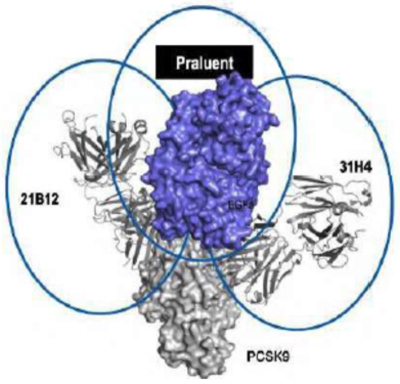
    (which illustrates, importantly for Respondents' arguments, that while Amgen's antibodies contact only 2-3 amino acids in the sweet spot, the "competitor antibodies" contact nearly all of them, due purportedly to the different methods by which the competitors produced them).  These structural differences have functional consequence, according to the scientists, as illustrated by the topography of where Sanofi/Regeneron's Praluent antibody binds PCSK9:

    Image 4
    (where "21B12" and "31H4" are Amgen's antibodies disclosed in Amgen's patent that bind on either side of the site to which Praluent binds).

    The brief states that an antibody's amino acid sequence is the "recipe" for the antibody (a description used by the U.S. during oral argument) because it determines both what an antibody is and what it does (its function), which is dependent on "precise order of amino acids [that] dictates how they will interact, how the chains will fold and arrange, and, additionally, which amino acids will comprise the CDR loops that ultimately interact with antigens."  Consequently, according to the brief, changing even a single amino acid in the sequence "could turn an antibody that binds to an antigen into an antibody that does not bind to that same antigen" as attested at trial by Amgen's expert (a property that can be shared with chemical entities, the scientists asserts in a footnote).  As a consequence, the scientists remind that it is unpredictable how an amino acid sequence change will influence function (in an antibody's case, what it binds to and how well).  The scientists use this unpredictability to criticize Amgen's reliance on "conservative substitutions" as somehow enabling a scientist to modify the antibodies whose sequences are disclosed in Amgen's patent to produce other antibodies having the same PCSK9 binding capabilities.  The scientists attest that conservative substitutions "are by no means a 'shortcut' in antibody engineering for therapeutics" because "the impact of such substitutions remains highly unpredictable," the brief going on to criticize some of Amgen's assertions about such conservative substitutions.  "The only sure way to determine whether the function of an antibody tolerates an amino acid substitution is to make the substitution and test the resulting antibody" according to the scientists.  Nothing about an antibody is predictable, from having an antibody having the desired function to changing portions of the amino acid sequence of such an antibody, even by conservative substitutions.

    The logical conclusion advanced by the scientists is that this feature of antibody structure makes obtaining antibodies other than those expressly disclosed by Amgen undue experimentation.  The degree of experimentation is more, not less, for antibodies that must bind to the identified amino acids in the PCSK9 sweet spot according to the brief.

    The brief then makes the argument that Amgen's invention is the result of hindsight and that the elements (the existence of the sweet spot) was not invented by Amgen (nor according to the scientists did Amgen discover PCSK9 or how LDL receptors bind to it, the brief identifying by name those scientists who did, none of which "had any connection with Amgen").  And the scientists affirm Respondents' argument that Amgen's claims do not encompass a small genus but rather "cover the entire genus of antibodies that bind to specific amino acid residues on PCSK9 and block PCSK9 from binding" to the LDL receptors (quoting the Federal Circuit), despite not reciting any amino acid sequence limitations.  (The brief spends a considerable number of pages addressing and rebutting analogies made by Amgen and other amici.)

    At the end of their legal arguments, the scientists assert that Amgen's disclosure does not satisfy the statutory "make and use" requirement because they "do not come close to teaching an antibody scientist how to make and use antibodies that bind to its claimed specific residues and block binding of LDL receptors."  With regard to Amgen's purported "roadmap" the scientists state that "[n]owhere in this 'roadmap' is any teaching or guidance that provides a practical shortcut to other scientists to make and use the claimed broad genus of antibodies without undue experimentation."

    The brief ends on a policy note, the scientists asserting that letting Amgen's claims stand would "block innovation and access to new medicines."  Amgen provided the two expressly recited antibodies (defined by structure) but did not "create or alter any of these natural residues; they existed in nature before Amgen found them."  This strikes (for the scientists) the "warning bell" that permitting claims having Amgen's scope would inherently give Amgen patent protection over the naturally occurring structure of PCSK9, contrary to Ass'n for Molecular Pathology v. Myriad Genetics, Inc., 569 U.S. 576, 589-90 (2013).  Having an enablement standard that would permit disclosures such as Amgen's here to pass muster would "incentivize companies to use their considerable resources to block access to new therapies by essentially calling 'dibs' on anything that binds to a naturally occurring target of interest" according to the brief.  These scientists rebut arguments by Amgen's amici that claims like Amgen's promote innovation and state that the opposite is true, that "an arms race to patent natural interfaces or surfaces of targets involved in key interactions in a disease undermines scientific development and gives an unfair advantage to companies with unlimited resources."

    The brief ends with this summary statement:

    In sum, purely functional claims like Amgen's are enormously harmful to scientists who seek to understand, research, and develop new therapies for known targets, particularly where the technology at issue is complex and unpredictable.  No entity should be able to contribute only a few drops and claim ownership of the ocean.  The current enablement standard protects innovation and limits exclusivity to that which is truly inventive.  It should be upheld.

    *This group of scientists were Sir Gregory Winter, who won a Nobel Prize in 2018 for methods of making fully human recombinant antibodies by antibody phage display technology; Timothy Springer, Ph.D., the Latham Family Professor of Biological Chemistry and Molecular Pharmacology at Harvard Medical School and Boston Children's Hospital, as well as the Principal Investigator in the Program of Cellular and Molecular Medicine, Division of Hematology/Oncology, Department of Medicine at Boston Children's Hospital, whose work has been in integrins; Robert Kamen, Ph.D., who is an advisory partner at Third Rock Ventures; Andrew Griffith, Ph.D., Professor of Biochemistry at École Supérieure de Chimie Industrielles de Paris (ESPCI Paris) in Paris and a founder of Cambridge Antibody Technology; Royston Jefferis, Ph.D., who is Professor Emeritus in the Institute of Immunology and Immunotherapy within the College of Medical and Dental Sciences at the University of Birmingham, UK, whose work is on antibody design; Nick Ray, Ph.D., Chief Scientific Officer of a UK drug discovery company, C4X Discovery, who has worked on oncology, respiratory diseases, inflammation, central nervous system, pain and metabolic disease and is a named inventor on over 75 patents; and David Manuta, Ph.D., current Board Chair of the American Institute of Chemists (AIC), "a national, non-profit organization founded in 1923 for emphasizing and promoting the relevance of the chemical profession and its practitioners to society at large."