• Antitrust Violation Found in Patent Infringement Litigation, and (Trebled) Attorney Fees for Defending Infringement Awarded as Damages

    By Joseph Herndon —

    Federal Circuit SealOn February 10, 2016, the Federal Circuit issued an opinion in a case captioned Transweb, LLC v. 3M Innovative Properties Company, 3M Company.

    3M had sued TransWeb for infringement of several patents.  TransWeb sued for declaratory judgment of invalidity and non-infringement of the patents.  A jury found the patents to be invalid based on TransWeb's prior public use of the patented method.  Further, in accordance with an advisory verdict from the jury, the District Court found the patents unenforceable due to inequitable conduct.

    Among other outcomes of the district court litigation, the jury found 3M to be liable for a Walker Process antitrust violation, based on fraudulent procurement and subsequent assertion of the patents, and that attorney fees were an appropriate antitrust remedy.  The District Court awarded approximately $26 million to TransWeb, including trebled attorney fees as antitrust damages.  On appeal, the Federal Circuit affirmed that the attorney fees are an appropriate basis for damages under the antitrust laws in this context.  The Federal Circuit found that TransWeb's attorney fees appropriately flow from the unlawful aspect of 3M's antitrust violation, and thus, are an antitrust injury that can properly serve as the basis for antitrust damages.

    Looking at the technology involved, TransWeb and 3M are both manufacturers of filters for respirators, such as might be worn by workers in a dirty or otherwise contaminated worksite.  The filter media at issue in this case consist of "nonwoven fibrous webs," which rely on a "web" of fibers rather than traditional woven material.  Both TransWeb and 3M use a process of melting pellets of a filter material, such as polypropylene, blowing the melted material into a thin film, and then allowing the material to cool and solidify into the nonwoven fibrous web.

    3M asserted U.S. Patent Nos. 6,397,458 and 6,808,551 against TransWeb.  These patents generally disclose uses of "hydrocharging," which is a technique that uses water to impart electrical charges on the filter medium to enable the medium to repel or capture particulates both by mechanical and electro-magnetic means.

    The District Court ultimately presented many issues to a jury including questions of infringement, invalidity, and unenforceability of the two patents.  Of note for this commentary is the Walker Process antitrust violation that was presented to the jury based on fraudulent procurement and subsequent assertion of the patents; sham litigation antitrust violation based on assertion of the patents; entitlement to lost profits damages for antitrust violations; and entitlement to attorney fees as damages for antitrust violations.  The jury delivered all verdicts (with the exception of no sham litigation) against 3M, and TransWeb was entitled to lost profits and attorney fees as antitrust damages.

    Walker Process Antitrust Violation

    In Walker Process, the Supreme Court held that a plaintiff could bring an action under § 2 of the Sherman Act based on the alleged maintenance and enforcement of a fraudulently-obtained patent.  To prevail on a Walker Process claim, the antitrust-plaintiff must show two things: (1) that the antitrust-defendant obtained the patent by knowing and willful fraud on the Patent Office and maintained and enforced the patent with knowledge of the fraudulent procurement; and (2) all the other elements necessary to establish a Sherman Act monopolization claim (e.g., (i) that the defendant has engaged in predatory or anticompetitive conduct with (ii) a specific intent to monopolize and (iii) a dangerous probability of achieving monopoly power).  In determining the dangerous probability of achieving monopoly power for element (iii), the courts look at the relevant market and the defendant's ability to lessen or destroy competition in that market.

    In this case, 3M does not contest that TransWeb's inequitable conduct showing, if affirmed, along with 3M's bringing of the infringement suit proves the first Walker Process requirement, as well as elements (i) and (ii) of the second Walker Process requirement.

    Because 3M did not challenge the sufficiency of the evidence supporting the jury's Walker Process fraud finding beyond challenging the inequitable conduct finding, the Federal Circuit accepted as admitted that TransWeb sufficiently demonstrated the Walker Process fraud component (note that the showing required for proving inequitable conduct and the showing required for proving the fraud component of Walker Process liability may be nearly identical, but debate still exists as to whether Walker Process liability requires a higher, more specific showing of knowing and willful fraud than the more inclusive inequitable conduct doctrine).

    On Appeal, 3M challenged whether the District Court properly defined the relevant market for determining dangerous probability of monopoly power in element (iii), and whether the award of TransWeb's attorney fees is appropriate even if the Walker Process case were proven.

    The relevant market is defined by both a product market and a geographic market.  TransWeb defined two distinct markets: an "upstream" market for "fluorinated polymeric material" and a "downstream" market for NIOSH-certified respirators in the United States.

    Product Market: The relevant product market consists of all products that are reasonably interchangeable by consumers for the same purposes.  Looking at all evidence submitted, the Federal Circuit concluded that a sufficient basis existed on which a reasonable jury could conclude that the price, use, and qualities of fluorinated material render it a distinct market from other filter media.

    Geographic Market: The relevant geographic market is the area in which a potential buyer may rationally look for the goods or services he or she seeks.  3M argued that the District Court erred in limiting the downstream market for NIOSH-certified respirators to the United States.  The Federal Circuit concluded, however, that there was a sufficient basis on which a reasonable jury could conclude that the United States was the relevant geographic market for the NIOSH-certified respirators.

    Thus, with the fraud component of the antitrust claim being admitted, and having found that the District Court properly defined the relevant market for determining dangerous probability of monopoly power in element (iii), the Federal Circuit affirmed that 3M is liable for the Walker Process anti-trust violation.

    Attorney Fees as Antitrust Damages?

    Section 4 of the Clayton Act provides that "any person who shall be injured in his business or property by reason of anything forbidden in the antitrust laws . . . shall recover threefold the damages by him sustained, and the cost of suit, including a reasonable attorney's fee."  15 U.S.C. § 15(a) (2012).

    The jury concluded that TransWeb was entitled to its lost profits ($34,000) and attorney fees in recompense for 3M's antitrust violation.  The District Court trebled the lost profits to the amount of approximately $103,000.

    But, for attorney fees, the District Court concluded that TransWeb incurred approximately $3.2 million in attorney fees prosecuting the antitrust claim and approximately $7.7 million defending the infringement suit.  The District Court awarded the $3.2 million on a one-for-one basis as "cost of suit" fees but awarded the $7.7 million trebled to approximately $23 million as damages for a total of over $26 million in trebled attorney fees damages.

    3M argued that the District Court erred in awarding the $23 million of attorney-fees damages due to defending the infringement suit because TransWeb failed to show any link between those attorney fees and an impact on competition.  3M argued that those attorney fees had no effect on competition because they did not force TransWeb out of the market or otherwise affect prices in the market.  On this basis, 3M argued that those attorney fees are not an antitrust injury, and thus cannot be a proper basis for antitrust damages.

    Section 4 of the Clayton Act does not provide recompense for any injury causally linked to a violation of the antitrust laws, but rather only for antitrust injury.  Thus, TransWeb's injury-in-fact of $7.7 million must be attributable to an anti-competitive aspect of the practice under scrutiny in order to qualify as an antitrust injury.

    The Federal Circuit noted that in this case, 3M's unlawful act was in fact aimed at reducing competition and would have done so had the suit been successful because 3M's unlawful act was the bringing of suit based on a patent known to be fraudulently obtained.  What made this act unlawful under the antitrust laws was its attempt to gain a monopoly based on this fraudulently-obtained patent.  TransWeb's attorney fees flow directly from this unlawful aspect of 3M's act.  That is, TransWeb's attorney fees flow from that which makes 3M's acts unlawful, and are attributable to this anti-competitive aspect of the practice under scrutiny.

    No assertion of a patent known to be fraudulently obtained can be a proper use of legal process.  No successful outcome of that litigation, regardless of how much the patentee subjectively desires it, would save that suit from being improper due to its tainted origin.  Therefore, the Federal Circuit found that allowing attorney fees as antitrust damages in contexts such as sham litigation and lawsuits in furtherance of a broader anticompetitive scheme is proper.

    The antitrust laws exist to protect competition.  The Federal Circuit noted that this outcome furthers the purpose of the antitrust laws to encourage TransWeb to bring its antitrust suit instead of waiting to be excluded from the market.  In summary, TransWeb's attorney fees that were incurred defending the infringement suit are an antitrust injury, and thus can form the basis for damages under § 4.

    The outcome of this case provides great power to defendants who are successful in challenging a patent as being unenforceable due to inequitable conduct, or knowing and willful fraud on the Patent Office.  With such a finding, defendants then need only show "a dangerous probability of achieving monopoly power," albeit a challenge itself, to achieve a successful Walker Process antitrust violation.  That violation, which may not ordinarily be attributable to large monetary damages to the defendant, now attaches attorney fees (trebled) for defending the infringement suit.

    Transweb, LLC v. 3M Innovative Properties Co. (Fed. Cir. 2016)
    Panel: Circuit Judges Wallach, Bryson, and Hughes
    Opinion by Circuit Judge Hughes

  • By Kevin E. Noonan —

    Federal Trade Commission (FTC) SealIn January, the Federal Trade Commission issued a report on the terms of settlement agreements between branded and generic drug companies in ANDA litigation under the Hatch-Waxman Act, according to the provisions of the Medicare Prescription Drug, Improvement, and Modernization Act of 2003.  While the Commission has been issuing these Reports since the MMA was enacted, this year's report is significant, because it is the first Report issued by the FTC after the Supreme Court's decision in FTC v. Actavis, which held that under some circumstances such settlement agreements containing so-called "reverse payments" could violate the antitrust laws.

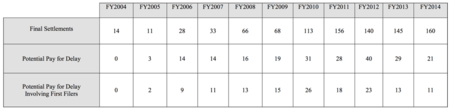
    According to the report (which can be accessed here), there were 160 settlement agreements between branded pharmaceutical companies and generic competitors filed in Fiscal Year 2014.  This number, according to the Report, is "substantially the same" as the number of settlement agreements in recent years.  Specifically, the Report notes that by comparison there were 156 agreements filed in FY 2011, 145 in FY 2012, and 140 in FY 2013.  As set forth in the Report, of the 160 agreements reported to the Commission in FY 2014:

    • 21 contained "potential" reverse payment provisions, involving 20 different drugs with sales totaling $6.2 billion;

    • 10 of these 21 involved compensation "solely in the form of cash," in amounts ranging from $35,000 – $5 million;

    • 6 of these 21 involved a "side" business deal between the parties;

    • 5 of the 21 included a promise from the branded pharmaceutical not to market an authorized generic;

    • 8 of the agreements contained ambiguous provisions, for example, related to "a declining royalty structure" that could act like an agreement not to market an authorized generic;

    • Of the rest, (111 of 160) the agreements restricted a generic company's ability to market their products but do not contain either explicit or "possible" compensation from the branded to the generic; and finally

    • 20 of the settlements contained no provisions limiting generic entry.

    What has changed is the number of these agreements containing reverse payment provisions, which "decreased significantly" (by about 50%).  The trend is clear:  there were 31 agreements containing reverse payment provisions in FY 2010, 28 in FY 2011, and 29 in FY 2013.  The trend is most pronounced for "first filers," those generic manufacturers who are first to file an ANDA application.  For first filers there were 18 agreements in FY 2011, 23 in FY 2012, and 13 in FY 2013, compared with 11 in FY 2014.  There has also been a reduction in the number of settlements involving first filers containing agreements by the branded drug maker not to market an "authorized generic" in competition with the generic entrant.  These provisions are particularly important to first filers, who get 180 days of market exclusivity if they successfully challenge the branded company's patents; competition by a "generic" form of the drug made by the branded manufacturer can greatly reduce the short-term profits (and hence economic incentives) for the generic entrant.  There were 15 agreements containing such provisions filed in FY 2010, 11 in FY 2011, 19 in FY 2012, and 4 in FY 2013, compared with 5 in FY 2014.

    Overall, the Report reveals that 81-87% of ANDA litigation settlement agreements filed in FY 2014 did not contain any compensation from the branded to the generic company and/or restrictions on generic market entry.  These results show that the outcome desired by the FTC in a decade of challenging these agreements that culminated in the Court's Actavis decision have borne the desired fruit.  Whether this outcome facilitates generic entry and reduced drug costs for consumers is a conclusion the data do not yet support.

    Table
    Exhibit 1 from Report (click to enlarge table)

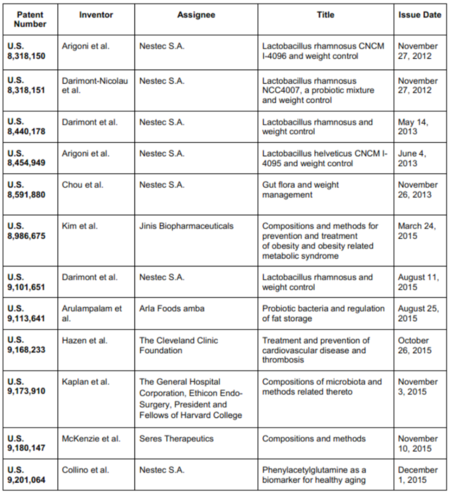
  • The gut microbiome, a collection of microbes living in the gastrointestinal tract, has emerged as an attractive target for pharmaceutical intervention for the treatment of a variety of disorders.  This is the fifth article in a series on advancements in microbiome research and development.  This installment will summarize issued U.S. microbiome-based patents that describe therapies relating to obesity and other metabolic disorders.  It is a follow-up to the fourth part of the series, which reviewed important research and development in this subject area.  The patents reviewed herein are neatly summarized in the table at the end of this installment.  Upcoming articles will continue to review important topics in this technology area, and patents of interest.

    By Jessica Miles* and Anthony D. Sabatelli** —

    The diet and nutrition industry is big business: the industry brings in over $60 billion dollars from the nation's 100 million-plus dieters.  Yet, years of R&D have failed to produce a blockbuster weight loss drug.  Clearly, there is a big incentive to develop new and effective therapies for this area, particularly considering the risks and adverse events that have plagued previous prescription therapies, and companies are looking to the untapped potential of the microbiome for an elusive wonder drug.

    The earliest patents issued relating to obesity and the microbiome describe formulations of lactic acid bacteria used to prevent weight gain.  Patent activity in this area started a few years ago with a series of patents obtained by Nestec S.A.  Recently dubbed "Pharma's newest nemesis" for its efforts to create pharmaceutical food products, the four-year-old research and development subsidiary of Nestlé has Patent Nos. 8,318,150; 8,318,151; 8,440,178; 8,454,949; and 8,591,880.  The '150 and '151 patents describe the use of two strains of the same probiotic species, Lactobacillus rhamnosus, for weight loss and treatment of metabolic disorders.  Patent No. 8,440,178 describes the use of two additional L. rhamnosus strains, while Patent No. 8,454,949 relates to the use of a similar probiotic species, L. helveticus.  Patent No. 8,591,880 describes a composition of L. rhamnosus to modulate a patient's microbiome.

    After growing steadily, the number of patents granted in this field peaked in 2015.  Patent No. 8,986,675 was issued to Jinis Biopharmaceuticals, a South Korean clinical and commercial life sciences manufacturer for an invention comprising mutagenized L. acidophilus strains.  Later that year, Nestec S.A. obtained another patent (Patent No. 9,101,651) for the use of probiotic L. rhamnosus strains for weight management.  Patent No. 9,113,641 relates to a composition of L. paracasei and a milk product used to regulate fat uptake.  The patent was granted to Arla Foods amba, the largest producer of dairy products in Scandanavia, and Sven Pettersson, a renowned microbiome researcher at Sweden's Karolinska Institute, is one of its listed inventors.

    Recently issued patents have focused on modulating the microbiome to diagnose and ameliorate obesity and other metabolic disorders.  MicroBiome Therapeutics LLC obtained Patent No. 9,040,101, which was mentioned in the second installment of this series, which describes a drug being evaluated in clinical trials for the treatment of diarrhea in patients taking metformin, a treatment for type II diabetes.  Patent No. 9,168,233 relates to the inhibition of Trimethylamine (TMA) N-oxide (TMAO), a product of the gut microbiome that is associated with atherosclerosis.  Patent No. 9,173,910, whose inventors include Peter Turnbaugh, relates to the use of bacteria of the phyla Verrucomicrobia to modulate the microbiome for the treatment of a suite of metabolic disorders, including obesity and diabetes.  Seres Therapeutics, which is still riding high on its widely-publicized 2015 IPO, was granted Patent No. 9,180,147, which describes a composition of bacterial spores and probiotic strains as a therapy for metabolic disorders and other diseases.  Patent No. 9,201,064 relates to the use of two microbial metabolites — phenylacetylglutamine (PAG) and p-cresol sulphate — as biomarkers in aging adults.

    Closing

    2015 was the best year yet for patent activity in microbiomics and obesity, with higher numbers and diverse technologies represented among the patent grantees.  These signs indicate that the field will see continued growth and increased commercialization activity in 2016.  However, securing patent protection has become more complicated in the aftermath of the Supreme Court's infamous Mayo and Alice decisions defining more stringent criteria for patent subject matter eligibility under 35 U.S.C. § 101.  Microbiomics inventions, which often utilize living bacteria and other natural products, will be vulnerable to such 101 rejections, and already-issued patents could also be vulnerable in post grant proceedings.  Careful, thoughtful, and creative patent drafting and prosecution will be vital for protecting on-going innovation in this area.

    Table 1: Selected Patents in Microbiomics Relating to Obesity and Metabolic Disorders (click on table to expand)

    Table_1
    * Jessica Miles is a Technology Specialist at Dilworth IP
    ** Dr. Sabatelli is a Partner with Dilworth IP

    For additional information regarding this topic, please see:

    • "The Emergent Microbiome: A Revolution for the Life Sciences – Part IV, Obesity and other Metabolic Disorders," February 18, 2016
    • "Jackson Laboratory Hosts Microbiome Symposium Related to Cancer and Immunology," January 19, 2016
    • "Guest Post — The Emergent Microbiome: A Revolution for the Life Sciences – Part III, Psychobiotics," October 13, 2015
    • "Guest Post — The Emergent Microbiome: A Revolution for the Life Sciences – Part II, 2015 Patent Trends," August 11, 2015
    • "Guest Post — The Emergent Microbiome: A Revolution for the Life Sciences – Part I, R&D Leaders," August 10, 2015

  • CalendarMarch 1, 2016 – "PTAB Best Practices for Petitioners" (American Intellectual Property Law Association) – 12:30 – 2:00 pm (Eastern)

    March 3, 2016 – "Patents and Export Control Compliance: Managing Risk and Avoiding Unintentional Violations — Minimizing Export Control Liability in Patent Application Preparation, Development and Analysis of Innovation, and Licensing" (Strafford) – 1:00 to 2:30 pm (EST)

    March 8, 2016 – Patent Quality Chat webinar series: "Latest on the Cooperative Patent Classification (CPC) System" (U.S. Patent and Trademark Office) – 12:00 to 1:00 pm (ET)

    March 9, 2016 – "Strategic Use of Patent Reissue Applications for University IP" (Technology Transfer Tactics) – 1:00 to 2:00 pm (Eastern)

    March 10, 2016 – "Biotech Patents and §101 Rejections: Meeting Patent Eligibility Requirements — Leveraging Recent Decisions and USPTO Guidance to Overcome Rejections" (Strafford) – 1:00 to 2:30 pm (EST)

    March 10-11, 2016 - Advanced Patent Law Seminar (Chisum Patent Academy) – Cincinnati, OH

    March 13, 2016 - American Intellectual Property Law Association Quarterly Journal (AIPLA QJ) Symposium – George Washington University Law School

    March 16, 2016 – "Preparing for the European Unified Patent Court (UPC)" (McDonnell Boehnen Hulbert & Berghoff LLP) – 10:00 am to 11:15 am (CT)

    March 16, 2016 – "Trade Secrets in Biotech, Biosimilars & Medical Devices" (American Intellectual Property Law Association) – 12:30 – 2:00 pm (Eastern)

    ***Patent Docs is a media partner of this conference or CLE

  • AIPLA #1The American Intellectual Property Law Association (AIPLA) will be offering a webinar entitled "Trade Secrets in Biotech, Biosimilars & Medical Devices" on March 16, 2016 from 12:30 – 2:00 pm (Eastern).  Victoria Cundiff of Paul Hastings will moderate a panel consisting of Elizabeth Howard of Orrick, ​Debora Plehn-Dujowich of Prismatic Law Group, and Austin Wang of Hologic will discuss using Trade Secrets Law as a complement or alternative to Patent Law, particularly in areas such as Biotech and Medical Devices where patent eligibility has become more uncertain.

    The registration fee for the program is $145 (AIPLA member rate) or $195 (non-member rate).  Those interested in registering for the program, can do so here.

  • AIPLA #1The first annual American Intellectual Property Law Association Quarterly Journal (AIPLA QJ) Symposium will be held on March 18, 2016 at the George Washington University Law School.  The program will offer panel discussions on the following topics:

    • Panel 1: Drafting Claims during Prosecution
    • Panel 2: Claim Construction during Post-grant Review
    • Panel 3: Practitioner Panel on Claim Construction in Federal Courts and ITC
    • Panel 4: Judicial Panel on Claim Construction in Federal Courts and ITC

    Additional information about the symposium can be found here, and a program, including a list of speakers, can be found here.

  • Technology Transfer Tactics will be offering a webinar entitled "Strategic Use of Patent Reissue Applications for University IP" on March 9, 2016 from 1:00 to 2:00 pm (Eastern).  Michael L. Goldman and Megan O'Gara of LeClair Ryan will discuss reissue opportunities as well as challenges and risks.  The webinar will cover the following topics:

    • What factors indicate that post-grant proceedings are warranted for your patent
    • Overview of Post-Issuance Proceedings Before the U.S. Patent and Trademark Office
        – Ex parte Reexamination
        – Supplemental Examination
        – Reissue Application
        – Inter Partes Review
        – Post-Grant Review
    • Components of a Reissue Application and Requirements for Filing
    • How reissue claims effect active patents
    • Errors Correctable by Reissue (e.g., claiming more or less than applicant had a right to claim, correcting errors relating to statutory subject matter)
    • Errors NOT Correctable by Reissue
    • Special Considerations when Broadening Claims
    • Considering how a Reissue Application will Affect Litigation

    The registration fee for the webinar is $197.  Those interested in registering for the webinar, can do so here.

    Technology Transfer Tactics

  • Strafford #1Strafford will be offering a webinar/teleconference entitled "Patents and Export Control Compliance: Managing Risk and Avoiding Unintentional Violations — Minimizing Export Control Liability in Patent Application Preparation, Development and Analysis of Innovation, and Licensing" on March 3, 2016 from 1:00 to 2:30 pm (EST).  Thomas Crocker of Alston & Bird and David G. Henry of Gray Reed & McGraw will provide guidance for patent counsel on navigating the intersection of patents and export control laws; examine the challenges facing patent owners, when and where export control issues arise, and licensing issues; and offer best practices for complying with export control laws.

    The registration fee for the webinar is $297.  Those interested in registering for the webinar, can do so here.

  • By Joseph Herndon —

    The test for what is patentable subject matter under 35 U.S.C. § 101 in the United States has become quite difficult to understand.  In Alice Corp. v. CLS Bank, the Supreme Court provided a two-step test for distinguishing patents that claim patent ineligible laws of nature, natural phenomena, and abstract ideas from those that claim patent-eligible applications of those concepts.  The first step requires a court to determine if the claims are directed to a law of nature, natural phenomenon, or abstract idea.  If not, the claims pass muster under § 101.  A court applies the second step only if it finds in the first step that the claims are directed to a law of nature, natural phenomenon, or abstract idea.  The second step requires the court to determine if the elements of the claim individually, or as an ordered combination, "transform the nature of the claim" into a patent-eligible application.  Step two has been described as a search for an "inventive concept".

    Many courts have complained that identifying whether a claim is "directed to an abstract idea" under step one of the Alice test is not always a simple undertaking.  Without a bright-line test, whether claims will be considered to satisfy 35 U.S.C. § 101 has become unpredictable at best.  With many court decisions, it would seem that the court could just as easily have come to the opposite decision.  Some bright-line rule of course would be welcomed, but I recognize that developing a single rule that applies to all technologies is difficult.

    Martin Snyder, of Main Sequence Technology Inc., has developed a possible solution, and a link to his paper, entitled "Subject Matter Eligibility in the Information Age," can be found here.

  • By Kevin E. Noonan —

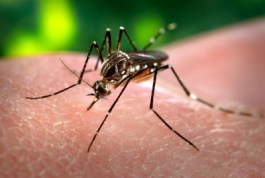
    Aedes aegyptiThe rise and spread of the Zika virus, although limited for now to South America, has raised concerns globally, particularly with the prospect of the Summer Olympics in Rio de Janeiro later this year.  And with those concerns comes renewed interest in the insect vector associated with zika virus transmission, the Aedes aegypti mosquito.  This mosquito is also the transmission vector for other arboviruses, including those responsible for yellow fever, dengue fever, and Chikungunya, and has been extensively studied for over fifty years.  These studies have been facilitated by the existence of a form of the mosquito that is readily adapted to the laboratory environment (perhaps related to the feral and domestic forms of the mosquito that exist in Africa).

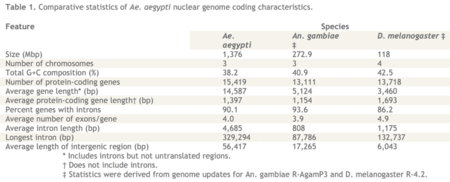
    So it seems appropriate to revisit the explication of the Ae. aegypti genome, as published in Science in 2007.1  This species is known to have radiated from the malaria vector Anopheles gambiae about 150 million years ago and the genome of that mosquito, along with the Drosophila melanogaster genome, was used for comparison purposes to understand the structure of the Aedes genome.  The Aedes aegypti genome has a sequence size of 1.38 Gbp, 5-fold larger than Anopheles gambiae mosquito (278 Mbp); both mosquitos have three chromosomes but Ae. aegypti lacks the heteromorphic sex chromosomes found in D. melanogaster.  The average gene length and size of intergenic regions was found to be 4-6 fold longer than in An. gambiae and D. melanogaster, which the authors believed was due to almost 50% of the Ae. aegypti genome comprising transposable elements.  Despite these differences, chromosomal synteny was reported to have been maintained between these mosquito species, but orthologous gene order was found to be twice as high between the mosquito species than in comparison between either mosquito and the fruit fly.

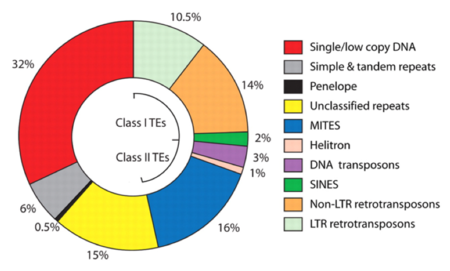
    Genetic analysis for the presence of open reading frames found 15,419 predicted proteins (and alternative splicing can increase this to 16,789 transcripts), with 80% of these confirmed as being transcriptionally active.  There is an increased gene number for odorant binding proteins, cytochrome P450 and cuticle domains relative to An. gambiae.  The relative distribution of genomic content was found as illustrated:

    Figure_1(where Penelope and Helitron are eukaryotic transposable elements and MITEs are miniature inverted repeat transposable elements that in Ae. aegypti have "terminal inverted repeat sequences and target-site duplications, features characteristic of transposition of DNA transposons" according to this report.  These researchers identified over 1,000 types of transposable elements in the mosquitoe's genome, which included most of the families identified in eukaryotes, wherein non-protein coding transposable elements comprise 16% of the genome and are more numerous than protein-coding transposable elements (present at about 3% of the genome).  Three percent of the Ae. aegypti genome comprise about 13,000 copies of long terminal repeat retrotransposons, and there are 50,000 copies of tRNA related SINE elements.  The pattern of transposable element distribution in Ae. aegypti was found to be consistent with "an overall lack of apparent horizontal transfer events."

    A consequence of the predominance of transposable elements in the Ae. aegypti genome created "an asymmetric distribution of intron lengths within genes" and frequent occurrence of transposable element-associated open reading frames "either in close proximity to genes or in introns" and an overall increase in gene length due to "infiltration" of transposable elements into introns.  Compared to related species, "67% of the Ae. aegypti proteins having an ortholog in An. gambiae and 58% having an ortholog in D. melanogaster," with an "average amino acid identity of 74% between the mosquito proteins, in contrast with ~58% identity between mosquito and fruit fly proteins."  Further:

    Approximately 2,000 orthologs are shared only between the mosquitoes and may represent functions central to mosquito biology.  Although most of these proteins are of unknown function, ~250 can be assigned a predicted function, of which 28% are involved in gustatory/olfactory systems, 12% are members of the cuticular gene family and 8% are members of the cytochrome P450 family.

    These authors also report "an expansion of Zn-fingers, insect cuticle, cytochrome P450, odorant binding protein (OBP) A10/OS-D, insect allergen related and HMG-I and MHG-Y domains in Ae. aegypti" compared to other insects (specifically, An. gambiae, D. melanogaster and Apis mellifera (the honey bee)).  Members of the superfamily of G-protein coupled receptors were also found, including "111 non-sensory class A, B and C GPCRs, 14 atypical class D GPCRs, and 10 opsin photoreceptors."  Again in comparison with An. gambiae and D. melanogaster, these authors report orthologs for more than 85% of non-sensory GPCRs (which suggest to these researchers that there has been "significant conservation of GPCR-mediated neurological processes across [the] Diptera [family]."  With regard to the ion transport-homologous genes found in the Aedes aegypti genome the paper states:

    Similar to other multi-cellular eukaryotes, ~ 32% of all three insect transporters code for ion channels and probably function to maintain haemolymph homeostasis under different environmental conditions by modulating the concentrations of Na+, K+ and Cl− ions.  Aedes aegypti encodes more paralogs of voltage-gated potassium ion channels, epithelial sodium channels and ligand-gated ion channels (LIC) such as the glutamate-gated ion channel than An. gambiae and D. melanogaster.  These channels play important roles in the signal transduction pathway and cell communication in the central nervous system and at neuromuscular junctions.  . . .  A collection of 64 putative ATP-binding cassette transporters was identified, including subgroups that encode multi-drug efflux proteins.  Aedes aegypti encodes more members of 4 different types of amino acid transporters than An. gambiae and D. melanogaster.  Mosquito larvae cannot synthesize de novo all the basic, neutral or aromatic L-amino acids, and must rely on uptake of these essential amino acids.  Aromatic amino acids phenylalanine and tryptophan are particularly important because they are precursors for the synthesis of neurotransmitters.  The richer repertoire of membrane transport systems in Ae. aegypti is likely to intersect with the apparent increase in odorant reception and detoxification capacity.

    Instead of bearing heteromorphic sex chromosomes, an Aedes aegypti gender is determined by an autosomal locus where the dominant allele determines maleness.  The researchers detected gender differences in gene expression:

    669 and 635 transcripts were enriched in females and males, respectively, and 6,713 transcripts were expressed at similar levels in both sexes.

    An additional 373 and 534 transcripts generated exclusive hybridization signals (with signal intensity below cutoff threshold level in one channel) in females and males, respectively, and may therefore represent sex specific transcripts.  Functional categorization of female and male enriched transcripts were remarkably similar, with male mosquitoes expressing a slightly larger number of immune and redox/stress related transcripts while females expressed a larger number of putative blood digestive enzyme transcripts.  This particular pattern of immune gene expression is surprising considering a predicted lower need for immune defense in the males, due to the lack of pathogen exposure that results from blood feeding.

    144 orthologous genes displaying the same sex specific transcription pattern in An. gambiae, while 74 orthologs showed an opposite profile, suggesting differences in certain sex specific functions between the two mosquito species.

    Finally, the overall chromosomal organization showed significant synteny ("a distinct one-to-one correlation") between the Aedes aegypti genome and that of both An. gambiae and D. melanogaster (with an exception on the 2p and 3q chromosomal arms.

    A summary of the genetic comparisons provided in the report was provided in tabular form as set forth below (click on table to enlarge).

    Table_1

    1 This work was the result of an international effort involving scientists from The Institute for Genomic Research, Broad Institute of MIT and Harvard, Virginia Polytechnic Institute and State University, Bloomberg School of Public Health, Johns Hopkins University, University of Notre Dame, Harvard University, College of Agricultural Sciences, Colorado State University, Northwestern University, University of California, Riverside, University of California, Santa Cruz, Purdue University, Texas A&M, the Joint Technology Center, and the University of Massachusetts in the U.S.; European Bioinformatics Institute (EMBL-EBI), University of Geneva Medical School, Swiss Institute of Bioinformatics, Imperial College London, University of Oxford, Centro Nacional de Genotipado, Fundación Pública Galega de Medicina Xenómica, Hospital Clínico Universitario de Santiago, Institut Pasteur, Universidade da Coruña, Institut Jacques Monod, Universität Göttingen, and Complexo Hospitalario Universitario de Santiago in Europe; and Universidade de Sao Paulo, Instituto de Quimica, Universidade de Sao Paulo, Institute of Biomedical Sciences, and the Instituto Butantan in Brazil.