•         By Sherri Oslick —

    Gavel About Court Report:  Each week we will report briefly on recently filed biotech and pharma cases.

    Merck & Cie et al. v. Lupin Ltd. et al.
    1:15-cv-00899; filed October 8, 2015 in the District Court of Delaware

    • Plaintiffs:  Merck & Cie; Bayer Pharma AG; Bayer HealthCare Pharmaceuticals Inc.
    • Defendants:  Lupin Ltd.; Lupin Pharmaceuticals, Inc.

    Infringement of U.S. Patent No. 6,441,168 ("Stable Crystalline Salts of 5-methyltetrahydrofolic Acid," issued August 27, 2002) following a Paragraph IV certification as part of Lupin's filing of an ANDA to manufacture a generic version of Merck's Beyaz® (drospirenone, 17α-ethinyl estradiol, and levomefolate calcium, used for oral contraception).  View the complaint here.


    Salix Pharmaceuticals, Inc. et al. v. Taro Pharmaceuticals U.S.A., Inc. et al.
    1:15-cv-00900; filed October 8, 2015 in the District Court of Delaware

    • Plaintiffs:  Salix Pharmaceuticals, Inc.; Norgine B.V.
    • Defendants:  Taro Pharmaceuticals U.S.A., Inc.; Taro Pharmaceutical Industries Ltd.

    Infringement of U.S. Patent Nos. 7,169,381 ("Colon Cleansing Compositions and Methods," issued January 30, 2007) and 7,658,914 ("Colon Cleansing Compositions," issued February 9, 2010) following a paragraph IV certification as part of Taro's filing of an ANDA to manufacture a generic version of Salix's MoviPrep® (PEG 3350, sodium sulfate, sodium chloride, potassium chloride, sodium ascorbate and ascorbic acid oral solution, used for cleansing of the colon as a preparation for colonoscopy).  View the complaint here.


    Helsinn Healthcare S.A. et al. v. Fresenius Kabi USA, LLC et al.
    3:15-cv-07378; filed October 8, 2015 in the District Court of New Jersey

    • Plaintiffs:  Helsinn Healthcare S.A.; Roche Palo Alto LLC
    • Defendants:  Fresenius Kabi USA, LLC; Exela Pharma Sciences, LLC; Exela Holdings, Inc.; Exela Pharmsci, Inc.

    Infringement of U.S. Patent Nos. 7,947,724 ("Liquid Pharmaceutical Formulations of Palonosetron," issued May 24, 2011), 8,518,981 ("Liquid Pharmaceutical Formulations of Palonosetron," issued August 27, 2013), 8,598,218 (same title, issued December 3, 2013), 9,066,980 (same title, issued June 30, 2015), and 9,125,905 (same title, issued September 8, 2015) following a Paragraph IV certification as part of defendants' filing of an ANDA to manufacture a generic version of Helsinn's Aloxi® (palonosetron hydrochloride intravenous solution, used to prevent chemotherapy induced nausea and vomiting).  View the complaint here.

  • By Kevin E. Noonan —

    AmgenLast Friday, Amgen filed a declaratory judgment action in the District Court for New Jersey against Sandoz, in the latest iteration of biosimilar litigation between the parties (see complaint).  Amgen's and Sandoz's actions and legal position both provide the District Court with another opportunity to parse Congressional intent and the practical implications of the Biologic Price Competition and Innovation Act (BPCIA).

    Sandoz #1The biosimilar at issue is NEULASTA®, generically pegfilgrastim, "a recombinantly expressed, 175-amino acid form of a protein known as human granulocyte-colony stimulating factor ("G-CSF") conjugated to a 20 kD monomethoxypolyethylene glycol (m-PEG) at the N-terminus of the G-CSF," as set forth in Paragraph 54 of the complaint.  The basis for Amgen's cause of action is Sandoz's refusal to comply with certain of the "patent dispute resolution" provisions of the BPCIA, specifically 42 U.S.C. § 262(l)(4) and § 262(l)(5).  In addition, Sandoz coupled its refusal with a demand that Amgen file suit under 42 U.S.C. § 262(l)(6) before those provisions were completed, and threated to seek penalties under the statute.  These penalties would leave Amgen with recourse only to a reasonable royalty unless Amgen filed suit within 30 days of Sandoz's notice of non-compliance.  That date was March 4, 2016 (the date of the filing of this complaint) (¶8).  These actions constitute disruption of "an intricate and carefully orchestrated set of procedures" that comprise the "patent dispute resolution" provisions provided under the statute (¶11).

    The complaint sets forth the procedures and advantage of using the abbreviated biosimilar pathway under 42 U.S.C. § 262(k) (¶¶41-49), and asserts that Congress intended there to be a "balance" between these advantageous provisions and the patent litigation provisions of 42 U.S.C. § 262(l) (¶¶50-53).  The complaint then sets out the activities and behaviors between the parties that raised Amgen's basis for filing suit for declaratory judgment.  As set forth in the complaint, Sandoz received notice that FDA accepted its aBLA on October 26, 2015 (¶63).  Unlike in litigation involving Amgen's NEUPOGEN® (see "Sandoz' NEUPOGEN® Biosimilar Now on the Market"), in this case Sandoz timely complied with the provisions of § 262(l)(2) (¶64) and disclosed its biosimilar application (or "aBLA") and relevant manufacturing methods.  Sandoz also complied with § 262(l)(3)(B) reciting its basis for alleging Amgen's patents would not be infringed, or were invalid or unenforceable (¶66) in response to Amgen providing Sandoz with its patent list, consisting of U.S. Patent Nos. 8,940,878 ("the '878 patent") and 5,824,784 ("the '784 patent") as required under § 262(l)(3)(A) (¶65).  However, before Amgen could respond to Sandoz's non-infringement, invalidity, and unenforceability contentions pursuant to § 262(l)(3)(C), Sandoz gave Amgen notice that it would not comply with the provisions of 42 U.S.C. § 262(l)(4) and § 262(l)(5) and "waived" its right to Amgen's statement under § 262(l)(3)(C).  Sandoz then invoked the provisions of 42 U.S.C. § 262(l)(6), demanding Amgen sue within the statutorily required 30 days or suffer the consequences of forfeiture of the right to seek an injunction and/or lost profits damages (¶67).

    Amgen asserts one count, for a declaratory judgment with regard to whether Sandoz can "unilaterally compel" Amgen to file suit within 30 days of its "repudiation" of the "patent dispute resolution" provisions of the BPCIA (¶¶71-75).  Amgen's Prayer for Relief seeks the following:

    "A. a declaration that Defendants have failed to comply with the requirements of the BPCIA mandatory information-exchange provisions, including 42 U.S.C. § 262(l)(4) and § 262(l)(5) if necessary;

    B. a declaration that Defendants' failure to comply with the requirements of the BPCIA mandatory information-exchange provisions, including 42 U.S.C. § 262(l)(4) and § 262(l)(5) if necessary, means that there can be no "immediate patent infringement action" under 42 U.S.C. § 262(l)(6);

    C. a declaration that Plaintiffs' not filing a patent infringement action by March 4, 2016 — before the parties have complied with 42 U.S.C. § 262(l)(4), and § 262(l)(5) if necessary — does not deprive Plaintiffs of the remedies for infringement available under 35 U.S.C. § 271(e)(4), including lost profits damages and injunctive relief;

    D. an order compelling Defendants to comply with the BPCIA mandatory information-exchange provisions set forth in 42 U.S.C. § 262(l)(4) and § 262(l)(5) if necessary;

    E. an order compelling Defendants to compensate Plaintiffs for and awarding damages incurred as a result of Defendants' actions or inactions;

    as well as attorneys' fees, costs and expenses and "such other relief as [the] Court may deem just and proper."

    So far, Sandoz has read the judicial tea leaves accurately and prevailed in convincing both the district court and Federal Circuit that its interpretation of the litigation provisions of the BPCIA has been correct.  As in earlier litigation, Sandoz has used the apparent complexity of these provisions to its tactical advantage, here requiring Amgen to initiate litigation or risk having its remedies greatly restricted.  It remains to be see whether Sandoz's current interpretation will once again have sufficient traction to be accepted by the courts, or whether the "stop-start" nature of its actions will provoke a less approving response as this case progresses.

  • By Joseph Herndon —

    Federal Circuit SealOn March 1, 2016, the Federal Circuit issued an opinion in a number of related appeals between Blue Calypso, LLC and Groupon, Inc.  These related appeals arise from five Covered Business Method (CBM) reviews of five patents owned by Blue Calypso (U.S. Patent Nos. 7,664,516; 8,155,679; 8,457,670; 8,438,055; and 8,452,640).

    The USPTO Patent Trial and Appeal Board (PTAB) granted the CBM petitions, filed by Groupon, for review under the transitional program for covered business method patents.  In its final written decisions, the PTAB found various claims of the Blue Calypso Patents unpatentable under 35 U.S.C. §§ 102 and 112.  In addition, the Board rejected Groupon's remaining argument that additional claims were unpatentable under 35 U.S.C. § 103.  Many issues were appealed by both Blue Calypso and Groupon, but here, we review Blue Calypso's appeal of the PTAB's decisions to review its patents and institute the CBM review in the first place, in which Blue Calypso asserted that the patents are not "covered business method" patents.

    The Blue Calypso Patents are all related and generally describe a peer-to-peer advertising system that uses mobile communication devices.  The '516 patent explains how advertising can be made to be more effective, compared to traditional broadcast advertising, when an advertiser enlists one of its customers to electronically forward advertisements to his like-minded peers.  A "subsidy program" is described to induce customers ("subscribers") to increase exposure of an advertisement.  An advertiser may customize its subsidy program by specifying the nature of the subsidy or incentive — e.g., product discounts or rewards points — and by identifying necessary demographic criteria that a user must meet before being eligible for the advertiser's subsidy program.  The advertiser can determine which subscribers satisfy the advertiser's criteria and are therefore eligible for the subsidy program.  Each subscriber may then select from the subsidy programs for which it qualified.  Only after this mutual ("bidirectional") selection does an advertiser transmit advertisements to that subscriber.  The advertisement includes a link, which, when executed, connects the subscriber to the advertiser's website for additional information, offers, or coupons.  The subscriber, using a "source communication device" may then forward this advertisement to his peer's "destination communication device."

    Independent claim 2 of the '516 patent is representative and reproduced below.

    2.  A method for providing access to an advertisement from an advertiser to a source communication device possessed by a subscriber and distributing the access to the advertisement from the source communication device to a destination communication device possessed by a recipient, wherein the destination communication device is compatible with the source communication device, and the recipient having a relationship to the subscriber, the method comprising the steps of:
        comparing a desired demographic profile to a subscriber demographic profile to derive a match;
        establishing a bi-lateral endorsement between the subscriber and the advertiser;
        pr
    oviding a subsidy program to the subscriber based  on the match;
        sending a token related to the advertisement to the source communication device;
        activating an endorsement manager in the source communication device;
        initiating a communication session between the source communication device and the destination communication device;
        transmitting a message, including the token, from the source communication device to the destination communication device contemporaneously with the communication session; and
        recognizing a subsidy, according to the subsidy program, for the subscriber after a termination of the communication session.

    Groupon petitioned the Board for CBM review of the Blue Calypso Patents under § 18(a) of the Leahy-Smith America Invents Act (AIA).  Groupon asserted that the claims were unpatentable under either 35 U.S.C. §§ 102 or 103, and some claims as being unpatentable for failing to satisfy the written description requirement of 35 U.S.C. § 112.  After examining the claims, the Board concluded that they met the statutory definition of a "covered business method patent," granted the petition, and instituted review.

    Can Federal Circuit Review Institution of CBM?

    Blue Calypso argued that the Board exceeded its statutory authority by interpreting the statutory CBM definition in an overly broad way that improperly sweeps in Blue Calypso's patents.  In Blue Calypso's view, the Board never should have instituted the CBM review of its patents.

    Although the Board's decision to institute a CBM review is, per the AIA, "final and nonappealable," see AIA § 18(a)(1); 35 U.S.C. § 324(e), the Federal Circuit has held that the question of whether a challenged patent claim is a CBM relates to the Board's authority to issue a final decision in a CBM review.  Versata Dev. Grp., Inc. v. SAP Am., Inc. (Versata II), 793 F.3d 1306 (Fed. Cir. 2015).  Thus, because the Federal Circuit has jurisdiction to review the Board's final decisions in CBM reviews, see AIA § 18(a)(1); 35 U.S.C. § 329, the AIA does not preclude the Federal Circuit from reviewing the Board's conclusion that the challenged patent claims are "covered business methods" that lack any "technological invention."

    The standard for CBM review is limited to patents "that claim[] a method or corresponding apparatus for performing data processing or other operations used in the practice, administration, or management of a financial product or service, except that the term does not include patents for technological inventions."  AIA § 18(d)(1) (emphasis added).

    Eligibility for CBM Review: (1) Financial Product or Service?

    Blue Calypso asserts that its patents are not CBM patents because they relate to a method for managing and distributing advertising content, which is not "a financial product or service" that traditionally originated in the financial sector, e.g., banks, brokerages, holding companies, and insurance firms.

    However, in Versata II, the Federal Circuit concluded that the statute "on its face covers a wide range of finance-related activities" and "[t]he statutory definition makes no reference to financial institutions as such, and does not limit itself only to those institutions."  The legislative history was found to support the proposition that the definition of CBM be broadly interpreted to encompass patents claiming activities that are financial in nature, incidental to a financial activity, or complementary to a financial activity.  More recently, in SightSound Techs., LLC v. Apple  Inc., 809 F.3d 1307 (Fed. Cir. 2015), the Federal Circuit noted that a financial activity not directed to money management or banking can constitute a financial product or service within the meaning of the statute.  Thus, CBM review is not limited to patent claims tied to the financial sector.

    In determining that the Blue Calypso Patents are CBM patents, the Board reviewed the claims, noting, for example, claim 1's recitation of "subsidizing the qualified subscriber according to the chosen subsidy program."  The Board construed the claim term "subsidy" as "financial assistance given by one to another."  The Board concluded that the challenged claims were financial in nature and therefore subject to CBM review under § 18(d)(1).

    The Federal Circuit agreed with the Board because, in its opinion, the claims of the Blue Calypso Patents are directed to methods in which advertisers financially induce "subscribers" to assist their advertising efforts.  Because the Federal Circuit found the claims at issue to have an express financial component in the form of a subsidy, the claims of the Blue Calypso Patents were found to meet the statutory definition of a CBM patent.

    Eligibility for CBM Review: (2) Technological Invention Exception?

    Blue Calypso alternatively contended that the challenged claims fall within the technological invention exception for CBM review because the claims are computer-based and contemplate hardware, software, a network, and communication devices.

    Congress created the technological inventions exception in § 18(d)(1), but expressly delegated authority to the PTO to provide a definition of "technological inventions" that would be excluded from CBM review.  The resulting regulation, 37 C.F.R. § 42.301(b), explains that a patent claims a technological invention if "the claimed subject matter as a whole recites a technological feature that is novel and unobvious over the prior art; and solves a technical problem using a technical solution" (37 C.F.R. § 42.301(b)).

    The USPTO's Patent Trial Practice Guide lists certain claim drafting techniques that are insufficient to render a patent a technological invention: (1) mere recitation of known technologies; (2) reciting the use of known prior art technology; and (3) combining prior art structures to achieve the normal, expected, or predictable results of that combination.

    Thus, merely reciting the use of a computer does not satisfy the technological invention exception.  The Federal Circuit noted that "the presence of a general purpose computer to facilitate operations through uninventive steps does not change the fundamental character of an invention," and cited to Alice Corp. Pty. Ltd. v. CLS Bank Int'l, 134 S. Ct. 2347 (2014).  Thus, the Federal Circuit agreed that the Board correctly rejected Blue Calypso's proposed interpretation of "technological invention."

    Blue Calypso, however, contended that the claims represent technological inventions because they are directed to a solution that remedies technological limitations of traditional broadcast advertising.  But, the Federal Circuit noted that the only recitation in the claims of hardware is nothing more than general computer system components used to carry out the claimed process of incentivizing consumers to forward advertisement campaigns to their peer destination communication devices.  There is no technological aspect in the claims that rises above the general and conventional.  Thus, the technological invention exception does not apply here.

    Thus, the Federal Circuit concluded that the Board acted within its authority in conducting CBM review of the challenged claims of the Blue Calypso Patents.

    This case illustrates the PTAB's broad reach under CBM review.  The claims at issue clearly include technical aspects, but the recitation of a "subsidy program" doomed them as being directed to a business method rather than a technical invention.  The PTAB has an ability to consider many patents as being CBM patents, since the technological invention exception has the caveat that a technological feature is only present if the feature is both "novel and unobvious over the prior art", which of course involves a § 102 and § 103 analysis as well.  But, while this is the standard, the PTAB did not undertake that analysis here, and rather, seemed to be able to know on its own when such features are well-known versus being new.  Of course, it is widely accepted that mere recitation of a computer or processor is not new or non-obvious, but it would seem plausible that the claims here solve a technical problem using a technical solution, and at least required some cursory analysis under §§ 102/103 to rule out the technological invention exception.

    Blue Calypso, LLC v. Groupon, Inc. (Fed. Cir. 2016)
    Panel: Circuit Judges Reyna, Schall, and Chen
    Opinion by Circuit Judge Chen; opinion dissenting in part by Circuit Judge Schall

  • CalendarMarch 8, 2016 – Patent Quality Chat webinar series: "Latest on the Cooperative Patent Classification (CPC) System" (U.S. Patent and Trademark Office) – 12:00 to 1:00 pm (ET)

    March 9, 2016 – "Strategic Use of Patent Reissue Applications for University IP" (Technology Transfer Tactics) – 1:00 to 2:00 pm (Eastern)

    March 9, 2016 – "First Response to Trade Secret Theft: Best Practices for Answering an Alarm" (Intellectual Property Owners Association) – 2:00 to 3:00 pm (ET)

    March 10, 2016 – "Biotech Patents and §101 Rejections: Meeting Patent Eligibility Requirements — Leveraging Recent Decisions and USPTO Guidance to Overcome Rejections" (Strafford) – 1:00 to 2:30 pm (EST)

    March 10-11, 2016 - Advanced Patent Law Seminar (Chisum Patent Academy) – Cincinnati, OH

    March 10-11, 2016 – Eleventh Annual Symposium (Northwestern Journal of Technology & Intellectual Property) – Chicago, IL

    March 15, 2016 – Patent Bar & Office Dialog Summit (Intellectual Property Owners Association) – Washington, D.C.

    March 16, 2016 – "Preparing for the European Unified Patent Court (UPC)" (McDonnell Boehnen Hulbert & Berghoff LLP) – 10:00 am to 11:15 am (CT)

    March 16, 2016 – "Trade Secrets in Biotech, Biosimilars & Medical Devices" (American Intellectual Property Law Association) – 12:30 – 2:00 pm (Eastern)

    March 18, 2016 - American Intellectual Property Law Association Quarterly Journal (AIPLA QJ) Symposium – George Washington University Law School

    March 30, 2016 – "Patent Prosecution from a Litigator's Viewpoint: Position Your Patent to Succeed in Litigation & Post-Grant Procedures" (American Intellectual Property Law Association) – 12:30 – 2:00 pm (Eastern)

    ***Patent Docs is a media partner of this conference or CLE

  • AIPLA #1The American Intellectual Property Law Association (AIPLA) will be offering a webinar entitled "Patent Prosecution from a Litigator's Viewpoint: Position Your Patent to Succeed in Litigation & Post-Grant Procedures" on March 30, 2016 from 12:30 – 2:00 pm (Eastern).  Tom Irving of Finnegan Henderson Farabow Garrett & Dunner, LLP; and Robert Sloss of Procopio Cory Hargreaves & Savitch, LLP will show attendees how to avoid mistakes in patent prosecution and prepare patents to withstand potential future litigation and the AIA's new post-grant procedures; teach attendees fundamentally sound principles to prepare and prosecute U.S. applications according to best practices, to obtain claims that should have enhanced chances of survival when challenged under AIA's IPR and/or PGR post-grant proceedings; and describe the hurdles litigators face in explaining complicated patents to technology-phobic judges and juries and will provide suggestions on how patent claims can be written to be better understood by non-engineers.

    The registration fee for the program is $145 (AIPLA member rate) or $195 (non-member rate).  Those interested in registering for the program, can do so here.

  • IPO #1The Intellectual Property Owners Association (IPO) Education Foundation will be sponsoring Patent Bar & Office Dialog Summit on March 15, 2016 in Washington, D.C.

    The Patent Summit program includes patent general sessions on the following topics:

    • Subject Matter Eligibility
    • Patent Quality Discussion
    • PTAB/IPR Discussion
    • Written Description/Section 112 Discussion

    In addition, attendees will have an opportunity to collaborate with fellow attendees and USPTO employees in small working groups.  Topics to be addressed in the working groups include:

    • Clarity of Record
    • Service Confidence
    • Improving Stakeholder and Examiner Interactions

    A copy of the program, including an agenda and list of panelists for the above sessions, can be found here.

    The registration fee for the conference, which includes breakfast, lunch, course materials, and networking reception is $700.  A registration form can be obtained here.

  • IPO #1The Intellectual Property Owners Association (IPO) will offer a one-hour webinar entitled "First Response to Trade Secret Theft: Best Practices for Answering an Alarm" on March 9, 2016 from 2:00 to 3:00 pm (ET).  Karen Cochran of DuPont, Jose Gonzales-Magaz of Honeywell, and Randall Kahnke of Faegre Baker Daniels will give best practices for secret holders when the alarm of a potential theft first sounds.  The webinar will review the following topics:

    • What questions to ask at the first hint of a problem;
    • How to quickly gather and maintain crucial evidence both in-house and externally;
    • Best practices for internal investigations and giving Upjohn warning to employees;
    • How to contact new employers of suspected thieves or other possible bad actors;
    • How to avoid an accusation of bringing a claim of trade secret theft in bad faith;
    • Should we call in law enforcement? Calculating the trade-offs;
    • First moves in litigation: Whether and how best to request a court for temporary restraining order or immediate injunctive relief.

    The registration fee for the webinar is $135 (government and academic rates are available upon request).  Those interested in registering for the webinar can do so here.

  • Northwestern University LogoThe Northwestern Journal of Technology & Intellectual Property will be holding its Eleventh Annual Symposium on March 10-11, 2016 on the Chicago Campus of Northwestern University.  The Symposium will consist of the following sessions:

    Thursday, March 10, 2016

    • IPR 3.5 Years Later — Where We've Been, and Where We're Going
    • Design Patent Construction in the post Apple v. Samsung Era
    • The Future of Orphan Works & Extended Collective Licensing after Author's Guild v. Google

    Friday, March 11, 2016

    • FDA's Proposed Hatch-Waxman Updates — Implications for Generics and Beyond
    • Why Can't I Get My Pizza by Air (Yet)? — Drone Regulation & Federalism
    • Lunch Panel — Non-JD's and Their Role in IP Strategy: How These Players are Impacting the Industry

    Additional information about the Symposium, including a complete schedule of the sessions, list of speakers, and a registration form can be found at the Symposium's website.  Those interested in registering for the conference can do so here.

    The Symposium is sponsored in part by McDonnell Boehnen Hulbert & Berghoff LLP.

  • By Donald Zuhn —

    Report CoverThe U.S. Patent and Trademark Office recently released its Performance and Accountability Report for Fiscal Year (FY) 2015.  In describing the USPTO's strategic and performance-planning framework, the 2015 report begins by reminding readers that the Office issued a new strategic plan in 2014, the 2014-2018 Strategic Plan.  The report indicates that the 2014-2018 Strategic Plan "demonstrates the progress made to date by building on the tangible successes of recent years with a focus on achieving the USPTO's vision as a global IP leader by:

    • Establishing the optimal pendency and quality levels for both patents and trademarks that will enable the USPTO to operate efficiently and effectively within the expectations of the IP community;
    • Administering effectively the provisions of the AIA;
    • Continuing to transform the USPTO with next-generation technology and services;
    • Maintaining a strong and diverse leadership team, agile management structure, and a diverse and engaged cadre of employees in achieving the agency's mission and vision;
    • Continuing to work with other government agencies, Congress, and USPTO's global partners to establish IP systems that benefit innovation, create jobs, and lead to strong economies around the world; and
    • Recruiting and retaining the highest quality employees to accomplish the agency's important work."

    As in the previous 2010-2015 Strategic Plan, the Office's 2014-2018 Strategic Plan sets forth three strategic goals and one management goal in support of the Office's mission to foster innovation, competitiveness and economic growth, domestically and abroad by delivering high quality and timely examination of patent and trademark applications, guiding domestic and international intellectual property policy, and delivering intellectual property information and education worldwide, with a highly-skilled, diverse workforce.

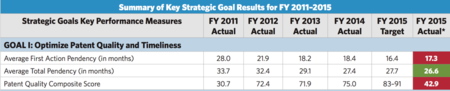
    The 2014-2018 Strategic Plan specifies eleven performance outcome measures for which the Office has developed annual performance targets.  According to the report, the Office met its annual performance targets for eight of the eleven performance targets (as the Office did in FY 2014).  Unfortunately, two of the three targets that were missed fell within the first strategic goal, which concerns optimizing patent quality and timeliness.  In particular, average first action pendency was 17.3 months (higher than the 16.4-month target, but lower than the 18.4-month average first action pendency of FY 2014), and patent quality composite score was 42.9 (lower than the 83 to 91 target and lower than the 75.0 patent quality composite score of FY 2014).  Average total pendency, however, was 26.6 months (lower than the 27.7 month target and lower than the 27.4 month average total pendency of FY 2014).

    The patent quality composite score performance target was new to the 2014 report, replacing the percent of patent applications that were filed electronically (in the 2013 report, the Office noted that 98.1% of patent applications were filed electronically, which left little room for improvement).  The 2014 report noted that the Patent Quality Composite Score is a quality metric comprising seven individual quality metrics that were developed in conjunction with external stakeholders.  In particular, the 2014 report explained that the seven factors measure:

    (a) the quality of the action setting forth the final disposition of the application; (b) the quality of the actions taken during the course of the examination; (c) the perceived quality of the patent process as measured through external quality surveys of applicants and practitioners; (d) the quality of the examiner’s initial search; (e) the degree to which the first action on the merits follows best examination practices; (f) the degree to which global USPTO data are indicative of compact, robust prosecution; and (g) the degree to which patent prosecution quality is reflected in the perceptions of the examination corps as measured by internal quality surveys.

    Table 2 of the report provides data for the patent-related performance targets for FY 2011 to FY 2015 (click on any table to expand):

    Table 2
    The report also presents data for the following patent-related performance targets:  patent average first action pendency for FY 2010 to FY 2015 (upper graph) and patent average total pendency for FY 2010 to FY 2015 (lower graph).

    Pendency graphsAs for the third patent performance target, the report notes that:

    The USPTO is working with internal and external stakeholders to reevaluate the entire quality process at the USPTO by engaging in public forums and roundtables to increase the effectiveness, clarity, and simplicity of the USPTO's quality review process by focusing on excellence in work products, excellence in measuring patent quality, and excellence in customer service.  As part of this effort, the USPTO aims to define and introduce revised quality metrics based on stakeholder input by September 2017.  Because the precise contours of the metric will likely change in the upcoming years, it is not useful to portray trends for the current measure.

    The report also notes that the number of applications filed increased from 618,457 in FY 2014 to 617,216 in FY 2015, which constituted a 0.2% decrease in filings (see Table 1 below).  This followed a 6.3% increase in application filings in FY 2013 and a 2.8% increase in application filings in FY 2014.

    Table 1
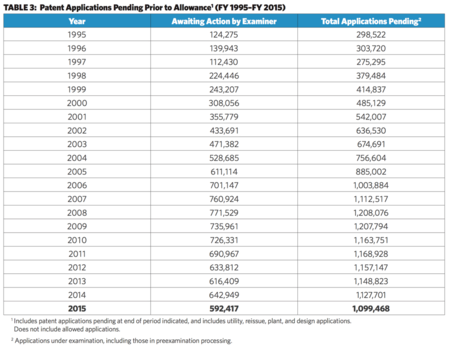
    The report also indicates that while the Office accepted more than 600,000 patent applications for the third straight year and topped 500,000 applications for the sixth consecutive year (see Table 2 below), it was able to reduce the number of applications awaiting action from 642,949 in FY 2014 to 592,417 in FY 2015 (see Table 3 below).  The total number of pending applications also decreased from 1,127,701 in FY 2014 to 1,099,468 in FY 2015.

    Table 2 - patent applications

    Table 3
    Stopping a seven-year trend, utility patent issuances were down in FY 2015, dropping from 303,930 in FY 2014 to 295,459 in FY 2015 (see Table 6 below).

    Table 6
    As noted above, the results for first action and total pendency were mixed, with first action pendency coming in above the Office's target, and total pendency coming in below the Office's target (see Tables 4 and 5 below).  And the goals for FY 2016 and FY 2017 present even tougher challenges:  for first action pendency, the annual performance target drops from 16.4 months for FY 2015 (which the Office failed to meet) to 14.7 months for FY 2016 and 13.2 months for FY 2017, and for total pendency, the annual performance target drops from 27.7 months in FY 2015 (which the Office met) to 23.9 months in FY 2016 and 22.6 months in FY 2017.

    Tables 4 and 5When comparing pendency statistics by Technology Center, Tech Center 1600 (biotechnology and organic chemistry) produced the best average first action pendency (14.1 months) and Tech Center 2100 (computer architecture, software, and information security) produced the worst average first action pendency (20.5 months) (see Table 4 below).  As for total average pendency, both Tech Center 1600 and Tech Center 2800 (semiconductor, electrical, optical systems, and components) produced the best numbers (25.3 months), and Tech Center 2100 the worst (31.1 months).

    Table 4 - pendency
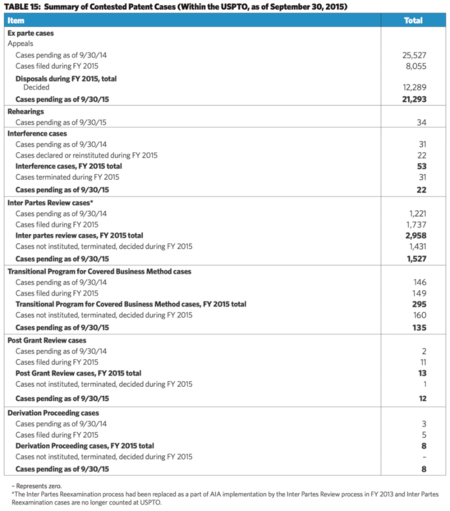
    Finally, the report indicates that 1,737 inter partes review cases were filed in FY 2015, up from 1,310 in FY 2014, and 11 post grant review cases were filed in FY 2015, up from 2 in FY 2014 (see Table 15 below).

    Table 15

    For additional information regarding this and other related topics, please see:

    • "USPTO Issues Performance and Accountability Report for FY 2014," April 7, 2015
    • "USPTO Releases Performance and Accountability Report for FY 2013," January 9, 2014
    • "USPTO Releases Performance and Accountability Report for FY 2012," November 28, 2012
    • "USPTO Releases Performance and Accountability Report for FY 2011," November 30, 2011
    • "USPTO Releases 2010 Performance and Accountability Report," November 17, 2010
    • "USPTO Announces 'Highest Performance Levels in Agency's History' in 2008," November 18, 2008
    • "USPTO Announces 'Record Breaking' 2007 Performance," November 15, 2007
    • "Patent Office Announces Record-Breaking Year," December 27, 2006

  • By Andrew Williams —

    Apotex #1According to the Federal Circuit website, the appeal from the Amgen Inc. v. Apotex Inc. case will be argued on April 4, 2016 in Courtroom 402.  This case is an appeal from a decision by Judge Cohn of the Southern District of Florida ordering a preliminary injunction requiring Apotex to "provide Amgen with at least 180 days notice before the date of the first commercial marketing of the biological product approved by the FDA."  Moreover, Apotex was "enjoined from any commercial marketing of it biosimilar pegfilgrastim product, including selling that product or offering it for sale for use in the United States, until Apotex gives Amgen proper notice . . . and the 180-day notice period is exhausted."  At first glance, this case appears to fit squarely within the Federal Circuit's Amgen v. Sandoz case — indeed Judge Cohn felt bound by that prior decision.  However, there is one crucial difference — Apotex provided Amgen with its aBLA and participated in the so-called "Patent Dance."  Therefore, the Federal Circuit will have the opportunity to address the apparent loophole that it created in its prior decision.

    AmgenThe issue in this case stems from the patent-dispute-resolution section of the BPCIA, found at 42 U.S.C. § 262(l).  This section is related to, but distinct from, the regulatory licensure provisions found at subsection (k) of the same statute.  The so-called patent dance is supposed to begin within 20 days of acceptance of a subsection (k) "biosimilar" application with the applicant providing to the reference product sponsor (or RPS) the aBLA "and such other information that describes the process or processes used to manufacture the biological product that is the subject of such application."  This begins a cascade of information exchange regarding patents that might possibly be asserted against the biosimilar applicant if they were to launch before expiration.  The culmination of this process is a (potential) two-phase litigation, where (potentially) only a subset of patents are asserted initially, and the balance of patents are held in reserve until the subsection (k) applicant provides notice that it intends to market sometime after 180 days from the date of notice.  At that time, the RPS can seek a preliminary injunction with regard to the second-phase patents.  Importantly, the statute provide in section (l)(9)(B) that "[i]f a subsection (k) applicant fails to complete an action required" by this patent resolution mechanism — including the Notice of Commercial Marketing provision of paragraph 8(A) — the RPS "may bring an action . . .  for a declaration of infringement, validity, or enforceability of any patent included in the list described in paragraph 3(A), including as provided under paragraph (7)."  In other words, the RPS can immediately bring suit with respect to any identified patent.

    The Federal Circuit, in the Amgen v. Sandoz case, appeared to turn this process on its head.  Even though the word "shall" is used in the provision beginning this process — the providing of the aBLA and other information — the Court held that because the statute contemplates such an action and provides a remedy, the subsection (k) applicant can voluntarily choose not to participate.  In the cases where the applicant fails to participate in the patent dance by not turning over the aBLA, the statute provides in (l)(9)(C) that the RPS can bring a declaratory judgment suit for "any patent that claims the biological product or a use of the biological product."  It is presumed that this remedy was provided because in such situations there would be no list of identified patents.  The Court also provided that the notice of commercial marketing could only be effective after the FDA has licensed the product, in other words after approval.  However, the "majority," (in this instance Judges Lourie and Newman), held that the Notice provision was a standalone provision, and therefore was independent of the patent dance.  Judge Chen disagreed in his dissent in part.  He believed that the Notice provision was "part and parcel to, and contingent upon" the patent dance.  This is where the Amgen v. Apotex case picks up.

    This dichotomy stems from section B(II)(b) of the majority decision and Judge Chen's dissent-in-part.  The majority noted that the BPCIA does not specify the consequence for noncompliance with paragraph (l)(8)(A) (the Notice of Commercial Marketing provision), even while acknowledging that paragraph (l)(9)(B) specifically references a remedy for violating this provision.  However, according to the Court, this remedy is only available "after the applicant has complied with paragraph (l)(2)(A) . . . ." (emphasis in original).  Therefore, "because Sandoz did not provide the required information to Amgen under paragraph (l)(2)(A), Amgen was unable to compile a patent list as described in paragraph (l)(3)(A) or paragraph (7)."  And, after stating that "Paragraph (l)(8)(A) is a standalone notice provision in subsection (l)," the Court concluded that:

    [W]here, as here, a subsection (k) applicant completely fails to provide its aBLA and the required manufacturing information to the RPS by the statutory deadline, the requirement of pargraph (l)(8)(A) is mandatory.  Sandoz therefore may not market Zarxio before 180 days from March 6, 2015, i.e., September 2, 2015.

    This of course leaves open the question of what happens if the subsection (k) applicant provides its aBLA.

    Judge Chen, on the other hand, found that "[t]he interwoven structure of subsection (l) indicates that Congress viewed the procedures of (l)(8) as inseverable from the preceding steps in (l)."  To reach this conclusion, he looked to the purpose behind the Notice provision:  "the entirety of (l)(8), including (l)(8)(A)'s notice provision, serves to ensure that an RPS will be able to assert all relevant patent before the (k) applicant launches it biosimilar product."  As such, "the most logical conclusion when reading (l)(8) in context is that (l)(8)'s vitality is predicated on the performance of the proceeding steps in subsection (l)'s litigation management process [the patent dance]."  Indeed, according to Judge Chen, "[w]ithout first engaging in these procedures, (l)(8) lacks meaning."  Therefore, according to him:

    The most persuasive reading of subsection (l) as a whole is that Congress provided two paths to resolve patent disputes: (1) the intricate route expressed in (l)(2)-(l)(8); and (2) the immediate, more flexible route provided in (l)(9), should the (k) applicant falter on any of its obligations recited in (l)(2)-(l)(8).

    With such a reading, the Notice provision should be as optional as the patent dance, with (l)(9) providing the requisite remedy should the subsection (k) applicant choose not to comply.

    We will continue to preview this case in upcoming posts, including detailing the positions advocated by both parties and the various amici that filed briefs in this case.  And, of course, we will assuredly have plenty of analysis once the Federal Circuit issues its decision sometime later this year.