• CalendarSeptember 6, 2018 – "From BRI to Phillips at the PTAB: Consequences for Practice" (Intellectual Property Owners Association) – 2:00 to 3:00 pm (ET)

    September 11, 2018 – "How Notre Dame's IDEA Center Took University Start-Up Formation from Puny to Powerhouse: A Case Study in Performance Improvement" (Technology Transfer Tactics) – 1:00 pm to 2:00 pm (ET)

    September 12, 2018 – "Evolving PTAB Trial Practice: Navigating Complex Procedural Rules — Strategically Using Routine and Additional Discovery, Requests for Joinder, and Motions to Amend" (Strafford) – 1:00 to 2:30 pm (EDT)

    September 13, 2018 – "Blockchain and IP: Navigating Emerging Issues — Blockchain, DLT Platforms, Crypto-Tokens, Smart Contracts, and More" (Strafford) – 1:00 to 2:30 pm (EDT)

    September 14, 2018 – "Trade Secrets: What Every IP Attorney and In-house Counsel Should Know" (John Marshall Law School Center for Intellectual Property, Information & Privacy Law ) – 9:00 am to 4:30 pm, Chicago, IL

    September 18, 2018 – "The Continued Influence of PTAB Proceedings on Bio/Pharma Patents" (McDonnell Boehnen Hulbert & Berghoff LLP) – 10:00 am to 11:15 am (CT)

    September 21, 2018 – "USPTO Post-Grant Patent Trials 2018: Change & Recalibration" (Practising Law Institute) – New York & Groupcasts in Philadelphia, Indianapolis, New Brunswick, NJ, Pittsburgh, and Mechanicsburg, PA

    September 26, 2018 – "IP Audit Checklist: Best Practices to Identify, Protect, Monetize and Enforce University IP Assets" (Technology Transfer Tactics) – 1:00 pm to 2:00 pm (ET)

    September 27-28, 2018 – "Advanced Patent Prosecution Workshop 2018: Claim Drafting & Amendment Writing" (Practising Law Institute) – Chicago, IL

    September 27-28, 2018 – FDA Boot Camp (American Conference Institute) – Boston, MA

    October 2, 2018 – "Advice of Counsel Defense in Patent Litigation and Protecting Attorney-Client Privilege — Limiting Scope of Discovery, Safeguarding Confidential Communications and Information" (Strafford) – 1:00 to 2:30 pm (EDT)

    October 2-3, 2018 – Paragraph IV Disputes master symposium (American Conference Institute) – Chicago, IL

  • IPO #2The Intellectual Property Owners Association (IPO) will offer a one-hour webinar entitled "From BRI to Phillips at the PTAB: Consequences for Practice" on September 6, 2018 from 2:00 to 3:00 pm (ET).  Eric Cohen of Brinks Gilson & Lione, Kevin Greenleaf of Dentons US LLP, and Shaun Zang of Goldman Ismail Tomaselli Brennan & Baum LLP examined dozens of litigations in recent years where both district courts and the PTAB construed the same patents, and will provide useful insights as the PTAB is expected to switch from BRI to Phillips in post-grant proceedings this fall.  The panel will also give tips on how both patent owners and petitioners should proceed in the interim, and discuss other ramifications of the change, such as:

    • Deciding on a proposed claim construction will require even more care, because there will no longer be an opportunity to take differing positions at the PTAB and district court, now a frequent and often successful litigation strategy
    • That defendants in litigation can expect to be able to mount stronger non-infringement positions as a uniform and narrower claim interpretation makes it less likely the accused device will infringe
    • The potential fallout from the PTAB adopting a standard for AIA proceedings that differs from the one used in all other USPTO proceedings, such as reexamination and reissue.

    The registration fee for the webinar is $135 (government and academic rates are available upon request).  Those interested in registering for the webinar can do so here.

  • Strafford #1Strafford will be offering a webinar entitled "Advice of Counsel Defense in Patent Litigation and Protecting Attorney-Client Privilege — Limiting Scope of Discovery, Safeguarding Confidential Communications and Information" on October 2, 2018 from 1:00 to 2:30 pm (EDT).  Krupa K. Parikh of Latham & Watkins, April E. Weisbruch of Sheppard Mullin Richter & Hampton, and Eleanor M. Yost of Carlton Fields Jorden Burt will provide patent counsel with an examination of the role of the advice of counsel defense in patent infringement cases in the aftermath of Halo, and the temporal and subject matter scope of the potential waiver of the attorney-client privilege and work product protection when an accused infringer relies upon such a willfulness defense.  The panel will also discuss recent decisions and offer guidance to counsel and companies for protecting privileged communications and attorney work product when relying upon an advice of counsel defense.  The webinar will review the following issues:

    • What is the practical impact of recent Supreme Court and federal court decisions on utilizing opinions of counsel in defense of willful infringement while protecting privileged communications and attorney work product?
    • What considerations regarding possible waiver of the attorney-client privilege and work product immunity should counsel consider before asserting the advice of counsel defense in patent infringement litigation?
    • What are the best practices for counsel and corporations to preserve the attorney-client privilege and work product immunity?

    The registration fee for the webcast is $297.  Those registering by September 14, 2018 will receive a $50 discount.  Those interested in registering for the webinar, can do so here.

  • Technology Transfer Tactics will be offering a webinar entitled "IP Audit Checklist: Best Practices to Identify, Protect, Monetize and Enforce University IP Assets" on September 26, 2018 from 1:00 pm to 2:00 pm (ET).  Jonathan Wachs, Gregory Grissett, Robert Katz, Scott Lloyd of Offit Kurman will take attendees step-by-step through the process and procedures of a general audit, event-driven audit, and limited-purpose IP audit.  They will also cover the following topics:

    • Tracking and maintaining regulatory upkeep on your IP assets
    • Understanding where your IP strengths and weaknesses are
    • Identifying IP for potential bundling and packaging for monetization
    • Realizing the value of your portfolio
    • Identifying risk areas that could trigger enforcement actions
    • Assessing risk of PTAB IPR and other challenges to validity
    • Understand what industry and licensees are looking for in high-quality IP assets

    The registration fee for the webinar is $197.  Those interested in registering for the webinar, can do so here.

    Technology Transfer Tactics

  • Intent Matters in Safe Harbor under BPCIA

    By Kevin E. Noonan

    District Court for the District of DelawareEarlier this week, Judge Richard G. Andrews, U.S. District Court Judge for the District of Delaware decided a veritable plethora of post-trial motions (by both parties) in Amgen Inc. v. Hospira, Inc. (he denied them all).  These included Hospira's Rule 50(a) Motion for Judgment as a Matter of Law on the Issues of Safe Harbor, Noninfringement, Invalidity, and Damages and related briefing, Hospira's Motion for Judgment as a Matter of Law Under Rule 50(b) and, in the Alternative, For Remittitur or New Trial Under Rule 59 and related briefing, Hospira's Motion to Seal Confidential Exhibits Admitted at Trial and related briefing, Amgen's Renewed Motion for Judgment as a Matter of Law of Infringement of the '349 Patent or, in the Alternative, for a New Trial and related briefing, and Amgen's Motion for Prejudgment and Post-judgment Interest and related briefing.  Of note is the basis for the Court's denial of Hospira's safe harbor motion under the provisions of the Biologics Price Competition and Innovation Act (BPCIA).

    The case arose over Amgen's complaint that Hospira infringed its U.S. Patent Nos. 5,865,298 and 5,756,349.  The jury found that Hospira had not carried its burden of showing either patent to be invalid by clear and convincing evidence; that Hospira infringed claims 24 and 27 of the '298 patent but had not infringed claims 1-7 of the '349 patent:

    '298 patent claims at issue:

    24.  A method of preparing erythropoietin molecules having a predetermined number of sialic acids per molecule said number selected from the group consisting of 1-14, comprising applying material containing erythropoietin to an ion exchange column and selectively eluting said molecules from the column.

    27.  A method for obtaining an erythropoietin composition having a predetermined in vivo specific activity comprising preparing a mixture of two or more erythropoietin isoforms of claim 1.

    Where independent claim 1 recites:

    1.  An isolated biologically active erythropoietin isoform having a single isoelectric point and having a specific number of sialic acids per molecule, said number selected from the group consisting of 1-14, and said isoform being the product of the expression of an exogenous DNA sequence in a non-human eucaryotic host cell.

    '349 patent claims at issue:

    1.  Vertebrate cells which can be propagated in vitro and which are capable upon growth in culture of producing erythropoietin in the medium of their growth in excess of 100 U of erythropoietin per 106 cells in 48 hours as determined by radioimmunoassay, said cells comprising non-human DNA sequences which control transcription of DNA encoding human erythropoietin.

    2.  Vertebrate cells according to claim 1 capable of producing in excess of 500 U erythropoietin per 106 cells in 48 hours.

    3.  Vertebrate cells according to claim 1 capable of producing in excess of 1000 U erythropoietin per 106 cells in 48 hours.

    4.  Vertebrate cells which can be propagated in vitro which comprise transcription control DNA sequences, other than human erythropoietin transcription control sequences, for production of human erythropoietin, and which upon growth in culture are capable of producing in the medium of their growth in excess of 100 U of erythropoietin per 106 cells in 48 hours as determined by radioimmunoassay.

    5.  Vertebrate cells according to claim 4 capable of producing in excess of 500 U erythropoietin per 106 cells in 48 hours.

    6.  Vertebrate cells according to claim 4 capable of producing in excess of 1000 U erythropoietin per 106 cells in 48 hours.

    7.  A process for producing erythropoietin comprising the step of culturing, under suitable nutrient conditions, vertebrate cells according to claim 1, 2, 3, 4, 5 or 6.

    The Court also assessed damages in the amount of $70 million, inclusive of pre- and post-judgment interest.

    Hospira contended that the jury instructions were "legally erroneous and prejudicial," inter alia, because "ulterior motives and intent are irrelevant to [entitlement to] the Safe Harbor."  Specifically, Hospira argued that the instructions did not clarify the use of the terms "use" and "make" as relevant to whether an activity was entitled to the safe harbor provisions of the statute.  ("We would urge the broader standard for uses, but focus on the instruction should be on the uses and not the motives or purposes in making [a] batch.  The statutory exemption is premised on the use aspect.")  According to Hospira, the jury was asked to determine whether "manufacture" of the accused infringing article (biosimilar erythropoietin, bEPO) fell under the safe harbor when the only burden Hospira rightfully was obliged to meet was whether "use" of the allegedly infringing bEPO was "reasonably related to obtaining FDA approval."  The Court disagreed, stating that "Hospira's potentially infringing 'use' of Amgen' s patented invention is Hospira's manufacture of the EPO drug substance referred to in its BLA (i.e., Hospira's performance of the steps of Amgen's method claims), not Hospira's subsequent use of the EPO drug substance (i.e., Hospira's subsequent use of the product obtained by practicing Amgen's method claims)."  Thus, the safe harbor is available to Hospira only if manufacture of its bEPO was "reasonably related to obtaining FDA approval."  Hospira's subsequent use of the bEPO is "probative in determining whether Hospira's manufacture of its EPO drug substance was reasonably related to obtaining FDA approval, [but] it is the manufacture itself (not Hospira's subsequent uses of EPO drug substance) that is the potentially infringing act which must be evaluated for safe harbor protection."

    In addition, Hospira argued that it was unduly prejudicial for the Court not to instruct the jury that "intent is irrelevant to evaluating safe harbor protection."  The Court interpreted Hospira's position to be that "intent is entirely irrelevant to the safe harbor analysis" but with that the judge expressly disagreed as being unsupported by the cited case law.  Specifically, the Memorandum Opinion interprets Abtox, Inc. v. Exitron Corp., 122 F.3d 1019 (Fed. Cir. 1997), to mean that a party can use the benefit of the safe harbor "to use its data from the tests for more than FDA approval" and "does not look to the underlying purposes or attendant consequences of the activity (e.g., tests led to the sale of the patent), as long as the use is reasonably related to FDA approval" but "did not state that intent was irrelevant in determining whether an activity is reasonably related to obtaining FDA approval."  On the contrary, the opinion states that "evidence of intent can be a relevant factor in determining whether an activity is reasonably related to obtaining FDA approval, and that these cases stand for the proposition that evidence of commercial intent is not determinative of the safe harbor inquiry."  "[O]nce it is determined that 'the activity is reasonably related to obtaining FDA approval,' [] intent or alternative uses are irrelevant to its qualification to invoke the section 271(e) shield," according to the opinion.  And further:

    [A]dopting Hospira's interpretation of the safe harbor defense would expand the defense beyond recognition and create a loophole that would make it virtually impossible to prove infringement in cases involving products regulated by the FDA.  Since Hospira's interpretation requires ignoring intent in deciding whether the safe harbor applies, a party could manufacture 200 drug substance batches and earmark them for future use as commercial inventory without infringing, so long as the party used each of those batches for at least one test to generate data of the type used by the FDA in determining whether to approve the drug.  In that scenario, each batch would be tested to generate data that could conceivably be used to respond to inquiries from the FDA, making each batch reasonably related to obtaining FDA approval.  Essentially, Hospira's interpretation allows a single "token" submission of information derived from a potential infringing act to exempt that act from infringement, without regard to the realities surrounding the potentially infringing act.  It seems to me that Hospira's interpretation reads the words "solely" and "reasonably" out of the statute, and that a party's stated intent may be considered as part of whether the manufacture or use of a patented drug was "solely for uses reasonably related to" obtaining FDA approval.  I think that the jury instructions properly recited the role of intent in the safe harbor analysis.

    The hypothetical nicely illustrates the practical considerations behind the scope of the safe harbor, and how these considerations influence how courts evaluate the safe harbor's proper scope.

    Amgen Inc. v. Hospira, Inc. (D. Del. 2018)
    Memorandum Opinion by Judge Andrews

  • Claims for Displaying Message Timing Data Found Patent Ineligible

    By James Korenchan

    District Court for the Central District of CaliforniaLast week, the U.S. District Court for the Central District of California ruled that claims related to providing time data for messages communicated between electronic devices in a messaging conversation are patent ineligible under 35 U.S.C. § 101.

    Back in March, BlackBerry Limited ("BlackBerry") filed suit against Facebook, Inc., WhatsApp, Inc., Instagram, Inc., and Instagram, LLC (collectively, "Facebook Defendants"), alleging infringement of nine patents.  BlackBerry then sued Snap, Inc. ("Snap") a month later alleging infringement of six of those nine patents.  The Defendants in each of these suits each moved to dismiss their respective cases.  Snap moved on the basis that each of the six asserted patents are patent-ineligible.  The Facebook Defendants moved on the basis that four of the nine asserted patents in that suit are patent-ineligible.  The Court's ruling addressed seven of the nine patents, three of which were common between the two suits.  In particular, the Court granted Snap's motion with prejudice as to the independent claims of asserted U.S. Patent No. 8,301,713 (the '713 patent) and otherwise denied all other motions, including Snap's movement with respect to the dependent claims of the '713 patent.  This post addresses only the ruling on the '713 patent.

    The '713 patent is directed to handheld electronic devices and providing information related to timing of messages (e.g., instant messages) in a messaging conversation.  The patent describes how handheld electronic devices have limited space for displaying information, which can make it difficult to provide a user with various time data related to the user's conversations.  The patent particularly aims to provide time data in scenarios where there are gaps between messages in a conversation.  For example, User 1 may send a message to User 2, but User 2 may not respond to the message immediately.  In this scenario, the patent purports to have User 1's electronic device determine that a predetermined duration of time (e.g., ten minutes) has elapsed since User 1's message was sent and that no other messaging has occurred since User 1's message was sent.  If after this duration elapses User 1's device detects an input, such as a message that User 1 is preparing to send to resume the conversation, the device will display a time at which the input occurred.  The patent describes other timing aspects of the conversation that can be provided as well, some or all of which can be provided to the user upon specific request.

    Representative claim 1 of the '713 patent is shown below.  The other independent claims recite similar language.

    1.  A method of operating an electronic device, the method comprising:
        outputting an electronic conversation comprising a plurality of indications, each indication being representative of at least a portion of a corresponding messaging communication between the electronic device and a second electronic device;
        identifying a first messaging communication between the electronic device and the second electronic device occurring at a first time, the first messaging communication having a corresponding first indication representative of at least a portion of the first messaging communication and which is one of the plurality of indications;
        determining that a predetermined duration of time has elapsed since the first time without additional communication between the electronic device and the second electronic device during that duration of time;
        detecting an input to the electronic device following said identifying and determining steps, said input occurring at a second time; and
        responsive to said detecting an input, outputting in the electronic conversation, a time stamp representative of the second time.

    With respect to Alice step one, Snap argued that the '713 patent is directed to the abstract idea of time stamping, which Snap noted is an "utterly unremarkable idea that has been practiced manually for centuries."  (Snap also pointed out that BlackBerry's complaint itself acknowledges that time stamping electronic messaging was already well-known.)  In addition, Snap argued that time stamping communications after a predetermined duration is well-known, and that the '713 patent provided no limitations of what the duration would be.  Finally, Snap noted that, although the '713 patent describes how the purported invention was useful for saving space on devices with small screens, the asserted claims were not limited to devices with small screens.

    In response, BlackBerry asserted that its invention "mak[es] a specific improvement to the way that time stamp information is displayed in an electronic conversation on a computer, specifically by displaying a timestamp when the user is most likely to be interested in one, rather than never displaying a timestamp (which under-informs users) and displaying a timestamp with each message (which unduly takes up valuable real estate and annoys users)" (emphasis in original).  BlackBerry also argued that the provisional patent leading to the '713 patent demonstrated that the '713 patent claims were directed to optimizing instant messaging for devices with small screens.

    Despite BlackBerry's opposition, the Court pointed out that the '713 patent doesn't provide any information that specifically defines how or where to display a timestamp.  The Court also agreed with Snap (and BlackBerry effectively conceded) that the '713 patent did not limit what the predetermined duration of time could be, and thus the duration could be anything.  Thus, the language of claim 1 was broad enough to encompass embodiments in which no improvements to timestamping messages were provided.  As the Court noted, the Federal Circuit has previously found that use of a rule alone does not necessarily make a set of claims non-abstract.  Here, the "predetermined duration of time" aspect of the claim, while a rule, hardly qualified as a rule to elevate the claim into the realm of patent-eligibility.  At best, BlackBerry characterized the claims as only inserting a time stamp when there is a "break" in the conversations, but the claims still do not address specific lengths of the break.  The Court concluded that the independent claims were directed to the abstract idea of "displaying a timestamp based on the rule of whether a predetermined duration of time has passed."

    The Court then went on to briefly discuss Alice step two.  The Court stating that, in contrast to BlackBerry's assertion that selective timing — namely, the "predetermined duration of time" aspect of the claim — was an inventive concept, this aspect was part of the abstract idea itself, and thus is not considered in performing the step two analysis.  The Court also noted the presence of "generic computer elements" in the independent claims.

    Although Snap asserted in its motion that the independent claims are representative of all claims of the '713 patent, the Court was not ready to doom the dependent claims, finding that Snap did not meet its burden of patent ineligibility with respect to those claims.  Still, it is hard to see the dependent claims surviving.  (Concepts covered by the dependent claims define the claimed "input" as a "resumption message" resuming the conversation, display the resumption message, and display the time stamp between the resumption message and the previous message in the conversation.)

    BlackBerry Ltd. v. Facebook, Inc. (C.D. Cal. 2018)
    In Chambers – Final Ruling on Facebook Defendant's Motion to Dismiss by District Judge Wu

  • By Kevin E. Noonan

    USPTO SealPatent law has traditionally been considered to be fraught with traps for the unwary, which in practice just means that it is unwise to assume anything (see Carl S. Koening, "Clarifying Patent Terminology and Patent Concepts – An Introduction to Some Basic Concepts and Doctrine," 15 Cath. U. L. Rev. 1 (1966)).  Petitioner for an inter partes review proceeding, Vizio, Inc., v. ATI Technologies ULC suffered the consequences of one of those traps, when its petition for review of U.S. Patent No. 7,633,506 was deemed untimely under 35 U.S.C. § 315(b) because the petition was not filed within one year of Patent Owner filing suit against Petitioner Vizio.  While a seemingly simple docketing matter, in this case the error arose over when (i.e., what date) the complaint was filed.

    As set forth in the Board's Decision denying institution, the facts are these.  Vizio filed its IPR petition on February 1, 2017, one year after receiving the complaint.  Patent Owner filed an affidavit of service, establishing that Patent Owner had mailed the complaint to Vizio on January 30, 2017.  The question before the Board was whether the one-year time period under § 315(b) for filing an IPR petition ran from the date of mailing by Patent Owner or the date of receipt of the complaint by Petitioner Vizio.

    To answer this question, the Board looked to Federal Rule of Civil Procedure 4(h)(1)(A), which states that a corporation is served "in the manner prescribed by Rule 4(e)(1) for serving an individual."  Fed. R. Civ. P. 4(e)(1) states that service on an individual under the Rules is done "following state law for serving a summons in an action brought in courts of general jurisdiction in the state where the district court is located" (or where service is made).  Thus, the Board reasoned, the time and manner where service was accomplished was a matter of Delaware law (where the Patent Owner was incorporated).

    Turning to Delaware law, service can be made "by any form of mail addressed to the person to be served and requiring a signed receipt," citing 10 Del. C. § 3104(d)(3).  The Delaware civil procedure rules provide, in particular, that "[s]ervice by mail is complete upon mailing."  Del. R. Civ. P. 5(b), which is consistent with the statutory predicate that "the time in which defendant shall serve an answer shall be computed from the date of the mailing which is the subject of the return receipt or other official proof of delivery."  10 Del. C. § 3104(g).

    Thus, the Board determined that:

    Applying the Delaware statutes and rules regarding service to the facts of this case, Patent Owner served Petitioner with a copy of the summons and complaint, in compliance with § 3104, with a date of mailing of January 30, 2017.  Petitioner filed the instant petition for inter partes review on February 1, 2018, which is more than one year after Petitioner was served with a complaint alleging infringement of the '506 Patent.  Accordingly, Petitioner's petition is time-barred under § 315(b) and inter partes review may not be instituted.

    In practice, the lesson is clear:  when calculating the bar date under § 315(b) for filing an IPR the service rules in the state where the district court resides must be consulted because the service date recognized in that state for civil actions will be dispositive for the date where the one-year term begins (and ends in the bar date).  As service rules vary from state-to-state, there is clearly no "one size fits all" answer to the bar date determination, creating yet another trap for practitioners (which should be alleviated by this decision).

    In this case, all may not be lost.  According to the Decision, three other IPR petitions have been filed by "entities unrelated to Vizio," and Vizio has filed a petition for IPR on a related patent (U.S. Patent No. 7,796,133).  Both District Court and International Trade Commission proceedings are also on-going between the parties.

    Vizio, Inc., v. ATI Technologies ULC (PTAB 2018)
    Panel: Administrative Patent Judges Hoff, Change, and McNamara
    Decision by Administrative Patent Judge McNamara

  • By Kevin E. Noonan

    610px-Koala_climbing_treeMany people of a certain age will remember their first awareness of the koala coming from a television commercial in the 1960's for an Australian airline ("I hate Qantas").  Thereafter, of course, zoos, like the San Diego Zoo and National Zoo in Washington, D.C., developed breeding programs for these marsupials (unrelated to bears despite their earlier moniker).  Today, these animals face a variety of ecological challenges and provide a biochemical conundrum with regard to their diet, which (as most know) is almost exclusively made up of eucalyptus leaves.  This is a curious food source, containing a variety of toxic compounds (perhaps to ward off insect predation) that includes elevated amounts of so-called secondary metabolites, including phenolic compounds and terpenes and being so low in available calories that the animals spend up to 22 hours a day asleep.  Koalas, Phascolarctos cinereus, are the only remaining species (of 15-20 fossil relatives) of the marsupial family Phascolaerctidae, having diverged from terrestrial wombats about 350,000 years ago.

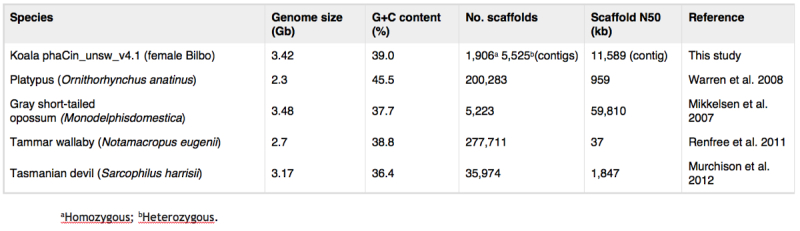
    Recently, an international group of investigators*, predominantly from Australian institutes but including researchers from Europe, Asia, and the U.S., reported the results of whole genome sequencing studies of three koala individuals, in a Nature Genetics article entitled "Adaptation and conservation insights from the koala genome."  The results were compared with other marsupial species:  platypus, opossum, wallaby, and Tazmanian devil, as set forth in this table from the report (click on table to expand):
    Table
    The koala genome consists of 16 chromosomes containing an estimated 3.42 Gigabasepairs of DNA.  Genetic analysis identified a total of over 26,000 genes, comprised of 6,124 protein-coding genes in 2,118 gene families, with 1,089 of these gene families having more members than orthologous family members in human, mouse, dog, tammar wallaby, Tasmanian devil, gray short-tailed opossum, platypus, or chicken.  Like most eukaryotic genomes, the koala genome contains a variety of repeated sequences, with interspersed repeats making up 47.5% of the koala genome (and 44% of these repeats comprising transposable elements).  Short interspersed repeats (SINEs) comprise 35.2% and long interspersed repeats (LINEs) comprise 28.9% of these repetitive elements.  The study also identified non-coding RNA species and in particular a species termed RSX, which is involved in X chromosome inactivation in females (and is expressed exclusively in female tissues).  Also of interest were the centromere structure of koala chromosomes, which are smaller in marsupials than eutherian mammals and comprise 2.6 Mb of the koala haploid genome (or about 300 bp per chromosome).  Like other species with small centromeres (such as gibbons) the koala centromeres comprise composite repeat elements and lack "higher order satellite arrays" found in more complex centromeres from other species.

    These researchers looked at particular genes and gene families that could be expected to be involved in providing means for detoxifying compounds from eucalyptus leaves and found expansion of genes encoding cytochrome P450 monooxygenases (CYP).  In particular, expansion of the CYP 2 subfamily C genes was detected in the koala genome, comprising 31 members of the family, which showed (the expected) high levels of expression in liver.  Fine structure genetic mapping indicated that this expansion was the result of tandem duplication of these genes, with a mixture of "purifying" selection and episodic diversifying selection at particular CYP codons.  This results, according to the authors, in higher expression levels of these detoxification enzymes along with neofunctionalization.  In addition to helping to explain koala dietary choices, these results are also relevant for better therapeutic intervention in treating koala diseases.  For example, CYP genes are also responsible for metabolizing non-steroidal anti-inflammatory drugs and antibiotics, which can influence dosage level choices to make treatment more effective.

    The koala genome also contains an expansion (six genes instead of just one in related marsupials and none in tammar wallaby, human, mouse, dog, platypus, or chicken) of the genetic lineage for vomeronasal receptor type 1, which is involved in detecting non-volatile odorants.  In contrast, the number of olfactory receptor genes in koala (1,169) is slightly lower than in gray short-tailed opossum (1,431 genes), tammar wallaby (1,660 genes, and Tasmanian devil (1,279 genes).  The koala genome also has had an expansion in genes enabling it to "taste water," i.e., detect leaves having a higher moisture content.  The koala genome also shows expansions (24, the highest in any marsupial and almost the highest in any mammal) of genes of the TAS2R gene family, which plays a role in detecting "bitter" tasting compounds.  In addition, genes in the TS1R family, which have been "pseudogenized" in giant panda (which also has a specialized diet) are fully functional in koalas.

    The study also identified genes involved in induced ovulation and koala milk production, which is important due to the peculiarities of koala development (like all marsupials, where the young complete development in a pouch and is nourished by its mother's milk).  These results showed a pattern of genes and gene expression that would permit the animal to "fine tune" the composition of her milk at various stages of her young's development.  The study also identified a gene, the marsupial milk 1 gene, that is analogous to eutherian genes for antimicrobial proteins.

    Koala populations are subject to two infectious diseases:  Chlamydia pecorum and a koala-specific retrovirus (KoRV, believed to be derived from a rodent virus).  The genome analysis identified "de novo assembly of complex, highly duplicated immune gene families and comprehensive annotation of immune gene clusters" that the authors believe will provide a basis for identifying genes involved, inter alia, with immune responses to various chlamydia vaccines.  The authors also report characteristic patterns of differential expression of immune response-related genes in chlamydia-infected animals.  "These annotated koala immune genes will now help us to define features of protective versus pathogenic immunological responses to the disease and may be invaluable for effective vaccine design," the authors believe.

    The KoRV is known to be transmitted by both germline and infectious, "horizontal" mechanisms, the reference genome reported in the article having 73 insertions of this retrovirus.  The genetic loci of these insertions were not, in the authors view, involved in retroviral pathogenesis, these sites being limited to introns and 3' untranslated regions (although the researchers did not discount the possibility that transcription from the retroviral long terminal repeats through to adjacent host cell genes might play a factor).

    Finally, the authors were able to assess modern koala population structure in Australia within the context of the species evolutionary history with the goal of permitting better ecological choices to be made in human efforts to improve koala population viability in the wild.  These studies involved mitochondrial DNA (mtDNA) and single nucleotide polymorphism (SNP) comparisons between individuals from geographically divergent populations.  The authors conclude:

    The information generated here provides a foundation for a conservation management strategy to maintain gene flow regionally while incorporating the genetic legacy of biogeographic barriers.  Furthermore, the contrast in genome-wide levels of diversity between southern and northern populations highlights the detrimental consequences of the unmonitored use of small isolated populations as founders for reestablishing and/or rescuing of populations on genome-wide levels of genetic diversity.

    * Rebecca N. Johnson, Denis O'Meally, Zhiliang Chen, Graham J. Etherington, Simon Y.W. Ho, Will J. Nash, Catherine E. Grueber, Yuanyuan Cheng, Camilla M. Whittington, Siobhan Dennison, Emma Peel, Wilfried Haerty, Rachel J. O'Neill, Don Colgan, Tonia L. Russell, David E. Alquezar-Planas, Val Attenbrow, Jason G. Bragg, Parice A. Brandies, Amanda Yoon-Yee Chong, Janine E. Deakin, Federica Di Palma, Zachary Duda, Mark D. B. Eldridge, Kyle M. Ewart, Carolyn J. Hogg, Greta J. Frankham, Arthur Georges, Amber K. Gillett, Merran Govendir, Alex D. Greenwood, Takashi Hayakawa, Kristofer M. Helgen, Matthew Hobbs ,Clare E. Holleley, Thomas N. Heider, Elizabeth A. Jones, Andrew King, Danielle Madden, Jennifer A. Marshall Graves, Katrina M. Morris, Linda E. Neaves, Hardip R. Patel, Adam Polkinghorne, Marilyn B. Renfree, Charles Robin, Ryan Salinas, Kyriakos Tsangaras, Paul D. Waters, Shafagh A. Waters, Belinda Wright, Marc R. Wilkins, Peter Timms and Katherine Belov

    Image of koala climbing up a tree, Great Otway National Park, Victoria, Australia by Diliff, from the Wikimedia Commons under the Creative Commons Attribution-Share Alike 3.0 Unported license.

  • District Court Refuses to Limit Application of In re Cray to Factual Circumstances Where Physical Products Are Involved

    By Donald Zuhn

    District Court for the District of NevadaLast month, in VoIP-Pal.com, Inc. v. Twitter, Inc., District Judge Richard F. Boulware, II of the U.S. District Court for the District of Nevada issued an Order granting a Motion to Change Venue filed by Defendant Twitter, Inc.  The dispute between the parties began when Plaintiff VoIP-Pal.com, Inc. filed suit against Twitter, asserting infringement of U.S. Patent Nos. 8,542,815 and 9,179,005.  Following a stay of the case due to pending proceedings before the Patent Trial and Appeal Board, Twitter filed its Motion to Change Venue, VoIP-Pal.com filed a response to Twitter's Motion, and Twitter filed a Reply to VoIP-Pal.com's response.  Prior to issuing its Order, the District Court held a hearing on the matter and ordered Twitter to file a Supplemental Declaration to address whether it had any physical equipment or leased any space in Nevada, including space for data storage, or other support equipment or hardware.

    The District Court began by noting that for the purposes of determining venue under the patent venue statute, the location where a defendant corporation "resides" is limited to the corporation's State of incorporation, citing TC Heartland LLC v. Kraft Foods Grp. Brands LLC, 137 S. Ct. 1514, 1517 (2017).  The District Court also noted that in view of TC Heartland, the Federal Circuit addressed the question of where a defendant corporation has a "regular and established place of business" under the patent venue statute in In re Cray Inc., 871 F.3d 1355 (Fed. Cir. 2017).  In Cray, the Federal Circuit set forth three requirements to establish the second prong of the § 1400(b) venue test: "(1) there must be a physical place in the district; (2) it must be a regular and established place of business; and (3) it must be the place of the defendant" (In re Cray, 871 F.3d at 1360), all three of which must be satisfied for venue to be proper.

    With respect to the instant case, the District Court found that VoIP-Pal.com is a Nevada corporation, with its principal place of business being located in Bellevue, Washington.  The Court also found that VoIP-Pal.com does not have any officers, directors, or employees based in Nevada; has no office, land, facilities, or sales in Nevada; and that all of its inventors reside outside of the U.S.  The Court further found that Twitter is a Delaware corporation with its principal place of business and headquarters in San Francisco, California.  In addition, the Court found that Twitter's product design, development, implementation, and financial activities are centered in San Francisco, and that:

    The accused technology is largely designed and built in San Francisco, and the bulk, if not all, of any relevant technical documentation, manuals, and product specifications, as well as all financial data relevant to revenue derived from Defendant's products, are located in San Francisco.  Defendant does not own or lease any offices, buildings, or other facilities in Nevada, and does not directly or indirectly store any data in Nevada.  It has no Nevada telephone number or local address listed on its website or in any directory.  Defendant is a software company that has no physical product inventory, and its advertising and marketing are primarily conducted online.  It does not store inventory or product literature in Nevada.

    The Court further found that Twitter had a single employee, a software engineer, living in Nevada, and that:

    [T]his particular engineer chose to live in Nevada for personal reasons and works from home.  He reports to a manager in San Francisco and uses San Francisco support staff.  Defendant does not own his home or pay his rent.  The decision to live in Nevada was the employee's alone; Defendant does not condition his employment on his location.

    In its Motion to Change Venue, Twitter argued that under In re Cray, the District of Nevada is not one where Twitter has a regular and established place of business.  VoIP-Pal.com countered that although Twitter does not reside in Nevada, the second prong of the § 1400(b) test is satisfied.  In particular, VoIP-Pal.com asked the District Court to recognize the nature of Twitter's business — facilitating communication over the web, in every state including Nevada — and limit the application of In re Cray to factual circumstances where physical products are involved.

    The District Court refused VoIP-Pal.com's invitation to limit the application of In re Cray, determining instead that "the In re Cray factors weigh in favor of transferring venue."  Looking at the first Cray factor, the Court found that:

    [T]he undisputed facts show that Defendant does not have a physical location in this district where its business is carried out.  Nor does Defendant store any of its data on servers located in Nevada.  The fact that one software engineer resides in this district is insufficient to establish such location.  The employee works remotely and reports to a team in San Francisco.  This employee is not required to live in Nevada.

    As for the second Cray factor, the Court explained that "[t]here are no facts to suggest that any of the business conducted out of the software engineer's home meets this requirement."  Finally, with respect to the third Cray factor, the Court stated that "[t]here is no dispute that Defendant neither owns nor leases the software engineer's residence," and "[t]here is no dispute that Defendant does not condition the engineer's employment upon his location in this district."

    In response to VoIP-Pal.com's request that the District Court distinguish In re Cray from the instant case because there are no physical or tangible products to be distributed or sold, and given the web-based nature of Twitter's business, the District Court stated that "the key inquiry is not whether physical objects are involved, but rather whether the public has access to the defendant corporation through an employee or office located in the district where a suit is brought or if the public directly accesses the services of defendant through a location in the respective forum."  Finding, however, that "the bulk of the defendant's employees, product development, and overall operations are located in San Francisco, and that it does not own or lease any buildings in this district, it has no Nevada phone numbers or addresses listed for its operations, and it stores no inventory or data in Nevada," the Court determined that "[t]hese facts demonstrate that Defendant maintains no place of business in Nevada, much less one that is both regular and established."

    In granting Twitter's Motion to Change Venue, the District Court also determined that "convenience and fairness to the parties requires transfer of this action."  In particular, the Court found that "[t]he litigation will . . . likely be more efficient and easier for both parties in the district of transfer," explaining that "[t]here is no dispute that the Northern District of California is closer in proximity to Plaintiff's center of operations in Bellevue, Washington," and finding that "the burden on the inventors of the technology in question will likely be the same regardless of whether the action proceeds in Northern California or in Nevada."

    VoIP-Pal.com, Inc. v. Twitter, Inc. (D. Nev. 2018)
    Order by District Judge Boulware, II

  • CalendarAugust 28, 2018 – "Ethics in USPTO Practice in 2018 – Understanding the Behavior as Well as the Rules" (Federal Circuit Bar Association) – 3:00 pm to 4:30 pm (EST)

    August 28, 2018 – "Structuring Patent Indemnification Provisions — Allocating Infringement Risk While Accounting for Changes to PTAB Estoppel and Statutory Bar Requirements" (Strafford) – 1:00 to 2:30 pm (EDT)

    August 29, 2018 – Intellectual property and innovation business roundtable (U.S. Chamber of Commerce Global Innovation Policy Center and St. Cloud Area Chamber of Commerce) – 1:00 pm to 2:00 pm (CDT), St. Cloud, MN

    August 30, 2018 – Intellectual property and innovation business roundtable (U.S. Chamber of Commerce Global Innovation Policy Center and Peoria Chamber of Commerce) – 9:00 am to 10:00 am (CDT), Peoria, IL

    August 30, 2018 – Intellectual property and innovation business roundtable (U.S. Chamber of Commerce Global Innovation Policy Center) – 12:30 pm to 1:30 pm (CDT), Mattoon, IL

    September 11, 2018 – "How Notre Dame's IDEA Center Took University Start-Up Formation from Puny to Powerhouse: A Case Study in Performance Improvement" (Technology Transfer Tactics) – 1:00 pm to 2:00 pm (ET)

    September 12, 2018 – "Evolving PTAB Trial Practice: Navigating Complex Procedural Rules — Strategically Using Routine and Additional Discovery, Requests for Joinder, and Motions to Amend" (Strafford) – 1:00 to 2:30 pm (EDT)

    September 13, 2018 – "Blockchain and IP: Navigating Emerging Issues — Blockchain, DLT Platforms, Crypto-Tokens, Smart Contracts, and More" (Strafford) – 1:00 to 2:30 pm (EDT)

    September 14, 2018 – "Trade Secrets: What Every IP Attorney and In-house Counsel Should Know" (John Marshall Law School Center for Intellectual Property, Information & Privacy Law ) – 9:00 am to 4:30 pm, Chicago, IL

    September 18, 2018 – "The Continued Influence of PTAB Proceedings on Bio/Pharma Patents" (McDonnell Boehnen Hulbert & Berghoff LLP) – 10:00 am to 11:15 am (CT)

    September 21, 2018 – "USPTO Post-Grant Patent Trials 2018: Change & Recalibration" (Practising Law Institute) – New York & Groupcasts in Philadelphia, Indianapolis, New Brunswick, NJ, Pittsburgh, and Mechanicsburg, PA

    September 27-28, 2018 – "Advanced Patent Prosecution Workshop 2018: Claim Drafting & Amendment Writing" (Practising Law Institute) – Chicago, IL

    September 27-28, 2018 – FDA Boot Camp (American Conference Institute) – Boston, MA

    October 2-3, 2018 – Paragraph IV Disputes master symposium (American Conference Institute) – Chicago, IL