• By Kevin E. Noonan —

    Supreme Court Building #2Last week, the Supreme Court denied certiorari to Regeneron Pharmaceuticals in its appeal of the Federal Circuit's decision in Regeneron Pharmaceuticals v. Merus that affirmed the District Court's decision that the claims of Regeneron's patent-in-suit were unenforceable due to inequitable conduct in the patent's procurement.  In so doing the Court passed up the opportunity to consider whether the split panel's decision was consistent with the Federal Circuit's own inequitable conduct jurisprudence, most recently handed down en banc in Therasense, Inc. v. Becton, Dickinson and Co., 649 F.3d 1276 (Fed. Cir. 2011) (en banc).  The Court also deigned not to consider for the first time in over 70 years a doctrine stemming directly from a trio of its own decisions (specifically, Hazel-Atlas Glass Co. v. Hartford-Empire Co., 322 U.S. 238, 250-51 (1944); Precision Instrument Mfg. Co. v. Auto. Maint. Mach. Co., 324 U.S. 806, 814 (1945); and Keystone Driller Co. v. General Excavator Co., 290 U.S. 240 (1933)).  Under the circumstances it is prudent for patent practitioners (prosecutors as well as litigators) to consider the lessons of the Federal Circuit's Regeneron decision.

    To recap, the case arose over Regeneron's infringement suit against Merus involving U.S. Patent No. 8,502,018, which is directed to transgenic mice expressing human variable domain immunoglobulin (Ig) genes.  Claim 1 is representative:

    A genetically modified mouse, comprising in its germline human unrearranged variable region gene segments inserted at an endogenous mouse immunoglobulin locus.

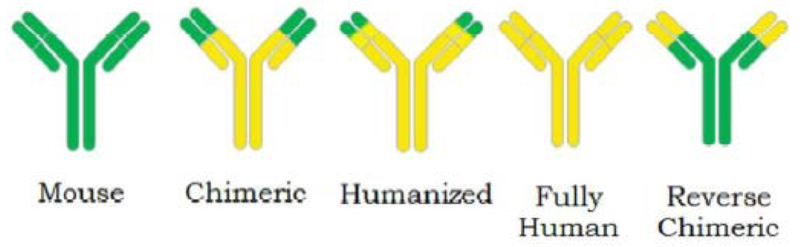
    As explained in the Federal Circuit's opinion, the types of antibody molecules that can be produced in mice using modern immunological and molecular biological techniques ranges from completely murine to completely human, and also include chimeric antibodies (encoded by human constant region genes and mouse variable domain genes) and "reverse" chimeric antibodies (encoded by human variable region genes and mouse constant region genes).  These possibilities are illustrated in the brief by a diagram (where green portions of the antibodies are encoded by mouse genes and yellow portions are encoded by human genes):
    2017-07-27 Figure
    Relevant to the issues before the Court was construction of the proper scope and meaning of the term "comprising in its germline human unrearranged variable region gene segments."  Regeneron argued that this term was limited to inserting only human unrearranged variable regions genes, and thus only reverse chimeric antibodies encoded in the recombinant mouse genome; Regeneron argued its construction was supported by the plain meaning of the term and the '018 patent specification.  Merus, on the other hand, argued that the word "comprising" in the claim made the proper construction broader than just insertion of human unrearranged variable region gene segments, but also encompassed humanized, fully human, and reverse chimeric antibody embodiments.  The District Court adopted Merus' construction, and the Federal Circuit agreed.

    This leads to the first lesson from the case:  with regard to the "but-for" materiality prong of the Therasense test, the issue arises whether the standard of claim construction used by the Examiner, broadest reasonable interpretation or BRI, is sufficient to prevent the district court from applying its own claim construction, consistent with Phillips v. AWH Corp., 415 F.3d 1303 (Fed. Cir. 2005) (en banc), to arrive at a different conclusion.  Here, whether the withheld references were "but-for" material depended on whether the interpretation of the phrase "comprising [human variable chain immunoglobulin genes]" was at least as broad before the U.S. Patent and Trademark Office as it was before the District Court.  (It is an unstated assumption that it should be, because the possibility that an applicant can amend the claims under the BRI test should make this the broadest construction.)  If, as Regeneron contended, the claim language precluded embodiments wherein all or part of the human constant region genes were included, then the materiality of the undisclosed references may not have been as apparent to Regeneron or the Examiner as it was to the District Court and a majority of the Federal Circuit panel.  This raises a serious issue of whether a district court must (or at least should) be bound by evidence of the context of prosecution to determine whether the Examiner would have considered an uncited reference to satisfy the but-for materiality test (which reasonably should be the standard for whether an applicant or applicant's counsel withheld material references during prosecution).  Under the Federal Circuit's Regeneron opinion the answer is no; this suggests that a patent prosecutor has two options for prudent practice:  either make explicit (even if only by repeating any claim construction assertions made by the Examiner) what the claims terms mean (contemporary practice avoids anything so potentially limiting) or expanding the scope of disclosure beyond either the applicant's or the Examiner's understanding to preclude any interpretation from being broader that the one before the Examiner.

    Turning to the references, it was undisputed that during prosecution of the '018 patent, four references were known to Regeneron and its counsel that were not cited to the U.S. Patent and Trademark Office.  These references are:

    1.  Marianne Brüggemann & Michael S. Neuberger, "Strategies for Expressing Human Antibody Repertoires in Transgenic Mice," 17(8) Review Immunology Today 391 (1996) ("Brüggemann");

    2.  Shinsuke Taki et al., "Targeted Insertion of a Variable Region Gene into the Immunoglobulin Heavy Chain Locus," 262 Science 1268 (1993) ("Taki");

    3.  Yong–Rui Zou et al, "Cre-lox P-mediated Gene Replacement: A Mouse Strain Producing Humanized Antibodies," 4(12) Current Biology 1099 (1994) ("Zou"); and

    4.  WIPO Patent Publication No. WO 91/00906 entitled "Chimeric and Transgenic Animals Capable of Producing Human Antibodies," credited to Clive Wood et al. ("Wood").

    These references were cited by a third party during prosecution of a related application after Regeneron received a Notice of Allowance for the '018 patent.  Regeneron did not submit these references to the Office in the application that was granted as the '018 patent but did cite these references in all other pending related applications.

    This leads to the second lesson:  cite everything, particularly references that are genuinely unknown to anyone under a Rule 56 duty, and when that art becomes known before allowed patent claims are permitted to issue.  Any such reference will need to be cited, as Regeneron did, in all further related applications, and compliance with the duty of candor in those cases can be used (as it was here) as evidence supporting the materiality of the references.  (These actions can also be used to support an inference of an intent to deceive; the District Court's application of an adverse inference, infra, prevented its decision from being an issue on appeal.)

    The District Court made the following findings of fact regarding the uncited references:

    • Brüggemann was a review article that suggested replacing mouse Ig genes with human Ig genes in the mouse Ig locus.  This specific "swapping" of the mouse and human genes would be an improvement over random integration (this was an argument Regeneron had made in support of its own invention).  Regeneron's basis for distinguishing this reference was that it does not teach reverse chimeric antibodies, but the District Court's claim construction vitiated whatever force that argument may have had (or the significance of that argument on the materiality of the reference).

    • The Wood reference (according to the District Court) also disclosed Ig locus targeting, based on expert testimony.  The materiality of this reference was also based on its teaching that the constant region can be exogenous or endogenous, and thus encompasses insertion into the mouse Ig locus.

    • The Taki reference disclosed insertion of variable region genes from one mouse into another mouse, but the District Court found the relevant consideration to be targeting exogenous Ig genes into an endogenous mouse Ig locus, not the mouse-human distinction.  However, neither the District Court nor the Federal Circuit addressed the distinction with the '018 patent claims that Taki discloses introduction of rearranged variable region genes and the '018 patent claims introduction of unrearranged human variable region genes.

    • The Zou reference disclosed modifying mouse constant region not variable region genes; but here again, the District Court found the salient disclosure was targeting exogenous Ig genes into the mouse Ig locus.

    Although neither the District Court nor the Federal Circuit found these references, alone or in combination, satisfied the requirements in the statute for invalidating the '018 patent claims (a fact noted in Judge Newman's dissent), the District Court found that these references were "but for" material and this satisfied the first prong of the Therasense test for finding inequitable conduct.

    The District Court also found that these references were not cumulative over the cited prior art, in particular U.S. Patent No. 6,114,598 to Kucherlapati, and a reference to Lonberg that had been overcome during prosecution of the '018 patent.  Regeneron argued that the Brüggemann reference was cumulative over Kucherlapati; the Wood reference was cumulative over Lonberg; and the Taki reference was cumulative over the combination of Kucherlapati and Lonberg.  Specifically, Regeneron argued that Kucherlapati taught substitution of an exogenous ("xenogeneic") locus at an endogenous target locus in the mouse genome, and that Lonberg taught a "knockout plus transgene" model, where the human antibody-encoding sequences are randomly inserted and the endogenous mouse Ig genes are disabled.  The District Court distinguished the Kucherlapati reference from the Brüggemann reference by finding that Kucherlapati taught wholesale replacement of exogenous Ig for the endogenous mouse Ig locus, and that such a replacement included mouse regulatory sequences whose removal could interfere with normal B-cell development and antibody production.  With regard to the Lonberg reference, the District Court found that the Wood reference taught targeted insertion (as recited in the '018 patent claims) while Lonberg taught insertion at random sites in the mouse genome.  And the District Court found that the combination of Kucherlapati and Lonberg was not cumulative to the Taki reference because Taki taught targeted insertion and neither Kucherlapati nor Lonberg have these teachings.

    This is the third lesson:  there is no way to apprehend the decisions a district court judge may make regarding whether uncited references are cumulative.  A Defendant's expert will likely be the vehicle for introducing such evidence, which is directed to questions of fact, and the District Court will be entitled to deference regarding not only the ultimate decision but also the credibility of contending expert witnesses.  Thus, the only prudent course is to consider all references not to be cumulative unless they are different versions of the same reference (for example, a PCT/WIPO published application and its counterpart EPO publication of the same application).

    With regard to the second prong of the Therasense test, intent to deceive, the Federal Circuit found (and the Supreme Court will not disturb) the District Court's drawing of an adverse inference based on the litigation misconduct catalogued by the District Court in its opinion was not an abuse of discretion.  The panel majority's decision was supported by Regeneron's failure to "meaningfully dispute[d] any of the factual findings underlying the district court's decision," which included improperly withholding and citing on privilege logs documents clearly not privileged (such as experimental data); withholding as privileged information where the privilege had been waived; and withholding evidence of patent prosecution counsels' reasoning and state of mind relevant to whether counsel had an intent to deceive.  The latter included, inter alia, the following cited in the Court's opinion:

    • "I firmly believed—and still believe today— that Brüggemann, Taki, Zou and Wood were not material to patentability because they were substantially different from the mice claimed in the '176 application . . . and were cumulative of other information before the Patent Examiner."

    • Counsel's description of his understanding of what a materiality analysis for inequitable conduct involves:  "Regardless of whether I satisfied the minimum requirements of being an ordinary skilled artisan, I felt comfortable evaluating the art from that perspective during the prosecution of the '176 application.  When I did have questions, however, I did not hesitate to reach out to those with more experience and knowledge."

    • "I routinely made Regeneron inventors aware of the foregoing obligations when providing them with invention declarations."

    • With regard to Brüggemann and Zou, "I was generally familiar with the subject matter of those two references . . . [a]t no time did I consider these references to be material to patentability to the claims pending in the '176."

    • "Because of this experience [prosecuting the '176 application as well as the '287 Patent], I was readily familiar with both prior art that was before the Examiner in the '176 application and the pending claims of the '176 application."

    • "I viewed the analysis [relating to the Withheld References] as straightforward."

    • "I concluded that [the Withheld References], alone or combined with other prior art of which I was aware, were cumulative of information already before the Examiner.  Furthermore, it was my view that the skilled artisan would not have viewed them as teaching the reverse chimeric inventions that the Examiner had allowed in the '176 application."

    The tragedy for the patent prosecutors in this case is that this evidence, not considered by the District Court, is the kind of evidence those prosecutors had a firm basis for believing they would be able to present at trial, and that it provided powerful, exculpatory evidence regarding their subjective intent at the time they made the decision not to submit the references.  Thus, the fourth lesson:  a patent prosecutor cannot have any reasonable basis for believing that they will have an absolute right, protected by due process, to present the evidence of their actual intent as a defense to an inequitable conduct charge.  The extent to which the purported litigation misconduct deserved the sanction of an adverse inference is not the issue; what is important it that whether a patent prosecutor is exposed to an inequitable conduct determination can be, under the precedent established in this case, totally devoid of any deceptive intent on their part, no matter what evidence the prosecutor may have that would excuse a failure to disclose material prior art.

    The Supreme Court's decision leaves a "split" between this decision and the pre-Therasense case, Aptix Corp. v. Quickturn Design Systems, Inc., 269 F.3d 1369 (Fed. Cir. 2001), cited by Judge Newman in her dissent.  In that case, according to Judge Newman, "[e]ssentially, we held that courts may not punish a party's postprosecution misconduct by declaring the patent unenforceable" and cited multiple cases applying the principle that litigation misconduct can bar a litigant but does not render a patent unenforceable.  Yet that is what happened here, and thus any comfort Therasense may have given the patent bar regarding the need for evidence, inferential or otherwise, of a patent prosecutor's intent to deceive is greatly diminished by this decision.

    Finally, because intent to deceive is personal (insofar as it applies only to those individuals who have a Rule 56 duty to disclose), it seems inequitable to draw such an inference against the attorneys who prosecuted the '018 patent based on the conduct (bad or just misunderstood) of litigation counsel who did not have a Rule 56 duty of candor and were not involved in prosecuting the '018 patent to allowance.  Inequitable conduct based on a practitioner's intent to deceive is a serious allegation having deleterious consequences to a patent prosecutor's reputation and can also have as negative repercussions an ethics inquiry by the PTO's disciplinary officials.  Accordingly, it is not unreasonable for patent prosecutors to be placed in such jeopardy solely due to their own mis- or malfeasance rather than to be at the whim of conduct by litigation counsel taken for strategic reasons at trial (as the District Court's decision and Federal Circuit opinion alleged here) that are found to be subject to sanction.  The decision also perhaps raises questions of whether improperly rendering a patent unenforceable for inequitable conduct by a misapplication of the Therasense standard may amount to a 14th Amendment violation for taking property rights without due process.  These issues were not enough for the Court to consider them worthy of its review, and thus remain.

  • MBHB Logo 2McDonnell Boehnen Hulbert & Berghoff LLP and Patent Docs will be hosting a CLE program on Biopharma Patent Law from 9:30 am to 1:00 pm on October 24, 2018 at the Boston Marriott Cambridge in Cambridge, MA.  MBHB attorneys and Patent Docs authors Kevin Noonan and Donald Zuhn, and MBHB attorneys Josh Rich, Lisa Hillman, Sarah Fendrick, John Conour, and Nate Chongsiriwatana will provide presentations on the following topics:

    • Updates on Subject Matter Eligibility Analysis
    • Patenting Repurposed Drugs
    • Antibody Patenting after Amgen v. Sanofi
    • The State of Biotech Patenting: Challenges
    • Maximizing Patent Term for Products Subject to Regulatory Review
    • Impact of Secondary Patents on Market Exclusivity
    • Strategies for Post-Grant Proceedings for Generics and Biosimilars

    There is no registration fee for the program.  However, because space is limited, those interested in attending the program must register by contacting Susan Hall at hall@mbhb.com.

  • CalendarOctober 9, 2018 – "Avoiding and Utilizing Prosecution History Traps: Litigation, Prosecution, and Due Diligence" (Intellectual Property Owners Association) – 2:00 to 3:00 pm (ET)

    October 9, 2018 – "Leveraging a Harmonized Patent Classification System" (U.S. Patent and Trademark Office) – 12:00 to 1:00 pm (ET) on 

    October 11, 2018 – "Patent Term Adjustments and Extensions: Leveraging Recent Decisions and USPTO Rule Changes" (Strafford) – 1:00 to 2:30 pm (EDT)

    October 12, 2018 – "Standard Essential Patents: What Every IP Attorney and In-house Counsel Should Know" (John Marshall Law School Center for Intellectual Property, Information & Privacy Law) – 9:00 am to 4:30 pm, Chicago, IL

    October 16, 2018 – "Negotiating IP Rights in Industry Sponsored Research Agreements — Structuring Ownership, Licensing, Assignment, Confidentiality, Publication and Use Provisions" (Strafford) – 1:00 to 2:30 pm (EDT)

    October 16, 2018 – "Patenting Machine Learning and AI Innovations: Strengthen Your Claims to Avoid Rejection" (Technology Transfer Tactics) – 1:00 to 2:00 pm (ET)

    October 16-18, 2018 – PCT Seminar (Oppedahl Patent Law Firm LLC) – Redwood City, CA

    October 23, 2018 – "The State of 'Printed Publication' Prior Art Case Law: Practical Considerations for Patent Holders and Patent Challengers" (Strafford) – 1:00 to 2:30 pm (EDT)

    October 24, 2018 – Biopharma Patent Law (McDonnell Boehnen Hulbert & Berghoff LLP and Patent Docs) – 9:30 am to 1:00 pm, Cambridge, MA

    October 24, 2018 – "Preparing 'Diagnose & Treat' Patent Claims to be Valid and Enforceable" (Technology Transfer Tactics) – 1:00 to 2:00 pm (ET)

    October 24, 2018 – "How to Analyze Federal Circuit Opinions on Patent Law" (LexisNexis) – 3:30 to 4:30 pm (ET), Washington, DC

    October 24, 2018 – "Crisis Management for IP Lawyers & Their Clients — Trade Secrets and Reputation Risk Management" (Intellectual Property Law Association of Chicago Trade Secret and Unfair Competition Committee) – 3:00 to 4:00 pm (CT), Chicago, IL

  • IPO #2The Intellectual Property Owners Association (IPO) will offer a one-hour webinar entitled "Avoiding and Utilizing Prosecution History Traps: Litigation, Prosecution, and Due Diligence" on October 9, 2018 from 2:00 to 3:00 pm (ET).  Bryan Diner of Finnegan, Henderson, Farabow, Garrett & Dunner, LLP; Brian Nolan of Mayer Brown LLP; and James Trainor of Fenwick & West LLP will look at the nature of legal traps that can lurk in prosecution history, caused both by disclaimers and amendments, and how they can snare defendants or plaintiffs in infringement litigation.  The panel will provide tips for patent prosecutors on how to try to avoid leaving damaging history — and for transactional lawyers on how to spot problems during due diligence that could turn the patent into a lemon for a purchaser.

    The registration fee for the webinar is $135 (government and academic rates are available upon request).  Those interested in registering for the webinar can do so here.

  • USPTO SealThe U.S. Patent and Trademark Office will be offering the next webinar in its Patent Quality Chat webinar series from 12:00 to 1:00 pm (ET) on October 9, 2018.  In the latest webinar, entitled "Leveraging a Harmonized Patent Classification System," Christopher Kim, Director of Classification Quality and International Coordination Division, Office of International Patent Cooperation (OIPC), and Acting Director of Classification Standards and Development Division, OIPC; and Justin Krause, International Patent Classifier Classification Quality and International Coordination Division, OIPC, will discuss how the USPTO's Office of International Patent Cooperation contributes to the development of the Cooperative Patent Classification (CPC) system and other international classification harmonization efforts, and how patent offices benefit from extensive searching capabilities while external users see improved searching and patenting activity analysis.

    Additional information regarding this webinar, including instructions for viewing the webinar, can be found here.

  • LexisNexisLexisNexis will be offering a CLE event on "How to Analyze Federal Circuit Opinions on Patent Law" on October 24, 2018 from 3:30 to 4:30 pm (ET) at The National Press Club in Washington, DC.  Donald Chisum, the author of Chisum on Patents, will discuss how to analyze the opinions of the Court of Appeals for the Federal Circuit to assess their impact on patent law and practice, and will illustrate how to "deconstruct" sometimes opaque opinions using recent cases from 2018 as examples.  Cases that will be covered include:

    • Monsanto v. DuPont: opinion by Judge Wallach on inherent anticipation and giving claims their "broadest reasonable interpretation" in the PTO
    • Texas Advanced v. Renease: opinion by Judge Taranto on extraterritorial sales, the intersection between patents and trade secret protection, and the jury trial right
    • Vanda Pharms.: opinion by Judge Lourie on Section 101 eligibility and active inducement

    Those interested in registering for the CLE, can do so here.

  • Technology Transfer Tactics will be offering a webinar entitled "Patenting Machine Learning and AI Innovations: Strengthen Your Claims to Avoid Rejection" on October 16, 2018 from 1:00 to 2:00 pm (ET).  Gregory Rabin of Schwegman, Lundberg & Woessner will address the following topics:

    • Definition of machine learning and types of machine learning
    • Drafting claims for machine learning technology (simple non-real-life example)
    • Real-life example that overcame a patentable subject matter (35 U.S.C. § 101) rejection
    • Patent Office Art Units for machine learning inventions
    • Berkheimer v. HP and its departure from Alice
    • Patent Office Berkheimer Memorandum — defining "well-understood, routine, conventional activity"
    • Suggestions for improving invention disclosures and claims

    The registration fee for the webinar is $197.  Those interested in registering for the webinar, can do so here.

    Technology Transfer Tactics

  • By Donald Zuhn —

    USPTO SealOn Monday, the U.S. Patent and Trademark Office announced the implementation of a new authentication method for signing into the EFS-Web and Private PAIR.  According to the Office, the new method is safer and simpler, grants access to multiple USPTO systems with one consolidated sign-in, and eliminates the need to share credentials by providing practitioners and their support staff with their own USPTO.gov accounts.  The new method also helps to resolve browser compatibility issues, and will provide users with access to the EFS-Web and Private PAIR until the full release of Patent Center, which is scheduled to replace the EFS-Web and Private PAIR, in 2020.

    The Office also announced the release of a migration tool, which allows existing PKI digital certificate holders to link their USPTO.gov accounts to their current PKI digital certificates.  To migrate an existing PKI digital certificate, users must have a USPTO.gov account.  Users who need to create a USPTO.gov account can do so by following the steps under the "Create a USPTO.gov Account" tab at the Office's authentication change webpage.  Once a USPTO.gov account has been created, users can follow the steps under the "Migrate your PKI Certificate" tab at the Office's authentication change webpage (or refer to the Guide for Migration) to link that account to their PKI certificate.  The Office notes that users should allow 1–2 business days after the migration steps are finished for the migration process to be completed.  Once the process is completed, users will be able to sign into the EFS-Web or Private PAIR using their USPTO.gov account.  Users should use the following new links to sign into the EFS-Web or Private PAIR using their USPRTO.gov accounts:

    EFS-Web:
    https://efs-my.uspto.gov/EFSWebUIRegistered/EFSWebRegistered

    Private PAIR:
    https://ppair-my.uspto.gov/pair/PrivatePair

    Additional information regarding the new authentication process can be found in the Office's Patent Electronic System Access Document.  This resource includes information about USPTO.gov accounts; two-step authentication; signing in and signing out from USPTO systems; Patent Electronic Access roles for practitioners, support staff, and inventors; suspension of accounts; authorization; authentication steps; the sponsorship process (by which practitioners can grant or remove sponsorship for support staff individuals to work under their direction and control); and the Office's verification policy and identity proofing of sponsored support staff.  With respect to identity proofing, the Office notes that "[e]ach practitioner will be responsible for verifying the identity of the person using any sponsored support Staff account."

    Practitioners are cautioned that migration to link USPTO.gov accounts to PKI certificates should be completed by the end of October, sponsorship of support staff should be completed by the end of November, and that PKI certificates are scheduled to be retired in December.  The Office notes that the Sponsorship Tool will not be available until November, so support staff should continue to sign into the EFS-Web and Private PAIR using PKI certificates until November.

    Users requiting assistance to create a USPTO.gov account should call the USPTO Contact Center (UCC) at 800-786-9199.  Users requiring assistance with migration should contact the Patent Electronic Business Center at ebc@uspto.gov or 866-217-9197.  The Office will also be offering several informational sessions on authentication changes; a schedule of upcoming sessions can be found at the "Information sessions" tab at the Office's authentication change webpage.  A list of Frequently Asked Questions (FAQs) about the authentication change for EFS-Web and Private PAIR can be found here.

  • By David Puleo* and Anthony D. Sabatelli** —

    FDATypically, we think of patents as the main tool that allows for product exclusivity in the pharmaceutical industry.  However, exclusivity has a regulatory component.  For example, a new drug product cannot be marketed until it has undergone review and approval by the U.S. Food and Drug Administration (FDA) or other foreign counterpart.  Probably the most familiar regulatory exclusivity is the five years given upon approval of a new drug application (NDA) during which no generic drug application can be filed.[1]  This regulatory exclusivity is a valuable asset, so much so in fact that it is often desirable to accelerate the drug approval process.  An untapped asset that has arisen out of this framework is the priority review voucher (PRV).  A helpful summary on PRVs was recently published in a piece from the Regulatory Affairs Professional Society.

    PRVs were first proposed in 2006 by faculty at Duke University to incentivize the development of drug therapies, specifically citing the unmet medical need for treatments against tropical diseases.[2]  One year later, the FDA implemented the Priority Review Voucher Program, which allows for expedited review of those drugs treating rare or unmet diseases.  The first program, which was created under the FDA Amendments Act of 2007, encouraged development of treatments for disease on the FDA list of tropical diseases, which includes tuberculosis, malaria, and cholera, to name a few.  The FDA also has PRV programs for Rare Pediatric Diseases (RPD) as well as for Medical Countermeasures.  Interestingly, these vouchers can either be used by the company that originally purchased them or can be re-sold to other companies and, thus, are seen as a valuable asset.  The first PRV re-sold for $67M in 2014; the most expensive was sold by United Therapeutics (UT) to AbbVie for $350M.  These prices are dizzying, considering that the FDA fees for the initial drug application filers are just north of $2M.  Despite this, vouchers have become coveted property.

    However, it appears that the value of PRVs has been declining in recent years.  Recently, Kyowa Hakko Kirin and partner Ultragenyx sold an RPD PRV to an undisclosed party for for $80.6 million, 3-4 fold less than the aforementioned UT-AbbVie deal.  However, it is not readily apparent why the value is decreasing.  One reason could be that the FDA has been issuing an increased number of PRVs.  Lawmakers see the added value in how PRVs drive innovation and treatments for unmet diseases; their opinions could have contributed to this trend.  It is uncertain whether this trend will continue.  Nonetheless, PRVs are an important part of a company's portfolio and are still a valuable bargaining chip and exclusivity asset in the tool box of the pharmaceutical company.

    [1] See 21 U.S.C. § 355(c)(3)(E)(ii) of this section of the U.S. Code relating to New Drugs.  The situation is more complex and other regulatory provisions apply, but the point being made is that the FDA provides for various exclusivity periods for small molecule drugs.  Analogous periods of exclusivity are provided under provisions for the Regulation of Biological Products at 42 U.S.C. § 262.

    [2] See the seminal paper proposing PRVs can be found here.

    * David Puleo is Technology Specialist with Dilworth IP
    ** Dr. Sabatelli is a Partner with Dilworth IP

  • By Kevin E. Noonan —

    Ulrich (Uli) Laemmli, an illustrious professor of biochemistry and molecular biology, developer of SDS (sodium dodecyl sulfate)-polyacrylamide electrophoresis (PAGE) for separating proteins, and responsible for identifying the "scaffold" structure of human chromosomes, was fond of saying (when he was a professor at Princeton) that in biological research it was helpful (if not essential) to "look for the mutant."  Difficulties in following this advice productively include the (low) frequency with which mutants arise, the fact that most such mutants lose or compromise the function(s) of the encoded proteins, and that conventional methods for producing mutants are as likely as not to be lethal to cells (either due to mutants of the protein of interest or other proteins that are mutated in passing).  So-called "targeted" mutations produced, in its most au courant version, by CRISPR-Cas9 (wherein CRISPR is an acronym for Clustered Regularly lnterspaced Short Palindromic Repeats) require knowledge of the site to be mutagenized and hence comprise only a limited subset of targets for productive mutagenesis.

    Figure 1
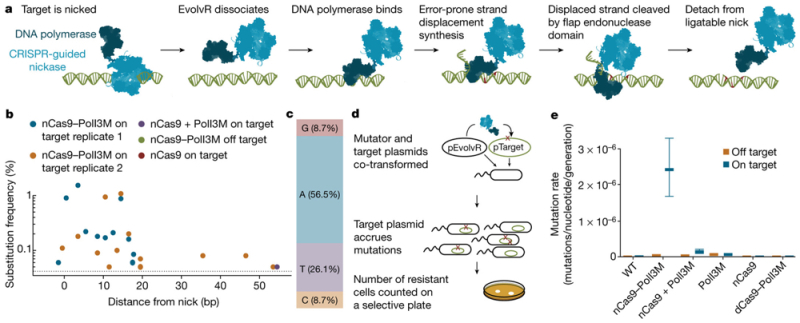
    A group of researchers* from Berkeley have used a modified version of Cas9 (nCas9, bearing a D10A mutation that produces "nicks" in target DNA) to produce a system they term EvolvR for dramatically (7,700,000-fold) increasing in vivo mutagenesis, as reported in the scientific journal Nature in a Letter entitled "CRISPR-guided DNA polymerases enable diversification of all nucleotides in a tunable window."  This is illustrated in E. coli bacteria for producing cells resistant to the antibiotic streptomycin.  The modified nCas9 is fused to the amino terminus of a fidelity-reduced variant (D424A, I709N, A759R) of E. coli DNA polymerase I.  The plasmid encoding this construct also encoded a guide DNA (gDNA) to target a second plasmid containing a homologous gene sequence.  These model experiments showed mutations (of all expected types) arising within a 17 nucleotide window 3' of the nick site, consistent according to these authors with the known 15-20 nucleotide processivity of the polymerase, as illustrated below.  There were also a low frequency of 5' mutations that the authors speculated may have been due to the polymerase's 3'-5' exonuclease activity.  Also tested was a reversion assay, wherein the target plasmid encoded a streptomycin resistance gene bearing a nonsense mutation.  Against a measured background mutation rate of 10-10 mutations/nucleotide/ generation, consistent with E. coli mutation rates, introducing the EvolvR plasmid into these cells "markedly increased the mutation rate at the targeted locus 24,500-fold over the wild type while increasing the global mutation rate 120-fold over the wild type," which the authors state is similar to other mutagenesis methods used in E. coli.

    Figure 2
    Mutation rates using this system were further enhanced by making additional mutations in nCas-9 (K848A, K1003A, R1060A); these mutations had been suggested in the art to "lower the non-specific DNA affinity of Cas-9."  These plasmids "increased the global mutation rate 223-fold compared to wild-type cells (1.9–fold greater than nCas9–PolI3M), yet elevated the mutation rate at the targeted locus by 212,000-fold (8.7-fold greater than nCas9–PolI3M)."  The mutagenesis rate was further increased to the maximum reported (7,700,000-fold) by further modifications (D424, I709N, F742Y, A759R, and P796H) to the polymerase portion of the fusion protein.  Alternative polymerases (from the bacteriophage Phi129) did not achieve this high a mutation rate, nor was inserting the thioreductase-binding domain of bacteriophage T7 DNA polymerase into the PolI sequence as effective (although this change did increase the reach of mutation rate in the target DNA).  Other refinements included removing internal ribosome binding sites in the PolI sequence to reduce (4.14-fold) "off-target" mutagenesis.

    The authors also report the ability to target separate DNA target sequences, although they note that when those targets are within 110 bp of each other, the nicking activity should be directed to the same strand to avoid lethality.

    The paper ends with the following hopes for future applications of the technology:

    EvolvR offers the first example of continuous targeted diversification of all nucleotides at user-defined loci, which will be useful for evolving protein structure and function, mapping protein–protein and protein–drug interactions, investigating the non-coding genome, engineering industrially relevant microbes and tracking the lineage of cell populations that cannot tolerate double-stranded breaks.  As a guiding principle for using this tool, our data suggest that 1µl saturated E. coli culture expressing enCas9–PolI3M–TBD for 16h contains all single substitutions in the 60-nucleotide window with more than tenfold coverage.  Future work towards adapting EvolvR for use in cells possessing low transformation efficiency, as well as increasing the mutation rate and window length of EvolvR mutagenesis, would enable new forward genetic applications.

    *Shakked O. Halperin, Connor J. Tou, Eric B. Wong, Cyrus Modavi, David V. Schaffer & John E. Dueber