• J A KempJ A Kemp will be offering a webinar entitled "Strategies for Speeding up or Slowing Down Patent Prosecution" on June 17, 2020 from 16:30 to 17:30 pm GMT (Greenwich Mean Time).  Ravi Srinivasan and Mark Roberts of J A Kemp will look at the procedural options that the EPO offers to streamline prosecution as well as initiatives to increase speed of processing and ways for avoiding fast grant, and explore practical tactics for achieving both outcomes.  Topics to be covered will include:

    • The EPO's acceleration procedure, PACE
    • The Patent Prosecution Highway
    • Early Certainty Programme
    • Waiver practice
    • Reasons for slowing down prosecution
    • Practical tips to defer grant

    Those wishing to register can do so here.

  • LexisNexisLexisNexis and IPWatchdog will be offering a webinar entitled "The Global Migration of IP" on June 9, 2020 at 12:00 pm (ET).  Gene Quinn of IPWatchdog.com; Mike McLean, formerly of TechInsights; Will Mansfield and Dr. Dirk Caspary of PatentSight® – A LexisNexis Company will show how the migration pattern for two technologies (LED and lithium-ion batteries (LIB)) can be understood from the development of IP portfolios at these locations and find a candidate for the "next technology to move."  The panel will examine and discuss:

    • patent ownership data and why data accuracy is extremely important for reliable analytics
    • companies that own strong portfolios in LED and LIB technologies
    • the origin of these patents; and portfolios in this technology that significantly grew in countries to which manufacturing transitioned
    • how to identify another technology that is ready for a migration in its manufacturing hub

    There is no registration fee for this webinar.  However, those interested in registering for the webinar, should do so here.

  • CPA GlobalCPA Global will hosting a webinar entitled "Practical Strategies for Agile IP Management" on June 10, 2020 beginning at 16:00 CEST.  Nadine Stuttle of Duff & Phelps, Gordon MacSween and Peter Thelen of CPA Global will address the following questions:

    • What opportunities can we seize as we evolve toward a 'new normal'
    • What has the impact been on in-flight change programmes?
    • What has been the human impact and how have different people/teams reacted?
    • What will the enduring effects be?
    • How have perceptions/openness to new ways changed?
    • How have priorities changed

    Those interested in registering for the webinar can do so here.

  • By Kevin E. Noonan —

    LionLions (Panthera leo) once were a widely distributed group of terrestrial mammals, ranging during the Pleistocene (from about 2,580,000 to 11,700 years ago) in Eurasia, Africa, and North America, with species that included the still-extant modern lions (Panthera leo leo), the cave lion (Panthera leo spelaea), and the American lion (Panthera leo atrox).  From the Pleistocene to modern times, all lion species except the modern lion have gone extinct (the cave and American lions in the late Pleistocene, about 14,000 years ago), and their modern range is limited to Sub-Saharan Africa and an isolated group restricted to the Kathiawar Peninsula of Gujarat State in India.  In modern times, lion populations present in southwestern Eurasia were eradicated in the 19th and early 20th Centuries, and lions (particularly the Barbary lion, the Cape lion, and lion species endemic to the Middle East) disappeared through extinction from Northern Africa during the 20th century.  Modern extirpation of lion populations is almost completely a consequence of human population growth, predation, and restriction of traditional environmental ranges, what is euphemistically called "anthropogenic factors."

    Population studies, most relying on mitochondrial DNA (mtDNA), have been pursued for living species and remains of extinct lions, with varying degrees of confidence.  Last month, an international group of researchers published a paper in the Proceedings of the National Academy of Sciences USA entitled "The evolutionary history of extinct and living lions" that reported results of genomic DNA analysis of twenty lion specimens, comprising two cave lions (Panthera leo spelaea), about 30,000 years old from Siberia and the Yukon; 12 "historic" lions (Panthera leo leo/Panthera leo melanochaita) that lived between the 15th and 20th centuries outside the current geographic distribution of lions, and 6 present-day lions from Eastern and Southern Africa (4) and India (2).  The broad conclusions these authors drew from this genetic data is that the cave and modern lion species shared a common ancestor that lived about a half million years ago, and that modern lions consist of two lineages that diverged about 70,000 years ago.  The "orphan" Indian lions showed what the authors termed "a nearly complete absence of genetic diversity," consistent with their low population sizes in recent years.

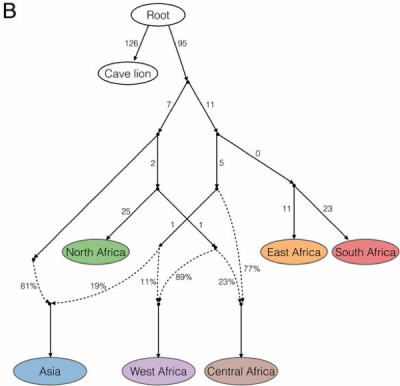
    The whole genome studies verified the inference from earlier mtDNA studies that the cave lions were a genetic "outgroup" of modern lions.  The two lineages of modern lions that diverged ~70,000 years ago comprised a "northern" lineage of lions from Asia, North Africa and West Africa, and a second "southern" lineage from Central, East and South Africa.  But unlike earlier mtDNA results, the genomic analyses showed that Central African lions were closely related to southern rather than northern African lions.  These authors' results also supported a closer but geographically incongruous relationship between North African lions with Asiatic lions rather than West African lions (which the authors say is "not unusual" in the cat family.
    Image
    Fig. 3(B) from de Manuel et al., 2020.

    Using a series of different genetic analytical techniques, these authors report a consistent time of divergence between ancestral lion populations and modern lions of about 500,000 year ago; using derived allele statistics this estimate was found to be 470,000 y-ago (392,000 – 529,000), whereas using pseudodiploid genomes (from the X chromosome of a male specimen) and "the estimate[d] rates of coalescence between their ancestral populations," this estimate was found to be 495,00 y-ago (460,000 – 578,000), and using sequence divergence an estimate of 540,000 y-ago (which relied upon a mutation rate of 4.5 × 10⁻⁹ per generation, a population size of 55,000 individuals, and a "transition (A-G or C-T)/transversion (A/G-C/T) ratio of 1.9," resulting in 108,000 generations at a generation time of ~5 years).  The authors state, based on the different methods of estimating the divergence time, that "[g]iven the general congruence among our estimates, we conclude that the most likely split time between cave and modern lions is ca. 500,000 y ago,"  which they note is "remarkably consistent with the early Middle Pleistocene appearance of P. fossilis in the European fossil record."

    The paper next provides a genetic analysis of gene flow (i.e., interbreeding) between cave lions and modern lions in their overlapping range in southwestern Eurasia during the Pleistocene; their results showed no evidence of gene flow between the Siberian cave lion and modern lions.  In contrast, these researchers found evidence of interbreeding between Yukon cave lions and South African modern lions, which further analysis appeared to be an artifact of the differences in "depth of [genomic sequence] coverage between the Yukon and Siberian cave lions."  The authors conclude that "there is no robust evidence for gene flow between the cave lion populations represented by our two samples and any of the modern lion lineages tested" (which would be expected for divergent species).  The authors speculate that these results could be due to a lack of sympatry between cave and modern lions, or sexual selection due to the cave lion lacking the characteristic prominent mane exhibited by modern lions.

    The authors also report the results of principal component analyses on the modern lion specimens, which were consistent with the "distinctiveness" of the southern and northern African lion populations.  Repeating some of the comparative analyses performed between cave and modern lions, the authors report a divergence between these African lions of ~70,000 years (52,000-98,000 y-ago), which the authors consider to be consistent with earlier mtDNA-derived estimates and also reflect a "severe" population bottleneck in the northern Africa lineage occurring coincident with a sharp reduction in the population of this lineage at about the same time.  (Both cheetahs and humans have experienced such population bottlenecks in their evolutionary histories.)  These authors report that there is also evidence for genetic admixture between populations of African lions, particularly in Central African lion populations.  They describe the Central African lion population as a potential "melting pot" of lineages after their divergence ~70,000 year ago. Another anomalous result, evidence of close genetic relationships between southern African lions and Asiatic lions (e.g., with about 18.5% of Asiatic lions genetic ancestry arising from southern African lion populations), these authors postulate might have arisen from "migration corridors between Sub-Saharan African and the Near East may have existed in the past, for instance through the Nile basin in the early Holocene" and that such interbreeding with northern African lions and Asiatic lions having been prevented by "geographical barriers represented by the Atlas Mountains and the Sahara desert."

    Among modern lions, assessment of autosomal heterozygosity frequency and the prevalence of "runs of homozygosity" were "consistent with a population history of consecutive bottlenecks in the northern lineage as their ancestors migrated away from Sub-Saharan Africa and persisted in more isolated smaller populations," which the authors speculate might also have arisen from "sustained anthropogenic pressure" due to a possible correlation between these effects on lion populations of large human populations in the Indus Valley and Mesopotamia in Asia, and Egyptian, Greek and Roman empires in North Africa.  The capacity of these literally man-made effects on lion populations are also seen in a reduction in genetic diversity in southern African lion populations associated with European colonization during the 20th Century.

    Turning to the Indian lions, the authors report the greatest extent of population reduction and inbreeding in these lions (a 16-fold reduction in heterozygosity compared with modern southern African lions), with 90% of the Indian lion genomic DNA residing in ROHs.  Further analyses showed that Indian lions carry on average 12.7% more deleterious mutations in homozygosity, which results in a substantial genetic load and even more so should these mutations be recessive (i.e., individuals would carry both mutant copies of the gene).

    The authors conclude their paper with a section on "implications for conservation," including efforts to resuscitate extinct or nearly extinct populations a la Jurassic Park.  (The risks of this embodiment of "playing God" using genetic methodologies have been set forth in Beth Shapiro's book, How to Clone a Mammoth: The Science of De-extinction.)  These authors caution that "although conservation efforts are contributing to increasing population size after centuries of decline, their remarkable lack of genomic diversity suggests that they could be extremely susceptible to inbreeding depression and genetic erosion, as well as future pathogen outbreaks."

    While providing the first whole-genome sequencing comparison of several extinct and living lion species, the paper illustrates that significant additional work will be needed to sort out the interrelationships between these different forms of the King of Beasts.

    * Marc de Manuel, Ross Barnett, Marcela Sandoval-Velasco, Nobuyuki Yamaguchi, Filipe Garrett Vieira, M. Lisandra Zepeda Mendoza Shiping Liu, Michael D. Martin, Mikkel-Holger S. Sinding, Sarah S. T. Mak, Christian Carøe, Shanlin Liu, Chunxue Guo, Jiao Zheng, Grant Zazula, Gennady Baryshnikov, Eduardo Eizirik, Klaus-Peter Koepfli, Warren E. Johnson, Agostinho Antunes, Thomas Sicheritz-Ponten, Shyam Gopalakrishnan, Greger Larson, Huanming Yang, Stephen J. O'Brien, Anders J. Hansen, Guojie Zhang, Tomas Marques-Bonet, and M. Thomas P. Gilbert

    Institutions: PRBB, Barcelona, Spain; University of Copenhagen; University Malaysia Terengganu, 21030 Kuala Nerus, Terengganu, Malaysia; University of Birmingham; eBGI-Shenzhen, China; Norwegian University of Science and Technology; University of Chinese Academy of Sciences; Yukon Palaeontology Program Russian Academy of Sciences; Pontifícia Universidade Católica do Rio Grande do Sul (PUCRS), Brazil; INCT-EECBio), Brazil; Instituto Pró-Carnívoros, Brazil; Smithsonian Institution; Walter Reed Army Institute of Research; University of Porto, Portugal; qDepartment of Biology, Faculty of Sciences, University of Porto, 4169-007 Porto, Portugal; Asian Institute of Medicine, Science and Technology, Malaysia; University of Oxford, OX; James D. Watson Institute of Genome Science, Hangzhou, China; Information Technologies, Mechanics and Optics University, Wt. Petersburg, Russia; Nova Southeastern University, Ft. Lauderdale, FL;, University of Copenhagen, 1350 Copenhagen, Denmark; Kunming Institute of Zoology, Chinese Academy of Sciences,Kunming, China; The Barcelona Institute of Science and Technology; ICREA,  Barcelona, Spain; and Universitat Autònoma de Barcelona, Barcelona, Spain

    Image of Lion (Panthera leo) lying down in Namibia by Kevin Pluck, from the Wikimedia Commons under the Creative Commons Attribution 2.0 Generic license.

  • By Donald Zuhn —

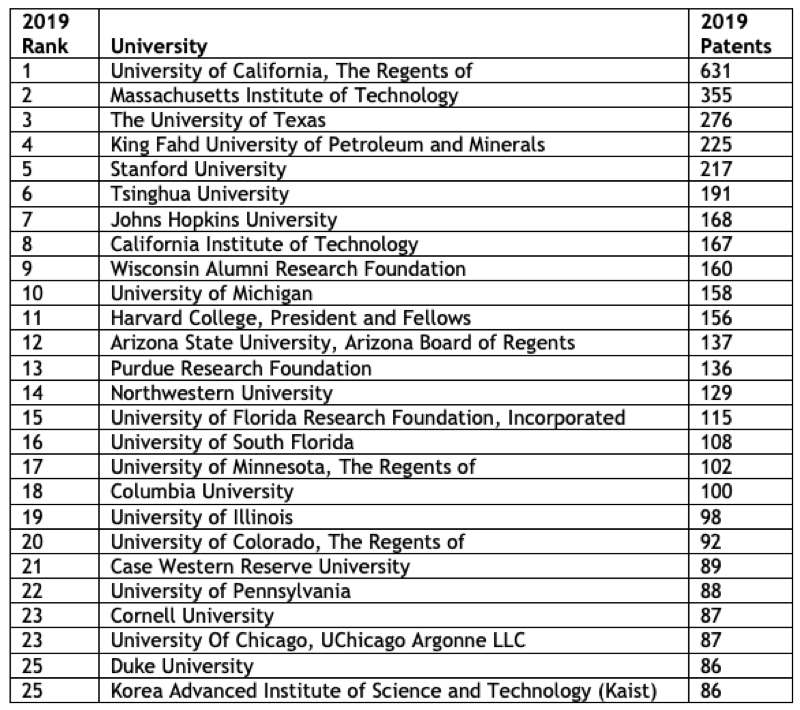
    CoverToday, the National Academy of Inventors (NAI) and the Intellectual Property Owners Association (IPO) published a list of the top 100 worldwide universities that received the most U.S. utility patents during the 2019 calendar year.  The NAI is a member organization comprising U.S. and international universities, and governmental and non-profit research institutions, with over 4,000 individual inventor members and Fellows spanning more than 250 institutions.  The organization was founded in 2010 to recognize and encourage inventors with patents issued from the U.S. Patent and Trademark Office, enhance the visibility of academic technology and innovation, encourage the disclosure of intellectual property, educate and mentor innovative students, and translate the inventions of its members to benefit society.  The joint effort by the NAI and IPO is based on data obtained from the U.S. Patent and Trademark Office.  For this report, the NAI and IPO defined a university as an institution that grants undergraduate-level degrees, and when a patent is assigned to one or more entities, credit was given to the first named entity.  The report indicates that the number of patents granted to a particular university does not necessarily indicate the value of a university's technology, the effectiveness of its research, or whether its patents will be successfully licensed and/or brought to market.  The top 25 universities on the NAI/IPO listing are as follows (click on table to expand):

    Table
    The complete list of 100 universities can be found here.

    For additional information regarding this and other related topics, please see:

    • "IPO & Harrity Analytics Release List of Top 300 Patent Holders for 2019," May 25, 2020
    • "IPO Releases List of Top 300 Patent Holders for 2018," August 7, 2019
    • "IPO Releases List of Top 300 Patent Holders for 2017," July 4, 2018
    • "Top 100 Universities Worldwide Granted U.S. Patents in 2016," June 15, 2017
    • "IPO Releases List of Top 300 Patent Holders for 2016," June 14, 2017
    • "NAI & IPO Release List of Top 100 Universities Receiving Patents in 2014," July 5, 2015
    • "IPO Releases List of Top 300 Patent Holders for 2014," July 1, 2015
    • "IPO Names Top 100 Patenting Universities," July 24, 2014
    • "IPO Releases List of Top 300 Patent Holders for 2013," July 7, 2014
    • "NAI & IPO Release List of Top 100 Universities Receiving Patents in 2012," January 7, 2014
    • "Brookings Paper Calls for Technology Transfer Model Based on University Start-ups," December 12, 2013
    • "IPO Releases List of Top 300 Patent Holders for 2012," June 24, 2013
    • "Another Look at IPO Top 300 and Life Sciences Top 53," June 11, 2012
    • "IPO Releases List of Top 300 Patent Holders for 2011," June 7, 2012
    • "IPO Releases List of Top 300 Patent Holders for 2010," June 30, 2011
    • "IPO Releases List of Top 300 Patent Holders for 2009," May 26, 2010
    • "IPO Releases List of Top 300 Patent Holders for 2008," May 14, 2009
    • "IPO Releases List of Top 300 Patent Holders," May 22, 2008
    • "IPO Posts List of Top 300 Patent Holders," April 20, 2007

  • By Donald Zuhn –-

    USPTO and JPO Issue Joint Message

    JPOYesterday, Director Andrei Iancu of the U.S. Patent and Trademark Office and Commissioner Akira Matsunaga of the Japan Patent Office issued a joint message to express the Offices' "most heartfelt sympathies to the victims of the novel coronavirus (COVID-19) and their families," and "hope that everyone affected recovers soon and that the spread of COVID-19 infection will end as soon as possible."  Noting that the pandemic has had a significant negative impact on the global economy, the two Offices also pointed out that the pandemic has served as a reminder of the importance of innovations that support our society.  The two Offices also reminded stakeholders of their "close cooperative relationship" to "establish[] various initiatives to support inventors worldwide."  The Offices conclude the joint message by expressing their belief that "we will be able to overcome this crisis by promoting and utilizing innovative technologies."


    USPTO to Allow Electronic Filing of PTE Applications

    USPTO SealIn an official notice issued last week, the U.S. Patent and Trademark Office announced that because it considered the effects of the COVID-19 pandemic to be an "extraordinary situation" within the meaning of 37 C.F.R. § 1.183, the Office would permit patentees to file initial Patent Term Extension applications that meet certain criteria via EFS-Web or Patent Center.  In particular, the official notice states that "the prohibition against filing initial patent term extension applications in accordance with 37 CFR 1.740 or 37 CFR 1.790 via the USPTO patent electronic filing systems is hereby waived until further notice."  The notice also states that "the requirements in 37 CFR 1.740(b) and 37 CFR 1.790(b) for two additional copies of the initial extension application are waived until further notice."  In order to be entitled to a filing date for an initial patent term extension application filed via EFS-Web or Patent Center, the notice sets forth the following requirements:

    1. An appropriate document description:
      a. "Patent Term Extension Application Under 35 USC 156" (Doc Code TERM.REQ) must be selected for an initial submission under 35 U.S.C. 156(d)(l) (governed by 37 CFR 1.740), or
      b. "PTE Interim Patent Extension filed" (Doc Code TERM.REQ.ITM) must be selected for an initial submission under 35 U.S.C. 156(d)(5) (governed by 37 CFR 1.790);
    2. An email address in the contact information to facilitate contact with the applicant's representative; and
      3. The applicable fee:
      a. the fee set forth in 37 CFR 1.20(j) for submission of an initial application for patent term extension under 37 CFR 1.740, or
    3. the fee set forth in 37 CFR 1.20(j) for submission of an initial application for interim patent term extension under 37 CFR 1.790.

    While the notice indicates that the waiver will be "effective only until the USPTO provides further notice," the Office also indicates that it is making efforts to allow for electronic filing of PTE applications on a permanent basis.


    USPTO Makes COVID-19 Statement Form Available

    In a Patent Alert e-mail distributed last month, the U.S. Patent and Trademark Office announced the release of a form to assist applicants with making the required statement of delay due to the COVID-19 pandemic (see "USPTO Announces Further Extension of Certain Patent Deadlines").  The Office noted that the "Statement of Delay Due to COVID-19 Outbreak" form (PTO/SB/449) is being released in response to requests from applicants for guidance on how best to make the required statement as well as to assist the Office in processing those requests.


    USPTO to Allow Electronic Filing of Plant Patent Applications

    In an official notice issue last month, the U.S. Patent and Trademark Office announced that because it considered the effects of the COVID-19 pandemic to be an "extraordinary situation" within the meaning of 37 C.F.R. § 1.183, the Office will temporarily permit the filing of plant patent applications and follow-on documents via the EFS-Web or Patent Center until further notice.  More details about the Office's temporary waiver can be found in the official notice.  However, as with the PTE application waiver described above, the Office indicates that it is making efforts to allow for electronic filing of plant patent applications on a permanent basis.

  • UIC John Marshall's Center for Intellectual Property, Information & Privacy Law will be offering its Annual Ethics in the Practice of IP Law Seminar — for the first time as an online webinar — on June 5, 2020 from noon to 3:45 pm (CDT).  The program will cover a variety of topics on ethics and professionalism that are relevant to IP lawyers.  Attendees will learn about the types of ethical issues that arise in daily practice, as well as fundamental principles, rules, and insights to help them handle these issues.  This year's program focuses on patent law issues and features two mental health presentations.

    The Seminar is approved for 3.25 Hours of Professional Responsibility including 1 Hour of Mental Health/Substance Abuse by the Illinois MCLE Board.  Attorneys who need CLE from other states are welcome to apply to their jurisdictions on their own.  The extension of CLE credit is subject to each state's approval.

    The registration fee is $40 (general registration) or free (government attendees, UIC students, faculty, adjunct professors, staff, and IP Center advisory board members).  Additional information regarding the program can be found here.

    Ethics logo 2

  • By Kevin E. Noonan —

    Supreme Court Building #2In the Supreme Court's recent clarifying campaign through the Federal Circuit's U.S. patent law jurisprudence, one section of the statute, 35 U.S.C. §112(a) has been noticeably left unscathed.  Indeed, avoidance of this statutory section continues a pattern that has existed since the 1952 Patent Act was enacted.  It is not for lack of petitions for certiorari, which have included during the Court's denials in Amgen v. Sanofi; Janssen Biotech, Inc. v. Abbott Laboratories; CoreValve Inc. v. Edwards Lifesciences AG; and Ariad v. Eli Lilly & Co.  Last week, the Court's refusal to consider this section recurred with its denial of certiorari in Actavis Laboratories FL, Inc. v. Nalproprion Pharmaceuticals, Inc.

    To recap, the case arose in ANDA litigation over Nalproprion Pharma's Contrave® extended-release tablets of the combination of naltrexone hydrochloride and buproprion hydrochloride, for treatment of obesity, as claimed in Orange Book-listed U.S. Patent Nos. 7,375,111; 7,462,626; and 8,916,195.  The District Court found that Defendant Actavis had not established that one claim (claim 11) of the '195 patent was invalid for failure to satisfy the written description requirement of 35 U.S.C. § 112(a) with regard to the claim limitation reciting USP dissolution methods ("USP1" versus "USP2"):

    Claim 11 of the '195 patent:

    A method of treating overweight or obesity having reduced adverse effects comprising orally administering daily about 32 mg of naltrexone and about 360 mg of bupropion, or pharmaceutically acceptable salts thereof, to a person in need thereof, wherein the bupropion or pharmaceutically acceptable salt thereof is administered as a sustained release formulation, wherein the naltrexone or pharmaceutically acceptable salt thereof is ad- ministered as a sustained release formulation, and wherein said sustained release formulation of naltrexone has an in vitro naltrexone dissolution pro- file in a dissolution test of USP Apparatus 2 Paddle Method at 100 rpm in a dissolution medium of water at 37° C. of:
        a) between 39% and 70% of naltrexone re- leased in one hour;
        b) between 62% and 90% of naltrexone re- leased in two hours; and
        c) at least 99% in 8 hours;
        wherein about 16 mg of said sustained re- lease formulation of naltrexone or a pharmaceutically acceptable salt thereof is administered twice daily, and about 180 mg of said sustained release formulation of bupropion or a pharmaceutically acceptable salt thereof is administered twice daily.

    The claims expressly recited the USP 2 Paddle Method, but Actavis argued that the specification disclosed only the UPS 1 Basket Method.  The District Court based its decision on the skilled worker not having a doubt that the inventors had possession of the invention based on the nature of the dissolution method disclosed in the specification.  The Court held that disclosure of a "substantially equivalent method" was sufficient to satisfy the requirement.

    The Federal Circuit, in an opinion by Judge Lourie, joined by Judge Wallach, affirmed the District Court on its written description determination over Chief Judge Prost's dissent.  The majority's written description decision was based in part on the "peculiarity" of the structure of claim 11, which is directed to a method for treating obesity using specific amounts of the two drugs and reciting the method for determining the dissolution profile of what the majority termed "resultant in vitro parameters," which were not the "operative steps to treat overweight or obesity."  The majority found no clear error in the District Court's holding that "irrespective of the method of measurement used, the specification shows that the inventors possessed the invention of treating overweight or obesity with naltrexone and bupropion in particular amounts and adequately described it."  The majority noted that this determination by the District Court was supported by more credible testimony from Nalproprion Pharma's expert and "untrustworthy, self-serving statements by Actavis's expert."  The majority stated that it refused to disturb the District Court's weighing of witness credibility in the performance of its "fact-finding function."  The majority further recognized (in the face of the Chief Judge's dissent) that "[w]hile as a general matter written description may not be satisfied by so-called equivalent disclosure," under these facts the District Court had not clearly erred.

    The Chief Judge's dissent on the written description question was based on the majority's reliance on "substantially equivalent disclosure" to support claim language not having clear and explicit support in the specification.  The Chief Judge characterized the majority's decision as "add[ing] what appears to me to be a new rule to this court's long-standing written description jurisprudence."  She set forth three reasons for her disagreement with the majority:

    First, the USP 2 clause is limiting.  Second, the majority's "substantially equivalent" rule is inconsistent with this court's precedent.  Third, the district court clearly erred in finding that the '195 patent's written description includes a disclosure "substantially equivalent" to USP 2.

    Important to the Chief Judge's reasoning, inter alia, were arguments from the prosecution history where the patentee appeared to rely on the dissolution profile (and the manner of determining it) to distinguish the claims from the prior art.  The Chief also disagreed with the District Court's (and the majority's) disregard for Defendant's expert testimony and found his assertion that the USP1 an USP2 methods would not have produced the same dissolution profile results to have been relevant to the written description issue before each court.

    In its certiorari petition, Actavis submitted this Question Presented:

    Whether § 112 requires a patent's specification to contain a written description of all of the limitations of a patent's claims, not just a "substantially equivalent" disclosure.

    Actavis argued that the statutory requirement for a written description was "straightforward" and meant what it said:  that the specification was required to set forth a written description of "the invention" (emphasis on petition), which, of course, is what is claimed.  Actavis contended that the Federal Circuit majority had broken with "longstanding precedent, [and] adopted a new rule: now disclosing something 'substantially equivalent' can suffice."  This inquiry is "amorphous" and contrary to the statutory language and (of necessity) Federal Circuit precedent.  Almost pandering to Supreme Court prejudices, the petition argued that "[r]equiring a patent to contain sufficient written description support ensures that a patent-holder cannot assert a broader monopoly than what 'the inventor actually invented,'" citing Ariad Pharm., Inc. v. Eli Lilly & Co., 598 F.3d 1336, 1351 (Fed. Cir. 2010) (en banc), and that "[a]n adequate written description is also necessary 'to inform the public during the life of the patent of the limits of the monopoly asserted, so that it may be known which features may be safely used or manufactured without a license and which may not,'" citing Permutit Co. v. Graver Corp., 284 U.S. 52, 60 (1931).

    According to Actavis, this decision, if permitted to stand (which is has been), overturns the certainty provided by the Federal Circuit's prior precedent on Section 112(a), substituting a "substantially equivalent" standard for one where "an obvious variant of that which is disclosed in the specification," which was previously excluded, can now suffice, citing Lockwood v. Am. Airlines, Inc., 107 F.3d 1565, 1572 (Fed. Cir. 1997).  In addition to the doctrinal error Actavis asserts, the petition also maintains that the decision "disrupt[s] the settled expectations of the inventing community" that the Supreme Court (somewhat ironically) advised against in Festo Corp. v. Shoketsu Kinzoku Kogyo Kabushiki Co., 535 U.S. 722, 739 (2002).  And on a practical level, Actavis reminded the Court that this case is an excellent vehicle for review, wherein only one claim is at issue, there is no dispute on the facts, and the alternative outcome would permit Actavis to "bring its generic to market forthwith, instead of being blocked for another full decade."

    The petition reminded the Court of the fundamental basis ("a bedrock principle") of the written description requirement, having been part of U.S. patent law "practically since the Founding," setting forth an explication of the history of this requirement to support its statement.  The importance of properly applying the requirement includes that "it ensures that an inventor does not claim patent protection for something broader than what he or she has invented by the time of filing the patent application, exemplified in the Court's decisions including O'Reilly v. Morse, 56 U.S. (15 How.) 62 (1853), and Federal Circuit decisions including Vas-Cath Inc. v. Mahurkar, 935 F.2d 1555, 1561 (Fed. Cir. 1991), and Agilent Techs., Inc. v. Affymetrix, Inc., 567 F.3d 1366, 1379 (Fed. Cir. 2009).  A second benefit of the requirement is to the public, wherein "the description effectuates the patent bargain: what the inventor claims, and secures a monopoly over, he or she must describe," citing Gill v. Wells, 89 U.S. (22 Wall.) 1, 25-26 (1874) and Ariad.

    "The decision below creates a new rule that hopelessly muddies what previously was clear and cannot be reconciled with the court of appeals' previous decisions" according to Actavis's petition.  These decisions cited in the petition include Lockwood; Regents of the Univ. of Cal. v. Eli Lilly & Co., 119 F.3d 1559, 1566 (Fed. Cir. 1997); Lucent Techs., Inc. v. Gateway, Inc., 543 F.3d 710 (Fed. Cir. 2008); PowerOasis, Inc. v. TMobile USA, Inc., 522 F.3d 1299, 1306 (Fed. Cir. 2008); ICU Medical, Inc. v. Alaris Medical Systems, Inc., 558 F.3d 1368 (Fed. Cir. 2009); Vas-Cath; and D Three Enters., LLC v. SunModo Corp., 890 F.3d 1042, 1052 (Fed. Cir. 2018).  This is not the same as imposing an in haec verba requirement according to Actavis; the panel majority's error Actavis emphasized that the Federal Circuit departed from years of consistent decisions to the contrary by "accepting a disclosure that was 'substantially equivalent'—i.e., different but close enough."

    Actavis also challenged the basis for the majority's decision — that the disputed, assertedly unsupported claim term — did not related to a "operative claim step."  There is no basis in the statutory language for this distinction, Actavis argued, nor in "this Court's clear precedent," citing Supreme Court precedent in  Limelight Networks, Inc. v. Akamai Techs., Inc., 572 U.S. 915, 921 (2014); Warner-Jenkinson, Inc. v. Hilton Davis Chem. Co., 520 U.S. 17, 29 (1997); and Water-Meter Co. v. Desper, 101 U.S. 332, 337 (1880), and the Federal Circuit (and its predecessor Court, the C.C.P.A.) in In re Sabatino, 480 F.2d 911, 913 (C.C.P.A. 1973); Exxon Chem. Patents, Inc. v. Lubrizol Corp., 64 F.3d 1553, 1557 (Fed. Cir. 1995); and Nidec Motor Corp. v. Zhongshan Broad Ocean Motor Co., 851 F.3d 1270, 1273 (Fed. Cir. 2017).

    And yet, to no avail.  Whether the Federal Circuit's decision below will lead to the dire consequences envisioned by Petitioners or is cabined by the facts and circumstances of the case before the Federal Circuit is uncertain.  But what seems certain is that the Supreme Court has not been, and perhaps cannot be, presented with a case that has been able to overcome a seeming institutional reticence against deciding questions presented regarding Section 112(a).

  • Claims for an Interactive 3D Virtual Environment Found Patent Ineligible

    By James Korenchan —

    District Court for the Northern District of CaliforniaIn the field of computer gaming, the U.S. District Court for the Northern District of California recently granted Defendants' Rule 12 motion alleging that claims 1, 3, and 6 of U.S. Patent No. 8,228,325 (the '325 Patent) are invalid as claiming patent-ineligible subject matter under 35 U.S.C. § 101.  Plaintiff Barbaro Technologies, LLC (hereinafter "Barbaro") had contended that the video games Ingress and Pokémon Go, developed and published by Defendant Niantic, Inc. (hereinafter "Niantic"), infringed these claims.  The suit also involves U.S. Patent No. 7,373,377, of which the '325 Patent is a divisional.  However, Niantic's motion only addressed the claims of the '325 Patent.

    The '325 Patent claims a computer system for providing a "three-dimensional virtual thematic environment" (abbreviated in the opinion and hereinafter as "3D VTE").  The background of the '325 Patent notes that "virtual environments, especially those present on the internet, for example, have not provided the user with a real world experience."  The '325 Patent thus aims to integrate audio, video, 2D/3D technology, and other applications or services (e.g., "mini-applications," as the '325 Patent calls them, such as word processing programs or email programs) in order to provide a virtual and real world experience to users.  More particularly, the '325 Patent describes that the 3D VTE can be a gaming environment, geographic environment, or other theme of environment in which and with which a software application can simulate real-world interaction.  For example, a user can select a city to visit and the software will integrate real-world data (e.g., satellite and street view images, 2D/3D graphics) into a 3D VTE resembling the city that the user can navigate and interact with, such as in a third or first person view.  For instance, a user might travel down a street in the simulated city and "enter" a bookstore by clicking a mouse on the virtual representation of the bookstore.  The '325 Patent lists numerous examples of real-time and real-world data that can be integrated into 3D VTEs, such as sports scores, film, news, and a "real-world geographic location of a user."

    The claims at issue in this case are reproduced below:

    1.  A computer system for providing a virtual thematic environment, comprising:
        at least one memory having at least one program comprising the steps of:

    retrieving information for utilization with a three-dimensional virtual thematic environment, from external sources over the internet, said information including a real-world geographic location of a user within said three-dimensional virtual thematic environment; and

    integrating said information into the three-dimensional virtual thematic environment, such that the three-dimensional virtual thematic environment includes said real-world geographic location displayed to the user as said three-dimensional virtual thematic environment;

        wherein the user interacts with the three-dimensional virtual thematic environment as a simulated real-world interaction, depending on the user's geographical three-dimensional movement through the three-dimensional virtual thematic environment; and
        at least one processor for running the program.

    3.  The system according to claim 1, wherein said information includes real-time information.

    6.  The system according to claim 1, further comprising: displaying said information to a user in a mini-application within the virtual thematic environment.

    In Alice Corp. v. CLS Bank Int'l, the Supreme Court set forth a two-part test for determining whether a claim is directed to patent-eligible subject matter under § 101.  First, it must be determined whether the claim involves a judicially-excluded law of nature, a natural phenomenon, or an abstract idea.  If so, it must be determined whether the claim recites an inventive concept — that is, an element or combination of elements that is sufficient to ensure that the claim is significantly more than the judicial exclusion.  But generic computer implementation of an otherwise abstract process does not qualify as significantly more, nor does an element or combination of elements that is well-understood, routine, and conventional.

    In applying the first part of the Alice test, the District Court deemed claim 1 to be directed to an abstract idea of removing the disconnect between the user in the real-world and a VTE.  As noted above, and as argued by Barbaro, the prior art virtual environments allegedly did not provide users with real-world experiences, and thus the '325 Patent improves over these environments by providing a way to integrate AV, 2D/3D technology, etc. to maximize a real-world experience for users, thereby effectively removing the disconnect between the real-world user and the 3D VTE.  Barbaro also argued that its claims are analogous to those in Federal Circuit cases such as Enfish, LLC v. Microsoft Corp.

    The Court was not convinced, instead asserting that the claimed computer system, memory, and processor are "standard" components, and that "[t]he claims demonstrate the improvement offered by the '325 Patent is directed at a result—integrating the real and virtual worlds—rather than at any particular method of achieving it."  The Court noted that the claimed computer system, memory, and processor are "standard" components, and that the claimed steps can be performed using any combination of existing technologies.  Neither the claims nor the patent specification, in the Court's view, elaborated on how to integrate real-world information into the 3D VTE.  In particular, the Court said:

    [T]he claims of the '325 Patent are not directed to the means or method of the claimed invention. They are focused on the result: allowing the user to "interact[] with the [3D VTE] as a simulated real-world interaction, depending on the user's geographical three dimensional movement through the [3D VTE]."  '325 Patent at 42: 53–56.  The specification of the '325 Patent recites dozens of embodiments of the claimed result, accomplished by a variety of existing technologies, as discussed above, but does not purport to make any improvements to them.

    The Court also distinguished the asserted claims over those in Enfish and other cases.  The Court pointed out that, in Enfish for instance, the court found that the claims about a database management system were not directed to any form of storing tabular data, but rather to a specific self-referential table.  The Court here further noted that, unlike the specific sensor configuration/method and the specific improvements to computer memory claimed in Thales Visionix Inc. v. United States and Visual Memory LLV v. NVIDIA Corp., respectively, the claimed invention here provided no such improvement to computer technology or specific configuration/method for achieving its desired result.

    Instead, the Court analogized the asserted claims to Federal Circuit cases pointed to by Niantic, such as Electric Power Group, LLC v. Alstom S.A., In re Morsa (finding claims for customizing information based on user information and other specific data to be abstract), and Move, Inc. v. Real Estate All. Ltd. (finding claims about displaying real estate properties based on a user-selected area of a map were directed to an abstract idea of collecting, organizing, manipulating, and displaying data and were "devoid of any implementation details").

    The Court concluded its part one analysis stating that the claims are directed to an abstract idea because "computers are simply invoked as a tool for solving a problem that has predated them: integrating real-world information about a user into a virtual model."

    Regarding part two of the Alice test, Barbaro had argued that integrating real-world information into a virtual world such as a video game solves a uniquely technical problem.  But the Court was quick to note that the concept of building models of real-world locations, and integrating the user's location or a user avatar into such models "long predates computers," and that the framing of Barbaro's argument "ignores the fact that computer games were not the original virtual worlds" (emphasis in original).  And as we've seen before in § 101 cases, this Court found the lack of technological details in the claims and specification — that is, any details beyond mere instructions to apply a "pre-Internet abstract idea" using generic computer components — to be fatal to the claims' validity.

    Thus, the Court found the asserted claims to be patent ineligible under § 101.

    Barbaro Technologies, LLC v. Niantic, Inc. (N.D. Cal. 2020)
    Order Granting Motion for Judgment on the Pleadings by District Judge Seeborg

  • Impact of COVID-19 Pandemic on Patent Offices and Federal Courts – May 27 UPDATE

    By Donald Zuhn –-

    USPTO SealIn a notice posted on its website earlier today, the U.S. Patent and Trademark Office announced that it was further extending the time to file certain patent-related documents and to pay certain required fees, but only for certain types of entities.  As with the initial extensions announced by the Office on March 31, 2020 (see "USPTO Announces Extension of Certain Patent Deadlines") and the extension of those deadlines announced by the Office on April 28, 2020 (see "USPTO Announces Further Extension of Certain Patent Deadlines"), the additional extensions are the result of the temporary authority provided to the USPTO by the Coronavirus Aid, Relief, and Economic Security Act (CARES Act), which was signed by President Trump on March 27, 2020.

    According to the Office's latest notice, the additional extensions apply to deadlines for the filing of certain patent-related documents or payment of certain required fees — as described in the Office's April 28, 2020 notice — that would have been otherwise due between March 27 and June 1, 2020, which "will now be deemed timely filed if filed by July 1, 2020."  However, the Office's latest notice makes it clear that the additional extensions are "[f]or small and micro entities only" (emphasis added).  For large entities, the Office's notice states that after May 31, 2020 (the ending date of the Office's April 28, 2020 extension), large entities "should seek relief on a case-by-case basis, through the filing of a petition for an extension of time or a petition to revive, accompanied by any required fee."  In announcing the additional extensions for small and micro entities, the Office stated that it "recognizes that the COVID-19 pandemic continues to impose various hardships, especially on small businesses and individual inventors, and will continue to evaluate the evolving situation around the COVID-19 outbreak and the impact on the USPTO's operations and stakeholders."

    The Office's most recent notice also states that for all entities, the Office will continue to provide relief in the form of a waiver of the petition fee for the revival of applications (and reexamination proceedings).  This relief has now been extended to applications and reexamination proceedings that became, or will become, abandoned (or terminated or limited) on or before June 30, 2020, as a result of the COVID-19 outbreak.  Applicants will still have to file a statement with their petition to revive indicating that the delay in filing or payment was due to the COVID-19 outbreak as defined in the April 28 Notice.

    The Office's latest notice also reminds applicants and patentees that "extensions of time under 37 CFR § 1.136 are available for filing replies to Office actions and notices issued during patent processing or examination . . . and petitions under 37 CFR § 1.378 to accept a delayed maintenance payment are available if a maintenance fee has not been paid by its due date."

    Patent-related inquiries regarding the Office's latest notice can be directed by e-mail to Covid19PatentsRelief@uspto.gov or by telephone to the Office of Patent Legal Administration at 571-272-7704 or 571-272-7703 for reexamination.

    Patent Docs will continue to monitor and report on patent-related developments related to the COVID-19 pandemic.  In addition, we encourage our readers to let us know about developments related to the COVID-19 pandemic at other patent offices.

    For additional information regarding this and other related topics, please see:

    • "USPTO Announces COVID-19 Prioritized Examination Pilot Program," May 18, 2020
    • "USPTO Announces Further Extension of Certain Patent Deadlines," April 30, 2020
    • "Impact of COVID-19 Pandemic on Patent Offices and Federal Courts – April 12 UPDATE," April 12, 2020
    • "USPTO Answers FAQs on Extension of Patent Deadlines under CARES Act," April 6, 2020
    • "Impact of COVID-19 Pandemic on Patent Offices and Federal Courts – April 2 UPDATE," April 2, 2020
    • "USPTO Announces Extension of Certain Patent Deadlines," March 31, 2020
    • "Impact of COVID-19 Pandemic on Patent Offices and Federal Courts — March 29 UPDATE," March 29, 2020
    • "Impact of COVID-19 Pandemic on Patent Offices and Federal Courts — March 26 UPDATE," March 26, 2020
    • "Impact of COVID-19 Pandemic on Patent Offices and Federal Courts — March 19 UPDATE," March 19, 2020
    • "Impact of COVID-19 Pandemic on Patent Offices and Federal Courts — March 18 UPDATE," March 18, 2020
    • "Impact of COVID-19 Pandemic on Patent Offices and Federal Courts — March 17 UPDATE," March 17, 2020
    • "Impact of COVID-19 Pandemic on Patent Offices and Federal Courts – UPDATED," March 16, 2020
    • "Impact of COVID-19 Pandemic on Patent Offices and Federal Courts," March 15, 2020