• IPO #2The Intellectual Property Owners Association (IPO) will offer a one-hour webinar entitled "Ethical Issues in Litigation Funding: An Update" on June 18, 2020 at 2:00 pm (EDT).  Gaston Kroub of Kroub, Silbersher & Malykov, Lucian Pera of Adams and Reese, and Anthony Sebok of Cardozo Law School will analyze the legal ethics issues raised for lawyers by litigation funding, including the question of who controls the litigation; the traditional law of champerty; confidentiality and privilege; disclosure and client consent; and possible conflicts if the case litigator is the one negotiating the funding.

    The registration fee for the webinar is $135 (IPO member) or $150 (non-member) (government and academic rates are available upon request).  Those interested in registering for the webinar can do so here.

  • GowlingGowling WLG will be offering a webinar entitled "Patent Strategy: Optimising Life Sciences Patents" on June 16, 2020 from 9:00 to 10:00 am EDT.  John Norman will moderate a panel consisting of Ruben Dzhermakyan (Moscow, Russia), Paul Inman (London, UK), Thomas Mayer (Munich, Germany), Jian Xu (Beijing, China), and Sonia Ziesche (Vancouver, Canada) of Gowling will explore the scope of patent protection across jurisdictions and discuss how to draft patents with an eye to the future.  The panel will also highlight key issues in patent scope that arise from the Doctrine of Equivalence, discuss how the doctrine applies across jurisdictions, and offer tips on how to use the doctrine to your advantage.

    Those wishing to register can do so here.

  • LexisNexisLexisNexis and IPWatchdog will be offering a webinar entitled "How USPTO Examiner Type Affects Patents" on June 18, 2020 at 12:00 pm (ET).  Gene Quinn of IPWatchdog.com, Megan McLoughlin of LexisNexis® IP, and Dr. Michael Sartori of Baker Botts will discuss the impact of the type of examiner by exploring important milestones in the life cycle of a U.S. patent application through historical trends and counter-intuitive results, and help attendees to better understand how certain types of examiners at the USPTO allow and examine disproportionately more U.S. patents each year than other types of examiners, resulting in few examiners allowing many patents, and many examiners allowing few patents.  The panel will examine and discuss:

    • How the type of examiner you are assigned to can dramatically affect your prosecution outcomes
    • Predicting examiner behavior with the PatentAdvisor ETA™ metric
    • Using objective metrics to measure prosecution performance

    There is no registration fee for this webinar.  However, those interested in registering for the webinar, should do so here.

  • By Kevin E. Noonan —

    The inherent, ineluctable unpredictability of biology can be the basis for biological patent claims being non-obvious (lacking the requisite "reasonable expectation of success"; see, e.g., OSI Pharmaceuticals v. Apotex) and for the greater quantum of disclosure necessary to satisfy the written description and enablement requirements of § 112 (see, e.g., Amgen v. Sanofi), despite complaints from the life sciences patent bar that these increased requirements are improper doctrinally and unfair.  These two different characteristics can be frequently in tension for patenting in the life sciences, it being difficult to maintain on the one hand that there is insufficient expectation of success for a claim to be obvious and on the other hand that deficiencies in disclosure can be appropriately supplemented by the knowledge of one of ordinary skill.

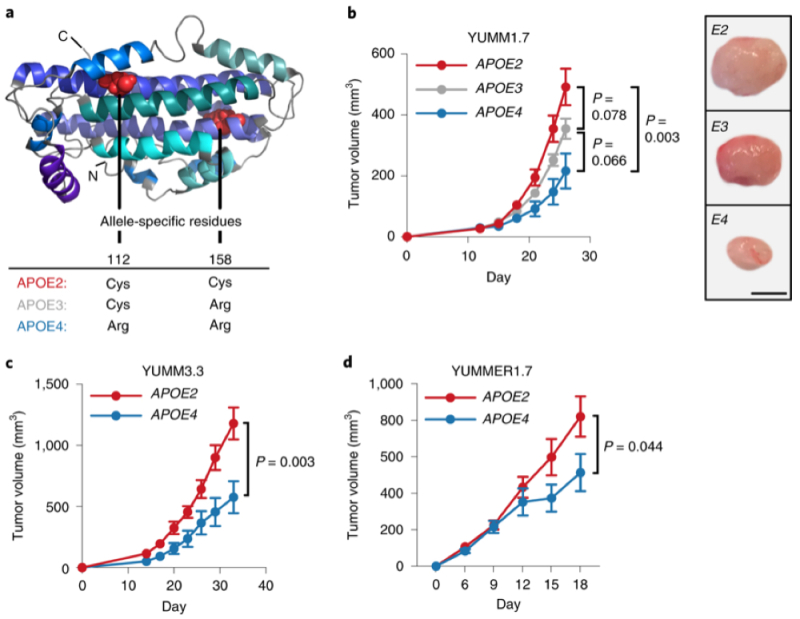
    This unpredictability was illustrated in a paper recently published in Nature Medicine, entitled "Common germline variants of the human APOE gene modulate melanoma progression and survival."  These authors* showed (somewhat paradoxically) that one variant of the human APOE gene (APOE2) was associated with a propensity for tumor cells to metastasize, while a different variant (APOE4), which has been known for several years to be associated with development of Alzheimer's disease (see Strittmatter et al., 1993, Proc. Natl. Acad. Sci. USA 90: 1977-81), exhibited a metastasis-inhibiting effect (and APOE2 itself can have a protective effect on development of late-onset Alzheimer's; see Corder et al., 1994, Nat. Genet. 7: 180-84).

    The experiments were performed in mice expressing human APOE4 or APOE2 by genetic replacement of the mouse analogs.  Differences in melanoma tumor growth in these two mouse strains carrying these different human APOE genes were shown by comparing mouse melanoma tumor growth as shown in this Figure:

    Image
    (where YUMM3.3 and YUMMER1.7 are murine melanoma cell lines).

    The protective effects against metastasis of APOE4 were compared with APOE2 in these mice was demonstrated by tail vein injection of B16F10 melanoma cells, an established metastasis animal model.  The human APOE4-bearing mice had a phenotype of enhanced anti-tumor immune response and improved outcomes under PD1 immune checkpoint blockade.

    Because APOE was known to have modulatory effects on immune response, flow cytometric analysis of APOE gene variants in mice was performed and showed "enhanced recruitment of CD45+ leukocytes in animals bearing various melanoma tumors in APOE4 mice compared with APOE2 mice."  Proportions of immune suppressor cells (Ly6G+ granulocytic myeloid-derived suppressor cells) were found to be diminished in APOE4-bearing mice, while these mice showed increased proportions of antitumor effector cells such as natural killer (NK) cells and CD8+ T cells.  These results were confirmed by single-cell RNA sequencing for detecting lineage-specific gene expression.  Further experiments showed that T cell depletion "completely abrogated" differences in melanoma tumor growth between human APOE4– and human APOE2-bearing mice.  The authors concluded that "[t]hese data suggest that APOE genotype modulated both the abundance and the functional state of the tumor immune microenvironment, with the APOE4 variant eliciting an enhanced anti-tumor immune profile relative to the APOE2 variant."  These authors also showed that APOE4 suppressed melanoma cell invasion and endothelial recruitment (involved in angiogenesis), which was consistent with lower blood vessel density in APOE4 mice.

    In addition to these mouse studies, the authors assessed APOE genotype association in melanoma human patients from The Cancer Genome Atlas (TCGA).  Neither of these APOE variants was enriched in the database, which the authors said indicated neither gene was involved in increased melanoma incidence.  However, APEO4 carriers had improved survival, with 10.1 years for these patients versus 2.1 years for APEO2 carriers.  This outcome was surprising due to the reduced longevity associated with APOE4 carriers, which the authors attributed to the high rates of melanoma-associated death.  These results demonstrated that "germline genetic variants of APOE differentially associated with survival in patients with advanced melanoma who were at increased risk for melanoma-associated death and metastasis."

    PD-1 immunotherapy is a commonly used treatment for melanoma, and "APOE4 mice survived significantly longer than APOE2 mice upon anti-PD1 treatment, suggesting that APOE genotype modulates melanoma outcome also in the context of immunotherapy," according to the results shown in the paper.  In humans,  "APOE4 and APOE2 carriers exhibited the longest and shortest survival outcomes, respectively, upon anti-PD1 therapy," consistent with the results in mice.

    The final set of experimental results reported in this paper involved pharmacologic activation of APOE through liver X receptors, which are "nuclear hormone receptors that transcriptionally activate several genes implicated in cholesterol and lipid metabolism, including APOE."  In mice, this effect was completely abrogated in APOE2 mice but showed "robust anti-tumor effects" upon treatment in APOE4 mice.  The authors concluded from these results that "distinct APOE genotypes elicited differential responsiveness to LXR agonistic therapy and might serve as potential genetic biomarkers for current clinical efforts investigating the use of LXR agonism in cancer therapy."

    The authors provide the following context for the results set forth in their paper:

    Our findings have several potential clinical implications.  Most importantly, they suggest that common germline variants might serve as biomarkers to identify patients with melanoma who are at high risk for metastatic relapse and melanoma-associated death for treatment with adjuvant systemic therapy.  Notably, these clinical association findings will need to be assessed in prospective studies.  It will be important to also assess the effect of APOE genotype on the outcome of additional cancer types.  More generally, our findings support the notion that hereditary germline variants in the same gene can positively or negatively affect future progression and survival outcomes and responsiveness to therapy in a common human malignancy.

    Authors: Benjamin N. Ostendorfa, Jana Bilanovica,  Nneoma Adakua, Kimia N. Tafreshiana, Bernardo Tavoraa, Roger D. Vaughanb & Sohail F. Tavazoiea 

    a Laboratory of Systems Cancer Biology, The Rockefeller University, New York, NY, USA
    b Department of Biostatistics, The Rockefeller University, New York, NY, USA

  • By Donald Zuhn —

    World Health OrganizationOn March 11, World Health Organization Director-General Tedros Adhanom declared that the COVID-19 outbreak "can be characterized as a pandemic."  At the time of the announcement, the WHO noted that there were 118,000 cases reported globally; in its situation report for June 10, the WHO indicates that to date there have been 7,145,539 cases globally.  The WHO's declaration in March — and global developments since then — raise the question of how the pandemic has been affecting the patent community.

    We have been reporting (see links below) on the impact of the COVID-19 pandemic on the U.S. Patent and Trademark Office, World Intellectual Property Organization, European Patent Office, IP Australia, Intellectual Property Office of New Zealand (IPONZ), Brazilian Patent and Trademark Office (INPI), Canadian Intellectual Property Office (CIPO), Mexican Institute of Industrial Property (IMPI), National Office of Intellectual Property (ONAPI) in the Dominican Republic, Intellectual Property India, National Intellectual Property Office (NIPO) in Sri Lanka, Israel Patent Office, Intellectual Property Office of Vietnam (NOIP), and Directorate General of Intellectual Property (DGIP) in Indonesia, as well as U.S. Federal courts, including, in particular, the Supreme Court and Federal Circuit.  Today, we present an update regarding COVID-19-related extensions for several of the above patent offices:

    Canadian Intellectual Property Office (CIPO)

    • CIPO has designated any deadline falling between March 16, 2020 and July 3, 2020 as being a day where any time period ending on one of those dates is extended to the next day, which means that, effectively, any deadlines for Canadian applications falling within between March 16, 2020 and July 3, 2020 are extended to Monday, July 6, 2020 (see CIPO website).

    European Patent Office (EPO)

    • The EPO has announced that it will temporarily waive the additional fee due when a renewal fee is paid late. This waiver will only be applicable from June 1, 2020 until August 31, 2020 with respect to European patent applications where a renewal fee has fallen due on or after March 15, 2020, and the renewal fee was not paid by the due date (see EPO website).

    Office of the Controller General of Patents, Designs and Trade Marks (CGPDTM) – Intellectual Property India

    • The Delhi High Court stayed (until further orders) the operation of two public notices issued in May by the IPO, which had set a new deadline of June 1, 2020 for the submission of documents in proceedings under the Patents Act. As a result, all due dates from March 15, 2020 currently stand suspended.

    Directorate General of Intellectual Property (DGIP) — Indonesia

    • The DGIP has extended the closure period of the DGIP's Intellectual Property Service Counter until further notice.

    Instituto Mexicano de la Propiedad Industrial (IMPI)

    • IMPI has announced that the suspension of activities and interruption of terms has been extended until the Government’s COVID restrictions are lifted (the suspension of activities and suspension of terms began on March 24, 2020). IMPI may resume its normal activities between June 15 and June 30, 2020, but this will depend on the evolution of the COVID-19 pandemic in Mexico City.

    United States Patent and Trademark Office (USPTO)

    • The USPTO has waived the petition fee pursuant to 37 C.F.R. § 1.17(m) when patent applicant or patent owner files a reply with a petition under 37 CFR 1.137(a) in those instances when patent applicants or patent owners were unable to timely reply to an Office communication due to the effects of the coronavirus outbreak, which resulted in the application being held abandoned or the reexamination prosecution terminated or limited.
    • The USPTO has also waived requirements for submitting an original handwritten signature personally signed in permanent dark ink or its equivalent for certain correspondence with the Office of Enrollment and Discipline and certain payments by credit card.
    • Pursuant to Coronavirus Aid, Relief, and Economic Security Act (CARES Act), the USPTO previously extended deadlines for the filing of certain patent-related documents or payment of certain required fees (as specified in the USPTO's April 28, 2020 notice) that would have been otherwise due between March 27 and May 31, 2020, to June 1, 2020.
    • Pursuant to Coronavirus Aid, Relief, and Economic Security Act (CARES Act), the USPTO has extended deadlines for the filing of certain patent-related documents or payment of certain required fees (as described in the USPTO's April 28, 2020 notice) that would have been otherwise due between March 27 and June 1, 2020, which "will now be deemed timely filed if filed by July 1, 2020."  However, the additional extensions are "[f]or small and micro entities only" (emphasis added).


    Patent Docs
    will continue to monitor and report on patent-related developments related to the COVID-19 pandemic.  In addition, we encourage our readers to let us know about any changes or updates to the information provided above, as well as any developments related to the COVID-19 pandemic at other patent offices.

    For additional information regarding this and other related topics, please see:

    • "USPTO Announces Further Extension of Certain Patent Deadlines for Small and Micro Entities," May 27, 2020
    • "USPTO Announces COVID-19 Prioritized Examination Pilot Program," May 18, 2020
    • "USPTO Announces Further Extension of Certain Patent Deadlines," April 30, 2020
    • "Impact of COVID-19 Pandemic on Patent Offices and Federal Courts – April 12 UPDATE," April 12, 2020
    • "USPTO Answers FAQs on Extension of Patent Deadlines under CARES Act," April 6, 2020
    • "Impact of COVID-19 Pandemic on Patent Offices and Federal Courts – April 2 UPDATE," April 2, 2020
    • "USPTO Announces Extension of Certain Patent Deadlines," March 31, 2020
    • "Impact of COVID-19 Pandemic on Patent Offices and Federal Courts — March 29 UPDATE," March 29, 2020
    • "Impact of COVID-19 Pandemic on Patent Offices and Federal Courts — March 26 UPDATE," March 26, 2020
    • "Impact of COVID-19 Pandemic on Patent Offices and Federal Courts — March 19 UPDATE," March 19, 2020
    • "Impact of COVID-19 Pandemic on Patent Offices and Federal Courts — March 18 UPDATE," March 18, 2020
    • "Impact of COVID-19 Pandemic on Patent Offices and Federal Courts — March 17 UPDATE," March 17, 2020
    • "Impact of COVID-19 Pandemic on Patent Offices and Federal Courts – UPDATED," March 16, 2020
    • "Impact of COVID-19 Pandemic on Patent Offices and Federal Courts," March 15, 2020

  • By Kevin E. Noonan —

    Federal Circuit SealIn Amneal Pharmacueticals LLC v. Almirall, LLC, the Federal Circuit professed to address a question it had not considered before:  whether attorney's fees and a exceptional case determination was available for fees and costs incurred when a patent owner defended an inter partes review (IPR) challenge before the Patent Trial and Appeal Board.  The Court decided they were not, based on Court of Claims and Patent Appeals (CCPA) precedent and its plain meaning reading of the statute.

    The case arose over Almirall's U.S. Patent Nos. 9,161,926 and 9,517,219, which were listed in the Orange Book with regard to Almirall's ACZONE (dapsone) prescription acne treatment.  Prior to filing an ANDA, Amneal petitioned the PTAB for IPR individually against the '926 and '219 patents (the latter IPR and patent not being part of this appeal).  Thereafter, Amneal filed its ANDA and Almirall filed suit, alleging infringement only of the '219 patent.  Amneal filed a declaratory judgment counterclaim against the '926 patent (the subject of this appeal) and the parties attempted to settle, which negotiations included Almirall's offer to give Amneal a covenant-not-to-sue on the '926 patent.  The parties being unable to agree on settlement terms, the IPR was allowed to proceed to Final Written Decision, where the PTAB found Amneal had not established that the challenged '926 patent claims were unpatentable.  Amneal appealed but then moved the Federal Circuit for voluntary dismissal.

    Almirall did not challenge the dismissal but moved that the Court grant it attorney's fees and costs incurred but only during the time between when the settlement negotiations broke down and the trial date in the IPR, as well as the fees and costs involved in defending against Amneal's motion to dismiss.  Almirall's argument that the case was exceptional and thus that fees and costs should be assessed against Amneal was that it was unreasonable for Amneal to have continued to pursue the IPR against the '926 patent after Almirall offered the covenant-not-to-sue and to remove the '926 patent from the Orange Book.

    In an Opinion and Order issued by Judge Dyk, joined by Judges Lourie and Reyna the Federal Circuit refused to assess attorney's fees and costs against Amneal.  The panel based its decision, first, on the "American Rule" that generally in the U.S. (unless there is a recognized or statutory exception) "each party in a lawsuit ordinarily shall bear its own attorney's fees," quoting Hensley v. Eckerhart, 461 U.S. 424, 429 (1983).  The Court recognized that Congress has provided such an exception under the Patent Act, in Section 285, where (should a court find the case is exceptional) reasonable attorney's fees can be awarded to the prevailing party.  The opinion states that the Court finds no authorization in the statute for awarding such fees for proceedings before the Patent Office in an appeal to the Federal Circuit.

    The Court reasoned that, first, being bound by CCPA precedent (under S. Corp. v. United States, 690 F.2d 1368, 1370 (Fed. Cir. 1982) (en banc)) the several occasions where that Court considered and denied attorney's fees petitions were binding.  These decisions include Reddy v. Dann, 529 F.2d 1347, 1349 (C.C.P.A. 1976), where the CCPA reasoned that the placement of Section 285 in Chapter 29 of the statute, which is concerned with infringement, indicated that such attorney's fees petitions were "clearly inapplicable to this court."  The CCPA reached the same conclusion in Meitzner v. Mindick, 549 F.2d 775, 784 (C.C.P.A. 1977), regarding an "exceptional interference," which precedent was followed by the district court in Bowmar Instr. Corp. v. Tex. Instr., Inc., No. F74-137, 1978 WL 21733, at *1 (N.D. Ind. Aug. 1, 1978).

    The opinion also found no support for Almirall's petition in the plain meaning of the statute.  The determinative terms were that reference to "[t]he court" was limited to "judicial proceedings," relying on Blyew v. United States, 80 U.S. (13 Wall.) 581, 595 (1872), for meaning of terms like "case and "cause" as being limited to proceedings before a court, in a suit or action.

    The opinion also finds support for analogous "fee-shifting" provisions in other statutes involving administrative proceedings, citing Kahane v. UNUM Life Ins. Co. of Am., 563 F.3d 1210, 1215 (11th Cir. 2009), regarding 29 U.S.C. § 1132(g)(1) and W. Watersheds Project v. U.S. Dep't of the Interior, 677 F.3d 922, 926–27 (9th Cir. 2012), regarding the Equal Access to Justice Act, 28 U.S.C. § 2412(d)).  The Court did not credit Almirall's cases asserted in support of its opinion to lead to a contrary result.  In Sullivan v. Hudson, 490 U.S. 877 (1989), the panel interprets the Supreme Court's decision permitting attorney's fees for administrative proceedings to be limited to cases "where 'a suit has been brought in a court,' and where 'a formal complaint within the jurisdiction of a court of law' remains pending and depends for its resolution upon the outcome of the administrative proceedings" (emphasis in opinion), which was not the case here.  And in its own Therasense v Becton Dickenson, the panel states that "we were clearly only referring to district court and appellate court proceedings."  (The panel also notes that PPG Indus., Inc. v. Celanese Polymer Specialties Co., 840 F.2d 1565, 1569 (Fed. Cir. 1988), not cited by Almirall, is consistent with its views, wherein the fees awarded were limited to those fees "incurred after the filing of a civil action, and the fees were awarded in that district court proceeding" and because the proceedings before the PTO were "intimately tied to the resolution of that action.")

    There has been an increase in motions for attorney's fees and awards of such fee since the Supreme Court's decisions in Octane Fitness, LLC v. ICON Health & Fitness, Inc. and Highmark Inc. v. Allcare Health Mgmt. Sys., Inc.  This decision by the Federal Circuit draws a line limiting such awards for fees and costs incurred in PTAB proceedings (although the opinion notes is a footnote that sanctions provisions exist under PTAB rule for misconduct should the need for such sanctions arise).

    Amneal Pharmaceuticals LLC v. Almirall, LLC (Fed. Cir. 2020)
    Panel: Circuit Judges Lourie, Dyk, and Reyna
    Opinion by Circuit Judge Dyk

  • CalendarJune 9, 2020 – "Discussion with Senior PTAB Judges on PTAB Operations in Light of COVID-19" (Intellectual Property Owners Association) – 2:00 pm (EDT)

    June 9, 2020 – "The Global Migration of IP" (LexisNexis and IPWatchdog) – 12:00 pm (ET)

    June 10, 2020 – "Practical Strategies for Agile IP Management" (CPA Global) – 16:00 CEST

    June 11, 2020 – "Litigation Funding Underwriting: How Good Is Your Patent Case?" (Intellectual Property Owners Association) – 2:00 pm (EDT)

    June 17, 2020 – "Strategies for Speeding up or Slowing Down Patent Prosecution" (J A Kemp) – 16:30 to 17:30 pm GMT (Greenwich Mean Time)

  •     By Donald Zuhn —

    Federal Circuit SealIn April, the Federal Circuit affirmed a decision by the U.S. District Court for the Eastern District of Texas granting summary judgment in favor of Repro-Med Systems, Inc., finding that Repro-Med did not infringe U.S. Patent No. 8,961,476.  EMED Technologies Corp., which owns the '476 patent, had filed suit against Repro-Med, asserting that Repro-Med's safety needle devices infringed the '476 patent.

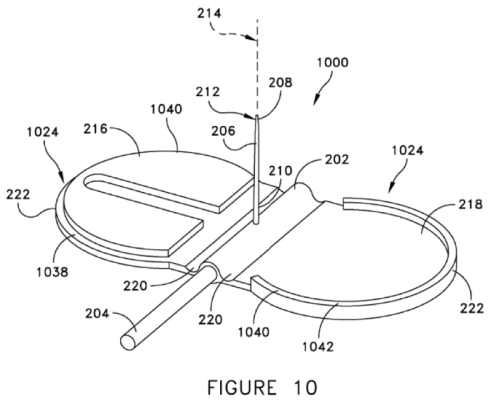
    The '476 patent is directed to medical needle devices with built-in safety structures to protect users from the sharp tip of the medical needle, with the specification describing various embodiments, and the relevant embodiment being depicted in Figure 10:

    Image 1As shown in Figure 10, the safety device includes a needle 208 between a pair of opposing "wings" 216 and 218, which when rotated into a closed position, house the needle into a "groove" (which is not labeled in Figure 10, but which is shown in the figure as a narrow recess in wing 216).

    In response to EMED's complaint, Repro-Med petitioned for inter partes review of claims 1-10 of the '476 patent.  The Board instituted the IPR and found claims 1-8 and 10 to be unpatentable.  In an earlier decision, the Federal Circuit affirmed the Board's determination, leaving claim 9 as the only claim at issue before the District Court.  Claim 9 depends from claim 8, which depends from claim 1.  Claims 1, 8, and 9 recite (with emphasis in claims 8 and 9 from the panel opinion):

    1.  A device for protecting a user from a sharp tip of a medical needle, the device comprising:
        a central body portion;
        the medical needle having a first end in fluid connection with a delivery tube, and a second end distal from the central body portion including the sharp tip;
        a pair of wings, each wing of the pair of wings having an inner region and an outer region, the inner region of each wing in attachment to the central body portion, the outer region of each wing extending away from the central body portion, the pair of wings disposed in opposition to one another with the medical needle positioned therebetween, and the pair of wings being selectively positionable from an open position to a closed position, where the wings in the open position are spaced apart from each other to expose the medical needle to al-low placement of the medical needle into a treatment site and delivery of a medicinal fluid, and wherein the wings in the closed position cover the medical needle to protect against accidental needle stick injury from the medical needle;
        a mechanical fastener disposed on at least one wing of the pair of wings, the mechanical fastener con-figured to selectively attach the pair of wings together with the medical needle positioned therebetween so as to protect against accidental needle stick injury from the sharp tip of the medical needle;
        the mechanical fastener including a lip extending along at least a portion of a perimeter of at least one wing of the pair of wings, and a mating portion along a perimeter of at least one other wing of the pair of wings, and wherein the mating portion and the lip are configured to align the at least one wing relative to the at least one other wing in the closed position.

    8.  The device in accordance with claim 1, wherein at least one of the pair of wings is formed with a groove having a size configured for housing at least a portion of the medical needle when the pair of wings are in the closed position.

    9.  The device in accordance with claim 8, wherein the groove is formed in a single one of the pair of wings.

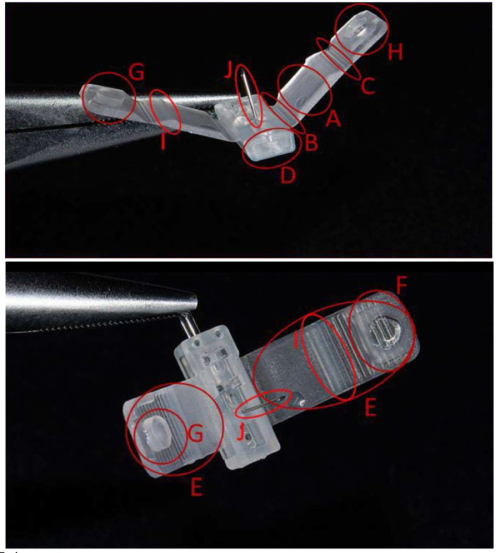
    In response to EMED's assertion of infringement, Repro-Med argued that its safety needle devices differ with respect to the exposed length of the needle as measured from the housing to the sharp tip.  Repro-Med provided the annotated figures and description of those figures set forth below:

    Image 2

    [E]ach wing (E) has a needle facing surface that in-cludes a smooth rectangular section (A) interposed between two thinned areas (B and C). A first thinned area (B) is provided between the housing (D) and the wing (E), thereby allowing each wing (E) to move between open and closed positions. A second thinned area (C) is provided between the rectangular section (A) and the outer section (F) of the wing (E) bearing the plug (G) and the wing (E) bearing the socket (H). This second thinned area (C) allows the outer section (F) of each wing (E) to bend relative to its adjacent smooth rectangular section (A), allowing the plug (G) and the socket (H) to engage and thereby lock the wings together in the closed position about the medical needle. Each of the rectangular surface sections (A) have a ridge (I) adjacent the second thinned area (C), the ridge (I) extending perpendicular to the length (J) of the medical needle extending from the housing.

    At trial, the District Court construed several terms relating to the "groove" of claim 9, determining that the term "groove" means "a long narrow cut or depression," and adopting the parties' agreed-upon constructions of the claimed groove "having a size configured for housing at least a portion of the medical needle" to mean "having a size designed for housing at least a portion of the medical needle that includes the sharp tip," and the phrase "wherein the groove is formed in a single one of the pair of wings" to mean "wherein the groove is formed in only one of the pair of wings."  Repro-Med moved for summary judgment of noninfringement, and a magistrate judge recommended that summary judgement be granted in favor of Repro-Med.  Because there is no space to house the needle in Repro-Med's safety needle devices, the magistrate recommended a finding of no literal infringement.  The magistrate also recommended a finding of no infringement under the doctrine of equivalents because treating portions of Repro-Med's safety needle devices as the claimed "groove" would vitiate the claim limitations of "a groove having a size configured for housing at least a portion of the medical needle when the pair of wings are in the closed position" and "wherein the groove is formed in a single one of the pair of wings."  The District Court adopted the magistrate's recommendation and granted summary judgment of noninfringement in favor of Repro-Med.

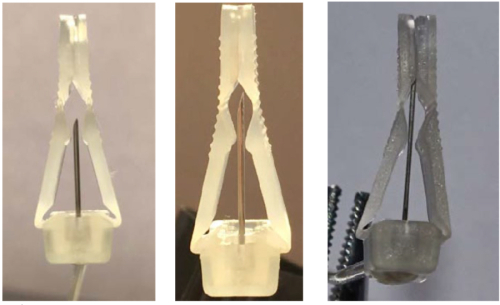
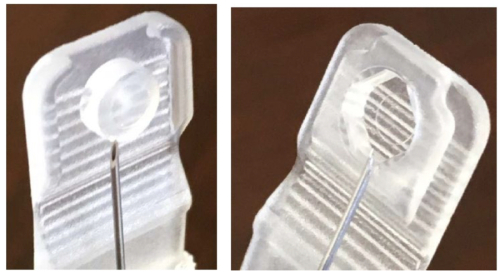
    The Federal Circuit begins by explaining that under the District Court's constructions, which neither party disputed, the claimed groove is a "a long narrow cut or depression" formed in "only one of the pair of wings," "ha[s] a size designed for housing at least a portion of the medical needle that includes the sharp tip," and must perform the specific function of housing the needle "when the pair of wings are in the closed position."  The opinion notes, however, that Repro-Med's safety needle devices lack a "groove" as claimed and protect the user from the needle in a different way:

    Image 3

    Image 4
    Although EMED argued that the "groove" is self-evident in the images above, the Federal Circuit disagreed, explaining that "EMED's theory fails to account for the requirement that the groove 'house[s]' the needle 'when the pair of wings are in the closed position.'"  The Federal Circuit therefore agreed with the District Court that there was no genuine dispute that Repro-Med's safety needle devices do not contain the claimed groove, and therefore do not literally infringe claim 9 of the '476 patent.

    With respect to infringement under the doctrine of equivalents, the Federal Circuit noted that the claims explicitly require that the "groove" must house the needle when the wings are in the closed position, and explained that "[t]o extend the claimed 'groove' to encompass structures that do not house the needle would vitiate that claim limitation."  The Federal Circuit, therefore, affirmed the District Court's grant of summary judgment of noninfringement.

    EMED Technologies Corp. v. Repro-Med Systems, Inc. (Fed. Cir. 2020)
    Nonprecedential disposition
    Panel: Circuit Judges Chen, Schall, and Hughes
    Opinion by Circuit Judge Chen

  • IPO #2The Intellectual Property Owners Association (IPO) will offer a one-hour webinar entitled "Discussion with Senior PTAB Judges on PTAB Operations in Light of COVID-19" on June 9, 2020 at 2:00 pm (EDT).  Hon. Jacqueline Wright Bonilla, Deputy Chief Administrative Patent Judge; Hon. Michael W. Kim, Acting Vice Chief Administrative Patent Judge for Operations; and Hon. Michael P. Tierney, Vice Chief Administrative Patent Judge, all of the Patent Trial and Appeal Board (PTAB) at the U.S. Patent and Trademark Office (USPTO); and Todd R. Walters of Buchanan Ingersoll & Rooney will discuss PTAB operations and recent trends and developments in practice before the PTAB in light of COVID-19.  Topics to be addressed include maintaining schedules, handling requests for extensions of time, complying with statutory mandates, depositions, oral hearings, and unique issues that have arisen in light of current events.

    There is no registration fee for IPO members for this webcast (the fee for non-members is $150).  Additional information regarding the webcast can be found here.

  • IPO #2The Intellectual Property Owners Association (IPO) will offer a one-hour webinar entitled "Litigation Funding Underwriting: How Good Is Your Patent Case?" on June 11, 2020 at 2:00 pm (EDT).  Charles Agee of Westfleet Advisors, Eric Carlson of Burford Capita, and Christopher Lee of Lee Sheikh Megley & Hahn will give attendees sophisticated insight into how funders decide in which cases they will invest and what determines the pricing; how the calculus has changed since the advent of IPRs; surprises patent owners and law firms may encounter in their search for funds; and what work a law firm needs to accomplish on a case before seeking funding.

    The registration fee for the webinar is $135 (IPO member) or $150 (non-member) (government and academic rates are available upon request).  Those interested in registering for the webinar can do so here.