
By Michael Borella and Walter DeGroft[1] –

For the fifth consecutive year, we have surveyed how the Patent Trial and Appeal Board (PTAB) decides appeals of § 101 rejections from examiners. Readers of the previous installments will know the drill by now. Applicants who appeal a subject matter eligibility rejection to the PTAB have historically faced odds somewhere between long and laughable. The affirmance rate was 87.1% in 2021, 88.4% in 2022, 91% in 2023, and 88.6% in 2024.[i] Against the PTAB’s overall affirmance rate of roughly 60% across all grounds of rejection,[ii] these numbers painted a picture of an institution that, whatever the merits of any individual appeal, treated ineligibility as close to a foregone conclusion. We attributed this less to the weakness of applicants’ inventions and more to the Alice Corp. v. CLS Bank Int’l framework itself, a test so malleable that decision-makers could reach nearly any result while appearing to follow precedent, and one that the PTAB near-consistently resolved against applicants.
This year, for the first time, we have something resembling good news. On September 18, 2025, John A. Squires was confirmed as Director of the USPTO, and he wasted no time signaling that the Office’s approach to § 101 would change. Barely a week into his tenure, Squires wrote an Appeals Review Panel decision vacating a PTAB panel’s sua sponte § 101 rejection of a machine learning application in Ex parte Desjardins, chiding the PTAB for evaluating the claims at too high a level of generality and reminding it that §§ 102, 103, and 112 are the traditional and appropriate tools for limiting patent scope.[iii] The decision was designated precedential on November 4, 2025, and its reasoning has since been incorporated into the MPEP.[iv] PTAB panels took notice, with post-Desjardins decisions such as Ex parte Carmody reversing § 101 rejections in a manner that tracks the new guidance.[v]
So, has the fever finally broken? The answer, based on the 2025 data, is a qualified “somewhat.” The overall affirmance rate for 2025 was 84.9%, a modest but measurable decline from prior years, with most of the movement concentrated in decisions issued after Squires took office. Indeed, broken out by quarter, we found that the affirmance rate dropped to 75.4% in Q4 of 2025, after being 88.3% through Q1, Q2, and Q3.
To be clear, an applicant appealing a § 101 rejection still loses far more often than not, and one precedential decision cannot untangle a decade of Alice-induced confusion. But after four years of reporting that the situation was bad and nothing was changing, we can at least report that something has. Whether that something amounts to a long-term course correction or a blip remains to be seen.
As was the case in previous years, we applied a strict search methodology on the PTAB’s decision portal to identify qualifying § 101 appeals. Particularly, we specified the following criteria: decision dates between January 1, 2025 and December 31, 2025, a proceeding type of “appeal”, a decision type of “decision”, and an issue type of “101”. These search results were overinclusive and thus required filtering and a degree of manual review.
We only included decisions in which the applicant appealed an examiner’s Alice-based § 101 rejection and the PTAB ruled on this basis of appeal. To simplify the analysis, we considered a decision to be an “affirmance” of the examiner’s § 101 rejection if the PTAB held at least one claim invalid under § 101. Excluded cases were those in which: (i) the appeal was not of a § 101 issue but the PTAB set forth a new ground of rejection based on § 101, and (ii) the appeal was of a § 101 issue but the PTAB did not decide the case on § 101 grounds (e.g., the examiner withdrew the § 101 rejections after the appeal was filed). This gave us 977 qualifying appeals, of which 829 resulted in affirmance on § 101 grounds, yielding the aforementioned affirmance rate of 84.9%.[vi]
In order to determine the Squires Effect, we broke this data out by month.
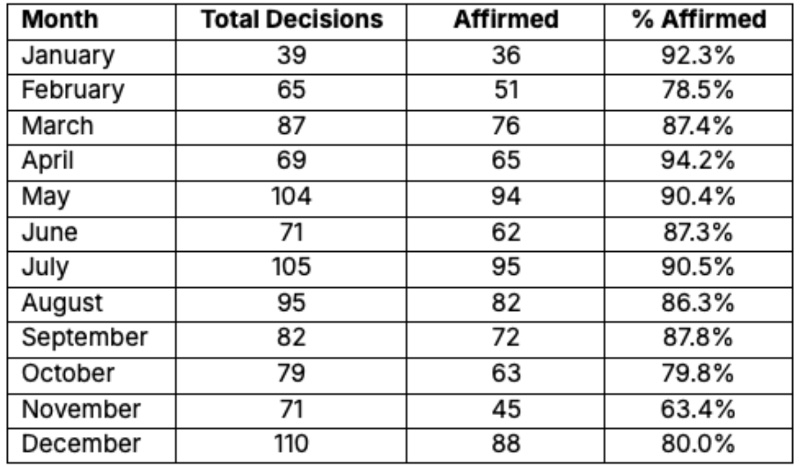
As noted above, until Squires’ appointment, the 2025 data tracked the rates we had found in 2021-2024. But in October through December of 2025, the rates dropped. This suggests that the new Director’s policy change had an immediate, if limited, impact. To keep things in perspective and assuming the Q4 rates hold steady, an applicant appealing a § 101 rejection has about the same chance of success as correctly calling two coin flips in a row. The house still wins – and wins often. But for the first time since we began tracking these numbers, the house’s edge has visibly narrowed, and that alone is worth noting.
The data also provided additional insights. For example, when broken out by technology center, we found a pattern consistent with previous years – that the vast majority of appeals and affirmances come from TC2100, TC3600, and TC3700.
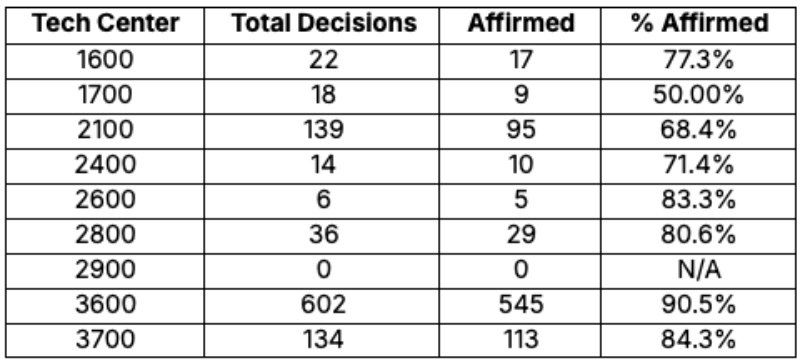
Having said that, the affirmance rates in all three of these technology centers dropped off in comparison to previous years.[vii] For example, TC3600 and TC3700 had hovered above 95%, while TC2100 had fluctuated between 75% and 86%. The drops in 2025 are notable, and even more so when considering just the Q4 data – TC2100 was 48.3%, TC3600 was 86.8%, and TC3700 was 73.1%.
We also considered situations in which the PTAB came up with its own grounds of rejection under § 101. This can occur when the PTAB reverses the examiner’s grounds of rejection and replaces it with their own, or when the examiner did not reject the claims under § 101 but the PTAB issued a sua sponte rejection. We were curious regarding the Squires Effect on this metric, as Squires wrote in Desjardins: “However, it is with this view that the panel’s sua sponte action is most troubling, as it eschewed the clear teachings of Enfish, and instead substituted only a cursory analysis that ignored this well-settled precedent. Panels should treat such precedent with more care, especially when acting sua sponte.”
Indeed, we found that this chiding seemed to have the desired result. While there were relatively few new grounds of rejection under § 101 in the data (at most 9 in any month), the quarterly numbers dropped from 9, 14, and 13 in Q1, Q2, and Q3, respectively, to 5 in Q4. The data here is too sparse to draw firm conclusions, but the early trend is promising.
Finally, 2025 had 4 utility rejections, more than we have seen in any previous year. These decisions are not reflected in the data above (as there was no Alice analysis). One such decision adopted the Examiner’s reasoning of “because the device, as disclosed, would violate Newton’s Laws of motion as well as fundamental Conservation of Momentum principles, the device is incapable of a specific, credible, and substantial utility as required by 35 U.S.C. § 101.”[viii] We take no position on this matter, aside from noting that the decision serves as a reminder that § 101 was intended to be a coarse filter to reject or invalidate clearly non-statutory inventions. The Alice overreach is judge-made law incongruously grafted onto the legislation.
So where does this leave us? After four years of documenting a tribunal that affirmed § 101 rejections with reliability akin to that of a sunrise, we can finally report a wobble in the orbit. The Squires Effect seems to be measurable, if modest in the grand scheme of things. An applicant appealing an eligibility rejection in late 2025 still lost three times out of four, which is nobody’s definition of a fair fight. But in a corner of patent law where the status quo has survived a decade of criticism from judges, scholars, and at least one long series of articles from frustrated practitioners at a certain Chicago-based firm, a ten-point drop in a single quarter qualifies as notable activity. Whether this is the beginning of a genuine correction or merely a brief administrative mood swing will depend on what the Director does next, what the PTAB internalizes, and whether anyone in Congress remembers that § 101 is their statute to fix.
[1] Walter DeGroft is a 2026 summer associate at MBHB. In the Fall, he will begin his final year of law school at Chicago-Kent.
[i] See https://patentdocs.org/2022/09/13/think-twice-about-appealing-a-101-rejection-to-the-ptab/, https://patentdocs.org/2023/01/31/ptab-remains-hostile-to-section-101-appeals/, https://patentdocs.org/2024/08/12/91-that-is-the-rate-at-which-the-ptab-affirms-examiner-section-101-rejections/, https://patentdocs.org/2025/08/25/ptab-101-appeal-stats-for-2024-the-more-things-stay-the-same-the-worse-they-remain/.
[ii] https://www.uspto.gov/sites/default/files/documents/appeal_stats_may2026.pdf.
[iii] https://www.uspto.gov/sites/default/files/documents/202400567-arp-rehearing-decision-20250926.pdf.
[iv] See https://www.uspto.gov/sites/default/files/documents/memo-desjardins.pdf.
[v] Ex parte Carmody, Appeal 2025-002843 (PTAB Dec. 30, 2025).
[vi] This total of 977 decisions is the highest by far of any of the four previous years in which we have conducted this study. The previous record was 708 decisions in 2021.
[vii] The table sums to 971, rather than 977, due to intentional omissions of the “experimental” technology centers, such as 3900, RD00, OPQA, OPT, and OPET. All decisions from these technology centers resulted in affirmance.
[viii] Ex parte Wood, Appeal 2023-004154 (PTAB Jun. 2, 2025).


Leave a comment