
By
Andrew Williams —
The
mainstream media continues its attack on the patent system. This problem has become significant, because
the average American does not appear to understand the purpose (and benefits)
of the patent system. With all of the
misinformation being reported, it is no wonder that lay people have the
perception that the patent system is "broken." This blog has reported in the past about NPR's
criticisms of the patent system, which have occurred on such shows as "This
American Life" and podcasts as "Planet Money" (see "When NPR Podcasters Hit the Patent System"). We pointed out that one of the downsides of
these various reports was that the NPR hosts and reporters did not appear to
understand the patent system. But, on
the plus side (if it can be considered as such), these reporters did not hide
the fact that they did not understand the system, and they certainly did not
profess to be patent law experts.
 A
A
different tone has been taken in an article recently published on Wired.com by
Patrick Hall entitled "Patent Law Broken, Abused to Stifle Innovation." Mr. Hall's article is written from the
perspective of an "expert" in the field, beginning with the axiomatic
proposition that the system is not only broken, but that its abuse is stifling
innovation. However, a review of this
article with even a minimal understanding of the patent system suggests that not
only is Mr. Hall not actually an expert on the subject, but that he may even
lack an understanding of even the most basic tenets of U.S. patent law. This would not be so disconcerting but for
the fact that his piece was published on a site that has a wide-reaching
readership, and there was no indication or suggestion provided that the opinions
expressed were just that — opinions by someone who appears to believe that software
patents are "bad."
To
be fair, the focus of Mr. Hall's article is almost entirely on software patents
(even though he does appear to suggest that mechanical patents, such as those
that would cover automobiles, are absurd). This software focus on its own might not be of much interest to the
readership of this blog. However, the
provided "recommendations," and the criticisms provided as a whole,
are not limited to software patents, and therefore could impact pharmaceutical,
chemical, and biotech patents. Moreover,
the more public bashing that software and business-method patents take can only
result in a detriment to the patent system as a whole, especially when this is
the only exposure to the system that most Americans ever receive.
 Mr.
Mr.
Hall's piece begins with the assumption that the patent system is broken. However, any support for this proposition was
anecdotal at best. For example, the
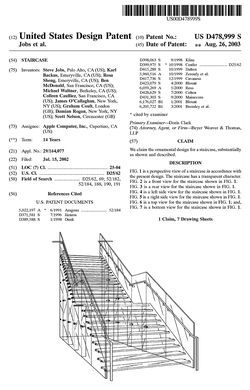
article complained that Apple received a patent for its glass staircase in
2003. No explanation was given as to why
such a patent was undeserved, but the clear implication was that there is a
problem if companies are receiving patents on staircases. No patent numbers were provided, so we are
left assuming that the article was referring to Design Patent No.
D478,999. If Mr. Hall understood the
difference between utility and design patents, it was not included in his
article. As explained on the Patent Office
website, "[a] design patent protects only the appearance of the article
and not structural or utilitarian features." So, "a 'utility patent' protects the way
an article is used and works (35 U.S.C. 101), while a 'design patent' protects
the way an article looks (35 U.S.C. 171)." Id. Therefore, instead of the
absurd proposition that Apple has patented the staircase, as the article
suggests, Apple has instead simply protected the way its staircases look.
Mr.
Hall's article also cited three "absurd" patents as evidence of a
broken system: the motorized ice cream cone, the banana suitcase, and the gas
grabber (we are not supposed to ask about this last one). There is apparently support for the
proposition that these patents are absurd — they were all featured on the "Patently
Absurd" website. But, Mr. Hall's article did not explain why
he thought these patents were absurd (other than the fact that absurdity must
be self-evident). Looking at the first
example, the motorized ice cream cone, it would appear at first glance that this
is a patent to a novelty product. But, is
the article suggesting that novelty products are undeserving of patent
protection? And a simple web search reveals
that at least someone was marketing such a device at some point (it was even
featured on Katie Lee and Hoda, a video for which can be found with the same
web search). Is Mr. Hall suggesting a
new category of inventions that are not patent eligible? But fear not, if you want to create your own
motorized ice cream cone, you can do so without threat of suit from U.S. Patent
No. 5,971,829 — that patent expired for failure to pay a maintenance fee around
2011. Of course, this highlights one of
the points that Mr. Hall's article fails to address — obtaining and maintaining
a patent can be an expensive proposition, and that if a patent is truly "absurd,"
it is unlikely someone is going through the cost and effort of obtaining or
enforcing one.
 As
As
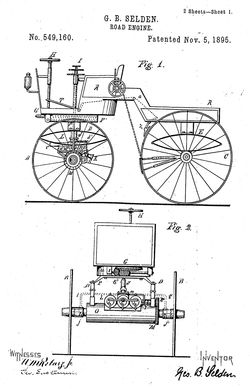
one of the most puzzling examples of how the "current" patent system
is broken, Mr. Hall's article cites U.S. Patent No. 549,160, which issued in
1895 to George Selden. This patent
claims a "road-locomotive" with "a liquid hydrocarbon gas-engine
of the compression type," or as the article puts it, an automobile. As with the other examples, the article does
not explain why a car should be underserving of patent protection. But all is well, according to article,
because Henry Ford allegedly successfully challenged this "absurd"
patent in 1911. Except that isn't quite
what happened. A simple Internet search
that digs a little deeper than the Wikipedia page for Selden's patent reveals
that his patent was never found to be invalid. It is true that his patent was surrounded by controversy, but that was
because his application was filed in 1879. Mr. Selden was apparently able to keep his application pending for close
to 20 years, until others had gotten into the business. It appears that Mr. Selden was using a "submarine"
patent more than half a century before Jerome Lemelson. Mr. Selden's downfall occurred not because
his patent was determined to be invalid, but rather the type of combustion
engines that automobile manufacturers were using at the turn of the century
were different than those use in 1879. Therefore, Mr. Ford successfully appealed a finding of infringement. Of course, such a "submarine"
patent is not feasible anymore, both because almost every application is published
after filing, and more importantly, the expiration date of patents are now limited
by the filing date. Therefore, under the
patent system that actually exists today, Mr. Selden would have only have been
able to assert his patent for a couple of years. Not surprisingly, these subtleties are missing from Mr. Hall's article.
 Mr.
Mr.
Hall's article culminates with "seven simple changes" to fix the
patent system. However, the article
makes statements and assumptions about the patent system that are incorrect,
but a layperson reading the article would have no idea that this is the case. The starting point for these seven "fixes"
were similar proposals for software patents offered by the "Defend
Innovation" initiative of the Electronic Frontier Foundation ("the
EFF"). Without taking a position on
the EFF's proposals, we note that Mr. Hall's article's exposition on these
fixes is not limited to software patents. In fact, it is in the article's expounding of these proposals that the most
confusion would be introduced for those unfamiliar with the patent system. For example, the EFF has suggested that
software patents be required to provide an example of the software code for
each claim. Patents already have a
requirement that the claims be sufficiently enabled and described, in order to
satisfy 35 U.S.C. § 112. Mr. Hall's
article, however, provides no indication that such a requirement exists. Instead, the following question is posed: "[d]o
I deserve a patent for a hovering skateboard that I cannot create?" The article gets the answer right ("Absolutely
not"), but posing the question in the first place suggests to the reader
that there is currently no enablement requirement. Such a reader is therefore left with the
impression that the Patent Office is issuing patents on "ideas" that the inventor has no idea how to implement.
As
another example, the EFF has suggested that all patents and licenses be made public. In fact, such a proposal to require the
recordation of real parties-in-interest has been included in many of the legislative
proposals that have been recently proposed (see "Congress Continues Efforts to "Reform" U.S. Patent Law"). However, Mr. Hall's article suggests that this proposal is necessary because,
without it, no one would know that a particular patent existed. "Otherwise," the article asks, "how
can innovators know if they are infringing on a patent." Such reporting leaves the lay-reader with the
impression that issued patents (or even published applications) are not
publically available. Not only is this
incorrect, it is counter to the purpose behind the patent system — to provide a
period of exclusivity in exchange for the disclosure of an invention.
Many
of the other proposals are simply unworkable or impractical. For example, the EFF had suggested a patent
term for software patents no longer than five years from the date that the
application was filed. It is unclear how
they derived that the ideal term for software patents is five years, but at
least the EFF recognized that this proposal might cause a problem with
international treaties. Mr. Hall's
article ignored this complication, and instead expanded the original proposal
by suggesting that "[p]atent lengths should reflect the speed of
innovation within individual industries." No guidance is provided, however, as to how this "speed of
innovation" is to be calculated. In
fact, if his proposal was codified, then there is no reason that the converse should
not be applied — that industries with slower innovation speeds be given patent
terms longer than the current twenty years from filing date. More importantly, Mr. Hall's article does not
take into account the logistical nightmare of how to categorize into which
industry a particular patent falls — and who would be responsible for that
determination.
The
final proposal in the article is perhaps the most ironic. The article reiterates the EFF's request that
Congress hold hearings to determine whether software patents are beneficial to
society. However, the starting point of
this article already assumed this conclusion — that the system is broken, and
is being abused to stifle innovation. But if
this is true, why should Congress waste its time with such a
study? Maybe the article's underlying
premise is not as strong as it would lead the readers to believe. The article refers to scholarly studies that
apparently have concluded that patents do not, in fact, protect economically
useful inventions. However, no such study
is cited or even mentioned. Making such
statements without providing support is irresponsible journalism.
Mr.
Hall's article concludes with the statement that "[o]nly countries with
enlightened legal institutions can sustain long-term economic growth, facilitate
innovation, and benefit from the genius of resourceful creators." On this point, the article is probably
correct. Nevertheless, this article
provides mostly unsupported statements as fact, which leads the reader to
assume that our country does not have such a legal institution. There is nothing wrong with Mr. Hall having
such an opinion, or even his putting his opinion on the internet. However, when a media outlet such as
Wired.com posts such an article, without disclaimer or qualification, it
invites the reader to assume that the piece represents reality. It is no wonder that public outrage over the
patent system is mounting. Instead, the
mainstream media needs to apply a balanced approached to the issues, present
the merits and weaknesses of both sides, and allow the readers to reach an
informed conclusion for themselves. Of
course, this is probably too much to ask.


 Patent Docs
Leave a reply to Skeptical Cancel reply