By Grantland Drutchas

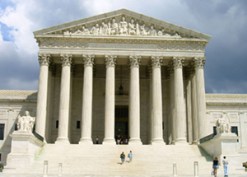
Supreme Court Building #3Perhaps one of
the most intriguing issues coming out of the Supreme Court's Myriad
decision
is whether it leaves any room for the "inventive concept"
test raised by earlier Supreme Court decisions, including Mayo v. Prometheus.  Or is inventive concept merely limited to method claims?  Compare the
mental gymnastics that the Federal Circuit had to go through for the CLS
Bank v. Alice
decision.  Where is any of that in this Supreme Court
decision?

For cDNA
claims, Justice Thomas issued nothing more than the following terse statement:

cDNA
does not present the same obstacles to patentability as naturally occurring,
isolated DNA segments.  As already explained, creation of a cDNA sequence from
mRNA results in an exons-only molecule that is not naturally occurring.  Petitioners concede that cDNA differs from natural DNA in that "the
non-coding regions have been removed."  Brief for Petitioners 49.  They nevertheless argue that cDNA is not patent eligible because "[t]he
nucleotide sequence of cDNA is dictated by nature, not by the lab technician."  Id., at 51.  That may be so, but the lab technician unquestionably creates
something new when cDNA is made.  cDNA retains the naturally occurring exons of
DNA, but it is distinct from the DNA from which it was derived.  As a result,
cDNA is not a "product of nature" and is patent eligible under §101,
except insofar as very short series of DNA may have no intervening introns to
remove when creating cDNA.  In that situation, a short strand of cDNA may be
indistinguishable from natural DNA.

Op. at pp.
16-17.  Although he dropped a footnote stating that "[w]e express no
opinion whether cDNA satisfies the other statutory requirements of
patentability" (Id., p. 17 n. 9), none of the types of "inventive
concept" analyses the Federal Circuit wrestled over in the CLS case
was provided.

Justice Scalia's
equally terse concurrence also does not address the "inventive concept"
issue as it relates to cDNA.  "[T]he portion of DNA isolated from its
natural state sought to be patented is identical to that portion of the DNA in
its natural state; and that complementary DNA (cDNA) is a synthetic creation
not normally present in nature."  Scalia Concurrence, p. 1.

There is no
question that producing cDNA is and was a well-understood, routine, conventional
activity, but that didn't seem to trouble Justice Thomas or the rest of the
Supreme Court.  If it is enough that the lab technician is, as Justice
Thomas notes, "unquestionably creat[ing] something new,"
regardless of how routine such a step is during the relevant time period, what
does that mean for the "inventive concept" concept?  Or is it
that the Supreme Court believes the "inventive concept" test is
limited to method claims, and these claims are directed to compounds?

Note, too, that
not all cDNA may be patentable:  A "very short series of DNA may have
no intervening introns to remove when creating cDNA. In that situation, a short
strand of cDNA may be indistinguishable from natural DNA."  Op. at
17.

Posted in ,

8 responses to “The Supreme Court’s Myriad Decision: Where Does It Leave the “Inventive Concept” Test?”

  1. Dan Feigelson Avatar

    Sometime in the not too distant future, someone is going to argue the Myriad sub silentio repudiates the “inventive concept” concept. Probably won’t gain much traction…

    Like

  2. Skeptical Avatar
    Skeptical

    Do you really think that a decision from the Court based on one doctrine means that any and all other doctrines are repudiated?
    I am VERY…

    Like

  3. Courtenay Brinckerhoff Avatar

    Prometheus is an example of bad claims making bad law. Hopefully the Federal Circuit will do its part to limit it to its facts — a method relating to a correlation involving a known compound/parameter with no active steps other than measuring and determining.

    Like

  4. What, me worry? Avatar
    What, me worry?

    cDNA passes the Supreme Court’s 101 hurdle, but will likely trip over the 103 hurdle.

    Like

  5. Skeptical Avatar
    Skeptical

    What, me worry?
    Please read the decision again closer. Not all cDNA passes the 101 hurdle.
    I agree with you regarding the 103 hurdle, especially given the obvious to try, marketplace as a driver, combining items without synergy cloud that has developed around 103 since the KSR decision.

    Like

  6. Matthew Gibson Avatar

    cDNA will only trip over the 103 hurdle if the gene or the protein it encodes had already been identified. If you identify a novel gene, describe a sufficient utility (which would likely require linkage to some disease or condition) and claim the cDNA sequence corresponding to the novel gene, then there is no basis for an obviousness rejection. Now, if the protein product had been identified previously and is in the prior art, then you will hit the 103 hurdle and fall on your face (see In re Kubin – Fed Cir case from 2008 or 2009- I think that’s the name of the case).

    Like

  7. Skeptical Avatar
    Skeptical

    Thanks Matthew for the in re Kubin reminder.
    This was an intersting read: http://www.patentdocs.org/2009/04/in-re-kubin-fed-cir-2009.html
    However,… since that time, the Supreme Coourt has taken upon itself EVEN MORE of a penchant for confusing 101 with rationales of dubious 103 nature. Not only have 103-like methods gone beyond making 103 rejctions for compositions, these same 103-like method rejections are being inserted into patent eligibility considerations.
    Someone (more like 9 someones) are forgetting that something pretty significant happened in 1952 when the common law ability to define invention was stripped from the courts and the pre-cursor of 101, and placed in 103, with a direct admonition not to negate patentability because of the manner in which the invention was made.
    Is there anyone in Congress who can step up and tell the nine Justices that their robes are missing?
    I am…

    Like

  8. Shrivan Avatar
    Shrivan

    Courtney: “Prometheus is an example of bad claims making bad law.”
    What’s “bad” about the holding in Prometheus, Courtney? I don’t think it was particularly controversial or “bad” that Myriad lost their method claims which covered merely looking at someone’s DNA sequence information and “determining” that they had a particular mutation or not.
    I also don’t see how the holding in Prometheus was necessary or sufficient to reach the Court’s decision here. Any Supreme Court decision can be misapplied. The Funk Brothers case seems to have been the key bit of “bad law” that the Supreme Court relied on, somehow, to reach the result in Myriad.

    Like

Leave a reply to Skeptical Cancel reply