
By Kevin E. Noonan —
 As it has frequently in
the past decade, the Federal Trade Commission on Thursday released a Report on
the frequency of reverse payment settlement agreements in ANDA litigation
between generic and branded drug makers, pursuant to its authority to
scrutinize all ANDA agreements under the provisions of the Medicare
Modernization Act of 2003.
The FTC Report contains
information from the 2012 fiscal year (from October 1, 2011 through September
30, 2012). There were 40 reverse payment
agreements among 140 "final resolutions" of ANDA litigation. According to the Report, these agreements
involved 31 different branded drugs having total combined sales of $8.3
billion. Nineteen of the 40 agreements
contained provisions wherein the branded drug maker agreed not to bring an "authorized
generic" version of the branded drug to market (thus removing a strong
competitor for the generic drug), at least for some period of time. The Report also notes that seven branded
drugs entered into "multiple" reverse payment settlements, i.e., with different generic
challengers. The Report compares this
trend with historical data from 2004, noting that in one case a branded drug
maker had entered into reverse payment settlement agreements with ten generic
challengers, with 14 branded drugs being involved in payments to three or more
generic drug makers.
Of the other 100
settlement agreements, 81 contained provisions without express payments but
with restrictions on time for generic entry, which the final 19 agreements
contained no restrictions of the generic challenger.
Forty-three of these
140 settlements were between the branded drug maker and the first ANDA filer. Of these, 23 settlement agreements had provisions both for payments and delay
or other restrictions on generic drug entry with another 16 agreements
providing for generic delay but no express compensation.
The Report draws
conclusions from this data, the most significant of which is that there were a "record"
number of reverse payment settlement agreements in fiscal 2012. The 40 agreements containing reverse payment
provisions increased from the 28 such agreements in fiscal 2011, and the 19
agreements providing for no authorized generic entry (but without express
payments) were also a record (up from 11 in fiscal 2012, perhaps reflecting the
effects of the FTC's campaign against agreements containing payment provisions
to generic drugmakers).
In the end, however,
the FTC was forced to admit that "[d]espite the record number of potential
pay-for delay settlements in FY 2012, the vast majority of patent settlements
(greater than 70%) continued to be resolved without compensation to the generic
manufacturer," at least suggesting that the Commission itself has created
this particular tempest in its teapot. The Report concludes with a table comparing rates of ANDA settlements
and the frequency of reverse payment settlement agreements since FY 2004.
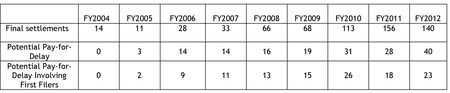
Looking at these data dispassionately,
the number of settlements of ANDA litigation has decreased, while the number of
settlements having some economic incentive for generic drug makers has
increased. However, the data also show
that this economic incentive in the form of direct payments has actually
decreased, and the Commission's statistics show an increase because it has
included agreements with "no authorized generic" provisions as "potential
pay-for-delay" agreements.
In a press release
accompany the Report, the Commission highlighted these increases,
characterizing them as having "significantly increased" and
comprising a "record number" of such agreements. (As is its wont, the Commission characterizes
these agreements as "pay for delay," even for agreements with no
express payments from the branded to the generic drugmaker.) But the Commission considers even these
agreement to be "potentially anticompetitive," saying that "[s]uch 'no-AG' [authorized generic] promises are valuable to generic firms,
as they significantly reduce the level of competition the new generic entrant
will face, allowing the generic firm to secure greater market share and extract
higher prices from consumers." The
latter statement is, of course, at least unlikely to be untrue: the value of a "no-AG"
promise is that the generic drug company will make more money, of course, but
not by charging higher prices but by recouping more of the total generic market
as a consequence of not having to split the market with the authorized generic
product.
FTC Chairman Jon Leibowitz added his own
ideological opinion on these results, saying:
Sadly, this year's report makes it clear that
the problem of pay-for-delay is getting worse, not better. . . . More
and more brand and generic drug companies are engaging in these sweetheart
deals, and consumers continue to pay the price. Until this issue is
resolved, we will all suffer the consequences of delayed generic entry — higher
prices for consumers, businesses, and the U.S. taxpayer.
This sentiment is
continued in the remainder of the press release, which correctly notes that the
average "delay" for generic drug entry is 17 months, but ignores the
reality that this is a delay from a putative successful ANDA challenge. It does not take into effect the acceleration
of generic drug entry that results from settlement of ANDA litigation rather
than that proportion of these cases where the generic drug challenger loses and
is barred from the marketplace until the challenged Orange Book listed patents
expire. While this emphasis on delay is
understandable in view of the Commission's ideological biases (and its
unsupported and unrealistic belief that only holders of "bad" patents
settle ANDA litigation), it does not give the public a clear picture of the
actual circumstances behind the data the Commission presents.
This may be the last
Report from the Commission on reverse payment settlement agreement frequency,
should the FTC prevail in its challenge to these agreements before the Supreme
Court (FTC v. Watson Pharmaceuticals). That would be the culmination of a steady
stream of Commission, district court, and appellate court challenges to these
agreements, as well as several stalled legislative efforts. The Commission's position has been rejected
often by several appellate courts (including the 2nd, 9th,
11th and Federal Circuit courts of appeal) based on an analysis of
the business and legal realities not overburdened with the Commission's
ideological bias (i.e., that any delay in generic drug entry is anticompetitive
per se). The Supreme Court should have the last word
on this issue.

 Patent Docs
Leave a reply to EG Cancel reply