
By
Donald Zuhn


ACLU In
a
motion filed on June 28, Plaintiffs-Appellees in the Association for Molecular Pathology v.
United States Patent and Trademark
case have moved for Chief Judge Randall
R. Rader to recuse himself from any involvement in the appeal.  The motion, which was filed by
attorneys from the American Civil Liberties Union (ACLU) and Public Patent
Foundation (PUBPAT) (the same two organizations that represented Plaintiffs-Appellees
before the District Court), is based on Chief Judge Rader's attendance at
events at which the case was discussed and his comments at two such events.  In particular, the motion states that
"Plaintiffs-Appellees are aware of one occasion in which Chief Judge Rader
expressed his views on the correctness of the district court's decision in this
case and another occasion when the case was being discussed when he insinuated disagreement
with Plaintiffs/Appellees' view of the law."  The motion contends that "Chief Judge Rader's
statements in this case have created an appearance of partiality that calls
into question his ability to engage in impartial legal analysis based on the
record and the argument of the parties."
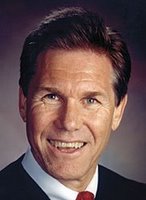

Judge Rader The
motion first describes Chief Judge Rader's (at left) participation as a panelist in a
session entitled "Patenting Genes: In Search of Calmer Waters" at the
Biotechnology Industry Organization (BIO) International Convention last May.  According to the motion, "at the
start of the session, the moderator, attorney Jennifer Gordon of Baker Botts
LLP — the same attorney who was the lead author of the BIO amicus brief in this case at the
district court — asked for a vote of those in the audience asking if they
agreed with the decision of the district court in this case," and "Chief
Judge Rader observed this popular vote by a roomful of people who had already expressed
their collective view in an amicus
brief."  The motion cites a
report in the BNA's Patent, Trademark
& Copyright Journal
, which quoted the Chief Judge as saying during the panel (ellipsis in the motion):

A troublesome question for me is the
lack of legal standard for making this decision.  In an obviousness analysis, there are some neutral steps
that I can apply.  But using
Section 101 to say that the subject matter is unpatentable is so blunt a tool
that there is no neutral step to allow me to say that there is a line here that
must be crossed and that this particular patent claim crosses it or does not.  . . .  This approach is subjective, and, to be frank, it's politics.  It's what you believe in your soul, but
it isn't the law.

The
motion asserts that the above statement demonstrates that "without reading
the briefs submitted by the parties or hearing argument, Chief Judge Rader
expressed his view of the district court's decision," and "did so in
front of an audience that was heavily biased in favor of one party, further
rais[ing] questions about his impartiality in this case."

Plaintiffs-Appellees
point to one other occasion on which Chief Judge Rader "attended a
discussion concerning the facts and legal theories of the case," namely a
panel entitled "Patent Eligible Subject Matter" at the Fordham
University School of Law Eighteenth Annual Conference on International
Intellectual Property Law & Policy. 
The motion notes that PUBPAT attorney Dan Ravicher, one of the attorneys
of record for Plaintiffs-Appellees, participated as a speaker on the panel, and
states that "[n]ot only did Chief Judge Rader attend the session, but when
Prof. Ravicher began to make his remarks about this case, Chief Judge Rader interjected
with a question hinting at disagreement with Prof. Ravicher's expected remarks
and position in the case."

In
a footnote, the motion acknowledges that "Plaintiffs-Appellees are aware,
of course, that Chief Judge Rader has not been yet assigned to the panel that
will hear the case and may not be," but states that the motion was filed
"in order to allow Chief Judge Rader time to consider the matter now,
rather than having to make the decision, if he is assigned to the panel, on the
day of argument."

In
their
response, filed on July 2, Defendants-Appellants contend that
"[e]ach of [Plaintiffs-Appellees'] allegations depends on a subjective and
unreasonable gloss' placed upon the reported remarks by Plaintiffs-Appellees
and their counsel, and fall far short of the requirement that the statements
would cause a reasonable and informed observer to "reasonably . . . question"
Chief Judge Rader's impartiality in this case" (ellipsis in response).  They argue that "there is no basis for a reasonable and
informed observer to conclude that Chief Judge Rader's two isolated comments
were tied to the merits of this particular case," and contend that Chief
Judge Rader "stands accused of nothing more than attending and
participating in legal symposia," which is "something that the law
both allows and encourages."


Ravicher, Dan With
respect to the BIO panel session, Defendants-Appellants note that "despite
their intimations that the BIO panel in question was a one-sided one,
Plaintiffs-Appellees fail to point out that the BIO panel in question also
included Robert Cook-Deegan, who submitted a declaration in support of
Plaintiffs-Appellees in the district court."  As for the Forham panel, Defendants-Appellants describe the
exchange between Chief Judge Rader and Mr. Ravicher (at right) as follows:

Mr. Ravicher had pointed at a bottle of
purified water before him and posed the question:  "Was that [purification] sufficient intervention
between what God gave us . . . and what man created to merit a
patent?"  Judge Rader, it was
reported, asked in response, "How many people have died of water pollution
over the course of human events?", then added, "Probably billions."

Interestingly,
Mr. Ravicher's profile
at the Benjamin N. Cardozo School of Law, where he is a lecturer in Law and
Associate Director of the Intellectual Property Law Program, indicates that he served for
a summer in the chambers of Chief Judge Rader.

Note:  Four
Patent Docs attended the BIO session
discussed in Plaintiffs-Appellees' motion for recusal.  In an article that will be posted later
this week, Dr. Kevin Noonan will report on the discussion that took place
during that panel session.

For additional information regarding Plaintiffs-Appellees' motion to recuse and Defendants-Appellants' response, please see the IP LAW360 report "Plaintiffs Want Rader Recusal in Gene Patent Case" (subscription required).  Patent Docs thanks IP LAW360 for making the motion and response available to the patent community.

Posted in ,

16 responses to “Appellees Move for Recusal of Chief Judge Rader in AMP v. USPTO Appeal”

  1. Dan Feigelson Avatar

    Trying to save a sinking ship? I guess if you know you can’t win the appeal on the merits, you try whatever you can.

    Like

  2. EG Avatar
    EG

    Don,
    The gall and arrogance of the ACLU hath no limits in this case. I can’t ever recall an appellate judge, much less a chief judge, being asked to recuse themselves. In my opinion, this recusal motion by them is a huge tactical error. I hope (and expect) that this motion blows up in their face.

    Like

  3. joe reporter Avatar
    joe reporter

    You should at least give some attribution to the reporter who broke this story. This is shameful.
    Noonan, if you can prove you copied the briefs before IP Law 360 did, the fine. If not, correct your error and post a note saying that you learned of the motion and its contents through the Law360 article.
    Be fair, Noonan.

    Like

  4. Geoff Karny Avatar

    More political grandstanding by the ACLU. They’re totally shameless.

    Like

  5. moocow Avatar
    moocow

    When Steven Colbert spoofed the case they also complained. At the very least, they lack a sense of humor.
    Let’s hope they go after the bottled water industry next, for violating our Due Process rights to free and unimpeded self-hydration.

    Like

  6. Donald Zuhn Avatar
    Donald Zuhn

    Joe Reporter:
    We have corrected our oversight and provided a link to the IP LAW360 report authored by Richard Vanderford. Patent Docs thanks IP LAW360 for making the motion and response available to the patent community.
    Don

    Like

  7. saddlepack maker Avatar
    saddlepack maker

    Don,
    It appears that the real reason behind Plaintiffs-Appellees may be seen in Part III of Judge Rader’s dissent in In re Bilski (see http://www.cafc.uscourts.gov/images/stories/opinions-orders/07-1130.pdf at p. 128 of the pdf). Judge Rader appears to be very open to making diagnostic innovations patent-eligible. The fact that he was a speaker on two panels appear to be convenient excuses.

    Like

  8. 6 Avatar

    Idk guys, you know I like Rader and all but as a a reasonable and informed observer to this I reasonably question the Chief Judge Rader’s impartiality in this case. In fact, he appears to be very partial to a particular side.
    I also note that, indeed, Rader’s answer to the water question is a non-sequitur of epic proportions. One doesn’t claim the filtered water, one claims the water filters. That was the entire point of the guy’s question, which appears to be lost on you people who have a severe aversion to engaging in the pursuit of furthering the Useful Arts.

    Like

  9. saddlepack maker Avatar
    saddlepack maker

    6, oh wise and judgmental number,
    On what grounds do you come to your conclusion regarding the Chief Judge?

    Like

  10. 6 Avatar

    First the fact that I reasonably question the Chief Judge Rader’s impartiality in this case is not a conclusion. It is a fact. That is in fact the only thing which I can confirm as an actual fact in the following post.
    Second, the conclusion which I did reach, that he appears to be very partial to a particular side is based upon consideration of the appearance of the following facts.
    He apparently did knowingly attend a conference full of people whom have already sent him an amicus breif and did engage amorously therewith. Indeed, the fact appears to be that he put forth his position on the matter, stating that the law has nothing to do with the question at hand, and rather is based solely upon what one believes in one’s soul, or is, in other words, political. Therefore, his decision cannot be expected by the reasonable person to be based upon the law, but rather upon his political beliefs, or what he “believes in his soul”.
    I take this opportunity to note that plainly his assertion that there are no neutral steps he can apply in order to judge based on the law, rather than what he believes in his soul is false, though they are not widely publicized steps. I recently wrote some of them up on PO, and you can find them there. I can give you a link if you wish.
    Finally, I note first that, factually speaking, Rader is a very smart guy. Indeed it would appear as if he is way too smart to submit a non-sequitur in response to a question unless he has a specific reason to. It does further thus appear that, factually speaking, he did knowningly attend a conference lecture being put on by other people and did attempt to verbally smear one person’s position by the presentation of a blatant non-sequitur, again indicating that his position on the issue that will soon be before the court has no logical basis or basis in the law but is instead founded upon only his personal/political beliefs “in his soul”. Indeed, it appears that, factually speaking, he is publicly espousing his position on what he considers to be a political belief rather than an actual application of the law to a particular case.
    The people and “other people” referred to above are the two parties in a case.
    I therefore conclude that he is partial to one side based upon, what he, himself, believes to be his political beliefs or his beliefs in his soul, these being explicitly different than a matter of law.
    I note that, lest Rader think I am smearing him, or otherwise libeling him etc, I should conclude by noting that he is a great guy overall and I am one of his biggest fans. The above is merely what appears from the facts as they have been presented to me, not as I am reporting as actual facts. I also note that it appears to me that he was likely just participating in good fun at the events, as his demeanor is well known, but one has to be careful about those kinds of things in his position.
    I note further that I am one of the people on this very site whom have noted that indeed, the determination might be political or based on “what you believe in your soul”. But that doesn’t mean that I don’t expect the judiciary to do their damdest to uphold only the law.

    Like

  11. Skeptical Avatar
    Skeptical

    abstract grounds, of course.

    Like

  12. moocow Avatar
    moocow

    Wow! 6, I urge you to write up your comment in the form of an amicus brief supporting ACLU’s motion. It would be a sure winner!

    Like

  13. saddlepack maker Avatar
    saddlepack maker

    6,
    So the facts that lead you to your conclusion are:
    1. Chief Judge Rader “attend a conference full of people whom have already sent him an amicus breif [sic]” – this is a fact
    2. Chief Judge Rader “did engage amorously therewith” – this is a conclusion
    3. Chief Judge Rader “put forth his position on the matter, stating that the law has nothing to do with the question at hand, and rather is based solely upon what one believes in one’s soul, or is, in other words, political” – so he provided his understanding as to SCOTUS Bilski’s test
    4. Chief Judge Rader asserted that “there are no neutral steps he can apply in order to judge based on the law” – again providing his understanding as to SCOTUS Bilski’s test with which you disagree
    5. Chief Judge Rader provided “a non-sequitur in response to a question” – a conclusion not a fact
    6. Chief Judge Rader “did attempt to verbally smear one person’s position by the presentation of a blatant non-sequitur, again indicating that his position on the issue that will soon be before the court has no logical basis or basis in the law but is instead founded upon only his personal/political beliefs ‘in his soul’” – I do not understand this point at all (sorry 6, I’m an odd #)
    So you seem to be saying that because he was present at a meeting organized by an organization that authored an amicus in a prior case and because he criticized the SCOTUS test he may be asked to apply (and which position you disagree), he should recuse himself because he gives an appearance of impartiality. I probably misunderstood your points, because that just does not seem right.

    Like

  14. 6 Avatar

    “I probably misunderstood your points,”
    You did. And you also have trouble distinguishing facts from conclusions.
    Let me bottom line it for you. Rader has stated, apparently, that he believes that the question that will soon be before the court can only be decided based upon political beliefs, or what one believes in one’s soul RATHER than on the law.
    I do not take issue with him having an opinion, I take issue with his opinion being that the law is simply not applicable, and he’d have to decide based on what is in his soul or his political beliefs.
    If that doesn’t catch your attention at all then I’m afraid we’re at an empasse as you apparently don’t understand the fundamentals of what we expect from the judiciary. In case you’re simply not aware, we expect application of the law to the case at hand, not politics, not what they believe in their soul, but rather, application of the law.

    Like

  15. Skeptical Avatar
    Skeptical

    “and he’d have to decide based on what is in his soul or his political beliefs.”
    Reminds me of Stevens.

    Like

  16. sarah mcpherson Avatar

    Does that make me a chinese slave?

    Like

Leave a reply to Skeptical Cancel reply