
By
Donald Zuhn —
 In
In
a motion filed on June 28, Plaintiffs-Appellees in the Association for Molecular Pathology v.
United States Patent and Trademark case have moved for Chief Judge Randall
R. Rader to recuse himself from any involvement in the appeal. The motion, which was filed by
attorneys from the American Civil Liberties Union (ACLU) and Public Patent
Foundation (PUBPAT) (the same two organizations that represented Plaintiffs-Appellees
before the District Court), is based on Chief Judge Rader's attendance at
events at which the case was discussed and his comments at two such events. In particular, the motion states that
"Plaintiffs-Appellees are aware of one occasion in which Chief Judge Rader
expressed his views on the correctness of the district court's decision in this
case and another occasion when the case was being discussed when he insinuated disagreement
with Plaintiffs/Appellees' view of the law." The motion contends that "Chief Judge Rader's
statements in this case have created an appearance of partiality that calls
into question his ability to engage in impartial legal analysis based on the
record and the argument of the parties."
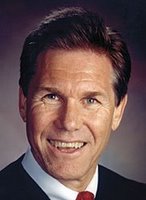 The
The
motion first describes Chief Judge Rader's (at left) participation as a panelist in a
session entitled "Patenting Genes: In Search of Calmer Waters" at the
Biotechnology Industry Organization (BIO) International Convention last May. According to the motion, "at the
start of the session, the moderator, attorney Jennifer Gordon of Baker Botts
LLP — the same attorney who was the lead author of the BIO amicus brief in this case at the
district court — asked for a vote of those in the audience asking if they
agreed with the decision of the district court in this case," and "Chief
Judge Rader observed this popular vote by a roomful of people who had already expressed
their collective view in an amicus
brief." The motion cites a
report in the BNA's Patent, Trademark
& Copyright Journal, which quoted the Chief Judge as saying during the panel (ellipsis in the motion):
A troublesome question for me is the
lack of legal standard for making this decision. In an obviousness analysis, there are some neutral steps
that I can apply. But using
Section 101 to say that the subject matter is unpatentable is so blunt a tool
that there is no neutral step to allow me to say that there is a line here that
must be crossed and that this particular patent claim crosses it or does not. . . . This approach is subjective, and, to be frank, it's politics. It's what you believe in your soul, but
it isn't the law.
The
motion asserts that the above statement demonstrates that "without reading
the briefs submitted by the parties or hearing argument, Chief Judge Rader
expressed his view of the district court's decision," and "did so in
front of an audience that was heavily biased in favor of one party, further
rais[ing] questions about his impartiality in this case."
Plaintiffs-Appellees
point to one other occasion on which Chief Judge Rader "attended a
discussion concerning the facts and legal theories of the case," namely a
panel entitled "Patent Eligible Subject Matter" at the Fordham
University School of Law Eighteenth Annual Conference on International
Intellectual Property Law & Policy.
The motion notes that PUBPAT attorney Dan Ravicher, one of the attorneys
of record for Plaintiffs-Appellees, participated as a speaker on the panel, and
states that "[n]ot only did Chief Judge Rader attend the session, but when
Prof. Ravicher began to make his remarks about this case, Chief Judge Rader interjected
with a question hinting at disagreement with Prof. Ravicher's expected remarks
and position in the case."
In
a footnote, the motion acknowledges that "Plaintiffs-Appellees are aware,
of course, that Chief Judge Rader has not been yet assigned to the panel that
will hear the case and may not be," but states that the motion was filed
"in order to allow Chief Judge Rader time to consider the matter now,
rather than having to make the decision, if he is assigned to the panel, on the
day of argument."
In
their response, filed on July 2, Defendants-Appellants contend that
"[e]ach of [Plaintiffs-Appellees'] allegations depends on a subjective and
unreasonable gloss' placed upon the reported remarks by Plaintiffs-Appellees
and their counsel, and fall far short of the requirement that the statements
would cause a reasonable and informed observer to "reasonably . . . question"
Chief Judge Rader's impartiality in this case" (ellipsis in response). They argue that "there is no basis for a reasonable and
informed observer to conclude that Chief Judge Rader's two isolated comments
were tied to the merits of this particular case," and contend that Chief
Judge Rader "stands accused of nothing more than attending and
participating in legal symposia," which is "something that the law
both allows and encourages."
 With
With
respect to the BIO panel session, Defendants-Appellants note that "despite
their intimations that the BIO panel in question was a one-sided one,
Plaintiffs-Appellees fail to point out that the BIO panel in question also
included Robert Cook-Deegan, who submitted a declaration in support of
Plaintiffs-Appellees in the district court." As for the Forham panel, Defendants-Appellants describe the
exchange between Chief Judge Rader and Mr. Ravicher (at right) as follows:
Mr. Ravicher had pointed at a bottle of
purified water before him and posed the question: "Was that [purification] sufficient intervention
between what God gave us . . . and what man created to merit a
patent?" Judge Rader, it was
reported, asked in response, "How many people have died of water pollution
over the course of human events?", then added, "Probably billions."
Interestingly,
Mr. Ravicher's profile
at the Benjamin N. Cardozo School of Law, where he is a lecturer in Law and
Associate Director of the Intellectual Property Law Program, indicates that he served for
a summer in the chambers of Chief Judge Rader.
Note: Four
Patent Docs attended the BIO session
discussed in Plaintiffs-Appellees' motion for recusal. In an article that will be posted later
this week, Dr. Kevin Noonan will report on the discussion that took place
during that panel session.For additional information regarding Plaintiffs-Appellees' motion to recuse and Defendants-Appellants' response, please see the IP LAW360 report "Plaintiffs Want Rader Recusal in Gene Patent Case" (subscription required). Patent Docs thanks IP LAW360 for making the motion and response available to the patent community.


 Patent Docs
Leave a reply to Geoff Karny Cancel reply