
By
Donald Zuhn —
 A
A
paper published in the latest issue of the policy journal Health
Affairs disputes the
widely held notion that the United States has eclipsed Europe in terms of pharmaceutical
research productivity. In the
article, entitled "Global Drug Discovery: Europe Is Ahead,"
Dr. Donald Light,
a professor of social medicine in the Department of Psychiatry at the
University of Medicine and Dentistry of New Jersey, reexamined a data set
originally collected by Dr. Henry Grabowski (professor of economics at Duke University) and Richard Wang (director of health services research and policy analysis at AstraZeneca Pharmaceuticals) and concluded that "the
United States never overtook Europe in research productivity."
In
a 2006 Health Affairs paper entitled
"The Quantity And Quality Of Worldwide New Drug Introductions, 1982–2003," Dr. Grabowski and Mr. Wang looked
at all of the 919 new chemical entities (NCEs) approved between 1982 and 2003, and
concluded that "U.S. firms overtook their European counterparts in
innovative performance or the introduction of first-in-class, biotech, and
orphan products." In particular,
the authors compared the number of NCEs discovered in the U.S., Europe, or
Japan between 1982-1992 and 1993-2003, and determined that NCE development was
shifting away from Europe and Japan and towards the U.S. Following a reexamination of this data,
Dr. Light concluded that "Congress and large purchasers are motivating
companies to develop and market drugs that add little value, instead of
rewarding true added value," and that "[t]his is not good for the
long-term vitality of the industry or for those paying too much for too little."
Simply
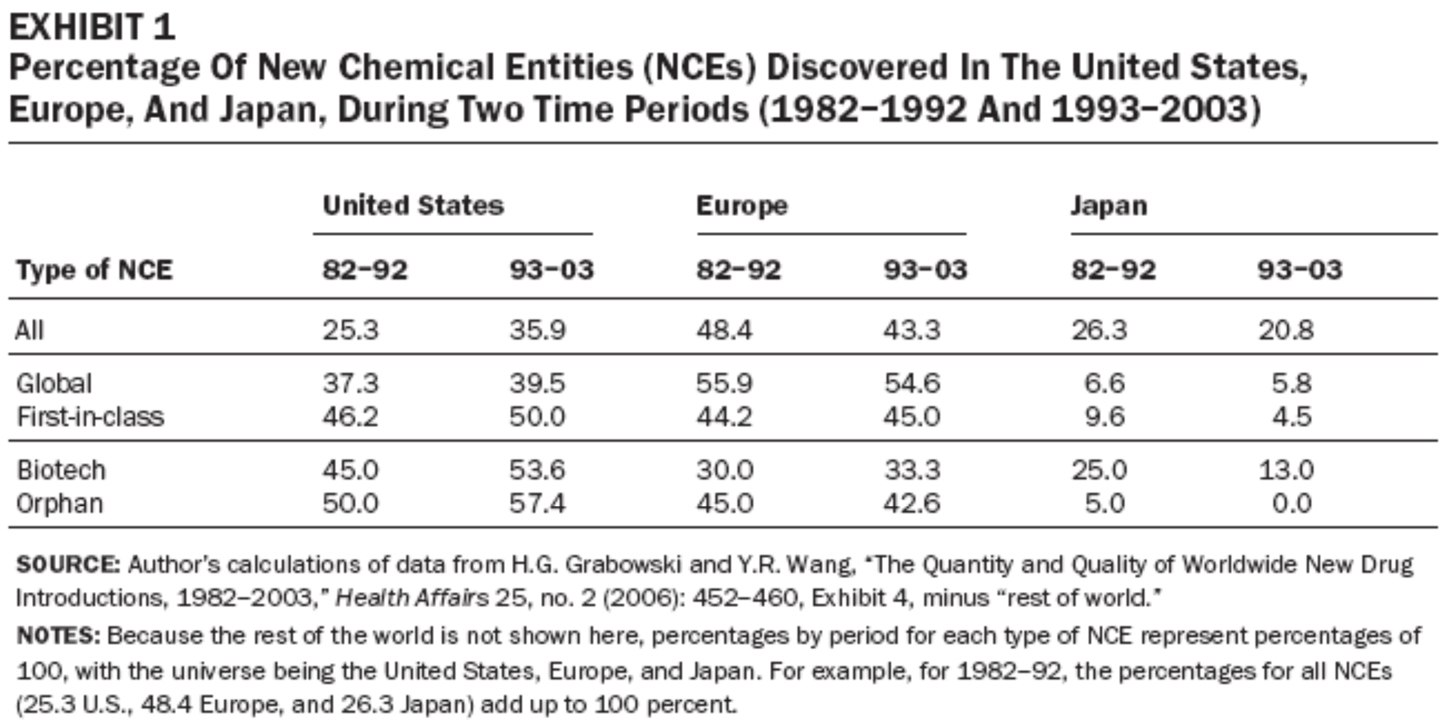
looking at the data collected by Dr. Grabowski and Mr. Wang, Dr. Light noted that
"European research productivity scarcely declined, and Europe continued to
dominate in discovering all NCEs as well as the highly profitable global NCEs,"
adding that "[c]learly, the United States did not overtake Europe in
discovering new chemical entities, and European researchers lost less ground
than either Europeans or Americans believe." (see Light, 2009, Exhibit 1).
Dr.
Light, however, was interested in analyzing this data in view of total research
funding (especially in view of data showing that research investment between 1990
and 2007 grew 5.2 times in the U.S. versus 3.3 times in Europe). In other words, Dr. Light wanted to determine
how much bang for the buck each region was getting. Thus, he compared the proportion of industry R&D funding
in the United States, Europe, and Japan to the proportion of NCEs developed in
each. In his paper, Dr. Light
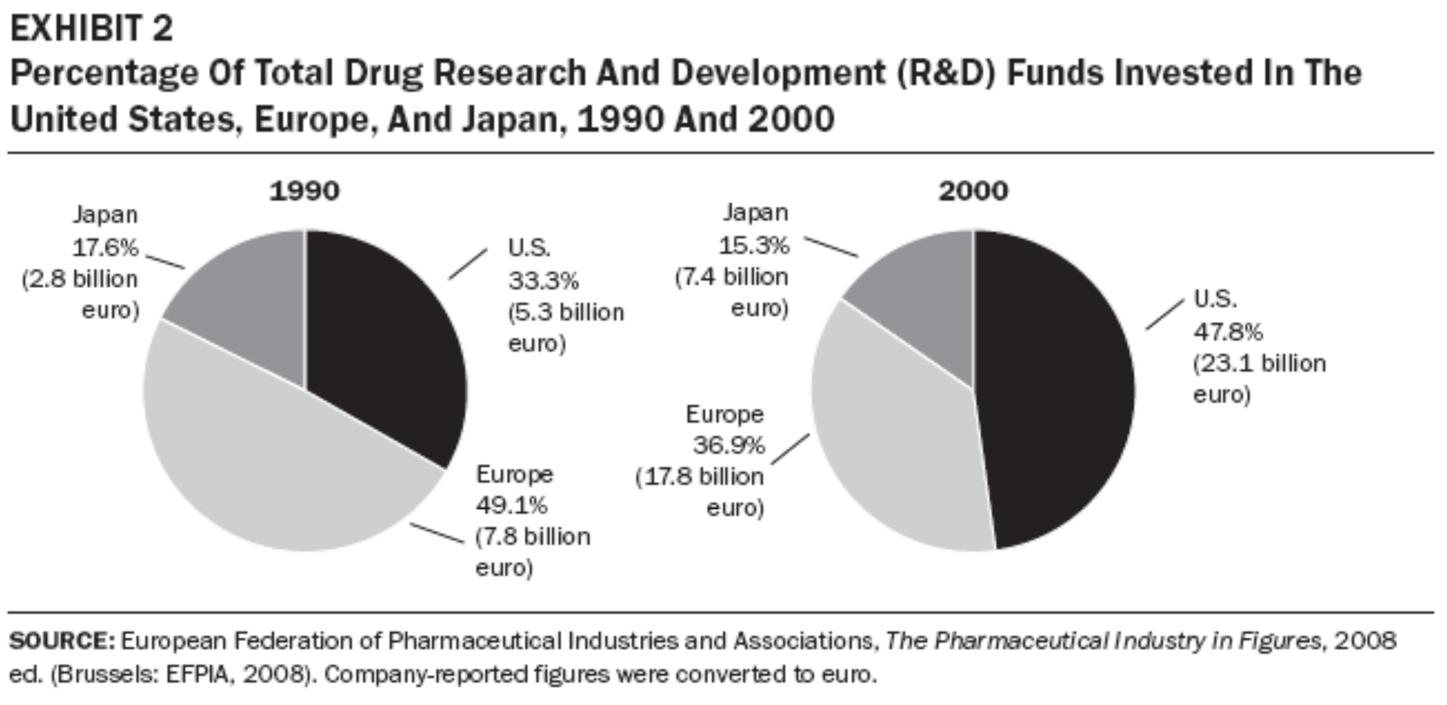
notes that because annual figures were not available, he used investment
figures for 1990 and 2000 that were reported by member companies to U.S.,
Japanese, and European trade associations, and which were collected by the European
Federation of Pharmaceutical Industries and Associations (see Light, 2009, Exhibit 2).
Dividing
the proportion of NCEs shown in Exhibit 1 by the proportion of R&D
investment shown in Exhibit 2, Dr. Light determined that:
[T]he
United States discovered far fewer NCEs than its proportional share of funding: 0.76 (25.3/33.3) in the first period [1982-1992]
and 0.75 in the second [1993-2003].
Europe's ratio of all NCEs to investment went from 0.99 in the first
period to 1.17 (43.3/36.9) in the second.
Japan's proportionate ratio was the highest: 1.49 in the first period
and 1.36 in the second.
From
this, he contended that "[t]he big news in terms of innovation and
international policy is the low and flat U.S. productivity and the high
Japanese productivity," and further argued that "Grabowski and Wang's
conclusions about U.S. dominance are not supported by their own data." However, in view of the growing
importance of biotech drugs (see, e.g., "BioWorld Reports on the Top
25 Biotech Drugs"
and "Future Drug Sales Predictions Highlight Importance of Follow-on
Biologics Legislation"),
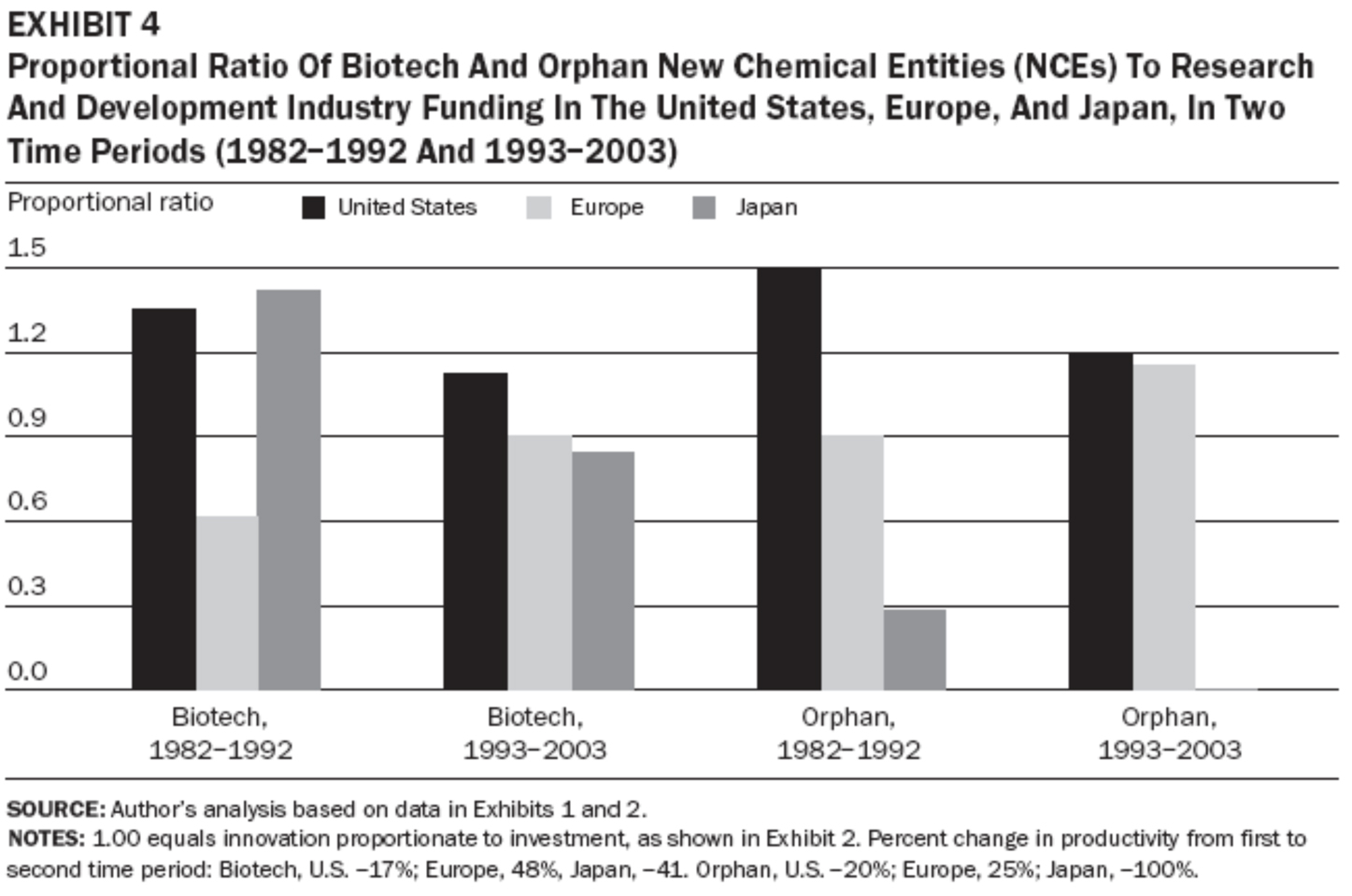
it is interesting to note that Dr. Light's analysis shows that "European
researchers became much more innovative in the second period but did not catch
up with their U.S. counterparts, even though U.S. productivity declined" (see Light, 2009, Exhibit 4).
Looking
forward, Dr. Light suggests that "[g]iven the new institutes in European
countries that bring together applied scientists from industry and academe to
translate discoveries into drugs, such as Top Institute (TI) Pharma in the
Netherlands [which funded Dr. Light's study]; Karolinska Institutet Innovations
in Stockholm, Sweden; and the broader European Innovative Medicines Initiative,
returns on R&D investment in Europe may increase further during the next
decade of 2004-2014." As for
the implications of his study on U.S. drug policy, Dr. Light states that:
Congressional
leaders and others concerned about high prices of new patented drugs will be
heartened by this analysis, because lower European prices seem to be no
deterrent to strong research productivity. A previous analysis using industry-based data showed that
pharmaceutical companies recover all costs and make a good profit at European
prices. Europeans are not
"free riders" on American patients — another myth promoted by
industry that assumes that countries are separate R&D/market silos that
should each pay for themselves.


 Patent Docs
Leave a comment