• By Kevin E. Noonan —

    In Interference No. 106,115 between Senior Party the Broad Institute (joined by Harvard University and MIT) and Junior Party the University of California, Berkeley; the University of Vienna; and Emmanuelle Charpentier (collectively, "CVC"), the Patent Trial and Appeal Board granted CVC's Preliminary Motion for benefit of priority to U.S. Provisional Application No. 61/757,640, filed January 28, 2013 ("Provisional 3"), pursuant to 37 C.F.R. §§ 41.121(a)(1)(ii) and 41.208(a)(3) and Standing Order ¶ 208.4.1.  In Interference No. 106,127, Senior Party ToolGen filed its Substantive Preliminary Motion No. 1 to deny CVC priority benefit to the '640 provisional application.

    The relationships between the patents and applications in the '127 interference are set forth in this chart (filed in CVC's earlier preliminary motion in the '115 Interference):
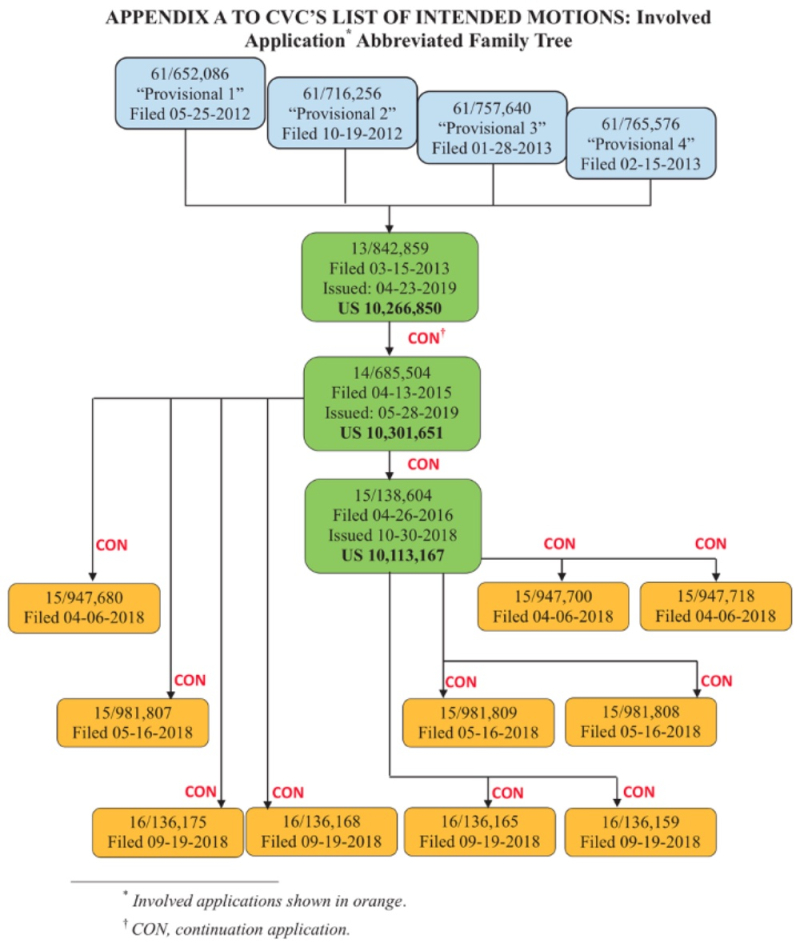
    Image 1
    ToolGen (stating that Broad did not substantively challenge CVC's assertion of this priority) challenges CVC's entitlement to priority benefit to the P3 provisional here on the grounds that it did not disclose "successful cleavage of DNA within eukaryotic cells, nor does it otherwise show a constructive reduction to practice of an embodiment within Count 1."

    ToolGen's argument depends on three assertions.  First, the brief identifies a single Example (Example 2) in the P3 provisional application directed towards purported eukaryotic cell embodiments of CRISPR gene editing (which, if it provided an adequate description of even a single enabled embodiment would be sufficient to satisfy the requirement for priority).  Second, ToolGen asserts that the Example (and Figures 38B and 36E related thereto) do not provide such an adequate description because "Figure 38B shows alleged cleavage bands at positions where there should be none and in some instances no bands where there should be bands."  Similarly, ToolGen asserts that Figure 36E "independently contains so many unexplained bands as to make it so shaky and unreliable that a [person of ordinary skill in the art or] POSA would not view it as showing possession of an embodiment within Count 1."  Taken together, ToolGen argues that "the Figures cannot be evidence that discloses successful cleavage to a POSA in eukaryotes, and the applicants' failure to sequence the resulting products further cements this conclusion."  Third, ToolGen argues that "applicants lysed the cells before DNA extraction such that they left the Cas9 protein active to cleave DNA outside of intact cells, as opposed to within the eukaryotic cell as required by Count 1" and "a POSA would understand that any cleavage shown in the gel results cannot confirm that cleavage occurred within eukaryotic cells."  Like U.S. provisional applications 61/652,086 ("P1") and 61/716,56 ("P2") (for which the Board refused to recognize priority for failure to disclose an adequate description of even a single enabled embodiment of CRISPR in a eukaryotic cell), ToolGen argues that the P3 provisional application is similarly deficient and the Board should deny CVC the accorded priority benefit.

    After setting forth the statutory requirements for a party to be accorded benefit of priority and discussing the level of ordinary skill in the art, ToolGen sets forth its analysis of the deficiencies in the P3 disclosure synopsized above. Supported by expert testimony (Dr. Turchi), ToolGen argues that a POSA at the time of the invention would not have considered the P3 disclosure to satisfy these requirements. Like Broad, ToolGen argues that "adapting the native prokaryotic CRISPR-Cas9 system to cleave DNA within eukaryotic cells was highly unpredictable." Like Broad before it ToolGen enumerates the many differences between the prokaryotic milieu where CRISPR was expressed natively and eukaryotic cells (the existence of the nucleus, packaging genomic DNA in chromatin, the intracellular components for gene expression in eukaryotic cells, and the resulting uncertainty ToolGen alleges arises as a consequence regarding whether the CRISPR-Cas9 system could be adapted for use in these cell types. (An uncertainty ToolGen notes that the Board acknowledged supported by the now infamous, improvident statements by CVC's inventors.)

    Besides these somewhat theoretical obstacles (which, had CRISPR been readily reduced to practice would not have their current asserted significance), ToolGen critically reviews what it contends are deficiencies in the disclosure of Example 2 as illustrated by Figures 38B and 36E (as these deficiencies were attested to by ToolGen's expert witness).  This analysis was set out graphically to show the expected DNA fragments and sequences that the skilled worker would expect and need to observe to conclude successful CRISPR gene editing in the HEK293T human embryonic kidney cells used in the experiments disclosed in Example 2 of the P3 provisional application:
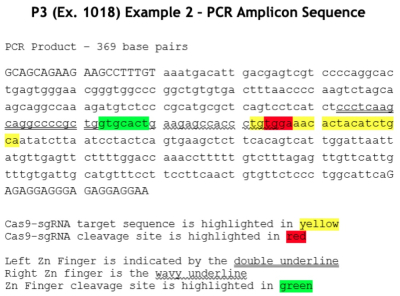
    Image 2
    The brief then sets out the bands produced by successful CRISPR according to ToolGen's expert:

    • A 369 bp PCR product band because not all of the DNA would have been cleaved.  Any larger bands would be unexpected because the PCR product should contain only 369 bp DNA fragments in all lanes.
    • Approximately 183 and 186 bp Cas9-sgRNA cleavage bands in the lanes with both Cas9 and sgRNA.
    • Approximately 162-169 and 200-207 bp ZFN cleavage bands in the ZFN positive control lane.

    Instead of these results, the brief (relying of ToolGen's expert) asserts that:

    If the Figure 38B and 36E gels showed successful DNA cleavage at the target site, a POSA would expect the data in the gels to be consistent with the above.  They are not.  Rather, Figure 38B contains bands that differ significantly from the bands that a POSA would expect if cleavage had been successful.  Figure 36E shows results inconsistent with Figure 38B, and also contains so many unexplained bands as to render the data unreliable—and a POSA would view it as insufficient to demonstrate possession [citations to exhibits omitted].

    The brief further sets forth an "annotated" version of Figure 38B to illustrate its purported deficiencies:

    Image 3
    ToolGen's expert's analysis is set forth in the brief as follows (citations to the exhibits omitted):

    The ~378 bp PCR band (band 1) is consistent with the predicted 369 bp full-length PCR band.  In contrast, the digestion product (band 2)—which the applicants claim is a CRISPR-Cas9 cleavage band—is not the expected size in any of the Cas9-sgRNA lanes (Lanes F, H, and I).  As Dr. Turchi explains, the supposed cleavage band in Figure 38B measures ~280 bp (band 2)—almost 100 bp longer than the expected ~185 bp.  There is no band at all in the expected ~185 bp range—which should have been identifiable at slightly below the 200 bp control ladder marker.  It is also irreconcilable with the sizes of the other bands.

    If the ~280 bp band (band 2) was a digestion band from the ~378 bp PCR band (band 1), there is an unaccounted for ~98 bp DNA fragment, making it unlikely that the ~280 bp band is an actual cleavage band.  Ex. 1410   88; F23.  There are also several unexpected bands—larger than the PCR band—of unknown origin that disappear upon digestion (bands 5 and 6).  Therefore, it is possible that the alleged cleavage band (band 2) comes from one of the larger, digestion sensitive bands and not the PCR band.

    Accordingly, because "applicants nowhere address the irregularities in Figure 38B or provide a POSA with any comfort that they possessed an embodiment within Count 1" and thus "a POSA at the time P3 was filed would find Figure 38B to be unreliable and would have disregarded it in its entirety."

    The brief then sets forth a similar analysis of the experimental results shown in Figure 36E.  The bands found in this Figure should be the same as those in Figure 38B, according to ToolGen's expert, but it does not.  One deficiency is the presence of additional bands; as stated in the brief, "[a]lmost every lane has more than one unexpected band, making it impossible to determine the origin of each digestion product band, which P3 does not attempt to explain."  As with Figure 38B, ToolGen's expert prepared an annotated version of this Figure:
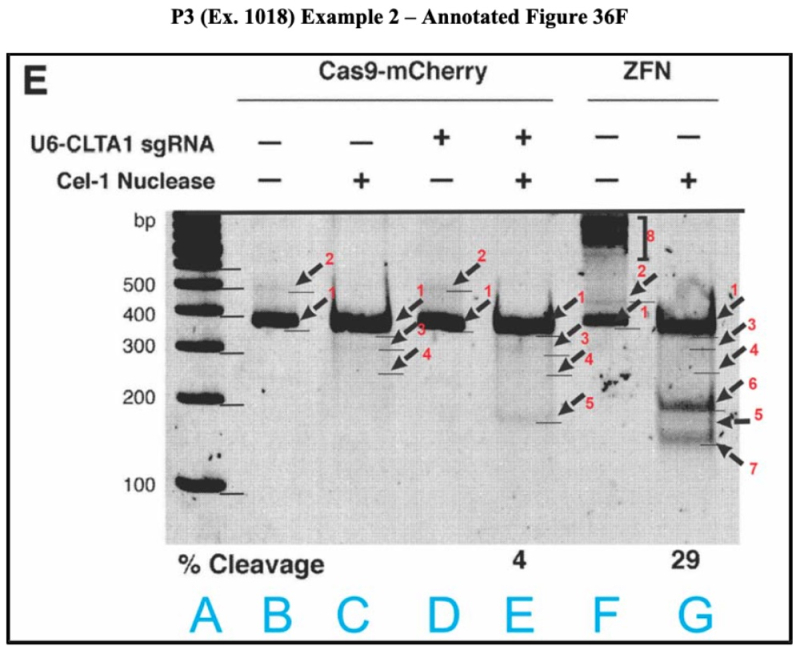
    Image 4
    As explained by ToolGen's expert:

    The PCR band (band 1) measures ~352 bp, consistent with its expected size.  The applicants rely on a single ~173 bp band (band 5) in Lane E to indicate CRISPR10 Cas9 cleavage at the target site.  However, the alleged cleavage band (band 5) could just as easily be a digestion product of the unexpected ~477 bp band (band 2) in Lanes B, D, and F that disappear upon digestion in the Surveyor assay Lanes E and G.  This is fully consistent with the presence of an unexpected digestion band at ~297/312 bp (band 3) also in Lanes E and G, because the unexpected ~477 bp band (band 2) could have been digested into the ~173 and ~297/312 bp digestion product bands (bands 5 and 3, 4 respectively).  And there is yet another unexpected digestion product band at ~252 bp (band 4) in Lanes E and G, which could reflect the unexpected ~477 bp band (band 2) being digested into two equal DNA fragments.  These anomalies would leave the POSA unconvinced of the applicants' possession of an embodiment within Count 1.

    As Dr. Turchi notes, a digestion band is visible in Lane G—between the two ZFN cleavage bands—of similar size and intensity as the purported cleavage band (band 5) in Lane E.  This digestion band is significant because it would further lead a POSA to conclude that band 5 in Lane E is simply a digestion product of one of the larger unexpected band (band 2) in the undigested lanes (Lanes, B, D, and F), and not indicative of successful Cas9 cleavage at the target site.

    From this analysis ToolGen's expert opines that the evidence in Figure 36E is "inconclusive" and "riddled with anomalies and uncertainties" sufficiently inconsistent with CVC's assertion of successful practice of CRISPR-Cas9 in eukaryotic cells that these assertions would not be believed by a person of ordinary skill in the art.

    In view of the asserted poor quality of these experimental results, ToolGen further asserts that the skilled worker "next have performed sequencing on the PCR product to confirm and characterize any potential cleavage results."  Yet, as the brief notes, "no such work was reported in [the] P3 [provisional application]."

    As the final asserted defect in the evidentiary support for CVC's purported reduction to practice of CRISPR in eukaryotic cells, the brief then sets forth its argument that the way the cells were lysed after introduction of CRISPR-Cas9 could have permitted any observed cleavage to have occurred after lysis and thus fall outside the scope of the invention as defined by the Count.  This is illustrated in annotated Figure 37A:
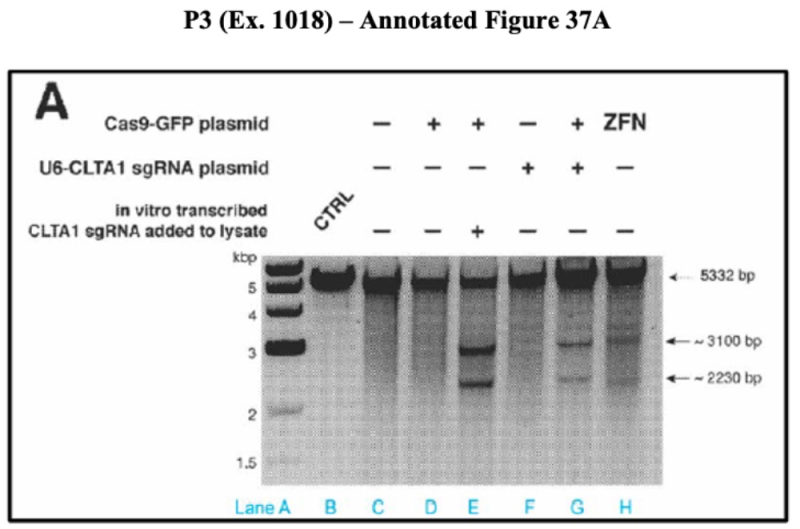
    Image 5
    As set forth in the brief, "the presence of two bands indicates to a POSA that the plasmid was successfully cleaved extracellularly at the predicted Cas9-sgRNA target site and the donor plasmid restriction enzyme site" (emphasis added).  As a consequence, the brief goes on to say that "[t]he results shown in Figure 37A undermine any arguable cleavage results in Figures 38B and 36E because they show that extracellular cleavage occurred in cell lysates prepared using the same Cas9-preserving protocol that was used to prepare the cell lysate in Figure 38B and 36E [emphasis in the brief].  Because the applicants preserved the activity of Cas9 in the lysate, any alleged cleavage shown in Figures 38B or 36E could have occurred outside the cells, in the lysate."

    In addition, the relative cleavage efficiencies between the ZFN positive control and the purported CRISPR-Cas9 lanes further support the conclusion that such CRISPR-Cas9-mediated cleavage occurred in vitro in the lysis buffer and thus does not support reduction to practice of eukaryotic cell embodiments of CRISPR gene editing by CVC in the P3 provisional priority document.

    ToolGen thus asks the Board to rule that CVC is not entitled to the benefit of priority of the P3 provisional application.

  • CalendarJune 29, 2021 – "Proud Innovation — Learn from LGBTQ+ Innovators" (U.S. Patent and Trademark Office) – 1:00 to 3:30 pm (ET)

    June 30, 2021 – "Patentability of Simulations at the EPO" (J A Kemp) – 16:00 pm BST (GMT+1)

    June 30, 2021 – "Waiving IP Protections to Address COVID-19: The WTO Proposals and Ensuring Equitable Access to the Vaccines" (Intellectual Property Owners Association) – 12:00 pm to 1:00 pm (ET)

    June 30, 2021 – "The Better Part of Valor? Discretionary Institution in PTAB Proceedings" (Fitch Even) – 12:00 pm to 1:00 pm (ET)

    July 21-22, 2021 – Advanced Summit on Life Sciences Patents conference (American Conference Institute)

    July 27-28, 2021 – Practitioners' Think Tank on ITC Litigation and Enforcement conference (American Conference Institute)

    July 28-29, 2021 – Women Leaders in Life Sciences Law conference (American Conference Institute)

  • June-29-lgbtq-event-1500px
    The U.S. Patent and Trademark Office will host an online event entitled "Proud Innovation — Learn from LGBTQ+ Innovators" on June 29, 2021 from 1:00 to 3:30 pm (ET).  The event will consist of two panels:

    • Inspiring innovation: A discussion on creating change and building a legacy
    • Creating opportunities: A conversation about building networks and securing funding

    Those interested in attending the panel discussion can do so here.

  • J A KempJ A Kemp will be offering a webinar entitled "Patentability of Simulations at the EPO" on June 30, 2021 at 16:00 pm BST (GMT+1).  John Leeming of J A Kemp will detail the approach of the EPO to computer-implemented inventions (including simulations) and consider what the recent G 01/19 does (and does not) tell us about the patentability of simulations and computer-implemented inventions in general, and also provide practical advice regarding the drafting and prosecution of applications directed to computer-implemented inventions in Europe in light of the decision.  The webinar will address the following topics:

    • The EPO's general approach to computer-implemented inventions
    • What G 01/19 tells us about how this approach should be applied to simulation inventions
    • Further guidance in the decision regarding how the EPO views important concepts such as technicality
    • Practical tips for drafting applications directed to computer-implemented inventions in light of G 01/19
    • Helpful arguments that can be deployed in prosecution

    There is no registration fee for this webinar.  However, those interested in registering for the webinar, should do so here.

  • IPO #2The Intellectual Property Owners Association (IPO) will offer a one-hour webinar entitled "Waiving IP Protections to Address COVID-19: The WTO Proposals and Ensuring Equitable Access to the Vaccines" on June 30, 2021 from 12:00 pm to 1:00 pm (ET).  Tanuja Garde of Raytheon Technologies; David Kappos of Cravath, Swaine & Moore LLP; James Pooley of James Pooley, PLC; and Tony Rollins of Rollins IP Strategies Ltd. will share information about the status of the waiver proposals made by India and South Africa and the European Union's proposal to increase the global supply of COVID-19 vaccines, the logistics of negotiations at the WTO, and the roles of various U.S. governmental and international agencies.  The panel will also discuss questions such as whether a waiver would actually increase access to vaccines and other technologies, the impact of a waiver on innovation, impediments to ensuring broader vaccine access, and the effectiveness of ongoing voluntary efforts to distribute the vaccine and other important technologies more widely.

    The registration fee for the webinar is $150 for non-members or free for IPO members (government and academic rates are available upon request).  Those interested in registering for the webinar can do so here.

  • Fitch EvenFitch Even will be offering a webinar entitled "The Better Part of Valor? Discretionary Institution in PTAB Proceedings" on June 30, 2021 from 12:00 pm to 1:00 pm (ET).  David A. Gosse and Karen J. Wang of Fitch Even will discuss the following topics:

    • How the PTAB exercises its discretion to deny institution in the face of parallel district court proceedings, e.g., in the Western District of Texas "rocket docket"
    • Whether prior reexamination, IPR, PGR, or even prosecution will cause the PTAB to exercise its discretion and deny institution
    • Why the PTAB may or may not deny institution of multiple petitions challenging a single patent

    While there is no cost to participate in the program, advance registration is required.  Those interested in attending the webinar can register here.

  • ACIAmerican Conference Institute (ACI) will be holding its 19th Advanced Summit on Life Sciences Patents conference on July 21-22, 2021 as a virtual conference.

    The conference will offer presentations on the following topics:

    • Refining global patenting strategies in the U.S., Europe, China, and Brazil
    • Gauging the continued impact of the COVID-19 pandemic, including compulsory licensing and march-in rights
    • A PTAB year in review, including latest developments at the Board, the Federal Circuit, and an update on the Arthrex case
    • Future landscape of Section 101: Will there ever be clarity?
    • An international perspective on written description and enablement standards in antibody claims
    • Examining the recent surge in doctrine of equivalents decisions
    • Developments in patent term extensions in the U.S. and Europe, including the implications of Biogen v. Banner and Europe's SVC manufacturing waiver
    • Obviousness, obviousness-type double patenting, and inherency
    • Method of treatment and second medical use claims, personalized medicine and dosage regime patents
    • Separate interactive sessions from life sciences litigators regarding what they wish the prosecutor had done, the implications on skinny labels of GSK v. Teva, and ethical dilemmas in patent prosecution

    The registration fee for the conference is $1,595 if registered and paid by July 2nd and $1,695 if registered and paid by July 20th.  There is an in-house counsel rate of $1,295 available until July 20th.  Patent Docs readers are entitled to a 10% discount off of registration using discount code D10-762-762DX03.  Those interested in registering for the conference can do so here, by e-mailing CustomerService@AmericanConference.com, or by calling 1-888-224-2480.

    Patent Docs is a media partner of ACI's 19th Advanced Summit on Life Sciences Patents Conference.

  • ACIAmerican Conference Institute (ACI) will be holding its 13th Annual Practitioners' Think Tank on ITC Litigation and Enforcement conference on July 27-28, 2021 as a virtual conference.

    The conference will offer presentations on the following topics:

    • ITC State of the Union: Predictions for the future
    • ITC Year in Review, including the Top Ten developments in 2021 and forecasts for 2022
    • Evaluation of trade secret jurisprudence at the ITC
    • Public interest considerations in 337 investigations
    • Discretionary denials and developments in parallel proceedings before the ITC and PTAB
    • Satisfaction of the domestic industry requirement
    • New NPE 337 tactics and what ITC practitioners need to know in 2021
    • In-house counsel perspectives, including insights and best practices for managing ITC actions
    • Winning strategies for enforcing exclusion orders
    • ALJ insights on procedures and effective trial strategies
    • How to maneuver the 100-day early disposition program and assessing its merits
    • Keynote addresses from ITC leaders and 1:1 virtual networking

    The registration fee for the conference is $1,295 if registered and paid by June 18th and $1,895 if registered and paid by July 26th.  Patent Docs readers are entitled to a 10% discount off of registration using discount code D10-868-868DX02.  Those interested in registering for the conference can do so here, by e-mailing CustomerService@AmericanConference.com, or by calling 1-888-224-2480.

    ACI is offering a limited amount of complimentary in-house passes to their 13th Annual Practitioners' Think Tank on ITC Litigation and Enforcement conference.  Apply for your complimentary pass here.

    Patent Docs is a media partner of ACI's 13th Annual Practitioners' Think Tank on ITC Litigation and Enforcement Conference.

  • ACIAmerican Conference Institute (ACI) will be holding its 8th Annual Women Leaders in Life Sciences Law Virtual Conference on July 28-29, 2021 from 10:00 am to 5:45 pm EDT.  ACI faculty will give presentations on:

    • Opening remarks from the Conference co-chairs on the impact of the past year on women in the life sciences industry
    • An interactive session on working together to restore and boost female workforce momentum in the wake of the pandemic
    • Examination of key legal developments impacting life sciences
    • Getting hired and noticed in the virtual world, including tips and tools for interviewing, onboarding and moving up in the virtual environment
    • An honest discussion on what's working and what's not in diversity and inclusion efforts, including how to keep strong female talent once it's in the door
    • Empowering female conferences across generational boundaries
    • Setting boundaries and achieving personal and professional balance
    • Tacking COVID pandemic-related legal challenges faced by life sciences companies
    • Knowing your worth, and asking for it, including ways to effectively negotiate salaries
    • Advice from inspiring and influential General Counsel

    There will also be a keynote address by Dr. Julie Gerberding and opportunities for 1:1 virtual networking.

    An agenda for the conference, a brochure, and additional information regarding the workshops can be found here.  The registration fee is $1,495 with paid registration by July 29th.  An on-demand version of last November's conference is available for $895.  Patent Docs readers are entitled to a 10% discount off of registration using discount code D10-684-684DX05.  Those interested in registering for the conference can do so here, by e-mailing CustomerService@AmericanConference.com, or by calling 1-888-224-2480.

    Patent Docs is a media partner of ACI's 8th Annual Women Leaders in Life Sciences Law Virtual Conference.

  • By Donald Zuhn —

    Biotechnology Innovation OrganizationIn a message distributed to Biotechnology Innovation Organization (BIO) members, Dr. Michelle McMurry-Heath, BIO President and CEO, released a declaration signed by the corporate and organizational leaders of 209 global biotechnology companies and 41 biotech associations, in which the signatories acknowledged their "social responsibility to work with other stakeholders — healthcare providers, governments, multilateral organizations, and non-governmental donor organizations — to ensure that COVID vaccines and treatments get to the patients in the world who most need them."

    Dr. McMurry-Heath began her message to BIO members by recognizing "the ongoing effort by some political leaders to strip our scientific intellectual property rights pertaining to vaccines and treatments for COVID-19," and noting that "[t]his proprietary science and technology was developed by our scientists working day and night at great financial risk to our companies."  The BIO CEO also highlighted BIO's efforts to establish a COVID-19 global Strategy for Harnessing Access Reaching Everyone (SHARE) program, which seeks to ensure a sufficient global supply of COVID-19 vaccines, to ensure safe and expeditious global access to COVID-19 vaccines and therapeutics, and to strengthen and support healthcare systems in low-and middle-income countries in addressing COVID-19.  Dr. McMurry-Heath also pointed out that biotech companies "ARE sharing our IP and know-how through almost 300 voluntary global agreements to increase vaccine manufacturing and distribution capacity."  Yet, the BIO CEO notes that these efforts have "not changed the minds of those who believe we should simply turn over all of our science to countries around the world," an idea Dr. McMurry-Heath asserts "is misguided, and most importantly, won't solve the problem."

    The declaration sets forth five statements or goals.  First, the signatories state that the biotech sector "must continue to play a constructive, proactive part in developing COVID solutions and the global manufacturing capacity to produce them."  The declaration notes that in the past year, more than 950 global R&D projects have been launched on COVID-19 vaccines, treatments, and biologics, and more than 250 global partnerships have been formed to build manufacturing capacity.

    The declaration next states that intellectual property is the foundation of the biotech sector, explaining that:

    [Intellectual property] is responsible for creating the global biotech network that responded so quickly to the COVID crisis in the first place.  It is what gives investors the confidence to fund companies with long time horizons and high risks.  It gave companies the assurance that they could quickly pivot during the early days of the pandemic into COVID projects.  And it helped ensure the type of global cooperation and partnerships that are driving companies, countries, and manufacturers to quickly scale up the production.

    The signatories also express their support for strong, collaborative efforts like those endorsed by the G-20 to address the global imbalances in access to COVID vaccines and treatments.

    Turning to the proposed World Trade Organization (WTO) waiver of intellectual property rights, the signatories declare that the proposed waiver "will be ineffective and counterproductive in addressing this crisis," arguing that:

    Intellectual property rights are not responsible for the imbalance in COVID vaccine supplies between higher and lower income countries.  It will create a long contentious global negotiation that will not urgently address the crisis, and foster more "vaccine nationalism," exacerbating shortages in an already strained global supply chain.  It would divert limited resources from companies that are focused on maximizing current global partnerships while maintaining quality and patient safety.  Lastly, it would send a powerful signal to the biotech sector and investors to avoid taking the risks to develop solutions in future public health emergencies.

    The declaration concludes with the goal of producing more than 11 billion doses of COVID-19 vaccines in 2021, and significantly more in the first part of 2022, and a commitment by the signatories to work with other global stakeholders "to see that these doses get to those that most need them, wherever they may be."

    A list of the corporate and organizational signatories to the declaration can be found here.