• By Donald Zuhn

    CoverEarlier this month, the National Academy of Inventors (NAI) and the Intellectual Property Owners Association (IPO) published their annual list of the top 100 worldwide universities that received the most U.S. utility patents during the 2020 calendar year.  The NAI is a member organization comprising U.S. and international universities, and governmental and non-profit research institutions, with over 4,000 individual inventor members and Fellows spanning more than 250 institutions.  The organization was founded in 2010 to recognize and encourage inventors with patents issued from the U.S. Patent and Trademark Office, enhance the visibility of academic technology and innovation, encourage the disclosure of intellectual property, educate and mentor innovative students, and translate the inventions of its members to benefit society.  The joint effort by the NAI and IPO is based on data obtained from the U.S. Patent and Trademark Office.  For their report, the NAI and IPO defined a university as an institution that grants undergraduate-level degrees, and when a patent is assigned to one or more entities, credit was given to the first named entity.  The report indicates that the number of patents granted to a particular university does not necessarily indicate the value of a university's technology, the effectiveness of its research, or whether its patents will be successfully licensed and/or brought to market.  The top 25 universities on the NAI/IPO listing are as follows (click on table to expand):

    Top 25 Universities - 2020
    The complete list of 100 universities can be found here.

    For additional information regarding this and other related topics, please see:

    • "IPO & Harrity Analytics Release List of Top 300 Patent Holders for 2020," February 18, 2021
    • "NAI & IPO Release List of Top 100 Universities Receiving Patents in 2019," June 3, 2020
    • "IPO & Harrity Analytics Release List of Top 300 Patent Holders for 2019," May 25, 2020
    • "IPO Releases List of Top 300 Patent Holders for 2018," August 7, 2019
    • "IPO Releases List of Top 300 Patent Holders for 2017," July 4, 2018
    • "Top 100 Universities Worldwide Granted U.S. Patents in 2016," June 15, 2017
    • "IPO Releases List of Top 300 Patent Holders for 2016," June 14, 2017
    • "NAI & IPO Release List of Top 100 Universities Receiving Patents in 2014," July 5, 2015
    • "IPO Releases List of Top 300 Patent Holders for 2014," July 1, 2015
    • "IPO Names Top 100 Patenting Universities," July 24, 2014
    • "IPO Releases List of Top 300 Patent Holders for 2013," July 7, 2014
    • "NAI & IPO Release List of Top 100 Universities Receiving Patents in 2012," January 7, 2014
    • "Brookings Paper Calls for Technology Transfer Model Based on University Start-ups," December 12, 2013
    • "IPO Releases List of Top 300 Patent Holders for 2012," June 24, 2013
    • "Another Look at IPO Top 300 and Life Sciences Top 53," June 11, 2012
    • "IPO Releases List of Top 300 Patent Holders for 2011," June 7, 2012
    • "IPO Releases List of Top 300 Patent Holders for 2010," June 30, 2011
    • "IPO Releases List of Top 300 Patent Holders for 2009," May 26, 2010
    • "IPO Releases List of Top 300 Patent Holders for 2008," May 14, 2009
    • "IPO Releases List of Top 300 Patent Holders," May 22, 2008
    • "IPO Posts List of Top 300 Patent Holders," April 20, 2007

  • By Kevin E. Noonan

    Great DaneThe domestic dog (Canis lupus familiaris) has been the subject of many genetic studies, particularly since the dawning of the age of Whole Genome Sequencing in the late 20th Century.  These studies have elucidated some interesting facts about "man's best friend," some of which have been discussed here (see "The Genetic Basis of Coat Variation in Dogs"; "Leg Length Variation in Dogs and its Relevance to Human Mutations"; "From Toy Poodle to Rottweiler: Why Is Fido So Small (or Large)?";  "Selection for Facial Features in Domestic Dogs: The Evolution of Cuteness") and comparators to related species (see "Red Fox Genome Sheds Light on Domesticated Dogs (and Maybe Humans)").

    But as with other organisms, a great deal of the genetic sequence set forth early in the 21st Century was incomplete due to technical limitations. Chief amongst these was difficulty in obtaining reliable sequence information on sequences repeated in many places in the genome, which interfered with reliable assembly of sequenced portions (termed "contigs") into longer (ideally, chromosomal-length) linear sequence assemblies (termed "scaffolds).  Improvements in sequencing technology now permit better sequence determinations for high GC and highly repetitive regions.

    The existence of a prior reference genome (produced from a female boxer named Tasha), combined with these new sequencing tools, was used by an international team of researchers* in a paper published in March of this year in the Proceedings of the National Academy of Sciences (USA) entitled "Long-read assembly of a Great Dane genome highlights the contribution of GC-rich sequence and mobile elements to canine genomes."  These scientists reported elucidation of the genomic sequence from a female Great Dane named Zoey, wherein they were able to identify and eliminate (in large part) incorporation of false contigs due to repetitive ends and fragment ends that map to multimer genomic locations.  Using alignment with the reference dog genome revealed gaps between contigs as earlier reported in dog genomic DNA.  They report finding 373 additional sequence regions spanning contigs having N50 of 30kb and a total length of 10.5 Mbp.  The resulting aligned scaffolds were assigned to dog chromosomes to constitute a genomic sequence for the dog genomic complement of 78 chromosomes.

    From this sequence the researchers were able to identify 22,182 protein-coding gene models; full-length matches with the reference canine genome were found for only 84.9% (18,834) of all protein-coding gene models, and almost full-length alignments were found for 93% (20,670) of the models; in addition they identified 49 protein-coding genes not present in the earlier canine reference genome.  Also annotated were 7,049 long noncoding RNAs that included 84 with no or only partial alignment to the reference canine genome.  From this comparison they further were able to appreciate that the assembly from the Great Dane genome spanned the majority of sequence gaps not having been sequenced in the reference dog genome.  Mapping of these gaps showed that 2,151 gaps (16.8% of gaps) overlapped the transcription start site of a predicted protein-coding gene and were found to be extremely GC rich (67.3%).  Further, a subset of the resolved gaps, having a median 80.95% GC content, were found to be preferentially localized (i.e., at a frequency greater than random chance) at transcription start sites and recombination hotspots.  About 12% (1,457 of 12,304 on the autosomes) of gap segments were found to be located within 1 kbp of a hotspot (the expected percentage of such location was closer to 3%).  These hotspot-adjacent segments were extremely GC rich; 5,553 such identified segments had a GC content greater than that what would be expected from random sequence permutations.  The total extent of these extreme GC segments spanned 4.03 Mbp in the Great Dane sequence assembly, were found to have "a median length of 531 bp, a median GC content of 80.95%, and are located much closer to transcription start sites (median distance of 290 bp) and recombination hotspots (median distance of 68.7 kbp) than expected by chance."

    Analysis of the Great Dane genome assembly with the reference canine genome identified 16,834 deletions (median size: 207 bp) and 15,621 insertions (median size: 204 bp) in Great Dane DNA.  Genetic assessment of these sequences revealed predominantly the presence of two forms of "retrotransposon insertion/deletion polymorphisms" which included dimorphic canine short interspersed elements (SINECs) (16,221 copies) and dimorphic long interspersed element-1 sequences (LINE-1_Cfs) (1,121 copies).  The 3' flanking sequence for the LINE-_Cfs elements suggested "multiple retrotransposition-competent LINE-1_Cfs segregate among dog populations."

    The researchers further reported a length distribution of the detected variants having "a striking bimodal pattern, with clear peaks at ∼200 bp and ∼6 kbp, consistent with the size of SINEC and LINE-1 sequences," as shown in this Figure:

    Image 1
    The location of these sequences was associated with insertions and deletions, the researchers reporting that inspection of the sequences in the 150-250-bp range (dimorphic SINEC elements) were found at 7,298 deletion and 6,071 insertion sites, and that "LINE-1 sequences accounted for 339 deletions and 581 insertions longer than 1 kbp." When combined with data from the reference canine genome there were at least 16,221 dimorphic SINEC and 1,121 dimorphic LINE-1 sequences identified.  "Hallmarks of retrotransposition" were identified at these sites, wherein the SINEC and LINE-1 sequences were flanked by "target site duplications having a 15 bp median size with the elements ending in poly(A) tracts having median lengths of 9 bp to 12 bp."

    To test whether these sequences were capable of retrotransposition, a particular sequence was cloned that had intact open reading frames encoding the ORF1p and ORF2p predicted proteins and lacked mutations expected to disrupt protein function.  This element was introduced into human cells in vitro and shown to be capable of retrotransposition, as illustrated in this Figure:

    Image 2
    This element also capable of mobilizing both the canine SINEC elements and analogous human Alu elements.  The researchers speculated that this result was consistent with ongoing retrotransposon activity as a driver of canine genetic variation.

    The researchers set forth a synopsis of their results as follows.  They had identified 49 predicted protein-coding genes from the Great Dane assembly that were not found in the canine genome, as well as 2,151 protein-coding gene models having a transcription start position located in a gap in the reference genome sequence.  The existence of high GC-content sequences in canine promoter regions distinguishes the preferential location of recombination events in dogs, which lack a functional PRDM9 gene known to mediate recombination in other mammals; see Paigen & Petkov, 2018, "PRDM9 and its role in genetic recombination," Trends Genet. 34, 291–300, and Auton et al., 2013, "Genetic recombination is targeted towards gene promoter regions in dogs," PLoS Genet. 9, e1003984.  The researchers assert that "[t]he presence of extremely GC-rich segments likely reflects a key aspect of canine genome biology" as a consequence of these findings.  Further, a comparison of the number of single nucleotide variants (i.e., differences) found in Zoey and Tasha (3.57 million) was lower than found in similar comparison between humans (4.1-5.0 million).  In contrast, the levels of LINE-1 and SINEC dimorphism between these two dog genomes was "disproportionately large," there being "an ∼17-fold increase in SINE differences (16,221/915) and an eightfold increase in LINE differences (1,121/128) compared to the numbers found among humans" (indeed, the researchers report that "more dimorphic SINEs were found between these two breed dogs than have been found in studies of thousands of humans").  They note that these results are consistent with prior studies, including Wang & Kirkness, 2005, "Short interspersed elements (SINEs) are a major source of canine genomic diversity," Genome Res. 15, 1798–808.

    The authors conclude by saying:

    [O]ur study suggests that retrotransposition is an ongoing process that continues to affect the canine genome.  We provide proof-of-principle evidence that dog genomes contain LINE-1 and SINEC elements that are capable of retrotransposition in a cultured cell assay.  We also identified two LINE-1 lineages with the same 3′ transduced sequence associated with multiple elements, suggesting the presence of multiple canine LINE-1s that are capable of spawning new insertions.  Additionally, analysis of 3′ transduction patterns suggests the presence of additional active LINE-1s in canines that have yet to be characterized.  Thus, a full understanding of canine evolution and phenotypic differences requires consideration of these important drivers of genome diversity.

    * From  the Department of Biological Sciences, Bowling Green State University; the Department of Human Genetics, Department of Computational Medicine and Bioinformatics, and the Department of Internal Medicine, University of Michigan; the Université Côte d'Azur, CNRS, INSERM, Institut de Recherche sur le Cancer et le Vieillissement de Nice, Nice; the Université de Rennes 1, CNRS, Institut de Génétique et Développement de Rennes−UMR 6290, Rennes; and the Department of Biomedical Sciences, Cornell University, Ithaca, NY 14850.

  • LexisNexisLexisNexis and IPWatchdog and will be offering a webinar entitled "A Conversation with the Commissioner: A Look Inside Patent Processes at the USPTO" on July 15, 2021 at 12:00 pm (ET).  Gene Quinn of IPWatchdog, Inc. and Megan McLoughlin of LexisNexis IP will discuss the processes and policies driving the U.S. Patent and Trademark Office with Robin Evans, Deputy Commissioner of Patents, USPTO; Drew Hirshfeld, Commissioner of Patents, USPTO; and Robert Bahr, Deputy Commissioner of Patents, USPTO.  The panel will discuss the following:

    • Hot Issues on the Commissioner's Desk:
    — New rules to streamline the OED patent bar examination process
    — Making sense of the Alice-Mayo line of cases from the Federal Circuit
    — This year, Commissioner Hirshfeld is sitting in the place of the Director as we await nomination and confirmation of a new Director from President Biden

    • Information Technology at the USPTO:
    — How is the Office using Artificial Intelligence (AI)
    — What are the plans for future use of AI
    — Plus, a deep dive into .docx

    • Quality Assurance:
    — The latest information on rejection statistics
    — Discussion of 112 best practices from the Office's perspective

    • Patent Examination Policy:
    — It is critical for patent practitioners to know and understand the direction being given to patent examiners

    There is no registration fee for this webinar.  However, those interested in registering for the webinar, should do so here.

  • By Kevin E. Noonan

    University of California-BerkleyOn June 11th, Junior Party the University of California, Berkeley; the University of Vienna; and Emmanuelle Charpentier (collectively, "CVC") filed its Responsive Preliminary Motion No. 2 in Interference No. 106,127 to be accorded benefit of priority to U.S. provisional application No. 13/842,859, filed March 15, 2013, pursuant to 37 C.F.R. §§ 41.121(a)(2) and 41.208(a)(3) and Standing Order ¶ 208.4.1.  CVC filed this motion contingent on the Board granting Senior Party ToolGen's Substantive Preliminary Motion No. 2 to deny CVC priority benefit to U.S. provisional application No. 16/757,640, filed January 28, 2013 ("P3").

    ToolGen's Substantive Preliminary Motion No. 2 challenged CVC's entitlement to priority benefit to the P3 provisional in this interference on the grounds that it did not disclose "successful cleavage of DNA within eukaryotic cells, nor does it otherwise show a constructive reduction to practice of an embodiment within Count 1."  Deferring its arguments against this motion to its Opposition, in this Responsive Motion CVC seeks to establish its entitlement to later-filed applications, to retain its best priority position against ToolGen (CVC itself has filed its Preliminary Motion No. 2 to deny ToolGen of the priority benefit to its earliest application, U.S. provisional application No. 16/717,324, filed October 23, 2012).  In its Responsive Motion, CVC argues entitlement to the '859 application as a matter of law because it is the earliest application having an identical specification to CVC's applications-in-interference and CVC argues that it therefore is entitled to a presumption that this application provides a constructive reduction to practice thereby, citing Transco Prod. Inc. v. Performance Contracting, Inc., 38 F.3d 551, 556–57 (Fed. Cir. 1994).  In the alternative, CVC in this motion asks to be accorded benefit of the filing date of U.S. Application No. 14/685,504, filed April 13, 2015 ("the '504 application") or U.S. Application No. 15/138,604, filed April 26, 2016 ("the '604 application"), all of which share a common specification with the '859 application "as a string of continuation applications and thus provide the same disclosure as the involved applications."

    In addition to asserting the presumption that it is entitled to priority benefit to its earliest application having a specification identical to its involved applications, CVC sets forth its comparison evidence of what is disclosed in the specification of the '859 application with each element of the Count:

    Image
    while at the same time reiterating its contention that it is entitled to priority benefit to its P1 (No. 61/652,086, filed May 25, 2012), P2 (No. 61/716,256, filed Oct. 19, 2012), and P3 provisional applications for providing a constructive reduction to practice of at least one embodiment falling within the scope of the Count.  This assertion is based on CVC's purported demonstration of eukaryotic CRISPR-Cas9 mediated genetic alterations in its E1 (fish cell), E2 (human cell), and E3 (fruit fly cell) embodiments (see "Berkeley Files Responsive Motion to Broad's Substantive Motion No. 2 in Interference").  CVC also relies on the Board's determination in the '115 Interference that CVC was entitled to priority benefit of the P3 provisional application (see "PTAB Decides Parties' Motions in CRISPR Interference").  CVC sets forth its evidence that the relevant disclosure in the P3 provisional, as well as in the '859 application in this interference, is the same, specifically with regard to the fish, human, and fruit fly cell embodiments.

    The brief sets forth separately its arguments regarding the disclosure in Example 4 of the "common specification," which the brief describes as "an RNA-guided DNA endonuclease from a Type II CRISPR system" called CRISPR interference (CRISPRi)."  This system can suppress RNA transcription in human HEK293 cells, according to the brief, and that it meets all the elements of the Count in the '127 interference.  This example also avoids the criticism ToolGen aimed at CVC's Example 3 with regard to cell lysis being used to isolate CRISPR-modified DNA (which ToolGen asserts could result in artifactual, in vitro CRISPR cleavage outside the scope of the Count).  CVC argues in its brief that CRISPRi down-regulates transcription inside the cell without the need for cell lysis and thus ToolGen's criticism on this basis is inapposite.

    The "common specification" also contains Example 5 according to the brief, which CVC argues discloses use of a "a fusion protein compr[i]sing a catalytically inactive Cas9 and an . . . activator domain or a repressor domain" that also modulates transcription within a eukaryotic cell. According to CVC the CRISPR system disclosed in Example 5 also comprises all the elements recited in the interference Count.

    Finally CVC relies on disclosure in the common specification of Example 7, which discloses generating:

    "[a] transgenic mouse expressing Cas9," isolating embryonic stem cells from the transgenic mouse, and using the Cas9-expressing embryonic stem cells to rapidly generate "new knock-out or knock-in cells (and therefore mice) . . . at any desired locus in the genome by introducing an appropriately designed DNA-targeting RNA that targets the Cas9 to a particular locus of choice."

    As explained by CVC's expert cited in the brief, "gene knock-in" was known in the art, produced by other means, and the CRISPR system disclosed in Example 7 satisfied all the elements recited in the Count of the 106,127 Interference.

    On these grounds CVC asked the Board to be accorded benefit of the '859 application's March 15, 2013 filing date in this interference.

  • CalendarJuly 13, 2021 – "We Did It Our Way: Women IP Trailblazers Share Their Incredible Journeys" (IPWatchdog and Foresight) – 2:00 pm (ET)

    July 14, 2021 – "IP Case Law Mid-Year Review" (Intellectual Property Owners Association) – 2:00 pm to 3:00 pm (ET)

    July 21-22, 2021 – Advanced Summit on Life Sciences Patents conference (American Conference Institute)

    July 27-28, 2021 – Practitioners' Think Tank on ITC Litigation and Enforcement conference (American Conference Institute)

    July 28-29, 2021 – Women Leaders in Life Sciences Law conference (American Conference Institute)

  • IPWatchdogIPWatchdog and Foresight and will be offering a webinar entitled "We Did It Our Way: Women IP Trailblazers Share Their Incredible Journeys" on July 13, 2021 at 2:00 pm (ET).  Gene Quinn of IPWatchdog, Inc. will moderate a panel consisting of Angela Grayson, Founder and Principal Member, PRECIPICE; Mary Jutten, CEO Traklight, Inc and Juetten Law, P.C.; Efrat Kasznik, Founder and Founder & President, Foresight Valuation Group, LLC; and Renée C. Quinn, Chief Operating Officer & Chief Financial Officer, IPWatchdog, Inc.  The panel will address questions such as what a "typical" career in IP entails and how women are faring as IP professionals.

    There is no registration fee for this webinar.  However, those interested in registering for the webinar, should do so here.

  • IPO #2The Intellectual Property Owners Association (IPO) will offer a one-hour webinar entitled "IP Case Law Mid-Year Review" on July 14, 2021 from 2:00 pm to 3:00 pm (ET).  Paul Berghoff of McDonnell Boehnen Hulbert Berghoff LLP, Greg Castanias of Jones Day, and Wendy Larson of Pirkey Barber PLLC will provide a roundup of this year's most significant intellectual property cases, review the most significant decisions as of June 30, and give a sneak peek at coming attractions.

    The registration fee for the webinar is $150 for non-members or free for IPO members (government and academic rates are available upon request).  Those interested in registering for the webinar can do so here.

  • By Kevin E. Noonan

    University of California-BerkleyOn May 20th, Junior Party the University of California, Berkeley; the University of Vienna; and Emmanuelle Charpentier (collectively, "CVC") filed its Substantive Preliminary Motion No. 3 in Interference No. 106,127 (which names ToolGen as Senior Party), asking the Patent Trial and Appeal Board to add claims in ToolGen's U.S. Patent No. 10,851,380* to this interference, pursuant to 37 C.F.R. §§ 41.121(a)(1)(i) and 41.208(a)(2) and Standing Order ¶ 208.3.2.

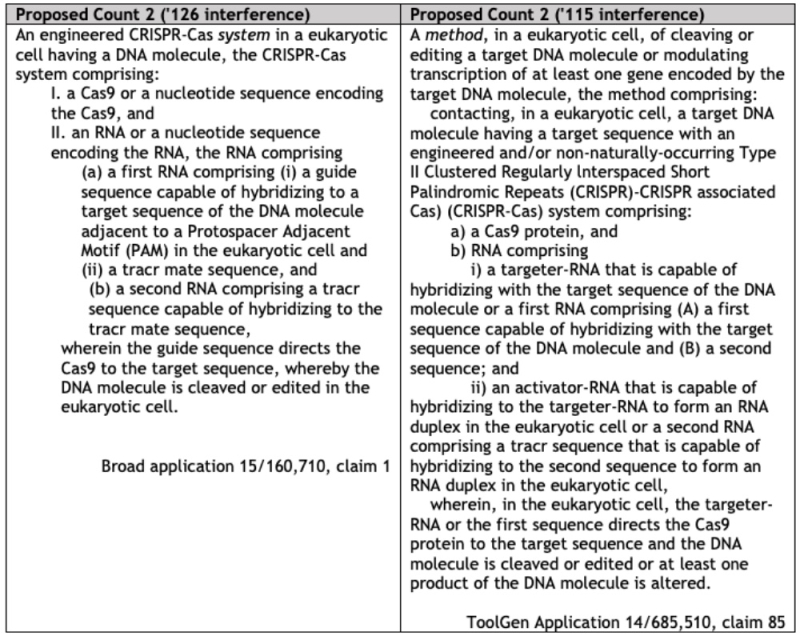
    Relevant to CVC's motion is the portion of the Count identical to Claim 85 of ToolGen's priority application, U.S. provisional application No. 14/685,510:

    An isolated mammalian cell comprising a Type II Clustered Regularly Interspaced Short Palindromic Repeats (CRISPR)/Cas system for site specific, cleavage of a double-stranded target nucleic acid sequence in the isolated mammalian cell, wherein the CRISPR/Cas system comprises:
        a)    a nucleic acid encoding a Cas9 polypeptide, wherein the Cas9 polypeptide comprises a nuclear localization signal and wherein said nucleic acid is codon-optimized for expression in mammalian cells, and
        b)    a chimeric guide RNA comprising a CRISPR RNA (crRNA) portion and a transactivating crRNA (tracrRNA) portion,
        wherein the target nucleic acid sequence comprises a first strand having a region complementary to the crRNA portion of the chimeric guide RNA and a second strand having a trinucleotide protospacer adjacent motif (PAM), and
        wherein the Cas9 polypeptide and the chimeric guide RNA form a Cas9/RNA complex in the isolated mammalian cell and mediate double stranded cleavage at the target sequence.

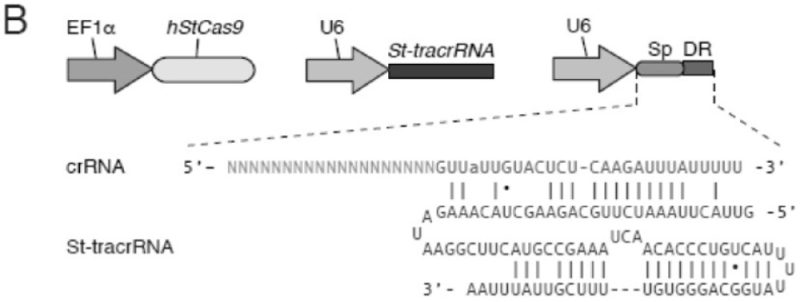
    CVC argues that the only difference between the language of the Count and the claims in the '380 patent is that those claims require the addition of two guanine residues ("GG") positioned before the crRNA portion of the sgRNA sequence.  CVC argues that these species of sgRNA (the fusion of crRNA and tracrRNA) recited in the '380 patent claims are a consequence of using the T7 phage RNA polymerase to produce sgRNA and that in vitro RNA production using T7 RNAP promoters was well-known in the art ("for decades"; emphasis in brief) at the priority date of the '380 patent; these arguments are supported by testimony from CVC's expert, Dr. Scott Bailey.

    This method of producing sgRNA and relevant prior art disclosing the use of T7 RNAP and promoters recognized by the polymerase are set forth in the brief as follows:

    Image 1 Image 2
    wherein the diagrams follow the source of the characteristic "extra" GG residues at the 5' end of crRNA and sgRNA produced thereby.  CVC also asserts a second reference, the Deltcheva reference, to illustrate the extent to which T7-catalyzed in vitro RNA production using a T7 promoter was well-known:

    Image 3
    CVC argues that the distinction of including two guanine residues in crRNA and sgRNA comprised thereof is not enough to distinguish the claims of the '380 patent from the Count in this interference (to which CVC argues these claims correspond) because "including a 5'-GG would have been obvious over Count 1 in view of [CVC's] Jinek 2012" reference as illustrated above, which reliance is permitted under Desjardins v Wax, Interference No. 105,915, Paper 127, 17-20 (P.T.A.B. Jan. 21, 2014).  Regarding motivation to combine the teachings of the Jinek reference in this regard with the more general teachings of producing an sgRNA for eukaryotic CRISPR, CVC argues that such motivation is supported by the method's "low cost, efficiency, and accuracy," and because "Jinek 2012 had already used the method to generate RNAs that effectively cleave eukaryotic DNA sequences (e.g., GFP) in CRISPR-Cas9 systems (i.e., ToolGen knew the method would be successful in eukaryotic CRISPR).  This success also would have provided the requisite reasonable expectation of success to complete a prima facie case of obviousness and hence for the '380 claims to properly be determined to correspond to the Count in this interference.

    The brief sets forth in detail comparison between the Count and claims of the '380 patent to set forth CVC's argument that those claims would have been obvious over the Count (considered as part of the prior art for this analysis; see N.V. Nutricia v. Mass. Inst. of Tech., Interference No. 106,096, Paper 80, 4 (P.T.A.B. Mar. 29, 2019)) in combination, inter alia, the Jinek 2012 reference (or any other reference teaching the use of the T7 promoter/ T7 RNA polymerase system for producing RNA including sgRNA in vitro.  CVC characterizes its argument by stating that those claims "the predictable use of prior art elements according to their established functions," citing  KSR Intern. Co. v. Teleflex Inc., 127 S.Ct. 1727, 1731 (2007); these arguments are supported by a detailed claim chart set out as Appendix 3 to CVC's brief (providing the comparison with the portion of the Count taken from ToolGen's application).  (Appendix 4 contains a similar claim chart from the portion of the  Count taken from claim 156 of the CVC's U.S. Application No. 15/981,807.)

    Turning to the basis for CVC's assertion of there being a reasonable expectation of success, CVC argues that:

    Expectation of success in eukaryotes would not be in doubt because "whether a CRISPR-Cas9 system would have been expected to work in a eukaryotic cell . . . is assumed under the framework of 37 C.F.R.  41.207(b)(2), wherein Count 1 is presumed to be prior art to the . . . claims," citing The Univ. of Calif. v. The Broad Inst., Inc., Interference No. 106,115, Paper 877, 66 (P.T.A.B. Sept. 10, 2020); 37 C.F.R. 41.207(b)(2).

    Having set forth the basis for the Board to find claim 1 obvious, the brief then sets forth CVC's obviousness analysis regarding claims 2-10 as having been obvious (and the brief is supplemented with Appendix showing those sites).

    The brief completes its obviousness assessment by asserting that there was no objective indicia that would contradict the prima facia case of obviousness supported by the facts and argument set forth above.  These include specifically the absence of any evidence of unexpected results (which ToolGen argued during prosecution of the '380 patent) in view of (for the purposes of this interference) ToolGen's half of the Count, which differs from the '380 claims only by the addition of the GG residues at the 5' end of the sgRNA as a consequence of producing that RNA species in vitro using T7 RNA polymerase and its cognate promoter.  CVC arrives at this conclusion because the claim corresponding to ToolGen's half of the interference Count (claim 85 of ToolGen's involved '510 application) was prosecuted to allowance, inter alia, by ToolGen's argument for unexpected results; as CVC asserts "there can be no  unexpectedly superior results when the closest prior art (i.e., Count 1) has the same results as the claimed method," citing Millennium Pharmaceuticals, Inc. v. Sandoz, Inc., 862 F.3d 1356, 1368 (Fed. Cir. 2017) (emphasis in brief).  In addition, CVC argues that here the prima facie case is sufficiently strong so as not to be rebutted by unexpected results, citing Ohio Willow Wood Co. v. Alps South, LLC, 735 F.3d 1333, 1344 (Fed. Cir. 2013) ("[W]here a claimed invention represents no more than the predictable use of prior art elements according to established functions, as here, evidence of secondary indicia are frequently deemed inadequate to establish  nonobviousness.").  Finally, merely discovering the effect of adding the GG residues at the 5' end of the sgRNA is not sufficient to overcome a prima facie obviousness case, based on Federal Circuit precedent that a "'previously-unknown, yet inherent, food-effect property' did not make the claims patentable because 'merely discovering and claiming a new benefit of an old process cannot render the process again patentable,'" citing In re Huai-Hung Kao, 639 F.3d 1057 (Fed. Cir. 2011).

    Finally, CVC's brief concludes with its argument that there is an interference-in-fact between CVC's involved claims in this interference and the '380 patent claims (illustrating the principle that once bitten is twice shy).  CVC argues here that the "two-way" test for interfering subject matter is met between at least one claim of the '380 patent and at least one of CVC's involved claims.  Specifically, the brief calls out claim 1 of the '380 patent and claim 156 of CVC's involved application No. 15/981,807:

    156.    A eukaryotic cell comprising a target DNA molecule and an engineered and/or non-naturally occurring Type II Clustered Regularly Interspaced Short Palindromic Repeats (CRISPR)-CRISPR associated (Cas) (CRISPR-Cas) system comprising
        a)    a Cas9 protein, or a nucleic acid comprising a nucleotide sequence encoding said Cas9 protein; and
        b)    a single molecule DNA-targeting RNA, or a nucleic acid comprising a nucleotide sequence encoding said single molecule DNA-targeting RNA;
    wherein the single molecule DNA-targeting RNA comprises:
            i)    a targeter-RNA that is capable of hybridizing with a target sequence in the target DNA molecule, and
            ii)    an activator-RNA that is capable of hybridizing with the targeter-RNA to form a double-stranded RNA duplex of a protein-binding segment,
            wherein the activator-RNA and the targeter-RNA are covalently linked to one another with intervening nucleotides; and
            wherein the single molecule DNA-targeting RNA is capable of forming a complex with the Cas9 protein, thereby targeting the Cas9 protein to the target DNA molecule,
    whereby said system is capable of cleaving or editing the target DNA molecule or modulating transcription of at least one gene encoded by the target DNA molecule.

    CVC identifies as "the only relevant differences" between this claim and claim 1 of ToolGen's '380 patent:

    • codon optimization of the Cas9 polynucleotide,
    • the NLS-tag on Cas9, and
    • including a 5'-GG on the guide RNA.

    Noting that claim 185 of CVC's '807 application recites use of the NLS tag, CVC argues that the skilled worker would have had a reasoned basis for including all of these features into a CRISPR-Cas9 system, under the rubric that a "combination of familiar elements according to known methods is likely to be obvious when it does no more than yield predictable results," citing KSR Intern. Co. v. Teleflex Inc., 127 S.Ct. 1727, 1731 (2007).  And, CVC maintains, the skilled worker would have had a reasonable expectation of success in achieving operative embodiments of CRISPR thereby, satisfying one prong of the two-way test.

    With regard to the other prong, CVC argues that claim 1 of ToolGen's '380 patent teaches all the elements of CVC's claim 156 in the order in which it is claimed, which is enough to satisfy the test for anticipation.

    Accordingly, CVC concludes, the Board should designate the claims of the '380 to correspond to Count 1, adding that "[t]here are no adequate alternative remedies because leaving the '380 patent out of this proceeding risks the inefficiency and expense of another interference proceeding involving CVC and ToolGen."

    * '830 Patent claims CVC asserts correspond to the Count in the '127 Interference:

    1.    A method of introducing a site-specific, double-stranded break at a target nucleic acid sequence in a eukaryotic cell, the method comprising introducing into the eukaryotic cell a Type II Clustered Regularly Interspaced Short Palindromic Repeats (CRISPR)/Cas system, wherein the CRISPR/Cas system comprises: a) a nucleic acid encoding a Cas9 polypeptide comprising a nuclear localization signal, wherein the nucleic acid is codon-optimized for expression in eukaryotic cells, and b) a guide RNA that hybridizes to the target nucleic acid, wherein the guide RNA is a chimeric guide RNA comprising a CRISPR RNA (crRNA) portion fused to a trans activating crRNA (tracrRNA) portion, wherein the guide RNA comprises two guanines at its 5' end, and there are no additional nucleic acid residues between the two guanines at the 5' end and the crRNA portion of the guide RNA; whereby a site-specific, double stranded break at the target nucleic acid sequence is introduced.

    2.    The method of claim 1, wherein the nuclear localization signal is located at the C terminus of the Cas9 polypeptide.

    3.    The method of claim 1, wherein the eukaryotic cell is a mammalian cell.

    4.    The method of claim 3, wherein the mammalian cell is a human cell.

    5.    The method of claim 1, wherein the nucleic acid encoding the Cas 9 polypeptide is codon-optimized for expression in mammalian cells.

    6.    The method of claim 1, wherein the target nucleic acid sequence is a genomic sequence located at its endogenous site in the genome of the eukaryotic cell.

    7.    The method of claim 1, wherein the nucleic acid encoding the Cas9 polypeptide is a vector.

    8.    The method of claim 1, wherein the Cas9 polypeptide is a Streptococcus pyogenes Cas9 polypeptide.

    9.    The method of claim 1, wherein the nucleic acid encoding the Cas9 polypeptide is introduced into the eukaryotic cell before introducing the guide RNA into the eukaryotic cell.

    10.    The method of claim 1, wherein the Cas9 polypeptide is a Streptococcus Cas9 polypeptide.

  • From our Foreign Correspondents —

    University of California-BerkleyWhile many patiently await developments in the pending U.S. interference proceedings relating to the CRISPR patents in the U.S., matters are progressing in Europe.  The Opposition Division (OD) of the European Patent Office (EPO) has just issued (on June 29, 2021) its written decision in the case of EP3241902, owned by the University of California/Berkeley, the University of Vienna, and Emmanuelle Charpentier (collectively termed "CVC").  While the headline decision of the OD to revoke the patent was delivered orally at the hearing on April 13, 2021, the OD has now provided its detailed reasoning behind the decision.

    Formally, EP3241902 was revoked for lack of inventive step.  However, pivotal in this decision was the finding by the OD that the patent was not entitled to priority from at least the first priority claim of May 25, 2012 (US 61/652,086; "P1").  In view of this, the inventors' own landmark publication from June 28, 2012 ("Jinek 2012") became prior art.

    Readers may recall that the Broad Institute's European patent EP2771468 was previously revoked for lack of novelty as a result of lack of priority entitlement.  However, the basis for that decision on priority was very different from the present case.  Broad's priority claim fell due to a formal defect in the priority claim (as a result of removal of an inventor at the PCT stage), meaning that the applicant for the patent was not the same entity (or successor in title) as the applicant for the priority application.

    In contrast, CVC's patent was denied priority for two more substantive reasons, relating to the content of P1 vis-à-vis the claims of the granted patent, namely:

    1)    P1 lacked a sufficient (enabling) disclosure to support the claims of the patent; and
    2)    P1 did not disclose the "same invention" as claimed in EP3241902.

    To give a little background, EP3241902 had various claims directed to "chimeric Cas9 proteins" and their uses.  In the "chimeric Cas9 proteins," a Cas9 enzyme with "reduced nuclease activity" is fused to a heterologous effector domain (e.g., transcriptional activator/repressor, methylase, etc.).  The Cas9 component is intended to act as a DNA-targeting protein, delivering the effector domain to a desired target site, somewhat akin to the use of TALEN and zinc finger nucleases well-known in the art.  Because EP3241902's earliest priority date of May 25, 2012 antedated Jinek 2012, a successful challenge of the priority claim was required in order to make Jinek 2012 available as prior art and, ultimately, to provide a basis for revocation.

    In the first preliminary opinion issued on February 13, 2020 along with a summons to oral proceedings, the OD initially considered that the patent was entitled to its earliest priority date, and therefore Jinek 2012 was not available as prior art.  In arriving at this preliminary view, the OD was persuaded by CVC's arguments that the sufficiency was evidenced by the fact that several research groups were able to carry out aspects of the claimed invention following on from the Jinek 2012 publication.

    In the run up to oral proceedings, which were cancelled due to COVID, the opponents filed further submissions focused heavily on the lack of an enabling disclosure in P1, and, moreover, that the disclosure in P1 was extremely limited compared to Jinek 2012.  Furthermore, the success of the research groups reported in the post-published articles was the result of significant research endeavor, building on the more extensive disclosure in Jinek 2012 than was found in the P1 specification.

    In view of these submissions, the OD issued a revised preliminary opinion on September 29, 2020, in which the OD reconsidered its position on the enablement in view of P1.  The OD provisionally concluded that the claimed invention was not plausible in view of P1 which, inter alia, did not disclose how to reduce nuclease activity of Cas9.  Because the disclosure in P1 did not render the claimed subject matter plausible, under EPO jurisprudence CVC could not rely on post-filing evidence to remedy the lack of enablement.  The OD deferred venturing an opinion on novelty or inventive step until entitlement to priority had been discussed fully at the oral proceedings rescheduled for April 12-14, 2021.

    The oral proceedings were scheduled to take place by videoconference over three days; this is atypically long for opposition hearings, reflecting the complexity of the case and number of parties (albeit fairly typical for the European CRISPR hearings).  However, by the end of the second day, the patent had been revoked in its entirety.  The minutes accompanying the decision reveal that the majority of the discussion centered around entitlement to priority.  The Main Request and 10 Auxiliary Requests (representing a series of "fallback" amended claim sets) filed by CVC were all found to lack entitlement to priority and were therefore obvious in view of a combination of the TALEN and zinc finger nuclease systems well-known from the art and the disclosure of Jinek 2012.

    Examining the decision further, there are two distinct strands to the findings of the OD on entitlement to priority:

    The first relates to the concept of Cas9 with "reduced nuclease activity".  While P1 mentioned in broad terms the concept of Cas9 with "reduced nuclease activity," there was no material disclosure in the P1 specification of how the skilled person might actually produce such a modified Cas9 without an undue burden.  OD found that the disclosure in P1 was vague and speculative regarding the regions of Cas9 conferring nuclease activity against a target DNA (later discovered to be the RuvC and HNH domains), and gave no meaningful guidance to the skilled person on how nuclease activity might be modified.  Moreover, the OD further found that the sole example in P1 was ill-suited to identify Cas9 variants with reduced nuclease activity.  There was considerable debate about the level of common general knowledge of the skilled person, and the extent to which this might supplement the disclosure of P1.  The OD did not arrive at a settled view on the common general knowledge, but it concluded that at best the skilled person would be able to produce a completely nuclease-inactive Cas9 (so-called "dead Cas9") without an undue burden.  The use of a dead Cas9 was also consistent with the TALEN and zinc finger nuclease systems known from the art, which do not have any intrinsic nuclease activity.  Thus, inasmuch as the claims related to reduced but not eliminated nuclease activity, they were not enabled by P1.

    Secondly, the OD considered whether Auxiliary Request 2, with claims limited to Cas9 with "substantially no nuclease activity", was entitled to priority from P1.  Priority was again denied but for a quite different reason.  The claimed subject matter was held not to relate to the "same invention" as disclosed in P1, as required under Art. 87 EPC.  The "same invention" requirement is assessed using the strict "direct and unambiguous" disclosure test favored by the EPO (see G 2/98).  Readers may have encountered essentially this same strict test in the more familiar context of assessing basis for amendments during EP prosecution.  In brief, the OD found that while the claims related to a modified but otherwise whole Cas9 protein linked to a heterologous domain, the disclosure in P1 was limited to a portion of Cas9 (i.e., not the whole protein) linked to a heterologous domain.  P1 disclosed in general terms various hypothetical embodiments of chimeric Cas9s comprising an "RNA-binding portion" derived from Cas9 linked to a heterologous domain, and in the OD's view this "RNA-binding portion" was always disclosed in P1 as a sub-portion of Cas9 (i.e., excluding the "activity portion" of Cas9).  This issue was compounded by the absence of any actual example of a chimeric Cas9 protein in P1.  While the "same invention" issue arose with respect to Auxiliary Request 2, it applied equally to all of the requests filed by CVC.

    CVC were given the opportunity to propose further amendments in an attempt to overcome the priority issues, but they failed to do so.  CVC have filed a notice of appeal against the decision, and the issuance of the written decision sets a four month deadline for them to file their complete grounds of appeal.

    Thus, another CRISPR patent has been revoked in EPO opposition proceedings because of priority issues.  While the Broad case drew attention to the strict formal requirements of priority at the EPO, the present case serves as a reminder of the particularly strict requirements of the EPO that the priority document discloses the "same invention" as the patent.  Regarding enablement, the EPO has a reputation for being comparatively patentee friendly, placing a correspondingly onerous burden on opponents to prove "serious doubts substantiated by verifiable facts," with any benefit of the doubt typically going to the patentee.  This can be a difficult challenge for opponents, but where a priority document is thin on experimental work and largely speculative, as seems to be the case here, priority can fall on this ground.

    EP3241902 is one of a number of patents in the name of CVC currently in the opposition and appeal process at the EPO.  EP2800811 (the parent of EP3241902), directed to Cas9 and single-guide RNA for DNA cleavage, was maintained in amended form by the OD and that decision is currently under appeal.  EP3401400 is directed to use of Cas9 in eukaryotes, and oral proceedings before the OD are scheduled to begin on November 29, 2021.  It is likely that the CRISPR patents will continue to face such challenges in view of the nature of the invention and its powerful and flexible applications in a number of commercially important areas of genetic modification.

  • By Kevin E. Noonan

    University of California-BerkleyOn May 20th, Junior Party the University of California, Berkeley; the University of Vienna; and Emmanuelle Charpentier (collectively, "CVC") filed its Substantive Preliminary Motion No. 2 in Interference No. 106,127 (which names ToolGen as Senior Party), asking the Patent Trial and Appeal Board to deny ToolGen benefit of priority to U.S. provisional application No. 16/717,324, filed October 23, 2012, pursuant to 37 C.F.R. §§ 41.121(a)(1)(ii) and 41.208(a)(3) and Standing Order ¶ 208.4.1.  The significance of the Board granting this motion would be that CVC would be Senior Party, with all the presumptions benefiting from Senior Party status.

    CVC argues that the Board should deny ToolGen priority benefit to the '324 application based on party admissions because this provisional application does not disclose an operative embodiment falling within the scope of the interference Count.  Specifically, CVC argues that ToolGen in the prosecution of the '324 patent application leading to allowance (and declaration of this interference) had argued to the Patent Examiner (and PTAB) that "a codon-optimized Cas9 nucleic acid is required for CRISPR-Cas9 to function in eukaryotic cells" and that "a skilled artisan would have no idea what the outcome may be if one were to codon optimize a Cas9 nucleic acid."  This position was consistent with the prokaryotic source of Cas9, and the Board and Examiner relied upon these arguments to find allowable claims in the '324 application (now claims designated as corresponding to the Count in this interference), CVC asserts.  All such claims require use of a Cas9-encoding nucleic acid that is codon-optimized for expression in eukaryotic cells, and ToolGen added this limitation to the claims to overcome anticipation and obviousness rejections based on the prior art.  But ToolGen's '324 application does not disclose a codon-optimized Cas9 nucleic acid, according to CVC, nor by ToolGen's own argument would the skilled worker be able to discern such a nucleic acid with any reasonable basis for expecting such an embodiment could be produced using the disclosure in the '324 application.  Accordingly, CVC argues in its motion, ToolGen cannot in this interference renounce these arguments and rely on the priority date of the '324 patent to constitute a constructive reduction to practice for eukaryotic CRISPR-Cas9 embodiments falling within the scope of the interference Count.  Thus, according to CVC, the Board should deny ToolGen priority benefit to the '324 application (and redeclare the interference naming CVC as Senior Party).

    The brief is replete with examples from the '324 prosecution history (CVC characterizing these statements as "unambiguous" and "unequivocal"), including this colloquy from oral argument before the Board in an appeal during that prosecution:

    Image 1
    *  *  *Image 2
    and

    Image 3
    ToolGen even went so far as to represent to the Office that CRISPR-Cas9 would not function in eukaryotic cells without codon optimization, CVC argues.  In summary, CVC asserts ToolGen took the position:

    ToolGen's position during prosecution is clear and unmistakable: its invention required a codon-optimized Cas9 nucleic acid, codon-optimizing the Cas9 nucleic acid was unpredictable, and one would have "no idea" of the outcome of codon optimizing [emphasis in brief].

    and should not now be permitted to disavow it.  (And the fact that the Board instituted this interference having a Count comprising in the alternative a CVC claim that does not require a codon-optimized nucleic acid encoding Cas9 does not change the argument, CVC asserts.)

    CVC concedes that, in fact, codon optimization was known in the art as of the '324 application's filing date.  But ToolGen's admissions should preclude this fact from overcoming the estoppel-creating admissions, CVC tells the Board in their brief.  The legal basis for CVC's argument is based on judicial estoppel (citing Zedner v. United States, 547 U.S. 489 (2006)), and the effect of party admissions on positions taken in a later proceeding before the Board.  Citing Springs Window Fashions LP v. Novo Industries, L.P., 323 F.3d 989, 995 (Fed. Cir. 2003), CVC argues that "[t]he public notice function of a patent and its prosecution history requires that a patentee be held to what he declares during the prosecution of his patent" (emphasis in brief); accord, Louis v. Okada, 59 U.S.P.Q.2d 1073, 1075 (B.P.A.I. 2001) (precedential), wherein the Board denied a motion to amend the Count to "better align with [a party's] best proofs" because the party had relied on the element in question to overcome a prior art-based rejection.  In addition to Zedner, CVC cites New Hampshire v. Maine, 532 U.S. 742, 742 (2001), in support of the application of the "equitable doctrine of judicial estoppel" here, and Wilson v. Martin, 789 Fed. Appx. 861, 872 (Fed. Cir. 2019), for the Board having the authority to apply the doctrine.  CVC bases its argument on the inconsistency of a finding that there is any basis of support in the '324 for providing a constructive reduction to practice in this interference in the absence of disclosure of codon-optimized CAS9-encoding nucleic acid with ToolGen's consistent position to the contrary during prosecution (as evidenced by citations to the prosecution history throughout the brief).  And ToolGen would receive an unfair advantage should the Board rule to the contrary, CVC asserts (that advantage including ToolGen being Senior Party instead of CVC in this interference).

    One factual basis for CVC's argument is that while ToolGen's asserted codon optimization was necessary to produce a Cas9 protein functional in a eukaryotic cell, and the undisputed fact that codon optimization was known in the art at the '324 application's filing date, which embodiment of a codon-optimized nucleic acid encoding Cas9 was not disclosed therein, and not only did the '324 not provide any nucleic acid encoding Cas9 from any species other than its native one (S. pyogenes), the application did not even disclose a codon-optimization table (for a feature ToolGen argued was necessary to achieve operative eukaryotic CRISPR embodiments).  CVC also proffered expert testimony regarding the significance of these deficiencies, including the existence at the priority date of several codon-usage tables in the art having different frequencies for 12 of the 20 naturally occurring amino acids (and thus there being no consensus in the art as to which codons would be optimal for eukaryotic cell expression of Cas9).

    And the fact that ToolGen's specification purportedly shows successful reduction to practice of CRISPR-Cas9 mediated gene editing in eukaryotic cells does not cure the lack of written description of a codon-optimized Cas9 according to CVC, citing In re Alonso, 545 F.3d 1015, 1021 (Fed. Cir. 2008), for the principle that "[p]roof of a reduction to practice, absent an adequate description in the specification of what is reduced to practice, does not serve to describe or identify the invention for purposes of the written description requirement" (emphasis added).

    CVC is careful to argue that "of course" ToolGen's deficiencies in no way can be attributed to CVC, because CVC never argued the absolute need for codon optimization for nucleic acids encoding Cas9 for operable eukaryotic embodiments of CRISPR, nor did CVC argue that codon optimization was either essential nor unpredictable (indeed, CVC asserts its consistent argument that by May 2012 codon optimization was "a routine technique such that skilled artisans would have expected to express a functional Cas9 protein from a codon-optimized nucleic acid in eukaryotic cells").

    CVC asserts that these arguments are sufficient for the Board to deny priority benefit to ToolGen of the '324 application.