• By Kevin E. Noonan

    ToolGenOn May 20th, Junior Party the University of California, Berkeley; the University of Vienna; and Emmanuelle Charpentier (collectively, "CVC") filed its Substantive Preliminary Motion No. 3 in Interference No. 106,127 (which names ToolGen as Senior Party), asking the Patent Trial and Appeal Board to add claims in ToolGen's U.S. Patent No. 10,851,380* to this interference, pursuant to 37 C.F.R. §§ 41.121(a)(1)(i) and 41.208(a)(2) and Standing Order ¶ 208.3.2.  On July 5th ToolGen filed its Opposition.

    In its Motion No. 3, CVC argued that the only difference between the language of the Count and the claims in the '380 patent is that those claims require the addition of two guanine residues ("GG") positioned before the crRNA portion of the sgRNA sequence.  CVC argued that these species of sgRNA (the fusion of crRNA and tracrRNA) recited in the '380 patent claims are a consequence of using the T7 phage RNA polymerase to produce sgRNA and that in vitro RNA production using T7 RNAP promoters was well-known in the art ("for decades"; emphasis in brief) at the priority date of the '380 patent; these arguments are supported by testimony from CVC's expert, Dr. Scott Bailey.

    This method of producing sgRNA and relevant prior art disclosing the use of T7 RNAP and promoters recognized by the polymerase was set forth in the brief as follows:
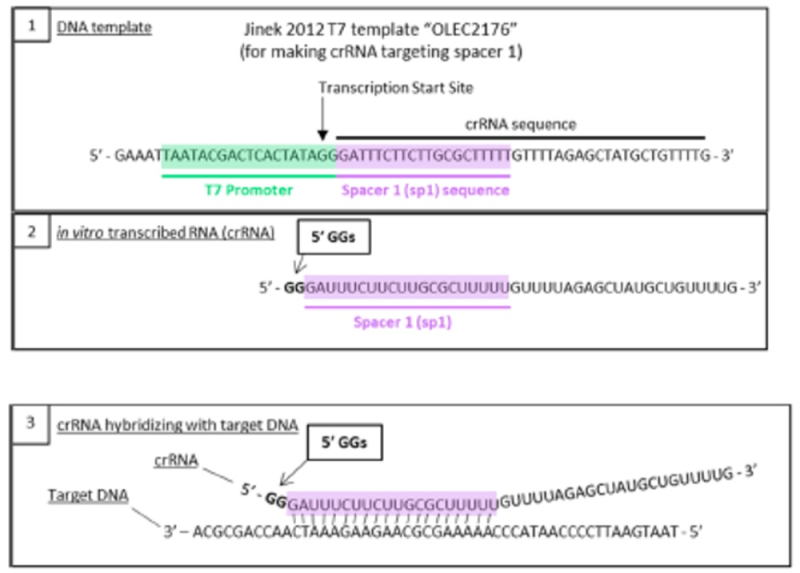
    Image 1
    wherein the diagrams follow the source of the characteristic "extra" GG residues at the 5' end of crRNA and sgRNA produced thereby.  CVC also asserts as second reference, the Deltcheva reference, to illustrate the extent to which T7-catalyzed in vitro RNA production using a T7 promoter was well-known:

    Image 2
    CVC argued that the distinction of including two guanine residues in crRNA and sgRNA comprised thereof is not enough to distinguish the claims of the '380 patent from the Count in this interference (to which CVC argues these claims correspond) because "including a 5'-GG would have been obvious over Count 1 in view of [CVC's] Jinek 2012" reference as illustrated above, which reliance is permitted under Desjardins v Wax, Interference No. 105,915, Paper 127, 17-20 (P.T.A.B. Jan. 21, 2014).  Regarding motivation to combine the teachings of the Jinek reference in this regard with the more general teachings of producing an sgRNA for eukaryotic CRISPR, CVC argued that such motivation is supported by the method's "low cost, efficiency, and accuracy," and because "Jinek 2012 had already used the method to generate RNAs that effectively cleave eukaryotic DNA sequences (e.g., GFP) in CRISPR-Cas9 systems (i.e., ToolGen knew the method would be successful in eukaryotic CRISPR).  This success also would have provided the requisite reasonable expectation of success to complete a prima facie case of obviousness and hence for the '380 claims to properly be determined to correspond to the Count in this interference.

    ToolGen argues in its opposition that the claims of the '380 patent do not correspond to Count 1 of this interference and that CVC's motion does not comply with the requirements of 37 C.F.R. §§ 41.202 and 41.203.  With regard to the substantive question, ToolGen's brief focuses on whether the Count would render those claims obvious (because the lack of the two guanine residues positioned before the crRNA portion of the sgRNA sequence in the Count precludes anticipation, i.e., each and every limitation in the claim is not found therein).  And, ToolGen contends, Count 1 alone cannot render the '380 patent claims obvious (and CVC did not so argue).  Thus, the issue is whether the combination of the language of the Count and the disclosure of the Jinek 2012 reference raises a prima facie obviousness case, which ToolGen maintains it does not.  ToolGen's reasoning is that, at the priority date of the '380 patent (October 23, 2012), "(1) a POSA would not have been motivated to combine Count 1 and Jinek; (2) a POSA would not have had an expectation of success in implementing the CRISPR/Cas9 system of independent claim 1 in eukaryotic cells; and (3) the claims of the '380 patent exhibit superior properties and advantages that a POSA would have found surprising or unexpected."  ToolGen's reasoning reiterates in part the argument raised in its opposition to CVC's Preliminary Motion No.2, that Jinek describes use of prokaryotic CRISPR-Cas9 in a "non-cellular, experimental environment," citing the Board's decision in Interference No. 105,048 and the Federal Circuit's affirmance thereof.  Further, ToolGen argues that the Jinek 2012 reference does not describe any experiments using CRISPR in eukaryotic cells nor introduction of CRISPR complexes into such cells.  Finally, ToolGen cites the PTO's determination during prosecution of the '380 patent that Claim 1 of the '380 patent was non-obvious over the Jinek 2012 reference which is binding here, citing Harris Corp. v. Fed. Exp. Corp., 502 F. App'x 957, 968 (Fed. Cir. 2013), and Glaxo Grp. Ltd. v. Apotex, Inc., 376 F.3d 1339, 1348 (Fed. Cir. 2004).

    ToolGen also challenges CVC's contention that the skilled worker would have been motivated to combine the teachings of the Jinek 2012 reference with the subject matter of Count 1 in support of a prima facie obviousness case.  The basis for this argument is that "nothing in the prior art—cited by CVC or otherwise—'suggest[s] the desirability' of RNA transfection—a method necessitated by Jinek—as a method of introducing sgRNA (or 'guide RNA') into eukaryotic cells as of the priority date" (emphasis in brief), citing In re Fulton, 391 F.3d 1195, 1200 (Fed. 21 Cir. 2004), and Forest Labs., LLC v. Sigmapharm Labs., LLC, 918 F.3d 928, 22 934 (Fed. Cir. 2019).  This argument is based on the limitation recited in Count 1 to a method for "introducing into [a] eukaryotic cell" a CRISPR-Cas9 complex comprising an sgRNA. Jinek's disclosure in limited to a method for preparing RNA by in vitro transcription (emphasis in brief) and this RNA would be understood by the skilled worker to be introduced into eukaryotic cells using RNA transfection techniques, ToolGen asserts, which were not routinely employed in the art.  And the Jinek 2012 reference provides no disclosure (being "entirely silent" on the question) regarding RNA transfection that would overcome these limitations in the prior art according to ToolGen (supported by copious citations to that art).

    ToolGen also argues that the prior art, including the Jinek 2012 reference, did not disclose any reason to introduce two guanine residues before the crRNA portion of the sgRNA sequence, asserting that it was the '380 patent inventors who first discovered that doing so resulted in greater specificity.  Accordingly, ToolGen states, "as of the priority date, a POSA would have understood the Jinek method as having inherent limitations, i.e., the requirement of one or more guanines at the 5' end, without any known benefit."  Indeed, ToolGen makes the case that the state of the prior art would have preferred using eukaryotic promoters, such as the U6 promoter, as part of a DNA plasmid encoding sgRNA as the preferred method for producing (rather than introducing using RNA transfection methods fraught with known difficulties) sgRNA in a eukaryotic cell for achieving CRISPR in such a cell.  (After all, ToolGen notes that CVC's own application, filed three months after the '380 patent's priority date, utilized plasmids encoding sgRNA expressed using a eukaryotic promoter to produce RNA in a eukaryotic cell.)

    ToolGen next turns to CVC's argument that the skilled worker would have had a reasonable expectation of success in combining the Jinek 2012 reference with the limitations of Count 1 to achieve  CRISPR in a eukaryotic cell.  ToolGen bluntly asserts such a POSA would not have had such a reasonable expectation of success because it had been established by the Board, and affirmed by the Federal Circuit, "that as of 5 December 2012—two months after the priority date—a POSA 'would not have reasonably expected success' in implementing CRISPR/Cas9 in eukaryotic cells" by any means.  ToolGen refers to "a similar argument" made by CVC in Interference No. 106,115 (against Broad) and CVC's reliance on the Board distinguishing its decision in the '048 interference as meaning that "[e]xpectation of success in eukaryotes would not be in doubt" as of the priority date.  CVC is incorrect, ToolGen argues, because it ignores the distinctions regarding the limitations in Count 1 (which under 37 C.F.R §41.207(b) is considered prior art) and the "problematic nature of RNA transfection as of the priority date" arising in the context of this interference.  Under the prior art presumption regarding the Count, ToolGen argues, "to interpret §41.207(b) as providing for an assumption of a reasonable expectation of success—as CVC suggests—would be inconsistent with the plain language of the rule and Board precedent" and "such an interpretation would effectively nullify the requisite obviousness analysis of §41.207(b)."  Nor does the routine nature of producing RNA in vitro using T7 promoter and polymerase support a reasonable expectation of using such RNA to achieve CRISPR in eukaryotic cells as CVC argues in its Motion No. 3, ToolGen asserts.

    Finally, in this regard ToolGen contends that the invention claimed in Claim 1 of the '380 patent "exhibits superior properties and advantages that a POSA would have found surprising and unexpected as of the priority date."  Specifically, these include that having two guanine residues positioned before the crRNA portion of the sgRNA "discriminated off-target sites effectively," an improvement over a recognized drawback. CVC's arguments to the contrary, based on other sgRNA configurations lacking the double guanine motif also achieving eukaryotic CRISPR are unavailing to their position, according to ToolGen, because more than one feature of embodiments of an invention in an unpredictable art can have their own surprising and unexpected results indicating non-obviousness.

    ToolGen relies on the non-obviousness of Claim 1 of the '380 patent in support of its contention that Claims 2-10 are also non-obvious when considered in view of the Jinek 2012 reference in combination with the limitations recited in Count 1 and thus the Board should deny CVC's motion to designate them as corresponding to the Count and including them in this interference.

    Finally, ToolGen sets forth its procedural argument that CVC's motion fails to comply with the requirements of 37 C.F.R. §§ 41.202 and 41.203.  The reason is simple: the rule requires a party asking the Board for this remedy to "[e]xplain in detail why the applicant will prevail on priority[.]"  ToolGen argues that CVC made no such showing, and the Board has denied similar motions for this failure, citing Australia v. Leiden, Interference 2 No. 106,007 (RES), 2016 WL 1752729, at *24 (P.T.A.B. Apr. 29, 2016).

    For all these reasons, ToolGen asks the Board to deny CVC's Preliminary Motion No. 3.

    * '830 Patent Claims CVC Asserts Correspond to the Count in the '127 Interference

    1.  A method of introducing a site-specific, double-stranded break at a target nucleic acid sequence in a eukaryotic cell, the method comprising introducing into the eukaryotic cell a Type II Clustered Regularly Interspaced Short Palindromic Repeats (CRISPR)/Cas system, wherein the CRISPR/Cas system comprises: a) a nucleic acid encoding a Cas9 polypeptide comprising a nuclear localization signal, wherein the nucleic acid is codon-optimized for expression in eukaryotic cells, and b) a guide RNA that hybridizes to the target nucleic acid, wherein the guide RNA is a chimeric guide RNA comprising a CRISPR RNA (crRNA) portion fused to a trans activating crRNA (tracrRNA) portion, wherein the guide RNA comprises two guanines at its 5' end, and there are no additional nucleic acid residues between the two guanines at the 5' end and the crRNA portion of the guide RNA; whereby a site-specific, double stranded break at the target nucleic acid sequence is introduced.

    2. The method of claim 1, wherein the nuclear localization signal is located at the C terminus of the Cas9 polypeptide.

    3. The method of claim 1, wherein the eukaryotic cell is a mammalian cell.

    4. The method of claim 3, wherein the mammalian cell is a human cell.

    5. The method of claim 1, wherein the nucleic acid encoding the Cas 9 polypeptide is codon-optimized for expression in mammalian cells.

    6. The method of claim 1, wherein the target nucleic acid sequence is a genomic sequence located at its endogenous site in the genome of the eukaryotic cell.

    7. The method of claim 1, wherein the nucleic acid encoding the Cas9 polypeptide is a vector.

    8. The method of claim 1, wherein the Cas9 polypeptide is a Streptococcus pyogenes Cas9 polypeptide.

    9. The method of claim 1, wherein the nucleic acid encoding the Cas9 polypeptide is introduced into the eukaryotic cell before introducing the guide RNA into the eukaryotic cell.

    10. The method of claim 1, wherein the Cas9 polypeptide is a Streptococcus Cas9 polypeptide.

  • By Michael Borella

    Federal Circuit SealIn academic settings, objective indicia of non-obviousness are sometimes presented as a common way of rebutting contentions that a claimed invention is obvious.  These indicia, set forth in Graham v. John Deere Co. and reiterated in KSR Int'l Co. v. Teleflex, Inc., include commercial success, long felt but unsolved needs, unexpected results, copying by others, industry praise, and failure of others.  While aesthetically pleasing from a procedural point of view, secondary considerations are notoriously difficult to successfully apply outside of law school exams.

    This difficulty is largely due to the requirements that:  (1) the evidence actually exists, (2) the patentee is able to locate this evidence, and (3) the patentee can establish a nexus between the evidence and the claimed invention.  A commercial success rebuttal might involve providing sales or market share figures for a product before and after a patented new feature is released, where the latter is notably higher than the former, as well as support for the notion that this commercial success is actually a result of the patented new feature.  Industry reviews or expert testimony might be required.  And still, this evidence can be rebutted with further evidence that the commercial success was actually caused by other forces than what is claimed.

    Intuitively, this all makes sense.  If one is going to argue that a claimed invention is non-obvious because it was commercially successful, the product or service that enjoyed this commercial success should have done so due to the innovative features of the claims.  Commercial success cannot be used in this fashion when it was caused by some extraneous factor, such as a major competitor leaving the market or going out of business.

    Having said all of that, it is fairly rare for a patentee to win on a commercial success argument.  Recent inter partes review (IPR) final written decisions from the PTAB show how easy it is for commercial success arguments to fail.  Samsung Electronics Co., Ltd v. Cellect, LLC, No. 2020-00475 (PTAB Aug. 17, 2021) (patent owner's licensing of a product, where the patent owner's contentions do not specify which entities took a license to the patent or for what reason the licenses were taken, does not establish a nexus); Microsoft Corp. and HP Inc. v. Synkloud Technologies, LLC, No. 2020-00316 (PTAB Jun. 14, 2021) (patent owner's claim chart between the claimed invention and allegedly successful products was too high level and non-specific to establish a nexus); Red Diamond, Inc. v. Southern Visions, LLP, 2019-01671 (PTAB Mar. 31, 2021) (patent owner did not establish commercial success merely by providing sales data and contending that its market share was "high").

    Successful rebuttals require specific allegations regarding both the nexus and the commercial success, which often have to be backed up by sales / market data and explained in one or more expert declarations.  Due to the time and cost of preparing such evidence, these allegations are rarely made before USPTO examiners.

    Commercial success arguments remain a trap for the unwary.  Nonetheless, two recent Federal Circuit decisions that came down on two consecutive days add a little color to the landscape.

    In Chemours Company FC, LLC v. Daikan Industries, Ltd, patent owner Chemours appealed a PTAB decision finding its claims obvious over its allegations of commercial success.  The Court described the relevant law as:

    In general, evidence supporting objective indicia of nonobviousness must be shown to have a nexus to the claimed invention.  In the obviousness analysis, the claimed invention is, admittedly, a combination of elements that were known individually in the prior art.  Evidence of commercial success, therefore, can be linked to an inventive combination of known elements to show a sufficient nexus.

    The PTAB, focusing on individual claim limitations, found that Chemours failed to establish a nexus on this basis.  The Court disagreed, however, stating that "the separate disclosure of individual limitations, where the invention is a unique combination of three interdependent properties, does not negate a nexus," and that "[c]oncluding otherwise would mean that nexus could never exist where the claimed invention is a unique combination of known elements from the prior art."

    Chemours also argued that the PTAB improperly required market share data to establish a finding of commercial success, where sales data alone could be sufficient.  The Court agreed here as well, observing that:

    When a patentee can demonstrate commercial success, usually shown by significant sales in a relevant market, and that the successful product is the invention disclosed and claimed in the patent, it is presumed that the commercial success is due to the patented invention.  However, market share data, though potentially useful, is not required to show commercial success.

    This holding does not contradict that of Red Diamond above, as the PTAB "is certainly entitled to weigh evidence and find, if appropriate, that Chemours's gross sales data were insufficient to show commercial success without market share data."  Consequently, the Court reversed the PTAB's decision regarding commercial success.

    In Oren Techs., LLC v Proppant Express Investments LLC, patent holder Oren also appealed a PTAB decision finding its claims obvious over its allegations of commercial success.  Regarding the procedural requirements of establishing a nexus, the Court wrote:

    For objective evidence of secondary considerations to be accorded substantial weight, its proponent must establish a nexus between the evidence and the merits of the claimed invention.  That is, objective evidence of non-obviousness must be commensurate in scope with the claims which the evidence is offered to support.  There can be a presumption of nexus for objective considerations when the patentee shows that the asserted objective evidence is tied to a specific product and that product is the invention disclosed and claimed in the patent.  The presumption can apply even when the product has additional, unclaimed features.  Once established, this presumption of nexus is rebuttable with evidence showing the objective evidence is due to extraneous factors other than the patented invention.

    Oren provided a mapping of its commercial product to the claims of its patent, and this mapping was sufficient to conclude that the product was what was being claimed.  Proppant argued that a broader version of the product with more features was responsible for any commercial success.  This argument was enough for the PTAB to conclude that the commercial success was primarily a result of the non-claimed features.

    The Court disagreed, however, stating that the PTAB ignored evidence that the claimed features were also an important factor driving the commercial success of the broader product.  Oren provided licensing data and market analysis evidence that this was the case.  Since "it is not necessary that the patented invention be solely responsible for the commercial success, in order for this factor to be given weight appropriate to the evidence, along with other pertinent factors," the Court remanded the case to the PTAB for further consideration of the evidence.

  • CalendarSeptember 1, 2021 – "Inventor Diversity Part 2: How to Publish Your Inventor Diversity Metrics" (Intellectual Property Owners Association) – 2:00 pm to 3:00 pm (ET)

    September 13-14, 2021 – National Forum on Paragraph IV Litigation (Momentum Events)

    September 17, 2021 – "IP and Tech Corporate Counsel Conference" (Center for Intellectual Property, Information & Privacy Law at the University of Illinois Chicago School of Law) – 7:30 am to 4:15 pm on 

    September 24-25, 2021 – Elevate Your Prosecution 2021 conference – Salt Lake City

    September 29-30, 2021 – FDA Boot Camp (American Conference Institute)

  • IPO #2The Intellectual Property Owners Association (IPO) will offer a one-hour webinar entitled "Inventor Diversity Part 2: How to Publish Your Inventor Diversity Metrics" on September 1, 2021 from 2:00 pm to 3:00 pm (ET).  Ahsan Shaikh of McDermott Will & Emery will moderate a discussion with Carole Boelitz, Executive Director – IP, Lenovo, and Jason Friday, IP Counsel, Lenovo, who will discuss the challenges and rewards of publishing an organization's diversity in innovation metrics, as Lenovo did in 2020, and what other organizations can do to follow in the Lenovo's footsteps.

    The registration fee for the webinar is $150 for non-members or free for IPO members (government and academic rates are available upon request).  Those interested in registering for the webinar can do so here.

  • UIC LawThe Center for Intellectual Property, Information & Privacy Law at the University of Illinois Chicago School of Law will be holding a program entitled "IP and Tech Corporate Counsel Conference" from 7:30 am to 4:15 pm on September 17, 2021.  The conference will provide sessions on the following topics:

    • Session 1: Thinking Globally, Acting Locally
    • Session 2: Best Practices & Pitfalls
    • Featured Session: Innovation that Sticks: Engineering Intellectual Property, Internationality & Inclusiveness — Yen Florczak, Chief Intellectual Property Counsel, 3M Company
    • Session 3: Tips for Patent Prosecution, Licensing & Litigation
    • Session 4: Brand v. Budget
    • Session 5: Diversity in the Profession

    Additional information about the program, including an agenda and list of speakers, can be found here.  Those interested in registering for the conference online can do so here.  The registration fee is $95 (CLE admission).  Those not seeking CLE credit; UIC faculty, students, and staff; and government employees can register for free.  Patent Docs readers who register for the program will be entitled to a 20% discount off of the registration fee using the discount code patentdocs2021.

    Patent Docs is an Institutional Partner of the UIC School of Law IP Center.

  • By Kevin E. Noonan

    Federal Circuit SealDominating the entering gallery of the Impressionists exhibit at the Art Institute of Chicago is Georges Seurat's A Sunday on La Grande Jatte (see below).  Painted in the pointillist style, the work comprises millions of individual paint dots reminiscent of photos taken with late 20th Century technology made up of hundreds of individual photographs.  Both these examples of "from many, one" come to mind when considering the Federal Circuit's opinion today in Juno Therapeutics, Inc. v. Kite Pharma, Inc., wherein the Court overturned a jury's factual determination that Kite had not shown by clear and convincing evidence that the asserted claims were invalid for failure to satisfy the written description requirement of 35 U.S.C. § 112(a).  As a consequence, the Court also vacated a $1.2 billion judgment to Juno Therapeutics.

    A Sunday on La Grande JatteThe case arose over Juno's allegations that Kite infringed claims 3, 5, 9, and 11 of U.S. Patent No. 7,446,190 by "the use, sale, offer for sale, or importation of [Kite's] YESCARTA®" product; claim 1 is representative (although the opinion is directed to grounds of invalidation for all asserted claims):

    1.  A nucleic acid polymer encoding a chimeric T cell receptor, said chimeric T cell receptor comprising
        (a) a zeta chain portion comprising the intracellular domain of human CD3 ζ chain,
        (b) a costimulatory signaling region, and
        (c) a binding element that specifically interacts with a selected target, wherein the costimulatory signaling region comprises the amino acid sequence encoded by SEQ ID NO:6.

    As explained in the opinion, the invention is related to so-called "CAR-T" anticancer therapy, wherein a chimeric targeted receptor (CAR) directed to T cells is used to stimulate a patient's immune response against tumor cells.  The components include the intracellular domain of human CD3 ζ, "a signaling domain that, when the T cell binds to an antigen, is activated to create an initial immune response."  This is linked to a costimulatory signaling region, which has a specific amino acid sequence (SEQ ID NO: 6) that is part of naturally occurring CD28 expressed in T cells.  Stimulation of this sequence enhances an immune response by, inter alia, causing T cells to multiply.  The final portion is a specific binding element that binds to an antigen expressed by a target cell such as a tumor.  A nucleic acid encoding CAR is introduced into a patient's T cells after isolation from the patient and then returned, wherein these altered T cells specifically bind to the tumor cell, causing multiplication of these tumor-specific T cells and resulting in tumor cell death.

    A species of the specific binding element at issue in this case is a single chain antibody variable fragment or scFv, produced by linking together antigen-binding portions of the heavy and light chain of an antibody's variable region to form the binding element.  Important to the Court's decision, "[e]ach variable region has a unique amino acid sequence that can dictate whether and how an antibody, and thus an scFv, binds to a target."  The '190 patent specification discloses only two such svFvs, one that binds CD19 (a protein expressed on the cell surface of diffuse large B-cell lymphoma cells) and one that binds to PSMA, an antigen that is expressed at the cell surface of prostate cancer cells.  The specification does not disclose the amino acid sequence of either of these scFvs.

    A jury determined that Kite had not shown by clear and convincing evidence that Juno's asserted claims were invalid under the written description requirement of § 112(a) and the District Court denied Kite's motion for judgment as a matter of law directed at overturning this verdict.  This appeal followed.

    The Federal Circuit reversed in an opinion by Chief Judge Moore, joined by Judges Prost and O'Malley.  While the opinion is based on several Federal Circuit opinions rendered in this century, the fundamental (doctrinal) basis for the decision is the Court's opinion in Regents of the Univ. of Cal. v. Eli Lilly & Co.:

    A written description of an invention involving a chemical genus, like a description of a chemical species, "requires a precise definition, such as by structure, formula, [or] chemical name," of the claimed subject matter sufficient to distinguish it from other materials.

    119 F.3d 1559, 1568 (Fed. Cir. 1997) (quoting Fiers v. Revel, 984 F.2d 1164, 1171 (Fed. Cir. 1993)).  (It will be recalled that this decision stemmed from a time when isolating a gene was if not herculean then at least a daunting experimental task, fraught with unpredictability with regard to the similarity between a gene isolated from one organism (in the Lilly case, the gene encoding rat insulin) compared with another (human insulin).  The Court prudently ruled it improvident to hold that a party should be able to claim the undiscovered nucleic acid based on success in discovering a different one.  This factual predicate has not existed for almost a generation.)

    The panel agreed with Kite's contention that "the '190 patent discloses neither representative species nor common structural features of the claimed scFv genus to identify which scFvs would function as claimed," because:

    [T]he claims cover an enormous number (millions of billions) of scFv candidates, only a fraction of which satisfy the functional binding limitation for any given target, and that the written description does not meet the written description requirement for this functional binding limitation [and] the scFv field is unpredictable since an scFv's binding ability depends on a variety of factors.

    The opinion assesses the failure to satisfy the written description requirement for dependent claims 3 and 9, which the Court properly identifies as "[t]he broadest asserted claims."  These claims recite scFv binding elements that "specifically interact[] with a selected target."  The specification discloses that "[t]he target . . . can be any target of clinical interest to which it would be desirable to induce a T cell response" (emphasis in opinion), or as the opinion paraphrases "any scFv for binding any target."  (Rarely has a validity kiss of death been stated in fewer words.)  The opinion states in this context that the written description "fails to provide a representative sample of species within, or defining characteristics for, that expansive genus," i.e., utterly fails to satisfy the Eli Lilly test for satisfying the written description requirement.

    The opinion then explicates the degree to which the '190 patent specification is deficient in its disclosure, being limited to two examples of this "expansive genus."  In particular, the specification designates the targets merely by their "alphanumeric designations" (i.e., providing no sequence information), while noting elsewhere that this feature is not dispositive.  The panel rejects Juno's argument that this disclosure constitutes a representative number of species of the scFv genus, if only because "there is no limit as to the particular target" encompassed by claims 3 and 9, asserting "the patent needed to demonstrate to a skilled artisan that the inventors possessed and disclosed in their filing the particular species of scFvs that would bind to a representative number of targets."

    The panel was not convinced that the expert testimony Juno adduced to counter Kite's invalidity allegations was sufficient (again, disregarding factual determinations by a jury having the conventional opportunity to judge demeanor, believability, and other aspects of testimony usually kept somewhat sacrosanct within the province of the jury).  Yet the opinion is careful to distinguish its decision here from the Court's opinion in Capon v. Eshhar, 418 F.3d 1349, 1357 (Fed. Cir. 2005), based on the error by the Board of Patent Appeals and Interference in that case to require an applicant to recite in its specification sequences "already known in the prior art."  The opinion adheres to the requirement set forth in Ariad Pharms., Inc. v. Eli Lilly & Co., 598 F.3d 1336, 1351 (Fed. Cir. 2010) (en banc), that the purpose of the written description requirement is to "lead a person of ordinary skill in the art to understand that the inventors possessed the entire scope of the claimed invention," something that the Court held Juno's specification did not do.  And the Court further rejected Juno's contention that the fact that scFvs were generally known was sufficient (this being essentially an argument sounding in enablement rather written description jurisprudence).  The Court sets forth the impossible standard they impose:

    To satisfy written description, however, the inventors needed to convey that they possessed the claimed invention, which encompasses all scFvs, known and unknown, as part of the claimed CAR that bind to a selected target.  Even accepting that scFvs were known and that they were known to bind, the specification provides no means of distinguishing which scFvs will bind to which targets.

    The opinion then turns to the alternative Lilly basis for satisfying the written description requirement, disclosure of common structural features, and finds the '190 specification similarly wanting.  While acknowledging that scFvs have "structural commonalities," the differences in amino acid sequences are what determine different specificities to different antigens, and thus the '190 specification "fails to disclose a way to distinguish those scFvs capable of binding from scFvs incapable of binding those targets" (emphasis in opinion).  This situation is reminiscent for the Court with the (frankly very much different) circumstances in the Ariad case, because the '190 patent is claiming a "problem to be solved while claiming all solutions to it . . . cover[ing] any compound later actually invented and determined to fall within the claim's functional boundaries."

    The opinion then asserts as a basis of its recent (and philosophical twin) opinion in Idenix Pharms. LLC v. Gilead Scis. Inc., 941 F.3d 1149, 1164 (Fed. Cir. 2019), as well as the more distant (but more antibody-related) decision in AbbVie Deutschland GmbH v. Janssen Biotech, Inc., 759 F.3d 1285, 1301–02 (Fed. Cir. 2014), for the broader principle that functional similarities are not enough to satisfy the written description requirement absent "an established correlation between the structure and the claimed function."

    The opinion then turns to asserted claims 5 and 11, which recite the further limitations that the scFv bind to CD19.  This limitation does nothing to satisfy the written description requirement, the panel stating that while there are "four or five" scFvs that bind to CD19 known in the prior art, "the universe of possible sequences for scFvs is in the range of 'millions of billions'" according to Kite.  This is enough, accompanied with the total lack of any disclosure (such as "exemplary amino acid sequence") for the panel to determine that the '190 specification lacks disclosure of any general structural characteristics and thus would not be considered by the skilled artisan to show possession of the invention having the scope claimed.  The panel expressly rejects both expert and inventor testimony to the contrary, characterizing some of it as "circular reasoning" with regard to testimony that the witness was not aware of any functional CD19-specific svFv that was not functional in the CAR-T context.  At most, the panel was willing to concede that the "invention" was the "backbone" comprising the combination of the intracellular domain of human CD3 ζ and the costimulatory sequence identified by SEQ ID NO: 6.  But, of course, satisfaction of the written description requirement for these claims requires all components of the claimed invention to be sufficiently disclosed, and the deficiencies in disclosure of the svFv portions was enough to invalidate all asserted claims.

    To continue the artistic analogy, the situation with all antibody-related claims (and in truth a great many chemical claims; see Idenix) is that there are sufficiently large combinatorial universes of species that only a vanishingly small number of them are (or practically can be) disclosed in a specification, like only dozens of the millions of paint dots making up Seurat's masterpiece.  Under these conditions, the painting would be rendered as something perhaps more akin to Jackson Pollack's work, and the picture produced thereby lacking entirely the characteristics that have made it a masterpiece.  Returning to patent law, the scope of claims relating to antibodies (and soon perhaps more mundane chemical species) will likely be limited to a "what you see (i.e., disclose expressly) is what you get (patented)" model, which will no doubt (by reducing valid claim scope) allow copyists to piggyback on others' inventions to make their own competing species of valuable therapeutic agents.  This will likely increase the universe of potential commercial embodiments for antibody-related inventions; whether first mover advantages will be enough to make advantageous commercialization by inventors and their companies is another question.

    Juno Therapeutics, Inc. v. Kite Pharma, Inc. (Fed. Cir. 2021)
    Panel:  Chief Judge Moore and Circuit Judges Prost and O'Malley
    Opinion by Chief Judge Moore

  • By Kevin E. Noonan

    ToolGenOn May 20th, Junior Party the University of California, Berkeley; the University of Vienna; and Emmanuelle Charpentier (collectively, "CVC") filed its Substantive Preliminary Motion No. 2 in Interference No. 106,127 (which names ToolGen as Senior Party), asking the Patent Trial and Appeal Board to deny ToolGen benefit of priority to U.S. Provisional Application No. 16/717,324, filed October 23, 2012, pursuant to 37 C.F.R. §§ 41.121(a)(1)(ii) and 41.208(a)(3) and Standing Order ¶ 208.4.1.  The significance of the Board granting this motion would be that CVC would be Senior Party, with all the presumptions benefiting from Senior Party status.  On July 5th, ToolGen filed is opposition to this Motion.

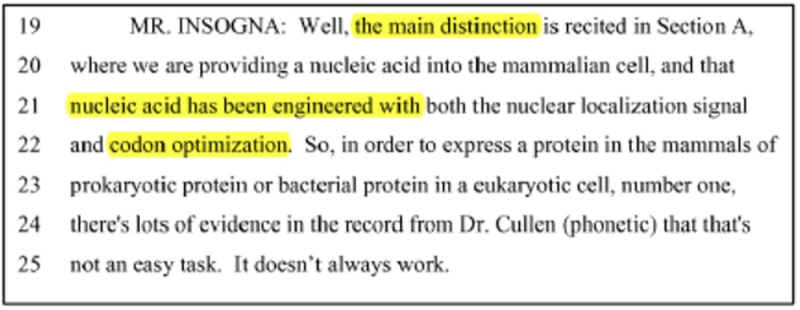
    In its Motion No. 2, CVC argued that the Board should deny ToolGen priority benefit to the '324 application because this application does not disclose an operative embodiment falling within the scope of the interference Count, based on party admissions.  Specifically, CVC argued that in the prosecution of the '324 patent application leading to allowance (and declaration of this interference), ToolGen had argued to the Patent Examiner (and PTAB) that "a codon-optimized Cas9 nucleic acid is required for CRISPR-Cas9 to function in eukaryotic cells" and that "a skilled artisan would have no idea what the outcome may be if one were to codon optimize a Cas9 nucleic acid."  This position was consistent with the prokaryotic source of Cas9, and the Board and Examiner relied upon these arguments to find allowable claims in the '324 application (now claims designated as corresponding to the Count in this interference) according to CVC.  All such claims require use of a Cas9-encoding nucleic acid that is codon-optimized for expression in eukaryotic cells, and CVC asserted that ToolGen added this limitation to the claims to overcome anticipation and obviousness rejections based on the prior art.

    But, CVC argued, ToolGen's '324 application does not disclose a codon-optimized Cas9 nucleic acid, nor (by ToolGen's own argument according to CVC) would the skilled worker be able to discern such a nucleic acid with any reasonable basis for expecting such an embodiment could be produced using the disclosure in the '324 application.  Accordingly, CVC argued in its motion, ToolGen cannot in this interference renounce these arguments and rely on the priority date of the '324 patent to constitute a constructive reduction to practice for eukaryotic CRISPR-Cas9 embodiments falling within the scope of the interference Count.  Thus, according to CVC, the Board should deny ToolGen priority benefit to the '324 application (and redeclare the interference naming CVC as Senior Party).  The brief contained examples from the '324 prosecution history and at oral argument before the Board in support of its allegations.

    ToolGen, characterizing CVC's arguments (as did CVC, citing Zedner v. United States, 547 U.S. 489 (2006), and Springs Window Fashions LP v. Novo Industries, L.P., 323 F.3d 989, 995 (Fed. Cir. 2003)) as sounding in judicial estoppel, argues this is a "misrepresentation of the prosecution history" and that the '324 application provides a constructive reduction to practice of eukaryotic CRISPR as defined under CVC's portion of the Count in this interference (and that CVC does not effectively challenge this disclosure) but not ToolGen's portion of the Count.  ToolGen affirmatively argues that the '324 application "describes a successful experiment using a codon-optimized nucleic acid encoding Cas9 to yield a Cas9 protein complex that functions in eukaryotes to cleave DNA" in support of this assertion.  But more fundamentally, ToolGen argues, Count 1 in the interference does not require codon-optimized Cas9 as part of a eukaryotic CRISPR complex and thus CVC's argument (and Motion) should fail.

    ToolGen sets forth the legal basis for denying a party accorded benefit, when the priority document "does not provide a constructive reduction to practice of an embodiment within the count," under 37 CFR §41.208(b); and S.O. ¶¶ 121.3 and 208.4.2 and citing Hunt v. Treppschuh, 523 F.2d 1386, 1389 (CCPA 1975).  Regardless of the distinction between the CVC and ToolGen portions of the Count, ToolGen argues it does not matter because the '324 application "expressly describes the use of a codon-optimized nucleic acid encoding Cas9 to achieve DNA cleavage in a eukaryotic cell, satisfying both halves of Count 1."  And, according to ToolGen, CVC does not dispute (indeed, admits) that the '324 application disclosure satisfies CVC's portion of the Count.  Rather, ToolGen contends, CVC tries to rewrite the Count to include a limitation to codon-optimized Cas9 protein without requesting leave to revise the Count in this manner, providing another reason why its Motion should be denied.

    ToolGen distinguishes the circumstances here with the legal requirements for judicial estoppel based on its version of the prosecution history.  According to ToolGen, its argument to the Examiner and the Board was that its claims to eukaryotic CRISPR embodiments were not obvious because the skilled worker would not have had a reasonable expectation of success in view of the cited prior art and hence were non-obvious.  In ToolGen's view, codon-optimization and conjugation with a nuclear localization signals were elements of their claims that overcame "the then-prevailing unpredictability and pessimism" regarding eukaryotic embodiments of CRISPR.  ToolGen's point is that their claims were not enabled by comprising codon-optimized and NLS conjugated Cas9 species, but that such embodiments rendered eukaryotic CRISPR non-obvious.  Nevertheless, ToolGen argues (and explicates in its brief) that its '324 application disclosed three CRISPR embodiments functional in eukaryotic cells and thus is entitled to priority benefit.  It was the Examiner who focused on codon optimization (mistakenly, according to ToolGen) and that error was the basis for its successful appeal to the Board.

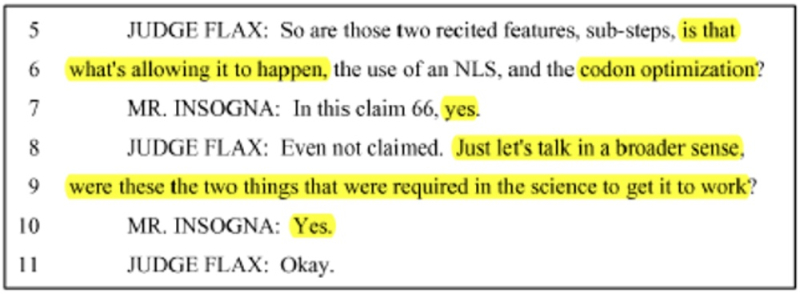
    ToolGen contends that CVC cites to the prosecution history "selectively and inaccurately," in a rare rhetorical flourish arguing that "[i]ts Motion relies on contextual fragments of arguments, statements with omitted words, and disparate questions and answers, all stitched together like Frankenstein's monster, to assemble a false narrative that ToolGen achieved patentability by focusing on codon optimization, not the unpredictability in prokaryote-to-eukaryote translation."  Interestingly, ToolGen argues that the portion of the Board's interrogation of their representative cited in CVC's Motion No. 2:

    Image 1
    *  *  *

    Image 2
    and

    Image 3
    is misleading because the purported answer above is to a different question.  Properly understood the colloquy reads as follows:
    Image 4
    And, according to ToolGen, its answer regarding codon optimization was to a question by another judge on the ex parte panel to a different question ("whether one of ToolGen's pending claims contained limitations as to 'amounts or levels of different things' that would distinguish ToolGen's claims from prior art"):

    Image 5
    ToolGen asserts these answers are consistent with its disclosure of codon-optimized Cas9 protein being used to achieve eukaryotic CRISPR conjugated to an NLS.

    In addition, ToolGen rebuts CVC's argument that it told the PTO during ex parte prosecution that codon optimization was itself unpredictable.  According to ToolGen, prior to its achievement of using CRISPR in eukaryotic cells "there were multiple reasons . . . why an ordinary artisan would have had no reasonable expectation of successfully transitioning prokaryotic CRISPR/Cas9 to eukaryotic cells" of which codon optimization was but one.  This argument is consistent with what Broad has argued in Interference Nos. 105,048 and 106,115 regarding the unpredictability of adapting CRISPR to the eukaryotic environment and with ToolGen's own expert (who testified during ex parte prosecution that codon optimization might cause unpredictable effects on Cas9 folding and hence operability in a eukaryotic cell).

    Turning to the question of judicial estoppel, ToolGen argues that it took no position during ex parte prosecution that is contrary to its position in this interference and hence there is no factual or legal basis for CVC's judicial estoppel argument.  Moreover, ToolGen argues, there is no basis for believing that the Board during ex parte prosecution reversed the Examiner and held ToolGen's claims to be non-obvious based on unpredictability of codon optimization.  Nor according to ToolGen does prosecution history estoppel cure these purported deficiencies in CVC's argument, because it is inapplicable to the priority question before the Board.

    ToolGen's primary affirmative argument in rebutting CVC's challenge to its priority claim is that CVC did not dispute or establish that the '324 application failed to satisfy the disclosure requirements for priority benefit in an interference.  ToolGen maintains that CVC's expert erred (and was coached to err, based on the expert's declaration evidence) by not considering the disclosure question properly from the point of view of the ordinarily skilled worker.  This prejudice renders his evidence "both irrelevant and unreliable" according to ToolGen and should be disregarded, citing AAT Bioquest, Inc. v. Texas Fluorescence Laboratories, Inc., 2015 WL 1738402, *5-*7 (N.D. Cal. 2015), for this principle.  ToolGen also rebuts CVC's argument that the '324 specification did not disclose human codon-optimized Cas9, stating that the passage below from the '324 specification makes this disclosure (albeit "just not in CVC's quoted words") that would be understood by the skilled artisan, something both sides' experts agreed with (with emphasis in brief):

    The Cas9-coding sequence (4,104 bp), derived from Streptococcus pyogenes strain M1 GAS (NC_002737.1), was reconstituted using the human codon usage table and synthesized using oligonucleotides.

    ToolGen completes its rebuttal of CVC's arguments by asserting that an ordinary artisan would not have required a sequence listing to appreciate that the '324 specification disclosed codon-optimized Cas9, citing Falko-Gunter Falkner v. Inglis, 448 F.3d 1357, 1368 (Fed. Cir. 2006), and that a nucleic acid construct encoding such a codon-optimized Cas9 would not need "enhanced" expression to display the CRISPR phenotype.

    For all these reasons ToolGen asks the Board to deny CVC's Preliminary Motion No. 2.

  • By Michael Borella

    Federal Circuit SealTwo years ago, MyMail and ooVoo went to the mat in the Federal Circuit over claims that the District Court for the Northern District of California found ineligible under 35 U.S.C. § 101.  Patent holder MyMail was able to convince two out of three judges on the Federal Circuit panel that the dispute between the parties regarding claim construction required a remand to the District Court.  Now, with claims construed and once more found ineligible by the District Court judge, MyMail again appeals.

    Background

    MyMail's U.S. Patent Nos. 8,275,863 and 9,021,070, are both directed to "methods of modifying toolbars that are displayed on Internet-connected devices such as personal computers."  As an example of the claims under dispute, claim 1 of the '863 patent recites:

    A method for dynamically modifying a toolbar, the method comprising:
        displaying the toolbar, at a user Internet device, that includes one or more toolbar buttons, the toolbar defined by toolbar data stored in one or more toolbar-defining databases, the toolbar data comprising a plurality of toolbar button attributes associated with the one or more toolbar buttons of the toolbar, wherein at least one of the plurality of toolbar button attributes identifies a function to be performed by a specific toolbar button upon actuation of the specific toolbar button;
        invoking, from the user Internet device without user intervention, communication of information associated with the one or more toolbar-defining databases to a server associated with a network address;
        receiving, at the server, the information associated with the one or more toolbar-defining databases;
        determining, based on the information associated with the one or more toolbar-defining databases, that the user Internet device should receive updated toolbar data;
        receiving, at the user Internet device, the updated toolbar data in response to determining that the user Internet device should receive the updated toolbar data;
        initiating, at the user Internet device and without user interaction, an operation to update the toolbar data in accordance with the received updated toolbar data;
        updating the toolbar data at the user Internet device based on the operation and in accordance with the updated toolbar data, thereby updating the toolbar data, the updating comprising at least one member of a group comprising (a) and (b): (a) updating the toolbar data to include at least one new attribute of the toolbar data to change the toolbar by adding a toolbar button to the toolbar; and (b) updating the toolbar data to modify an attribute of at least one of the one or more toolbar buttons of the toolbar; and
        displaying at the user Internet device the toolbar as defined by the updated toolbar data, wherein the information associated with the toolbar data includes at least one member of a group comprising a revision level, version, time, date, user ID, account owner ID, PAP ID, IP address, session keys, billing data, name, address, account information, connection history, procedures performed by a user, group ID, e-mail address, e-mail ID, e-mail password, residential address, and phone number.

    In Alice v. CLS Bank, the Supreme Court set forth a two-part test to determine whether claims are directed to patent-eligible subject matter under § 101.  One must first decide whether the claim at hand involves a judicially-excluded law of nature, a natural phenomenon, or an abstract idea.  If so, then one must further decide whether any element or combination of elements in the claim is sufficient to ensure that the claim amounts to significantly more than the judicial exclusion.  But elements or combinations of elements that are well-understood, routine, and conventional will not lift the claim over the § 101 hurdle.  While this inquiry is generally carried out as a matter of law, factual issues can come into play when determining whether something is well-understood, routine, and conventional.

    Last year, the Federal Circuit provided a major clue as to how to think about patent eligibility in practice.  In Dropbox Inc. v. Synchronoss Techs. Inc., the Court wrote that "an inventive concept exists when a claim recites a specific, discrete implementation of the abstract idea where the particular arrangement of elements is a technical improvement over the prior art."  This suggests that in order for a claim that is otherwise directed to an abstract idea to be successful under § 101, it should have three qualities:  specificity, a technical solution that it provides, and some degree of novelty.  More particularly, there should be a nexus between these three qualities — specificity, technical character, and novelty should appear in the same claim element or at least be explicitly linked in some fashion in the recitation of the claim.

    District Court Proceedings

    The claim construction issue centered on the term "toolbar."  The District Court construed this term to mean "a button bar that can be dynamically changed or updated via a Pinger process or a MOT script."  The District Court noted that changing or updating the toolbar with the Pinger process or MOT script is not required but the capability must exist.

    While definitions of these two techniques turned out to not be critical in the ultimate § 101 outcome, for sake of completeness they are provided as follows.  A Pinger process is an identification and updating procedure for the toolbar that involves downloading of a database from server device to a client device hosting the toolbar.  A MOT script specifies how the toolbar is built from the database.

    Applying part one of Alice, the District Court found that the claims are "directed to the abstract idea of updating toolbar software over a network without user intervention."  The District Court saw no significant difference between how the Pinger process and MOT scripts were defined in the specification versus the language of the claim.  Further, "MyMail failed to identify a specific improvement in computer functionality or a problem in the prior art that the claims solve."

    Applying part two, the District Court concluded that all claimed components were generic and conventional, merely implementing the abstract idea.  MyMail did not make any arguments regarding the combination of additional elements, and the District Court found no inventive concept therein.

    Federal Circuit Opinion

    On appeal, the Federal Circuit largely agreed.

    With reference to part one of Alice, the Court wrote that "we look at the focus of the claimed advance over the prior art to determine if the claim's character as a whole is directed to excluded subject matter."  For software inventions, this determination often is based on "whether the claims focus on specific asserted improvements in computer capabilities or instead on a process or system that qualifies as an abstract idea for which computers are invoked merely as a tool."

    In view of these parameters, the Court observed that the claims are drawn to "no more than invoking computers as a tool to perform the abstract ideas of collecting information, analyzing information, and presenting the results of the analysis in the software update context."  The construction of the "toolbar" term did nothing to change the Court's view.

    MyMail argued, somewhat circularly, that the "claims are instead directed to an improvement in the functionality of the software updating process . . . via a Pinger process or a MOT script."  But the Court found nothing in the specification that supported this notion, and stated that MyMail's arguments regarding the alleged improvement were conclusory.

    Moving on to part two, the Court also found no inventive concept in the claims.  In particular, the Court found the claimed computer components to be generic and their functions to be routine.  The Court took a dim view toward the lack of specificity in how the claimed functions are performed, even when considered as an ordered combination in light of the claim construction.

    Finally, MyMail cited to its success in avoiding and overcoming prior art challenges at the PTAB.  But MyMail pushed this too far, arguing that it was incorrect for the District Court to ignore those proceedings.  The Court adopted reasoning that we have seen since 2014's Ultramercial v. Hulu — that claims found novel and/or non-obvious do not automatically have an inventive concept.  Instead, "a claim for a new abstract idea is still an abstract idea."

    This aesthetically unsatisfying doctrine is best understood in terms of the three qualities noted above.  Even if there was some daylight between the claimed invention and the prior art, this difference needs to be a specifically-claimed technical improvement.  Since the Court found no technical improvement and implied that the claims were vague, at least two of the three qualities were missing.

    Thus, the Court found the claims to lack patentability under § 101.

    MyMail, Ltd. v. ooVoo, LLC (Fed. Cir. 2021)
    Panel: Chief Judge Moore and Circuit Judges O'Malley and Reyna
    Opinion by Circuit Judge O'Malley

  • By Kevin E. Noonan

    Federal Circuit SealThe Federal Circuit issued three decisions on Monday relating to Eli Lilly & Co's. challenge in separate inter partes review proceedings on obviousness grounds of nine patents licensed by Teva Pharmaceuticals Int'l, with disparate results.

    The patents were related to humanized monoclonal antibodies immunologically specific for calcitonin gene-related peptide (CGRP), for treatment of "all forms of vascular headache, including migraines"; each party marketed a product for this purpose (Teva's AJOVY® and Lilly's Emgality®).  The appeals clustered separate but related IPR proceedings that the Board had combined for oral argument.  In the first of these (as considered here), Eli Lilly & Co. v. Teva Pharmaceuticals Int'l GmbH, Lilly appealed the Board's decision that it had failed to show that challenged claims 1, 3, 4, 8–17, 19, 20, and 24–31 of U.S. Patent No. 8,586,045, claims 1–18 of U.S. Patent No. 9,884,907, and claims 1–18 of U.S. Patent No. 9,884,908 were obvious.  Representative claims from each patent are:

    The '045 patent:

    1.  A method for reducing incidence of or treating at least one vasomotor symptom in an individual, comprising administering to the individual an effective amount of an anti-CGRP antagonist anti-body, wherein said anti-CGRP antagonist antibody is a human monoclonal antibody or a humanized monoclonal antibody.

    The '907 patent:

    1.  A method for treating headache in an individual, comprising:
        administering to the individual an effective amount of a humanized monoclonal anti-Calcitonin Gene-Related Peptide (CGRP) antagonist antibody, comprising:
        two human IgG heavy chains, each heavy chain comprising three complementarity determining regions (CDRs) and four framework regions, wherein portions of the two heavy chains together form an Fc region; and
        two light chains, each light chain comprising three CDRs and four framework regions;
        wherein the CDRs impart to the antibody specific binding to a CGRP consisting of amino acid residues 1 to 37 of SEQ ID NO:15 or SEQ ID NO:43.

    The '908 patent:

    1.  A method for treating headache in an individual, comprising:
        administering to the individual an effective amount of a humanized monoclonal anti-Calcitonin Gene-Related Peptide (CGRP) antagonist antibody, comprising:
        two human IgG heavy chains, each heavy chain comprising three complementarity determining regions (CDRs) and four framework regions, wherein portions of the two heavy chains together form an Fc region; and
        two light chains, each light chain comprising three CDRs and four framework regions;
        wherein the CDRs impart to the antibody specific binding to a CGRP consisting of amino acid residues 1 to 37 of SEQ ID NO:15 or SEQ ID NO: 43, and wherein the antibody binds to the CGRP with a binding affinity (KD) of about 10 nM or less as measured by surface plasmon resonance at 37o C.

    Lilly asserted three prior art references in support of its obviousness challenge:

    • Olesen et al., "Calcitonin Gene-Related Peptide Receptor Antagonist BIBN 4096 BS for the Acute Treatment of Migraine," N. ENG. J. MED. 350: 1104–10 (2004), which taught treatment of migraine with CGRP receptor antagonist.

    • Tan et al., "Calcitonin gene-related peptide as an endogenous vasodilator: immunoblockade studies in vivo with an anti-calcitonin gene-related peptide monoclonal antibody and its Fab' fragment," 89 CLINICAL SCI. 6: 565–73 (1995), which taught using full-length anti-CGRP mAb to block CGRP binding to its receptor in rats.

    • U.S. Patent No. 6,180,370, which is a general reference teaching use of "recombinant DNA and monoclonal antibody technologies for developing novel therapeutic agents."

    The Board rendered its decision that Lilly failed to show the challenged claims were obvious over this art.  This decision depended in part of its claim construction wherein the preambles of each of the challenged claims constituted a "statement of intended purpose" and were limiting to that extent, which thus raised in Lilly the burden of showing that the skilled worker would have had a reasonable expectation of success in achieving this intended purpose.  In a bit of circular reasoning, the Board construed the claim term "effective amount" to be the amount that would achieve this preamble purpose of a beneficial result but not a clinical result (i.e., of treating migraine).

    The Board found the cited art taught each and every one of the limitations recited in the claims, and the skilled artisan would have been motivated to combine the teachings in the cited art and that safety concerns would not have deterred, discouraged, or taught away from pursuing" the invention.  But Lilly failed to show a reasonable expectation of success in the Board's opinion, including that the blood-brain barrier "raised uncertainty, unpredictability, and skepticism in using full-length anti-CGRP antibodies" therapeutically.  This was enough to defeat obviousness for these method claims, which the panel stated was consistent with Honeywell International Inc. v. Mexichem Amanco Holdings S.A. DE C.V., 865 F.3d 1348, 1356 (Fed. Cir. 2017), and were analogous to Novartis Pharmaceuticals Corp. v. West-Ward Pharmaceuticals International Ltd., 923 F.3d 1051 (Fed. Cir. 2019).

    The Federal Circuit affirmed in a decision (as all three decisions were) by Judge Lourie joined by Judges Bryson and O'Malley.  On appeal, Lilly raised two arguments.  First, that the Board's claim construction was in error for interpreting the preambles to require a beneficial result that was related to the construction of "effective amount."  Second, Lilly argued the Board's standard for reasonable expectation of success was improperly high.

    With regard to claim construction, the panel agreed with Teva that the Board properly construed the preambles to be limiting.  Specific to the facts in each case, as it must be under Storage Tech. Corp. v. Cisco Sys., Inc., 329 F.3d 823, 831 (Fed. Cir. 2003), here the panel held that in this case, the claims were directed to methods for achieving a particular purpose, i.e., "treating or reducing the incidence of vasomotor symptoms, and the method comprises a single step of administering an effective amount of a composition, namely, a humanized anti-CGRP antagonist antibody."  The panel recognized the contrast between method claims such as these and composition of matter or apparatus claims, which are directed to what the claimed invention is rather than what it does, citing Hewlett-Packard Co. v. Bausch & Lomb Inc., 909 F.2d 1464, 1468 (Fed. Cir 1990); Cochlear Bone Anchored Solutions AB v. Oticon Med. AB, 958 F.3d 1348, 1355 (Fed. Cir. 2020); Boehringer Ingelheim Vetmedica, Inc. v. Schering-Plough Corp., 320 F.3d 1339, 1345 (Fed. Cir. 2003); and Jansen v. Rexall Sundown, Inc., 342 F.3d 1329, 1333 (Fed. Cir. 2003).  The Board's construction with regard to the limiting nature of the preambles satisfied the "essence of the claimed invention" requirement and thus was proper.  Recitation of the affirmative limitation of an "effective amount" raised the question of an "effective amount" to do what according to the opinion, which is to achieve the purpose recited in the preamble (the opinion calls this "the only metric by which one practicing the claim could determine whether the amount administered is an 'effective amount'").  The specification defined this amount to be "an amount sufficient to effect beneficial or desired results" and further the specification contained "extensive discussions of such treatment in every section of the patent[]," according to the opinion.  Under these circumstances the panel held that the preamble thus gives "life and meaning" to the claimed methods and is thus properly construed to be limiting.  And the panel further recognized that the preamble also provides antecedent basis for reciting "an individual" in the affirmative limitations recited in the claim, distinguishing Cochlear because that was an apparatus claim and method claims were at issue here.

    Turning to reasonable expectation of success, the panel pointed out that the Board's finding of sufficient motivation to combine does not necessarily satisfy the reasonable expectation of success standard, citing Procter & Gamble Co. v. Teva Pharms. USA, Inc., 566 F.3d 989, 994 (Fed. Cir. 2009), and in particular Novartis Pharmaceuticals Corp. v. West-Ward Pharmaceuticals International Ltd., 923 F.3d 1051 (Fed. Cir. 2019).  The Court found the claims here to be analogous to those in WestWard, where despite there being motivation to combine, the biology involved was sufficiently uncertain and unpredictable for there to be no reasonable expectation of success.  Because the limitations in the preamble were properly construed by the Board to require successful methods of treatment, these limitations informed the expectation of success argument as to what is expected and what constitutes success according to the Court.

    This understanding by the Board as supported by definition in specification according to the opinion:

    As is understood by those skilled in the art, individuals may vary in terms of their response to treatment, and, as such, for example, a "method of reducing incidence of headache in an individual" reflects administering the anti-CGRP antagonist antibody based on a reasonable expectation that such administration may likely cause such a reduction in incidence in that particular individual.

    The expectation was not based on a requirement for clinical data (which Lilly argued) and not supported by "isolated, out-of-context statements plucked from dozens of pages of the Board's factual findings" by Lilly.  As in the Court's decision in Sanofi v. Watson Labs. Inc., 875 F.3d 636, 647 (Fed. Cir. 2017), the panel "decline[d] to infer a demand for data from the Board's observation that references did not include those data."  The substantial evidence standard merited the panel's deference to the Board's conclusion that Lilly had not shown a reasonable expectation of success for the challenged method claims.

    The Court also rejected Lilly's challenge of error based on considerations of the blood-brain barrier and whether there was uncertainty regarding the capacity for the claimed antibodies to traverse this natural barrier.  Lilly argued that the prior art showed some evidence for migraine relief in the absence of crossing the blood-brain barrier, and thus that any basis by the Board for finding no reasonable expectation of success on this basis as error.  The Court focused on the uncertainty of whether the antibody therapeutic used in the claimed method would actually cross the blood-brain barrier or would need to do so to provide a beneficial effect.  The Court held that Lilly bore the burden of establishing a reasonable expectation of success which under the facts considered by the Board it did not do.

    The second appeal, Teva Pharmaceuticals Int'l GmbH v. Eli Lilly & Co., was directed to the Board's finding that claims to anti-CGRP monoclonal antibodies were obvious.  The claims challenged by Lilly in these IPRs were claims 1–7 and 15–20 of U.S. Patent No. 9,340,614, claims 1–6 and 14–19 of U.S. Patent No. 9,266,951, and claims 1–5 of U.S. Patent No. 9,890,210.  The following claims are representative:

    The '614 patent:

    1.  A human or humanized monoclonal anti-CGRP antagonist antibody that preferentially binds to human α-CGRP as compared to amylin.

    The '951 patent:

    1.  A human or humanized monoclonal anti-CGRP antagonist antibody that (1) binds human α-CGRP and (2) inhibits cyclic adenosine monophosphate (cAMP) activation in cells.

    The '210 patent:

    1.  A humanized monoclonal anti-Calcitonin Gene-Related Peptide (CGRP) antagonist anti-body, comprising:
        two human IgG heavy chains, each heavy chain comprising three complementarity determining regions (CDRs) and four framework regions, wherein portions of the two heavy chains together form an Fc region; and
        two light chains, each light chain comprising three CDRs and four framework regions;
        wherein the CDRs impart to the antibody specific binding to a CGRP consisting of amino acid residues 1 to 37 of SEQ ID NO:15 or SEQ ID NO:43.

    Lilly asserted these prior art references in support of its obviousness challenge in these IPRs:

    • Tan et al., "Calcitonin gene-related peptide as an endogenous vasodilator: immunoblockade studies in vivo with an anti-calcitonin gene-related peptide monoclonal antibody and its Fab' fragment," 89 CLINICAL SCI. 6: 565–73 (1995), which taught using full-length anti-CGRP mAb to block CGRP binding to its receptor in rats.

    • Wimalawansa, "Calcitonin Gene-Related Pep-tide and its Receptors: Molecular Genetics, Physiology, Pathophysiology, and Therapeutic Potentials," 17 ENDOCRINE REVIEWS 5: 533–85 (1996), which is a review article regarding CGRP, its structure and effects, as well as possible uses for agonists and antagonists.

    • U.S. Patent No. 6,180,370, which is a general reference teaching use of "recombinant DNA and monoclonal antibody technologies for developing novel therapeutic agents."

    The Board found the skilled worker would have both a reason to combine these teachings to achieve the claimed invention and have had a reasonable expectation of success in finding the claims obvious.  The Board based its decision on the existence of anti-CGRP mAbs from other species, which would have provided sufficient motivation for the skilled worker to make humanized counterparts, and for the reasonable expectation of success that the claims recited no limitations regarding safety or efficacy for any intended purpose (in this way differing from the method claims the Board found not to be obvious over the same or related art as discussed above).  On this basis, the Board rejected Teva's argument that Lilly had a burden of establishing a reasonable expectation from the cited art for treating any disease or condition.

    (In a side note, Teva had challenged the Board's decision based on the purported unconstitutionality of the APJs under the Court's decision in Arthrex, Inc. v. Smith & Nephew, Inc., 941 F.3d 1320 (Fed. Cir. 2019).  After the Supreme Court's decision in United States v. Arthrex, Inc., 141 S. Ct. 1970 (2021), during the pendency of this appeal, the panel gave Teva the choice of a hearing on the merits of the appeal or request for an immediate remand to the Board for resolution of the Arthrex question.  Teva chose this appeal on the merits, and the Federal Circuit's opinion followed.)

    The Federal Circuit affirmed, in an opinion by Judge Lourie joined by Judges Bryson and O'Malley.  The panel rejected Teva's argument that the Board erred in finding a motivation and basis for the skilled worker to combine the cited art that differed from what Lilly had argued in this regard.  The difference, Teva maintained, was that under Lilly's purported argument there would need to be a therapeutic aim implicating safety and efficacy for the claimed anti-CGRP antibodies while in the Board's consideration it did not.  The Federal Circuit agreed with the Board that this was not a case where the Board "deviate[d] from the grounds in the petition and raise its own obviousness theory," citing Sirona Dental Sys. GmbH v. Institut Straumann AG, 892 F.3d 1349, 1356 (Fed. Cir. 2018).  In a nuanced argument, the panel found that the Board's appreciation of the motivation to make the claimed antibodies was to make humanized antibodies for treating human disease, based on "[c]ommon sense and scientific reality."  But the needed motivation was to make the antibodies not to use the antibodies to treat disease.  For the panel, "the relevant inquiry—which the Board extensively analyzed—is whether those [safety and efficacy] concerns would have dissuaded a skilled artisan from making the claimed antibodies to study their therapeutic potential in the first place."  That not being the case, the panel held that the Board had properly considered and was convinced by Lilly's evidence for a motivation to combine sufficient to support the Board's obviousness determination.  The panel noted that the Board had not disregarded Teva's arguments regarding safety and efficacy, according to the opinion; rather, it had considered the evidence in making a factual finding supported by substantial evidence to which the Court was obligated to defer.

    Teva also argued more specifically that the Board had relied upon "unsupported interpretations of isolated statements in the prior art to find a motivation to study or use humanized anti-CGRP antibodies."  The panel noted that Lilly provided evidence, including expert testimony, to the contrary.  But the basis for the Court's rejection of Teva's arguments is that "[b]ut what a piece of prior art teaches presents a question of fact that is reviewed for substantial evidence," citing In re Warsaw Orthopedic, Inc., 832 F.3d 1327, 1332 (Fed. Cir. 2016), and In re Gartside, 203 F.3d 1305, 1316 (Fed. Cir. 2000).  Under this deferential review, the panel held that the Board did not err in finding a reasoned basis for the skilled worker to combine the references.

    The panel also considered and rejected Teva's arguments that the Board's determination that Teva's evidence for secondary considerations (or objective indicia) of non-obviousness failed due to a lack of nexus between the evidence and the claimed invention.  This evidence was related to both Teva's own (AJOVY®) and Lilly's (Emgality®) anti-CGRP mAb products with regard to "industry-wide acclaim, satisfied a long-felt need, achieved unexpected results, faced industry skepticism, and achieved commercial success" (i.e., almost all the secondary considerations), as well as licenses with third parties for its products falling within the scope of the claims.  With regard to the Board's lack-of-nexus determination, the panel acknowledged the presumption that a nexus exists if tied to a specific product "that is the invention disclosed and claimed," under Fox Factory, Inc. v. SRAM, LLC, 944 F.3d 1366 (Fed. Cir. 2019).  However, under certain circumstances there can be unclaimed features of such a commercial product along a continuum that can affect the nexus determination under this precedent.  Although the Court found that the "rule" the Board distilled from the Court's precedent was flawed and error, the panel held that the Board nevertheless conducted the proper nexus assessment in finding Teva was not entitled to the nexus presumption that can attach to a successful commercial product and that its error was thus harmless.  That assessment was consistent with the Court's rubrics set forth in Immunex Corp. v. Sandoz Inc., 964 F.3d 1049, 1067–68 (Fed. Cir. 2020), in the distinctions the panel appreciates between this invention and the one in Immunex.  In that case, the antibodies were disclosed and claimed based on structure whereas here they are claimed with regard to their function.  The Court cited its decision in Amgen Inc. v. Sanofi, 987 F.3d 1080, 1087 (Fed. Cir. 2021) (acknowledging in a footnote that the Amgen decision was rooted in Section 112 considerations), that antibodies claimed by function can be broad (or overbroad) because they do not define antibodies falling within the scope of the claims by structural limitations.  As a result, the panel opined that "[a] claim to 'anything that works' hardly has a nexus to any particular product."  Once again, the panel found that the Board's factual determinations were sufficient to support by substantial evidence its determination that there was a lack of nexus here between the parties' commercial products and the claimed invention.

    The panel also rejected Teva's arguments that the third party licenses were sufficient to show the required nexus.  This decision rested on those licenses encompassing 188 patents (including the ones at issue here) and that the royalty obligations did not depend on whether these patents were invalidated or not.

    The final decision, Teva Pharmaceuticals Int'l GmbH v. Eli Lilly & Co., was the only non-precedential decision and was directed to the Board's determination that the challenged claims of Teva's U.S. Patents 9,346,881, 9,890,211, and 8,597,649 were obvious.  In a summary opinion by Judge Lourie joined by Judges Bryson and O'Malley, the Court affirmed the Board's obviousness determination, substituting any detailed explication of the Board's decision and the panel's own rationale by stating:

    In the two consolidated appeals, the parties made substantively identical arguments, mostly copied and pasted verbatim from one case to the other.  Teva included the following footnote in its opening brief:

    In a second decision issued the same day, the Board also held unpatentable the challenged claims of three related composition patents.  That decision, which is materially identical in reasoning, is the subject of Teva's companion appeal no. 20-1747.  Teva's arguments in the two appeals are the same . . . [emphasis in opinion].

    Lilly, not disagreeing with this sentiment, the panel asserted that "[d]uring the combined oral argument in the two consolidated appeals, neither party argued that any one of the six appeals should be decided differently from the others."  Accordingly, the Court based this opinion on its opinion affirming the Board's obviousness determination in Teva's other appeal of rejection of its monoclonal antibody claims for being obvious.

    Teva Pharmaceuticals Int'l GmbH v. Eli Lilly & Co. (Fed. Cir. 2021)
    Panel: Circuit Judges Lourie, Bryson, and O'Malley
    Opinion by Circuit Judge Lourie

    Eli Lilly & Co. v. Teva Pharmaceuticals Int'l GmbH (Fed. Cir. 2021)
    Panel: Circuit Judges Lourie, Bryson, and O'Malley
    Opinion by Circuit Judge Lourie

    Teva Pharmaceuticals Int'l GmbH v. Eli Lilly & Co. (Fed. Cir. 2021)
    Panel: Circuit Judges Lourie, Bryson, and O'Malley
    Opinion by Circuit Judge Lourie

  • By Kevin E. Noonan

    ToolGenOn May 20th, Junior Party the University of California, Berkeley; the University of Vienna; and Emmanuelle Charpentier (collectively, "CVC") filed its Substantive Preliminary Motion No. 1 in Interference No. 106,127 (which names ToolGen as Senior Party), asking the Patent Trial and Appeal Board for benefit of priority to U.S. Provisional Application No. 61/652,086, filed May 25, 2012 ("P1"), U.S. Provisional Application No. 61/716,256, filed October 19, 2012, ("P2"), and U.S. Provisional Application No. 61/757,640, filed January 28, 2013 ("Provisional 3"), pursuant to 37 C.F.R. §§ 41.121(a)(1)(ii) and 41.208(a)(3) and Standing Order ¶ 208.4.1.  On July 15th, ToolGen filed its opposition.

    The relationships between the patents and applications in the '127 interference are set forth in this chart (filed in CVC's earlier preliminary motion in the '115 Interference):

    Image 1
    The significance of the Board granting this motion with regard to the P1 or P2 provisional applications would be that CVC would be Senior Party, with all the presumptions benefiting Senior Party status.

    In its Preliminary Motion No. 1, CVC argued that its inventors invented eukaryotic cell CRISPR using a single-molecule guide RNA (sgRNA) that is described in each of the three provisional applications.  Once that breakthrough had been achieved, CVC argues that adapting CRISPR to the eukaryotic cell environment would have been "pretty straightforward" (quoting Dr. Luciano Marraffini, who informed the Broad inventors of the sgRNA embodiment in June, 2012 (see "CVC Files Motion in Opposition to Broad Priority Motion").  CVC supported this assertion with contemporaneous consistent statements from other scientists; by the existence of "platforms that had already been successfully used with the two incumbent systems: zinc-finger nucleases ("ZFNs") and transcription activator-like effector nucleases ("TALENs")"; and by the successful practice of CRISPR by several groups (including ToolGen) "[j]ust months after CVC presented this work" and the absence in the reports from any of these groups of "any 'special' adaptations or conditions needed to achieve CRISPR gene editing in eukaryotic cells."

    CVC also addressed the PTAB's decision not to grant CVC's patents and applications in the '115 patent the benefit of priority to the P1 and P2 provisional applications sought here; the basis for that decision, according to CVC was that it was made "without the benefit of the now well-developed evidentiary record," specifically, that "[t]he prior decision credited assertions that have been seriously undermined by evidence presented during the priority phase of the '115 interference."  Part of that evidence is that the P1 provisional "contemplates and teaches that the sgRNA CRISPR-Cas9 system can be microinjected as a pre-assembled ribonucleoprotein ("RNP") complex into embryos, including fish cells ("E1"), which obviates the concerns alleged in the '115 interference" (emphasis in brief).  In view of this evidence, concerns raised by Broad regarding eukaryotic CRISPR embodiments ("RNA and protein expression, co-localization, and assembly") are avoided because the CRISPR-Cas9 complex is already formed in vitro prior to being microinjected into the embryo.

    ToolGen bases its opposition on three arguments.  First, ToolGen argues that (as a procedural matter) CVC failed to allege that either the P1 or P2 provisional application provide an enabling disclosure.  Second, ToolGen argues that the Board has already denied CVC benefit of priority to the P1 and P2 provisional applications in the '048 Interference (as part of its determination that there was no interference-in-fact) and the '115 Interference.  Third, ToolGen argues that CVC's arguments in support of its Preliminary Motion No. 1 do not cure the deficiencies of their arguments in earlier interferences and are just as unavailing.

    As to ToolGen's procedural argument, the basis is simple:  ToolGen asserts that "[n]one [of the twenty-five facts in CVC's Statement of Material Facts] allege that P1 and P2 are enabled, or provide material facts that would support [a] conclusion [that P1 or P2 enable practice of CRISPR in eukaryotic cells]," contrary to Standing Order ¶ 121.5.2.  Because the Board has mandated that "[a] motion may be denied if the facts alleged in [the SOMF] are insufficient to state a claim for which relief may be granted" under the rule, ToolGen contends that this failure is sufficient for the Board to deny CVC's Preliminary Motion No. 1.

    ToolGen's second argument is more substantive, reminding the Board that CVC has made these arguments before, and the Board has rejected them (and in one instance the Federal Circuit agreed).  As for CVC's argument that it presents new evidence in support of this motion, ToolGen dismisses that evidence as being "1) irrelevant events that occurred after the filing of CVC's P1 and 2) litigation-inspired retractions of contemporaneous statements by the inventors and their colleagues that they did not know based upon in vitro or prokaryotic data whether CRISPR-Cas9 would work in eukaryotic cells."  After explicating the Board's decision-making in prior Interference Nos. 105,048 (see "Regents of the University of California v. Broad Institute, Inc. (Fed. Cir. 2018)") and 106,115 (see "PTAB Decides Parties' Motions in CRISPR Interference") (based on principles of collateral estoppel), ToolGen turns to what it terms CVC's "supposedly 'new' evidence," characterizing it as being "not new, but are all merely recycled from the '048 and '115 Interferences"; as "evidence [that] does not change the disclosures of P1 or P2, nor the contemporaneous doubts and concerns of a POSA in 2012"; and "litigation-inspired attempts to explain contemporaneous statements ten years later."  Specifically, ToolGen castigates CVC for arguing in its Motion No. 1 that ZFN/TALENs and CRISPR/Cas9 were the most analogous art, which ToolGen contends has been presented to (and rejected by) the Board before (twice).  None of CVC's arguments in this regard have changed in any material way, ToolGen argues, and the comparison in ToolGen's view between ZFN/TALENs and CRISPR/Cas9 is an oversimplification based on their limited "commonality" as being "nucleases guided by DNA binding domains."  ToolGen also cites CVC's own witness as being unwilling to find the two systems to be analogous.  Distinctions drawn by ToolGen include that "[t]he DNA binding domains of ZFN/TALENs are made up of amino acids, while DNA binding in CRISPR/Cas9 occurs by Watson-Crick base pairing between nucleotides" and "[u]nlike the prokaryotic CRISPR/Cas9 system, both ZFN and TALENs have binding domains evolved to function in eukaryotes" (and thereby have been adapted to functioning on chromatin).  As for other DNA cleavage systems ("Group II introns, ribozymes, and riboswitches") cited by CVC, ToolGen dismisses them as being "inapposite" because, inter alia, "[a] POSA would have been aware that there had been numerous attempts to use prokaryotic-derived systems in eukaryotes and that success had been unpredictable, at best."

    Turning to CVC's argument regarding direct injection of CRISPR-Cas9 complexes into eukaryotic (fish or fruit fly) cells, ToolGen points out that neither of CVC's P1 nor P2 provisional applications discloses these embodiments (which the Board recognized in rejecting CVC's priority claim in both the '048 and '115 interferences).  In addition, ToolGen argues that using direct injection of CRISPR-Cas9 complexes "does not eliminate the potential challenges of chromatin access, degradation, and toxicity" that were in part the bases for the Board rejecting CVC's priority claim in earlier interference proceedings (it is "not the panacea CVC claims it to be").  ToolGen sets out the scientific bases for its contention in this regard, including the (unknown) propensity for the preformed CRISPR-Cas9 complexes to dissociate before being able to cleave eukaryotic DNA and the potential for the nucleic acid components of the complexes to trigger an interferon response in a eukaryotic cell.

    With regard to CVC's declaration evidence proffered in support of its Motion No. 1, ToolGen asserts that "all of these witnesses have significant professional or personal investments in CVC's success in these Interferences" and that "[t]heir statements also provide no new information that would change the Board's reasoning that CVC is not entitled to the benefit of P1 or P2."  In particular, ToolGen states that "none of these fact declarants can now change the message created by Dr. Doudna, or voiced by Dr. Carroll, that in 2012 those in the field doubted whether CRISPR/Cas9 could be successfully used in eukaryotes" (CVC's rhetorical Achilles' heel throughout these interferences).  The remainder of ToolGen's opposition regarding CVC's "new" evidence consists of a detailed explication of the purported deficiencies in these witnesses' testimony, including importantly that in some instances for some of the witnesses "much of their declarations are inadmissible hearsay."  ToolGen's most concentrated attack on CVC's evidence are no fewer than seven contemporaneous quotations from Jennifer Doudna herself, attesting to her uncertainty regarding whether CRISPR could be successfully adapted to eukaryotic cells.

    Having addressed CVC's evidence and arguments, ToolGen finally turns to its substantive argument regarding deficiencies in the disclosure of the P1 and P2 provisional applications.  The evidence CVC asserts in support of its argument for priority (E1, fish embryo; E2, human cell; and E3, a fruit fly cell) "only arise by piecing together, with the benefit of hindsight, disparate disclosures that are hundreds of paragraphs apart in the specification, and an entirely cell-free, in vitro example with prokaryotic target DNA," ToolGen contends.  Importantly, ToolGen states that "the experimental results in P1 and P2 do not show that the system is capable of acting on a eukaryotic target molecule in a eukaryotic cell as required" because all the experiments disclosed in the P1 and P2 provisional applications are performed in vitro in a cell-free environment.  ToolGen argues that the eight elements on the claimed invention embodied in the Count are not combined in the provisional specification to provide an enabling disclosure but are "picked and pieced together from various unrelated aspects of the 2012 disclosures with the benefit of hindsight of how CRISPR/Cas9 ultimately succeeded in eukaryotes."  And neither of these prior provisional applications discloses the single guide RNA species as recited in the Count according to ToolGen.

    Finally, ToolGen comtends that, "[i]n the summer and fall of 2012" a POSA would have understood the CRISPR field to be "nascent" and that "[n]o one had yet shown use of CRISPR/Cas9 systems in eukaryotic cells."  In that context, ToolGen argues, "a POSA would have needed to see relevant indicia that an applicant claiming to be in possession of a CRISPR/Cas system successfully adapted for use in eukaryotes had more than a mere hope or plan for eukaryotic CRISPR/Cas9," citing Centocor Ortho Biotech, Inc. v. Abbott Labs., 636 F.3d 1341, 1348 (Fed. Cir. 2011), for this principle.  In view of the obstacles known to at least potentially exist that could thwart adaptation of CRISPR to the eukaryotic cell context, according to ToolGen (which the brief sets forth again extensively) disclosure of in vitro, cell-free CRISPR experiments in the P1 and P2 provisional application would not satisfy the possession test required by the written description requirement.  Neither does either provisional provide an enabling disclosure, ToolGen argues, due to the uncertainties arising from these (at least theoretical) obstacles.  Post-filing evidence is irrelevant, ToolGen asserts, "because an applicant cannot use post-filing evidence to show that the art was predictable and the invention was enabled," citing In re Wright, 999 F.2d 1557, 1562–63 (Fed. Cir. 1993), and their publication in "well-regarded [scientific] journals is inconsistent with CVC's argument that achieving eukaryotic CRISPR was routine; after all, "if the experiments 'set forth in these articles, especially those successes in eukaryotes, were mere routine experimentation based on the written descriptions in the patent specifications, it is unlikely that they would have been published in such prestigious journals,'" citing Enzo Biochem, Inc. v. Calgene, Inc., 188 F.3d 1362, 1376 13 (Fed. Cir. 1999).

    Accordingly, neither the P1 not P2 specifications disclose eukaryotic embodiments of CRISPR to be entitled to priority benefit for the Count, and ToolGen asks the Board to deny CVC's Preliminary Motion No. 1.