• University of California-BerkleyBy Kevin E. Noonan

    On July 15th, Junior Party the University of California/Berkeley, the University of Vienna, and Emmanuelle Charpentier (collectively, "CVC") filed its Opposition to Senior Party ToolGen's Substantive Motion No. 1 for benefit of priority to U.S. Provisional Application No. 61/837,481, filed June 20, 2013 ("P3" or "ToolGen P3"), or alternatively, International Application No. PCT/KR2013/009488, filed Oct. 23, 2013 ("PCT"), in Interference No. 106,127.

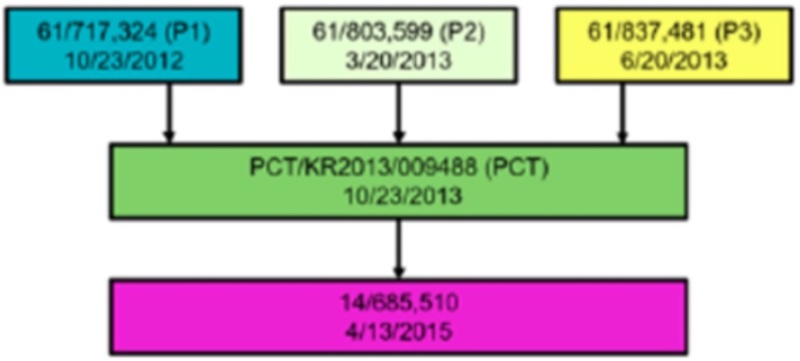
    In its motion, ToolGen set out graphically the relationship of these priority documents, including U.S. provisional application No. 61/717,324 ("P1") for which the Board had granted ToolGen priority upon institution:

    Image 1
    The basis ToolGen asserted for its priority claim was satisfaction of the written description and enablement requirements under 35 U.S.C. § 112(a) with regard to two embodiments falling within the scope of the Interference Count.  ToolGen argued satisfaction of the alternative language of the Count that recites claim 18 (dependent on claim 15) of Broad's U.S. Patent No. 8,697,359, the brief annotating the limitation recited therein to facilitate identification of ToolGen's disclosure corresponding thereto:

    [1] An engineered, programmable, non-naturally occurring Type II CRISPR-Cas system comprising
    [2] a Cas9 protein and
    [3] at least one guide RNA that targets and hybridizes to a target sequence of a DNA molecule in a eukaryotic cell,
    [4] wherein the DNA molecule encodes and the eukaryotic cell expresses at least one gene product and
    [5] the Cas9 protein cleaves the DNA molecules,
    [6] whereby expression of the at least one gene product is altered; and,
    [7] wherein the Cas9 protein and the guide RNA do not naturally occur together;
    [8] wherein the guide RNAs comprise a guide sequence fused to a tracr sequence.

    The brief asserted Examples 3 and 4 of the P3 (PCT) priority document in support of its satisfaction arguments, noting that one such embodiment (designated 3-1) comprises a Foxn1-specific sgRNA and a Cas9 mRNA, while embodiment 3-2 comprises the same sgRNA and recombinant Cas9 protein.  And in each case, ToolGen argued the Examples illustrate CRISPR-mediated cleavage and editing of the target Foxn1 DNA in mouse embryos expressed in the resultant genetically engineered mice.  The CRISPR-Cas9 complex is illustrated in the brief by this drawing:

    Image 2
    wherein "target DNA [is] in the green box, DNA-targeting sequence of crRNA [is] in the blue box, crRNA:tracrRNA duplex linked together by a -GAAA- loop [is] in the red box, remaining tracrRNA portion shown with brown underline, Cas9 protein with label shown with purple underline depicted as a shaded oval, which is in complex with sgRNA and cleaves the target sequence in the target DNA."

    The brief also noted the portions of the P3 priority document showing that such CRISPR-Cas9 complexes successfully cleaved and edited the target Foxn1 DNA, which ToolGen argued provided extensive disclosure in the P3 priority document of "abundant working examples and considerable guidance to a [person of ordinary skill in the art] to make and use CRISPR/Cas9 in eukaryotic cells."  ToolGen also noted that the P3 priority document shares the same specification with U.S. Application No. 14/685,510, to which the Board has recognized ToolGen's entitlement to priority.

    CVC disagrees in its opposition brief.  CVC's argument tracks much of the argument made in CVC's Substantive Preliminary Motion No. 2 that the Board deny ToolGen benefit of priority to it P1 provisional application (see "CVC Substantive Preliminary Motion No. 2 to Deny Priority Benefit").  In that argument, CVC maintained that the Board should deny ToolGen priority benefit to the '324 application based on party admissions because this provisional application does not disclose an operative embodiment falling within the scope of the interference Count.  Specifically, CVC argued that ToolGen in the prosecution of the '324 patent application leading to allowance (and declaration of this interference) had argued to the Patent Examiner (and PTAB) that "a codon-optimized Cas9 nucleic acid is required for CRISPR-Cas9 to function in eukaryotic cells" and that "a skilled artisan would have no idea what the outcome may be if one were to codon optimize a Cas9 nucleic acid" (and with the additional argument here that ToolGen's P3 and PCT applications do not disclose Cas9 embodiments comprising a nuclear localization signal, either, wherein both of these alterations CVC alleges ToolGen represented as the "secret sauce" before the Board during ex parte prosecution).  This position was consistent with the prokaryotic source of Cas9, and the Board and Examiner relied upon these arguments to find allowable claims that are now claims designated as corresponding to the Count in this interference, CVC asserts.  All such claims require use of a Cas9-encoding nucleic acid that is codon-optimized for expression in eukaryotic cells, and ToolGen added this limitation to claims-in-interference to overcome anticipation and obviousness rejections based on the prior art.  But neither of ToolGen's '481 provisional application nor its PCT application discloses a codon-optimized Cas9 nucleic acid, according to CVC, nor by ToolGen's own argument (unpredictability) would the skilled worker be able to discern such a nucleic acid with any reasonable basis for expecting such an embodiment could be produced using the disclosure in either the '481 provisional application or its PCT application.  Accordingly, CVC argues in its motion, ToolGen cannot in this interference renounce these arguments and rely on the priority date of the either the '481 provisional application or its PCT application to constitute a constructive reduction to practice for eukaryotic CRISPR-Cas9 embodiments falling within the scope of the interference Count.  And mere "generalized language" relating to these modifications are inadequate, CVC argues here, pursuant to University of Rochester v. G.D. Searle & Co., 358 F.3d 916, 923 (Fed. Cir. 2004).  Thus, according to CVC, the Board should deny ToolGen priority benefit to the '481 provisional application or its PCT application.

    CVC also takes issue with ToolGen's alleged argument that its disclosure satisfies CVC's half of the count (which doesn't recite these modifications) saying "the issue is what embodiments ToolGen may rely on given that it unambiguously told the Patent Office that NLS addition and codon optimization are required and unpredictable."  And the disclosure of the P3 provisional and PCT application to which ToolGen seeks to claim priority benefit do not pass muster under this precedent according to CVC.

    Finally, CVC argues that "Principles of party admission and judicial estoppel preclude ToolGen from taking positions inconsistent with its prior assertions," citing Zedner v. United States, 547 U.S. 489 (2006), and Louis v. Okada, 59 U.S.P.Q.2d 1073, 1075 (B.P.A.I. 2001) (precedential).

    The brief then points out with particularity ToolGen's arguments in its motion, pursuant to PTAB procedural rules in interferences, in a "call and response" format and hies back to its argument and the structure thereof in CVC's own motion to deny ToolGen benefit of priority to its '428 provisional application.  These arguments are all tied to CVC's assertion that "ToolGen's motion fails to show that its P3 and PCT provide a [constructive reduction to practice] of CVC's half of the count because neither application describes an embodiment with an NLS-tagged and codon-optimized Cas9 consistent with its prosecution representations," based on the priority benefit requirements as set forth inter alia in Falkner v. Inglis, 448 F.3d 1357, 1362 (Fed. Cir. 2006), and 37 C.F.R. § 41.201.  CVC's arguments further sound in familiar written description precedent (University of Rochester v. G.D. Searle & Co; Ariad Pharm., Inc. v. Eli Lilly & Co., 598 F.3d 1336, 1351 (Fed. Cir. 2010) (en banc); In re Alonso, 545 F.3d 1015, 1021 (Fed. Cir. 2008)) as applied to the description contained in the specification of ToolGen's P3 and PCT applications.  Specifically, CVC's brief focuses on Embodiment 3-1 and Embodiment 3-2 cited by ToolGen in support of its motion for priority benefit, each of which comprise a codon-optimized Cas9 protein having an NLS tagged therewith.  In particular, CVC argues that the P3 provisional application has no disclosure of a codon-optimized Cas9 sequence and lacks a formal sequence listing pursuant to 37 C.F.R. § 1.821 (despite the specification making reference to "SEQ ID NO:2" as an amino acid sequence encoding Cas9).  Moreover, the absence of this disclosure was conceded by ToolGen's expert according to CVC.  In addition, CVC argues that:

    P3 lacks the following disclosures that a skilled artisan would otherwise need to understand that ToolGen possessed a Cas9 mRNA of the count: (1) the bacterial Cas9 species from which the Cas9 mRNA was derived, (2) whether the Cas9 mRNA was codon-optimized or encoded an NLS-tagged Cas9 protein, (3) which NLS, if any, was attached; or (4) which Cas9 mRNA sequence was injected into the mouse cells,

    and ToolGen's expert merely cobbled together "disparate statements from other portions of the specification" in an attempt to establish sufficiency of disclosure.  (Perhaps infelicitously, ToolGen relied on the same expert to support its arguments before the Board during ex parte examination.)  CVC further argues that at the time the invention was made there were many codon optimization tables known in the art and that they differed with regard to how a bacterial protein like Cas9 would be effectively codon-optimized for expression un eukaryotic cells (and CVC notes that P3 does not inform the skilled worker which table or program should be used).  CVC asserts similar arguments with regard to choice of NLS tags known in the art.  According to CVC both embodiments have these flaws fatal to satisfaction of the requirements for a constructive reduction to practice.

    CVC asserts similar deficiencies in the disclosure of ToolGen's PCT application; in both arguments CVC focuses on element [2] in ToolGen's explication of Claim 18 of Broad's '359 patent corresponding to one half of the Count.  CVC also asserts deficiencies in Embodiment 4 in ToolGen's PCT application while "purports to transfect an NLS tagged Cas9 protein complexed with a sgRNA into the protoplast cells of the Arabidopsis plant (CVC noting in a footnote that codon optimization was not relevant because Cas9 protein was microinjected into the cells).  Again relying on ToolGen's purported arguments in related patents, CVC argues that the disclosure of the PCT is deficient for not disclosing the identity of the Cas9 protein nor the NLS signal (out of the "dozens and dozens" that CVC asserts were known in the art), despite ToolGen disclosing "five Cas9 nucleic acid sequences and two Cas9 amino acid sequences in a sequence listing."  CVC bases this portion of its argument on deficiencies in the sequence listing with regard to identifying which sequences used in which disclosed embodiment, and in other instances identifying certain sequences for human cell experiments but not for use in mouse or plant cells, or for use in transfection but not microinjection experiments.

    The brief concludes with CVC's arguments regarding party admissions and judicial estoppel in view of ToolGen's purported arguments before the Board during ex parte prosecution.  Citing Springs Window Fashions LP v. Novo Indus., L.P., 323 F.3d 989, 995 (Fed. Cir. 2003), CVC argues that "[t]he public notice function of a patent and its prosecution history requires that a patentee be held to what he declares during the prosecution of his patent" (emphasis in brief) and were not "simply an inadvertent mistake by the prosecuting attorney" because these statements were "detailed, consistent, and repeated" and were "effected with reasonable clarity and deliberateness" by ToolGen.  And in an interference context CVC relies on the BPAI's decision in Louis v. Okada that ToolGen must be bound by its earlier averments.

    CVC further argues that judicial estoppel also prevents ToolGen from eschewing its earlier arguments, citing Zedner v. United States, New Hampshire v. Maine, 532 U.S. 742, 742 (2001); and Wilson v. Martin, 789 Fed. Appx. 861, 872 (Fed. Cir. 2019).  CVC relies on the rubric that what is prohibited is a party taking a position that is "clearly inconsistent" with an earlier position (although to be fair the bulk of CVC's arguments is that ToolGen's P3 and PCT applications are insufficient to support the arguments it made previously before the Board in ex parte examination).  But CVC contends that the clears inconsistency is that "ToolGen's motion, by relying on generic disclosures of Cas9 mRNA and protein in P3 and PCT, directly contradicts ToolGen's prosecution position that NLS addition and codon optimization are required, yet unpredictable, to get CRISPR-Cas9 to function in eukaryotic cells."  Permitting ToolGen to garner priority benefit under these circumstances would work an unfair advantage and, on a broader policy plane, "would encourage other parties to advocate one position during prosecution to initiate an interference and then advocate the opposite position to survive the interference."

    For all these reasons CVC asks the Board to deny ToolGen's Substantive Motion No. 1.

  • CalendarSeptember 21, 2021 – European biotech patent law update (D Young & Co) – 9:00 am, noon, and 5:00 pm (BST)

    September 22, 2021 – "Bio Pharma: Current Trends in Written Description and Enablement, and Employee Mobility" (Federal Circuit Bar Association) – 11:00 am to 1:45 pm (ET)

    September 22, 2021 – "Balancing Product Development & Patent Risk: Freedom-to-Operate and Avoiding Liability in the Face of Mega Verdicts" (IPWatchdog and ClearstoneIP) 12:00 pm (ET)

    September 22, 2021 – "Honoring the 10th Anniversary of the America Invents Act" (US*MADE Coalition and Alliance for Automotive Innovation) – 12:30 pm to 2:00 pm (ET)

    September 23, 2021 – "Discovery and Litigation Funding in US Federal Courts" (Woodsford) – 12:00 pm to 1:00 pm (ET)

    September 23, 2021 – "Gender Inequality Among Federal Circuit Advocates" (Federal Circuit Bar Association Rules, Nexgen, and Diversity Committees) – 4:00 pm to 5:00 pm (ET)

    September 24-25, 2021 – Elevate Your Prosecution 2021 conference – Salt Lake City

    September 29-30, 2021 – FDA Boot Camp (American Conference Institute)

    October 5-21, 2021 – Hatch-Waxman and BPCIA Virtual Proficiency Series (American Conference Institute)

    November 9-10, 2021 – Paragraph IV Disputes Conference (American Conference Institute) – 8:00 am until 6:00 pm (EST) on November 9 and 7:50 am until 5:15 pm (EST) on November 10, 2021

  • D Young & CoD Young & Co will be offering its next European biotech patent law update on September 21, 2021.  The webinar will be offered at three times: 9:00 am, noon, and 5:00 pm (BST).  D Young & Co European Patent Attorneys Simon O'Brien and Antony Latham will provide an update of new and important EPO biotechnology patent case law.

    While there is no fee to participate, attendees must register in advance.  Those wishing to register can do so here.

  • Federal Circuit Bar Association_2The Federal Circuit Bar Association (FCBA) will be offering a remote program entitled "Bio Pharma: Current Trends in Written Description and Enablement, and Employee Mobility" on September 22, 2021 from 11:00 am to 1:45 pm (ET).  The program will consist of two panels:

    • Panel I — Current Topics in the Federal Circuit’s Law of Written Description and Enablement — John Josef Molenda of Steptoe & Johnson LLP will moderate a panel consisting of Larry Coury of Regeneron Pharmaceuticals, Inc.; Henry Hadad of Bristol-Myers Squibb; Joshua Rosenkranz of Orrick, Herrington & Sutcliffe LLP; and John Whealan of The George Washington Law School. The panel will discuss current topics in the Federal Circuit's law of written description and enablement, with a focus on recent Federal Circuit decisions and their impact on the biopharma industry.

    • Panel II — Practical Effects of Recent Caselaw on Employee Mobility in Biotech — John A. Dragseth of Fish & Richardson PC will moderate a panel consisting of Gregory A. Castanias of Jones Day, Nitika Gupta Fiorella of Fish & Richardson PC, and Jennifer Sklenar of Arnold & Porter Kaye Scholer LLP.  The panel will discuss recent decisions on patent inventorship, ownership, and related areas, including the Supreme Court's Minerva v. Hologic decision; consider practical implications of those decisions for litigators, prosecutors, in-house counsel, and management; and will consider how those considerations interact with trends in the technology employment landscape.

    The webinar is complimentary for FCBA members, judges, and students, $75 for government/academic/retired attendees, $150 for young lawyers (age 24 or younger) and small firm practitioners (less than 25 attorneys), and $300 for private practitioners.  Those interested in registering for the program, can do so here.

  • IPWatchdogIPWatchdog and ClearstoneIP and will be offering a webinar entitled "Balancing Product Development & Patent Risk: Freedom-to-Operate and Avoiding Liability in the Face of Mega Verdicts" on September 22, 2021 at 12:00 pm (ET).  Gene Quinn of IPWatchdog, Inc., Christopher Patrick of Baker Botts, Jennifer Russell of Surgalign Spine Technologies, Inc., and Gabe Sukman of ClearstoneIP will discuss where focus should be placed in order to maximize value and insight in patent clearance in the wake of a resurgence in large scale patent damage awards.  The panel will address the following topics:

    • Are FTO investigations necessary for risk mitigation today? If so, when?
    • How should in-house and law firm counsel best manage FTO investigations given the changing patent damages climate?
    • What rules and protocols need to be put in place to ensure to the greatest extent possible that FTO investigations and communications remain privileged?
    • How can the relationship between in-house counsel, outside counsel, and the R&D department best foster an agile, collaborative process?

    There is no registration fee for this webinar.  However, those interested in registering for the webinar, should do so here.

  • US-MADEThe US*MADE Coalition and Alliance for Automotive Innovation will be hosting an in-person and virtual program "Honoring the 10th Anniversary of the America Invents Act" from 12:30 pm to 2:00 pm (ET) on September 22, 2021.  The event will take place at the Ballroom at the Reserve Officers Association in Washington, DC.

    Alliance for Automotive InnovationThe Chairmen who wrote the AIA — Senator Patrick Leahy and the Hon. Lamar Smith, Former Chairman of the House Judiciary Committee, will discuss the AIA's original intent and the importance of recommitting to its safeguards.  A panel featuring Harvard Business School Professor Lauren Cohen, former Acting USPTO Director and Solicitor Joe Matal, and manufacturer-members of US*MADE and the Alliance for Automotive Innovation will also explore the impact that the AIA has had on the patent system and manufacturers in America.

    Those interested in attending the program, can do so here or by contacting Lauren DuBois at Lauren@US-MADE.org.

  • WoodsfordWoodsford will be offering a live webinar entitled "Discovery and Litigation Funding in US Federal Courts" on September 23, 2021 from 12:00 pm to 1:00 pm (ET).  John Goetz of Fish & Richardson P.C., W. Bradley Wendel of Cornell Law School, and Robin M. Davis of Woodsford will discuss trends in U.S. federal courts regarding discoverability of litigation funding agreements and other information shared with funders.

    Those wishing to register for the webinar can do so here.

  • Federal Circuit Bar Association_2The Federal Circuit Bar Association (FCBA) Rules, Nexgen, and Diversity Committees will be offering a remote program entitled "Gender Inequality Among Federal Circuit Advocates" on September 23, 2021 from 4:00 pm to 5:00 pm (ET).  Jenny Wu of Paul, Weiss, Rifkind, Wharton & Garrison LLP will moderate a panel consisting of Paul R. Gugliuzza and Rachel Rebouche of Temple University Beasley School of Law, Heidi Keefe of Cooley LLP, and Neema Kumar of Sandoz.  The panel will discuss a recent empirical study regarding gender disparity among the advocates who appear before the Federal Circuit in its patent cases and discuss what can be done to improve diversity in patent litigation.

    The webinar is complimentary for FCBA members and students, $50 for government/academic/retired attendees, and $175 for private practitioners.  Those interested in registering for the program, can do so here.

  • ACIAmerican Conference Institute (ACI) will be holding its 16th Annual Paragraph IV Disputes Conference on November 9, 2021 from 8:00 am until 6:00 pm (EST) and November 10, 2021 from 7:50 am until 5:15 pm (EST) as either an in-person or virtual conference.

    The conference opens with a Welcome Back Town Hall Meeting directed to "Forecasting the Future of Pharmaceutical Patent Litigation: Trends, Legal Analyses and Business Prognoses Post-Covid."  ACI faculty will give presentations on:

    • GSK v. Teva: Awaiting the Fate of Section VIII Carve-outs
    • The Current State of Patent Eligibility Jurisprudence: Redefining What Is Patent-Eligible Subject Matter Post-American Axle v. Neapco
    The Future of Obviousness: Objective Indicia of Nonobviousness and Obviousness-Type Double Patenting
    • Analyzing the Effect of the Latest FDA Initiatives on Generic Drug Access and PIV Disputes
    • The PTAB Live! Practice, Policy, and Procedure in the New World of Pharmaceutical Patent Validity Challenges
    • To Stay or Not to Stay: Winning Strategies for Addressing Parallel Proceedings at the District Court and IPR
    • Diversity, Equity, and Inclusion: Implementing Change and Expanding Innovation
    • Think Tank on State and Federal Antitrust Initiatives: Commercial Considerations for Patent Settlements, Reverse Payments, and Emerging Legislation
    • Written Description and Enablement: Defensive Strategies and Offensive Moves for §112 Rejections and Attacks
    • SCOTUS Weighs In: The Future and Scope of the Equitable Doctrine of Assignor Estoppel
    • The Ethical Practice of Paragraph IV Litigation: New Developments Impacting Professional Responsibility in the Hatch-Waxman Arena

    There will also be back-to-back break-out sessions on November 9th, with the alternatives being "The Business of Hatch-Waxman Litigation: A Global Approach" or "The Practice of Hatch-Waxman Litigation: Town Hall with the Magistrate Judges," followed by "Understanding the Importance of Aligning Legal and Business Functions for Patent Litigation Planning" or "Practical Strategies and Tactics for Effective Settlement Negotiation."  The first day will close with a virtual cocktail reception.

    An agenda for the conference and additional information regarding the workshops can be found here.  A complete brochure for this conference, including an agenda, detailed descriptions of conference sessions, list of speakers, and registration form can be obtained here.

    The registration fee for the in-person conference is $2,295 (paid registration by October 1st) or $2,395 for paid registration by November 8th.  The livestream virtual conference fees are $1,995 and $2,095, respectively.  ACI is offering a discount rate for in-house counsel that reduces the cost of each fee by $500.  Patent Docs readers are entitled to a 10% discount off of registration using discount code D10-895-895AX02.  Those interested in registering for the conference can do so here, by e-mailing CustomerService@AmericanConference.com, or by calling 1-888-224-2480.

    Patent Docs is a media partner of ACI's 16th Annual Paragraph IV Disputes.

  • By Kevin E. Noonan

    ToolGenOn May 28th, Junior Party the Broad Institute, Harvard University and MIT (collectively, "Broad") filed its Contingent Preliminary Motion No. 2 in CRISPR Interference No. 106,126 (where ToolGen is the Senior Party), pursuant to 37 C.F.R. §§ 41.121(a)(1)(i) and 41.208(a)(2) and Standing Order ("SO") 203.2.  This motion is contingent on the Board's grant of Broad's Substantive Preliminary Motion No. 1.  In that motion, Broad asked the Board to substitute (in part) a new Count No. 2 in place of Count 1 in the '126 Interference as instituted (see "Broad Files Substantive Preliminary Motion No. 1 in CRISPR Interference").

    In this motion, Broad asked the Board to add their U.S. Application Nos. 15/160,710 (having allowable claims 1, 40, and 41) and 15/430,260 (allowable claims 74, 94, and 95) to the Interference and designate the allowable claims as corresponding to Proposed Count 2.  Consistent with their arguments in Motion No. 1, Broad contended that these claims recite "generic" limitations with regard to the RNA components of CRISPR, i.e., both dual-molecule and single-molecule guide RNA.  In the alternative (i.e., should the Board deny Broad's Substantive Preliminary Motion No. 1), Broad in this motion asked the Board to designate claim 1 of the '710 application and claim 95 of the '260 application as corresponding to current Count 1.

    On August 6th, ToolGen filed its Opposition to Broad's Contingent Preliminary Motion No. 2.  ToolGen first asserts that it has shown (in its Opposition to Broad Preliminary Motion No. 1) that Broad's motion to substitute the Count should be denied (in which case this motion would become moot).  ToolGen also contends that "Broad has neither demonstrated that the claims should be added, nor that alternative remedies are unavailable," also providing a basis for the Board to deny this motion.  ToolGen focuses on Broad's arguments in its motion that "proceeding with Count 1 would be unfair [to Broad]," because (logically) should the Board reach this motion on the merits it would have had to grant Broad Motion No.1 and any "unfairness" would have been resolved ("Count 1 would no longer exist for Broad to complain about").  Some of the basis for this argument is also procedural, to the extent that Broad makes these unfairness arguments in Motion No. 2 they are duplicative of the same arguments in its Motion No. 1.

    Substantively, ToolGen argues that Broad has not borne its burden under 37 C.F.R. § 41.208(b) and SO ¶ 203.2 showing why these claims should be added to this Interference and why alternative remedies are unavailing or inadequate.  Instead, according to ToolGen, Broad merely shows how these claims correspond to the "Broad half" of Proposed Count 2.  ToolGen argues:

    "One cannot broaden the scope of a count just for the sake of doing so.  Likewise, one cannot simply add claims for the sake of designating more claims without offering a compelling reason" under 37 C.F.R. § 41.208(b) as provided by Louis v. Okada, 59 U.S.P.Q.2d 1073 (B.P.A.I. 2001) (precedential) to the effect that the scope of a count should be changed only when there is a "compelling reason" for doing so.

    According to ToolGen, Broad has failed to make a showing of such a compelling reason.

    ToolGen also argues the motion is not necessary, because either Broad will prevail under Proposed Count 2 and the claims at issue in this motion will grant, or Broad will not prevail and Broad will be estopped from pursuing them under the principles of interference estoppel.  In neither case, according to ToolGen, will these claims have any effect on the priority determination made in this Interference.

    Turning to alternative remedies, ToolGen argues that Broad has not explained why any such remedies would be inadequate, merely relying on its arguments of unfairness.  Alternatives exist, according to ToolGen, but Broad neither acknowledges them nor explains why they would be inadequate.  For example, ToolGen challenges Broad for not satisfying requirement (4) of SO ¶ 203.2, requesting the examiner to declare another interference (which the Board could then combine with this one).  Nor does Broad inform the Board (and ToolGen) if it has taken these steps in ex parte prosecution.

    ToolGen also argues that the Board did not authorize what ToolGen characterizes as Broad's "request for relief" of adding claim 41 of the '710 Application and claim 95 of the '260 Application as corresponding to Count 1 should the Board refuse to substitute Proposed Count 2 as Broad requested in its Preliminary Motion No. 1.

    Finally, ToolGen contends that Broad's motion exceeds the scope of the Motions List submitted to the Board in this interference because it contends in its motion that claims 40 and 41 of the '710 application and claims 95 and 96 of the '260 application are "generic as to the RNA configuration."  This is not how Broad characterized these claims in its Motions List, ToolGen asserting that Broad characterized all six claims in these two applications as being generic and that the Board relied upon these characterizations. Consequently:

    Because the Board relied on Broad's prior characterization (F12), the Board's authorization is also limited to the Broad's initial characterization of the claims as generic.  Broad may not now expand its arguments to urge that claims 40, 41, 94 and 95 are limited to single- or dual-molecule RNA.  In doing so, Broad exceeds the scope of its authorization for Motion 2.  Accordingly, for this additional reason, the Board should dismiss or deny Broad's request to add claims 40, 41, 94 20 and 95.