• By Kevin E. Noonan

    Federal Circuit SealImposition of liability under the equitable doctrine of inequitable conduct (as it has been variously defined) can result in a patent being held unenforceable; for this reason, former Chief Judge Rader called it the "atomic bomb of patent law" (see Aventis Pharma S.A. v. Amphastar Pharms., Inc., 525 F.3d 1334, 1349 (Fed. Cir. 2008) (Rader, J., dissenting)).  The Federal Circuit's most recent attempt to cabin the application of the doctrine arose in Therasense, Inc. v. Becton, Dickinson & Co., 649 F.3d 1276 (Fed. Cir. 2011) (en banc), and has generally led to narrowing the application of the doctrine by requiring a showing of materiality and intent to deceive, each under a clear and convincing evidentiary standard (but imperfectly; see Regeneron Pharma., Inc. v. Merus N.V., 864 F.3d 1343, 1350 (Fed. Cir. 2017)).  But sometimes even under this more exacting standard the patency of the violation is evident, as was the case in Belcher Pharmaceuticals, LLC v. Hospira, Inc.  As the Christian Bible says, "no one can serve two masters," at least not well.  Matthew 6:24.  But the attempt to satisfy the statutory requirements for patenting, particularly non-obviousness, can invite contradictory attempts to satisfy regulatory requirements before the FDA.  And that can (and did) lead to the outcome in this case.

    The case arose in ANDA litigation involving Belcher Pharmaceuticals' 1 mg/mL injectable L-epinephrine formulation, for which Hospira filed an ANDA and certified under 21 U.S.C. § 355(b)(2)(A)(iv) (a Paragraph IV certification) that Belcher's U.S. Patent No. 9,283,197 was invalid, not infringed, or unenforceable.  The '197 patent addressed compositions of L-epinephrine formulated using methods to avoid oxidation of L-epinephrine to adrenalone and thus reduces its potency, and to avoid racemization, a separate basis for loss of potency.  Both these chemical reactions are related to the pH of the formulation solution, with oxidation increasing with higher pH conditions and racemization increasing at lower pH levels.  As stated in the opinion, "[i]n other words, when an epinephrine solution becomes more acidic (i.e., pH decreases), racemization increases and oxidation decreases, and when the solution becomes more basic (i.e., pH increases), oxidation increases and racemization decreases."  This led to the prior art understanding that the optimum pH to minimize the effects of racemization and oxidation was between pH 3.0-3.8.

    Belcher's NDA specified that its formulation differed from prior art formulations that included sodium metabisulfite as an antioxidant and an amount of L-epinephrine in 10% excess (to account for losses of potency for whatever reason).  Belcher's NDA specified that its product did did not contain sulfite antioxidants or other preservatives but rather contained an increased amount of sodium chloride and 15% overage of L-epinephrine at a pH of between 2.8 and 3.3.  Importantly for the inequitable conduct question in this litigation, Belcher responded to FDA inquiries as follows:

    Addressing the FDA's question on racemization, Belcher explained that "[r]acemization of the enantiomerically pure L-Epinephrine isomer in injectable formulations of epinephrine is a well-known process," citing literature authored by Fylligen and Stepensky.  Responding to the FDA's inquiry on manufacturing process for the stability validation batches, Belcher stated that the only difference between the relied-upon Sintetica batches and Belcher's proposed formulation "is related to the in[-]process pH" and that it "consider[ed] the in[-] process pH change to be a very minor change not requiring additional stability studies."  Belcher also explained that the release specification of 2.2 to 5.0 "complies with [the] USP specification and stays unchanged between all the batches."  Id.

    In addition, Belcher's consultants advised that the pH maintained during formulation be kept at the art-recognized pH of 2.8-3.3; "Belcher followed that advice," according to the opinion.

    Belcher asserted claims 6 and 7 of the '197 patent in the ensuing ANDA litigation:

    6.  An injectable liquid pharmaceutical formulation of l-epinephrine sterile solution; said liquid pharmaceutical formulation having a pH between 2.8 and 3.3; said injectable liquid pharmaceutical formulation compounded in an aqueous solution as 1.0 to 1.06 mg/mL l-epinephrine, and further including a tonicity agent; said liquid pharmaceutical formulation including no more than about 6% d-epinephrine and no more than about 0.5% adrenalone at release, and no more than about 12% d-epinephrine and no more than about 0.5% adrenalone over a shelf-life of at least 12 months.

    7.  The said injectable liquid pharmaceutical formulation of claim 6 further having a concentration of 1 mg per mL l-epinephrine.

    In the single Office Action, Belcher argued that their claims were non-obvious over a prior art reference that disclosed "a 1 mg/mL epinephrine injection that was free of preservatives and antioxidants, was made in an oxygen free (i.e., nitrogen) environment, and had a pH range of 2.2 to 5.0" because the pH range of 2.8-3.3 "was unexpectedly found to be critical by the Applicant to reduce the racemization of l-epinephrine" and produced unexpected results.  These arguments were noted in the resulting Notice of Allowance as the basis upon which the Examiner allowed the claims (making subsequent establishment at trial of the materiality of Applicant's arguments in this regard rather easy).

    Hospira's inequitable conduct allegations centered on the knowledge and actions (including failing to disclose to the Examiner) of three pieces of information by Belcher's Chief Science Officer who, by his own admission, was "involved in the development of Belcher's NDA product and participated in drafting the NDA," and "involved in the prosecution of the '197 patent" including helping in application drafting and responding to the Examiner's Office Action (despite being neither a patent agent nor patent attorney).  The three pieces of information undisclosed to the patent Examiner were:  1) a label by third party (JHP) for a 1mg/mL epinephrine product; 2) Sintetica's prior art product (0.1 mg/mL l-epinephrine formulation); and 3) the 2004 Stepinsky reference, Long-term stability study of L-adrenaline injections: kinetics of sulfonation and racemization pathways of drug degradation, 93(4) J. PHARM. SCI. 969–80.  Hospira's expert testified persuasively that this information was but-for material on the issues of the pH range and level of impurities.  As for intent to deceive, the District Court cited Belcher's CSO's behavior (it being evident that he was under the duty of candor set forth in 37 C.F.R. § 1.56) before the FDA that "[Belcher's CSO] knew that Belcher described the claimed pH range of 2.8 to 3.3 as 'old'; that Belcher disclosed Stepensky, which teaches an overlapping pH range of 3.25 to 3.70; that Belcher had submitted data on Sintetica's and JHP's products showing a pH within the claimed range; and that Belcher switched from a lower pH range to the claimed 2.8 to 3.3 pH range at least in part to expedite FDA approval because that range matched the pH range of Sintetica's products," none of which he disclosed to the patent Examiner.  In contrast, the District Court found that "[Belcher's CSO] did not merely withhold this information but also used emphatic language to argue that the claimed pH range of 2.8 to 3.3 was a 'critical' innovation that 'unexpectedly' reduced racemization."  With regard to intent, the District Court found it "implausible" that Belcher's CSO considered this information to be irrelevant and also asserted that his "repeated efforts to evade questioning and inject attacks of the prior art into his answers [while testifying] raised serious questions as to his credibility."  On this basis, the District Court held the '197 patent to be unenforceable for inequitable conduct.  This appeal followed.

    The Federal Circuit affirmed, in an opinion by Judge Reyna, joined by Judges Taranto and Stoll.  The panel opinion made short work of the materiality prong of inequitable conduct, inter alia because the District Court held claims 6 and 7 to be invalid for obviousness over cited references that included one of the withheld pieces of information (JHP's epinephrine product), citing Aventis Pharma S.A. v. Hospira, Inc., 675 F.3d 1324, 1334 (Fed. Cir. 2012).  Regarding the intent-to-deceive prong of the Therasense test, the Court noted that Belcher's CSO was aware that the pH 2.8-3.3 range was known in the art and that Belcher had reverted to that range (after originally pursuing formulations having a pH range of 2.4-2.6) as a means to obtain FDA approval more expeditiously because in part that range had been used in the Sintetica prior art product.  Nevertheless, Belcher's CSO affirmatively asserted (in the '197 specification and in argument before the Examiner) that the pH 2.8-3.3 range was "a 'critical' innovation contrary to the knowledge of a person of ordinary skill in the art that yielded 'unexpected results,' namely reducing racemization of l-epinephrine."  These representations were "false" and "a fiction" according to the District Court and the Federal Circuit saw no reason to disagree.  Belcher maintained before the District Court and before the Federal Circuit on appeal that Belcher's CSO's representations were based on a genuine belief that the withheld information was irrelevant due to the high overage amounts used in their product.  The Federal Circuit, like the District Court, rejected what it called these "post hoc rationales," citing Aventis for similar circumstances and crediting the District Court for its firsthand assessment of Belcher's CSO's lack of credibility, stating that this conclusion was also supported by other evidence of record such as the substance of his representations to the FDA and patent Examiner and differences if not outright contradictions between them.

    Having found no clear error in the District Court's assessment and factual findings on either materiality or intent, the Federal Circuit affirmed the District Court's finding of inequitable conduct and resulting unenforceability of the '197 patent.

    Belcher Pharmaceuticals, LLC v. Hospira, Inc. (Fed. Cir. 2021)
    Panel: Circuit Judges Reyna, Taranto, and Stoll
    Opinion by Circuit Judge Reyna

  • By Kevin E. Noonan

    ToolGenOn May 28th, Junior Party the Broad Institute, Harvard University, and MIT (collectively, "Broad") filed its Substantive Preliminary Motion No. 1 in CRISPR Interference No. 106,126, where ToolGen is the Senior Party.  This Motion shared many similarities to a similar motion filed in Broad's Interference No. 106,115 against the University of California, Berkeley, the University of Vienna, and Emmanuelle Charpentier; Junior Party and collectively, "CVC"), but there were significant differences in the proposed Count 2 in this interference and the proposed Count 2 proposed in the '115 Interference (wherein the Board denied Broad's motion in that interference).  On August 6th ToolGen filed its Opposition.

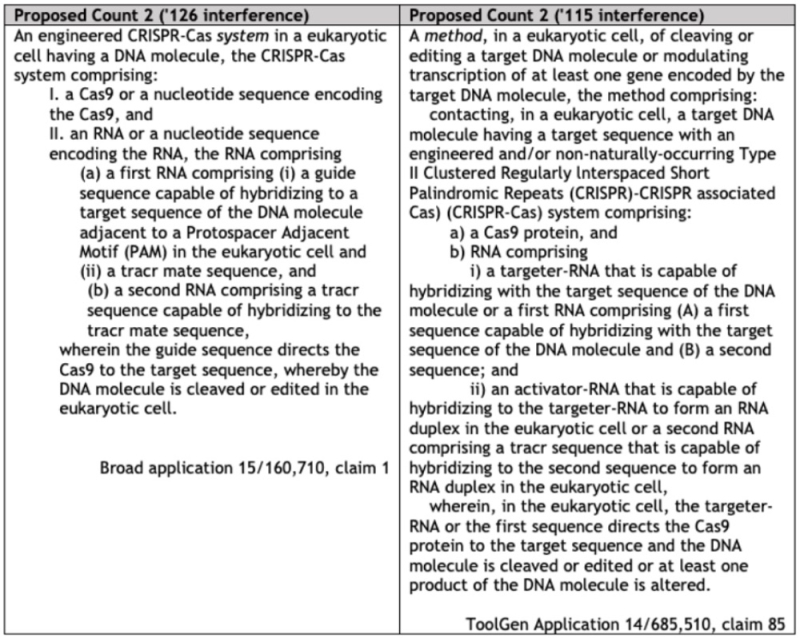
    Broad filed this motion pursuant to 37 C.F.R. §§ 41.121(a)(1)(iii) and 41.208(a)(1).  The two proposed Counts 2 are set forth as follows:

    Table
    Broad's argument, which was unsuccessfully in the '115 interference, was that it would be unfair to preclude them from establishing conception of the "genus" of eukaryotic CRISPR claims by limiting the Count to sgRNA species (which here, as in the '115 interference, would be subject to arguments of prior conception), an argument the motion asserts is "consistent with Broad's proofs in [the '115 interference]" (see "CRISPR Motions Day at the PTAB: Broad Files Its Substantive Motion No. 2").

    ToolGen argues that the Board should deny Broad's motion first, because Broad has neither established nor argued that dual-and single-molecule eukaryotic CRISPR is the same patentable invention, and second, that Broad's proposed Count 2 "does not define the common claimed subject matter [because] all of ToolGen's involved claims are limited to single-molecule RNA" species (emphasis in brief).  The first deficiency ToolGen asserts for Broad's first argument is that Broad's assertion that the two configurations are "analogous approaches" to eukaryotic CRISPR is not the same as arguing (which ToolGen notes Broad does not do) that they are the same invention.  This makes Broad's motion "doomed at the threshold," according to ToolGen and the cases Broad cites for broadening the scope of the Count — including Grose v. Plank, 6 15 U.S.P.Q.2d (BNA) 1338, 1342, (B.P.A.I. March 23, 1990), and Kondo v. Martel, 220 7 U.S.P.Q. (BNA) 47, 49 (B.P.A.I. May 2, 1983), are inconsistent with cases mandating that a Count cannot be "broadened to such an extent as to include another, separately patentable invention," citing Theeuwes v. Bogentoft, 2 U.S.P.Q.2d (BNA) 10 1378, 1379 (Comm'r Pat. & Trademarks December 11, 1986), and Lee v. McIntyre, 55 U.S.P.Q.2d 1137, 1142 (B.P.A.I. 2000).  Under these circumstances, ToolGen argues Broad has not satisfied its burden to show it is entitled to the relief requested under 37 C.F.R. § 41.121(b) and SO 121.3.  In this regard, ToolGen asserts the standard that a dual-molecule eukaryotic CRISPR system would be prima facie obvious over single-molecule embodiments, under Spine v. Biedermann Motech GmbH, 684 F. 18 Supp. 2d 68, 89 (D.D.C. 2010).  "Highly analogous" is not the standard ToolGen (correctly) maintains, yet that is the limit of Broad's argument in its motion.  ToolGen then explicates the deficiencies in Broad's evidence (comprising expert testimony) in the motion in support of the relief of changing the Count, including that it comprises mostly attorney argument, citing Invitrogen Corp. v. Clontech Labs., Inc., 429 F.3d 1052, 1068 (Fed. Cir. 2005); Elbit Sys. of Am., LLC v. Thales Visionix, Inc., 881 F.3d 1354, 15 1359 (Fed. Cir. 2018); and In re Gorniak, No. 90-1510, 1991 U.S. App. LEXIS 2741, at *3 (Fed. Cir. 16 Feb. 20, 1991).  Anticipating Broad's response, ToolGen reminds the Board that "Broad cannot attempt to make that showing for the first time in its reply," citing Nau v. Ohuchida, Int. No. 104,258, 9 Paper 57, at *4 (B.P.A.I. 1999).

    Turning to its second basis for Opposition, ToolGen argues that contrary to Broad's arguments, proposed Count 2 is broader than the common claimed invention between the parties because, as instituted by the Board, existing Count 1 is limited to single-molecule RNA embodiments of eukaryotic CRISPR and that common claimed subject matter is what defines an interference, citing Beech Aircraft Corp. v. Edo Corp., 990 F.2d 1237, 1248–49, and Louis v. Okada, 59 22 U.S.P.Q.2d 1073, 2001 WL 775529 at*4 (B.P.A.I. 2001).  ToolGen asserts (factually) that its claims corresponding to Count 1 are limited to single-molecule RNA eukaryotic CRISPR embodiments (which ToolGen maintains Broad admitted when it characterized ToolGen's claims as comprising "both dual- and single-molecule RNA configurations of CRISPR-Cas9 before amending to only the single-molecule approach currently claimed in their involved patent application" (emphasis in brief).  That its initially filed claims comprised both single- and dual-molecule embodiments is irrelevant according to ToolGen's brief because the interference as declared was limited to ToolGen's single-molecule embodiments.

    ToolGen then turns to Broad's "best proofs" arguments.  To this, ToolGen replies that Broad's Motion does not establish or identify its best proofs sufficiently for the Board to properly assess this argument and that regardless Broad's proposed Count 2 improperly "adds and removes elements" of the current Count.  As for Broad's deficiencies in establishing its best proofs, ToolGen cites the Board's decision in Interference No 105,048 that it is proper to broaden a Count "only i[f] there is a compelling reason to do so" and that "[a]rguments that a moving party's best or earliest proofs are outside the scope of the existing count are ordinarily not compelling by themselves."  Regents of Univ. of Cal. v. Broad Inst., Interference 106,115, Decision on Motions, 6 Paper 877, *33 (P.T.A.B. Sept. 10, 2020).  Rather, the standard according to ToolGen is that a party moving to substitute a Count in an interference is that the party "(1) should make a proffer of the party's best proofs, (2) show that such best proofs indeed lie outside of the scope of the current count, and (3) further show that the proposed new count is not excessively broad with respect to what the party needs for its best proofs" citing Louis v. Okada.  ToolGen's brief then sets forth with specificity its arguments regarding how Broad failed to satisfy these requirements, including inter alia failure to proffer testimony (that could be subject to cross-examination) from fact witnesses including Broad inventor Zhang.  What evidence there is proffered regarding Dr. Zhang's work is unsubstantiated hearsay or factually deficient according to ToolGen.  In this regard, ToolGen provides this synopsis of Broad's purported failures under the first prong of Louis:

    In summary, Broad has not met its burden of supporting its motion with "appropriate 5 evidence."  37 C.F.R. § 41.208(b).  Broad fails to provide sufficient information to evaluate whether its "best proofs" merit expansion of the count.  Byrn v. Aronhime, Int. No. 105,384, Paper 64, at 11 (B.P.A.I. Sept. 20, 2006).  The proofs that Broad relies upon do not even suggest, let alone prove, that Broad conducted dual-guide experiments before it conducted any single-guide experiments, or that it reduced to practice every element of the proposed count.

    Turning to prong 2 of the Louis test, ToolGen argues that Broad's own admissions vitiate Broad's arguments regarding its best proofs falling outside Count 1 of the '126 Interference as declared.  These included a declaration Broad submitted during ex parte prosecution, which included the statement that the inventors had an "appreciation that a single RNA can be used as a guide in the CRISPR-Cas system, including as shown by the RNA used in the experiment of the below figure entitled 'CRISPR NTF3 Surveyor . . . .'"  ToolGen also contends that such statements and positions taken during ex parte prosecution should raise an estoppel (judicial) against Broad from making such arguments in this interference, if only because such statements and positions, according to ToolGen, permitted Broad to get claims encompassing single-molecule RNA embodiments of eukaryotic CRISPR, citing Zedner v. United States, 547 U.S. 489, 504 (2006), as applied to agency adjudications, citing Trustees in Bankr. of N. Am. Rubber Thread Co. v. United States, 593 F.3d 1346, 1354 (Fed. Cir. 2010).

    Finally in this regard, ToolGen argues that Broad's Proposed Substitute Count No. 2 is overbroad and would "eliminate significant limitations on the current count" (specifically the limitation that "expression of at least one gene product is altered" (emphasis in brief).

    ToolGen then turns to Broad's argument that the Board could grant Broad's Preliminary Motion No. 1 or designate claims that are not explicitly limited to single-molecule RNA embodiments of eukaryotic CRISPR to not correspond to the Count.  "A determination that single-molecule RNA eukaryotic CRISPR systems are separately patentable from dual-molecule RNA systems is fatal to Proposed Count 2, because a count cannot include two separately patentable inventions" according to ToolGen's Opposition.  (ToolGen notes that Broad made similar arguments in the '115 Interference and the Board rejected them.)

    Finally, ToolGen argues that Broad failed to bear its burden to show that the new Count is unpatentable over the prior art.  ToolGen expressly requests that the Board reject Broad's argument that the Board's decision in the '048 Interference supports Broad's arguments based on differences in claim scope.

    The brief ends with ToolGen's challenge to Broad's assertion of five sets of its claims that do not correspond to Proposed Count 2.  ToolGen contends that Broad has not met its burden of showing that Proposed Count 2 would not have anticipated nor rendered obvious the claims at issue, under 37 C.F.R. § 41.207(b)(2), 37 C.F.R. §§ 41.121(b) and 41.208(b), and providing reasons therefor with regard to the use of vectors for RNA expression, Streptococcus aureus Cas9 protein, chimeric Cas9 species (including fusion with heterologous protein domains), and two or more nuclear localization signals in eukaryotic embodiments of CRISPR.

  • By Kevin E. Noonan

    Broad InstituteOn May 20th, ToolGen filed its Substantive Motion No. 1 for benefit of priority in Interference No. 106,126, which names ToolGen as Senior Party and as Junior Party The Broad Institute, the Massachusetts Institute of Technology, and the President and Fellows of Harvard College (collectively, "Broad").  On August 6th, Broad filed its Opposition to this Motion.

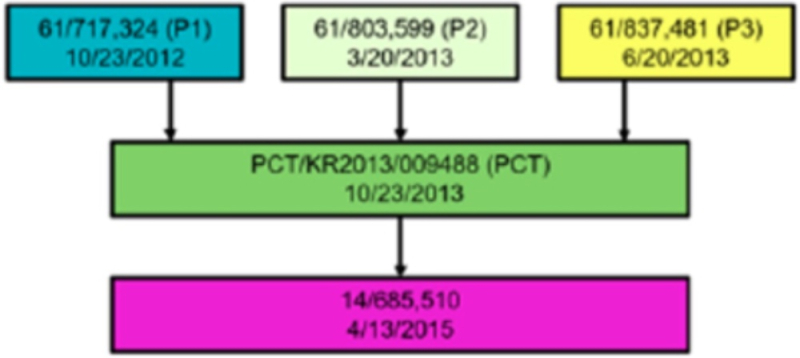
    As set forth in ToolGen's motion, the Board had granted ToolGen the benefit of its U.S. provisional application, Serial No. 61/717,324, filed October 23, 2012 ("P1"), resulting in ToolGen having an earlier priority date than Broad.  ToolGen submitted this motion to be accorded benefit of priority to two later-filed, related applications:  U.S. Provisional Application No. 61/837,481, filed June 20, 2013 ("P3" or "ToolGen 5 P3"), or alternatively, International Application No. PCT/KR2013/009488, filed Oct. 23, 2013 ("PCT").  In its motion, ToolGen explains that it is submitting this motion contingent on the Board granting CVC's Substantive Motion No. 2, which attacks ToolGen's entitlement to priority to the P1 priority document in Interference No. 106,127.  The brief sets out graphically the relationship of these priority documents:

    Image
    The brief then sets out the basis for ToolGen's claim of priority, setting forth its arguments for satisfaction of the written description and enablement requirements under 35 U.S.C. § 112(a) with regard to two embodiments falling within the scope of the Interference Count.

    In its Opposition, Broad asks the Board to defer consideration of ToolGen's Motion, properly pointing out that Broad (unlike CVC in the '127 Interference) has not challenged ToolGen's benefit of priority to its P1 provisional application.  Accordingly, Broad asserts that ToolGen's motion is premature and "completely irrelevant" at this time.  Broad further asserts that this motion may "potentially" become relevant "only if multiple contingencies in this and other proceedings—that may or may not ever come to pass—do actually arise."  These include that:

    1) the PTAB finds ToolGen is not entitled to the benefit of its P1 application in the co-pending 127 Interference,

    2) Broad requests and is granted permission to file a motion here challenging ToolGen's benefit to P1 on the basis of estoppel from that determination in the 127 Interference, and

    3) the PTAB grants Broad's motion, depriving ToolGen here of benefit of its P1.

    Broad's justification includes that the Board considering this motion under these circumstances would be "waste of judicial resources" as well as improperly constituting an advisory opinion.  The interference rules provide that the Board has discretion to defer consideration of motions under 37 C.F.R. § 41.125 as applied in Berman v. Housey, 291 F.3d 1345, 1352 (Fed. Cir. 2002).  Broad urges the Board to exercise that discretion with regard to ToolGen's Preliminary Motion No. 1.

    Broad's brief explicates in further detail the contingent nature of the circumstances needing to arise for ToolGen's motion to be timely, in support of its opposition and request for the Board to defer consideration thereof.

    One notable feature of Broad's argument is that good portions of it are redacted.  As set forth in associated Motion to permit portions to be redacted, Broad explains that these portions are to be kept confidential at ToolGen's behest and to protect ToolGen's proprietary information obtained from ToolGen's Priority Statement.  According to Broad in its motion to seal, the redacted portions of its Opposition, "Toolgen alleges that the potential harm to the holders of the information would be significant."  Broad's motion to permit redactions, an unusual request and one even less frequently granted under the Rule that proceedings should be open to the public in the public interest, 37 C.F.R. § 42.14, is (understandably) unopposed by ToolGen in view of the benefit it asserts it requires in Broad's unopposed motion and is based on ¶ 4(a)(ii) of the Protective Order entered by the Board in this interference.  Broad also assures the Board that the redactions have been "narrowly tailored" to "minimize the impact on the public."  In this motion, Broad makes the necessary averments, specifically: 1) The information sought to be sealed is truly confidential; 2) A concrete harm would result upon public disclosure; 3) The information is not necessary to understand the issues; and 4) Confidentiality interests outweigh any interest in access.

    Nevertheless, even with the redactions, it can be ascertained that Broad argues that priority to either of ToolGen's U.S. Provisional Application No. 61/837,481, filed June 20, 2013 ("P3" or "ToolGen P3"), or alternatively, International Application No. PCT/KR2013/009488, filed Oct. 23, 2013 ("PCT") would never be relevant because "ToolGen will be unable to beat Broad's dates of [conception and reduction to practice]" if Broad is granted priority in the '115 Interference.  This argument also sounds in representations made by ToolGen during prosecution regarding what was needed to provide a skilled worker with a reasonable expectation of success:

    Rather, the only thing that would have alleviated the unpredictability in the art and allayed the concerns of one of ordinary skill at this time would have been the actual demonstration of a Type II Cas9 system successfully introducing site-specific double-stranded breaks in a target nucleic acid sequence within a eukaryotic, e.g., mammalian, cell . . . . [emphasis in brief]

    Here, Broad resurrects an argument made in Interference No. 106,115, that eukaryotic CRISPR is an invention for which conception can only be shown by successful reduction to practice (under a theory of "simultaneous conception and reduction to practice" first enunciated thirty years ago with regard to conception of a nucleic acid encoding a particular protein; see, Amgen v. Chugai, Fed. Cir. 1990).

    The contingent nature of the events that must arise for ToolGen's Preliminary Motion No. 1 to require the Board to address it, and the intervening determinations that would make this motion moot, according to Broad, provide the basis for Broad's opposition to ToolGen's Preliminary Motion.

  • PLI #1PLI is offering a One-Hour Briefing on the Supreme Court's decision on assignor estoppel in Minerva Surgical, Inc. v. Hologic, Inc.  The briefing will be held online on September 15th at 1:00 pm EST, presented by Patent Docs co-founder Kevin E. Noonan and Patent Docs contributor Joshua R. Rich, both partners at McDonnell Boehnen Hulbert & Berghoff LLP.

    The registration fee is $299 and information on the agenda and, content, and associated materials can be found herePatent Docs readers can obtain a 20% discount on the briefing by entering priority code OHB1 KEV21 at checkout for a 20% discount to the briefing.

  • By Kevin E. Noonan

    Federal Circuit SealIn a nonprecedential decision, the Federal Circuit gave a mixture of success and failure to the parties in four separate inter partes review decisions by the Patent Trial and Appeal Board, in C.R. Bard, Inc. v. Medline Industries, Inc.

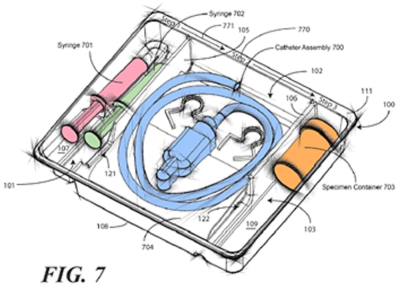
    The case arose in IPRs instituted in response to a challenge by Bard involving three Medline Patents:  U.S. Patent No. 9,745,088 (wherein claims 1, 2, 6–10, 16–19, 25–58, 60–74, 76–90, and 92 were challenged); U.S. Patent No. 9,808,596 (claims 7–16 and 21–22 challenged); and U.S. Patent No. 9,795,761 (claims 1–19 and 22–25 challenged).  The claims are directed to trays designed to store urinary catheterization tools, which include a lubricant syringe, an inflation syringe, and a fluid receptable.  They are useful in avoiding catheter-Associated Urinary Tract Infections (CAUTI), inter alia, by providing an organized, sterilized surface for the components used in catheterization according to a standardized protocol; a tray according to the invention is illustrated as Figure 7 of the '088 patent:

    Image 1
    The opinion sets forth the aspects of the invention claimed in the patents challenged in each IPR:

    • claims 1, 25, and 45 are representative of the '088 patent.  Claims 1 and 25 are generally directed to a tray with two syringes positioned at different heights.  Claim 45 is directed to a tray with two syringes in one compartment;

    • claims 7 and 9 are representative of the '596 patent.  Claim 7 is directed to a tray with a fluid receptacle positioned between the base and the catheter.  Claim 9 is directed to a tray with a compartment configured to receive lubricant; [and]

    • claim 10 is representative of the '761 patent and is directed to a tray with a lubricating jelly application chamber.

    Bard challenged the claims of these patents for being obvious over four prior art references, each of which were (not surprisingly) directed to medical kits or trays:

    • U.S. Patent No. 7,278,987 (Solazzo) disclosed a tray as set forth in Figures 2 and 8 below;

    Image 2
    The relevant features are the two compartments in Figure 8 holding respectively an inflation syringe and a Foley catheter and tube of lubricant, the compartments separated by a divider that can be removed.  Also, as illustrated in Figure 2, the bottom of the container has "deep" and "shallow" sections.

    • U.S. Patent No. 3,329,261 (issued July 4, 1967 to Serany) disclosed a catheterization package containing components stored in their "proper order of use" to "assure that a sterile field may be maintained as the components are removed."

    • U.S. Patent No. 3,166,189 (issued January 19, 1965 to Disston) disclosed a catheterization tray which, like Serany, has the components "arranged in such order and position as to be most conveniently available when the container is opened."

    • Japanese Patent No. 2007-229520 to Imai disclosed an epidural anesthesia tray containing three syringes in a single compartment.

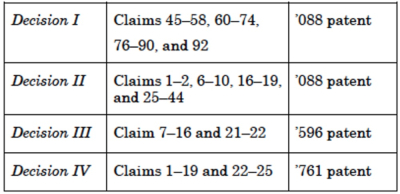
    The Board's decisions, that the cited art did not establish by a preponderance of the evidence that the challenged claims were obvious, is synopsized in a table in the opinion:

    Table
    None of the PTAB's opinion discussed either party's arguments regarding secondary considerations (or objective indicia) of non-obviousness and the opinions addressed similar arguments that the Court considered in this single appeal.

    The Federal Circuit affirmed-in-part, vacated-in-part and remanded, in an opinion by Judge Lourie, joined by Judges Bryson and Chen.  Bard argued that the Board erred and urged the Court to reverse the decisions without remand and without consideration of secondary considerations, while Medline argued that the decision should be affirmed on the grounds that the references were incompatible with one another (grounds the Board did not consider in any of the IPR proceedings, and regarding which Medline conceded at oral argument they were collaterally estopped from advocating on appeal).

    The opinion took the Board decision on each patent in turn.  Regarding the '088 patent, Claim 45 was representative:

    A medical procedure kit, comprising:
        a single layer tray having a first compartment for receiving syringes and a second compartment for receiving a medical assembly;
        a first syringe and a second syringe disposed within the first compartment;
        the medical assembly disposed in the second compartment, wherein the medical assembly comprises a coiled tubing coupled between a fluid drain bag and a Foley catheter;
        at least one layer of wrap material enclosing the single layer tray within one or more folds of the at least one layer of wrap material; and
        an outer packaging disposed about both the single layer tray and the at least one layer of wrap material.

    (wherein the italicized limitations were relevant to the appeal).  The basis for the Board's non-obviousness determination was that it was not obvious to store two syringes in one compartment in view of the prior art.  The rationale for Bard's argument was that the Solazzo reference disclosed two syringes but was silent as to the location of one of them, and that it would have been obvious to put both in one compartment consistent with the disclosure that the components in the prior art tray were arranged "in logical step-by-step order."  This conclusion was also supported according to Bard by the disclosure in Disston that components should be arranged in an order that they are "most conveniently available" upon use.

    The panel asserts that they agree with Bard on this issue, on the ground that there were only two alternatives (putting the two syringes together or separately) and the skilled artisan could have availed herself of the option of putting the syringes together.  "When two equally viable options are available, as here, then, without more, either one would seem to have been obvious" according to the Court's opinion.  The opinion criticizes the Board's application of the law as being "rigidly focused" on the disclosures of each prior art reference without taking into account the "creativity[] and common sense" of a person of ordinary skill in the art, citing KSR Int'l Co. v. Teleflex Inc., 550 U.S. 398, 415, 417 (2007), and Randall Mfg. v. Rea, 733 F.3d 1355, 1362 (Fed. Cir. 2013).  On this basis, the Court vacated the Board's decision regarding claims 45–58, 60–74, 76–90, and 92 of the '088 patent and remanded for further considerations.

    The opinion next considered the Board's obviousness determination regarding claims 1 and 25 of the '088 patent; claim 1 recites:

    A medical procedure kit, comprising:
        a tray having a compartment for receiving a medical assembly;
        a first syringe and a second syringe disposed within the tray;
        at least one layer of wrap material enclosing the tray within one or more folds of the at least one layer of wrap material; and
        an outer packaging disposed about both the tray and the at least one layer of wrap material, wherein:
        the first syringe and the second syringe are ordered within the tray in accordance with their use during a catheterization procedure; and
        the tray comprises a surface defining at least two compartments, the at least two compartments comprising a first compartment to support the first syringe and the second syringe; and
        the first compartment comprising a base member that defines a mnemonic device indicating which of the first syringe or the second syringe should be used first in the catheterization procedure.

    (wherein the italicized limitations were relevant to the appeal).  The mnemonic device, according to Medline, relates to arrangement of syringes at different heights in the claimed tray, on the basis that a practitioner would "intuitively" use the syringe closest to the top of the tray first.  The Board rejected Bard's argument that Solazzo taught such an embodiment on the grounds that the Solazzo reference did not disclose a "contour and shape" associated with positioning the lubricating syringe at an elevated height.  But the Court agreed with Bard on this issue, again finding an overly rigid analysis of obviousness by the Board.  The opinion sets forth the disclosure in Solazzo consistent with the claimed positioning of the syringes (the first containing lubricant, the second mediating inflation of a balloon attached to the catheter to keep it in place).  This disclosure was supported by the teachings in the Serany reference that components in the tray be arranged "in proper order of use," according to the opinion.  In the Court's opinion, "a skilled artisan would have been motivated to design a compartment with a bottom portion that would elevate one syringe above another, without the aid of other items" in view of the cited prior art.  Regarding claim 25, which did not disclose the mnemonic device, the Board erred for not properly considering the teachings of the Imai reference regarding arranging syringes at different heights.  According to the panel, "[g]iven the prior art disclosures and the finite number of predictable options, a skilled artisan would have been motivated to stack the syringes by height according to their order of use."  On these grounds, the Court vacated the Board's decision with regard to claims 1, 2, 6–10, 16–19, and 25–44 of the '088 patent.

    The Court next considered the Board's decision of non-obviousness for challenged claims 7 and 9 of the '596 patent, wherein representative claim 7 recites:

    A catheterization kit comprising: a single level container defining a first compartment bounded by a first compartment base member and at least a first portion of a perimeter wall, the single level container defining a second compartment bounded, at least in part, by a second compartment base member and at least a second portion of the perimeter wall; a first syringe disposed within the first compartment of the single level container, the first syringe containing an inflation fluid; a second syringe disposed within the first compartment of the single level container, the second syringe containing a lubricating jelly; and a coiled medical device disposed within the second compartment of the single level container, the coiled medical device including a Foley catheter, a fluid receptacle, and a tube coupling the Foley catheter to the fluid receptacle, the Foley catheter and the fluid receptacle positioned within the second compartment such that the fluid receptacle is between the second compartment base member and the Foley catheter.

    (wherein the italicized limitation was relevant to the appeal).  Once again the panel agreed with Bard that the Board erred in not concluding that the claims were obvious based on "(1) undisputed testimony that practitioners access the catheter before the fluid receptacle during a catheterization procedure, (2) Serany's disclosure that a fluid receptacle can be stored together with the catheter, and (3) Serany's disclosure that 'all the components [are] arranged in logical step-by-step order.'"  The opinion characterizes the Board's decision as "impos[ing] anticipation-like requirements on the prior art in determining obviousness."  Regarding claim 9, the relevant additional limitation is that the first compartment is "configured to receive the lubricating jelly from the second syringe to lubricate a tip of the Foley catheter when the tip is placed into the first compartment" as shown in use:

    Image 3
    For a change, the panel agreed with Medline on this issue, agreeing that the Board had substantial evidence for concluding that this claim was non-obvious because the relevant compartment was "too deep to store lubricant and facilitate catheter lubrication."  This evidence included "expert testimony that compartment 27's depth would render it unsuitable to store lubricant for the catheter" and "that, because a doctor needs to measure the urine, "[h]aving lubrication" in the urine compartment could "ruin[]" the measurement."  Bard's arguments, that "any chamber [of the claimed tray] regardless of size and shape" is "configured for receiving lubricating jelly and facilitating the lubrication of the tip of a catheter" was inconsistent with the disclosures in the prior art and that the issue was not one of proper vel non claim construction.  Accordingly, the Court vacated the portion of the Board's decision of non-obviousness regarding challenged claims 7, 8, and 11–13 of the '596 patent and affirmed that decision regarding challenged claims 9, 10, 14–16, 21, and 22.

    The last Board decision review by the Court related to the challenged claims of the '761 patent, wherein the opinion recites claim 10 as representative:

    A Foley catheter container, comprising: a single layer tray comprising a surface defining at least two compartments separated by a barrier, the at least two compartments comprising: a first compartment comprising a first compartment base member, the first compartment to accommodate a first syringe and a second syringe; a second compartment comprising a second compartment base member; the Foley catheter, situated in the second compartment; the barrier separating the first compartment from the second compartment; the first compartment base member situated at a different height within the tray than the second compartment base member; the first compartment defining a lubricating jelly application chamber to lubricate the Foley catheter when passed from the second compartment into the first compartment of the single layer tray; further comprising a patient aid comprising post-procedure information, disposed on a first portion of the patient aid, for caring for the Foley catheter applied to a patient.

    (wherein the italicized limitation was relevant to the appeal).  The Court's opinion was based on Bard's arguments with regard to the divider between compartments taught in the Solazzo reference and illustrate in the opinion by this Figure:

    Image 4
    The opinion characterizes Bard's arguments as being similar to those the challenger asserted regarding claim 9 of the '596 patent, and similarly agreed with Medline that substantial evidence supported the Board's non-obviousness determination.  On the other hand, the panel agreed with Bard that the Board erred with regard to the Board's conclusions regarding the presence of two syringes in one compartment positioned at different heights (for the same reasons set forth in the opinion for challenged claims in other patents at issue) but held that error to be harmless in view of "the deficiency of the prior art concerning the lubricating chamber limitation [being] supported by substantial evidence and hence sufficient to establish nonobviousness."  The Court thus affirmed the Board's non-obviousness determination regarding challenged claims 1–19 and 22–25 of the '761 patent."

    Finally, with regard to the secondary considerations issue, the Court remanded these arguments to the Board (subject to whether Medline should be collaterally estopped on remand from making "certain secondary considerations arguments").

    C.R. Bard, Inc. v. Medline Industries, Inc. (Fed. Cir. 2021)
    Nonprecedential disposition
    Panel: Circuit Judges Lourie, Bryson, and Chen
    Opinion By Circuit Judge Lourie

  • CalendarSeptember 8, 2021 – "How/Why to Protect Plants of Cannabis By Plant Breeder's Rights In LATAM?" (Moeller IP) – 11:00 am to 11:45 am (CT)

    September 10, 2021 – Supreme Court IP Review (SCIPR) conference (Chicago-Kent College of Law) – noon to 1:15 pm (CT)

    September 13-14, 2021 – National Forum on Paragraph IV Litigation (Momentum Events)

    September 17, 2021 – "IP and Tech Corporate Counsel Conference" (Center for Intellectual Property, Information & Privacy Law at the University of Illinois Chicago School of Law) – 7:30 am to 4:15 pm on 

    September 24-25, 2021 – Elevate Your Prosecution 2021 conference – Salt Lake City

    September 29-30, 2021 – FDA Boot Camp (American Conference Institute)

    October 5-21, 2021 – Hatch-Waxman and BPCIA Virtual Proficiency Series (American Conference Institute)

  • Moeller IPMoeller IP will be offering a webinar entitled "How/Why to Protect Plants of Cannabis By Plant Breeder's Rights In LATAM?" on September 8, 2021 from 11:00 am to 11:45 am (CT).  The webinar will address the use of the existing legal regimes of plant breeder's rights (PBR) available in Latin America to protect commercial projects related to cannabis, analyze how many PBR applications have been filed in the most important countries, from Canada and the U.S. down to Argentina and Chile, distinguish jurisdictions that allow some use and/or commercialization of cannabis from those that still prohibit them, and review the existing requirements to file and prosecute PBR in the most important jurisdictions in Latin America including some Mercosur (Argentina and Uruguay), Chile, some Andean Community of Nations (Colombia, Ecuador, and Peru), as well as Costa Rica and Mexico in Central/North America.

    While there is no cost to participate in the program, those interested in attending the webinar can register here.

  • Chicago-Kent College of LawThe Chicago-Kent College of Law will be holding the patent session of its annual Supreme Court IP Review (SCIPR) conference on September 10, 2021 from noon to 1:15 pm (CT).  The patent session will address the following two cases:

    • U.S. v. Arthrex Inc. — committed speakers include Prof. Melissa Wasserman of the Univ. of Texas at Austin School of Law, Prof. Harold Krent of Chicago-Kent College of Law, and Anthony Cho of Carlson, Gaskey & Olds P.C.

    • Minerva Surgical Inc. v. Hologic Inc. — committed speakers include Prof. Mark Lemley of Stanford Law School, Caroline Wong of Sidley Austin LLP, and Luke McCloud of Williams & Connolly LLP

    Additional information regarding the patent session can be found here.

    There is no registration fee for attending the conference, but those interested in attending the conference must register here.  A Zoom link for attending the conference will be emailed to registrants the day before each session of SCIPR.

  • ACIAmerican Conference Institute (ACI) will be holding its Hatch-Waxman and BPCIA Virtual Proficiency Series, a 3-week primer on IP basics and regulatory fundamentals on small molecule and biologic drugs and their generic and biosimilar equivalents, from October 5-21, 2021.

    In Week One, meeting on October 5th and 7th, the regulatory framework will be discussed, including:

    • The interplay between the PTO and FDA
    • Pre-commercialization concerns
    • Links between the FDA approval process and the patent process
    • The Orange Book

    Week Two, meeting on October 12th and 14th, will cover the Hatch-Waxman and BPCIA framework, including:

    • The Hatch-Waxman landscape
    • Paragraph IV disputes and litigation
    • Biosimilars, the BCIA and aBLA overview
    • Participating in the "patent dance"
    • The Purple Book

    Finally, in Week Three, the focus will be on bioequivalence, exclusivity, extensions, and exceptions, including:

    • Bioequivalence and interchangeability
    • 180-day exclusivity
    • Non-patent/regulatory exclusivity
    • Exploring the safe harbor
    • Examining patent term extensions

    The sessions will meet from:

    • 1:00 pm – 4:15 pm EST on October 5th,
    • 1:00 pm – 5:00 pm EST on October 7th,
    • 1:00 pm – 5:00 pm EST on October 12th,
    • 1:00 pm – 4:45 pm EST on October 14th,
    • 1:00 pm – 5:00 pm EST on October 19th, and
    • 1:00 pm – 4:45 pm EST on October 21st.

    An agenda for the conference can be found here.

    The all-inclusive registration fee for the conference is $1,695 if registered and paid by September 17th and $1,795 if registered and paid by October 4th.  Patent Docs readers are entitled to a 10% discount off of registration using discount code D10-130-130AX01.  Those interested in registering for the conference can do so here, by e-mailing CustomerService@AmericanConference.com, or by calling 1-888-224-2480.

    Patent Docs is a media partner of ACI's Hatch-Waxman and BPCIA Virtual Proficiency Series.

  • By Kevin E. Noonan

    ToolGenOn June 11th, Junior Party the University of California, Berkeley; the University of Vienna; and Emmanuelle Charpentier (collectively, "CVC") filed its Responsive Preliminary Motion No. 1 in Interference No. 106,127 to be accorded benefit of priority to U.S. Patent Application No. 13/842,859, filed March 15, 2013, or in the alternative U.S. Patent Application No. 14/685,504, filed April 7, 2015, or U.S. Patent Application No. 15/138,604, filed April 26, 2016, pursuant to 37 C.F.R. §§ 41.121(a)(2) and 41.208(a)(3) and Standing Order ¶ 208.4.1.  CVC filed this motion contingent on the Board granting Senior Party ToolGen's Substantive Preliminary Motion No. 2 to deny CVC priority benefit to U.S. Provisional Application No. 16/757,640, filed January 28, 2013 ("P3").

    ToolGen's Substantive Preliminary Motion No. 2 challenged CVC's entitlement to priority benefit to the P3 provisional in this interference on the grounds that it did not disclose "successful cleavage of DNA within eukaryotic cells, nor does it otherwise show a constructive reduction to practice of an embodiment within Count 1."  In its Responsive Motion, CVC sought to establish its entitlement to later-filed applications, to retain its best priority position against ToolGen (CVC itself has filed its Preliminary Motion No. 2 to deny ToolGen of the priority benefit to its earliest application, U.S. Provisional Application No. 16/717,324, filed October 23, 2012).  In its Responsive Motion, CVC argued entitlement to the '859 application as a matter of law because it is the earliest application having an identical specification to CVC's applications-in-interference and CVC argues that it therefore is entitled to a presumption that this application provides a constructive reduction to practice thereby, citing Transco Prod. Inc. v. Performance Contracting, Inc., 38 F.3d 551, 556–57 (Fed. Cir. 1994).  CVC's alternative priority claims were based on the common specification shared by all these applications, comprising "a string of continuation applications [that] thus provide[s] the same disclosure as the involved applications."  CVC provided the following table of comparison evidence of what is disclosed in the specification of the '859 application with each element of the Count:

    Table
    Specifically, CVC argued that Examples 4, 5, and 7 set forth a constructive reduction to practice of an embodiment falling within the scope of the Interference Count.

    ToolGen disagrees, arguing in its Opposition that CVC failed to carry its burden of showing the constructive reduction to practice it alleged.  As an initial matter, ToolGen cites CVC's argument that the disclosure in the three non-provisional applications here has been continuously disclosed in earlier provisional applications (U.S. Provisional Application No. 61/652,086, filed May 25, 2012 ("P1"), U.S. Provisional Application No. 61/716,256, filed October 19, 2012, ("P2"), and U.S. Provisional Application No. 61/757,640, filed January 28, 2013 ("P3"), priority to which CVC asked the Board to accord benefit in its Substantive Preliminary Motion No. 1 (opposed by ToolGen separately).  ToolGen understandably repeats (in brief) its principal argument in that Opposition, that CVC has not shown that CRISPR-mediated DNA cleavage in eukaryotic cells would have been a matter of routine and predictable experimentation, based inter alia on the Board's decisions in Interference No 105,048 (and Federal Circuit affirmance thereof; Regents of Univ. of California v. Broad Inst., Inc., 903 F.3d 1286, 1291–92 (Fed. Cir. 2018)) and Interference No. 106,115 to the contrary.  And ToolGen here, as it has done in its own Preliminary Motion No. 2 to deny priority benefit, argues that the Board erred in granted CVC priority benefit to its P3 provisional application (U.S. Provisional Application No. 61/757,640, filed January 28, 2013) in the '115 Interference because it did not consider ToolGen's arguments that CVC had not satisfied the constructive reduction to practice requirement for this provisional (again, briefly recounting their earlier arguments here).  ToolGen thus makes its first argument on the backs of its earlier arguments with regard to the P1, P2, and P3 priority documents, because if CVC was not entitled to priority to them then the Board should not grant CVC priority benefit to the three non-provisional applications at issue here in the face of CVC's representations that the disclosure in Examples 4, 5 and 7 was the same in these non-provisional applications and the earlier-filed provisional applications.

    ToolGen then sets forth for each of these Examples its arguments why they are defective in satisfying the disclosure requirements for entitlement to priority benefit.  For all these Examples ToolGen asserts that they lack "definitive evidence that CRISPR-Cas9 modulates transcription of at least one gene encoded by the target DNA molecule in eukaryotic cells" due to failure to include "proper experiments and controls" for human cells (which were included for examples using E. coli).  Regarding Example 4, ToolGen maintains that because the Example states that the results merely imply reduced target gene expression as a consequence of CRISPR cleavage, the Example leaves open the door for a skilled worker to entertain other explanations for the reported results and thus not be convinced that the inventors possessed the claimed invention.  ToolGen faults the Example for failing to show that the disabled Cas9 protein was expressed in a human cell and localized to the cell nucleus.  A "critical failure," according to ToolGen's Opposition, is that Example 4 provides no direct measurement of gene transcription in the cell, which is an affirmative limitation in the Count ("modulating transcription of at least one gene encoded by the target DNA molecule").  Without this direct measurement, ToolGen asserts the skilled worker "would not have concluded that Example 4 discloses the constructive reduction to practice of an embodiment of the Count."  Moreover, even assuming for argument that modulation of transcription had been demonstrated, what is disclosed (reduction in green fluorescence protein-catalyzed fluorescence) could be explained by many other mechanisms than CRISPR-specific ones, ToolGen contends.  In addition, ToolGen argues that there is no evidence for specific CRISPR-catalyzed gene-expression repression, i.e., non-targeting gene expression could also be being experienced in the cell (in another instance where the proper controls were performed in parallel experiments using E. coli but not in the human cell experiments according to ToolGen).  ToolGen also contends that Example 4 does not demonstrate gene expression modulation for endogenous cellular genes, or even more than the single GFP-encoding gene introduced exogenously.

    Turning to Example 5, ToolGen argues that it is apparently a "follow-up experiment" from those disclosed in Example 4.  Accordingly, ToolGen asserts that this Example suffers from "all the same issues" as Example 4, i.e., (in summary) "absence of any evidence that a complex is indeed formed and then binds the target gene, the lack of proper controls to demonstrate specificity in modulating the target genes, the absence of studies on endogenous genes to dispel concerns arising from gene integration, and the absence of any measurements to detect gene transcription instead of just GFP fluorescence."  In addition, ToolGen contends that this Example reports only a low level of gene expression modulation with no explanation regarding its magnitude, or that the results were due to specific "RNA-mediated targeting" of the GFP target sequence.

    Example 7 differs from the other two as being "strictly prophetic," being a "plan" to produce transgenic mice expressing Cas9.  However, ToolGen maintains that there is no guidance for making such mice nor any experimental results regarding performing CRISPR in transgenic mice or cells derived therefrom and thus this Example does not satisfy the requirements for CVC to receive benefit of priority thereto.

    For all these reasons, ToolGen asks the Board to deny CVC's attempt to be according benefit of any of these three prior patents.