•     By Sherri Oslick

    Gavel
    About Court Report: Each week we will report briefly
    on recently filed biotech and pharma patent cases.  A few interesting cases will be selected for
    periodic monitoring, providing our readers with an opportunity to follow the
    progress of these cases.


    Stratagene California v. Bio-Rad Laboratories Inc. et
    al.

    3:06-cv-02553; filed November 20, 2006 in the Southern
    District of California

    Infringement of U.S. Patent Nos. 6,054,263 ("Thermal
    Cycler Including a Temperature Gradient Block," issued April 25, 2000) and
    5,779,981 (same title, issued July 14, 1998) based on Bio-Rad's manufacture and
    sale of various thermal cycler devices, and U.S. Patent Nos. 5,288,647
    ("Method of Irradiating Biological Specimens," issued February 22,
    1994) and 5,395,591 ("Apparatus of Irradiating Biological Specimens,"
    issued March 7, 1995) based on Bio-Rad's manufacture and sale of irradiating
    devices, including Bio-Rad's GS Gene Linker UV® device.  View the complaint here.


    Barr Laboratories Inc. v. Aventis Pharmaceuticals, Inc.

    2:06-cv-05605; filed November 21, 2006 in the District
    Court of New Jersey

    Declaratory judgment of invalidity, unenforceability, and
    noninfringement of U.S. Patent No. 7,138,524 ("Processes for Preparing
    Anhydrous and Hydrate Forms of Antihistaminic Piperidine Derivatives,
    Polymorphs and Pseudomorphs Thereof," issued November 21, 2006).  The '524 patent covers a particular crystal
    form of fexofenadine hydrochloride (Aventis' Allegra®, used to treat
    allergies), as does U.S. Patent No. 7,135,571 (same title, issued November 14,
    2006).  Aventis asserted the '571 patent
    against Barr in a complaint filed on November 14, 2006 (2:06-cv-00469, ED
    Texas).  View the complaint here.

  •     By Christopher P. Singer

    Cytogen_logo
    In a November 27, 2006 press release Cytogen announced
    that U.S. Patent No. 7,135,457 issued for oral drug delivery agents that are random
    peptide compositions that bind to gastro-intestinal tract (GIT) transport
    receptors.  These agents aid in the
    transport of active agents from the lumen of mammalian GIT into the circulatory
    system and/or target active agents to the GIT.  Cytogen is seeking partnerships for oral drug delivery based on its
    preclinical models as well as successful in vivo delivery results of insulin
    and leuprolide in animal models.  The
    company hopes that these delivery agents can be utilized to make more drugs
    available for oral administration, particularly drugs currently administered
    via injection.

    The ‘457 patent claims priority to a U.S. Provisional Patent
    Application filed on May 15, 1997.  Briefly, the patent claims relate to compositions, pharmaceutical
    compositions, and nano- or microparticles comprising various chimeric or
    purified proteins, or portions thereof of at least six contiguous amino acids,
    that mediate binding to the human intestinal peptide-associated transporter,
    HPT1.  As recited in the claims, the
    chimeric or purified proteins are bound to various active agents.  Representative independent Claim 1 recites:

    1.  A composition comprising a purified protein which
    specifically binds to the gastro-intestinal tract receptor HPT1 (SEQ ID
    NO:178), wherein the purified protein is bound to a material comprising an
    active agent selected from the group consisting of an imaging agent, a drug,
    and an antigen, and wherein the protein comprises the amino acid sequence of
    SEQ ID NO:50 or a portion thereof of at least 6 contiguous amino acids that
    mediates binding to HPT1.

    More information regarding this technology as well as
    Cytogen’s other technology platforms can be found at
    www.cytogen.com.

  •     By Mark Chael

    USPTO Seal
    On November 22, 2006, the Board of Patent Appeals and
    Interferences (BPAI) at the U.S. Patent and Trademark Office
    decided a patent interference in favor of Prof. J. Gregor Sutcliffe and
    colleagues at the Scripps Research Institute related to hypocretins.

    Hypocretins are a recently discovered family of
    neuropeptide hormones comprising Hcrt 1 and Hcrt 2, derived from a common
    precursor protein.  They are synthesized
    by neurons located in the hypothalamus and may act in the CNS as
    neurotransmitters, including possible roles in nutritional homeostasis and
    narcolepsy, among others.

    The interference was originally requested on December 12,
    2000, in U.S. Patent App. No. 09/735,138 titled
    "Hypothalamus-Specific Polypeptides," however the USPTO and the
    applicants had to come to terms on allowable claims before the interference
    could be declared, a process which took about three years.

    Previously, on December 14, 1999, Drs. Bergsma and
    Yanagisawa, the junior parties in the interference, were awarded U.S. Patent
    No. 6,001,963, which is titled "Ligands of the Neuropeptide Receptor
    HFGAN72."  That patent is
    assigned on its face to SmithKline Beecham Corporation and the University of
    Texas Southwestern Medical Center at Dallas.

    In the interference, Drs. Bergsma and Yanagisawa filed a
    concession of priority, thereby prompting the Board to rule in favor of Dr.
    Sutcliffe and colleagues.  It was also
    noted by the Board that a settlement agreement existed between the parties and
    the Board directed the parties' attention to 35 U.S.C. § 135(c) and 37 C.F.R. §
    41.205(a).  The Board ordered that the
    inventors were not entitled to claims 1 and 3 of the '963 patent, which
    corresponded to the only count in the interference (Count 2).

    Bergsma v. Sutcliffe (B.P.A.I. 2006)
    Panel: Administrative Patent Judges Schafer, Medley, and Moore
    Opinion by Administrate Patent Judge Moore

  •     By Jason Derry —

    Delawarequarter
    The Philadelphia Inquirer reported today that Delaware
    has instituted a new agency to receive donated patents with the goal of
    inspiring economic growth within the State.  The agency hopes to generate Delaware-based companies through licensing
    of its available patents.  The agency
    currently has over 250 patents from DuPont Co. and Hercules Chemical Co., Inc.  The
    available patents can be viewed here.

    In 2001, Wisconsin started The Center for Advanced
    Technology and Innovation to facilitate economic growth in its state through
    licensing of donated patents.  The
    Inquirer reports that four companies have been started through The Center’s
    work.

    Patent donation is a great way to reap some benefit from
    patents that a company owns but doesn’t plan to commercialize.  If the company cannot, or does not want to,
    license such patents, it can donate the patents and receive significant tax
    benefits.  However, the IRS has recently
    cracked down on overvaluation of donated patents.  Thus, if you are considering patent donation,
    be sure to carefully review the valuation requirements.

    For more information on patent donation, check out the
    Special Report on Patent Donations prepared for the Department of Treasury; a law review
    article by Don Macbean;
    and a Policy Review prepared by Ron Layton and Peter Bloch for the International Intellectual Property Institute.  In addition, be sure to contact the IRS for the latest requirements.

    Jason Derry, Ph.D., who graduated with honors from DePaul University College of Law, is a molecular biologist and founding author of Patent Docs.

  •     By Donald Zuhn

    In an
    appeal from a District Court judgment of infringement of U.S. Patent Nos.
    5,714,520; 5,731,355; and 5,731,356, the Federal Circuit reversed the District
    Court's claim construction and finding of literal infringement, and affirmed
    the District Court's finding of infringement under the doctrine of equivalents.

    Abraxis Bioscience
    The patents
    at issue relate to an improved formulation of a general anesthetic and sedative
    containing propofol (2,6-diisopropylphenol), in which an antimicrobial agent
    has been added.  AstraZeneca
    Pharmaceuticals LP (AstraZeneca), the original assignee of the patents at
    issue, had discovered that microbial contamination of its propofol composition
    had led to an increase in post-operative infections, which necessitated that a
    patient's infusion device be changed at least every 6-12 hours.  The inventors of the patents at issue
    discovered that by adding preservatives to its propofol composition, the microbial
    contamination could be retarded such that a patient's infusion device need be
    changed only once every 24 hours.  In
    particular, the inventors discovered that the preservative disodium edetate was
    unexpectedly effective in retarding microbial growth in the propofol
    composition.  Abraxis Bioscience, Inc.
    (Abraxis) subsequently acquired all rights to the patents at issue.

    Mayne Pharma
    Seeking to
    develop a generic formulation of AstraZeneca's improved propofol composition,
    ESI Lederle (ESI) began a research effort aimed at identifying an antimicrobial
    agent that would work as well as the edetate in AstraZeneca's propofol
    composition.  ESI's research efforts led
    to the identification of the calcium trisodium salt of diethylenetriaminepentaacetic
    acid (calcium trisdoium DTPA) as a suitable antimicrobial additive, and ESI was
    granted U.S. Patent No. 6,028,108 (the '108 patent) for a propofol composition
    containing calcium trisodium DTPA.  Following issuance of the '108 patent, Wyeth Pharmaceuticals, Inc.
    (Wyeth), of which ESI was a division, notified AstraZeneca that it was seeking
    FDA approval for ESI's propofol composition.  AstraZeneca responded by filing a patent infringement action against
    Wyeth and ESI.  Mayne Pharma (USA), Inc.
    (Mayne) subsequently acquired the Abbreviated New Drug Application (ANDA) for
    ESI's propofol composition, and AstraZeneca filed a second patent infringement
    action against Mayne.  Ultimately, Mayne
    was substituted for Wyeth and ESI in the first action, and the two actions were
    consolidated.

    In its
    Markman ruling, the District Court construed three contested terms, including
    the term "edetate" (i.e., the antimicrobial agent recited in the
    asserted claims).  The District Court
    noted that the patentees defined "edetate" in the patents at issue as
    "EDTA and derivatives thereof," and thus, construed the term
    "edetate" as meaning "EDTA as well as compounds structurally
    related to EDTA regardless of how they are synthesized."  Following a bench trial, the District Court
    determined that Mayne's propofol composition infringed the asserted claims of
    the patents at issue both literally and under the doctrine of equivalents.

    Federal Circuit Seal
    With
    respect to the District Court's construction of "edetate," the
    Federal Circuit noted that the District Court had adopted a broad definition of
    the term "derivatives" in arriving at a construction of
    "edetate" that encompassed structural analogs of EDTA as well as
    synthetic derivatives.  The Federal
    Circuit determined, however, that the instrinsic evidence failed to support a
    construction of "edetate" that would encompass structural analogs of
    EDTA.  For example, while the patents at
    issue list several derivatives of EDTA that are suitable for the invention, the
    Federal Circuit observed that none of these derivatives are structural
    analogs.  The Federal Circuit concluded,
    therefore, that "the listing of EDTA salts as '[p]articular derivatives of
    use in the present invention,' coupled with the statements regarding the
    uniqueness of edetate as the only successful antimicrobial agent, and the
    patentees' description of EDTA salts as advantageous, preferable, and
    'exceptional,' limit the term 'derivatives' to EDTA salts or compounds that
    maintain the EDTA free acid structure."  Thus, the Federal Circuit determined that the District Court had erred
    in adopting a broad definition of the term "derivatives," and held
    that "the proper construction of 'edetate' is EDTA and derivatives of
    EDTA, such as salts, but not including structural analogs."

    With respect
    to the District Court's finding of literal infringement, the Federal Circuit
    noted that Abraxis had conceded during oral argument that calcium trisodium
    DTPA is not a salt of EDTA, and further, that calcium trisodium DTPA is not a
    derivative of EDTA, since it cannot be synthesized from EDTA in a
    laboratory.  The Federal Circuit
    concluded that because neither EDTA nor any of its salts or derivatives was
    present in Mayne's propofol composition, the District Court had erred in
    finding that Mayne's propofol composition infringed the patents at issue.

    In
    affirming the District Court's finding of infringement under the doctrine of
    equivalents, the Federal Circuit rejected three arguments proffered by Mayne in
    support of its position that the District Court had erred in finding that
    calcium trisodium DTPA was an equivalent of edetate.  Mayne first asserted that the District Court,
    in applying the function-way-result test, had improperly defined the
    "way" in which edetate works.  The Federal Circuit, however, agreed with the District Court's determination
    that the "way" in which both calcium trisodium DTPA and edetate
    "function" to retard microbial growth is by metal ion chelation.  Mayne next asserted that because the
    patentees chose to narrowly claim their invention, it was impermissible as a
    matter of law to extend the meaning of edetate to calcium trisodium DTPA by
    equivalence.  The Federal Circuit,
    however, determined that "[c]ontrary to Mayne’s assertion, the inventors
    did not clearly disavow other polyaminocarboxylates, including DTPA, by
    claiming edetate," and further that "[t]here is no evidence that the
    patentees made a clear and unmistakable surrender of other
    polyaminocarboxylates, or calcium trisodium DTPA in particular, during
    prosecution."  Finally, Mayne
    asserted that the lack of known interchangeability between calcium trisodium
    DTPA and edetate as an antimicrobial agent indicated that the substitution of
    calcium trisodium DTPA for edetate was a substantial change.  With respect to Mayne's last argument, which
    the Federal Circuit stated was largely premised on Mayne's ability to secure a
    patent for its own propofol composition, the Federal Circuit concurred with the
    District Court's determination that "the separate patentability of Mayne’s
    generic formula did 'not outweigh the substantial evidence of equivalence
    between Mayne’s calcium trisodium DTPA and the claimed edetate.'"

    Abraxis Bioscience, Inc. v. Mayne Pharma (USA) Inc. (Fed. Cir. 2006)
    Panel: Circuit Judge Lourie, Senior Circuit Judge Plager, and Circuit Judge Rader
    Opinion by Circuit Judge Lourie

  •     By Christopher P. Singer

    Introgen
    In a November 22, 2006 press release, Introgen
    Therapeutics, Inc. (INGN) announced that it has been awarded U.S. Patent No.
    7,125,706, titled "An Improved Method for the Production and Purification
    of Adenoviral Vectors."  This patent represents the third issued U.S.
    patent in Introgen’s adenoviral vector intellectual property portfolio.  Adenoviral vectors can be used to carry
    transgenes that encode therapeutic proteins.  Currently, some adenoviral based therapies are in clinical trials for
    treatment of certain cancers, including cancers of the lung, head, and neck.

    In its press release, Introgen states that the ‘706 patent
    relates broadly to adenoviruses of commercial scale, quantity, and purity,
    regardless of whether the adenovirus is used as a delivery system for
    therapeutic genes, used directly as a therapeutic agent, used as a vaccine or
    vaccine component or simply used for research and development purposes.

    The ‘706 patent claims priority through a series of
    divisional and continuation-in-part applications back to November 20, 1996
    (U.S. Provisional Application No. 60/031,329).  The independent claims of the ‘706 patent
    recite:

    1. A recombinant
      adenovirus composition comprising between 5×10¹⁴ and 1×10¹⁸ viral particles and
      having less than 50 ng of BSA per 1×10¹² viral particles.
    2. A purified
      recombinant adenovirus composition comprising between 5×10¹⁴ and 1×10¹⁸
      adenoviral particles and between about 100 pg and 10 ng of contaminating human
      DNA per 1×10¹² viral particles.

    Introgen’s corporate profile can be found at this
    link.  More information on Introgen
    Therapeutics can be found at the company’s website: http://www.introgen.com.

  •     By Christopher P. Singer

    Pfizer
    Pfizer and Teva on November 21, 2006 announced that the
    companies reached an agreement that resolves litigation surrounding the drugs
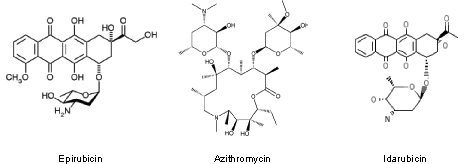
    idarubicin and azithromycin, as well as issues relating to epirubicin.  The resolution includes full releases between
    the parties and directs a payment as large as $70 million from Teva to
    Pfizer.  The dispute between subsidiary
    companies Pharmacia (Pfizer) and Sicor (Teva) centered on Sicor’s sale of a
    generic form of the injectible anti-cancer drug idarubicin HCl (Pharmacia's
    IDAMYCIN PFS).  Pfizer also filed suit
    against Teva for its sale of a generic form of the antibiotic azithromycin
    (Pfizer’s Zithromax).  Under terms of the
    agreement Teva will continue its sale of generic idarubicin and azithromycin,
    and has a 2007 option to sell a generic version of epirubicin (Pfizer's ELLENCE), which is used in adjuvant therapy in patients that show evidence of
    axillary node tumor Teva
    involvement following resection of primary breast
    cancer.  Pfizer’s patent coverage of
    epirubicin is set to expire in August 2007.

    Compounds

  •     By Christopher P. Singer

    USPTO Seal
    Last week the United States and European Patent Offices
    announced that the agencies will begin to exchange priority documents in an
    electronic format.  This program will
    impact applicants that have filed an application with the U.S. or European
    Patent Offices (a "priority document"), and subsequently wish to file a
    corresponding application in Europe or the U.S. within 12 months of the first
    filed application.  This document
    exchange program will be free to applicants.  Currently, the offices charge administrative fees for providing priority
    documents to the other office.  While
    this savings may be insignificant relative to the total cost of application
    filing fees, it is unarguably better than a sharp stick in the eye.

    EPO-EPC
    The Offices will begin testing the system in December and
    intend to be in full-scale operation in January 2007.  More details regarding this announcement can
    be found at this link.

  •     By Donald Zuhn

    In an
    appeal from a District Court judgment of validity and noninfringement, the
    Federal Circuit reversed the District Court's finding of validity, holding the asserted
    claims in U.S. Patent No. 5,990,176 to be anticipated by the
    disclosure in U.S. Patent No. 5,684,211.

    Abbott Laboratories #2
    The '176
    patent relates to degradation-resistant compositions of the inhalation
    anesthetic sevoflurane and processes for preventing the degradation of
    sevoflurane.  Abbott Laboratories
    (Abbott), an assignee of the '176 patent, had discovered that its sevoflurane
    product was being degraded by Lewis acids located on the interior of the containers in
    which the sevoflurane was being shipped.  This degradation reaction yielded hydrofluoric acid, which is highly
    dangerous if inhaled.  Abbott also
    discovered that sevoflurane could be protected from degradation by mixing the
    sevoflurane with water, which would bind to and deactivate the Lewis acids.  Neither the degradation of sevoflurane by
    Lewis acids nor the protective effects of water were known in the art at the
    time of the '176 invention.

    Baxter
    Seeking to
    ship their own sevoflurane product, Baxter Pharmaceutical Products, Inc. and
    Baxter Healthcare Corp. (Baxter) filed a certification of noninfringement and
    invalidity of the '176 patent with the FDA, giving rise to the suit with
    Abbott.  Before the District Court,
    Baxter argued, inter alia, that the '211 patent disclosed a composition of
    water-saturated sevoflurane that met all of the limitations of the asserted
    claims of the '176 patent, and therefore, anticipated the '176 patent.  The District Court, however, determined that
    because the purpose of the '211 patent was not to produce sevoflurane in its
    final useable form, the purposes of the '211 and '176 patents were different,
    and therefore, under Bristol-Myers Squibb Co. v. Ben Venue Labs., Inc., the
    '211 patent did not anticipate the '176 patent.  246 F.3d 1368 (Fed. Cir. 2001) ("Newly discovered results of known
    processes directed to the same purpose are not patentable because such results
    are inherent.").

    Federal Circuit Seal
    In
    rejecting the District Court's application of Bristol-Myers Squibb, the Federal
    Circuit noted that the purpose-based distinction set forth in that case
    "is applicable only to process claims [and] does not speak to composition
    claims."  The Federal Circuit,
    therefore, determined that the District Court erred by applying Bristol-Myers
    Squibb
    to sustain the validity of the composition claims in the '176
    patent.  With respect to the process
    claims in the '176 patent, the Federal Circuit disagreed with the District
    Court's determination that the processes of the '211 and '176 patents were not
    directed to the same purpose, finding that "[a]ll of the steps of the '176
    patent are disclosed in the '211 patent in furtherance of the same
    purpose: the delivery of safe, effective sevoflurane anesthetic.  All that is contributed by the method claims
    of the '176 patent is the recognition of a new property of the prior art
    process."

    The Federal
    Circuit also rejected Abbott's argument that at the time of the '211 patent,
    nobody knew that the water-saturated sevoflurane composition disclosed in the
    '211 patent could resist Lewis acid degradation, stating that "[o]ur cases
    have consistently held that a reference may anticipate even when the relevant
    properties of the thing disclosed were not appreciated at the time."  Noting that the "lack of knowledge
    [regarding the property of degradation resistance] is wholly irrelevant to the
    question of whether the '176 patent claims something 'new' over the disclosure
    of the '211 patent," and finding that the claimed property was inherently
    present in the '211 patent, the Federal Circuit determined that the '211
    patent's disclosure of water-saturated sevoflurane anticipated the claims of
    the '176 patent.  The Federal Circuit,
    therefore, reversed the District Court's finding of validity.

    Abbott Laboratories v. Baxter Pharmaceutical Products, Inc. (Fed. Cir. 2006)
    Panel: Circuit Judge Bryson, Senior Circuit Judge Archer, and Circuit Judge Gajarsa
    Opinion by Circuit Judge Gajarsa

  •     By Jason Derry–Biotechnology_australia

    For companies interested in entering the Australian
    biotechnology industry, the Australian Government has created a new website
    related to biotechnology regulatory requirements.  The website, BioRegs Online (www.bioregs.gov.au),
    was designed to provide easily accessible information to assist companies in
    devising plans for developing and marketing biotech products.  Specifically, BioRegs Online hopes to
    facilitate understanding of and compliance with the regulatory requirements in
    Australia, which will hopefully speed up the approval process for biotech
    products.

    Jason Derry, Ph.D., who graduated with honors from DePaul University College of Law, is a molecular biologist and founding author of Patent Docs.