• Calendar
    January 29-30, 2007 – Biotechnology 2007 (Law Seminars International) – San Francisco, CA

    January 29-30, 2007 – BIO-Asia Partnering Conference (Biotechnology Industry Organization) – Tokyo, Japan

    February 27-28, 2007 – Patent Portfolio Management (American Conference Institute) – New York, NY

    April 16-18, 2007 – Biotechnology: Patent Prosecution, Licensing, Litigation &
    Hatch-Waxman
    (Patent Resources Group) – Orlando, FL

  • Permanent Injunction Issued Against Abbott HCV Genotyping Test Kit

        By Robert Dailey —

    Abbott Laboratories #1
    District Judge Barbara Crabb of the Western District of Wisconsin has issued a permanent
    injunction against Abbott that halts worldwide sales of its HCV genotyping test
    kits.  In an opinion issued last week
    (and reported on Patent Docs), the Court already held Abbott liable for
    infringing U.S. Patent No. 5,846,704, owned by Innogenetics.

    To receive a permanent injunction, a successful plaintiff
    in a patent infringement suit must show that (i) it has suffered irreparable
    harm; (ii) the remedies available at law are inadequate to compensate for that
    harm; (iii) considering the balance of hardships between the plaintiff and
    defendant, an equitable remedy is warranted; and (iv) the public interest would
    not be harmed by the issuance of the permanent injunction.

    Innogenetics
    In last week's opinion, the Court found that Innogenetics
    had clearly satisfied the first three factors in the four-factor test.  On the first factor, the Court found
    irreparable harm because Abbott's products directly compete with the products
    of the plaintiff's licensees (e.g., Bayer).  On the second factor, Abbott had argued that the Plaintiff's prior
    efforts to license its technology indicate its willingness to accept a purely
    legal remedy to the dispute.  Yet the
    Supreme Court expressly rejected this line of reasoning in eBay Inc. v.
    MercExchange L.L.C.
    , 126 S. Ct. 1837, 1840 (2006).  On the third factor, the Court held that Abbott recited no harms that
    differed from those suffered by patent infringers generally.

    The Court scheduled a separate hearing this week to hear
    parties' evidence on the public interest factor.  Abbott argued that Innogenetics could not
    fill the market need for FDA-compliant test kits and that enjoining Abbott
    would disrupt the HCV diagnostics services market.  In an order issued this morning, Judge Crabb
    rejected both of these contentions.  The Court held that Innogenetics does have ample capacity to supply the market need
    for HCV genotyping test kits.  Furthermore, the Court found Abbott's market disruption claims to be
    unpersuasive.  Abbott sells 90% of its
    infringing kits to a single customer – a laboratory that is already taking
    steps to replace its use of Abbott's test kits.

    Abbott also argued that 35 U.S.C. § 271(f) could not
    prevent it from selling its products to foreign customers who could use its
    kits to practice the plaintiff's patented method outside of the U.S.  On a similar set of facts, however, the
    Federal Circuit had already held that § 271(f) does apply to U.S.-based
    companies that directly supply foreign customers with components that could be
    used to infringe a U.S. method patent.  See Union Carbide Chem. & Plastics Tech. Corp. v. Shell Oil Co., 425 F.3d 1366 (Fed. Cir. 2005).  The permanent injunction, therefore,
    encompasses all of Abbott's domestic and foreign sales of its HCV genotyping
    kits.

    Innogenetics, N.V. v. Abbott Labs., No. 05-C-0575-C (W.D.
    Wis.)

    Click here
    for last week's opinion.

    Click here
    for this morning's permanent injunction order.

    Robert Dailey, Ph.D., is a physical chemist and a third-year law
    student at the University of North Carolina at Chapel Hill.  Dr. Dailey
    was a member of MBHB's 2006 class of summer associates.

  • PRG
    Patent Resources Group is providing a course entitled "Biotechnology: Patent Prosecution, Licensing, Litigation &
    Hatch-Waxman" in Orlando on April 16-18, 2007.  According to the PRG website, the course will
    focus on:

    1. Biotechnology Patent Prosecution;
    2. Biotechnology Patent Enforcement;
    3. the Hatch-Waxman Effect on Biotechnology Patent
      Practice; and
    4. Licensing Biotechnology Inventions.

    A number of other courses are being offered by PRG the
    week of April 16th in Orlando.  Click
    here for a
    complete listing and description of the available courses.  Continuing Legal Education credit is
    available to those attending PRG's courses.

  •     By Jason Derry —

    CytrRx
    CytRx Corp. has announced that it has
    contributed its RNA interference portfolio to RXi Pharmaceuticals Corp.  CytRx owns 85% of RXi while the remaining 15%
    will be owned by RXi's scientific advisory board.  The members of the advisory board, subject to
    consent from each member's employer, include Craig C. Mello, Ph.D., Gregory J. Hannon, Ph.D., Tariq M. Rana,
    Ph.D., and Michael P. Czech, Ph.D.  RXi will focus on developing RNAi therapeutics
    for treating human diseases. According
    to the press release, Tod Woolf, Ph.D. will be the Chief Executive Officer of
    RXi.

    Jason Derry, Ph.D., who graduated with honors from DePaul University College of Law, is a molecular biologist and founding author of Patent Docs.

  •     By Kevin Noonan

    Back in the 1970's, Firesign Theater had a comedy album entitled "Everything You Know is Wrong."  This seems to be the Supreme Court's current opinion on the Federal Circuit; the Court hasn't actually affirmed a CAFC decision since J.E.M. Ag Supply v. Pioneer Hi-Bred Int'l. Inc. in 2001.

    Supreme Court Building #1 The trend continues in MedImmune, Inc. v. Genentech, Inc., where the Court not only reversed the Federal Circuit's decision that the licensee, MedImmune, failed to state a case or controversy under Article III, but rejected the CAFC's GenProbe v. Vysis line of cases on the issue.  In GenProbe, the Federal Circuit held that a licensee who believes it does not infringe the licensed patent, or that the patent is invalid, could not continue to pay royalties under the license and challenge validity or infringement by a declaratory judgment action.  The CAFC distinguished Supreme Court precedent on licensee estoppel in Lear v. Adkins because in that case the licensee had refused to pay patent royalties.  The Federal Circuit's precedent on the question left licensees with a Hobson's choice:  continue to pay royalties on an invalid patent or one they did not infringe, or refuse to pay and run the risk of being liable for treble damages, attorney's fees, and an injunction.

    Synagis The underlying dispute involved Synagis®, MedImmune's drug to prevent respiratory infections in infants and young children.  MedImmune had licensed from Genentech a patent and (at the time) pending application related to recombinant expression of chimeric antibodies.  The license terms provided that MedImmune agreed to pay royalties on such antibodies that "would, if not licensed under th[e] Agreement, infringe one or more claims of either or both [of the covered patents and] which have not expired nor been held invalid by a court or other body of competent jurisdiction."  Upon grant of the application as a patent, Genentech informed MedImmune that it expected royalties under the patent for the Synagis® product.  MedImmune paid, but only "under protest and with reservation of all [its] rights."  The Court noted, in particular, that Synagis® represented 80% of MedImmune's revenue, and that failure to pay royalties would have left MedImmune liable for treble damages, attorney's fees, and a possible injunction against further sales of Synagis®.

    Medimmune #1 MedImmune filed a declaratory judgment action, but the District Court below granted Genentech's motion to dismiss for lack of subject matter jurisdiction; specifically, because there was no "case or controversy" between the parties as required under Article III of the U.S. Constitution.  This decision was based on controlling Federal Circuit precedent in GenProbe Inc. v. Vysis, Inc.  In that case, the Federal Circuit held that the existence of the license "obliterate[d] any reasonable apprehension" that the licensee would be sued under the license, and hence took the case outside declaratory judgment jurisdiction under Article III.  The Federal Circuit affirmed the District Court's dismissal of MedImmune's suit, at least in part because (as the Supreme Court noted) the three-judge panel hearing the appeal could not overturn the court's GenProbe precedent.

    The Supreme Court, in an opinion written by Justice Scalia (Justice Thomas dissenting), noted that there would be no dispute had MedImmune taken the ultimate step of refusing to pay patent royalties, and that its own declaratory judgment jurisprudence had not always drawn "the brightest of lines" as to what did or did not fall properly within the scope of declaratory judgment jurisdiction.  In reversing the CAFC, the Supreme Court pointed out that it had long been the case that a party did not need to put itself at risk when the issue was government action.  Thus, a party that disputed a law (such as one prohibiting public distribution of leaflets; Steffel v. Thompson) could raise a case or controversy under Article III without having to violate the law and be at risk for prosecution ("the declaratory judgment procedure is an alternative to pursuit of the arguable illegal activity"; Rehnquist, A.J.).  The principle was based on the existence of coercion, because the behavior that vitiated the threat of prosecution — compliance with the law — was coerced by the threat.

    Turning to private causes of action, the Court referenced lower courts that had permitted subject matter jurisdiction in cases where a private party was in a position to coerce another's behavior.  Justice Scalia did find one case, fortuitously enough, in the Court's precedence that appeared on point.  In Altvater v. Freeman, the Court held there was subject matter jurisdiction under Article III's case and controversy requirement in a dispute involving patent royalty payments compelled under an injunction.  In that case, the Court held that Federal Courts had jurisdiction to hear the declaratory judgment action by the plaintiff licensees on the validity of the underlying patent, even while paying "under protest" the patent royalties ordered by the injunction.  Just as argued by MedImmune here, in Altvater the Court based subject matter jurisdiction on the peril involved with forcing the declaratory judgment plaintiffs to "risk not only actual but treble damages in infringement suits."  The Altvater Court held that "the requirements of case or controversy are met where payment of a claim is demanded as of right and where payment is made, but where the involuntary or coercive nature of the exaction preserves the right to recover the sums paid or challenge the legality of the claim."

    Applying the Altvater precedent to the instant case, the Court first rejected the distinction drawn by the Federal Circuit in GenProbe: that Altvater involved patent royalty payments compelled by an injunction.  The proper analysis was not that the injunction was a form of government action that fell within Steffel v. Thompson-like exemptions.  The Court noted that the Altvater Court did not base its decision on risks stemming from a contempt citation by the court, but rather (as here) on the risks of increased damages owed to the patentees for willful patent infringement (i.e., a private cause of action).  The Court also distinguished Willing v. Chicago Auditorium Association, a case where the Supreme Court had denied subject matter jurisdiction.  In that case, the declaratory judgment plaintiffs had applied for judicial imprimatur for tearing down a building in the face of a lease term preventing it.  Justice Scalia distinguished the Willing precedent in part because the Declaratory Judgments Act was not law when Willing was decided.  Without overruling Willing, the Court opined that it was "confident" that a different result would have been obtained had "the legal disagreement between the parties been as lively" as in this case.

    Genentech The Court made short work of the other arguments presented by Genentech.  The license was not just an "insurance policy" against a lawsuit.  Moreover, the promise to pay royalties on patents that have not expired or been deemed invalid is not a promise not to seek a holding of the patent's invalidity.  The Court also rejected application of the common law precept that a party could not challenge a contract while enjoying its benefits.  While explicitly refusing to opine on whether its estoppel decision in Lear was predicated on that plaintiff having repudiated its license, the Court maintained that the principle did not apply since MedImmune was not challenging the validity of the contract but rather the validity of the underlying patents that formed the basis for the contractual obligation to pay royalties.

    The Court thus held that a patent licensee could sue under the Declaratory Judgment Act for a determination of invalidity or non-infringement while continuing to pay patent royalties under the license, and that such a suit fulfilled the "cases or controversies" requirement of Article III.  The result is a boon for those who believe (albeit with scant evidence) there are a plethora of invalid patents holding hostage unwilling licensees.  The decision appears to bring some common sense to the question, since it is unlikely that either Lear or the Declaratory Judgments Act envisioned, sanctioned, or required the type of Catch 22 created by the Federal Circuit's jurisprudence.  And the case gave the Supreme Court one more opportunity to reverse settled Federal Circuit precedent, a recently recurring pastime for the Court.

    We all await the Court's decision in KSR v. Teleflex to see whether and to what extent this trend continues.

    MedImmun, Inc. v. Genentech, Inc. (2007)
    Opinion by Justice Scalia; dissenting opinion by Justice Thomas

  •     By Kevin Noonan

    Illustrating once again distinctions between permanent
    and preliminary injunctions in its jurisprudence, the Federal Circuit used a
    combination of its patent-specific precedent and regional circuit law to affirm
    a preliminary injunction against only one of three co-defendants.  In Abbott Lab. v. Andrx Pharm., Inc., the Court held that one
    co-defendant couldn't "piggy-back" its burden of showing a likelihood
    of success on the merits for its invalidity or unenforceability defenses on a
    successful showing of either defense made by another co-defendant, leading to
    different outcomes for the parties.

    Cl2
    Abbott sued Andrx Pharmaceuticals, Inc, Ranbaxy
    Laboratories, Inc., and Teva Pharmaceuticals USA, Inc. for ANDA filings with the
    FDA for generic versions of Abbott's Biaxin XL, an extended release formulation
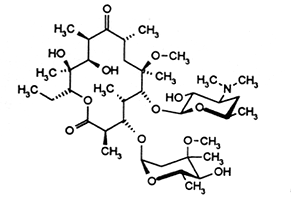
    of the antibiotic clarithromycin.  Abbott
    asserted against Andrx claims 1, 4, and 6 of U.S. Patent No. 6,010,718; claim 2 of
    U.S. Patent No. 6,551,616, and claims 8 and 16 of U.S. Patent No. 6,872,407.  The District Court granted Abbott's preliminary
    injunction motion, holding that Abbott had established a likelihood of success
    on the merits that Andrx infringed the claims at issue, and that Andrx had
    failed to establish the likelihood that it would be successful in showing that
    the claims were invalid.  The District
    Court's holding was limited to infringement under the doctrine of equivalents
    for the '718 and '616 patents.

    Andrx
    The bases for Andrx's appeal were two-fold:  first, that the District Court was wrong, but
    more importantly, that Abbott was collaterally estopped from asserting these
    patent claims due to that court's denial of Abbott's preliminary injunction
    motion as to the other defendants.  Specifically, the District Court had denied the injunction as to Ranbaxy
    on the grounds that Ranbaxy had shown a likelihood that it would be able to
    establish at trial that the '616 and '407 patents were unenforceable for
    inequitable conduct.  The Court had also
    denied the injunction as to Teva because it found Teva had shown the required
    likelihood that claim 2 of the '616 patent was invalid for obviousness, and the
    Federal Circuit had held, in Abbott's appeal of the District Court's decision
    denying the injunction as to Teva, that Teva had raised a substantial question
    of invalidity as to claims 2, 4, and 6 of the '718 patent.

    Andrx's appeal was limited solely to the first prong of
    the preliminary injunction standard:  the
    likelihood that Abbott would prevail on the merits of its patent infringement
    case.  Andrx's arguments on appeal were
    based on Blonder-Tongue Laboratories v. University of Illinois Foundation, that
    a patentee is collaterally estopped from asserting patent claims against a
    defendant that had been found invalid or unenforceable against a different
    defendant.

    Federal Circuit Seal
    The Federal Circuit applied the law of the 7th Circuit
    since the issue was not unique to patent law.  First, the Federal Circuit distinguished Blonder-Tongue on the grounds
    that the Supreme Court had emphasized the importance of the estoppel-creating
    decision being a final determination on the merits.  The patentee must have had the opportunity to
    fully litigate the question of invalidity or unenforceability before a court
    could preclude it from asserting its patent against another party.  In addition, the collaterally-estopped issues
    in the later case must be identical to those issues in the prior case.

    Andrx acknowledged that Blonder-Tongue required a final
    determination, but that the holding should be extended to preliminary
    injunctions because these decisions are "final" as to the question of
    whether Abbott was entitled to the preliminary injunction.

    Under 7th Circuit law, preliminary injunctions were
    recognized to be made on an incomplete record and to be tentative
    determinations at best, being decided not on a conclusive determination but on
    an estimate of the likelihood of success.  The Federal Circuit found that there were "rare instances"
    where the 7th Circuit would find estoppel in the absence of a final
    determination.  Under 7th Circuit law, those rare instances arose when the preliminary injunction determination raised
    an "insuperable obstacle" to a plaintiff's success on the
    merits.

    Abbott A
    The Court determined that those circumstances did not
    apply.  The Federal Circuit found that
    the District Court in its denial of Abbott's motion for preliminary injunction
    against Ranbaxy and Teva had not evinced the required intention to "firmly
    and finally decide" the issues of invalidity and unenforceability.  Under 7th Circuit law, therefore, the Federal
    Circuit refused to find collateral estoppel against Abbott in its preliminary
    injunction motion and affirmed.

    Andrx's other contention was that the District Court was
    incorrect, which the Federal Circuit reviewed under the abuse of discretion
    standard.  Andrx argued on appeal that
    its product did not infringe because Abbott's patent claims recited the use of
    a "pharmaceutically-acceptable polymer" whereas Andrx's ANDA generic
    comprises glyceryl monostearate (GMS).  The Federal Circuit construed the term "pharmaceutically-acceptable
    polymer" in Abbott's claims and determined that Andrx's GMS was not
    outside the scope of equivalents.  In so
    doing, the Court disagreed with the District Court's claim construction, and asserted
    that the use of Markush language ("selected from the group consisting
    of") in the specification did not have the limiting effect that such
    language has in a claim.  In addition,
    the Court found that the patentee had used the term "means" in the
    specification consistently when reciting explicit definitions, but had used the
    word "is" when reciting examples of pharmaceutically-acceptable
    polymers.  In the Court's view, these
    differences did not "unambiguously signify" that the patentee had
    intended to be a lexicographer and limit the scope of the
    pharmaceutically-acceptable polymers used in the invention.  According to the Court, this determination
    was supported by the testimony of both parties' experts, neither of whom
    maintained that the language was explicitly definitional.  Based on this more expansive meaning of the
    term "pharmaceutically-acceptable polymer" in the claims, the Federal
    Circuit found that the District Court had not abused its discretion in granting
    the preliminary injunction based on the likelihood that Abbott would prevail on
    the merits, that Andrx's generic clarithromycin formulation infringes Abbott's
    claims under the doctrine of equivalents.  In doing so, the Court explicitly rejected Andrx's contentions that a
    finding of equivalents would vitiate the "pharmaceutically-acceptable
    polymer" limitation, or violate the specific exclusion principle
    (prohibiting a finding as an equivalent of a compound excluded from the claimed
    limitation).

    Abbott Lab. v. Andrx Pharm., Inc. (Fed. Cir. 2007)
    Panel: Chief Judge Michel, Circuit Judge Prost, and District Judge Ellis
    Opinion by Circuit Judge Prost

  •    By Robert Dailey —

    Amgen
    Last Friday the Federal Circuit refused Ariad's request
    to hear its appeal of a pre-trial ruling in its district court litigation with
    Amgen.  In mid-2006, Amgen filed a
    declaratory judgment action against Ariad in the U.S. District Court for the
    District of Delaware.

    Ariad
    Ariad responded by asking Judge Kent Jordan to dismiss
    the suit for (i) failure to demonstrate the existence of an actual controversy
    under the declaratory judgment standards, and (ii) for failure to join Harvard
    and MIT as indispensable parties.  Judge
    Jordan denied Ariad's motion, but certified the issues for appeal.  Friday's ruling requires cash-strapped Ariad
    to return to district court and proceed with the litigation involving U.S.
    Patent No. 6,410,516 (the '516 patent).

    Lilly
    Ariad is also embroiled in protracted litigation over the
    same patent with Eli Lilly & Co. in the District of Massachusetts.  Although Ariad received a favorable jury
    verdict last May on the infringement-related issues, the parties are still
    awaiting the outcome of an August bench trial on invalidity and inequitable
    conduct.

    The '516 patent took a huge hit in September, however,
    when the USPTO invalidated 160 of its 203 claims in a reexamination
    proceeding.  Ariad is in the process of responding
    to the USPTO's findings.

    Amgen Inc. v. Ariad Pharms., No. 1:06-cv-00259 (D. Del.).

    Ariad Pharms. v. Eli Lilly & Co., No.
    1:02-cv-11280-RWZ (D. Mass.).

    Robert Dailey, Ph.D., is a physical chemist and a third-year law
    student at the University of North Carolina at Chapel Hill.  Dr. Dailey
    was a member of MBHB's 2006 class of summer associates.

  •     By Jason Derry —

    Genentech
    Genentech and
    Seattle Genetics have announced an agreement involving the development and commercialization of a humanized
    monoclonal antibody for treating hematologic malignancies, including multiple
    myeloma, chronic lymphocytic leukemia, and non-Hodgkin's lymphoma.  The antibody, SGN-40, is currently in Phase I
    and II clinical trials.  According to the
    press release, Seattle Genetics will receive $60 million in up-front payment,
    and may receive more than $800 million in milestone payments and increasing
    royalties on sales of SGN-40 in the future.

    Seattle Genetics
    Jason Derry, Ph.D., who graduated with honors from DePaul University College of Law, is a molecular biologist and founding author of Patent Docs.

  • Innogenetics Wins $7 Million Judgment Against Abbott for Infringing HCV Genotyping Method

        By Robert Dailey —

    Innogenetics
    Judge Barbara Crabb, in an opinion
    issued last week,
    rejected all of Abbott's post-trial motions and upheld an earlier $7 million
    verdict against its diagnostics division for infringing an Innogenetics patent.

    Innogenetics owns U.S. Patent Number 5,846,704 (the '704 patent), which is
    directed to methods of genotyping the hepatitis C virus (HCV) by hybridizing
    probes to a particular region of the HCV genome.  Claim 1 covers:

    1.  A method of genotyping HCV present in a biological sample
    comprising hybridizing nucleic acids in a biological sample with at least one
    probe and detecting a complex as formed with said probe and said nucleic acids
    of HCV, using a probe that specifically hybridizes to the domain extending from
    the nucleotides at positions -291 to -66 of the 5' untranslated region of HCV.

    Abbott sells HCV genotyping assays that perform the
    claimed method using Realtime PCR.

    Abbott Laboratories #2
    Abbott argued that its assay does not infringe the patent
    because Realtime PCR is an after-arising technology that was not known when
    Innogenetics filed its initial parent application in 1992.  The court provides several reasons for
    rejecting this argument.  First, SuperGuide Corp. v. DirectTV Enterprises, Inc., 358 F.3d 870 (Fed. Cir. 2004), holds
    that "[t]he law does not require that the applicant describe in his
    specification every conceivable and possible future embodiment of his
    invention."  Nevertheless, the court
    provides no basis for distinguishing SuperGuide from cases in which the Federal
    Circuit has held that a claim fails the written description requirement when
    the patentee attempts to sweep after-arising technology into the claim's scope.  See Chiron Corp. v. Genentech, Inc., 363 F.3d 1247
    (Fed. Cir. 2004).  Second, Realtime PCR
    was already known in the art by 1992 and, therefore, does not qualify as
    after-arising technology.  Third, Abbott
    made this argument for the first time at 9:30 p.m. on the eve of the trial
    while submitting its proposed jury instructions.  This contradicted Abbott's earlier averments
    that it had no further theories of non-infringement.  (Consequently, Judge Crabb prevented Abbott
    from presenting this argument at trial.)

    Abbott also argued that the '704 patent was invalid
    because it was anticipated by and obvious in light of prior art directed to
    detecting HCV in the 5' untranslated region (UTR).  But the Innogenetics method had not merely
    dealt with detecting HCV in the 5' UTR; their patent also taught how to
    distinguish among (i.e., classify) different types and subtypes of HCV in the
    5' UTR.

    Abbott's obviousness argument rested on a combination of
    prior art references.  Yet Abbott offered
    the court nothing more than an expert's conclusory statements of
    obviousness.  The court held that an
    expert must at least explain how and why the asserted combination of references
    renders the patent obviousness.

    Abbott's anticipation argument was rejected by a jury,
    whose verdict has now been upheld.  This
    portion of Abbott's case seems to have failed in part because Abbott refused to
    offer its primary witness (a trained expert and the author of the asserted
    prior art reference) as an expert.  As a
    mere fact witness, he was prevented from giving any opinion-related testimony
    in court connected to the technology at issue.  Relying on Day v. Consolidated Rail Corp., 1996 WL 257654 (S.D.N.Y.
    1996), the court held that Abbott's decision to offer its "expert" as
    a non-expert did not exempt the witness from the report requirement of Rule
    26(a)(2)(B).  (The Rule requires
    witnesses who give opinion-related testimony on scientific or technical matters
    to submit reports to the court during pre-trial discovery.)  This left Abbott with little evidence to
    bring before the jury.

    The jury's damage award of $7 million was upheld and the
    plaintiff's motion for treble damages was denied.  Judge Crabb will issue a subsequent opinion
    regarding the plaintiff's request for a permanent injunction.

    Innogenetics v. Abbott Labs., No. 05-C-0575-C (W.D. Wis.).

    Robert Dailey, Ph.D., is a physical chemist and a third-year law
    student at the University of North Carolina at Chapel Hill.  Dr. Dailey
    was a member of MBHB's 2006 class of summer associates.

  •     By Christopher P. Singer

    The Patent Board
    In a January 2, 2007 press release, The Patent Board®
    announced that it will provide The Patent Scorecard to The Wall Street Journal
    on a weekly basis.  The Wall Street Journal
    plans to publish the information every Tuesday in the "Money & Investing"
    section, and will be accessible through its online publication.  Using its arsenal of
    tools and metrics for analyzing patents and I.P. investment, The Patent Board®
    generates The Patent Scorecard which includes categories such as patent
    portfolio quality, technological strength, and breadth of impact.  This feature will provide in-depth analysis
    of the intellectual property of leading companies in 17 different industries.  The Scorecard launched on January 2, 2007,
    with a review of the consumer electronics sector.  According to the press release, The Wall
    Street Journal
    plans to profile other sectors in the upcoming weeks, including
    the automotive, semiconductors, information technology, aerospace and defense,
    and pharmaceuticals.

    With the recent launch and success of the Ocean Tomo
    300® Patent Index, as previously reported by Patent Docs, this weekly feature puts additional public spotlight on the
    importance of corporate valuation and leveraging of its intellectual property.

    More information about the Scorecard or The Patent
    Board® can be found here.

    Wall Street Journal