•     By Kevin Noonan

    New York Times
    The New York Times
    continued its recent campaign against patents this week, running an Op-Ed piece by Denise Caruso on gene patenting.  Perhaps this attack is rooted in the Times loss before the Supreme Court a few years ago when it tried to usurp copyright from authors for online versions of articles.  New York Times Co. v. Tasini, 533 U.S. 483 (2001).  Or perhaps the Times takes the European view that patents are just the way "big business" frustrates entrepreneurship (despite plenteous evidence to the contrary).  Whatever its motivation, the latest Times jeremiad is full of the usual falsehoods and half-truths.
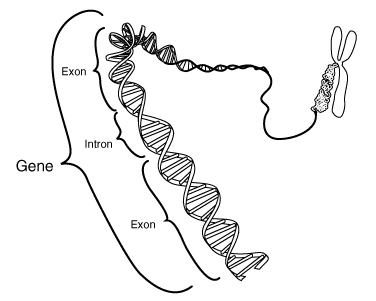
    Gene
    This begins with the title of the piece, "Re: Framing:  Someone (Other Than You) May Own Your Genes."  Readers of this space will recognize the falsity of this statement:  no one (other than you) owns your genes.  Patent offices around the world, including in the U.S., require that a gene be "isolated and purified" by a scientist before patent rights will attach.  Moreover, this is but the threshold for patenting in the U.S.; in addition, the nucleic acid sequence of the gene must be new (meaning that it wasn't disclosed previously by anyone), and the function of the gene product must be known (or the gene lacks utility).  No one would probably wish to own "your" genes, since it is highly likely that at least one of the copies of any particular one of "your" genes is a variant, or even a mutant, that would not perform as does the genetically "wildtype" version of the gene.  Finally, the title implies that someday a patent holder will knock on your door and ask for royalties because they "own" the gene for alcohol dehydrogenase, and since there is a bottle of wine in your garbage, the patent holder knows your liver must be busy using this gene to make the enzyme that detoxifies the alcohol in the wine.  Hogwash, to quote our current Vice-President.

    Andrews, Lori
    The subtitle is in some ways worse:  "Is it time to consider an alternative to patenting life forms."  This is part of a new "vitalism" expressed by some writers (such as Lori Andrews (at right) of Chicago-Kent College of Law) when it comes to DNA patenting.  DNA "is a chemical, albeit a complex one" according to the Federal Circuit, and as such is no different than other biological substances such as vitamins and proteins that are non-controversial subjects of patent protection.  But there is something about DNA, perhaps because its status as the "genetic material" that is so compelling, that renders irrational otherwise sober discussion.  Western science rejected the concept of vitalism — that biological molecules or processes are not subject to the chemical and physical laws that govern other matter — late in the 19th century when Pasteur and Wohler and others showed that there was no scientific basis for the concept.  Rapid progress in biology and biochemistry followed.  Yet the framing of the issues in the new vitalism seems to revive these simply incorrect views for political rather than scientific reasons (since there are no scientific reasons to support them).

    Hilgartner, Stephen
    The body of the piece discusses the ideas of an academic (notably, not one with any scientific or legal background) who believes that there is an "acceptable" level of intellectual property, by analogy to an "acceptable" level of risk.  The semantic implications are clear, since most readers will not think of risk as a good thing; of course, there would be little money made in a reader's 401(k) account without it.  Professor Stephen Hilgartner (at left), according to the author, suggests somehow that intellectual property rights need to be restricted much like real property rights are restricted, for example, by zoning ordinances.  A review of his paper reveals much talk about the crisis in patenting "life" but little critical thinking about whether there is, in fact, a crisis that needs correcting.

    Conflated throughout the Times article are issues surrounding genetically modified foods; rights of indigenous societies when traditional flora, fauna, or methods are expropriated; and how corporations own 20% of the human genome.  A prominent example cited in the piece is Canavan disease, where a group of parents of children carrying a mutation that caused the disease challenged the researchers who patented their identification of the mutation (for use in a diagnostic test).  What the piece downplays is that the parents were able to get the patent holder to settle, in view of their unique financial and biological contributions to the discovery.  All of which could have been avoided by having a good patent attorney involved on the parents' behalf in the first place.

    And nowhere in any of this discussion is there a mention of the fundamental qualities of patents:  limited rights for limited times.  Limitations in scope arise from the duality of DNA as both chemical and information.  As a chemical, DNA can be protected by patent rights.  However, as part of the quid pro quo of the patent system, the nucleotide sequence of a patented gene must be disclosed, and that information is not patentable.  So even while a patent is in force, every researcher in the world can work to "design around" the gene sequence to avoid infringement.  Limitations in time result from the Constitutional mandate that the "exclusive rights" granted to inventors for their discoveries not be perpetual:  currently the patent term is 20 years from filing, and for many patents the effective term is much less.  Thereafter, of course, the patent "monopoly" is done, and the researcher's work is freely available to all.

    Wegner, Harold
    There is a great deal to be discussed about patents and their application to the life sciences, but most of what is current is political not rational.  An article (usually from the popular press) about this "crisis" is used as a reference to support another article about that "crisis," and soon everyone is shouting fire in a crowded theatre without knowing what caused the "crisis" in the first place.  Biotech patenting has allowed a generation of (predominantly) U.S. companies to bring diagnostic tests and therapeutic agents to market and to attack diseases that were death sentences just a few short years ago.  As Professor Hal Wegner (at right) notes in his recent Patently-O piece, it is just those parties that have provided these benefits (universities, small start-up biotech companies, and pharma) that have the most need for the limited exclusivity provided by patents.  Political Cassandras do us no service with their misinformed cries that the sky is falling; we listen to them at our peril.

    For additional information on this topic, please see:
    • "In Support of Gene Patents," December 7, 2006

  •     By Jason Derry —

    Sigma-Aldrich
    PharmaLive has reported that Vanderbilt-Ingram Cancer Center and the University of Michigan added their names to the list of members currently involved in Sigma-Aldrich's RNAi Partnership Program.  The Program was set up by Sigma-Aldrich to provide members with access to its functional genomics portfolio, which comprises shRNA libraries that target over 30,000 human and mouse genes.  Sigma-Aldrich hopes the Program will enhance RNAi-related research at select academic institutions by offering its members access to background information, search tools, workshops, and techniques relating to RNAi technology.  The Program also provides its members with special pricing on RNAi products.  Other members of the Program include the Cleveland Clinic, Washington University of St. Louis, Princeton University, the Wistar Institute, and Rutgers University.  Those interested in becoming members of the RNAi Partnership Program can check out this link.

    Mission RNAi
    Jason Derry, Ph.D., who graduated with honors from DePaul University
    College of Law, is a molecular biologist and founding author of Patent Docs.

  • Calendar
    Monday & Tuesday – Biotechnology 2007 (Law Seminars International) – San Francisco, CA

    Monday & Tuesday – BIO-Asia Partnering Conference (Biotechnology Industry Organization) – Tokyo, Japan

    February 27-28, 2007 – Patent Portfolio Management (American Conference Institute) – New York, NY

    March 25-29, 2007 – American Chemical Society National Meeting – Chicago, IL

    April 16-18, 2007 – Biotechnology: Patent Prosecution, Licensing, Litigation &
    Hatch-Waxman
    (Patent Resources Group) – Orlando, FL

  •     By Christopher P. Singer

    EFS-Web
    On January 30, 2007 at 1:00pm (EST) the USPTO will
    provide online training regarding proper document indexing when submitting
    filings using EFS-Web.  Proper indexing
    of documents is important for minimizing potential errors and delays in the
    Patent Office's processing of submissions by EFS-Web.

    Since enrollment for this event was closed in a little more than an hour, at the conclusion of the event, Patent Docs will provide highlights of the broadcast as well as links to supplemental
    information that the Office may provide.

  • American Chemical Society The American Chemical Society is holding its Spring 2007 meeting on March 25-29 in Chicago, Illinois.  According to the ACS website, over 12000
    attendees are expected.  We note that our
    colleagues Steve Sarussi and Brad Crawford will be giving presentations at the meeting on March 28th during a session entitled: "Ensuring the Effective Patent Protection of Innovative Molecular Technology."  In particular, Mr. Sarussi will be speaking about: "Threshold intellectual property issues for the V.P. of R&D at small pharmaceutical companies," and Mr. Crawford will be speaking about: "International patent protection and strategy."

    For more information, visit the
    ACS website by clicking here.

  •     By Christopher P. Singer

    Roche
    In a January 24, 2007 press release, Roche announced that
    its multinational phase III study of Actemra (tocilizumab) for treatment of
    rheumatoid arthritis has met its endpoint.  The study focused on patients with rheumatoid arthritis that had poor
    response to treatment with methotrexate.  Over the course of the 24 week study, patients receiving Actemra (i.v.)
    plus methotrexate reported improvements in symptoms relative to patients
    receiving placebo plus methotrexate.  Additional Actemra-rheumatoid arthritis phase III trials are ongoing
    with results expected later this year.

    Actemra is a humanized interleukin-6 (IL-6) receptor
    monoclonal antibody being developed by Roche in collaboration with Chugai.  Actemra was initially launched in Japan in
    2005 as a therapy for Castleman's disease.

  •         By Christopher P. Singer

    USPTO Seal
    In a rule change that is sure please patent practitioners
    living in Hawaii, the U.S. Patent and Trademark Office
    (USPTO) announced several amendments to Title 37 of the Code of Federal Regulations (C.F.R.) relating to
    EFS-Web correspondence.  In particular, the following sections of 37 C.F.R. have been amended:  §§
    1.4 (signature requirement; form usage/modification), 1.6 (U.S. national stage
    correspondence; filings; follow-on communications), 1.8 (certificate of
    transmission by EFS-Web, local time of filer controls timeliness of response),
    and 1.33 (e-mail acknowledgement of correspondence between the USPTO and
    correspondence address).  To review the
    Federal Register notice regarding these rules changes consult this link

    EFS-Web
    The most significant change is introduced by new sections
    1.8(a)(1)(i)(C) and 1.6(a)(4), which effectively allow a practitioner to use
    EFS-Web Certifications like Certificates of Mailing under 37 C.F.R. §
    1.8.  Thus, correspondence as described
    in § 1.8 and the EFS-Web "Legal Framework" can be submitted with the
    proper certification statement and will be considered timely filed as long as such correspondence is "transmitted prior to expiration of the set period of time by
    being: transmitted via the Office electronic filing system in accordance with §1.6(a)(4)" (37 C.F.R. §
    1.8(a)(1)(i)(C)).  Accordingly, the filer
    needs to include a certificate for each piece of correspondence stating the
    date of transmission.  NOTE:  The
    "receipt date" stamp will still reflect the date and time of the
    submission at the USPTO.  Therefore, for
    example, applications having critical bar dates should be submitted by EFS with
    respect to the time and date at the USPTO, not the practitioner's particular
    local time, or by Express Mail under 37 C.F.R. § 1.10.

    For information regarding and clarification of this procedure, the USPTO encourages practitioners to review the "Legal Framework" for EFS-Web at
    this link.

    The USPTO advises that filers should be generally cautious
    regarding e-filings.  For example, when
    using EFS-Web to file correspondence with the Office, the filer should make
    sure to receive (and save) the USPTO-generated E-filing acknowledgement.  Should the filer be unsure about the whether
    the filing was received by the USPTO, he or she should review the application on
    Private PAIR to confirm the filing, and retrieve a copy of the e-filing
    acknowledgement.  Additionally, if a
    practitioner attempts a transmission when the electronic filing system is
    inactive (repair, maintenance, etc.), alternative methods of filing should be
    used (e.g., Facsimile, Express Mail-Post Office to Addressee, First Class
    Mail).

  •     By Donald Zuhn

    Federal Circuit Seal
    On January 22, 2007, the Federal Circuit announced a proposal to amend its rules by adopting Federal Circuit Rules 28(a)(15) and (16), 28(j), 30(k), and 31(b), (e), and (f); and by deleting Federal Circuit Rule 32(e).  According to the Court's announcement, the rule changes would require parties represented by counsel to file a digital version of every brief and appendix, unless counsel could certify that such submission would not be practical or would constitute a hardship.  The Court's requirements for the filing of paper copies of the briefs and appendices would continue unchanged.  Proposed Rule 30(k) would result in the posting of digital versions of all briefs and appendices on the Federal Circuit's website, provided that such briefs and appendices are not redacted, sealed, or otherwise restricted by court order.  In conjunction with the adoption of the proposed rules, the Court has also proposed to withdraw Federal Circuit Rule 32(e), which at present permits the filing of briefs on CD-ROM media.  Comments regarding the proposed rules changes should be sent to the Office of the Clerk of the United States Court of Appeals for the Federal Circuit, and must be received by the close of business on February 16, 2007.

  •     By Donald Zuhn

    Caraco Pharmaceutical Laboratories
    In an appeal from a District Court decision granting summary judgment in favor of Defendant-Appellee Caraco Pharmaceutical Laboratories, Ltd. (Caraco), the Federal Circuit concluded that the District Court did not err in construing the term "about 1:5" or in finding no literal infringement or infringement under the doctrine of equivalents, and thus, affirmed the District Court's grant of summary judgment of non-infringement.

    Ortho-McNeil
    Plaintiff-Appellant Ortho-McNeil Pharmaceutical, Inc. (Ortho) owns U.S. Patent No. 5,336,691 (the '691 patent), which relates to a pharmaceutical composition comprising certain weight ratios of the analgesics tramadol and acetaminophen (Ortho sells this composition under the trademark Ultracet®).  The '691 patent discloses that "[c]ertain ratios [of tramadol and acetaminophen] result in a composition which exhibits synergistic analgesic effects," and that "[t]he most preferred ratios are from about 1:19 to 1:50."  The '691 patent also discloses that ratios of "about 1:1 and about 1:5 are encompassed by the present invention."

    FIG1
    Seeking approval to market a pharmaceutical composition containing tramadol and acetaminophen having a weight ratio of no less than 1:7.5 and an average weight ratio of 1:8.67, Caraco filed an Abbreviated New Drug Application (ANDA) with the FDA.  In response, Ortho filed suit against Caraco, alleging that the filing of the ANDA infringed claim 6 of the '691 patent.  The asserted claim recites a pharmaceutical composition comprising tramadol and acetaminophen in a weight ratio of "about 1:5."  Caraco then moved for summary judgment of non-infringement.

    Ultracet
    The threshold issue in this case involves the proper construction of the term "about 1:5."  Before the District Court, Ortho argued that "about 1:5" means "approximately 1:5, and . . . encompasses a range of ratios of at least 1:3.6 to 1:7.1," and Caraco countered that the term means "approximately 1:5, subject perhaps to minor measuring errors of, say, 5 or 10%."  Relying on Ortho's experts, who testified that those of ordinary skill in the art would understand that the term "about 1:5" encompasses a range of ratios between 1:3.6 and 1:7.1, the District Court construed the term "about 1:5" to mean "approximately 1:5, encompassing a range of ratios no greater than 1:3.6 to 1:7.1."

    Based on its construction of the term "about 1:5," the District Court concluded that the composition described in Caraco's ANDA did not literally infringe the '691 patent.  In addition, the District Court determined that Caraco's composition – having an average weight ratio of 1:8.67 – did not infringe the '691 patent under the doctrine of equivalents, since such a finding would render the "about 1:5" limitation meaningless.

    With regard to the District Court's construction of the term "about 1:5," the Federal Circuit considered the intrinsic and extrinsic evidence in the case, and determined that the District Court had not erred in construing the term "about 1:5" to mean "approximately 1:5, encompassing a range of ratios no greater than 1:3.6 to 1:7.1."  In reaching this determination, the Federal Circuit noted that "[t]he intrinsic evidence points to a meaning for the term 'about 1:5' that is narrow because the 1:5 weight ratio, along with the 1:1 weight ratio, is distinctly claimed and distinguished from other broader weight ratios in the patent."  In particular, the Court noted that because some of the claims in the '691 patent recite a single weight ratio and some claims recite ranges of weight ratios, "one of ordinary skill in the art would understand the inventors intended a range when they claimed one and something more precise when they did not."  The Court also noted that while the inventors tested ratios of 1:1, 1:3, 1:5, 1:5.7, and 1:15, "the patentees chose to specifically claim ratios of 1:1 and 1:5" rather than "claim[] a ratio range of 'about 1:1 to about 1:5,' or even a ratio range of 'about 1:3 to about 1:5.'"

    With regard to the District Court's decision to grant summary judgment of non-infringement, the Federal Circuit first determined that under the District Court's claim construction, "there can be no literal infringement because Caraco's formulation must have a weight ratio of tramadol to acetaminophen of no less than 1:7.5."  Turning to the issue of infringement under the doctrine of equivalents, the Federal Circuit agreed with the District Court that to expand the weight ratio of "about 1:5" to encompass a composition having an average weight ratio of 1:8.76 "would eviscerate the limitation."  The Federal Circuit, therefore, concluded that the District Court properly granted summary judgment of non-infringement in favor of Caraco.

    Ortho-McNeil Pharm., Inc. v. Caraco Pharm. Lab., Ltd. (Fed. Cir. 2007)
    Panel: Circuit Judges Schall and Gajarsa and Chief Judge McKinney
    Opinion by Chief Judge McKinney

  •     By Jason Derry —

    Australia Coat of Arms copy
    As discussed by Gareth Dixon and Jacinta Flattery-O'Brien of Shelston IP, a bill has been passed by Australia's Federal Parliament that allows otherwise infringing activities to be carried out for the purposes of obtaining regulatory approval.  The bill allows generic companies to obtain approval for products during the patent term of a drug, so the generic version can be marketed in Australia immediately after the patent expires.  Previously, such activities, known as "springboarding," were only permitted on pharmaceutical product patents that obtained a patent term extension.  The new bill permits springboarding on patents that cover pharmaceutical products, methods of making the products, products related to a pharmaceutical product (e.g., a prodrug or metabolite), and uses of pharmaceutical products.

    Jason Derry, Ph.D., who graduated with honors from DePaul University
    College of Law, is a molecular biologist and founding author of Patent Docs.