•     By Kevin E. Noonan

    Supreme_court_building_3
    The Supreme Court’s recent KSR Int’l Co. v. Teleflex Inc. decision is stunning in the amount of dicta it contains (and confusing dicta at that).  The Court succumbed to imprecise language (albeit not quite gobbledygook) even when addressing the merits of the case, particularly its reasoning for reversing the Federal Circuit’s opinion.  Nowhere is this more evident than in its foray into the question of when something that is "obvious to try" is also obvious under 35 U.S.C. § 103.

    This portion of the Court’s opinion consists of a mere 124 words, but has raised the temperature of commentators and less measured members of the patent bar, who opine that it somehow lowers the bar for courts (and more fearfully, the Patent and Trademark Office) to find inventions obvious:

    The same constricted analysis led the Court of Appeals to conclude, in error, that a patent claim cannot be proved obvious merely by showing that the combination of elements was "obvious to try."  Id., at 289 (internal quotation marks omitted).  When there is a design need or market pressure to solve a problem and there are a finite number of identified, predictable solutions, a person of ordinary skill has good reason to pursue the known options within his or her technical grasp.  If this leads to the anticipated success, it is likely the product not of innovation but of ordinary skill and common sense.  In that instance the fact that a combination was obvious to try might show that it was obvious under § 103.

    Supreme_court_seal
    The take-home message for many are the words "error" in conjunction with "that a patent claim cannot be proved obvious merely by showing that the combination of elements was ‘obvious to try.’"  Having created the impression that something that is "merely . . . obvious to try" can be obvious, the Court then contradicts its own statement by qualifying it:  something that is "[m]erely . . . obvious to try" is also obvious only when there is a design need or market pressure (or, in the words of the TSM test, "motivation") and "a finite number of identified, predictable solutions" that "leads to the anticipated success."

    Part of the difficulty in explicating the KSR text is the Court’s penchant (not limited, of course, to patent law) in reciting established legal principles as if newly-minted by the Court.  In this case, a close reading of the text reveals the not surprising (and close to mundane) conclusion that things that are obvious can also be obvious to try, and that under limited circumstances (i.e., a limited – "finite" – number of "identified, predictable solutions" that "lead to the anticipated success") things that are "obvious to try" are also obvious.  This is consistent with twenty years of Federal Circuit precedent, as illustrated by two cases: In re O’Farrell (Fed. Cir. 1988) and Pfizer, Inc. v. Apotex, Inc. (Fed. Cir. 2007).

    In O’Farrell, the Federal Circuit had this to say about the relationship between obviousness and what is "merely obvious to try":

    It is true that this court and its predecessors have repeatedly emphasized that "obvious to try" is not the standard under §103.  However, the meaning of this maxim is sometimes lost.  Any invention that would in fact have been obvious under §103 would also have been, in a sense, obvious to try.  The question is: when is an invention that was obvious to try nevertheless nonobvious?

    The admonition that "obvious to try" is not the standard under § 103 has been directed mainly at two kinds of error.  In some cases, what would have been "obvious to try" would have been to vary all parameters or try each of numerous possible choices until one possibly arrived at a successful result, where the prior art gave either no indication of which parameters were critical or no direction as to which of many possible choices is likely to be successful.  In others, what was "obvious to try" was to explore a new technology or general approach that seemed to be a promising field of experimentation, where the prior art gave only general guidance as to the particular form of the claimed invention or how to achieve it.

    Obviousness does not require absolute predictability of success.  Indeed, for many inventions that seem quite obvious, there is no absolute predictability of success until the invention is reduced to practice.  There is always at least a possibility of unexpected results, that would then provide an objective basis for showing that the invention, although apparently obvious, was in law nonobvious.  For obviousness under § 103, all that is required is a reasonable expectation of success.  (Citations omitted).

    And in Pfizer v. Apotex:

    Parties before this court often complain that holdings of obviousness were based on the impermissible "obvious to try" standard, and this court has accordingly struggled to strike a balance between the seemingly conflicting truisms that, under 35 U.S.C. § 103, "obvious to try" is not the proper standard by which to evaluate obviousness, but that, under O’Farrell and other precedent, absolute predictability of success is not required.  Reconciling the two is particularly germane to a situation where, as here, a formulation must be tested by routine procedures to verify its expected properties.  The question becomes then, when the skilled artisan must test, how far does that need for testing go toward supporting a conclusion of non-obviousness?

    First, this is not the case where there are "numerous parameters" to try.  Rather, the only parameter to be varied is the anion with which to make the amlodipine acid addition salt.  Although we recognize some degree of unpredictability of salt formation, the mere possibility that some salts may not form does not demand a conclusion that those that do are necessarily non-obvious.  This is especially true here, where (1) as noted above, the skilled artisan had a reasonable (although not guaranteed) expectation that amlodipine besylate would form; (2) Pfizer conceded in prior litigation that the type of salt had no effect on the therapeutic effect of the active ingredient, amlodipine, and was practically interchangeable, and (3) numerous other publications (described above) clearly directed the skilled artisan to a pharmaceutically-acceptable acid addition salt made from benzene sulphonate, including, significantly, the Carabateas patent which taught the besylate acid addition salt form of another dihydropyridine pharmaceutical compound.

    Second, this is not the case where the prior art teaches merely to pursue a "general approach that seemed to be a promising field of experimentation" or "gave only general guidance as to the particular form of the claimed invention or how to achieve it."  Here, as admitted by Mr. Davison, in selecting an acid addition salt formulation, one skilled in the art looked to pharmacopoeias and compendia to find a salt that was previously approved by the FDA and used successfully within the pharmaceutical industry.  Berge clearly pointed the skilled artisan to 53 anions that, as of 1974, were pharmaceutically acceptable.  As Dr. Wells’ testimony and the Carabateas patent demonstrated, one of ordinary skill in the art was capable of further narrowing that list of 53 anions to a much smaller group, including benzene sulphonate, with a reasonable expectation of success.

    Finally, Pfizer protests that a conclusion that amlodipine besylate would have been obvious disregards its "discovery" because it was obtained through the use of trial and error procedures.  While the pharmaceutical industry may be particularly adversely impacted by application of an "obvious to try" analysis, that Pfizer had to verify through testing the expected traits of each acid addition salt is of no consequence because it does not compel a conclusion of non-obviousness here.  In coming to this conclusion, we have not ignored the fact that "[p]atentability shall not be negatived by the manner in which the invention was made."  35 U.S.C. § 103(a).  Nor are we ignorant of the fact that reference to "routine testing" or "routine experimentation" is disfavored.

    *  *  *

    However, on the particularized facts of this case, consideration of the "routine testing" performed by Pfizer is appropriate because the prior art provided not only the means of creating acid addition salts but also predicted the results, which Pfizer merely had to verify through routine testing.

    Thus, while patentability of an invention is not negated by the manner in which it was made, "the converse is equally true: patentability is not imparted where ‘the prior art would have suggested to one of ordinary skill in the art that this process should be carried out and would have a reasonable likelihood of success.’"  (Citations omitted).
    Federal_circuit_seal
    Taken in the context of established Federal Circuit (and C.C.P.A. precedent), the Supreme Court’s latest assertion of the relationship between obviousness and what it "obvious to try" accomplishes nothing other than to create the (false) impression that new law, or a new interpretation of the law, has been made.  Not so:  it remains the case that what is obvious is also frequently "obvious to try," because there are a limited number of parameters to be varied or new technological methods are applied to an old problem.  And what is merely "obvious to try," without more (i.e., the limited number of finite and predictable solutions that lead to a predictably successful result) is frequently nonobvious, particularly when the result is unpredictable or indeed, suprising and unexpected.  Perhaps it would have been better had the Supreme Court heeded the cautionary note sounded by the Federal Circuit in DyStar Textilfarben GmbH v. C.H. Patrick Co. (Fed. Cir. 2006):

    Obviousness is a complicated subject requiring sophisticated analysis, and no single case lays out all facets of the legal test.  [There is] danger inherent in focusing on isolated dicta rather than gleaning the law of a particular area from careful reading of the full text of a group of related precedents for all they say that is dispositive and for what they hold.  When parties . . . do not engage in such careful, candid, and complete legal analysis, much confusion about the law arises and, through time, can be compounded.

    For additional information and commentary regarding the KSR decision, please see:

  •     By Kevin E. Noonan

    Supreme_court_building_1
    Lost in the reaction to KSR Int’l Co. v. Teleflex Inc. two weeks ago was the Court’s decision in Microsoft Corp. v. AT&T Corp., rendered on the same day.  While not directed to a biotechnology invention, the case has interesting implications for the relationship between activities overseas and the extraterritorial reach of U.S. patent law.

    AT&T holds a patent on an apparatus for speech recognition technology.  The patented apparatus comprises in combination a computer and software loaded on the computer.  The parties agreed that stand-alone copies of the software, or a computer, did not infringe AT&T’s apparatus claim, but that a computer running the Microsoft Windows operating system would infringe.  At issue was whether Windows-based computers outside the U.S. would infringe and be included in the damages calculus owed by Microsoft.

    Microsoft’s extra-territorial activities consist of sending a master (or "golden") disk to foreign computer manufacturers, who (significantly for the majority decision here) copy this master disk into several working disks that are actually used to upload the Windows software into their OEM computers.  (Under certain circumstances, the Windows software is "streamed" over the Internet rather than being sent as a physical disk, but these delivery methods had no effect on the Court’s decision.)  These working disks are thus the means by which the software was loaded onto computers sold abroad, and it was admitted that loading the software onto a computer produced an apparatus that, were it to be made, used, sold, offered for sale or imported into the U.S., would constitute an act of infringement.

    The Court was called upon to determine the scope of 35 U.S.C. § 271(f) as it applies to computer software.  This statute, which has the effect of providing patent infringement liability for infringing actions performed abroad, was enacted in response to the Supreme Court’s earlier decision in Deepsouth Packing Co. v. Laitram.  In that case, the Court had determined that it was not an act of infringement to produce the parts of a patented device and ship them abroad, where they were reassembled into the patented machine.  The Court declined the opportunity to declare such activity to be patent infringement, since declaring this activity to be patent infringement would have extended the reach of U.S. patent law beyond the country’s borders, and the Court considered this extraordinary step to require Congressional action.  In enacting 35 U.S.C. § 271(f), Congress responded by making the shipment of "all or a substantial portion" of a patented device out of the country to be reassembled abroad an infringing activity subjecting a party to liability for patent infringement.

    The technology in Deepsouth Packing was a mechanical device – a shrimp deveining machine.  There is a clear analogy between the facts of the Deepsouth Packing case and the situation in the Microsoft case, but here one of the components was software.  Once again, the Court decided that extending extraterritorial liability for assembling a patented apparatus by loading software onto a computer was beyond its Constitutional mandate, leaving it to Congress to amend 35 U.S.C. § 271(f).

    The relevance of this case to biotechnology is based on the Court’s distinction between the facts in Deepsouth Packing and those before it in Microsoft.  The majority based its decision, at least in part, on the fact that the apparatus "component" shipped from this country (i.e., the "golden disk" containing the software program) was not used directly to produce the patented apparatus, but rather, that the information on the disk was copied into working copies used for the production phase.  To AT&T’s argument that this was merely an easily-performed, trivial reproduction step that did not change the nature of the infringing activity, the Court stated:

    Keys or machine parts might be copied from a master; chemical or biological substances might be created by reproduction; and paper products might be made by electronic copying and printing.  (Slip op. at 14)

    The analogy of the Microsoft case for biotechnology is evident.  Where the apparatus is a recombinant cell (that produces a particular protein or otherwise performs a function), the computer is a cell capable of expressing the protein, and a recombinant expression construct comprising a gene encoding said protein is equivalent to "software."  Under the teachings of the Microsoft case, sending such a recombinant expression construct abroad should not be considered an act of infringement if such a construct was introduced into a cell and used to produce the encoded protein, even in the face of U.S. patent claims on the recombinant cell.  Whether the act would be infringing could depend on whether the construct was also claimed, and whether sending the construct overseas would constitute a "use."  But merely sending DNA out of the country is unlikely to be a use of the construct, since it is not being used in any way (analogous to sending the "golden disk" overseas).

    The Supreme Court’s Microsoft decision did not address other aspects of this hypothetical situation, and there are ancillary activities that could constitute infringement (such as preparing the construct or producing useful quantities of it).  However, in view of the similarities between the facts in Microsoft and a recombinant cell, and the potential for Congress to address legislatively the question of whether 35 U.S.C. § 271(f) should be extended to encompass the situation in Microsoft, there is a possibility that Congress could change the statutory language in a way not limited to software.  Any such change would inure to the benefit of the biotechnology industry, preventing efficient recombinant genetic technology from being shipped overseas and used to produce useful biological products; this would be particularly important in cases where the product itself is either unpatented or for which patent protection has been exhausted.

    Microsoft Corp. v. AT&T Corp. (2007)
    Opinion by Justice Ginsburg
    Concurring in part: Justice Alito with Justices Thomas and Breyer
    Dissenting: Justice Stevens

    Additional information regarding this case can be found at Patently-O.

  •     By Christopher P. Singer

    Rosetta_genomics
    Rosetta Genomics, Ltd. announced that U.S. Patent No. 7,217,807, entitled "Bioinformatically detectable group of novel HIV regulatory genes and uses thereof" has been granted by the U.S. Patent and Trademark Office.  The ‘807 patent relates to a group of viral RNA regulatory genes, termed "viral genomic address messenger genes" or "VGAM genes," which selectively inhibit translation of known host target genes.  The patented technology relates to microRNAs (or miRNAs), which are a naturally occurring type of RNA interference (RNAi) molecule comprising small RNAs that function as protein regulators.  Further, expression levels of certain miRNAs have been associated with certain disease states.  Thus, the technology holds potential use in therapeutics, diagnostics, and prognostics.  According to a statement issued by Rosetta Genomics, the patent covers a composition of matter directed at a specific microRNA gene found in HIV.

    The ‘807 patent issued from U.S. Application No. 10/604,944 (filed August 28, 2003) and claims priority to a number of provisional applications as well as to several continuation-in-part applications, going back as early as November 26, 2002.  The patent contains a total of five claims relating to isolated nucleic acids, vectors, and probes.  Representative independent Claim 1 recites:

    1.  An isolated nucleic acid consisting of 77 up to 120 nucleotides, wherein the nucleic acid comprises the sequence of SEQ ID NO: 14.

  •     By Sherri Oslick

    Bio_international_convention
    Last Tuesday, May 8th, a session entitled "Developments from the JPO, EPO, SIPO, & USPTO" was offered at the BIO 2007 conference.  The speaker from the USPTO was John LeGuyader, a Director for TC 1600.  He addressed the KSR decision, and here’s what he had to say:

    Uspto_seal
    On the day of the KSR decision, walking down the hallway, he could hear examiners excitedly remarking that they could now do whatever they wanted with obviousness.  He stressed that this is incorrect, and that examiners were being told that things were more or less status quo.  Examiners, according to Mr. LeGuyader, have always been trained to use the Graham factors in assessing obviousness, that their best case scenario was where the motivation to combine was within the references themselves, but that the motivation could also be founded in sound scientific reasoning, which they would need to present.  That, he added, is still the case, so in his view nothing has changed in terms of examination relative to obviousness.

    Mr. LeGuyader shared some other interesting tidbits:  he noted that the USPTO is going to be re-training the examining corps on restriction practice, particularly in the chemical/pharmaceutical arts, as the examiners appear to be struggling with it.

    Mr. LeGuyader also addressed USPTO restriction practice as it pertains to nucleotide and/or amino acid sequences.  As reported previously by Patent Docs, with the repeal of the old O.G. notice stating that the PTO would search up to 10 sequences, it is now the official position of the PTO that they will only search a single sequence unless it would not be an undue burden to search more.  According to Mr. LeGuyader, sequences sharing a common core, or significant overlap, generally fall into the category of "not an undue burden to search."  Mr. LeGuyader encouraged practitioners to petition when an examiner maintains a restriction requirement to a single sequence where there is such a common core or overlap – he said he’s seen quite a few such petitions and in most instances the examiner is overturned.

  •     By Kevin E. Noonan

    Supreme_court_building_2
    The U.S. Supreme Court today denied without comment
    Amgen’s petition for certiorari to review the Federal Circuit’s reversal (for
    the second time) of the District Court’s construction of the term
    "therapeutically effective amount" in its patent infringement suit
    against Sanofi-Aventis over erythropoietin (EPO).

    This lawsuit has been reviewed twice by the Federal
    Circuit from a bench trial in the Massachusetts District Court (before Judge
    Young), and each time the Federal Circuit has disagreed with the District
    Court’s interpretation of the term "therapeutically effective amount"
    in claim 1 of U.S. Patent No. 5,955,422:

    A pharmaceutical composition comprising a therapeutically
    effective amount
    of human erythropoietin and a pharmaceutically acceptable
    diluent, adjuvant, or carrier, wherein said erythropoietin is purified from
    mammalian cells grown in culture.

    (emphasis added).  The meaning of this term is important, because the
    validity of the claim rests upon whether the term requires that the claimed
    erythropoietin be capable of treating or curing anemia (see "Amgen Asks Supreme Court to Reverse Cybor").  According to the Federal Circuit, the District
    Court’s interpretation of the term was flawed because the District Court improperly focused on the ability of EPO to cause an increase in hematocrit,
    which is one of EPO’s biological properties recited in the specification, to
    the exclusion of several others.  Since
    prior art EPO formulations existed that
    did not have the capacity to increase hematocrit or cure anemia, the District
    Court used this distinction for finding that said prior art did not anticipate
    Amgen’s claim.

    The Federal Circuit disagreed.  It considered causing an increase in hematocrit to be only one of
    EPO’s biological properties, and remanded to the District Court to consider the
    prior art in light of its construction of the claim term.

    Amgen
    In response, Amgen first petitioned for rehearing en
    banc
    , which was denied.  However, the
    published decision denying rehearing en banc illustrated the fractured
    consensus on the Federal Circuit over its decision, in Cybor Corp. v. FAS Technologies, Inc., that the
    court would show no deference to lower courts’ claim construction decisions,
    and would review claim construction (both the legal determinations and the
    underlying factual findings) de novo.  In
    its petition, Amgen cited the specific deficiencies of the Federal Circuit in
    its construction of the claim term relative to the trial court (which Amgen
    asserted "had received tutorials from an M.I.T. scientist, listened to 32
    days of testimony from 35 scientists, and read countless pages of written
    submissions").  Amgen also based its
    petition on misappropriation of judicial resources, usurpation of the trial
    court’s duty of assessing the evidence firsthand, and the litany of:

    (1)
    a steadily high reversal rate; (2) a lack of predictability about appellate
    outcomes, which may confound trial judges and discourage settlements; (3) loss
    of the comparative advantage often enjoyed by the district judges who heard or
    read all of the evidence * * * ; and (4)
    inundation of our court with the minutia of * * * disputed claim terms * * * in
    nearly every patent case,

    citing Judge Michel’s dissent from the Federal
    Circuit’s denial of rehearing en banc.

    Federal_circuit_seal_2
    In view of its penchant recently to review (and reverse)
    Federal Circuit precedent, the Supreme Court’s decision to decline this
    opportunity is both surprising and puzzling.  Perhaps the Court believes it may be time to step back from its more
    aggressive oversight of the Federal Circuit, particularly since that court
    seems to "gotten the message" and adapted its recent jurisprudence to
    Supreme Court mandates (see "Is It Time for the Supreme Court to Stop Flogging the Federal Circuit?" and "Syngenta Seeds, Inc. v. Monsanto Co. (Fed. Cir. 2007)").  Also possible is that the Supreme Court agrees with the Federal
    Circuit’s approach as being consistent with its own thinking in Markman v.
    Westview Instruments, Inc.
      Finally, since a significant
    minority of the Federal Circuit judges have, in dissent of the en banc
    rehearing decision, indicated that the application of the Cybor doctrine
    has not worked well in practice and was ripe for review, the Supreme Court may
    be content to permit the Federal Circuit to come to its own consensus before
    stepping in.

    Notwithstanding the Supreme Court’s decision to deny Amgen’s petition, Amgen’s EPO franchise would appear to be safe no matter what the District
    Court decides.  There were four other
    patents-in-suit in this litigation, and Amgen has prevailed on validity and
    infringement with respect to two of them.

    For additional information regarding this case, please see:

  •     By Kevin E. Noonan

    Rickey_branch
    Branch Rickey said "luck is the residue of design" to indicate his belief that good things happen to those who plan carefully.  However, sometimes good fortune is an unintended consequence of earlier circumstance, like a folk remedy for an illness thought to have been overcome long ago.  In view of the Supreme Court’s decision in KSR Int’l Co. v. Teleflex, Inc., the provisions of 35 U.S.C. § 103(b) may once again be useful in protecting biotechnology inventions (in this case, method claims) from the decision’s deleterious effects.

    The statute reads as follows:

    35 U.S.C. 103 Conditions for patentability; non-obvious subject matter.

    * * *

    (b)(1)  Notwithstanding subsection (a), and upon timely election by the applicant for patent to proceed under this subsection, a biotechnological process using or resulting in a composition of matter that is novel under section 102 and nonobvious under subsection (a) of this section shall be considered nonobvious if-

    (A)  claims to the process and the composition of matter are contained in either the same application for patent or in separate applications having the same effective filing date; and
    (B)  the composition of matter, and the process at the time it was invented, were owned by the same person or subject to an obligation of assignment to the same person.

    (2)  A patent issued on a process under paragraph (1)-

    (A)  shall also contain the claims to the composition of matter used in or made by that process, or
    (B)  shall, if such composition of matter is claimed in another patent, be set to expire on the same date as such other patent, notwithstanding section 154.

    (3) For purposes of paragraph (1), the term "biotechnological process" means-

    (A)  a process of genetically altering or otherwise inducing a single- or multi-celled organism to-

    (i)  express an exogenous nucleotide sequence,
    (ii)  inhibit, eliminate, augment, or alter expression of an endogenous nucleotide sequence, or
    (iii)  express a specific physiological characteristic not naturally associated with said organism;

    (B)  cell fusion procedures yielding a cell line that expresses a specific protein, such as a monoclonal antibody; and
    (C)  a method of using a product produced by a process defined by subparagraph (A) or (B), or a combination of subparagraphs (A) and (B).

    Antibody
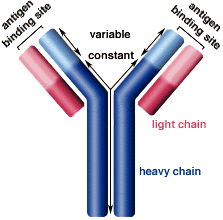
    These provisions were enacted in 1995, in the wake of the continued resistance of the U.S. Patent and Trademark Office to granting claims to methods it deemed obvious.  The analogy with the factual circumstances in KSR is important:  in KSR, the Supreme Court found obvious the replacement of an electronic component for a mechanical one, in part because this was the trend in the industry (moving from mechanical to electronic components).  The Patent Office grounds for finding biotechnology method claims obvious was, inter alia, that biotechnology products (genes or antibodies) were merely being substituted in art-recognized processes, and thus were obvious.  Passage of the statute overcame this problem; however, the Federal Circuit’s decisions in In re Brouwer and In re Ochiai, rendered shortly after § 103(b) went into effect, largely eliminated the need for its protections.

    Until now.  The protections provided by § 103(b) are not automatic, however, requiring an affirmative election to obtain the benefit.  They are also not absolute, requiring that the underlying biotechnology product be novel and non-obvious.  But the statute is quite broadly drafted with regard to the scope of the methods it encompasses.  These include methods for producing recombinant cells, organisms, and antibodies, and methods for affecting gene expression (including, for example, siRNA methods), as well as methods for using products produced by such processes. 

    Most importantly, the statute stands as a Congressional "thou shalt not" to any Court (or the Patent Office) that attempts to prevent the patenting of methods using a novel and non-obvious biotechnology product.  This protection may be once again necessary, in view of the "fuzzy" rubrics on obviousness contained in much of the Supreme Court’s dicta in KSR.  It provides what the Court is unwilling to:  a bright-line standard for determining non-obviousness for a specific type of claim.  And it provides some measure of comfort in the face of the present uncertainties about how the Patent Office will interpret and implement the Court’s uncertain calculus on obviousness.  For biotechnology method claims this may be the best that can be had, but it may just be enough.

    For additional information and commentary regarding the KSR decision, please see:

  •     By Sherri Oslick

    Gavel About
    Court Report:  Each week we will report briefly on recently filed
    biotech and pharma cases, and a few interesting cases will be selected
    for periodic monitoring.


    Purdue Pharma Products LP et. al. v. Par Pharmaceuticals Inc. et. al.

    1:07-cv-00255; filed May 9, 2007 in the District Court of Delaware

    Infringement of U.S. Patent No. 6,254,887 ("Controlled Release Tramadol," issued July 3, 2001) following a paragraph IV certification as part of Par's filing of an ANDA to manufacture a generic version of plaintiffs' Ultram® ER (tramadol hydrochloride, used to treat moderate to moderately severe chronic pain).  View the complaint here.


    Abbott Laboratories v. Teva Pharmaceuticals USA Inc.

    1:07-cv-00250; filed May 4, 2007 in the District Court of Delaware

    Infringement of U.S. Patent No. 6,419,953 ("Controlled Release Formulation of Divalproex Sodium," issued July 16, 2002) following a paragraph IV certification as part of Teva's filing of an ANDA to manufacture a generic version of Abbott's Depakote® ER (divalproex sodium, used to treat manic episodes associated with bipolar disorder).  View the complaint here.


    Bioglan Pharmaceuticals Corp. et. al. v. Novartis Consumer Health, Inc.

    2:07-cv-02075; filed May 3, 2007 in the District Court of New Jersey

    Infringement of U.S. Patent Nos. 5,852,002 ("Treatment of Conditions and Disease," issued December 22, 1998), 5,929,048 (same title, issued July 27, 1999), and 5,985,850 ("Compositions Comprising Hyaluronic Acid and Drugs," issued November 16, 1999) following a paragraph IV certification as part of Novartis' filing of an NDA (under § 505(b)(2) of the Food, Drug and Cosmetic Act) to manufacture a generic version of Bioglan's Solaraze® (diclofenac sodium, used to actinic keratosis).  View the complaint here.

  • Calendar May 17, 2007 – 2007 Corporate IP Conference (Law Bulletin Publishing Company) – Chicago, IL

    May 18, 2007 – "Obviousness in Patent Litigation: KSR International v. Teleflex" (IPLAC & JMLS) – Chicago, IL

    May 22, 2007 – "KSR International v. Teleflex: Supreme Court Radically Changes Test for Obviousness" (Strafford CLE Teleconferences)

    May 30, 2007 – "Patent Law After KSR v. Teleflex: Are Your Patents Still Valid?" (ABA CLE)

    May 31, 2007 – "Biotechnology and the Law: A Primer" – Part I (ABA CLE)

    June 7, 2007 – "Biotechnology and the Law: A Primer" – Part II (ABA CLE)

    June 26-28, 2007 – Euro-Biotech Forum 2007 – Paris, France

  • JMLS The Intellectual Property Law Association of Chicago (IPLAC) and The John Marshall Law School are co-sponsoring a panel discussion entitled: "Obviousness in Patent Litigation: KSR International v. Teleflex" to be held on May 18, 2007 from 12:00-2:00 PM (CST) at The John Marshall Law School in Chicago, Illinois.  The panel, which includes two District Court judges, two law professors, former law clerks from the Supreme Court and the Federal Circuit, experienced patent Iplac_2
    litigators, and patent prosecution lawyers, will examine the Supreme Court's decision in KSR Int'l Co. v. Teleflex, Inc. and discuss its ramifications.  Panelists include:

    • Hon. James F. Holderman, Chief Judge of the U.S. District Court for the Northern District of Illinois;
    • Hon. Matthew F. Kennelly, U.S. District Court for the Northern District of Illinois;
    • Meredith Martin Addy, Brinks Hofer Gilson & Lione;
    • Patrick G. Burns, Green Burns & Crain;
    • Bradford P. Lyerla, Marshall, Gerstein & Borun, LLP;
    • George P. McAndrews, McAndrews Held & Malloy;
    • Professor David L. Schwartz, The John Marshall Law School;
    • Professor Katherine Strandburg, DePaul University College of Law; and
    • Constantine L. Trela, Jr., Sidley Austin.

    Those interested in attending the panel discussion can reserve a spot by sending an e-mail to 6bridges@jmls.edu.  While there is no cost for attending the panel discussion, reservations are required.  More information regarding the panel discussion, and a form for securing CLE credit, can be found here.

  • ABA CLE The American Bar Association will be offering a two-part webcast entitled: "Biotechnology and the Law: A Primer."  Part I will be held on May 31, 2007 from 1:00-2:30 PM (EST), and Part II will be held on June 7, 2007 from 1:30-2:30 PM (EST).  The two-part webcast is based on the book "Biotechnology and the Law," which the webcast's speakers recently released.

    In Part I of the webcast, speakers Hugh B. Wellons of LeClair Ryan, Eileen Smith Ewing of K&L Gates, and William Wofford of the Hutchison Law Group will cover the fundamentals of corporate structure; address issues involved in starting up a biotech company, including staffing and the acquisition of intellectual property and financing; and discuss research, development, and collaborations.

    In Part II of the webcast, speakers Hugh B. Wellons of LeClair Ryan, Robert F. Copple of Copple & Associates, Erika Lietzan of Covington & Burling, and Christine C. Vito of K&L Gates will provide an overview of the regulatory approval process for pharmaceutical and biologic products, describe how patent prosecution and litigation impact the success or failure of a biotech company, and discuss strategies to help minimize and manage litigation risks.  Although Part II of the webcast will primarily focus on U.S. legal issues, the speakers will also touch on certain aspects of European and other foreign laws that can affect a biotech company's prospects for success.

    Those interested in registering for Part I, can do so here (individuals) or here (groups), and those interested in registering for Part II, can do so here (individuals) or here (groups).  The registration fee for each webcast ranges from $85 to $150.  Discounted rates are available for those interested in registering for both webcasts.