• By Kevin E. Noonan

    House of Representatives SealIt being the holiday season in America, it is perhaps appropriate that patent traditionalists get something more than coal in their stocking from Representatives Massie (R-KY), Gohmert (R-TX), Gosar (R-AZ), and McClintock (R-CA) in the form of H.R. 5874, the "Restoring America's Leadership in Innovation Act of 2021."

    The bill recites Congress's findings that the Leahy-Smith America Invents Act (along with "several decisions by the Supreme Court") have harmed the progress of Science and the useful Arts by eroding the strength and value of the patent system (Sec. 2).  In addition, this Findings section asserts that "a United States patent secures a private property right to an inventor."

    The Bill proposes to rectify the situation by restoring the U.S. patent system to be one that awards a patent to the "first to invent" (Sec. 3), complete with the one-year grace period and having the same definitions of the terms "in public use" and "on sale in this country" as they had before enactment of the AIA.  The justification for this change is a "sense of the Congress" that reverting to the prior standard would promote progress and enable inventors "once again to disclose inventions in order to attract investment, complete research and development on the invention, test, improve, and perfect the invention so as to improve the invention and the quality of the patent application."  The bill proposes to "restore sections 100, 102, 103, 135, and 291 of title 35, United States Code, to the way such sections read on the day before the date of the enactment of such Act."

    The bill also abolishes the inter partes and post-grant review provisions of the AIA (Sec. 4) and would abolish the Patent Trial and Appeal Board (Sec. 5).  The justifications for these changes are that the Congress senses that "inter partes review and post-grant review proceedings introduced by the Leahy-Smith America Invents Act have harmed the progress of science and the useful arts by subjecting inventors to serial challenges to patents" (Sec. 4(c)(1)); they "invalidate patents at an unreasonably high rate" (Sec. 4(c)(2)); and that "patent rights should be protected from unfair adjudication at the Patent and Trademark Office and duly issued patents should be adjudicated in a judicial proceeding" (Sec. 4(c)(3)).  Inter partes reexamination would not be restored.  The PTAB would be replaced by reinstitution of the Board of Patent Appeals and Interferences (BPAI); challenges to appointment of Administrative Patent Judges are provided in that the APJ is a "de facto officer."  Interferences would be resurrected as well.

    Section 6 provides that fee diversion would be eliminated and that the USPTO would be "full[y] funded."

    Section 7 provides for abrogation of the Supreme Court's recent jurisprudence regarding subject matter eligibility.  To that end, the bill provides a revision of Section 101 to read:

    (a) In General.—Whoever invents or discovers any new and useful process, machine, manufacture, or composition of matter, or any new and useful improvement thereof, may obtain a patent therefor, subject to the conditions and requirements of this title.

    (b) Exception.—A claimed invention is ineligible patent subject matter under subsection (a) if the claimed invention as a whole, as understood by a person having ordinary skill in the art, exists in nature independently of and prior to any human activity, or exists solely in the human mind.

    (c) Eligibility Standard.—The eligibility of a claimed invention under subsections (a) and (b) shall be determined without regard as to the requirements or conditions of sections 102, 103, and 112 of this title, or the claimed invention's inventive concept.

    The bill "effectively abrogates Alice Corp. v. CLS Bank International, 573 U.S. 208 (2014), Bilski v. Kappos, 561 U.S. 593 (2010), Association for Molecular Pathology v. Myriad Genetics, 569 U.S. 576 (2013), Mayo Collaborative Services v. Prometheus Laboratories, 566 U.S. 66 (2012), and its predecessors to ensure that life sciences discoveries, computer software, and similar inventions and discoveries are patentable, and that those patents are enforceable" (Sec. 7(b)(3)).

    Section 8 restores Section 102 of the Patent Act to its pre-AIA contours, except that a disclosure in a patent or patent application will not be considered prior art to the extent that it was derived, directly or indirectly, from the first inventor, or the invention was publicly disclosed by the inventor during the one-year grace period, or "the information disclosed and the claimed invention were owned by the same person or subject to an obligation to assign to the same person" (Sec. 8(b)(3)).

    Section 9 purports to restore a U.S. patent as a property right, proposing new Section 106 of the patent statute to read:

    § 106. Private property patent right

    A patent right is a private property right secured to an inventor upon issuance of the patent that shall only be revoked by a court ruling in a judicial proceeding, unless the patent owner consents to an administrative or other procedure.

    In addition, Section 261 is amended by replacing the phrase "patents shall have the attributes of personal property" with "patents shall be recognized as private property rights."  The Bill cites Oil States Energy Services v. Greene's Energy Group, 138 S. Ct. 1365 (2018), and Impression Products Inc. v. Lexmark International, Inc. (2017), as necessitating this change in statutory language.

    Section 10 ends automatic publication of pending U.S. patent applications and provides for publication only upon request of the Applicant.

    Section 11 provides for a presumption of validity that applies to each claim independently of any other and that dependent claims are to be presumed valid even if they depend from an invalid base claim.  The burden of proving any claim invalid is recited to be clear and convincing evidence.  Moreover, the Bill has a term tolling provision, wherein the term of a patent until expiry is tolled "from the time the validity of the patent is challenged to the time of resolution of the validity issue by the court" (Sec. 281(d)).

    Section 14 provides for a permanent injunction to a prevailing patentee, amending Sec. 283 to read:

    (b) Permanent Injunction.—

    (1) IN GENERAL.—Upon a finding of infringement of a patent, the court shall presume that further infringement of the patent would cause the patent owner irreparable harm.  This presumption may be overcome only by a showing of clear and convincing evidence by the infringing party that the patent owner would not be irreparably harmed by further infringement of the patent.  The patent owner is not required to make or sell a product covered by the patent to show irreparable harm.

    The sense of the Congress regarding this change is that it abrogates the Supreme Court's decision in eBay Inc. v. MercExchange, L.L.C., 547 U.S. 388 (2006).

    Finally, in Section 13, the amendments to Sec. 112(a) and any other change in the U.S. patent statute under Section 15 of the AIA are repealed, specifically the elimination of best mode as a defense.

    But like a belief in Santa Claus, passage of this bill is a pleasant (t'were pretty if t'were so) fantasy.  There is no evidence for any type of groundswell for reversing the excesses of the Leahy-Smith America Invents Act, and Senator Leahy is still serving in the Senate, is Chair of the Intellectual Property Subcommittee of the Senate Judiciary Committee, and a vocal supporter of his handiwork (see "Statement of Senator Patrick Leahy, Chair, Intellectual Property Subcommittee, on the Supreme Court's Decision in Arthrex").  Whatever analogy you prefer (snowballs in hell, camels passing through the eye of a needle), it is hard to see this decidedly non-bipartisan bill being anything other than a feel-good present from these Representatives to those members of the patent community who abhor the consequences of the AIA's enactment.
  • By Kevin E. Noonan

    Federal Circuit SealThe question of the proper court for a branded pharmaceutical maker to bring suit against an Abbreviated New Drug Application filer under the Hatch-Waxman Act is surprisingly unsettled seeing as the Act was enacted in 1984.  The Federal Circuit brought some measure of clarity to the question recently when it affirmed a District Court dismissal of an ANDA action on improper venue grounds, in Celgene Corp. v. Mylan Pharmaceuticals Inc.

    The case arose over Celgene's multiple-myeloma drug pomalidomide (Pomalyst).  Celgene filed suit in the District of New Jersey, where none of the named defendants (Mylan Pharmaceuticals Inc. (MPI), Mylan Inc., or Mylan N.V.) have their headquarters.  These actions involved separate ANDA litigations initiated by Celgene in response to the Mylan defendants' Paragraph IV certifications (21 U.S.C. § 355(j)(2)(A)(vii)(IV)).  The first of these litigations commenced in 2017 involving four Orange Book-listed patents, the second in 2018 involving one of a separate five OB-listed patents and the third action commencing in 2020 involving yet another of the five separate OB-listed patents.  All these actions were consolidated.  Celgene also asserted the remaining three of the five separate OB-listed patents in an action commenced in 2019; it is this last case on appeal here.  The relevance of these other litigations is that the parties stipulated that the District Court's decision on Rule 12 motions in the earlier cases would be binding on them in this case.  The District Court's decision dismissing the action for improper venue was based on the Federal Circuit's holding in In re Cray, that to satisfy the venue statute (28 U.S.C. § 1400(b)) a plaintiff must show the defendant had "committed acts of infringement and has regular and established place of business" in the district.  (Celgene did not appeal on the merits the District Court's ruling that they had failed to state a claim against Mylan N.V. under Fed. R. Civ. Pro. 12(b)(6) on the basis that the ANDA had been filed only in the name of MPI, but rather argued the adequacy of its pleadings and that the District Court had abused its discretion in denying Celgene's motion for leave to amend its complaint, as discussed below.)

    The Federal Circuit affirmed, in an opinion by Judge Prost joined by Judges Chen and Hughes.  The opinion recites the plaintiff's burden to show that a defendant "resides" in the district or "has committed acts of infringement and has a regular and established place of business" there.  The first option is clearly not satisfied, according to the Court ("No one argues that the defendants-appellees reside in New Jersey").  The questions then devolved into whether the defendants committed acts of infringement in the district and had a regular and established place of business in New Jersey.  The basis for Celgene's infringement action was that filing an ANDA itself constitutes an act of infringement under 35 U.S.C. § 271(e)(2) and that this was sufficient for proper venue.  The panel rejected Celgene's argument that this act has a nationwide consequence and effect and thus the effects will be "felt" in New Jersey.  Unfortunately for Celgene, venue is "predicated on past acts of infringement" under Valeant Pharms. N. Am. LLC v. Mylan Pharms. Inc., 978 F.3d 1374, 1381–82 (Fed. Cir. 2020), and thus this argument was precluded according to the Court.  (The opinion further recites that Supreme Court precedent requires venue determinations to be "specific and unambiguous" and not "given a liberal construction," citing Andra Grp., LP v. Victoria's Secret Stores, L.L.C., 6 F.4th 1283, 1287 (Fed. Cir. 2021).)  Moreover, submission of an ANDA does not occur in New Jersey, nor does the destination of the Paragraph IV letter (Celgene's New Jersey headquarters) make venue proper as an act of infringement in the district according to the opinion.  Citing Valeant, the opinion limits the act of infringement under § 271(e)(2) to be the ANDA submission itself, which does not occur in the district.  And while the Paragraph IV letter is a necessary part of the ANDA process, the panel stated that "the statute and regulations treat the infringing ANDA submission and the notice letter as different things," in part based on timing of filing the ANDA followed by sending the notice letter to the NDA holder (and not the FDA) in rejecting Celgene's argument (also noting that it is the ANDA filing that raises a cause of action not the notice letter).

    Next the Court turned to the question of whether MPI and Mylan had a "regular and established place of business" in the district, concluding (as had the District Court) that they did not.  The opinion cites the Federal Circuit's Cray decision for the requirements that "(1) there must be a physical place in the district; (2) it must be a regular and established place of business; and (3) it must be the place of the defendant" and notes that the absence of any of these requirements fails to satisfy the standard.  The panel found the third requirement to be "particularly relevant," to the extent that it is not limited to places where a defendant's employee happen to be located.  Resorting once again to Cray, the opinion recites the four "non-exhaustive relevant factors, specifically"

    (1) "whether the defendant owns or leases the place, or exercises other attributes of possession or control over the place"; (2) "whether the defendant conditioned employment on" "an employee's continued residence in the district" or "the storing of materials at a place in the district so that they can be distributed or sold from that place"; (3) "a defendant's representations" about that place, including advertisements; and (4) "the nature and activity of the alleged place of business of the defendant in the district in comparison with that of other places of business of the defendant in other venues."

    The opinion recognizes that no party has argued that either MPI or Mylan Inc. have a physical presence in New Jersey.  Rather, Celgene relied on New Jersey as being the situs of "places associated with Mylan employees" or "places associated with Mylan affiliates."  For the former, the Court noted the distinction between an employee "owning or leasing" a place of business and a defendant doing so, stating that the former does not support proper venue (it also being significant to the extent the opinion mentions it that "MPI and Mylan Inc. have tens of thousands of employees.  Seventeen live in New Jersey.").  Defendants rebutted this Celgene argument by noting that none of these employees were required by MPI or Mylan Inc. to live in New Jersey, nor did the companies pay for these homes nor store materials there or provide support staff there.  Nor said the Court was there any evidence that MPI or Mylan identified these residences as places of their business (and the evidence that they in fact may be is "too speculative" to establish the residences as places where MPI or Mylan business is conducted).  Nor did job postings "asking that candidates live in New Jersey or 'within reasonable driving distance'" suffice according to the panel.  In these regards the Court saw a clear parallel with the factual predicate in Cray, the opinion drawing those similarities expressly.  The panel also rejected Celgene's assertion that a "now-defunct" related corporate entity, Mylan Laboratories Inc., had once had a physical presence in New Jersey, agreeing with the District Court that Celgene had not established that "a subsidiary's presence isn't imputed to a parent for venue unless the parties 'disregarded the corporate form in their dealings with their respective subsidiaries and affiliates,'" which Celgene had not shown was the case here.  Nor was Celgene's assertion that venue should be proper on a corporate "alter ego" theory that would justify piercing the corporate veil any more persuasive before the Federal Circuit than it had been before the District Court.

    Having dispensed with the venue question, the Court next addressed an issue of sufficiency of the pleadings in the District Court's dismissal of Celgene's complaint against Mylan N.V. On the Rule 12(b)(6) question, the panel found persuasive, in reviewing the decision de novo, that MPI and not Mylan N.V. had signed the ANDA and that MPI had not acted as Mylan N.V.'s corporate alter ego (as had the District Court).  In coming to this conclusion, the Court relied heavily on the procedural principles underlying the Supreme Court's decisions in Ashcroft v. Iqbal, 556 U.S. 662, 678 (2009), and Bell Atl. Corp. v. Twombly, 550 U.S. 544, 570 (2007), regarding Celgene's failure to establish either ground for Mylan N.V.'s liability based on assertion of insufficient facts.  The opinion summarizes Celgene's asserted litany of possible liability-inducing facts as being "too conclusory" and "[j]ust not enough."  The Court expressly rejected Celgene's attempt to analogize the situation in this case with that in In re Rosuvastatin Calcium Pat. Litig., 703 F.3d 511 (Fed. Cir. 2012), where, according to the opinion, "the entity that signed the ANDA sought to escape liability because it claimed that it was only filing the ANDA as the agent of a Canadian company" (emphasis on opinion).  In this case all that Celgene had asserted was "unadorned suspicion" of defendants "working in concert" for an ANDA where only MPI submitted the ANDA in question.

    On the leave-to-amend question, the Court held the District Court had not abused its discretion on the facts before them.  In addition, the opinion states that Celgene had not complied with the District Court's local rules (based on a deadline for filing amendments to the complaint).  Celgene unsuccessfully argued that the District Court applied the wrong deadline based on a difference in such deadlines in other related cases as set forth above.  Unfortunately for Celgene, however, the parties had stipulated that resolution of Rule 12 motions in this case would be governed by the decision in the earlier case, and the Federal Circuit applied this stipulation to the question before it under Rule 15.  And further, the opinion notes that Celgene had not made this argument before the District Court, further dooming its efforts before the Federal Circuit.

    The Court's precedential decision establishes the principle that a notice letter under Paragraph IV cannot form the basis for establishing venue and reinforces the primacy of the principles enunciated in Cray in patent venue cases, here as applied in ANDA cases.  For those reasons alone the decision is a significant advance in certainty regarding the requirements for establishing venue.

    Celgene Corp. v. Mylan Pharmaceuticals Inc. (Fed. Cir. 2021)
    Panel: Circuit Judges Prost, Chen, and Hughes
    Opinion by Circuit Judge Prost

  • By Kevin E. Noonan

    FDAIn September, the U.S. Food and Drug Administration issued Final Guidance entitled "Questions and Answers on Biosimilar Development and the BPCI Act: Guidance for Industry," and Draft Guidance entitled "New and Revised Draft Q&As on Biosimilar Development and the BPCI Act (Revision 2)."

    The Final Guidance provides its Answers in final form, having been subject to the notice and comment requirements for FDA Guidances and originally promulgated as Questions and Answers on Biosimilar Development and the BPCI Act (April 2015) and New and Revised Draft Q&As on Biosimilar Development and the BPCI Act (Revision 2) (December 2018).  The Answers are classified into three groups:  biosimilarity or interchangeability; provisions related to the requirement to submit a BLA for a "biological product"; and exclusivity.

    The Answers in the initial section of this Final Guidance on Biosimilarity or Interchangeability track the draft Guidance, involving sources of information regarding development programs for both biosimilar and interchangeable products (Question I.1), meetings with FDA (Q.I.2), formulation, delivery device or container differences (which "may be acceptable"; Q.I.3 and Q.I.4), and licensure for fewer than all administration routes, "presentations," or conditions of use (yes to all; Q.I.5, Q.I.6, and Q.I.7).  Further Final Answers provide an extensive discussion of use of comparative animal or clinical data for non-U.S-licensed products (with a series of potential issues to be addressed and factors to be considered; Q.I.8), and specific answers on drug-drug interactions and cardiac delay studies (which may need to be addressed to the extent they were relevant to the reference product; Q.I.9).  The Guidance also describes "how long and in what manner" samples of biological products should be retained in comparative clinical PK/PD studies (Q.I.10) and what is to be considered "publicly available information" regarding the information used to establish that a reference product is "safe, pure, and potent" and included in a 351(k) application (Q.I.13).  Further subject to Final Answer status are the requirements for dosage forms for injectable biosimilars (distinguishing between an "injection" meaning in liquid form and "for injection" meaning a lyophilized powder; Q.I.18), the requirements for importing non-U.S.-licensed product for bridge studies (and whether a separate IND is required; Q.I.19), and the "nature and type of information" needed related to post-approval manufacturing changes for a licensed biosimilar product (Q.I.20).

    In addition to these more general Questions, the Guidance includes Final Answers on requirements under the Pediatric Research Equity Act (Q.I.15, Q.I.16, and Q.I.17), and to the question of whether a biosimilar applicant can seek approval for an indication wherein the reference product has unexpired orphan exclusivities (Q.I.24) (and in this regard the Guidance in the Exclusivity section provides information for how a biosimilar applicant can determine whether a reference produce has any such unexpired orphan exclusivity by reference to FDA's Orphan Drug Product database; see "Search Orphan Drug Designations and Approvals"; Q.III.2).

    Questions receiving a negative final answer include whether a biosimilar applicant can seek approval for an administration route, dosage form, or strength different from the reference product (Q.I.21) or a condition of use (Q.I.22).

    Some questions did not receive final determinations; these include Q.I.11 (which had been withdrawn with a reference to Guidance entitled "Scientific Considerations in Demonstrating Biosimilarity to a Reference Product"); Q.I.12, which was published in "New and Revised Draft Q&As on Biosimilar Development and the BPCI Act (Revision 3)" (see below); and Q.I.23, which has been withdrawn with no further comment nor explanation.  And some Questions have been superseded by other Guidances, such as the standards for establishing interchangeability (Q.I.14) (see "FDA Issues Final Guidance Regarding Biosimilar Interchangeability").

    In Section II regarding questions relating to requirements for submitting a Biologic License Application for a biological product, the Guidance provides clarification concerning what FDA will consider the same product class (Q.II.2).  For antibody-drug conjugates, the Guidance directs these compounds be submitted as a BLA (Q.II.3), citing section 503(g) of the FD&C Act, Transfer of Therapeutic Biological Products to the Center for Drug Evaluation and Research (June 30, 2003), available here; and Intercenter Agreement Between the Center for Drug Evaluation and Research and the Center for Biologics Evaluation and Research (October 31, 1991), available here.  Question Q.II.1 was withdrawn regarding the meaning of the term "protein" during the transition period for drugs approved prior to March 23, 2010.

    The final section of the Guidance concerns Exclusivity and permits an applicant for a BLA under section 351(a) to apply for reference product exclusivity under section 351(k)(7) (Q.III.1).

    Despite being a "Final" Guidance, this one contains two Notices, the first surrounded by a black box stating:

    This guidance represents the current thinking of the Food and Drug Administration (FDA or Agency) on this topic.  It does not establish any rights for any person and is not binding on FDA or the public.  You can use an alternative approach if it satisfies the requirements of the applicable statutes and regulations.  To discuss an alternative approach, contact the FDA office responsible for this guidance as listed on the title page.

    Second, each page of the Guidance contains the label that it "Contains Nonbinding Recommendations." 

    Issued on the same day, the FDA provided a Draft Guidance (see above) that is limited to Question 12 from the Final Guidance and having an Answer to this Question:

    Q.I.12      How can an applicant demonstrate that its proposed injectable biosimilar 145 product or proposed injectable interchangeable product has the same 146 "strength" as the reference product? (repeated from the December 2018 Guidance)

    The Answer cites Section 351(k)(2)(A)(i)(IV) to the effect that a biosimilar applicant must demonstrate that the "strength" of a proposed biosimilar (or interchangeable) product is the same as the reference biologic product, based on data, and analytical similarity assessment.  As in many prior Guidances, this one counsels that an applicant should discuss their approach with FDA prior to implementing it and provide an "adequate scientific basis" for their approach.

    Specifically with regard to an injection-based product, the Guidance counsels comparison for "the same total content of drug substance" and "the same concentration of drug substance."  Biosimilar drug products provided as bulk solids should contain information on the concentration of drug when constituted or reconstituted as an injection and that it is the same as for the reference biologic drug product.

    As with other draft Guidances, this one contains the statement (surrounded by a black box) that:

    This draft guidance, when finalized, will represent the current thinking of the Food and Drug Administration (FDA or Agency) on this topic.  It does not establish any rights for any person and is not binding on FDA or the public.  You can use an alternative approach if it satisfies the requirements of the applicable statutes and regulations.  To discuss an alternative approach, contact the FDA staff responsible for this guidance as listed on the title page.

    And like the Final version of the Q&As, each page of the Guidance contains the label that it "Contains Nonbinding Recommendations."

  • CalendarNovember 8, 2021 – "Legal Ethics: Securing Email and Messaging" (Oppedahl Patent Law Firm LLC) – 3:00 to 4:40 pm (Mountain Time)

    November 9, 2021 – "Patent Pools & SEP Licensing: Shifting Trends & Industry Tensions" (IPWatchdog) -11:00 am (EST)

    November 9-10, 2021 – Paragraph IV Disputes Conference (American Conference Institute) – 8:00 am until 6:00 pm (EST) on November 9 and 7:50 am until 5:15 pm (EST) on November 10, 2021

    November 10, 2021 – "Post-Grant Attacks on Patents: Understanding the Benefits and Perils of All Options" (Intellectual Property Owners Association) – 2:00 pm to 3:00 pm (ET)

    November 10, 2021 – "Accepting the Status Quo: Subject Matter Eligibility Nearly a Decade after Mayo" (Biotechnology Innovation Organization IP Counsels Committee) – 3:00 pm (EDT)

  • Biotechnology Industry OrganizationThe Biotechnology Innovation Organization IP Counsels Committee will be offering the next installment in its webinar series on November 10, 2021 at 3:00 pm (EDT).  In the webinar, entitled "Accepting the Status Quo: Subject Matter Eligibility Nearly a Decade after Mayo," Kevin Noonan and Donald Zuhn Jr. of McDonnell Boehnen Hulbert & Berghoff LLP will moderate a panel consisting of Cara Coburn of Genentech, June Cohan of the U.S. Patent & Trademark Office, and Derek Maetzold of Castle Biosciences, Inc.  The panel will discuss how almost a decade after the Supreme Court's decision in Mayo v. Prometheus, the current subject matter eligibility standard has become the status quo with little prospect for change.  The panel will also discuss how innovators can best protect their technology under these circumstances, how subject matter jurisprudence has impacted the patent process, and whether incremental changes could improve the situation.

    The webinar is complimentary for BIO members and $99 for non-members.  Those interested in registering for the program, can do so here.

  • Oppedahl Patent Law Firm LLC will be offering a webinar entitled "Legal Ethics: Securing Email and Messaging" on November 8, 2021 from 3:00 to 4:40 pm (Mountain Time).  Carl Oppedahl of Oppedahl Patent Law Firm LLC will address what steps can be easily taken to greatly improve security of email communications, how some VOIP phone lines are vastly more secure than others and are much more secure than ordinary landline telephones or ordinary mobile phones, and which messaging services are much more secure than others.

    The registration fee for the webcast is $49.  Those interested in registering for the webinar, can do so here.

  • IPWatchdogIPWatchdog will be offering a webinar entitled "Patent Pools & SEP Licensing: Shifting Trends & Industry Tensions" on November 9, 2021 at 11:00 am (EST).  Matthias Schneider of AUDI AG, Mattia Fogliacco of Sisvel Group, Taraneh Maghamé of Via Licensing Corporation, Hasan Rashid of GE, and Gene Quinn of IPWatchdog, Inc. will discuss:

    • The role of patent pools in the SEP licensing ecosystem
    • Are patent pools appropriate for non-traditional SEP verticals?
    • Are patent pools win-win from innovators and implementers?
    • The intersection of patent licensing and antitrust enforcement

    There is no registration fee for this webinar.  However, those interested in registering for the webinar, should do so here.

  • IPO #2The Intellectual Property Owners Association (IPO) will offer a one-hour webinar entitled "Post-Grant Attacks on Patents: Understanding the Benefits and Perils of All Options" on November 10, 2021 from 2:00 pm to 3:00 pm (ET).  In the second installment of a three part series, Emily Johnson of Amgen, Inc., Jay Tatachar of Ericsson, Vaishali Udupa of Hewlett Packard Enterprise, Todd Walters of Buchanan Ingersoll & Rooney PC, and Jenifer Ward General Electric Co. will discuss the pros and cons of the various options for challenging the validity of patent claims, giving perspectives from both challenger and patent owner, and highlight strategic considerations of practice and procedure before the PTAB, district courts, and the ITC.  Key topics to be addressed by the panel will include the overall landscape, success rates, costs, timing considerations, presumptions and burdens, and estoppel.

    The registration fee for the webinar is $150 for non-members or free for IPO members (government and academic rates are available upon request).  Those interested in registering for the webinar can do so here.

  • By Donald Zuhn

    U.S. Chamber of CommerceIn a letter sent to U.S. Trade Representative Katherine Tai last week, the U.S. Chamber of Commerce expressed disappointment that the Biden Administration "continues to entertain actions, such as a waiver of the TRIPS Agreement, that would undermine the pandemic response."  The Chamber instead urged the Administration "to double down on efforts to distribute vaccines globally."

    The Chamber sent its letter to the U.S. Trade Representative in advance of the 12th Ministerial Conference (MC12), which will take place from November 30 to December 3, 2021 in Geneva, Switzerland (the Ministerial Conference is the top decision making body of the World Trade Organization (WTO)), noting that the MC12 "will be an inflection point for global pandemic response, the rules-based multilateral trading system, and international IP."  In its letter, the Chamber "strongly urge[s]" the Administration at the MC12 "to herald the tremendous success of the U.S. and international innovation ecosystem that continues to produce technological solutions to the technical problems of the COVID-19 pandemic."

    According to the Chamber, "the appropriate solutions to continued effective pandemic response do not include weaker IP," but instead should focus on three objectives:

    1. Return to health: accelerate supplies through safe and effective manufacture and licensing of vaccines and other medical technologies; 2. Return to Growth: ensure we continue to foster innovation (across the board); and 3. Prepare for the ongoing vaccination needs and the next pandemic, especially in least developed economies –- through effective and lasting solutions to national infrastructure for healthcare delivery and remove supply chain and regulatory barriers, not false solutions like IP waivers.

    In its letter, the Chamber contends that "the United States found itself nearly uniquely positioned to provide durable and unprecedented answers to the problems posed by a novel coronavirus" as a result of "the strength of our IP framework and substantial contributions from the public sector, private sector and academic institutions whose work it supports."  The Chamber points out that since the start of the pandemic, COVID-19 vaccine manufacturing has risen to 1.6 billion doses per month, 9.3 billion doses so far in 2021, and a projected 24 billion doses by the end of June 2022, and states that "[t]his explosive growth in global vaccine production confirms that IP was not an impediment to vaccine discovery, development, or production at a scale to serve the world."

    The Chamber's letter argues that:

    [I]n those nations around the world where IP rights and private contracts are adequately protected by law, hundreds of IP licensing partnerships are driving the successful testing and production of both vaccines and therapies to meet the ever-shifting challenges of the pandemic.  Should we move from a cooperative, voluntary licensing arrangements to a compulsory, forced technology transfer environment, it would risk diverting scar[c]e inputs to startup facilities ill-prepared to use them efficiently or quickly.

    In concluding its letter by opposing the Administration's support of a COVID-19-related TRIPS Agreement waiver, the Chamber declares that:

    U.S. support for even a limited cessation of TRIPS standards will have an immediate dampening effect on the ability of the private sector to finance research and development, and a chilling long-term impact on U.S. technological leadership (in biotechnology, green technology, defense and other key sectors), all while providing formal impunity to IP theft by Chinese entities and other serial offenders.

  • By Kevin E. Noonan

    On May 28th, Junior Party the Broad Institute, Harvard University, and MIT (collectively, "Broad") filed its Substantive Preliminary Motion No. 1 in CRISPR Interference No. 106,126, where ToolGen is the Senior Party.  On August 6th, ToolGen filed its Opposition and on September 24th Broad filed its Reply.

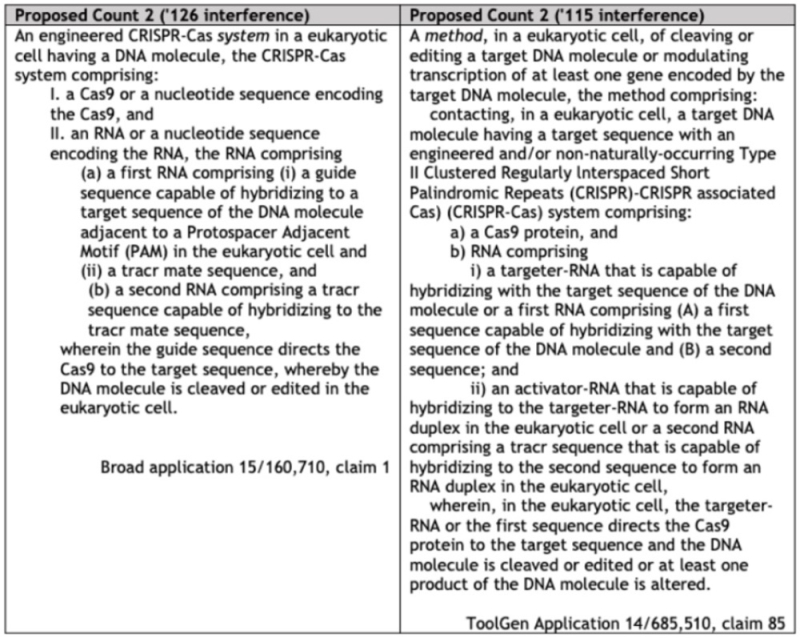
    Broad's Motion sought to substitute the Count; Broad's Proposed Count 2 is shown in comparison to the Count in the interference as declared below:

    Table
    Broad's argument (the consequences of which are discussed below) was that their "best proofs" are better represented in Proposed Count 2, which encompasses dual-molecule guide RNA CRISPR embodiments rather than being limited to single-molecule guide RNA (sgRNA) species.

    ToolGen argued in its Opposition that the Board should deny Broad's motion first, because Broad has neither established nor argued that dual-and single-molecule eukaryotic CRISPR is the same patentable invention, and second, that Broad's proposed Count 2 "does not define the common claimed subject matter [because] all of ToolGen's involved claims are limited to single-molecule RNA" species (emphasis in brief).  As to the first argument, ToolGen contended that there is a distinction to be made between Broad's position that dual- and single-molecule CRISPR embodiments are "alternative approaches" to eukaryotic CRISPR and that they are the same invention, which ToolGen asserted they are.  Presciently, ToolGen argued that "Broad cannot attempt to make that showing for the first time in its reply," citing Nau v. Ohuchida, Int. No. 104,258, 9 Paper 57, at *4 (B.P.A.I. 1999), regarding making the argument that a dual-molecule eukaryotic CRISPR system would be prima facie obvious over single-molecule embodiments, under Spine v. Biedermann Motech GmbH, 684 F. 18 Supp. 2d 68, 89 (D.D.C. 2010).  And in this regard ToolGen argued that Broad had not established that Broad has best proofs that would be best adjudged for priority under Proposed Count 2.

    ToolGen also argued that proposed Count 2 is broader than the common claimed invention between the parties because, as instituted by the Board, existing Count 1 is limited to single-molecule RNA embodiments of eukaryotic CRISPR and that common claimed subject matter is what defines an interference, citing Beech Aircraft Corp. v. Edo Corp., 990 F.2d 1237, 1248–49, and Louis v. Okada, 59 22 U.S.P.Q.2d 1073, 2001 WL 775529 at*4 (B.P.A.I. 2001).

    In its Reply, Broad sets forth clearly its strategic focus in making its Preliminary Motion No. 1 and the consequences of the Board granting the motion.  According to Broad's brief:

    Broad's proffered best proofs are—as ToolGen's expert now admits—directed to dual3 molecule RNA work.  These proofs underlie, inter alia, Broad's generic molecule RNA claims at issue in this Interference.  Accordingly, the PTAB should adopt Proposed Count 2, a Count broad enough to include Broad's best proofs.  See Grose v. Plank, 15 U.S.P.Q.2d 1338, 1341 (B.P.A.I. 1990) (allowing a party to rely on its best proofs of priority "is an accepted reason in interference practice for granting" a motion to modify the count).

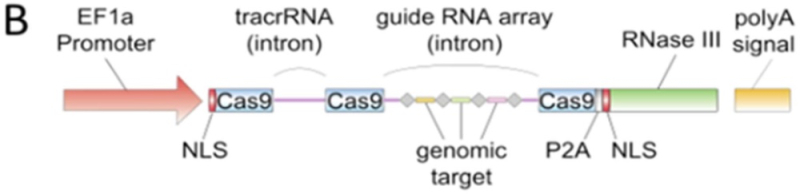
    Broad illustrates these "best proofs" by two examples from the record.  The first comes from Inventor Zhang's January 12, 2012 NIH grant application describing this vector to be used in practicing eukaryotic CRISPR:

    Image 1
    (It should be remembered that grant applications, unlike patent applications, are under no burden of showing that a proposed research plan has been used, successfully or otherwise, and that many research proposals describe work to be performed using the monies applied for in the grant.)

    The second example of best proofs also comes from that grant proposal, this one showing the expected products of the vector disclosed in the previous figure:

    Image 2
    Broad's brief argues that under interference practice a party is permitted to move (and the Board can grant such a motion) to change the Count under circumstances where their best proofs are better accommodated by the changed Count.  Many of Broad's arguments intended to counter ToolGen's opposition recite the absence of a rule against substituting the Count in this instance.  For example, Broad argues that:

    The rules do not require a proposed count to be directed to the same patentable invention as the original count.  See Board Rule 41.208(c)(2).  None of the cases cited by ToolGen at 2:6-18 require a showing that the proposed count is the same patentable invention as the original one.  Indeed, the Standing Order, consistent with the cited cases, contradicts ToolGen's position—it does not recite any rule that a proposed count must be directed to the same patentable invention as the original count.  Paper 2 at ¶ 208.

    Broad counters ToolGen's citation of Theeuwes v. Bogentoft, 2 U.S.P.Q.2d (BNA) 1378, 1379 (Comm'r Pat. & Trademarks December 11, 1986) for what is required to show that Proposed Count 2 is the same invention by asserting that "claimed generic RNA genus of Proposed Count 2 would be anticipated by the Count 1 species claim limited to single-molecule RNA."  Indeed, the fact that Proposed Count 2 recites CRISPR generically as regards the nature of the guide RNA is the major theme of their Reply, Broad stating that "even if the proposed count needed to be directed to the same patentable invention as the original count, the relevant question would be whether a generic RNA genus is directed to the same invention as the single-molecule RNA species" because "it is"; Broad supports this argument by the Board's designating their generic CRISPR claims as corresponding to Count 1 in the Declaration (which designation ToolGen has adopted in its Opposition to Broad's Preliminary Motion No. 3 to have these claims de-designated).

    The Reply also notes that the manuscript for the scientific paper that was ultimately published as the Le Cong et al. 2013 reference was submitted in October 5, 2012, which antedates (for the purposes of Broad's Motion) the earliest filing date according by the Board to ToolGen in its Interference Declaration, which Broad contends are relevant under Byrn v. Aronhime, Patent Interference 105,384 (McK), Paper 64, at 11:17 (P.T.A.B. Sept. 20, 2006).

    Outside these substantive arguments, Broad's brief sets forth its procedural justifications under the Rules and relevant case law that would permit the Board to grant its motion.  And Broad argues that ToolGen is asking the Board to unfairly consider priority to its generic guide RNA-encompassing CRISPR claims in this interference while not permitting its "best proofs" regarding species outside the scope of Interference Count 1.  Finally, the Reply sets forth specific rebuttals to ToolGen's arguments with regard to correspondence between Broad's claims and Proposed Count 2 regarding vector delivery, SaCas9, the use of two or more nuclear localization signals (NLS), and Cas9 fusion to heterologous protein domains.

    The Board's consideration of Broad's Preliminary Motion No. 1 raises an interesting possibility.  If it is indeed the case that eukaryotic CRISPR was only (and could only) be achieved using single guide RNA embodiments (as CVC has argued in this and its pending interference with Broad (No. 106,115); see "CVC Files Motion in Opposition to Broad Priority Motion") then Broad has fashioned a way to provide its "best proofs" with regard to dual-molecule CRISPR embodiments to establish an earlier conception date even though those embodiments would not have satisfied the enablement requirement for the claimed CRISPR methods.  Interestingly, in its priority motion in the '115 interference, Broad asserted an earliest reduction-to-practice date of July 20, 2012 (wherein that embodiment involved the use of sgRNA in eukaryotic CRISPR).  While this may reflect merely a parsimonious approach towards asserting just enough to satisfy what was required to have an earlier priority fate than CVC in that interference, CVC had asserted an earlier conception date (March 2012) that Broad's purported best proofs" would antedate.  While there is nothing untoward about Broad asking the Board to change the Count to accommodate these proofs, it does raise the possibility that the arcane mechanisms of interference practice could result in what can conservatively be called an anomalous result.