• By Donald Zuhn –-

    FireworksAfter reflecting upon the events of the past twelve months, Patent Docs presents its 15th annual list of top patent stories.  For 2021, we identified nine stories that were covered on Patent Docs last year that we believe had (or are likely to have) a significant impact on patent practitioners and applicants.  Today, we count down stories #9 to #7, and later this week we will count down the top six stories of 2021.  As with our other lists (2020, 2019, 2018, 2017, 2016, 2015, 2014, 2013, 2012, 2011, 2010, 2009, 2008, and 2007), links to our coverage of these stories (as well as a few links to articles on related topics) have been provided in case you missed the articles the first time around or wish to go back and have another look.  As always, we love to hear from Patent Docs readers, so if you think we left something off the list or disagree with anything we included, please let us know.  In addition, we will be offering a live webinar on the "Top Patent Law Stories of 2021" on January 19, 2022 from 10:00 am to 11:15 am (CT).  Details regarding the webinar, which will focus on a few of the most important stories on this year's list, can be found here.

    9.  FDA Approves First Interchangeable Biosimilars

    In August, the U.S. Food and Drug Administration approved an interchangeable biosimilar to insulin glargine, an approval that was notable because it was the first approved interchangeable biosimilar product under the Biological Price Competition and Innovation Act of 2009 (BPCIA), enacted with the Affordable Care Act (commonly known as "Obamacare").  The approved interchangeable product is Semglee (insulin glargine-yfgn), produced by Mylan Pharmaceuticals, Inc., and under this approval, it is interchangeable with Lantus (insulin glargine) made by Sanofi.  While there has been some concern with the perceived slow pace of biosimilar uptake by physicians and patients, one of the benefits of interchangeability is that physicians' input (and approval) is not needed and can be implemented at the pharmacy level.  The approval of Semglee was followed by the approval a few weeks later of the interchangeable biosimilar drug Cyltezo (adalimumab-adbm), which is produced by Boehringer Ingelheim.  Whether a dam-burst of interchangeable biosimilar drug products will now arise remains to be seen.

    For information regarding this and other related topics, please see:

    • "FDA Issues Final and Draft Guidances on Biosimilar Development under BPCIA," November 7, 2021
    • "FDA Approves Another Interchangeable Biosimilar Drug," October 21, 2021
    • "FDA Approves Biosimilar Drug for Treating Macular Degeneration," September 20, 2021
    • "FDA Approves First Interchangeable Biological Product," August 5, 2021

    8.  CRISPR Interference(s) Move Forward

    Six years ago, the journal Science picked the CRISPR (clustered regularly interspaced short palindromic repeats) technology as its "Breakthrough of the Year," declaring that the technology had "matured into a molecular marvel."  Not surprisingly, CRISPR's status as breakthrough molecular marvel has resulted in a battle over who has the best patent position with respect to this technology.  And despite the continuing pandemic, Interference No. 106,115 between the Broad Institute, Harvard University, and the Massachusetts Institute of Technology (as Senior Party) and the University of California/Berkeley, the University of Vienna, and Emmanuelle Charpentier (as Junior Party) continued to move forward in 2021 with the two Parties presenting various motions and oppositions to those motions.

    Meanwhile, in February the U.S. Patent and Trademark Office Patent Trial and Appeal Board declared two additional interferences between Toolgen as Senior Party and the parties in Interference No. 106,115 as Junior Parties.  And then in June the Board declared two more interferences naming Sigma-Aldrich as Senior Party and the parties in Interference No. 106,115 as Junior Parties.  CRISPR interferences have now made four of our last five top stories lists, and with five pending interferences, the dispute over the protection of this technology could very well be on next year's list as well.

    For information regarding this and other related topics, please see:

    • "PTAB Sets Motions and Times in CVC vs. Sigma Interference No. 106,132," December 28, 2021
    • "PTAB Sets Motions and Times in Broad vs. Sigma Interference No. 106,133," December 26, 2021
    • "Sigma-Aldrich and CVC Propose Preliminary Motions in CRISPR Interference No. 106,132," December 19, 2021
    • "Sigma-Aldrich and Broad Propose Preliminary Motions in Recent CRISPR Interference No. 106,133," December 15, 2021
    • "Sigma-Aldrich Joins the CRISPR Interference Fray," December 13, 2021
    • "Inequitable Conduct by Senior Party Broad Alleged in Interference No. 106,115 (and PTAB May Finally Hear Evidence About It)," December 6, 2021
    • "SNIPR Technologies Ltd. v. The Rockefeller University (PTAB 2021)," December 6, 2021
    • "ToolGen Files Motion to Exclude Evidence, Broad Opposes, and ToolGen Replies in Interference No. 106,126," November 23, 2021
    • "ToolGen Files Motion to Exclude Evidence, CVC Opposes, and ToolGen Replies in Interference No. 106,127," November 21, 2021
    • "CVC Files Motion to Exclude Evidence, ToolGen Opposes, and CVC Replies in Interference No. 106,126," November 18, 2021
    • "Broad Files Reply to ToolGen Opposition to Broad Preliminary Motion No. 1," November 1, 2021
    • "Broad Files Reply to ToolGen's Opposition to Broad's Preliminary Motion No. 3," October 24, 2021
    • "CVC Files Reply to ToolGen's Opposition to CVC's Substantive Preliminary Motion No. 2," October 20, 2021
    • "Broad Files Reply to ToolGen Opposition to Broad's Contingent Preliminary Motion No. 2," October 18, 2021
    • "ToolGen Reply to Broad Opposition to ToolGen Preliminary Motion No. 1," October 12, 2021
    • "CVC Files Reply to ToolGen's Opposition to CVC Preliminary Motion No. 3," October 3, 2021
    • "CVC Files Reply to ToolGen's Opposition to CVC's Responsive Motion No. 1," September 29, 2021
    • "CVC Files Reply to ToolGen Opposition to CVC Preliminary Motion No. 1," September 26, 2021
    • "ToolGen Files Reply Brief to CVC's Opposition to its Substantive Preliminary Motion No. 2," September 22, 2021
    • "ToolGen Files Reply to CVC Opposition to ToolGen Substantive Motion No. 1," September 21, 2021
    • "CVC Files Opposition to ToolGen Substantive Motion No. 1," September 19, 2021
    • "ToolGen Files Opposition to Broad Contingent Preliminary Motion No. 2 to Add Claims Corresponding to the Count," September 15, 2021
    • "ToolGen Files Opposition to Broad Preliminary Motion No. 3 to De-Designate Claims as Corresponding to Either Interference Count," September 14, 2021
    • "ToolGen Files Opposition to Broad Preliminary Motion No. 1 to Change Interference Count," September 9, 2021
    • "Broad Files Opposition to ToolGen Substantive Preliminary Motion No. 1," September 7, 2021
    • "ToolGen Files Opposition to CVC Contingent Responsive Preliminary Motion No. 1," September 1, 2021
    • "ToolGen Files Opposition to CVC Substantive Preliminary Motion No. 3 to Add Claims in ToolGen Patent," August 31, 2021
    • "ToolGen Files Opposition to CVC Substantive Preliminary Motion No. 2 to Deny Priority Benefit," August 24, 2021
    • "ToolGen Files Opposition to CVC Substantive Preliminary Motion No. 1 for Priority Benefit," August 17, 2021
    • "CVC Files Opposition to ToolGen's Substantive Preliminary Motion No. 2," August 15, 2021
    • "Broad Files Substantive Preliminary Motion No. 3 in CRISPR Interference," August 11, 2021
    • "Broad Files Cont
    ingent Preliminary Motion No. 2 in CRISPR Interference
    ," August 8, 2021
    • "Broad Files Substantive Preliminary Motion No. 1 in CRISPR Interference," August 2, 2021
    • "PTAB Denies Two CVC Requests Regarding Motions," July 27, 2021
    • "CVC Files Responsive Preliminary Motion No. 1 Contingent on Grant of ToolGen Substantive Preliminary Motion No. 2," July 11, 2021
    • "CVC Substantive Preliminary Motion No. 3 To Add Claims in ToolGen Patent," July 8, 2021
    • "News from Abroad: European CVC CRISPR Patent Revoked Because of Invalid Priority Claim," July 6, 2021
    • "CVC Substantive Preliminary Motion No. 2 to Deny Priority Benefit," July 4, 2021
    • "CVC Substantive Preliminary Motion No. 1 for Priority Benefit," June 29, 2021
    • "ToolGen Files Substantive Preliminary Motion No. 2 to Deny CVC of Priority Benefit," June 27, 2021
    • "Meanwhile . . . ToolGen Files Substantive Motion No. 1 in Interference with CVC," June 22, 2021
    • "CVC Opposes Broad's Motion to Exclude Evidence and Broad Files Reply," June 17, 2021
    • "Broad Opposes CVC's Motion to Exclude Evidence and CVC Files Reply," June 15, 2021
    • "CRISPR Interference Parties File Motions to Exclude Evidence and for Oral Hearing," June 9, 2021
    • "Broad Files Reply to CVC's Opposition to Broad's Priority Motion," June 6, 2021
    • "Broad Files Reply to CVC's Opposition to Broad's Contingent Motion to Correct Inventorship," June 1, 2021
    • "CVC Files Reply to Broad's Opposition to CVC Motion for Misjoinder of Inventorship under 35 U.S.C. § 102(f)," May 27, 2021
    • "CVC Files Reply to Broad's Opposition to CVC's Priority Motion," May 25, 2021
    • "ToolGen Files Proposed Protective Orders in CRISPR Interferences," April 14, 2021
    • "CVC Files Motion Opposing Broad Motion to Correct Inventorship," April 11, 2021
    • "Broad Files Motion Opposing CVC Motion for Misjoinder of Inventorship under 35 U.S.C. § 102(f)," April 7, 2021
    • "CVC Files Motion in Opposition to Broad Priority Motion," April 6, 2021
    • "Broad Files Motion in Opposition to CVC Priority Motion," April 4, 2021
    • "Time Periods in Toolgen Interferences Extended by Party Stipulation," April 1, 2021
    • "CRISPR Chronicles Continue," March 16, 2021
    • "PTAB Sets Preliminary Motions in Broad v. ToolGen Interference," March 10, 2021
    • "PTAB Sets Preliminary Motions in CVC v. ToolGen Interference," March 4, 2021
    • "The Toolgen Interference: Broad Preliminary Motions List," February 14, 2021
    • "The Toolgen Interference: Preliminary Motions Lists," February 10, 2021
    • "The Toolgen Interference: CVC Preliminary Motions List," February 7, 2021
    • "The CRISPR Chronicles: Enter Toolgen," February 3, 2021
    • "PTAB Grants CVC Motion for Marraffini Deposition," January 27, 2021
    • "Separate Interferences Declared between Toolgen and Broad and CVC over CRISPR Priority Question," January 13, 2021
    • "CVC Files Reply to Broad's Opposition to CVC's Miscellaneous Motion No. 6; Board Issues Orders," January 10, 2021

    7.  Congress Discussing Proposals to Change U.S. Patent System

    In November, Representatives Thomas Massie (R-KY), Louie Gohmert (R-TX), Paul Gosar (R-AZ), and Tom McClintock (R-CA) introduced the "Restoring America's Leadership in Innovation Act of 2021" (H.R. 5874).  The bill recites Congress' findings that the Leahy-Smith America Invents Act (along with "several decisions by the Supreme Court") have harmed the progress of Science and the useful Arts by eroding the strength and value of the patent system, and proposes to rectify the situation by restoring the U.S. patent system to be one that awards a patent to the "first to invent," complete with the one-year grace period and having the same definitions of the terms "in public use" and "on sale in this country" as they had before enactment of the AIA.  The bill would also abolish the inter partes and post-grant review provisions of the AIA and the Patent Trial and Appeal Board and resurrect interferences.  In addition, the bill would abrogate the Supreme Court's recent jurisprudence regarding subject matter eligibility and revise 35 U.S.C. § 101, restore 35 U.S.C. § 102 (for the most part) to its pre-AIA contours, and end the automatic publication of pending U.S. patent applications.

    Although we referred to passage of H.R. 5874 as a "pleasant fantasy," Senators Thom Tillis (R-NC) and Tom Cotton (R-AR) in March made a more reasonable request of Drew Hirshfeld, the Commissioner for Patents at the U.S. Patent and Trademark Office, to conduct a pilot program on a sequenced approach to patent examination, in which applications are first examined for compliance with 35 U.S.C. §§ 102, 103, and 112, and then for compliance with 35 U.S.C. § 101.  The Senators sugested that a sequenced approach to patent examination could "avoid unnecessary and inefficient rejections on grounds of patent eligibility."  Last week, the Patent Office announced that the Deferred Subject Matter Eligibility Response (DSMER) Pilot Program would launch on February 1, 2022 (see "USPTO Announces Deferred Subject Matter Eligibility Response Pilot Program").

    For information regarding this and other related topics, please see:

    • "Congressional Republicans Propose to Abolish America Invents Act (and a Bit More)," November 10, 2021
    • "Senate Passes the Endless Frontier Act," June 21, 2021
    • "Senators Ask President to Prioritize Appointment of IP Officials," April 13, 2021
    • "Senators Tillis and Cotton Propose Sequenced Examination Approach," March 24, 2021

  • By Michael Borella —

    USPTO SealOn January 6, 2022, the U.S. Patent and Trademark Office announced a new program with the goal of increasing examiner efficiency.  The Deferred Subject Matter Eligibility Response (DSMER) Pilot Program will launch on February 1, 2022 and end on July 30, 2022, unless extended.[1]  The Program allows applicants to, in certain circumstances, not include a substantive reply to a 35 U.S.C. § 101 rejection in an Office action response.  The USPTO initiated the Program at the suggestion of Senators Thom Tillis and Tom Cotton (see "Senators Tillis and Cotton Propose Sequenced Examination Approach").

    In order for an application to quality for the Program, it must meet the following requirements:

    • Assignment to a participating examiner.  All primary examiners can participate in the Program, but participation is not mandatory.

    • Be of the proper application type and status.  All original non-provisional utility applications (including those in national stage) that do not claim priority to an earlier non-provisional application are candidates.  These applications may claim priority to an earlier effective priority date than their own, such as to a U.S. provisional or a PCT application.  Further, candidate applications cannot also participate in expedited prosecution programs (e.g., Track 1), though expedited after-final program (e.g., AFCP2.0 and QPIDS) participation is allowed.

    • The claims are subject to rejection on the basis of both subject matter eligibility (35 U.S.C § 101) and one or more additional conditions for patentability (e.g., 35 U.S.C. §§ 102, 103, and/or 112, utility, inventorship, or double patenting).  No one claim needs to be rejected under both § 101 and any of these other grounds.  Further, both types of § 101 rejections qualify — claims that fail to be of one of the four statutory categories as well as those that are directed to a judicial exception without reciting significantly more than that exception.

    A qualifying application will be identified in the first Office action on the merits (restriction or election requirements are not considered first actions on the merits), thus limiting the program to otherwise unexamined applications.  In this Office action, the examiner will invite the applicant to participate in the Program.  If the applicant agrees to participate, it must electronically file a form PTO/SB/456 concurrently with a timely response to the Office action.[2]  If the applicant does not file the form, the application will not be in the Program and normal prosecution will continue.  While participation in the Program cannot be withdrawn, the applicant may at any time choose not to avail itself of the Program's provisions (i.e., the applicant can file a substantive reply to a § 101 rejection if desired).

    For a participating application, the applicant may file a response that defers "presenting arguments, evidence, or amendments in response to the SME rejection(s) until the earlier of final disposition of the participating application or the withdrawal or obviation of all other outstanding rejections."  But, the applicant must respond to all other objections and rejections in the Office action.  In other words, if the claims are rejected on the grounds of subject matter eligibility and obviousness, the applicant must respond to the obviousness rejections and can choose whether to respond to the eligibility rejections.

    The "final disposition" above is when the earliest of any of the following events occurs: (i) mailing of a notice of allowance, (ii) mailing of a final Office action, (iii) filing of a notice of appeal, (iv) filing of an RCE, or (v) abandonment of the application.[3]  In the case that the applicant receives a subsequent non-final Office action in which only the § 101 rejection remains, the applicant must respond to this rejection even though the application has not reached a final disposition.

    Further, the applicant's deferral of § 101 responses can be on a rejection-by-rejection basis.[4]  For instance, if an Office action contains two different § 101 rejections, the applicant may defer one, the other, or both.  The USPTO also contemplates removing an application from the Program in certain rare situations, such as when a participating examiner resigns or retires and the application is not reassigned to another participating examiner.

    Even when § 101 issues are deferred by the applicant, the examiner must consider whether the applicant's responses made to address other rejections (e.g., claim amendments in response to obviousness rejections) overcome the § 101 rejections.  Additionally, § 101 issues can be made of record in interview summaries, should these issues be discussed by the examiner and the applicant's representative, as well as in an examiner's reasons for allowance.

    On paper, the Program appears to be a positive step forward, albeit a small one.  With very few exceptions, the Program only applies when an application qualifies and the applicant is responding to a first action on the merits.[5]  Nonetheless, it does simplify the response process for the applicant (in some cases, responding to a § 101 rejection atop responding to a prior art rejection can double the amount of time and cost of preparing the response).

    Moreover, many attorneys and agents have already adopted the practice of focusing on prior art rejections over § 101 rejections until the former are overcome.  This is because for §§ 102 and 103 rejections, whether the applicant should make claim amendments is usually more cut and dry than for § 101 rejections.  And, if amendments are made to overcome prior art, then this narrowing may also place the claims in a more favorable light with respect to § 101.

    The USPTO is inviting comments on the Program until March 7, 2022.

    [1] The USPTO really needs to work on its acronyms.  DSMER?  It had the opportunity to go with the "Subject Matter Eligibility Laying Low (SMELL) Pilot Program" . . . but no.

    [2] The announcement states that the "form must be signed, in accordance with 37 CFR 1.33(b), by a person having the authority to prosecute the application."  This implies that a power of attorney from the applicant to the attorney or agent should not be required for this form to be effective. 

    [3] In the case of revival of an abandoned application with pending § 101 rejections, the applicant must include a response to these rejections even if the application was in the Program.

    [4] It is not clear whether the applicant can choose to defer § 101 rejections on a claim-by-claim basis.

    [5] It would be interesting to know whether the USPTO considered opening the program to post-RCE non-final Office actions, and if so, why applications with such a status do not qualify. 

  • By Kevin E. Noonan —

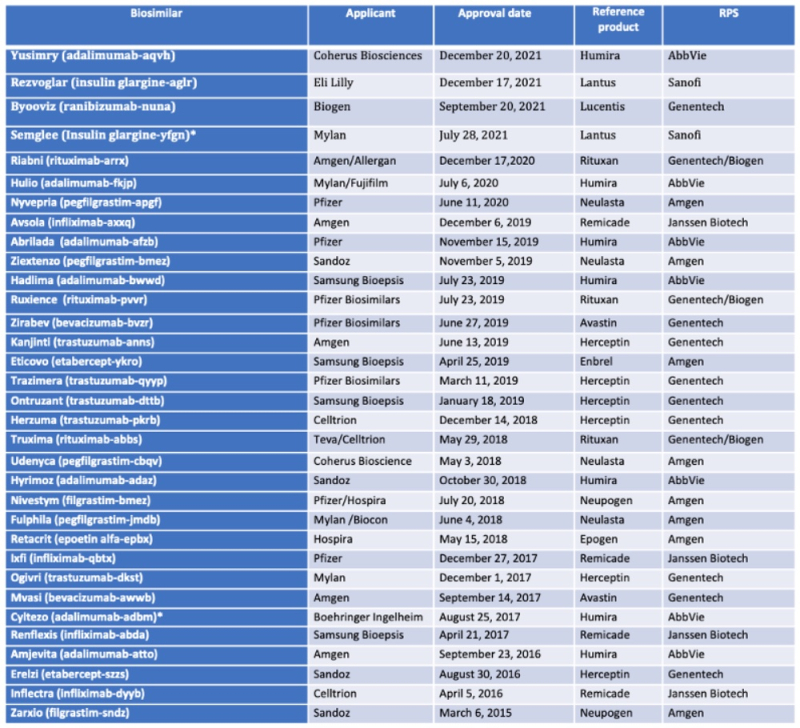
    FDAThe U.S. Food and Drug Administration approved four biosimilar drugs in 2021 under the provisions of the Biologics Price Competition and Innovation Act (BPCIA, codified at 42 U.S.C. § 262) as part of the Affordable Care Act of 2010 (colloquially known as "Obamacare").  This brings to 33 the total number of approved biosimilars, although the effects of the pandemic has been felt in the last two years.  From 2015 (when there was only a single approved biosimilar, Sandoz’s Zarxio®, see chart below), the rate of approvals rose every year (3 in 2016, 5 in 2017, 7 in 2018, and 10 in 2019), but 2020 saw only 3 approvals.  The roster of approved drugs is in this table:

    Table 1
    One bright spot in the approval trend is denoted by asterisks in the table, where this year, the FDA approved the first interchangeable biosimilar, Mylan Pharmaceutical’s Semglee® (insulin glargine-yfgn) followed by the FDA granting interchangeability to an earlier-approved biosimilar drug, Cyltezo® (adalimumab-adbm), produced by Boehringer Ingelheim.  The two most recent approvals include Eli Lilly & Co.'s Rezvoglar®, an injectable insulin glargine and the Coherus Bioscience's Yusimry®, a Humira® biosimilar.

    In contrast, the FDA approved fifty new drugs in 2021, including New Molecular Entities (NME) and biologic products regulated under the FDA's Center for Drug Evaluation and Research (CDER), as well as thirteen approvals for vaccines, allergenic products, blood and blood products, plasma derivatives, cellular and gene therapy products approved by FDA's Center for Biologics Evaluation and Research (CBER).

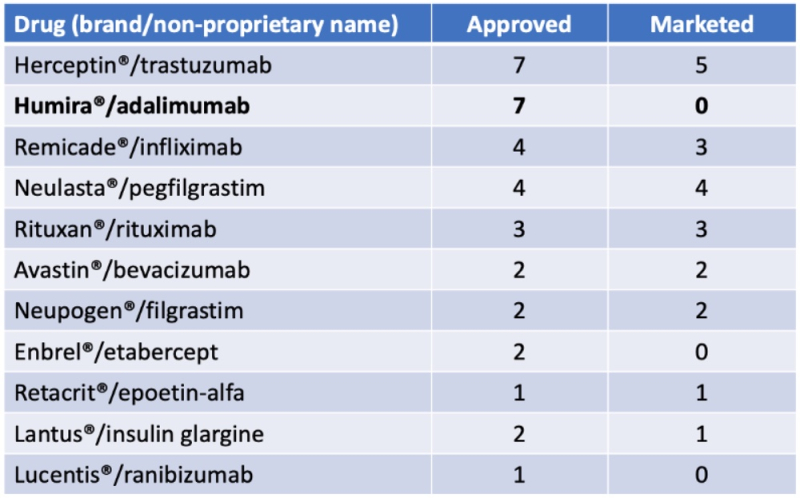
    While encouraging, only one of these products, Semglee®, is yet on the market, and Byooviz®, approved earlier this year, will not enter the market place until June 2022.  These occurrences exacerbate a trend set forth in the following table:

    Table 2
    As this table shows, almost one third of approved biosimilar products are not yet on the market and the ones that are cluster among seven reference products.  There are many reasons for these delays, some relating to disputes arising under the BPCIA involving patent litigation.  While legislators (see "Senators Ask FTC to Investigate Biosimilar Litigation Settlement Agreement") and legislation (see "A Solution in Search of a Problem") concerning the relatively slow pace of approval (and the pandemic hasn't helped) it is most likely the case simply that the complexity of the process, patient and physician resistance to change, and other factors are responsible and can be expect to ameliorate over time.

  • By Kevin E. Noonan —

    Federal Circuit SealWhen does the absence of evidence turn into evidence of absence, and when does such absence amount to an adequate written description of the absence of a step of a method claim?  This is a question that comes readily to mind when reading the Federal Circuit's opinion (and Chief Judge Moore's dissent) in Novartis Pharmaceuticals Corp. v. Accord Healthcare, Inc. (Fed. Cir. 2022).

    The case arose in ANDA litigation over U.S. Patent No. 9,187,405, which recites methods for treating recurring remitting multiple sclerosis (RRMS), a degenerative disorder of the myelin surrounding nervous tissue, with fingolimod (2-amino-2-[2-(4-octylphenyl)ethyl]propane-1,3-diol) sold by Novartis under the brand name Gilenya®.  Claim 1 was included in the opinion as representative:

    A method for reducing or preventing or alleviating relapses in Relapsing-Remitting multiple sclerosis in a subject in need thereof, comprising orally administering to said subject 2-amino-2-[2-(4-octylphenyl)ethyl]propane-1,3-diol, in free form or in a pharmaceutically acceptable salt form, at a daily dosage of 0.5 mg, absent an immediately preceding loading dose regimen.

    The italicized limitation in this claim was the focus of the appeal, the Court's opinion, and Chief Judge Moore's dissent.  As set forth therein, the practice in the prior art had been (for drugs having a necessary therapeutic threshold) to administer a "loading dose," defined as "a higher-than-therapeutic level dose, usually given . . . as the first dose in order to get therapeutic levels up quickly" by undisputed expert testimony.  Similarly undisputed was that loading dose regimens had been used in the prior art for treating multiple sclerosis (MS).  Defendant HEC Pharm Co. Ltd. (the only remaining defendant at trial from more than two dozen generic drug makers and ANDA filers sued by Novartis under 35 U.S.C. § 271(e)(2)) maintained that the '405 patent was invalid because its specification and its priority British patent application filed eight years before did not provide an adequate written description of an invention comprising the "absent an immediately preceding loading dose regimen" limitation under 35 U.S.C. § 112(a).  As the Federal Circuit's opinion sets out, these applications both disclosed results of an animal model of MS by treatment by oral administration of a hydrochloride salt of fingolimod at 0.3 mg/kg/week dosages.  Both also recited a prophetic example of a human clinical trial using "preferred daily dosage range [of] about from 0.1 to 100 mg" and "a dose of 0.5 to 30 mg [of fingolimod hydrochloride] every other day or once a week" and specifically "0.5, 1.25, or 2.5mg[/day]."  Nowhere in either specification was there express disclosure that a loading dose was to be avoided (but similarly nowhere in either specification was administration of a loading dose expressly taught).

    The District Court found that HEC's ANDA product would infringe the '405 patent and that HEC had not shown by clear and convincing evidence that the '405 patent failed to satisfy the written description provisions of § 112(a).  The Court found that the skilled worker would "make the leap" of increasing the dose from 0.3 mg in a rat to 0.5 mg in a human based on expert testimony, and that this specific dosage was found in the recited range of "from 0.1 to 100 mg."  Regarding the absence of a loading dose in the claimed regimen, the District Court found persuasive expert testimony that "'[i]f a loading dose were directed, the Patent would say that a loading dose should be administered 'initially.'"  This was enough for the District Court to find that the specification provided an adequate written description of this negative limitation.  This appeal followed.

    The Federal Circuit affirmed, in an opinion by Judge O'Malley joined by Judge Linn; Chief Judge Moore dissented.  The majority made short work of HEC's argument regarding the purported inadequacy of the written description of the 0.5 mg/day fingolimod hydrochloride dose, finding the District Court's decision regarding the adequacy of the '405 patent specification's disclosure of this limitation was supported by substantial evidence including expert testimony.  With regard to that expert testimony (and its consistency with the disclosure in the '405 specification), the Court noted that "[a] 'disclosure need not recite the claimed invention in haec verba,'" citing Ariad Pharms., Inc. v. Eli Lilly & Co., 598 F.3d 1336, 1351 (Fed. Cir. 2010), and held that "[t]o accept HEC's argument would require us to ignore the perspective of the person of ordinary skill in the art and require literal description of every limitation, in violation of our precedent."  Furthermore, the majority rejected HEC's assertion that the '405 specification contained insufficient "blazemarks" regarding the 0.5 mg/day dose because the blazemarks considerations are only relevant "where the specification describes a broad genus and the claims are directed to a single species or a narrow subgenus"; in such cases "'blazemarks' . . . would lead an ordinarily skilled investigator toward such a species among a slew of competing possibilities," citing Novozymes v. DuPont Nutrition Biosciences APS, 723 F.3d 1336, 1349 (Fed. Cir. 2013).  But the need for blazemarks does not arise "where the claimed species is expressly described in the specification, as the 0.5 mg daily dosage is here," according to the majority citing Snitzer v. Etzel, 465 F.2d 899, 902 (C.C.P.A. 1972).  The absence of "laundry-list-type disclosure" (which Judge O'Malley discussed in her dissent in Biogen Int'l GmbH v. Mylan Pharmaceuticals Inc.) made a difference in this regard, further supporting the majority's decision against HEC's argument.  Finally, the majority opinion noted that the specification has literal description support for the 0.5 mg/day dose.  Accordingly, the majority held that the District Court's determination that HEC failed to show inadequate written description on these grounds was supported by both the specification and "ample expert testimony" and thus affirmed.

    Turning to the negative limitation regarding the absence of a loading dose, the majority opinion began by noting that, under Inphi Corp. v. Netlist, Inc., 805 F.3d 1350, 1356 (Fed. Cir. 2015), there is no "new and heightened standard for negative claim limitations" and supported the continued vitality of this principle by citation to several Federal Circuit opinions including Santarus, Inc. v. Par Pharmaceutical, Inc., 694 F.3d 1344, 1350–51 (Fed. Cir. 2012); In re Bimeda Research. & Development Ltd., 724 F.3d 1320, 1324 (Fed. Cir. 2013); and Nike, Inc. v. Adidas AG, 812 F.3d 1326, 1348 (Fed. Cir. 2016).  The majority perceived HEC's argument as "attempt[ing] to create a new heightened written description standard for negative limitations" contrary to the "central tenet of [the Court's] written description jurisprudence—that the disclosure must be read from the perspective of a person of skill in the art" as well as specific precedent such as All Dental Prodx, LLC v. Advantage Dental Prod., Inc., 309 F.3d 774, 779 (Fed. Cir. 2002).  The majority opinion distinguished HEC's argument (and Chief Judge Moore's dissent, vide infra) that "[t]he mere absence of a positive recitation is not a basis for an exclusion" (M.P.E.P. § 2173.05(i)), and "silence alone is insufficient" (citing the dissent) with the concept of context, specifically "how a skilled artisan reads a disclosure" which is what "matters" to the majority.  For Judges O'Malley and Linn, both HEC and the Chief Judge "urge us to elevate form over substance by creating a new rule that a limitation which is not expressly recited in the disclosure is never adequately described, regardless of how a skilled artisan would read that disclosure."  The adequacy of the '405 specification's written description regarding the negative loading dose limitation was supported, according to the majority, by the District Court who "correctly, and quite carefully, conducted 'an objective inquiry into the four corners of the specification from the perspective of a person of ordinary skill in the art'" (which the opinion then summarized and quoted).  Based on this analysis, the majority stated that they could find no clear error and thus affirmed.

    Chief Judge Moore's dissent, as foreshadowed in the majority opinion, focused on the adequacy vel non of the written description of the negative limitation regarding the absence of a loading dose of fingolimod hydrochloride.  Perhaps sensitized to the issue by the Court's recent Biogen decision, the Chief Judge asserted that "[t]he majority dramatically expands a patentee's ability to add, years after filing a patent application, negative claim limitations that have zero support in the written description" (emphasis added), summarizing her position with appropriate pith as "[s]ilence is not disclosure."  The dissent illustrates how readily answers to questions like the one before the Court can be completely divergent depending on which "policy lever" (as legal academics might call them) are considered most relevant.  The Chief focused on disclosure, which carries with it a requirement for affirmative statements and definitions that without question are not found in the '405 specification (although it can be appreciated that there must be a limit to the requirement for affirmatively disclosing what an invention does not comprise, lest a specification become overburdened with unnecessary verbiage directed to irrelevancies).  The dissent provided a basis for the Chief's apprehension that in this case the question of whether the absence of an initial loading dose was not so straightforward when it noted that the limitation was added in response to an obviousness rejection asserted against claims in a co-pending priority application to the '405 patent.  The Chief Judge found support for her position in many of the same cases cited by the majority or distinguished them, to the point that these cases require that a patent specification must "describe[] a reason to exclude the relevant limitation," citing Sartorius (emphasis in dissent).  And the Chief parsed the specification and the testimony to support her conclusion that the District Court's interpretation of the adequacy of the written description regarding the negative limitation concerning a loading dose, and the majority's affirmance thereof, was error.  According to the dissent "the district court (and now the majority) [engaged in] rewriting the specification with expert testimony" to arrive at their conclusion regarding such adequacy.  The Chief concluded her dissent by stating:

    The inventors do not get to claim as their invention something they did not disclose in the patent.  There are no fact findings here to defer to—the patent is silent as to loading doses.  The district court relied upon that silence: "The absence of an immediately preceding loading dose from the specification, and from the Prophetic Trial, would tell a person of skill that loading doses are excluded from the invention."  . . .  This is not a finding of fact; it is a misunderstanding of the law.  An inventor cannot satisfy the written description requirement through silence.  And when the majority concludes otherwise, it creates a conflict with our long-standing, uniformly-applied precedent . . . .  While the negative limitation need not be recited in the specification in haec verba, there must be something in the specification that conveys to a skilled artisan that the inventor intended the exclusion:  disadvantages, alternatives, inconsistencies, just something.  This specification is entirely silent and ambivalent about loading doses.  These inventors did not disclose treatment that must exclude a loading dose, and the district court's finding to the contrary is clearly erroneous.  After this case, negative limitations are supported by a specification that simply never mentions them [citations to the record and precedent omitted].

    Novartis Pharmaceuticals Corp. v. Accord Healthcare, Inc. (Fed. Cir. 2022)
    Panel: Chief Judge Moore and Circuit Judges Linn and O'Malley
    Opinion by Circuit Judge O'Malley; dissenting opinion by Chief Judge Moore

  • By Donald Zuhn —

    USPTO SealUSPTO Proposes Electronic Issuance of Patents

    In a notice of proposed rulemaking published last month in the Federal Register (86 Fed. Reg. 71209), the U.S. Patent and Trademark Office is proposing to issue patents electronically through its patent document viewing systems (i.e., Patent Center and Patent Application Image Retrieval (PAIR)).  As a result of the proposed changes to the rules, the Office would no longer issue patents on paper or physically deliver patents by mailing them to the correspondence address, and 37 C.F.R. § 1.315, which states that "[t]he patent will be delivered or mailed upon issuance to the correspondence address of record," would be removed and reserved.

    Currently, the Office issues "letters patent" as paper copies bound with a cover sheet that has both an embossed seal and the signature of the USPTO Director.  Under the proposed process, the Office would issue patents electronically under a new digital USPTO seal and with a digital signature from the USPTO Director.  The notice indicates that the electronic issuance of patents will allow the Office to issue patents approximately two weeks faster than the current process.  Stakeholders and patentees, however, would still have the option of ordering certified copies or paper presentation copies of patents.

    The notice provides some historical background regarding the Office's efforts to establish beginning-to-end electronic processing for patent applications, noting that the Office implemented an electronic filing system in 2001, launched the Image File Wrapper system to replace paper processing of patent applications in 2003, and initiated the e-Office Action Program in 2007.  According to the notice, electronic issuance of patents would be another step in the Office's effort to continue streamlining its service delivery processes.  The notice also indicates that the Office is also considering electronically issuing reexamination certificates, statutory invention registrations, patent term extension certificates, and certificates of correction.

    The notice provides some advice to stakeholders regarding best practices in view of the proposed change to the patent issuance process.  In particular, the Office notes that:

    Under the proposed electronic patent issuance process, the USPTO would issue the patent shortly after the payment of the issue fee.  As a result, applicants would have less time, after the payment of the issue fee, to file continuing applications, Quick Path Information Disclosure Statements, or petitions under 37 CFR 1.313(c) to withdraw an application from issue.  Therefore, the best practice would be for applicants to file these submissions as early as possible.  Preferably, continuing applications should be filed before the payment of the issue fee.

    The Office also encourages Applicants to participate in the e-Office Action Program in order to receive Issue Notifications, as the Office "foresees the possibility that a patent may issue electronically before the applicant receives a mailed Issue Notification," and the use of the e-Office Action Program would "avoid this possibility."

    The Office's notice indicates that comments regarding the proposed changes should be submitted by February 14, 2022 to ensure consideration, and that such comments should be submitted through the Federal eRulemaking Portal.


    USPTO Proposes Change to Receipt Date for Patent Electronic Submissions

    In a notice of proposed rulemaking published last month in the Federal Register (86 Fed. Reg. 69195), the U.S. Patent and Trademark Office is proposing to amend the patent rules of practice to provide that the receipt date of correspondence submitted via the Office's electronic filing system will be the date in the Eastern time zone when the Office receives the correspondence, as opposed to the date on which the correspondence is received at the correspondence address in Alexandria, Virginia.  The Office notes that the change is necessary because the Office is in the process of placing servers in Manassas, Virginia, and anticipates that in the future it might provide servers outside of the Eastern time zone.  According to the notice, the change to the rules will ensure consistency and predictability with respect to correspondence receipt dates as the date of receipt for electronic submissions will no longer depend upon the location of the Office's servers.

    The Office also proposes changing the rules to define "Eastern time" as meaning Eastern Standard Time or Eastern Daylight Time in the United States, as appropriate.  Finally, the notice points out that because the Office does not "strictly require" the use of an address when patent-related correspondence is submitted via the Office's electronic filing system, the proposed changes to the rules would exclude such correspondence from the address marking requirements of 37 C.F.R. § 1.1(a).  The Office notes, however, that Applicants may continue to provide an address on correspondence submitted via the Office electronic filing system consistent with § 1.1(a), but that the inclusion of an address is not mandatory.

    The Office's notice indicates that comments regarding the proposed changes should be submitted by February 7, 2022 to ensure consideration, and that such comments should be submitted through the Federal eRulemaking Portal.


    USPTO Delays Implementation of Voluntary CLE Certification

    In a notice of proposed rulemaking published last month in the Federal Register (86 Fed. Reg. 71453), the U.S. Patent and Trademark Office announced that it would be "delaying indefinitely" the implementation of voluntary continuing legal education (CLE) certification.

    In August 2020, the Office initially proposed allowing registered patent practitioners (and individuals granted limited recognition to practice before the USPTO in patent matters) to voluntarily certify to the Director of the Office of Enrollment and Discipline (OED) that they had completed 6 credits of CLE in the preceding 24 months (including 5 hours of CLE in patent law and practice and 1 hour of CLE in ethics).  The Office published proposed CLE requirements in October 2020 and sought public comment regarding those proposed requirements.  By the close of the comment period in January 2021, the Office had received 26 comments.  In June 2021, the Office announced that voluntary CLE certification would commence in the spring of 2022.  The Office's latest notice, however, has now delayed implementation of voluntary CLE certification.

    The notice indicates that the Office will provide at least 120 days' notice prior to implementation of voluntary CLE certification, and the Office will issue final CLE guidelines and specific instructions for making the certification prior to any implementation date.

  • CalendarJanuary 19, 2021 – "Top Patent Law Stories of 2021" (McDonnell Boehnen Hulbert & Berghoff LLP) – 10:00 am to 11:15 am (CT)

    January 19, 2022 – "Challenging the Validity of Patent Rights in Australia: Options and Strategies" (Spruson & Ferguson) – 4:00 pm (ET)

    January 25, 2022 – "User Interfaces — What Can You Patent?" (J A Kemp) – 4:00 pm to 5:00 pm (GMT)

  • MBHB Logo 2McDonnell Boehnen Hulbert & Berghoff LLP will be offering a live webinar on the "Top Patent Law Stories of 2021" on January 19, 2022 from 10:00 am to 11:15 am (CT).  Since 2007, the Patent Docs weblog has presented an annual, end-of-the-year review of the top stories in patent law.  In this presentation, Patent Docs co-authors Donald Zuhn, Kevin Noonan, and Michael Borella will take a look back at the top patent stories of 2021, many of which will likely impact patent applicants and practitioners in the coming year.

    While there is no fee to participate, attendees must register in advance.  Those wishing to register can do so here.  CLE credit is pending for the states of California, Illinois, New Jersey, New York, North Carolina, and Virginia.

  • Spruson & FergusonSpruson & Ferguson will be offering a webinar entitled "Challenging the Validity of Patent Rights in Australia: Options and Strategies" on January 19, 2022 at 4:00 pm (ET).  Mike Zammit and Doug Horton of Spruson & Ferguson will discuss:

    • The life cycle of a standard Australian patent;
    • Pre-grant challenges: (a) third party observations, (b) substantive oppositions (including appeals to a Court) and (c) re-examination;
    • Post-grant challenges: (a) re-examination, and (b) revocation before the Courts; and
    • Several case studies will be provided.

    While there is no cost to participate in the program, those interested in attending the webinar can register here.

  • J A KempJ A Kemp will be offering a webinar entitled "User Interfaces — What Can You Patent?" on January 25, 2022 from 4:00 pm to 5:00 pm (GMT).  Dominic Forsthye and Callum Docherty of J A Kemp will look at the EPO's approach to excluded matter as applied to user interfaces, using examples from case law to try to make sense of what can and cannot be patented at the EPO, and will discuss practical tips for drafting and prosecuting UI applications at the EPO to increase chances of success.  The webinar will address the following topics:

    • The EPO's approach to excluded subject-matter
    • Examples from case law to highlight how the EPO approaches user interfaces
    • Technical effect, and arguments that can be employed to highlight technical effect
    • A brief review of the UK approach to user interfaces
    • Practical drafting tips for user interface inventions

    There is no registration fee for this webinar.  However, those interested in registering for the webinar, should do so here.

  • By Kevin E. Noonan —

    Federal Circuit SealWhile the Federal Circuit has patent law as its principal focus, as a U.S. Circuit Court of Appeals, questions come before the Court on more mundane, procedural matters (which, sometimes being dispositive, does not reduce their importance to the parties and occasionally the rest of us).  One such case was decided on December 16th in Alpek Polyester, S.A. v. Polymetrix AG (complicated, as should be evident from the caption, by involving non-US. parties and having putatively infringing activities arising both here and abroad).

    The case arose over Polymetrix's asserted infringement of U.S. Patent Nos. 7,790,840, 7,868,125, and 7,192,545 owned by Alpek (a Mexican company) and exclusively licensed to co-Plaintiff DAK Americas LLC (a U.S. company), the patent claim being directed to methods for producing polyethylene terephthalate (PET) resins; because the matters on appeal were exclusively procedural there was no need in the opinion (or here) to delve into the scope of the claims any further.  Defendant Polymetrix is a Swiss company in the business of supplying equipment and engineering services for constructing plants for making PET resin (while not making the resin itself, i.e., it provides the means but not the product and thus did not itself practice the claimed methods).

    The activity that prompted the lawsuit was Polymetrix contracting with a Polish company, Indorama Ventures Poland sp. z o.o. ("IVP") wherein Polymetrix equipped a manufacturing plant located in Wloclawek, Poland to run the patented process.  When the work was completed Polymetrix entered into a "commissioning" period during which the plant was tested (using the patented process to product PET resin); during this time Polymetrix retained ownership of the equipment and IVP withheld payment until the installation passed appropriate tests.

    Jurisdiction arose in the U.S. when IVP sent to affiliates in the U.S. (Auriga Polymers and AlphaPet Inc.) samples of PET resin made in the Wloclawek plant using Polymetrix equipment to perform the patented process.  There were three instances of this importation, including one wherein an AlphaPet employee brought the sample into the country personally.  Alpek sued following these activities, alleging that Polymetrix induced infringement under 35 U.S.C. § 271(b) (the predicate literal infringement lying under the provisions of § 271(g)).  While the opinion references "a complicated and protracted international discovery process" that ensued, only three incidents were worthy of the Court's consideration.  The first involved failure of Defendant Polymetrix to disclose under Federal Rule of Civil Procedure 26 the identity of IVP's director, Mr. Saini (the relevance of this failure being Polymetrix's reliance on a declaration in support of a summary judgment motion at issue in this appeal).  Second was disputed testimony in a deposition (of a Rule 30(b)(6) witness representing Auriga) that Polymetrix owned the plant in Wloclawek, Poland, supporting Alpek's motion to amend its complaint to include an allegation of direct infringement under § 271(g).  The third and final discovery dispute involved an assertion of privilege by Polymetrix over an opinion of counsel concerning Alpek's infringement allegations, which Alpek alleged had been waived by disclosure to a potential corporate suitor.

    Polymetrix filed a summary judgment motion that it did not infringe, which the District Court granted.  The District Court rejected Alpek's arguments that there were disputed issues of material fact, denied Alpek's motion to strike the Saini testimony due to failure to satisfy Rule 26 when Polymetrix did not identify him as someone with knowledge about the company and its activities, and held that the misstatement at deposition was inadmissible under Federal Rule of Evidence 602 because the witness lacked personal knowledge regarding importation of PET resin made in the Polish plant using the patented process.  The District Court also denied Alpek's motion to amend the complaint as being untimely.  This appeal followed.

    The Federal Circuit affirmed, in an opinion by Judge Lourie joined by Judges O'Malley and Stoll.  The opinion addresses the four arguments raised by Alpek on appeal:

    • First, Alpek argues that the court abused its discretion by disregarding [the Rule 30(b)(6) witness's] admission that the July 17, 2014 sample was brought into the United States 'for Polymetrix' [arguing that the statement was admissible because the witness's testimony under Rule 30(b)(6) does not require personal knowledge to be admissible].

    • Second, Alpek argues that the court erred by finding that Polymetrix did not ratify IVP's importation by using test results from the United States [by receiving and relying on test results it knew were produced by Auriga and AlphaPet in the U.S.]

    • Third, Alpek argues that the court erred in failing to recognize fact disputes that stem from Polymetrix's ownership of the equipment under a Swedish law interpretation of the contract[ and]

    • [F]ourth, Alpek argues that the court erred by declining to strike the Saini declaration upon which Polymetrix heavily relied to support its summary judgment motion [based on Federal Rule of Civil Procedure 37].

    Polymetrix's counterargument was based on the causation prong of § 271(b), i.e., that its activities did not cause IVP to import into the U.S. PET resin samples for testing.  Regarding Alpek's first argument, Polymetrix contended that the witness misspoke due to misunderstanding the question (which the witness clarified at the time during subsequent testimony during the deposition).  The Federal Circuit, applying Eighth Circuit law appropriate for reviewing the District Court's decision here, noted that in the Eighth Circuit evidence to be considered on summary judgment must be "admissible evidence," citing Crews v. Monarch Fire Prot. Dist., 771 F.3d 1085, 1092 (8th Cir. 2014) (emphasis in original) (citing Nooner v. Norris, 594 F.3d 592, 603 (8th Cir. 2010).  Under the applicable abuse of discretion standard, the Federal Circuit found no abuse (noting that the witness did not testify at trial and "would not [have been] admissible at trial under Federal Rule of Evidence 801(d)(2)" nor Federal Rule of Civil Procedure 32(a)(3) relating to the testimony of an adverse party.  The opinion also distinguished seemingly contrary precedent in General Mills Operations, LLC v. Five Star Custom Foods, Ltd., 703 F.3d 1104, 1110 (8th Cir. 2013), because the disputed testimony was not by an adverse party's witness.  Finally, the Federal Circuit did not find Alpek's argument persuasive insofar as it relied on two words ("for Polymetrix") "excerpted from one question in one deposition in the larger context of a protracted discovery process that lasted years" and was asserted by Alpek for an inducement argument that was "contrary to the overwhelming majority of the evidence which demonstrates that Polymetrix had no knowledge or concern about where, when, or how IVP conducted performance tests."  In the panel's view the evidence showed the witness simply misspoke.  The Court found no genuine issue of material fact here that would justify the "delay and expense" of a trial.

    Regarding Alpek's second argument, the Federal Circuit did not see any genuine issue of material fact on the evidence, which the Court considered to be supported only with "a conclusory assertion by [Alpek's] expert."  According to the opinion, the "overwhelming majority of the evidence" supported a finding that AlphaPet was not the source of the data relied upon by Polymetrix with regard to the performance of the Polish plant (including agreement with the District Court that Alpek blundered when it asserted that this data "match[ed] up almost exactly," the opinion stating that "If the AlphaPet test results were really the source of the data for Polymetrix's report, we can discern no reason why the two sets of data would not match up exactly" (emphases in opinion).

    As for Alpek's third argument, the Federal Circuit agreed with the District Court that the details of Swedish contract law, asserted to support Alpek's contention that under that law Polymetrix was responsible for the activities in the Polish plant, were "inapposite."  "As a matter of American law," according to the opinion, 'the mere fact that Polymetrix owned the plant equipment is wholly insufficient for Alpek to meet its burden of proving that Polymetrix took active steps to induce IVP to infringe," citing MGM Studios Inc. v. Grokster, Ltd., 545 U.S. 913, 935–36 (2005), in support for this principle.

    Finally, the Court rejected Alpek's fourth argument, based in part on the breadth of the District Court's discretion on discovery matters and enforcement of the Civil Procedure rules.  The Federal Circuit saw none of the surprise or prejudice the Rule was intended to prevent, in view of the "more than 1,000 documents produced during discovery" bearing the witness's name.

    Having dispensed with the summary judgment portion of the appeal, the panel turned to the District Court's denial of Alpek's motion to amend its complaint.  Here the Court found no justification for Alpek's failure to file its motion by the deadline date the District Court had established, and the panel rejected Alpek's allegations that witness testimony adduced during a deposition that occurred after the deadline alerted it to the factual bases for the amended complaint, i.e., that Polymetrix was a literal infringer under § 271(g).  And Alpek's arguments, according to the opinion, "consist[ed] of mere disagreement with the magistrate judge's view of the facts."  Under these circumstances the Federal Circuit affirmed denial of Alpek's motion to amend.

    The final issue considered by the Court was Alpek's motion to compel production of attorney opinion based on waiver due to disclosure to Polymetrix's corporate suitor.  The Court agreed with Polymetrix that the panel need not address the issue because it "has no bearing on the district court's summary judgment ruling."  The opinion notes that Alpek had the burden of showing that Polymetrix caused IVP's infringement of the patents-in-suit, while the opinion even if offered into evidence would only address Polymetrix' intent to induce infringement, citing Omega Patents, LLC v. CalAmp Corp., 920 F.3d 1337, 1352–53 (Fed. Cir. 2019).  Because the District Court's basis for granting summary judgment was Alpek's failure to establish Polymetrix's causation of IVP's asserted infringement, "the issue of intent did not factor into the district court's grant of summary judgment" according to the Court (emphasis in opinion).  This issue, in view of the Court's affirmance of the District Court's grant of summary judgment, was thus moot according to the panel.

    Alpek Polyester, S.A. v. Polymetrix AG (Fed. Cir. 2021)
    Nonprecedential disposition
    Panel: Circuit Judges Lourie, O'Malley, and Stoll
    Opinion by Circuit Judge Lourie