•     By Christopher P. Singer

    USPTO Seal - background
    In a Notice to be published in tomorrow's Federal Register, the U.S. Patent and Trademark Office announced that the new rules relating to Practice before the Board of Patent Appeals and Interferences in Ex Parte Appeals (Appeal rules) will not take effect on December 10, 2008, as originally scheduled.

    The primary reason for the delay, according to the Notice, is that the Office of Management and Budget (OMB) has not yet had a chance to complete its review of all the information submitted in response to the information collection under the Paperwork Reduction Act (PRA).  As previously reported by Patent Docs, the public must be afforded an opportunity to submit comments directed to the burden impact of any proposed rule change to the OMB under the PRA.  The OMB uses the information provided by the agency advancing the rule change as well as the comments provided by the public and assesses the ultimate burden impact of the proposed rule changes.  This helps to insure that any rule changes advanced by a particular governmental agency are not unduly burdensome on the public.

    Patent Docs will monitor the status of the Appeal rules and provide an update as appropriate.

    For additional information regarding this topic, please see:

    • "More on Ex parte Appeal Rule," October 10, 2008
    • "Patent Office Posts Comments on New Appeals Rules," September 11, 2008
    • "More on USPTO Rulemaking Practices,"July 21, 2008
    • "USPTO Rulemaking Practices Being Called into Question (Again)," July 20, 2008
    • "New Appeals Rules Published," June 10, 2008
    • "Patent Office to Publish New Appeals Rules on Tuesday," June 9, 2008

  •     By Donald Zuhn

    Last Friday, the Federal Circuit heard oral argument in the Tafas v. Dudas appeal.  Arguing on behalf of Defendants-Appellants Director Jon Dudas and the U.S. Patent and Trademark Office was USPTO General Counsel James Toupin.  Plaintiffs-Appellees SmithKline Beecham Corp., SmithKline Beecham plc, and Glaxo Group Ltd. (GSK) were represented by John Desmarais, a partner with Kirkland & Ellis LLP, and Plaintiff-Appellee Dr. Triantafyllos Tafas was represented by Steven Moore, a partner with Kelley Drye & Warren LLP.

    Mr. Toupin argued first, and for seventeen and a half minutes, the Patent Office's General Counsel was peppered with questions from the panel, which consisted of Circuit Judges Rader, Bryson, and Prost.  Mr. Desmarais went next, addressing the Court for just over eighteen minutes, followed by Mr. Moore, who argued for almost eight minutes.  Mr. Toupin closed oral argument with another twelve and a half minutes of rebuttal.  An audio recording of the oral argument can be found here.  For practitioners and applicants who have not had a chance to listen to the nearly one-hour long oral argument in this case, a few highlights are offered below.

    Toupin, John
    Mr. Toupin (at right) began by stating that "[a]ll of the regulations at issue here fit squarely within the plain meaning of governing the conduct of proceedings before the Office, and seek to expedite the process of patent applications," adding that Lacavera v. Dudas, 441 F.3d 1380 (Fed. Cir. 2006), and Bender v. Dudas, 490 F.3d 1361 (Fed. Cir. 2007), indicate that "the PTO's interpretation of [35 U.S.C.] § 2 is entitled to Chevron deference."  The Court, however, reminded Mr. Toupin that whether the PTO was entitled to Chevron deference was "kind of the issue here."  Questioning the Office's counsel on the issue of deference, the Court asked:

    Court:  You want Chevron deference, but you only get that deference if you're acting within the scope of your authority, and [if not,] that's a matter on which there is no deference, right?

    Mr. Toupin:  No.  Under Bender and Lacavera, the Court accorded the agency Chevron deference with respect to . . .

    Court:  Under Borlem, we said very clearly:  only if you're within your statutory mandate, and the courts decide whether you're within the scope of your authority.

    On the issue of deference, the Court concluded by "asking" whether Mr. Toupin was "arguing that we ought to allow the [agencies] to themselves define their own limits of their power and receive deference for that?"

    Moving on to the limits on continuation applications imposed by the new rules, the Court stated that:

    Court:  The question remains, and I think you alluded to this earlier, that it's still . . . what you've done [with the continuation and claims rules] still has to be in accordance with law, and my concern there goes to the [35 U.S.C. §] 120 and the continuation issue.  It seems to me, and tell me if you disagree, that [§] 120 sets out quite clearly certain criteria for when an application is entitled to a priority date.  And as I read your proposed regulations, they create a very explicit exception.  In other words, they say an application — except for the third or more application that doesn't involve new matter — you don't get the priority date.  And that bumps up, in my view, to the language in the statute.

    Mr. Toupin:  First, that's not an accurate interpretation of the rule itself because additional continuations are permissible on a showing that with reasonable diligence one could not have brought the matter previously.

    The Court, not satisfied with Mr. Toupin's reply, snapped back that "[t]he statute says 'shall have the same effect' — shall have the same effect whether it's the third, the fifth, or the first, as long it's copending at the time [applicants] make the request."  The Court then asked:

    Court:  Do you disagree that the statute is absolutely clear that there's no exception or exclusion for third and fourth applications that do not provide anything that wasn't otherwise available?

    Mr. Toupin:  What the Court held in . . .

    Court:  Can you just answer the question as to whether you think the statute is clear?

    Mr. Toupin:  No, your Honor.  What the Court held in the Henricksen case was that it was not clear on the face of the statute, unequivocally clear on the face of the statute, that an applicant [could not be] limited to two continuations, and it therefore held the Board erred in finding that it was clear.

    Leaving the issue of continuation limits behind, the Court then turned to claims limits imposed by the new rules:

    Court:  Looking at the other rule, the 5/25 rule, do you read [35 U.S.C. §] 112 as — the "or more" language — as creating some kind of limit?

    Mr. Toupin:  [A]s the Court held in Rubinfield, "or more" requires an applicant to submit at least one claim.

    Court:  "Or more."  Does "or more" have a limit in it?  How many is "or more"?  Is six "or more"?

    Mr. Toupin:  Six is literally "or more."

    Court:  Thank you.

    Mr. Toupin reminded the Court that "[t]he agency, of course, has not here imposed a limit on the number of claims," and instead had "only imposed a requirement that over a certain number of claims the applicant should provide additional information to assist in the examination."  One of the oral argument's most interesting exchanges followed:

    Court:  Well, there's a little problem with that too.  Wouldn't you be crazy to use that [Examination Support Document (ESD)] procedure and subject yourself to inequitable conduct if you make a slightly wrong comment in the wrong place?

    Mr. Toupin:  To the contrary, your Honor . . .

    Court:  You're going to go out and advise your clients to use the ESD procedure routinely?  . . .  You're advising a pharma company now, and you've got clinical trials under way, and you know you're going to need to, down the road  . . .  identify your species that are the best ones.  You're going to need continuations to cover your real inventions.  You're going to need more claims because you're not only claiming the species but the various formulations and the administration methods.  . . .  And you're going to say:  "Well it's okay, we can go beyond five and we can go beyond the continuations limit because, ahhh, we can clarify it all with ESDs?"  That's the advice you're going to give your client?

    Mr. Toupin:  Well, look, first, your Honor . . .

    Court:  "Yes" is your answer?  I bet you're not going to be hired by very many pharmaceutical companies.  I just think you sent yourself to the electronics industry.

    The Court concluded its questioning of the Patent Office's counsel by pointing out that in promulgating the new rules, the PTO had "shifted the burden here . . . that the burden is kind of shifted to [an applicant] not only to prove that you deserve the extra claims, but that you deserve the patent based on your own reading of the prior art, which if you [make a] mistake in the slightest, it's going to cost you your head."

    Desmarais, John
    By any comparison, the Court's questioning of Mr. Desmarais and Mr. Moore was much less contentious.  With Mr. Desmarais (at left), the Court probed the issue of prosecution laches and whether its decision in In re Bogese informed the current appeal.  Using the facts in Bogese, the Court posed the following hypothetical:

    Court:  Could the PTO issue a rule that says applicants who file twelve continuations over an eight-year period without advancing prosecution when given the opportunity will forfeit their patent right?

    Mr. Desmarais:  This Court made it clear in the prosecution laches trilogy — in Symbol II, In re Bogese, and Symbol IV — that mechanical rules aren't the way to handle this.

    The Court noted, however, that unlike in Bogese, the new rules give applicants "an out," stating that "[t]hey say just explain your reasons, or why you shouldn't have done it earlier, and you can have more [continuations]."  Mr. Desmarais countered by stating:

    That's the problem with the current rules.  They're saying now with the current rules [that] when you get to the third [continuation], you have to sign a declaration that says you cannot have done this earlier.  That's not what [§] 120 says.

    On the issue of whether the new rules would actually address the PTO's growing backlog of applications, the Court and GSK's counsel engaged in the following exchange:

    Court:  What do you do with the factual predicate here?  [The PTO is] falling behind at least 100,000 applications a year.  Something's got to happen.

    Mr. Desmarais:  Yeah, something absolutely should happen, and that analysis and what should happen is something for Congress to deal with.  . . .  So what has Congress been doing?  Since 2005, Congress has been debating patent reform.  They have been considering should we give the PTO authority to mess with § 120.  They have been considering should we give the PTO substantive rulemaking authority.  They debated it in 2005, 2006, 2007, 2008 — it hasn't passed yet, but they know it's their job and they're attending to it.  It's not for the PTO to say we're tired of waiting for Congress, and to come in, grab the law themselves, and start to change it.  They can't do that.

    The difference in the tenor of the Court's questioning of Mr. Toupin and Mr. Desmarais was no more apparent than when the Court asked Mr. Desmarais whether pharmaceutical companies "could well need" more than the two continuations, five independent claims, and 25 total claims provided by the new rules.  GSK's counsel responded with an impassioned plea on behalf of the pharmaceutical industry:

    You will, in my view, cripple the pharmaceutical industry with these rules.  . . .  The problem for the pharmaceutical industry, and why these rules are so problematic, is [a pharmaceutical company] come[s] up with a class of compounds — which is a big genus of compounds, that's what they invent in the laboratory — it then takes them literally a decade, literally a decade and millions of dollars, to find the species that works.  Many of [these species] fail along the way.  They go into clinicals, phase I, phase II, whatever, and [a pharmaceutical company] may put in $100 million, or $200 million, or $300 million, and [the species] may fail in the clinic.  [The company has] to go back and pick another one and try again.  If you limit them to two continuations, and the third only if they couldn't have done it earlier, you're going to cripple them because they're going to get into the process, multi-years into the process, hundreds of millions of dollars into the process, and then they're going to find the compound that actually works and saves human lives, and they're not going to be able to patent it.  And you know what happens if they can't patent it?  They're not going to take it to market.

    Moore, Steven
    The Court then turned to Mr. Moore (at right), asking Tafas' counsel whether there should be any limits on the numbers of claims an applicant can file:

    Court:  Do you think if someone came in with 1,000 claims, and said to the examiner:  "Get busy"?  . . .  Do you think the examiner could say, or the PTO could say as a policy matter:  "No, that's just too many claims.  There's no way that you need a thousand claims.  We're just not going to look at a thousand claims"?

    Mr. Moore:  Under the law today, no.  They could not say that.  But we do know what they do.  I mean, we all know what they do.  They will restrict those 1,000 claims into 1,000 applications.

    As to whether the Office could address the problem with additional claims fees, the Court queried:

    Court:  Could they ask you to pay an extra fee if you want more than 25 claims?  Could they double, or triple, or quadruple the fee?

    Mr. Moore:  Under the current statutes, the fees are set by Congress.  So I don't think they can set fees.

    On rebuttal, Mr. Toupin covered the issues of retroactivity and the vagueness of the ESD rule (both of which had been first addressed by Mr. Moore), and then the Court tossed a few more questions Mr. Toupin's way:

    Court:  I know we're straying a little into policy here rather than direct law, but Mr. Desmarais made the point that this could be crippling for the pharmaceutical industry.  Was that considered as part of the notice and comment period and was that considered by the Office in [promulgating the new rules] in the first place?

    Toupin:  Absolutely, your Honor.  Our original proposal was one continuation or RCE as of right, and any additional [continuation or RCE] would require a showing.  We changed that explicitly in response to concerns about the effect [of the new rules] on commercialization to 2+1 [i.e., two continuations plus one RCE].

    The Court concluded by asking Mr. Toupin if he knew whether the use of delayed examination would "affect patent term restoration under the Hatch-Waxman Act," to which Mr. Toupin responded that he did not.

    Patent practitioners, applicants, and assignees will now await the Federal Circuit's decision.

  •     By Kevin E. Noonan

    EPO-EPC
    The Enlarged Board of the European Patent Office issued its decision denying a European patent on European Patent Application No. 96903521.1 (EP 0 770 125) to the Wisconsin Alumni Research Foundation (WARF), directed to human embryonic stem cells (hESCs).  This decision is another example of European antipathy to biotechnology inventions, an attitude that in the past has had an extremely negative effect on the continent's competitiveness with the U.S. and Asian countries.

    The bases of the Board's decision are provisions of the European Patent Convention (EPC) prohibiting patents on inventions that would be contrary to public order ("ordre public") or morality if exploited commercially (Rule 23d(c), recodified as Rule 28c).  The EPC also proscribes patenting expressly for any use of human embryos for industrial or commercial purposes.  The Board reached this result even though the stem cell claims at issue recited neither a use of a human embryo or the method for obtaining the claimed cells.  On its face, the decision seems a fair and accurate reading of the prohibition under the EPC.

    These "public morality" provisions exist in the patent law of many countries, as express provisions preventing certain types of patents.  They find their most common expression in prohibitions on methods of human treatment, resulting in "first" and "second" medical use claims.  With one exception, there are no similar provisions in U.S. patent law:  that exception, codified at 35 U.S.C. § 287(c), exempts medical practitioners (doctors, nurses, and others "licensed by a State to provide" medical activity) from the patent infringement provisions of the statute.  "Medical activity" is also expressly defined, to be the practice of a medical or surgical procedure on a [human] body"; however, the statute also excludes from protection "use of a patented medicine," "practice of a patented use," and "practice of a process in violation of a biotechnology patent."  Other proscriptions against certain types of patents on morality or other grounds are a consequence of either Patent Office procedures or judicial decisions; an example is the Office's rejection of the attempt by Jeremy Rifkin and a scientific colleague to patent a human-animal chimera (as a dramatic way to have transgenic animal claims assessed for patentability).

    Washington Post
    Generally, the European approach to biotechnology patenting has not inured to the benefits of its citizens or innovation in Europe.  As discussed in an earlier Patent Docs post, a Washington Post story reported that in the early 1980's half of the top ten pharmaceutical companies in sales were European, and European companies invented half of the world's new drugs.  Today, American pharmaceutical companies account for 60 percent of global sales.  The percentage is even greater for biotechnology companies (75 percent of biotech sales).  Indeed, U.S. companies have two and a half times as many biotech drugs in development as do their European counterparts — a staggering 4,500, according to the Post report.

    In addition to all of the other economic factors at work behind those numbers is the legal and political choice in the U.S. to support biotechnology through patents.  While true that:

    [t]he grant or denial of patents on micro-organisms is not likely to put an end to genetic research or to its attendant risks.  The large amount of research that has already occurred when no researcher had sure knowledge that patent protection would be available suggests that legislative or judicial fiat as to patentability will not deter the scientific mind from probing into the unknown any more than Canute could command the tides.  Whether respondent's claims are patentable may determine whether research efforts are accelerated by the hope of reward or slowed by want of incentives, but that is all.

    Diamond v. Chakrabarty, 447 U.S. 303, 317 (1980), the relative "acceleration" of biotechnology research and development as a consequence of the Chakrabarty decision provided the impetus for this sea change in the fortunes of U.S. as opposed to European pharmaceutical companies.

    Even regarding stem cells, the Bush administrations proscriptions against Federal funding has been well-recognized as "slow[ing] by want of incentives" the progress of human stem cell research in this country.  The result was a "brain drain" of top scientists to Singapore and other "stem cell friendly" countries, and efforts by private groups and several States (including, famously, California) to fund the banned research.  In Europe, a few countries (notably the United Kingdom and Sweden) treat stem cells as patentable subject matter in their national patent systems.  It is likely that applicants will be willing to expend the additional costs associated with pursuing national phase patents, but such a trend is contrary to the uniformity available using the European patent system under the EPC.

    Lovell-Badge, Robin
    These considerations are lost on those inclined to see stem cells (and gene patenting, and biotechnology generally) as being properly outside the scope of patents.  Bavarian Justice Minister Beate Merk, a member of the conservative Christian Democratic Union, called the ruling an "ethical victory," and Greenpeace praised the decision, saying (with no appreciation of its irony), "[w]ithout public interference, such patents would long be accepted."  Politicians were not alone in the anti-patent sentiment for stem cells:  Dr. Robin Lovell-Badge (at right), head of stem cell biology and developmental genetics at the U.K. National Institute for Medical Research mused that there might be "sighs of relief" from biotech companies wanting to use stem cells (inter alia, for screening purposes) or products derived from stem cells.  What is missing, of course, from this analysis is that the short-term "benefit" of license fee avoidance is purchased at the cost of investor support for new stem cell-based technologies that will lack patent protection.

    Dr. Lovell-Badge posited that the Board's ruling should make it easier for stem cell companies to operate in Europe than in the U.S., where WARF's stem cell patents recently survived a re-examination challenge by a California "taxpayer" ground and the Public Patent Foundation.  Europe (or at least those European countries that do not enact national law contrary to the Board's decision) now becomes the laboratory for testing the hypothesis that stem cell research will be more fruitful without patent protection.  If history provides any insight, that result is extremely unlikely.

  •     By Sherri Oslick

    Gavel_2About
    Court Report:  Each week we will report briefly on recently filed
    biotech and pharma cases, and a few interesting cases will be selected
    for periodic monitoring.


    Eli Lilly and Company v. Sun Pharmaceutical Industries Ltd. et al.

    1:08-cv-01629; filed December 4, 2008 in the Southern District of Indiana

    Infringement of U.S. Patent No. 5,023,269 ("3-Aryloxy-3-Substituted Propanamines," issued June 11, 1991) following a Paragraph IV certification as part of Sun's filing of an ANDA to manufacture a generic version of Lilly's Cymbalta® (duloxetine hydrochloride, used to treat depression and generalized anxiety disorder and for the management of diabetic peripheral neuropathic pain and fibromyalgia).  View the complaint here.


    Purac Biochem B.V. v. Dudas

    1:08-cv-02067; filed December 1, 2008 in the District Court of the District of Columbia

    Review and correction of the patent term adjustment calculation made by the USPTO for U.S. Patent No. 7,410,556 ("Purification of Aqueous Solutions of Organic Acids," issued August 12, 2008).  To view the complaint and additional coverage of this case, please see "More Patentees Follow Wyeth's Lead in Seeking Additional PTA."


    Molecular Insight Pharmaceuticals, Inc. et al. v. Dudas

    1:08-cv-02065; filed December 1, 2008 in the District Court of the District of Columbia

    Review and correction of the patent term adjustment calculation made by the USPTO for U.S. Patent No. 7,381,745 ("Ligands for Metabotropic Glutamate Receptors and Inhibitors of NAALADase," issued June 3, 2008).  View the complaint here.


    Molecular Insight Pharmaceuticals, Inc. v. Dudas

    1:08-cv-02068; filed December 1, 2008 in the District Court of the District of Columbia

    Review and correction of the patent term adjustment calculation made by the USPTO for U.S. Patent No. 7,381,399 ("Technetium-Dipyridine Complexes, and Methods of Use Thereof," issued June 3, 2008).  To view the complaint and additional coverage of this case, please see "More Patentees Follow Wyeth's Lead in Seeking Additional PTA."


    Solvay Pharmaceuticals GmbH v. Dudas

    1:08-cv-02053; filed December 1, 2008 in the District Court of the District of Columbia

    Review and correction of the patent term adjustment calculation made by the USPTO for U.S. Patent No. 7,381,729 ("4-(4-trans-hydroxycyclohexyl)amino-2-phenyl-7H-pyrrolo [2,3D] pyrimidine hydrogen mesylate, Its Polymorphic Forms, and Methods for Making Same," issued June 3, 2008).  To view the complaint and additional coverage of this case, please see "More Patentees Follow Wyeth's Lead in Seeking Additional PTA."


    Biogen Idec Inc. v. Dudas

    1:08-cv-02061; filed December 1, 2008 in the District Court of the District of Columbia

    Review and correction of the patent term adjustment calculation made by the USPTO for U.S. Patent No. 7,381,560 ("Expression and Use of Anti-CD20 Antibodies," issued June 3, 2008).  To view the complaint and additional coverage of this case, please see "More Patentees Follow Wyeth's Lead in Seeking Additional PTA."

  • CalendarDecember 8-9, 2008 – Pharmaceutical and Biotech Patent Opinion Writing*** (American Conference Institute) – Atlanta, GA

    January 3-7, 2009 – 26th Annual National CLE Conference (Law Education Institute) – Vail, CO

    January 12-13, 2009 – Pharmaceutical and Biotech Patent Opinion Writing*** (American Conference Institute) – San Diego, CA

    January 20-21, 2009 – Bio/Pharmaceutical Summit on Legal and Regulatory Product Lifecycle
    Strategies
    *** (Center for Business Intelligence) – Baltimore, MD

    January 26-27, 2009 – Structuring and Negotiating Pharma & Biotech Collaborative Agreements (C5) – London, England

    January 27-28, 2009 – ITC Litigation (American Conference Institute)*** – Washington, DC

    January 28-29, 2009 – 6th National Conference on Pharma/Biotech IP Due Diligence (American Conference Institute) – New York, NY

    January 29-30, 2009 – Commercialization of Life Sciences Inventions (Law Seminars International) – Phoenix, AZ

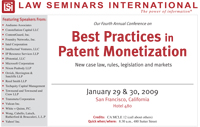
    January 29-30, 2009 – Fourth Annual Conference on Best Practices in Patent Monetization (Law Seminars International) – San Francisco, CA

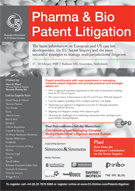
    February 17-18, 2009 – Pharma/Biotech Patent Litigation (C5) – Amsterdam, Netherlands

    ***Patent Docs is a media partner of this conference or CLE

  • San Francisco #2
    Law Seminars International (LSI) will be holding its Fourth Annual Conference on Best Practices in Patent Monetization conference on January 29-30, 2009 in San Francisco, CA.  During the conference, LSI's faculty will offer presentations on the following topics:

    • How do you get useful patents?
    • Creating and implementing decision rules for patent portfolio mining and management (hold, sell, license or abandon?);
    • Challenges and uncertainties in patent law:  Keeping on top of evolving standards for patentable subject matter and obviousness;
    • Strategies in the how and why of buying patents;
    • Designing a purchasing model to meet specific needs;
    09PATSCA-1
    • Continue the exchange of ideas:  Reception for faculty and attendees;
    • Patent sales case studies;
    • Making patent transactions more efficient; and
    • Licensing vs. litigation:  When you have a patent portfolio worthy of licensing, how do you determine the appropriate strategy to meet your business goals?

    The agenda for the conference can be found here.  A complete brochure for this conference, including an agenda, list of speakers, and registration form can be downloaded here.

    Law Seminars International
    The registration fee is $622.50 for students and new employees, $945 for government employees, or $1,245 for all other attendees (a group rate of $1095 each for two or more registrants from the same firm is also available).  Those interested in registering for the workshop can do so here.

  • Amsterdam
    C5 (UK) will be holding its Pharma/Biotech Patent Litigation conference on February 17-18, 2009 in Amsterdam, Netherlands.  At this conference, C5 faculty will offer presentations on the following topics:

    • Review of 2008 European case law developments;
    • Assessing the likely ramifications of the German olanzapine decision;
    • Inventive step post Angiotech:  Has UK patent law returned to the European fold?
    • Where is obviousness in the U.S. post KSR?
    • Reviewing recent U.S. judicial decisions;
    • Assessing the future of patent litigation and settlement agreements following the EC sector inquiry;
    • Ensuring that strategic litigation decisions are aligned with international business goals;
    • Analysis of the availability and strategic use of injunctions in Europe;
    • Managing the growing challenges associated with disclosure and the gathering of evidence across Europe;
    • Conducting complex multi-jurisdictional patent litigation:  Choosing your litigation strategy, managing your litigation team and ensuring optimal information flow;
    • Exploiting expertise:  Best practices for effective selection and use of expert witnesses;
    • Analyzing the growing trend of generic industry attacks on SPCs; and
    • Use of border detention measures in patent infringement disputes as an alternative to litigation.

    816L09-AMS3390
    An additional post-conference master class, entitled "Coordinating and Managing Complex Multijurisdictional Litigation Across Europe," will be offered on February 19, 2009.  This master class is designed to help attendees tackle the vast number of multijurisdictional legal, business, technological, and documentary issues that are characteristic of complex pharma-bio patent cases and help attendees hone the specialized set of case management skills and techniques winning such cases requires.

    A complete brochure for this conference, including an agenda, list of speakers, and registration form can be downloaded here.

    C5
    The registration fee for the conference is £1499 ($2,188.86), for the conference plus master class £2098 ($3,063.53), and for the master class alone £599 ($874.67).  For those registering before December 23, 2008, the registration fee for the conference is £1399 ($2,042.84) for the conference plus master class £1998 ($2,917.51), and for the master class alone £599 ($874.67).  Those interested in registering for the conference can do so here, by calling +44 (0) 20 7878 6888, by faxing a registration form to +44 (0) 20 7878 6896, or by e-mailing marketing@C5-Online.com.

  •     By Donald Zuhn

    USPTO Seal
    On Wednesday, the biotechnology, chemical, and pharmaceuticals (BCP) technology groups at the U.S. Patent and Trademark Office held their most recent quarterly customer partnership meeting.  During the last of six presentations, Associate Solicitor Janet Gongola outlined a new training module that the Office has begun using to instruct examining corps about case law.  Ms. Gongola noted that the new training module had been first used on November 18th, and that the examiners in Tech Center 1600 (biotechnology and organic chemistry) would receive their case law training sometime in December.

    The new training module has been designed by the Office to provide examiners with a basic understanding of case law, including the components of an opinion, the meaning of precedent, and how to cite cases, so that examiners will be better able to respond to the use of case law by patent practitioners.  The case law training module being used by the Office consists of a pair of two-hour sessions, the first session constituting a lecture by an attorney from the Office of the Solicitor and the second session constituting a series of four laboratory exercises in which trainees split off into small groups to address hypothetical situations involving §§ 101, 102, 103, and 112 rejections.

    Reviewing a number of slides from the first session of the training module, Ms. Gongola informed attendees that examiners are taught to always consult the MPEP first when attempting to ascertain the Office's policy regarding the meaning of a cited case.  In the event that the MPEP provides no information regarding the cited case, examiners are then taught to focus on the portion of the case that has been cited by the practitioner, and then, if necessary, to read other parts of the case that may be pertinent the issue.  The training module also helps examiners understand, identify, and distinguish holdings and dicta.  (Ms. Gongola noted, however, that examiners were being taught to avoid debates with practitioners over whether particular statements in a case constitute holdings or dicta.)  In addition, examiners are instructed on the difference between the headnotes/syllabus and the opinion itself and the difference between majority and plurality opinions, concurrences, and dissents.

    During her presentation, Ms. Gongola recommended that when citing cases, practitioners should always cite to the U.S.P.Q. reporter, as it is the only reporter to which examiners have access.  In view of the limited amount of time that examiners are allowed to spend examining applications on their dockets, this recommendation appears to be a good one.

    In an interesting aside, Ms. Gongola noted during her presentation that the Patent Office had hired 1192 new examiners in 2008, of which 32 had been assigned to TC 1600 and 207 had been assigned to TC 1700 (chemical and materials engineering).  The Associate Solicitor also noted that in 2007, 1196 new examiners had been hired, of which 62 had been assigned to TC 1600 and 154 had been assigned to TC 1700.  For the patent practitioners in the audience, who one might assume deal mostly with TC 1600 examiners, this does not come as particularly good news — especially since the average total pendency in YC 1600 rose to 34.8 months in 2008 from 34.4 months in 2007 (see "USPTO Announces 'Highest Performance Levels in Agency’s History' in 2008").

    A copy of Ms. Gongola's presentation can be obtained here.

  •     By Mark Chael

    Mylan
    On December 2nd, Mylan, Inc. and Mylan Pharmaceuticals, Inc. announced that they had settled their dispute with Novartis Pharmaceuticals Corp., Novartis Corp., and Novartis International AG over a generic version of Novartis' Femara® tablets.

    According to the press release, Femara® tablets, which are used in the treatment of breast cancer, had U.S. sales of about $470 million for the 12 months ending September 30, 2008.

    Novartis
    Novartis initiated the dispute in June of 2006, when it sued Mylan following Mylan's filing of an ANDA with a Paragraph IV certification seeking approval to market generic letrozole tablets prior to the expiration of U.S. Patent No. 4,978,672, listed in the Orange Book for Novartis' Femara® tablet NDA.  The patent claims are drawn to the active pharmaceutical ingredient in letrozole tablets as well as to methods of using the drug.

    With the settlement, Mylan will receive a license to market its generic version of Femara® tablets prior to the expiration of Novartis' patent in 2011.  Other details of the settlement were not released.

  •     By Donald ZuhnWyeth

    As we reported yesterday, Director Jon Dudas of the U.S. Patent and Trademark Office filed a Notice of Appeal in the District Court for the District of Columbia on November 28th, appealing the Court's decision in Wyeth v. Dudas to the United States Court of Appeals for the District of Columbia Circuit (see "USPTO to Appeal Wyeth v. Dudas").  As we noted earlier this fall in our summary of the Wyeth case, the decision could significantly impact the manner in which the Patent Office makes Patent Term Adjustment (PTA) determinations (see "Wyeth v. Dudas (D.D.C. 2008)").

    The Wyeth decision, however, has already had a significant impact in that a number of suits have been filed against Director Dudas asserting improper PTA determinations.  In November, we reported on the first two patentees to follow in Wyeth's footsteps by filing complaints against Director Jon Dudas for similar PTA "miscalculations" (see "Two Patentees Follow Wyeth's Lead in Seeking Additional PTA").  In particular, on September 5th, San Francisco-based Napo Pharmaceuticals, Inc. filed a complaint in the District Court for the District of Columbia, asserting that the correct PTA for U.S. Patent No. 7,341,744 (issued March 11, 2008) should be 1007 days rather than the 453-day period calculated by the Patent Office.  On November 7th, Ironwood Pharmaceuticals, Inc. of Cambridge, MA filed a complaint asserting that the correct PTA for U.S. Patent No. 7,371,727 (issued May 13, 2008) should be 702 days rather than the 411-day period determined by the Office.

    Solvay
    Recently, four more patentees filed complaints against USPTO Director Jon Dudas contending that the Patent Office's PTA determinations were incorrect.  On the same day that Director Dudas filed his Notice of Appeal, Solvay Pharmaceuticals GmbH of Hannover, Germany, filed a complaint asserting that the correct PTA for U.S. Patent No. 7,381,729 (issued June 3, 2008) should be 633 days rather than the 534-day period calculated by the Patent Office (see complaint).  And on Monday, three more patentees followed suit.  These patentees include:

    Biogen Idec
    • Biogen Idec Inc. of Cambridge, MA, which filed a complaint asserting that the correct PTA for U.S. Patent No. 7,381,560 (which issued June 3, 2008) should be 2,058 days rather than the 1,409-day period determined by the Office (see complaint);

    Purac BiochemPurac Biochem
    • Purac Biochem B.V. of the Netherlands, which filed a complaint asserting that the correct PTA for U.S. Patent No. 7,410,556 (which issued August 12, 2008) should be 949 days rather than the 386-day period determined by the Office (see complaint); and

    Molecular Insight Pharmaceuticals
    • Molecular Insight Pharmaceuticals, Inc. of Cambridge, MA, which filed a complaint asserting that the correct PTA for U.S. Patent No. 7,381,399 (which issued June 3, 2008) should be 1303 days rather than the 634-day period determined by the Office (see complaint).

    Because 35 U.S.C. § 154(b)(4)(A) specifies that "[a]n applicant dissatisfied with a [PTA] determination made by the Director . . . shall have remedy by a civil action against the Director filed in the United States District Court for the District of Columbia within 180 days after the grant of the patent," three of the four patentees above had little choice but to file complaints seeking additional PTA (while Purac had until February 8, 2009 to file its complaint, the other three patentees had until Sunday, November 30th to file their complaints).  And now that the Patent Office has decided to fight Judge Robertson's decision in Wyeth, patentees facing similar situations will be forced to file complaints to obtain additional PTA.  Patent Docs will continue to monitor newly filed actions in the District Court for the District of Columbia in order to identify other patentees seeking corrected PTA determinations.

    For additional information regarding this and other related topics, please see:

    • "USPTO to Appeal Wyeth v. Dudas," December 2, 2008
    • "Two Patentees Follow Wyeth's Lead in Seeking Additional PTA," November 12, 2008
    • "Wyeth v. Dudas (D.D.C. 2008)," October 16, 2008