• Federal Circuit Denies En Banc Review in GlaxoSmithKline LLC v. Teva Pharmaceuticals USA

    By Kevin E. Noonan

    Federal Circuit SealThe 2020 decision by a divided Federal Circuit panel in GlaxoSmithKline LLC v. Teva Pharmaceuticals USA regarding the extent to which an ANDA applicant who obtained regulatory approval under the Section viii carve-out provisions of the statute could be liable for inducement of infringement under 35 U.S.C. § 271(b) caused something of an uproar, leading to a panel rehearing on the matter but ultimately coming to the same conclusion.  Both decisions were issued in the face of a strong dissent by Judge Prost, in the first decision while she was Chief Judge.  Last Friday, the Court decided not to rehear the matter en banc, over the dissenting opinions of three of the judges (including Judge Prost).

    The matter arose in litigation over GSK's Coreg® product (carvedilol) for treatment of hypertension (the initial approved indication; U.S. Patent No. 4,503,067), congestive heart failure (CHF) (the subject of U.S. Patent No. 5,760,069), and left ventricular dysfunction following myocardial infarction (LVD-MI).  The '069 patent recites a method of treating CHF with a combination of carvedilol and "one or more of an angiotensin-converting enzyme ("ACE") inhibitor, a diuretic, and digoxin."

    Teva's ANDA was filed with a Paragraph III certification over the '067 patent and a Paragraph IV certification over the '069 patent.  The FDA tentatively approved Teva's generic product for "treatment of hypertension and heart failure" which Teva launched on expiration of the '067 patent.  Teva's label indicated that the product was approved for treatment of LVD-MI and hypertension and announced that the FDA had given its product an "AB rating" (which the opinion explained "allow[s] users to determine quickly whether the Agency has evaluated a particular approved product as therapeutically equivalent to other pharmaceutically equivalent products").  Thereafter, the FDA required Teva to amend its label to be identical to the GSK label for Coreg®, which introduced treatment of heart failure into the approved treatments recited in Teva's label.

    GSK filed for reissue of the '069 patent which was duly granted by the U.S. Patent and Trademark Office as Reissue Patent No. RE40,000; claim 1 is representative of the invention as claimed in the '000 reissue patent:

    1.  A method of decreasing mortality caused by congestive heart failure in a patient in need thereof which comprises administering a therapeutically acceptable amount of carvedilol in conjunction with one or more other therapeutic agents, said agents being selected from the group consisting of an angiotensin converting enzyme inhibitor (ACE), a diuretic, and digoxin,
        wherein the administering comprises administering to said patient daily maintenance dosages for a maintenance period to decrease a risk of mortality caused by congestive heart failure, and said maintenance period is greater than six months.

    (Where the italicized portion of the claim represents the modifications introduced in prosecution of the reissue application.)

    GSK filed suit against Teva for inducement of infringement based on the Teva label, based on direct infringement by physicians prescribing the drug for the label indications.  Teva argued that it had "carved out" the indication for CHF pursuant to 21 U.S.C. § 355(j)(2)(A)(viii), resulting in a "skinny label" with regard to this indication.  Thereafter, the FDA compelled Teva to amend its label to include that indication.  In addition, Teva argued that it could be liable for inducement only if GSK could show that Teva had "directly communicated with the direct infringers and 'caused' them to directly infringe the method in the '000 patent."  In a jury instruction, the District Court informed the jury that circumstantial evidence could be used to satisfy this burden.

    The jury found that Teva induced infringement of the '000 reissue patent both before and after the label amendment (albeit infringing several claims after but not before that change).  The District Court granted Teva's motion for judgment as a matter of law (JMOL) on the basis that GSK had not "caused" physicians to prescribe their product for the infringing uses.  Because proof of such causation was required, according to the District Court, its absence precluded the jury from basing its decision on substantial evidence.  The Court relied on the "many sources of information available to prescribing physicians" other than Teva's label (including paradoxically GSK's label and promotion of its Coreg® product) in finding this evidentiary deficiency.  Also, the Court based its decision on physician testimony that their prescribing behavior relied on "guidelines and research, as well as their own experience" and not Teva's label.  "In sum," the Court said, "substantial evidence [did] not support the jury's finding on causation, and therefore [did] not support its verdict that Teva is liable for induced infringement, during both the skinny and full label periods."

    On appeal the Federal Circuit reversed, in an opinion by Judge Newman joined by Judge Moore; Chief Judge Prost provided a lengthy, comprehensive dissent.  The panel majority relied on the Supreme Court's decision in Global-Tech Appliances, Inc. v. SEB S.A., 563 U.S. 754 (2011), that copying is evidence of inducement, and also found compelling evidence from Teva's website regarding its product's AB rating with GSK's Coreg® product and other promotional content, as well as testimony from GSK's witnesses regarding physician reliance on information from generic drug makers.

    The panel majority opined that the District Court erred in applying the incorrect legal standard, stating that "precedent makes clear that when the provider of an identical product knows of and markets the same product for intended direct infringing activity, the criteria of induced infringement are met."  Considering this precedent, the majority held that "[t]here was ample record evidence of promotional materials, press releases, product catalogs, the FDA labels, and testimony of witnesses from both sides, to support the jury verdict of inducement to infringe the designated claims for the period of the '000 reissue patent."

    Then-Chief Judge Prost dissented based on her objections to the quanta of evidence adduced and policy consequences should the majority's position be sustained.  In the then-Chief's view, the majority's decision undermined the policy goals, embodied in the provisions of the law regarding skinny labels, for balance between the incentives patents provide for pharmaceutical innovation and the public's need for access to that innovation once the patent term has expired.  In her view, the majority's decision undermined these policy goals by finding Teva induced infringement by marketing its generic drug produce for unpatented uses (emphasis in dissent) using its skinny label.  The dissent not only disagreed with the majority's decision, but apprehended it to "nullify[y] Congress's statutory provision for skinny labels—creating liability for inducement where there should be none," contrary to Congressional intent and "slowing, rather than speeding, the introduction of low-cost generics."

    The original majority opinion occasioned an outpouring of outrage from industry groups (particularly generic ones) who latched onto the then-Chief Judge's rhetoric in her dissent to the effect that the opinion eviscerated the congressional sanctioning of skinny labels.  The Court granted panel rehearing in February that resulted in the second opinion that was the subject of the Court's denial of en banc review.

    The outcome did not change in that second opinion (although the explication of the process aspects of the majority, per curiam opinion were perhaps more explicit).  After reciting the procedural posture of this decision (as a panel rehearing), the majority addressed amici's concerns (amply represented in eleven amicus briefs, including a brief by one of the architects of the generic's law former Representative Henry Waxman).  The opinion recited with approval the behavioral distinctions underpinning the majority's decision based on the law with regard to skinny labels:

    Generics could be held liable for actively inducing infringement if they marketed a drug with a label describing a patented therapeutic use or if they took active steps to encourage doctors or patients to use the drug in an infringing manner.  But generics could not be held liable for merely marketing and selling under a 'skinny' label omitting all patented indications, or for merely noting (without mentioning any infringing uses) that FDA had rated a product as therapeutically equivalent to a brand-name drug [emphasis in original].

    Stating that the panel (or at least the majority) agreed to rehear arguments "to make clear how the facts of this case place it clearly outside the boundaries of the concerns expressed by amici, the opinion stated that the basis for their decision that the jury correctly found Teva liable for inducing infringement was "by marketing a drug with a label encouraging a patented therapeutic use (emphasis in opinion).  The opinion also stated more precisely the procedural basis for their opinion:  "[t]his is a case in which substantial evidence supports a jury finding that the patented use was on the generic label at all relevant times and that, therefore, Teva failed to carve out all patented indications."  The majority also emphasized that their decision was a "narrow, case-specific review of substantial evidence [that] does not upset the careful balance struck by the Hatch-Waxman Act regarding section viii carve-outs."  The remainder of the majority opinion set forth (extensively) the evidentiary basis for their opinion that there was sufficient evidence (including expert testimony and marketing efforts occurring both before and after FDA-mandated changes to Teva's label) to satisfy the substantiality standard, and that the District Court erred in granting Teva JMOL to the contrary (inter alia including specific errors in treating factual questions as legal ones that the majority state were "not this court or the district court, to resolve").

    Former Chief Judge Prost remained unconvinced, in large part because this outcome (in her view) undermined the congressionally sanctioned skinny label regime (if only by rendering it much more case- and fact-specific than she perceived Congress intended).  The outcome-based philosophy of the dissent was presaged in its first sentence, where Judge Prost reminded the reader that "GSK's patent on carvediol expired in 2007" followed by the statement that "[b]ecause the FDA cannot authorize a generic version of a drug that would infringe a patent, this one remaining patented use could have prevented a less-expensive, generic carvedilol from coming to market altogether—even though the drug itself and other uses of it were unpatented."  The skinny label regime was Congress's solution to the "problem" it "saw coming" in Judge Prost's view.  The majority's decision thwarted this intent, according to Judge Prost, based on evidence of inducement that was "thin to nonexistent."  The District Court had properly exercised its supervisory role in remedying a situation where a jury came to the wrong conclusion Judge Prost concluded, based on her evaluation of the evidence before it.  The Judge sets forth her motivation for writing (once again) in dissent (and that the majority's attempt to provide a comforting standard falls short in her opinion):

    I write in this case because far from being a disagreement among reasonable minds about the individual facts, this case signals that our law on this issue has gone awry.  I am particularly concerned with three aspects of the majority's analysis.  First, even setting aside the majority's willingness to glean intentional encouragement from a label specifically designed to avoid encouragement, the majority further weakens the intentional-encouragement prong of inducement by effectively eliminating the demarcation between describing an infringing use and encouraging that use in a label.  Second, the majority defies basic tort law by eviscerating the causation prong of inducement.  The upshot of these two moves is that a plaintiff now has to show very little for a jury to speculate as to the rest.  Third, the majority creates confusion for generics, leaving them in the dark about what might expose them to liability.  These missteps throw a wrench into Congress's design for enabling quick public access to generic versions of unpatented drugs with unpatented uses.

    The decision by the full Court was announced in a simple Order to that effect, noting that Judges Lourie and Cunningham did not participate in the decision.  The Order was accompanied by three written dissents:  one by Judge Prost, joined by Judges Dyk and Reyna; another by Judge Dyk writing alone, and the third by Judge Reyna.  The majority of Chief Judge Moore and Judges Newman (who was the third member of the original panels), O'Malley, Taranto, Chen, and Stoll.  Judge Prost's dissent calls the decision not to rehear the case en banc "disappointing," insofar as the issues "affect[] millions of Americans," and she terms the Court's refusal to rehear en banc an "abdication of [the] responsibility [to review issues at the intersection of patent law and pharmaceutical regulation]."  The dissent characterizes the majority's treatment of the regulatory and statutory processes involved in obtaining skinny label regulatory approval as "quite unsatisfactory," saying the majority "refuses to confront the obvious question:  how could this label, which faithfully followed what the brand said about its own patents and which the FDA required Teva to use, itself be evidence that Teva intentionally encouraged something it knew would infringe?"  As a consequence of the majority decision, "no skinny-label generic is safe" in Judge Prost's view.  This is because "most skinny labels contain language that (with clever expert testimony) could be pieced together to satisfy a patent claim," as asserted by several amici (one of whom, Mylan Pharmaceuticals, termed this the "Where's Waldo" approach).  This outcome is contrary to Congressional intent, in Judge Prost's view, which was for generic companies to avoid inducement liability under skinny-label circumstances (emphasis in dissent).  Generic drug companies who follow FDA guidelines for skinny labels are "play[ing] by the skinny-label rules" she writes, and "[e]ven if remaining label language might be pieced together to 'meet' the elements of a patent claim, the extent to which that's true is an unreliable gauge of a generic's 'intent' in this highly regulated area; it can't meaningfully separate the liable from the lawful."  And she notes the consequences stemming from the generic drug maker's economic model by illustration:  Teva's revenues ("having made no profit," which is a bit curious), according to the dissent, were $74 million but the judgement below for inducing infringement was $234 million.  Under these circumstances, "generics simply won't play."  Judge Prost concludes her dissent by addressing what she considers inaccuracies in the majority's concurrence regarding arguments she believes were made but that the concurrence asserts were not, and its characterizations of her concerns to be fairness, when Judge Prost maintains those concerns are based on "what inducement law permits in view of the Hatch-Waxman Act.

    Judge Dyk's dissent writes "to further elaborate why there cannot be infringement liability for using a label required by the FDA during the partial label period at issue in this case."  These elaborations are based on the extent to which Teva was obligated under law to accept the label mandated by the FDA in making it's Section viii carve-out which is did (". . . FDA provided Teva with a redline for its skinny label, carving out the patented indication for congestive heart failure from GSK's branded label and keeping the remaining uses in the label").  Judge Dyk points out that, "[i]n In similar circumstances where states have sought to impose tort liability on generic drug manufacturers for using the label required under federal law, the Supreme Court has made clear that federal law preempts tort liability on the part of the manufacturers," citing Mutual Pharm. Co. v. Bartlett, 570 U.S. 472, 476 (2013), and PLIVA, Inc. v. Mensing, 564 U.S. 604, 609 (2011).  There is, in Judge Dyk's view a conflict between "FDA-required labeling" and the law of infringement, and using "[c]anons of statutory construction" concludes that the "more specific and later-enacted provisions of the Hatch-Waxman Act override the general infringement provisions of the Patent Act," citing United States v. Estate of Romani, 523 U.S. 517, 532 (1998); Morton v. Mancari, 417 U.S. 535, 550–51 (1974); Bulova Watch Co. v. United States, 365 U.S. 753, 758 (1961); and Rodgers v. United States, 185 U.S. 83, 87–89 (1902).  And Judge Dyk disagrees with the concurrence substantially along the same lines as Judge Prost does in her dissent.

    Finally, Judge Reyna in a brief dissent asserts that "the briefs, the majority opinion, the dissent, and the number of amicus briefs filed to date" satisfy the provisions of the Court's Internal Operating Procedure No. 13(2)(b) for rehearing en banc issues of "exceptional importance."

    Chief Judge Moore's concurring opinion illustrates an interpretation of Judge Prost's dissent that the majority and the dissenting judges interpreted very differently what had gone on below and before the Federal Circuit in the two prior appearances before the panel.  Judge Moore begins by the simple assertion that the dissent's basis for en banc review were "legal positions that Teva has not asserted or developed," reciting a litany.  The argument, according to the Chief, was simply "whether, considering all the facts, substantial evidence supports the jury's verdict that Teva actively encouraged infringement."  But Chief Judge Moore affirmatively asserts that "Teva never argued that there was a conflict between the FDA regulatory framework and patent law (as the dissents now claim); nor did it argue that the partial label was not evidence relevant to or otherwise impermissible for deciding inducement (as the dissents now suggest).  She characterizes the majority's opinion as being "narrow and fact dependent," supported by how one district court has interpreted the opinion, see Amarin Pharma, Inc. v. Hikma Pharma. USA Inc., No. 1:20-cv-1630 (D. Del. Jan. 4, 2022).  But the "cobbling together" argument made in Judge Prost's dissent was considered by the panel because Teva made that argument, which in a footnote the Chief terms "a non-starter" based on instances where the Court "regularly allow claim elements to be found in different portions of a label" and citing as an example  Sanofi v. Watson Lab'ys Inc., 875 F.3d 636, 646 (Fed. Cir. 2017).  The concurrence apprehends the dissents arguments to be grounded in fairness (a characterization Judge Prost's dissent directly rejects), based on the label not supporting the intent required by the statute (quoting extensively from Judge Prost's rhetoric about "playing by the skinny-label rules").  While expressing concern that "GSK's representations to the FDA are at odds with its enforcement efforts in this case" and "[i]t would be troubling to hold Teva liable for relying on GSK's representations to the FDA," "that concern does not readily fit the standards governing inducement."  The concurrence sees a possible solution in the doctrine of equitable estoppel, which provides a possible remedy on remand in the Chief's view.  And while Judge Prost thinks little of this use of equitable estoppel in this or any skinny-label instance, Chief Judge Moore asserts that the principles of equitable estoppel ("misleading conduct, reliance, and prejudice") "track this three-element framework precisely" and provide an analysis of this argument (saying "[t]his theory fits the textbook structure of an  equitable estoppel argument").  Chief Judge Moore believes it better to permit this argument to be asserted on remand and then, under appropriate circumstances, return to the Court for review.

    These considerations on remand suggest that for the parties it isn't over.  And to the extent that the Chief is correct that district courts (albeit using a N=1) have interpreted the panel decision parsimoniously perhaps Judge Prost's concerns about the effect the panel opinion will have on generic manufacturers' use of skinny labels are overblown.  And perhaps also these sentiments, although not binding will help define the contours of the District Court's application of the opinion and its effect on skinny-label practices.  Provided the panel decision does not significantly inhibit skinny-label practice these issues are sure to recur and be the subject of additional Federal Circuit decisions which will make the consequences of this decision, and the Federal Circuit's decision not to review the panel opinion en banc, more evident.

    GlaxoSmithKline LLC v. Teva Pharmnaceuticals USA (Fed. Cir. 2022)
    Per curiam order
    Chief Judge Moore, joined by Circuit Judges Newman, O'Malley, Taranto, Chen, and Stoll, concurs in denial of petition for rehearing en banc; Circuit Judge Prost, joined by Circuit Judges Dyk and Reyna, dissents from denial of petition for rehearing en banc; Circuit Judge Dyk dissents from denial of petition for rehearing en banc; Circuit Judge Reyna dissents from denial of petition for rehearing en banc

  • By Kevin E. Noonan

    Broad InstituteOn December 3rd, Junior Party the Broad Institute, Harvard University, and MIT (collectively, Broad) filed its Contingent Preliminary Motion No. 3 in Interference No. 106,133 (which names Sigma-Aldrich as Senior Party), asking the Patent Trial and Appeal Board to designate certain claims deemed in the Declaration as corresponding to the Interference Count as not having such correspondence, under 37 C.F.R. 4 §§ 41.121(a)(1)(i) and 41.207(b)(2).  These claims fall into five discrete categories:

    Category A:      Staphylococcus aureus Cas9 protein ("SaCas9");
    Category B:      Cas9 chimeric CRISPR enzyme;
    Category C:      Cas9 with two or more nuclear localization signals ("NLSs");
    Category D:      Cas9 fused to specified protein domains; and
    Category E:      Claims that are generic as to RNA and also do not specify integration of a donor polynucleotide sequence ("Donor Template Integration" claims), i.e., the only claims that should remain designated as corresponding to Count 1 are those that are either (i) limited to single molecule RNA ("sgRNA"), or (ii) require Donor Template Integration and are not otherwise separately patentable.

    Broad sets forth the claims they ask be de-designated for each example, but perhaps more telling is the recitation of the claims remaining as corresponding to the Count should the motion be granted:  "claims 4, 11 and 18 of U.S. Patent No. 8,697,359 . . . , claim 5 of U.S. Patent No. 8,771,945 . . . , all claims (1-18, 30) of U.S. Patent No. 8,795,965 . . . , claims 2, 5 and 30 of U.S. Patent No. 8,906,616 . . . , claims 8-9, 14, 16 and 27 of U.S. Patent No. 9,840,713 . . . , and claims 14-16 of Application No. 14/704,551 . . ." (references to exhibits and abbreviations omitted).

    The brief sets forth the relevant characteristics of the "McKelvey" Count comprising a claim from a Broad-involved patent (claim 18, U.S Patent No. 8,697,359) or claim 31 of Sigma-Aldrich's U.S. Application No. 15/456,204.  Broad makes as a basis for its motion the distinction that the Broad portion of the Count is directed to CRISPR-mediated cleavage in a eukaryotic cell (that "cover[s] many different inventions that are separately patentable from Count 1") while Sigma-Aldrich's portion of the Count recites CRISPR-mediated cleavage coupled with integration of a heterologous DNA molecule, termed "Donor Template Integration," should be de-designated as not corresponding to Count 1 of the '133 Interference (while being "generic" for the structure of the RNA CRISPR component, i.e., single- or dual-molecule embodiments).  The distinctions Broad draws in its argument track the categories of claims set forth above, and Broad argues that "[n]one of the claims directed to those improvements and selections are anticipated by, or obvious in view of Count 1 if considered as prior art alone or in proper combination with the prior art."  The brief reminds the Board that in related Interference No. 106,132, Sigma-Aldrich itself argued that these CRISPR embodiments were not obvious in view of what was known in the art in December, 2012  (see "Sigma-Aldrich Files Substantive Preliminary Motion 1 to Change the Count in Interference No. 106,132").  Broad also argues that "Proposed Count 2 in the 132 Interference and Count 1 (as well as Proposed Count 3) here are materially the same with respect to the relevant Cas9 and NLS related limitations" in support of its Motion.

    Getting to the point, the brief argues that Broad's claims "that are both generic as to RNA and not limited to Donor Template Integration" should be de-designated as not corresponding to Count 1 of the '133 Interference as declared (in addition to the categories of claims set forth above).  "The only claims that should correspond to Count 1 are those that either are limited to use of sgRNA (and so correspond to the Broad half of Count 1) or recite Donor Template Integration (and so correspond to the Sigma half of Count 1)," Broad argues.  In addition, Broad argues that its generic claims "that do not limit the RNA configuration to sgRNA are currently designated as corresponding to Count 1," even though the Count is limited to single-molecule guide RNA (sgRNA) and thus should not correspond to the Count (while conceding that the term "guide RNA" was limited to sgRNA by the Board in related Interference No. 106,115).  Broad supports its argument by noting that neither Sigma-Aldrich in this interference or the related '132 Interference, nor ToolGen in related Interference No. 106,126 limit the term "guide RNA" to the sgRNA species.  And under the "plain meaning" rubric of claim construction, Broad argues, the term "guide RNA' should not be limited to the sgRNA species.  Thus, according to Broad, the Board has basis to de-designate many of its claims are not corresponding to the "Broad" portion of McKelvey Count 1 of this interference.

    Moreover, Broad argues that many of its claims are not limited to eukaryotic CRISPR embodiments reciting the limitation for Donor Template Integration as recited in the Sigma-Aldrich portion of the McKelvey Count in this interference as declared.  Broad argues the patentable distinction between the invention(s) encompassed by this portion of the Count and Broad's claims is supported by Sigma-Aldrich's consistent arguments, during prosecution of its '204 application-in-interference.  Thus, Broad argues such claims do not correspond to the Count and the Board should accordingly de-designate them from this interference.

    The brief then sets forth in detail how its claims limited to each of the categories set forth above are neither anticipated not rendered obvious by the Count as declared and thus are independently patentable from the subject matter defined by the Count.  These claims are identified in the brief as follows:

    Category A:      All of the Involved claims of U.S. Patent No. 8,865,406, U.S. Patent No. 8,895,308 and Application No. 15/330,876, because these claims are limited to using Staphylococcus aureus Cas9 protein ("SaCas9") and, at the relevant times (2012) "there were more than 600 bacterial Cas9 orthologs that had been identified" but no suggestion of using SaCas9 in eukaryotic CRISPR embodiments; moreover, SaCas9 and SpCas9 (from Streptococcus pyogenes) shared only 17% amino acid sequence identity.  Regarding the obviousness question Broad also asserts several of the objective indicia of non-obviousness, including unexpected results and commercial success.

    Category B:      All of the involved claims of Broad's U.S. Patent No. 8,889,418 ("418 patent") reciting Cas9 chimeric CRISPR enzymes, because these claims are not anticipated by the Count nor would these claims be obvious, a position Broad asserts Sigma-Aldrich itself advanced during prosecution of its '204 application in interference and in the related '132 Interference (supported by expert testimony).

    Category C:      All of the claims of U.S. Patent No. 8,871,445, U.S. Patent No. 8,932,814, claim 7 of U.S. Patent No. 8,993,233, claims 9-11 of U.S. Patent Application No. 14/704,551, and claim 34 of U.S. Patent Application No. 15/330,876, which recite Cas9 with two or more nuclear localization signals ("NLSs").  Broad argues that the Broad portion of the Count is limited to Cas9 species bearing a single NLS (and hence does not anticipate) and regarding obviousness that "a POSA would have understood that adding amino acids to a protein such as Cas9 could alter its folding affecting its structure and function in ways that were not predictable."  This position, Broad argues, is one Sigma-Aldrich also took during ex parte prosecution of the '204 application-in-interference and in the related '132 Interference.  Finally, Broad argues unexpected results in the disclosure set forth in U.S. Application No. 61/736,527, filed December 12, 2012.

    Category D:      All of the claims (1-43) of Broad's U.S. Patent No. 8,993,233, all claims (1-28) of U.S. Patent No. 8,999,641, claims 18, 19, 25, 29-30, and 36 of U.S. Patent No. 9,840,713, and claim 21 of U.S. Patent Application No. 15/330,876, having claims reciting Cas9 fused to specified protein domains.  Broad argues that the Count recites no such limitation and thus does not anticipate and, as for obviousness, "there is no teaching or suggestion in Count 1 or the prior art directing a POSA to modify the naturally occurring Cas9 protein sequences as set forth in these claims" and the unexpected results set forth in the specifications of these Broad patents and applications supports a conclusion of non-obviousness.  Also, Broad here as elsewhere notes that Sigma-Aldrich has taken a like position the related '132 Interference (albeit directed to NLS-modified Cas9 species).

    Category E:      Claims Broad argues do not correspond to the Count as declared in this category "fall into one of three groups:"

    1) "claims that do not require an RNA component at all";

    2) "claims that are generic as to the RNA component and do not use the term 'guide RNA'"; and

    3) "claims that use the term 'guide RNA' but are still generic as to the RNA component under the proper construction of 'guide RNA.'"

    These claims include claims 15, 17-26, and 28-41 of U.S. Patent No. 9,840,713; claims 1-24 of U.S. Patent No. 8,889,418; claim 13 of U.S. Patent No. 8,871,445; claims 1, 2, 5, and 30 of U.S. Patent No. 8,906,616; claims 1, 8, 9, and 14 of U.S. Patent No. 9,840,713; claims 1, 4, 8, 11, 15, and 18 of U.S. Patent No. 8,697,359; claims 1 and 5 of U.S. Patent No. 8,771,945; claims 1, 6, 10, 25, 29, and 30 of U.S. Patent No. 8,895,308.

    Broad argues that these claims inter alia recite the RNA component of the CRISPR-Cas9 complex as generic with regard to single- and dual-molecule embodiments.  Thus these claims do not correspond to the Broad portion of the Count (although they are within its scope to the extent that they read on sgRNA CRISPR embodiments).  Broad addresses the fact that the Board disagreed with this argument in denying its Preliminary Motion No. 3 in the '115 Interference (see "PTAB Decides Parties' Motions in CRISPR Interference") but asserts that "evidence provided herewith shows that the BRI of "guide RNA" in Broad's claims is not so limited" (although it is unclear how the evidence set forth herein is substantially different).  Nevertheless Broad argues that the plain meaning under the "broadest reasonable interpretation" (BRI) standard supports its arguments, citing Bamberger v. Cheruvu, 55 U.S.P.Q.2d 1523, at *2 (B.P.A.I. 1998), and that their interpretation is further supported by how the term "guide RNA" was used in the art in 2012, in the Sigma-Aldrich application-in-interference here, and by ToolGen in the related '126 Interference.  Broad also argues the intrinsic evidence, specifically the disclosures in the specifications of its patents and applications-in-interference show a pattern of disclosing (and claiming) generically followed by narrowing disclosures and claims to particular RNA species.  Broad invokes the doctrine of claim differentiation in this regard, and recites what it characterizes as "the hierarchy of claim construction as counseling against interpreting claims "in a way that renders them void, meaningless, or superfluous," citing Wasica Fin. GmbH v. Cont'l Auto. Sys., Inc., 853 F.3d 1272, 1288 n.10 (Fed. Cir. 2017), and reciting specific instances as U.S. Patent Nos. 8,895,308 and 8,909,616.  To the extent generic "guide RNA" is disclosed, Broad further argues that interpreting these claims to fall within the scope of a Count directed to sgRNA embodiments would exclude these (preferred) embodiments from the claims, which is "rarely if ever correct," citing Ex Parte Andrew Graham, Ando Feyh, & Bernhard Gehl, Appeal No. 2017-009616, 2018 WL 4356999, at *3 (P.T.A.B. Aug. 23, 2018), and MBO Labs., Inc. v. Becton, Dickinson & Co., 474 F.3d 1323, 1333 (Fed. Cir. 2007).  Finally, Broad recites extrinsic evidence in support of its arguments, including Jinek 2012 (A programmable dual-RNA-guided DNA endonuclease in adaptive bacterial immunity, Science 337: 816-821), Sigma-Aldrich's disclosure, the disclosure in ToolGen's application-in-interference at issue in the '126 Interference.

    With regard to the Sigma-Aldrich portion of the McKelvey claim Count, the Board's failure to de-designate these claims would "work an unfairness to Broad and unfairly reward Sigma for limiting its claims in prosecution" because Sigma itself had represented to the USPTO, in both ex parte examination and in the related '132 Interference that such claims were patentably distinct from claims falling within the scope of the Broad portion of the Count (i.e., directed to "cleavage-only" aspects of CRISPR practiced in Broad's claims).

    Finally, Broad recites arguments raised in other interferences regarding its "best proofs" related to dual-molecule RNA embodiments of CRISPR and to the Board's decision (affirmed by the Federal Circuit) in Eli Lilly & Co. v. Bd. of Regents of Univ. of Wash., 334 F. 3d 1264, 1268 (Fed. Cir. 2003), directing that the one-way test for determining interference-in-fact would be "over-inclusive" because a "'genus [that] was invented before' a species is 'separately patentable from, the species' for the purposes of determining an interference-in-fact."

    The brief is supplemented with Appendices including, inter alia, a Summary Chart of Grounds and Claims (Appendix C) and a Claim Differentiation Chart (Appendix D).

  • CalendarFebruary 15, 2022 – "The Expanding Reach of the Abstract Idea — What Is and Is Not Patentable Eight Years After Alice" (McDonnell Boehnen Hulbert & Berghoff LLP) – 10:00 am to 11:15 am (CT)

    February 16, 2022 – "Making Sense of Chaos in Non-Competes" (Intellectual Property Owners Association) – 12:00 pm to 1:00 pm (ET).

    February 16, 2022 – "A Conversation with the Federal Circuit Clerk's Office" (Federal Circuit Bar Association Rules Committee) – 2:00 pm to 3:00 pm (ET)

    February 17, 2022 – "The Modern FTO Framework: Strategies for Connected, Risk-Reduced Innovation" (IPWatchdog and ClearstoneIP) – 11:00 am (EST)

    February 17, 2022 – "Building, Leveraging, and Enforcing IP Portfolios, Taking Diverse Perspectives into Account" (Federal Circuit Bar Association) – 12:00 pm to 1:00 pm (ET)

    February 22, 2022 – "Update on Plausibility" (J A Kemp) – 4:00 pm to 5:00 pm (GMT)

  • IPO #2The Intellectual Property Owners Association (IPO) will offer a one-hour webinar entitled "Making Sense of Chaos in Non-Competes" on February 16, 2022 from 12:00 pm to 1:00 pm (ET).  Russell Beck of Beck Reed Riden LLP; Jim Pooley of James Pooley, PLC; and John M. Williamson of Finnegan, Henderson, Farabow, Garrett & Dunner, LLP will address how companies can adapt and contain the legal risk while guarding the integrity of the information entrusted to their employees.

    The registration fee for the webinar is $150 for non-members or free for IPO members (government and academic rates are available upon request).  Those interested in attending the webinar should register here.

  • Federal Circuit Bar Association_2The Federal Circuit Bar Association (FCBA) will be offering a remote program entitled "Building, Leveraging, and Enforcing IP Portfolios, Taking Diverse Perspectives into Account" on February 17, 2022 from 12:00 pm to 1:00 pm (ET).  Patrick C. Keane of Buchanan Ingersoll & Rooney PC; Shawn Cage of Buchanan Ingersoll & Rooney PC (moderator); Isabella Fu of Microsoft Corporation; Qudus Olaniran of Avanci; and Farheena Rasheed, Deputy Solicitor, U.S. Patent & Trademark Office will discuss ways to create and expand patent portfolios under Federal Circuit case law (e.g., business method case law, 101 case law, bio-medical/diagnostic products case law) that align with products of broad consumer interest.  The panel will also explore the effect these patent portfolios can have on advancing licensing, strategies to develop diversity-sensitive portfolios, and the enforceability of such portfolios across diverse global jurisdictions.

    The webinar is complimentary for FCBA members and students, $50 for government/academic/retired non-members, and $175 for private practitioner non-members.  Those interested in registering for the program, can do so here.

  • J A KempJ A Kemp will be offering a webinar entitled "Update on Plausibility" on February 22, 2022 from 4:00 pm to 5:00 pm (GMT).  Ravi Srinivasan and Guy Brain of J A Kemp will cover recent developments in the assessment of whether a "plausible" disclosure of efficacy is present in the application as filed, including a discussion of the decision T 116/18 which has for the first time referred the topic of plausibility to the Enlarged Board of Appeal of the European Patent Office (pending as G 2/21).  The Court of Appeal decision in Fibrogen v Akebia will also be covered, which discusses the issue of plausibility in the context of claims directed to the medical use of a functionally-defined active agent.  The webinar will address the following topics:

    • Plausibility at the EPO and in the English courts
    • The referral of plausibility to the enlarged board of appeal of the EPO
    • Functional features and plausibility
    • The Court of Appeal case in Fibrogen v Akebia
    • Plausibility considerations for patent applications

    There is no registration fee for this webinar.  However, those interested in registering for the webinar, should do so here.

  • By Kevin E. Noonan

    Broad InstituteOn December 3rd, Junior Party the Broad Institute, Harvard University, and MIT (collectively, Broad) filed its Contingent Preliminary Motion No. 2 in Interference No. 106,133 (which names Sigma-Aldrich as Senior Party), asking the Patent Trial and Appeal Board to add claims 52-54 of Broad Application No. 16/177,403 to the interference, pursuant to the provisions of 37 C.F.R. §§ 41.121(a)(1)(i) and 41.208 and Standing Order ¶ 203.2.  The motion is contingent on the Board granting Broad's Substantive Preliminary Motion No. 1 to substitute the Count.

    These claims recite a CRISPR method in eukaryotic cells that cleaves both strands and repairs the break by integration of a template polynucleotide.  Claim 52 is generic with regard to the guide RNA species, comprising dual-molecule and single-molecule (sgRNA) species:

    52.  A method comprising: introducing into, or expressing in, a eukaryotic cell having a DNA molecule,
        (I) a Cas9 protein or one or more nucleotide sequences encoding the Cas9 protein,
        (II) an RNA or one or more nucleotide sequences encoding the RNA, the RNA comprising:
            (a) a first RNA comprising a first ribonucleotide sequence and a second ribonucleotide sequence, and
            (b) a second RNA, and
        (III) a template polynucleotide,
        wherein, the second RNA forms an RNA duplex with the second ribonucleotide sequence, and wherein, in the eukaryotic cell, the first ribonucleotide sequence directs the Cas9 protein to a target sequence of the DNA molecule, whereby the Cas9 cleaves both strands of the DNA molecule and the cleavage is repaired by integration of the template polynucleotide into  the DNA molecule in the eukaryotic cell.

    Claim 53 (dual molecule RNA species) and claim 54 (single-molecule RNA species) recite the two alternative species.  These claims were deemed allowable by the U.S. Patent and Trademark Office Examiner on November 15, 2021.

    The brief sets forth the four requirements for adding a claim to an interference:

    (1) Identify the application or patent to be added;

    (2) Certify that a complete copy of the application file for the application or patent has been served on all opponents except if it belongs to the opponent or if the Office has posted it electronically;

    (3) Indicate which claims of the patent or application should be designated as corresponding to the count and show how the claims correspond to the count(s);

    and

    (4) Explain whether there are alternative remedies; if so, why alternative remedies are not adequate; and what attempts, if any, have been made to have the examiner recommend declaration of another interference.

    Except for reiterating the grounds/bases for the Board to substitute the Count as declared for Proposed Substitute Count 3 (set forth more thoroughly in Broad's Substantive Preliminary Motion No. 1), the remainder of the brief sets out Broad's compliance with these four provisions of Rule 203.2.

  • By Michael Borella

    Federal Circuit SealMentone sued Digi for alleged infringement of Mentone's U.S. Patent No. 6,952,413.  The U.S. District Court for the District of Delaware found the claims of the patent to be ineligible under 35 U.S.C. § 101.  Mentone appealed.

    The invention of the '413 patent is directed to improvements in the allocation of wireless resources for wireless packet data channels (PDCHs).[1]  In the relevant technology, the wireless air interface resources are shared using a technique called time-division multiplexing.  Each PDCH is represented by a repeating set of paired time slots in the uplink and downlink directions.  The uplinks carry information from a mobile device to a base station and the downlinks carry information from the base station to one or more mobile devices.

    Fig. 1
    Figure 1 of the '413 patent, shown above, provides an example, with time flowing from left to right.  Each uplink and downlink consists of repeating frames of 8 slots, numbered 0 to 7.  Thus, Figure 1 depicts two frames of slots in both the uplink and downlink directions.

    A PDCH is the set of slots, from both the uplink and the downlink, that have the same number.  Thus, PDCH 0 consists of all slots numbered 0, PDCH 1 consists of all slots numbered 1, and so on.  These PDCHs are shared amongst the mobile devices that communicate by way of the base station.  Thus, a mechanism to allocate them dynamically is needed to allow for efficient packet data communication, which is often bursty.  A particular mobile device may be allocated n contiguous PDCHs at any given point (where n is no more than 8 in this example).

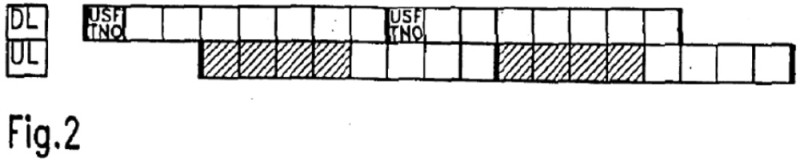
    To facilitate uplink communication, the base station transmits an uplink status flag (USF) in a downlink PDCH slot.  The USF identifies a particular mobile device and informs the mobile device that it may transmit in up to n uplink slots in the subsequent frame, beginning with the uplink slot of the same PDCH.  In other words, if n=4 and a USF in downlink slot 2 identifies the mobile device, then the mobile device may transmit in uplink slots 2, 3, 4, and 5 of the next frame.

    Fig. 2
    For example, in Figure 2 of the '413 patent, n=4 and the USFs in each downlink slot 0 indicates that a particular mobile device may transmit in uplink slots 0, 1, 2, and 3 (indicated by the shaded uplink slots).  Thus, there is a fixed relationship between the downlink slot in which a USF is received and the first uplink slot in which the mobile device can transmit.

    Fig. 3
    Such a system is limited by the ability of the mobile device to switch between receiving and transmitting modes.  In particular, a mobile device might not be able to receive a USF in a downlink slot that immediately follows an uplink slot in which the mobile device was transmitting.  Figure 3 of the '413 patent illustrates this problem — the second (rightmost) USF immediately follows the mobile device's last uplink transmission of the first frame.  The mobile device might not be able to transition quickly enough from transmitting mode to receiving mode in order to be able to receive this USF.

    The '413 patent purports to overcome the limitations of these standardized techniques by allowing the first uplink slot associated with a USF to be "shifted" so that there is enough time between downlink and uplink slots assigned to the mobile device for the mobile device to change its mode.  The resulting advantages, as stated in the patent's specification, involve elimination of rigid slot assignment restrictions thereby allowing increased data transmission rates.

    Fig. 4
    Applying the invention to the arrangement of Figure 3 could result in the arrangement of Figure 4, in which the USF slots and the transmission slots are at least one slot apart from one another.

    Independent claim 5 of the '413 patent was at issue, and recites:

    A multiple access communication method in a mobile station, comprising the steps of:
        receiving an assignment of at least a first PDCH (packet data channel) and a second PDCH;
        monitoring an assigned PDCH to detect a USF; and
        transmitting on an assigned PDCH corresponding to the USF,
        wherein (i) if shifted USF operation is not used then a first assigned PDCH is monitored to detect a USF corresponding to the first assigned PDCH and (ii) if the shifted USF operation is used then a second assigned PDCH is monitored to detect the USF corresponding to the first assigned PDCH and a USF corresponding to the second assigned PDCH.

    Digi moved to dismiss claim 5 and the other asserted claims under Rule 12(b)(6) on grounds of patent-ineligibility.

    In Alice Corp. v. CLS Bank Int'l, the Supreme Court set forth a two-part test to determine whether claims are directed to patent-eligible subject matter under § 101.  One must first decide whether the claim at hand involves a judicially-excluded law of nature, a natural phenomenon, or an abstract idea.  If so, then one must further decide whether any element or combination of elements in the claim is sufficient to ensure that the claim includes an inventive concept amounting to significantly more than the judicial exclusion.  But elements or combinations of elements that are well-understood, routine, and conventional will not lift the claim over the § 101 hurdle.  While this inquiry is generally carried out as a matter of law, factual issues can come into play when determining whether something is well-understood, routine, and conventional.

    Applying the Alice test, the Court rapidly determined that part one was met.  Rather than an abstract idea, the Court found that claim 5 "is directed to a patent-eligible improvement to computer functionality, namely permitting additional multislot configurations for certain classes of mobile stations using extended bandwidth allocation.  Further, "[i]t adds this capability through using a shifted USF that breaks the fixed relationship in the timing of downlink allocation signaling (i.e., receipt of a USF on a timeslot) and subsequent uplink transmission."

    In coming to this conclusion, the Court leaned heavily on the teachings of the specification with regard to the improvements over prior art techniques.  Particularly, the differences between the prior art arrangement of Figure 3 and that of Figure 4, as well as the resulting technical advantages, were emphasized.  Indeed, the Court emphasized that the term "shifted USF" was likely coined by the inventor and therefore one must look to the specification in order to be able to understand its meaning.

    In the District Court, Digi had contended that claim 5 lacked specificity and that it should have recited "when, how, or why one would . . . shift the USF or how a shifted USF would specifically improve the functioning of a prior art system."  But the Federal Circuit dismissed this notion, indicating that the claimed shifted USF operation was particular enough and that the specification contained a detailed flow chart supporting the claimed operation.  Further, the Court noted that an explicit recital of the improvement provided by the invention was not necessary.

    The District Court had found that claim 5 was directed to the abstract idea of "receiving a USF and transmitting data during the appropriate timeslots."  But the Federal Circuit shot down this interpretation, pointing to how the District Court had relied on "a high-level description of how USFs operate in mobile stations using extended bandwidth allocation generally" and was therefore improperly "untethered to the invention as claimed."

    Concluding that claim 5 was not abstract, the Federal Circuit reversed the District Court's dismissal.

    [1] The opinion does not do a fantastic job of describing the underlying technology.  A clearer explanation is found in the ‘413 patent, on which this description was based.

    Mentone Solutions LLC v. Digi International Inc. (Fed. Cir. 2021)
    Nonprecedential disposition
    Panel: Chief Judge Moore and Circuit Judges Lourie and Dyk
    Opinion by Chief Judge Moore

  • By Kevin E. Noonan

    USPTO SealThe Patent Trial and Appeal Board heard oral argument under 37 C.F.R. § 41.124(c) on February 4th in the Priority Phase of Interference No. 106,115 between the Broad Institute, Harvard University, and MIT (collectively, "Broad") as Senior Party and the University of California/Berkeley, the University of Vienna, and Emmanuelle Charpentier (collectively, "CVC") as Junior Party.  The hearing was held by telephone and after a short delay for technical reasons transpired with each party having 20 minutes of argument.  CVC as Junior Party argued first, represented by Eldora Ellison who reserved five minutes for rebuttal.  Raymond Nimrod representing Broad followed, having reserved two minutes of his time for rebuttal.

    CVC began its argument by asserting that there was no priority contest for the Board to decide because a party, like Broad, that took the invention from another could not be an original inventor.  The theme developed focused almost entirely on the activities of Dr. Marraffini and his disclosure to the Broad inventors of the single molecule (sgRNA) RNA embodiments of CRISPR that formed the basis for both Broad's June 2012 (and subsequent) reductions to practice as well as CVC's slightly later successful experiments.  CVC supported its argument with reference to Dr. Marraffini's testimony on cross examination as well as copious citations to the record.  The important feature supplied therein was what Dr. Ellison termed "processed" crRNA and tracrRNA, and she characterized Broad's earlier attempts (prior to Marraffini's disclosure) as "fumbling around" with regard to attempting to use dual molecule CRISPR embodiments in eukaryotic cells.  Judge Katz interrupted with a question about prior conception by CVC and the derivation issue that seemed to question CVC's premise regarding the completeness of CVC's conception with allusions to Broad's simultaneous conception and reduction to practice (SCRP) arguments.  After Dr. Ellison's response, Judge Katz then questioned whether the long period of time (Dr. Ellison contradicting this characterization in the context of experimentation in the biological sciences) indicated defects in CVC's conception sufficient to preclude the required degree of conception for CVC to be entitled to priority.  Despite CVC's spirited rebuttal of Broad's SCRP contention, Judge Katz in her questioning focused on the "multiple failures" CVC experienced in reducing eukaryotic CRISPR to practice.  CVC argued that the time taken to achieve actual reduction to practice was "lightning fast" for a biological invention, relying on Example 2 of CVC's P3 provisional application (Provisional Application No. 61/757,640) and reminding the Board that there was no evidence that would support any failure of CVC's diligence.  Judge Katz continued to press Dr. Ellison on this issue, citing citations in the record of e-mails indicating uncertainty about whether successful eukaryotic CRISPR had been achieved and specifically questioning the zebrafish embodiment CVC asserted using an RNP for introducing the components of CRISPR into the fish embryo.  The Judge asked whether there was anything outside the declarations CVC submitted in the interference that showed contemporaneous recognition that successful eukaryotic CRISPR had been achieved and whether there was evidence that, once an experiment had been performed that the CVC inventors considered to be successful, it had been repeated.  No other members of the panel asked any questions.

    Broad's advocate, Mr. Nimrod, for his part repeated familiar themes in this interference, first that eukaryotic CRISPR was sufficiently fraught with experimental uncertainty due to the complexity of eukaryotic cells in comparison to bacteria that only successful achievement could satisfy SCRP for determining priority.  Second, Broad emphasized CVC's inventors' uncertainty (evinced by e-mails and other statements) that Broad argued showed failure of conception, saying that all CVC had was "a hope and a wish" at the same time Broad had actually achieved success practicing CRISPR in eukaryotic cells.  Broad made frequent citations to the outcome and decisions, by the Board and Federal Circuit, in prior related Interference No. 106,048 regarding the overall degree of uncertainty in being able to practice CRISPR in eukaryotic cells.  Judge Katz asked for clarification on this point, whether there could be no conception without actual reduction to practice, which Mr. Nimrod deflected somewhat to a discussion of Broad's purported success in dual molecule CRISPR embodiments (which CVC contended were outside the scope of the Count in view of the limitation to sgRNA embodiments).  In Broad's view, CVC's derivation argument and purported earlier conception were irrelevant in view of the need for a showing of SCRP (which, in view of Broad's earlier actual reduction to practice would have the Board decide priority in Broad's favor).  Broad emphasized the many instances in the record where CVC's inventors seemed to question whether their attempts to reduce eukaryotic CRISPR to practice were successful.  Broad also referenced the many experts CVC collaborated with (having expertise in various different eukaryotic cell types) and their failure to achieve or recognize CRISPR cleavage during the relevant time period (June 2012-January 2013).  The panel raised an issue regarding some of Broad's corroborating witnesses who had been named as inventors in certain patents-in-interference, suggesting some weakness in Broad's proofs (the panel asked for a citation to support Broad's contention that such corroboration was proper).  Mr. Nimrod accentuated the "metadata" in Broad's documentary evidence as providing relevant corroboration and provided specific details regarding a July 27, 2012 picture of a gel showing CRISPR cleavage.  When the Dr. Marraffini question was finally reached in Broad's argument, they contended again that it is all irrelevant, here because sgRNA was not the invention.

    In rebuttal CVC argued that the '048 decision was not dispositive and that the Federal Circuit had rejected Broad's SCRP arguments.  Dr. Ellison contended that the RNP microinjection embodiment was a complete conception that was later reduced to practice and rebutted Broad's characterization of any deficiencies in CVC's disclosure of vectors encoding Cas9 or sgRNA.  She characterized Broad's description of the activities of various expert collaborators as "misleading" and accused Broad of using a double standard with regard to the SCRP argument.  CVC returned to its allegations regarding Dr. Marraffini's disclosure and the role it played in Broad reducing eukaryotic CRISPR to practice.

    Broad in its rebuttal refuted CVC's "fumbling around" description of the Broad inventors' work, referencing the dual molecule experiments, and cited Broad's October 5th manuscript that expert reviewers had accepted as showing successful eukaryotic CRISPR.  Mr. Nimrod returned to the litany of CVC's failures during the critical period and cited contemporaneous evidence of CVC attempting to reduce eukaryotic CRISPR that Broad cast as failures.

    Oral argument distilled each Party's narratives supporting their position.  For CVC's part Broad derived the invention from Dr. Marraffini's questionable (if not somewhat illicit) disclosure of sgRNA CRISPR embodiments that was the key to achieving CRISPR cleavage in eukaryotic cells.  Broad denied the relevance of any such disclosure and focused on the relatively longer amount of time it took CVC to achieve actual reduction to practice as evidence of a failure of conception.  To the extent that these are factual questions any decision by the Board will be entitled to substantial deference in the inevitable appeal to the Federal Circuit.  And lurking in the background are CVC's motion for a finding of disjoinder of inventorship and inequitable conduct by Broad.  As Judge Katz put it at the end of oral argument the interference is now closed; what is certainly the case is that it is also far from over.

  • By Donald Zuhn

    Tillis  ThomLast month, Sen. Thom Tillis (R-NC), the Ranking Member of the Subcommittee on Intellectual Property of the Senate Committee of the Judiciary, wrote to the Administrative Conference of the United States (ACUS) to request that the agency "conduct a study on whether Congress should create a unified, stand-alone, and independent Intellectual Property Office."  ACUS is an independent agency of the U.S. government, which was established in 1964 by the Administrative Conference Act, and which conducts research and issues reports concerning various aspects of the administrative process and, when warranted, makes recommendations to the President, Congress, particular departments and agencies, and the judiciary concerning the need for procedural reforms.

    Stating that "[t]he current fractured approach to intellectual property (IP) in the federal government, with multiple IP functions housed in different agencies, leads to conflicting policy agendas and unnecessary bureaucracy," Sen. Tillis (above right) noted that he was exploring the possibility of creating an independent agency that would unite the U.S. Patent and Trademark Office (USPTO) and the U.S. Copyright Office (USCO), and perhaps also the Intellectual Property Enforcement Coordinator and other relevant IP functions located in other agencies.  The Senator indicated that he believed that "a single, Senate-confirmed, presidentially appointed Director should lead such an office and that it should have, at a minimum, separate Commissioners for Patent, Trademark, Copyright, and Policy Coordination that would report to the Director."  Before pursuing legislation to create a single agency, however, Sen. Tillis suggested that ACUS should contract with the USPTO and USCO to study the issue.

    ACUSIn his letter to ACUS, Sen. Tillis set out three issues to be studied.  First, he suggested that ACUS look at different funding models, and in particular whether, if created, the U.S. IP Office should be fully fee-funded (as the USPTO is), be funded from fees and appropriations (as the USCO is), or whether some variation of a hybrid fee-funded and appropriations model should be used.  Sen. Tillis also indicated that "it is imperative that the IP Office have a reserve fund to provide continuity in operations, similar to the USPTO's current reserve."

    Next, Sen. Tillis suggested that the study should involve an assessment of the key functions of a unified office, and how a unified office would perform such functions.  The Senator's letter set out fifteen possible functions on which ACUS, in consultation with the USPTO and the USCO, should focus:

    1.  Granting and issuing of patents, and related recordations of assignments, grants, or conveyances.

    2.  Federal registration of trademarks, and related recordations of assignments, grants, or conveyances.

    3.  Registration of copyrights, related recordations, and licensing programs.

    4.  Providing information to the public about intellectual property.

    5.  Advising the President, Congress, Courts of the United States, and other Federal departments and agencies on national and international issues relating to intellectual property, other matters arising under the intellectual property laws, and related matters.

    6.  Conducting evidence-based studies regarding intellectual property and other matters arising under the intellectual property laws, or the administration of the Office.

    7.  Conducting educational programs for other federal agencies, members of the public, or cooperatively with foreign intellectual property offices and international intergovernmental organizations.

    8.  Representing the United States in international fora and negotiations on intellectual property matters.

    9.  Issuing rules and regulations, as needed, regarding intellectual property.

    10.  Participating in meetings of international intergovernmental organizations, and meetings with foreign government officials, relating to intellectual property, other matters arising under the intellectual property laws, and related matters.

    11.  Performing such other functions as Congress may direct, or as may be appropriate in furtherance of the functions and duties specifically set forth under the intellectual property laws.

    12.  Engaging directly with the public, including underrepresented communities, on intellectual property issues to appropriately balance diverse interests.

    13.  Providing administrative tribunals, such as the Copyright Royalty Board, the soon to be operational Copyright Claims Board, the Trademark Trial and Appeal Board, and the Patent Trial and Appeal Board. For example, the Copyright Office's Licensing program collects royalty fee payments and assists in the administration of certain statutory licensing provisions that are fully supported by its collection authority.

    14.  Funding for Public Advisory Committees: including the Patent Public Advisory Committee, a Trademark Public Advisory Committee, a Copyright Public Advisory Committee, and a Policy, Training, and Outreach Public Advisory Committee.

    15.  Any other functions that are deemed necessary or desired for the intellectual property office of the future.

    Finally, Sen. Tillis suggested that ACUS make an assessment of the functions being performed by both the USPTO and USCO that could be streamlined by the creation of a single IP office.

    In concluding his letter, Sen. Tillis requested that the study be completed no later than February 1, 2023.