• By Kevin E. Noonan

    Sigma-AldrichOn February 18th, Senior Party Sigma-Aldrich filed its Opposition to Substantive Preliminary Motion No. 4* from the University of California, Berkeley; the University of Vienna; and Emmanuelle Charpentier (collectively, "CVC"), Junior Party in Interference No. 106,132, wherein CVC moved to add Senior Party Sigma-Aldrich's U.S. Patent Nos. 10,731,181 and 10,745,716 to the interference and designate claims 1-17 of the '181 patent and claims 2-4, 11, 14, 21, and 22 of the '716 patent as corresponding to the Count, pursuant to 37 C.F.R. §§ 41.121(a)(1)(i) and 41.208(a)(2) and Standing Order ("SO") 203.2.  The basis for CVC's Motion No. 4 was that these claims would have been obvious over Count 1 and the Jinek 2012 reference (Jinek et al., 2012, "A Programmable Dual-RNA–Guided DNA Endonuclease in Adaptive Bacterial Immunity," Science 337(6096): 816-21) in light of the Krebber 2000 reference (Krebber and Silver, 2000, "Directing Proteins to Nucleus by Fusion to Nuclear Localization Signal Tags," Methods in Enzymology 327: 283-96) or the Lange 2007 reference (Lange, 2007, "Classical Nuclear Localization Signals: Definition, Function, and Interaction with Importin α," J. Biol. Chem. 282(8): 5101–05).

    CVC identified what it characterizes as only "nominal differences" between the Count and the claims to be designated in these two patents as "the recitation of the well-established Cas9 protein (from S. pyogenes), a well-known nuclear localization signal (a C-terminal SV40 NLS), and the natural and previously disclosed location for the DNA-targeting region (at the 5' end of the guide RNA)."  None of these differences render these claims patentably distinct from the Count, as evidenced CVC argued by "highly similar claims already being involved in this proceeding as part of Sigma's U.S. Application No. 15/456,204."  These claims satisfy the test set forth under 37 C.F.R. § 41.207(b)(2) and Standing Order ¶ 208.3.1 that claims correspond to the Count where "the subject matter of the count, if treated as prior art, would have anticipated or rendered obvious the subject matter of [each] claim."  This test is satisfied if additional references are relied upon to make out a prima facie case of obviousness CVC argued, citing Desjardins v Wax, Interference No. 105,915, Paper 125, 17-20 (P.T.A.B. Jan. 21, 2014).  The basis for CVC's argument that the distinctions set forth above do not render these clams patentably distinct was that these distinctions are found in the cited prior art or were otherwise "well known," the brief setting forth reasons for the Board to reach this conclusion.  Finally, CVC argued there are no objective indicia (or secondary considerations) that would provide the missing distinctions.

    Sigma-Aldrich's Opposition contends that CVC failed to apply the proper "two-way test" for determining whether a claim corresponds to an interference Court.  Sigma-Aldrich cites a decision from the PTAB's predecessor, the Board of Patent Appeals and Interferences, for the definition of "the same patentable invention" as requiring a "two-way obviousness test," citing Winter v. Fujita, 1999 Pat. App. LEXIS 7, *49-50, 53 U.S.P.Q.2d (BNA) 1234, 1248 (BPAI Nov. 16, 1999).  Noting that the rules for patent interferences were changed in 2004, Sigma-Aldrich sets forth the current rules as follows:

    • A party may suggest the addition of a patent or application to the interference or the declaration of an additional interference.  The suggestion should make the showings required under §41.202(a) of this part.  37 C.F.R. §41.203(d) [emphasis added].

    • For each count, provide a claim chart comparing at least one claim of each party corresponding to the count and show why the claims interfere within the meaning of §41.203(a).  37 C.F.R. §41.202(a) [emphasis added].

    • Interfering subject matter.  An interference exists if the subject matter of a claim of one party would, if prior art, have anticipated or rendered obvious the subject matter of a claim of the opposing party and vice versa.  37 C.F.R. §41.203(a) [second emphasis added].

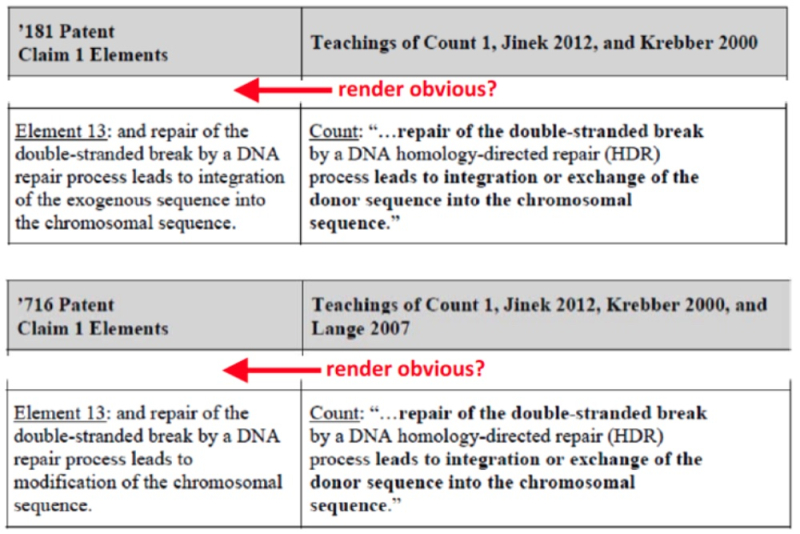
    And illustrates application of these rules in Ledenev v. Adest, 2020 Pat. App. LEXIS 6912, *35-36, Decision on Motions, at 31, 35 (PTAB Mar. 25, 2020) (JTM) (In moving to add patents to an interference, "[t]he standard to be applied is whether the claim is patentably distinct from the Count . . . .  [T]he burden placed upon movant [is] to compare the claims to the count in the required two way analysis.").  Sigma-Aldrich also notes (in a footnote) in this regard that "[t]he authority cited by CVC [37 C.F.R. § 41.207(b)(2) ("Claim correspondence"); Standing Order 208.3.1 ("Claim correspondence")] is directed to the analysis of whether a claim of an already involved patent or application corresponds to the interference count."  Such a one-way test would be appropriate, Sigma-Aldrich argues, only for showing claim correspondence to an interference Count for claims of an already-involved patent or application.  Applying the two-way obviousness test, Sigma-Aldrich's brief illustrates CVC's purported error with regard to "Element 13" for claims in both Sigma-Aldrich's '181 and '716 patents:

    Image 1
    Sigma-Aldrich further argues in this regard that what CVC set forth in its Motion No. 4 is whether the narrower interference Count would render obvious the '181 or '716 patent claims.  What CVC failed to do was the converse assessment, whether "the broader claim render[s] obvious the narrower Count" (emphasis in brief).

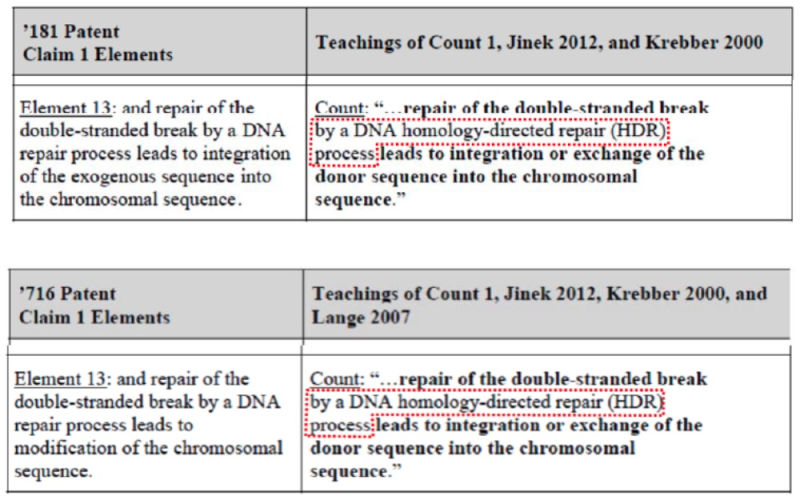
    In addition, Sigma-Aldrich argues that CVC failed to assert whether the "homology-dependent repair (HDR)" aspects of the Count would have been non-obvious when considered in view of Element 13 of the '181 and '716 patent claims:

    Image 2
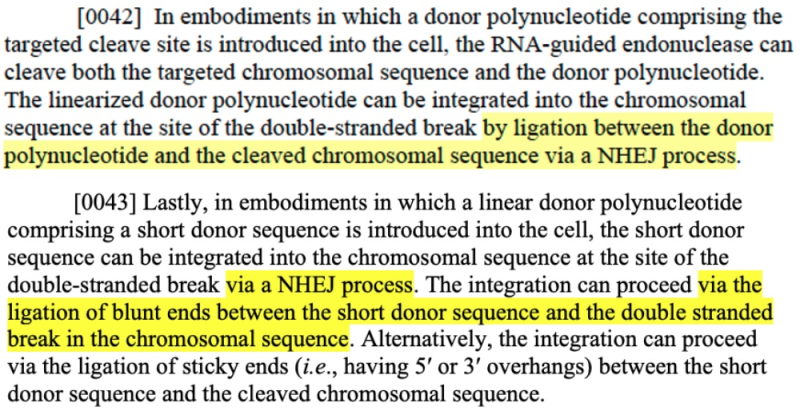
    (Sigma-Aldrich noting that, unlike other portions of the Count and prior art, CVC did not emphasize language relating to this aspect in its analysis.)  Sigma-Aldrich also asserts that "none of the Sigma Patents claims recite a homology-directed repair (HDR) process," being directed (more broadly) to "repair of the double-stranded break by a DNA repair process" and, in its P1 provisional (Application No/ 61/734,256, filed December 6, 2012) disclosing "non-HDR processes" involved in DNA repair (emphasis in brief).  These processes included non-homologous end joining (NHEJ), illustrated with these examples:

    Image 3
    Sigma-Aldrich also criticizes CVC's description of the contents of the Jinek (2012) reference, which Sigma-Aldrich contends contain "no teachings about cleaving eukaryotic DNA."

    Sigma-Aldrich also argues that CVC has been "on notice" from both its positions in its List of Proposed Motions and the Board regarding the patentable distinctions between what it terms "cleavage" embodiments of eukaryotic CRISPR and "cleavage + integration" embodiments.  Similarly, Sigma-Aldrich contends, the Board in its "Order Authorizing Motions" drew similar distinctions with regard to its basis for authorizing Sigma-Aldrich to file its Motion No. 1 to Substitute Proposed Count 2.  And, Sigma-Aldrich argues, both CVC Claim 164 and Sigma Claim 31 (comprising separate portions of the McKelvey Count in the Interference as declared) "expressly recite [a] limitation directed to cleavage plus integration via HDR."  In view of such notice, Sigma-Aldrich argues that "CVC has no justifiable excuse for failing to address that fundamental issue in its CVC Motion 4."

    Sigma-Aldrich also contends that CVC's Motion No. 4 would become moot should the Board grant its Preliminary Motion No. 1 to change the Count.  This is because, inter alia, CVC did not address Sigma-Aldrich's Proposed Count 2 in its Motion No. 4 nor did CVC file a responsive motion to add Sigma-Aldrich's U.S. Patent Nos. 10,731,181 and 10,745,716.

    The brief concludes with citations to the interference rules and the regard showing that the Board can in its discretion under the circumstances in this interference deny CVC's Motion No. 4, which Sigma-Aldrich asks them to do.

    * CVC captioned this as a Miscellaneous Motion.

  • By Donald Zuhn

    WTO logoA Reuters report published last week indicated that the United States, European Union, India, and South Africa had reached an agreement on a waiver with respect to patents for COVID-19 vaccines.  The text of the compromise proposal, however, was not released.  Following the announcement of the compromise, both the Biotechnology Innovation Organization (BIO) and U.S. Chamber of Commerce issued statements on the reported compromise (see "Compromise Reportedly Reached on COVID-19 Vaccine Patent Waiver").

    Earlier today, BIO provided a link to the alleged compromise in its daily email newsletter.  The "TRIPS COVID-19 solution," if approved by World Trade Organization (WTO) members, would allow "an eligible Member [to] authoriz[e] the use of patented subject matter required for the production and supply of COVID-19 vaccines without the consent of the right holder to the extent necessary to address the COVID-19 pandemic."  The compromise defines "eligible Member" as "any developing country Member that exported less than 10 percent of world exports of COVID-19 vaccine doses in 2021," and defines "patented subject matter" as "includ[ing] ingredients and processes necessary for the manufacture of the COVID-19 vaccine."

    Under the compromise, eligible Members could authorize the use of patented subject matter "through any instrument available in the law of the Member such as executive orders, emergency decrees, government use authorizations, and judicial or administrative orders, whether or not a Member has a compulsory license regime in place."  The compromise permits "a single authorization to use the subject matter of multiple patents necessary for the production or supply of a COVID-19 vaccine," and would require eligible Members to "communicate to the Council for TRIPS any . . . granting of an authorization," and "list all patents covered" by the authorization.  Eligible Members would not have to require "the proposed user of the patented subject matter to make efforts to obtain an authorization from the right holder," and could "allow any proportion of the authorized use to be exported to eligible Members," provided that they "undertake all reasonable efforts to prevent the re-exportation of the COVID-19 vaccine that has been imported into their territories."  The compromise proposal also states that "[n]o later than six months from the date of this Decision, Members will decide on its extension to cover the production and distribution of COVID-19 diagnostics and therapeutics."

    In a statement issued by WTO Director-General Ngozi Okonjo-Iweala on March 16, the Director-General "warmly welcomed the breakthrough," calling the compromise "a major step forward," but cautioning that "not all the details of the compromise have been ironed out."

    A statement from the Office of the U.S. Trade Representative indicated that the compromise proposal "offers the most promising path toward achieving a concrete and meaningful outcome," noting that "[w]hile no agreement on text has been reached and we are in the process of consulting on the outcome, the U.S. will continue to engage with WTO Members as part of the Biden-Harris Administration's comprehensive effort to get as many safe and effective vaccines to as many people as fast as possible."

    In its latest report regarding the waiver compromise, BIO provided reactions from Steve Bates, CEO of the UK Bioindustry Association and Chair of the International Council of Biotechnology Associations (ICBA), which includes BIO, who argued that the proposal would "have a chilling impact on investment into the small companies that have been at the heart of the solutions to COVID-19," adding that the proposal "directly threatens this innovative ecosystem's ability to attract the capital needed to develop next generation of vaccines whilst doing nothing to solve the access challenges we have in 2022."  Mr. Bates also noted that the biotech industry manufactured more than 11 billion vaccine doses in 2021, and stated that "[w]eakening IP rights does nothing to facilitate the distribution of these manufactured vaccines to people around the world who most need them—rather prioritizing addressing healthcare infrastructure and vaccine hesitancy in the developing world would lead to more shots in arms."  BIO Deutschland Chair Oliver Schacht suggested that the proposal "would jeopardize drug development with respect to other research areas, since drugs and vaccines are protected not only by one patent but by a whole bundle of patents, with individual patents in such a bundle in turn often protecting other drugs and vaccines."  BIO noted that the waiver compromise was "not a done deal," and that BIO would be "keeping a close eye on it."

    The Pharmaceutical Research and Manufacturers of America (PhRMA) and Médecins Sans Frontières have also provided statements on the compromise proposal.  PhRMA stated that:

    The fact remains that efforts to waive intellectual property commitments are unnecessary and harmful to our collective work to end the pandemic.  Strong intellectual property protections, voluntary technology transfers and partnerships are on target to facilitate the production of more than 20 billion doses in 2022 – more than enough to vaccinate the world – without confiscating intellectual property.  Global leaders should now focus on the real challenges of distributing and administering vaccines to people around the world.

    Médecins Sans Frontières (Doctors Without Borders) contended that "WTO members should remain vigilant to the fact that this leaked text contains considerable limitations, and needs to be urgently improved," arguing that "[i]t is incredibly concerning that the leaked text currently only covers vaccines, but neither treatments nor diagnostics."

    For additional information regarding this topic, please see:

    • "Compromise Reportedly Reached on COVID-19 Vaccine Patent Waiver," March 16, 2022
    • "Sen. Tillis Writes to U.S. Trade Representative (Again) Regarding TRIPS Waiver," December 12, 2021
    • "U.S. Trade Representative Responds to Letters from Senators Regarding TRIPS Waiver," November 14, 2021
    • "U.S. Chamber of Commerce Urges Administration to 'Double Down' on Global Vaccine Distribution," November 3, 2021
    • "Is This the WTO Waiver End Game?" July 25, 2021
    • "BIO Declaration on Global Access to COVID-19 Vaccines and Treatments and Role of IP," June 24, 2021
    • "GOP Legislators Write in Opposition to Proposed TRIPS Waiver," May 16, 2021
    • "Population of Patents at Risk from Proposed WTO Patent Waiver," May 12, 2021
    • "Sen. Daines Urges Biden Administration to Withdraw Support for COVID-19 IP Waiver," May 12, 2021
    • "Pfizer CEO Pens Open Letter on COVID-19 Vaccine IP Waiver," May 10, 2021
    • "If the Devil of the WTO IP Waiver Is in the Details, What Are the Details?" May 9, 2021
    • "The Road to Hell Is Paved with What Everybody Knows," May 6, 2021
    • "BIO & IPO Issue Statements on Biden Administration's Support for Proposed WTO Waiver," May 6, 2021
    • "Biden Administration Supports Waiver of IP Protection for COVID-19 Vaccines," May 5, 2021
    • "Suspending IP Protection: A Bad Idea (That Won't Achieve Its Desired Goals)," April 26, 2021
    • "Sen. Tillis Asks Biden Administration to Oppose WTO Waiver Proposal," April 21, 2021
    • "IP Organizations Support Continued Opposition to Waiver Proposal," April 5, 2021
    • "Industry Coalition Supports Continued Efforts to Oppose Waiver Proposal," March 29, 2021
    • "BIO and PhRMA Urge Biden Administration to Oppose Proposed WTO TRIPS Waiver," March 11, 2021
    • "IPO Sends Letter on IP Law and Policy to President-Elect and Vice President-Elect," January 4, 2021

  • By Kevin E. Noonan

    Sigma-AldrichOn February 18th, Senior Party Sigma-Aldrich filed its Opposition to Substantive Preliminary Motion No. 3 from the University of California, Berkeley; the University of Vienna; and Emmanuelle Charpentier (collectively, "CVC"), Junior Party in Interference No. 106,132, wherein the Junior Party moved to change the interference Count pursuant to 37 C.F.R. §§ 41.121(a)(1)(iii) and 41.208(a)(1).

    The basis for CVC's motion was to change the Count to be limited to so-called "single (RNA) molecule guide RNA (sgRNA) species."  CVC argued that substituting this Count is more symmetrical with CVC's portion of the Count and "avoids inconsistency" with the Counts in related interferences (see "CRISPR Battle Joined Again"; "The CRISPR Chronicles: Enter Toolgen"; and "Sigma-Aldrich Joins the CRISPR Interference Fray").

    Sigma-Aldrich responds in its Opposition that, contrary to any nebulous (and "self-serving") "inconsistency," what CVC is actually trying to accomplish is to prevent Sigma-Aldrich from asserting its "best proofs" in the interference.  Sigma-Aldrich contends it is the only party in any of the pending interferences — CVC, ToolGen, and Broad — having proofs of reducing to practice CRISPR in eukaryotic cells having both single-molecule RNA (sgRNA) and dual-molecule ("dgRNA") RNA species.  CVC's proposed motion on its face and according to its arguments in its Motion No. 3 would change the Count to exclude dual-molecule RNA-comprising eukaryotic CRISPR.  Sigma-Aldrich argues that any concerns CVC asserts regarding "inconsistency" and "the public interest" would be served by the Board granting its own Motion No. 1 (while characterizing CVC's concerns in this regard as being "á la Chicken Little's dire predictions, . . . highly remote and purely speculative at best."  Also raising questions about CVC's "ulterior motives," Sigma-Aldrich contends that CVC's proposed Count would "not []enable CVC to better make out CVC's priority case, but instead [would] hamstring Sigma from making out Sigma's priority case" which "is not a legitimate basis to seek to change the count."

    CVC has not carried its burden in making a showing that they are entitled to the relief sought, Sigma-Aldrich argues, because they have failed to assert the conventional basis for such a motion — that it would enable CVC to proffer its best proofs in the interference.  Instead, CVC asks the Board to alter the Count on the portion of the "McKelvey" Count taken from Sigma-Aldrich's claims, which request is but a "strategic maneuver to try to prejudice Sigma's ability to proffer its proofs of invention."  And there is no dispute raised by CVC that Sigma-Aldrich's best proofs encompass eukaryotic CRISPR claims generic to the type of guide RNA molecule it contains, Sigma-Aldrich notes, because CVC's own Motion No. 3 expressly recites such a concession.  These purported proofs comprise data in addition to FACS data provided for both guide RNA types, data which Sigma-Aldrich describes as "additional and confirmatory PCR data" (emphasis in brief) which is specifically provided for dgRNA (and not sgRNA) embodiments.  According to Sigma-Aldrich, "CVC's strategic goal of its Motion 3 is an unfair (and thinly disguised) attempt to prejudice Sigma's ability to rely upon Sigma's dgRNA PCR confirmation data as a component of Sigma's proofs of invention," and "[t]he remainder of CVC's arguments, directed to supposed 'uniformity' among the various interferences, and the 'public interest,' are all smoke and mirrors designed to disguise CVC's true objective here, namely, to unfairly preclude Sigma from relying upon the entirety of the data from Sigma's successful experiments."

    Sigma-Aldrich also asserts that there is a bit of rhetorical legerdemain in CVC's arguments to the extent CVC argues that "Sigma's proofs appear to be identical either way" (which Sigma-Aldrich disputes) (emphasis in brief).  Sigma-Aldrich contends that CVC is well aware that its proofs regarding sgRNA and dgRNA are not "identical" based on an Opposition between the parties in a European Opposition, captioned thusly:
    Image 1
    CVC's European representative, Mr. Schlich, was a "strawman" in the Opposition (which is perfectly acceptable in EPO practice).  But Sigma-Aldrich sets out evidence (from "U.S. litigation proceedings," In re Schlich, Case No. 16-MC-319 (VSB) (S.D.N.Y. Sept. 18, 2017)) that he was in fact representing a CVC licensee, Intellia, a company having CVC inventor Jennifer Doudna as a principal:

    Image 2Tying up this evidence neatly, Sigma-Aldrich shows that, in the European Opposition CVC was well aware of the dgRNA embodiments it contends "apparently" are not at issue in this interference with regard to CVC's motion to change the Count, particularly with reference to "Lane A" which involves eukaryotic CRISPR results obtained using dgRNA:

    Image 3
    Sigma-Aldrich also asserts that CVC's arguments regarding its eukaryotic CRISPR embodiments incorrectly ascribe to Sigma's disclosure sgRNA species that are actually disclosed in its own Jinek et al. Science article (and will be familiar to readers following Interference No. 106,115, wherein the Board recently awarded priority to Broad), as shown in this figure:

    Image 4
    Sigma-Aldrich further contends that CVC's expert, Dr. Bailey conceded during cross-examination that Sigma-Aldrich's P1 application (61/734,256) disclosed dgRNA embodiments of eukaryotic CRISPR used to practice CRISPR in eukaryotic cells.

    Sigma-Aldrich also argues that CVC's Motion No. 3 would be moot should the Board grant Sigma-Aldrich's own motion (No. 1) to change the Count, providing a colorful comparison regarding CVC's portion of the Count in this interference between CVC's proposed Count and Sigma-Aldrich's:

    Image 5 Image 6
    Sigma-Aldrich takes the time in its Opposition to distinguish CVC's citation to precedent, In re Vivint, 14 F.4th 1342 (Fed. Cir. 2021), as being unavailing because that case was not an interference case and involved denial of an ex parte reexamination request that was "essentially identical" to a denied inter partes review petition.

    Finally, Sigma-Aldrich argues that neither CVC's P1 nor P2 provisional applications provide a constructive reduction to practice of any embodiment falling within the scope of the proposed substitute Count in its Motion No. 3, citing Sigma-Aldrich's Opposition to CVC's Motion No. 1 (which recites many of the same arguments the Board found persuasive in awarding priority to Broad in the '115 Interference).

    Sigma-Aldrich accordingly asks the Board to deny CVC's Substantive Preliminary Motion No. 3.

  • CalendarMarch 22, 2022 – "The European Unitary Patent and Unified Patent Court: What Are They, When Are They Happening, and How Should I Prepare?" (Schwegman Lundberg & Woessner) – 12:00 pm (CT)

    March 23, 2022 – "Getting Your First Filing Right" (HGF Ltd) – 3:00 pm (GMT)

    March 23, 2022 – "Advanced Patent Search Strategies: What to Use When All Else Fails," Part I (Patent Information Users Group, Inc.) – 11:00 am to 12:00 pm (EDT)

    March 24, 2022 – "China IP: Quarterly Legislation and Case Law Update" (U.S. Patent and Trademark) – 1:00 pm to 2:00 pm (ET)

    April 6, 2022 – "Advanced Patent Search Strategies: What to Use When All Else Fails," Part II (Patent Information Users Group, Inc.) – 11:00 am to 12:00 pm (EDT)

    April 26-27, 2022 – Paragraph IV Disputes Conference (American Conference Institute) – New York City

  • Schwegman Lundberg WoessnerSchwegman Lundberg & Woessner will be offering a webinar entitled "The European Unitary Patent and Unified Patent Court: What Are They, When Are They Happening, and How Should I Prepare?" on March 22, 2022 at 12:00 pm (CT).  Jeff Cobia and Paul Urbanski of Schwegman Lundberg & Woessner will moderate a presentation by Tom Hamer and Emily Collins of Kilburn & Strode LLP, who will cover the basics of the UP/UPC, the decision points to take into account when planning your UP/UPC strategy, and the actions that should be taken now to prepare for the new system.  The webinar will cover:

    • UP and UPC: the basics and the background
    • Should applicants request Unitary Patents?
    • Should applicants opt out of the jurisdiction of the UPC?
    • What should applicants be doing now to prepare

    While there is no cost to participate in the program, those interested in attending the webinar can register here.

  • HGFHGF Ltd will be offering a webinar entitled "Getting Your First Filing Right" on March 23, 2022 at 3:00 pm (GMT).  Claire Irvine and Kerry Rees of HGF will cover the considerations required at the first filing stage to align patenting strategy with commercial strategy and minimise problems arising from both formal and content issues; cover such issues as the evidence required to get over the plausibility hurdle in relation to inventive step and sufficiency as applied to compound and therapeutic use claims, as well as formal considerations such as where to file and who should file, often especially important considerations in the case of collaborative projects involving inventors outside the UK; and also deal with how to ensure you keep priority of a first filing both legally and to maximise disclosure benefit.

    Those wishing to register can do so here.

  • PIUGPatent Information Users Group, Inc. (PIUG) will be offering a two-part webinar series entitled "Advanced Patent Search Strategies: What to Use When All Else Fails" on March 23 and April 6, 2022.  Both sessions will be held from 11:00 am to 12:00 pm (EDT).  Ron Kaminecki will discuss advanced search strategies to try when you have used the typical search methods and you want to make sure you did not miss something important — typical search methods including keywords, classification codes, citations, and advanced systems will be briefly reviewed, with the main focus being what to do after using these initial strategies.  The two-part webinar covers multiple techniques including:

    • The Building Block Approach: categorizing concepts to modify a strategy
    • Successive Fractions: paring a search down by concepts
    • Recombination of Elements:  narrowing  piecemeal results to avoid duplicates
    • Terms of Art: identifying the most important terminology
    • Linking: extending the search to  other database sources
    • Pearl Growing: expanding results starting with only a single result
    • Cherry Picking: using a few documents to locate more information
    • Analogous Arts: using alternative sources to locate the information

    The registration fee for the webinar is $199 for non-members or $159 for PIUG members.  Those interested in attending the webinar should register here.

  • USPTO SealAs part of its series of quarterly updates on IP developments in China, the U.S. Patent and Trademark Office will offer a webinar entitled "China IP: Quarterly Legislation and Case Law Update" on March 24, 2022 from 1:00 pm to 2:00 pm (ET).  The webinar will feature presentations by senior U.S. Patent and Trademark Office IP attorneys with extensive China IP experience.

    Those interested in registering for the webinar can do so here

  • But Not All the Judges Are Happy About It

    By Kevin E. Noonan

    Federal Circuit SealOn March 16th, the Federal Circuit denied Biogen's petition for panel rehearing and rehearing en banc in Biogen Int'l GmbH v. Mylan Pharmaceuticals Inc.  Judges Cunningham and Stoll did not participate in the decision, which was issued per curiam and supported by Judges Dyk, Prost, Reyna, Taranto, Chen, and Hughes.  Judge O'Malley (who dissented in the panel decision) participated (and putatively supported) the decision to deny the petition for panel rehearing (perhaps related to her decision to leave the Court on March 11th).  Judge Lourie, joined by Chief Judge Moore and Judge Newman (constituting two of the remaining most senior Judges on the Court) wrote an opinion in dissent.

    To recap, the case arose over Mylan's attempt to get regulatory approval and come to market with a generic equivalent of Biogen's Tecfidera® (dimethyl/monomethyl fumarate) multiple sclerosis drug.  Biogen asserted Orange Book-listed U.S. Patent Nos. 6,509,3767,320,9997,619,0017,803,8408,399,514; and 8,759,393, but the parties dismissed their causes of action on all patents except the '514 patent, where Biogen asserted claims 1-4, 6, 8-13, and 15-16; claim 1 is representative:

    1.  A method of treating a subject in need of treatment for multiple sclerosis comprising orally administering to the subject in need thereof a pharmaceutical composition consisting essentially of (a) a therapeutically effective amount of dimethyl fumarate, monomethyl fumarate, or a combination thereof, and (b) one or more pharmaceutically acceptable excipients, wherein the therapeutically effective amount of dimethyl fumarate, monomethyl fumarate, or a combination thereof is about 480 mg per day.

    (Wherein the italicized limitation was the entirety of the basis for the District Court's decision and the Federal Circuit majority's affirmance.)

    The District Court held that the asserted claims were invalid for failure to satisfy the written description requirement of 35 U.S.C. § 112(a).  The grounds for the District Court's decision, and the bases for Mylan's arguments that were persuasive, stemmed from certain characteristics of the prosecution history, which Mylan used to create an impression that Biogen had obtained claims based on clinical trial results for an invention not adequately disclosed in the application as filed in its earliest priority document (without such priority the claims perhaps would have been obvious).  Moreover, certain claim limitations (importantly, the effective dose) were recited only as part of a range and only once in the specification, which in the main was directed to methods for identifying compounds for treating neurological diseases and mentioned the specific disease treated by the claimed method, multiple sclerosis, only as one disease amongst many.  The District Court summed up the basis for its opinion succinctly, stating "[i]n sum, Biogen has attempted to satisfy the written description requirement of § 112 by selectively plucking specific words from the specification that correspond to each element of the claimed invention."

    The Federal Circuit affirmed, in an opinion by Judge Reyna joined by Judge Hughes, with Judge O'Malley dissenting.  Biogen was hampered by its burden of showing clear error by the District Court as well as the apparent "equities" between their position and Mylan's.  The majority considered Biogen to have ""cast[] a wide net for a myriad of neurological disorders, including neuro-degenerative diseases such as amyotrophic lateral sclerosis (ALS), Parkinson's disease, Alzheimer's disease, and Huntington's disease; demyelinating neurological diseases, such as various forms of MS and at least twenty-eight other disorders related to demyelination; polyneuritis; and mitochondrial disorders with demyelination" (something Judge O'Malley herself termed a "laundry list" form of disclosure).  The relevant elements of the claim (the disease treated, the drug used, and the dose) were each recited once in the specification, according to the majority, and those citations were scattered in different portions of the specification.

    Judge O'Malley's dissent was based on her appreciation of the majority misunderstanding the differences between therapeutic and clinical efficacy and the differences between what is required to obtain a patent and what is required for FDA approval of a drug.  This error, she contended, led the majority to apply the Court's Nuvo Pharms. (Ireland) Designated Activity Co. v. Dr. Reddy's Lab'ys Inc., 923 F.3d 1368, 1377, 1381 (Fed. Cir. 2019), precedent, also in error according to the Judge.  And the Judge stated that in her view the specification contained an adequate written description based on this reasoning:

    The majority's decision affirming the district court partially rests on the fact that the '514 patent only mentions the claimed DMF480 dose once.  . . .  But the majority cites no case law (and I know of none) for the proposition that the written description requirement demands that a patentee recite a claim element repeatedly to pass written description muster.  The majority does not, and cannot, deny that the claimed DMF480 dose is expressly disclosed.  To the extent the majority's opinion may be read to establish a requirement that a claim element must be disclosed multiple times, I dissent from that holding as well.

    Judge Lourie's dissent from the Court's decision not to rehear the case en banc cites four grounds of error by the District Court (and by not subtle implication the Federal Circuit Judges constituting the panel majority).  The dissent begins by noting that a proper written description analysis rests on the Court's en banc decision in Ariad Pharms., Inc. v. Eli Lilly & Co., 598 F.3d 1336 (Fed. Cir. 2010), but Judge Lourie sets out Federal Circuit precedent involving the variety of cases where an adequate written description was not found (many of them written by the Judge himself) and based, according to the dissent, on the CCPA case In re Ruschig, 379 F.2d 990, 995 (C.C.P.A. 1967), and (somewhat provocatively) on O'Reilly v. Morse, 56 U.S. 62, 113 (1853).  This case, according to the dissent, is an "outlier" "at the farthest end of the spectrum" because "every claim limitation is expressly described in the disclosure."  And the consequence is that the Court has "let a panel majority opinion stand that imports extraneous considerations into the written description analysis and blurs the boundaries between the written description requirement and the other statutory requirements for patentability.  In doing so, the court has contributed to the muddying of the written description requirement."

    The basis for an adequate written description is always what is disclosed, according to Judge Lourie, and here Example 4 was expressly directed to treating MS; accordingly, "from any perspective, including that of a person of ordinary skill in the art, the '514 patent describes the invention of a method for treating multiple sclerosis."  What is recited in claim 1, the dissent asserts, is "precisely what the specification discloses—treatment of multiple sclerosis with a 480 mg per day dose of DMF or MMF."  "Whatever shortcomings exist in this unfocused patent specification, failure of written description with respect to claim 1 is not one of them" according to Judge Lourie's dissenting opinion.

    So why did the panel majority go so astray in the dissenting Judges' opinion?  The dissent sets out the four grounds of error by the District Court and the panel majority that provide the basis for why the District Court's opinion should have been reversed by the panel.  The first is the "undue emphasis that the panel majority and the district court placed on unclaimed disclosures in the specification," engaging in "irrelevant comparisons between the amount of disclosure of the claimed subject matter versus the unclaimed subject matter," reciting as examples the majority's focus on the number of other neurological diseases set forth in the specification and the frequency (once) with which the 480mg dose was set forth.  Agreeing with Judge O'Malley's dissent, Judge Lourie faults the panel majority for relying on In re Ruschig for the use of "blazemarks" in performing a written description requirement, because they thereby neglected the important distinction that in Ruschig the specification did not disclose the claimed embodiment.  Discussing the extent of disclosure in genus/species claims, Judge Lourie recited portions of the body of precedent developed by the Court for making sufficiency determinations (a "representative number of species falling within the scope of the genus or structural features common to members of the genus so that one of skill in the art can 'visualize or recognize' the members of the genus," citing Regents of the Univ. of Cal. v. Eli Lilly & Co., 119 F.3d 1559, 1568–69 (Fed. Cir. 1997).  It is only when a claimed species is not expressly disclosed in the context of a disclosed genus that a blazemarks analysis is needed according to the dissenting Judges, something expressly set forth in Novozymes A/S v. DuPont Nutrition Biosciences APS, 723 F.3d 1336, 1349 (Fed. Cir. 2013): "'[b]laze marks' are not necessary where the claimed species is expressly described in the specification."  That is not the case here, Judge Lourie asserts, where the disease to be treated, the drug used for the treatment, and the administered dose is expressly disclosed.  In such cases, whatever else is disclosed in the specification does not support a finding of inadequate disclosure according to the dissent, citing Scriptpro, LLC v. Innovation Assocs., Inc., 762 F.3d 1355, 1359 (Fed. Cir. 2014), nor is the fact that there was only a single mention of the 480 mg dose contrary to a finding of an adequate written description ("once is enough" according to the dissent, citing Vanda Pharms. Inc. v. W.-Ward Pharms. Int'l Ltd., 887 F.3d 1117, 1137 (Fed. Cir. 2018).  Summing up this ground of error, the dissent states:

    The panel majority opinion implies that a patent fails the written description requirement of 35 U.S.C. § 112 when it contains too much disclosure beyond the claimed invention, which is incorrect.  The opinion implies that a patentee must disclose the claimed subject matter more than once, which is also incorrect.  And the opinion implies that a court may arbitrarily count the number of times the claimed subject matter is disclosed in the specification relative to the number of times unclaimed subject matter is disclosed, which is incorrect.

    The second ground of error (again in agreement with Judge O'Malley) is that Federal Circuit precedent does not require a patentee to show that "the specification proves the efficacy of the claimed pharmaceutical composition," citing Nuvo Pharms. (Ir.) Designated Activity Co.; In re Brana, 51 F.3d 1560, 1567 (Fed. Cir. 1995) (that the requirements for patenting and the requirements for drug marketing approval were different); and Scott v. Finney, 34 F.3d 1058, 1063 (Fed. Cir. 1994).  Merely stating the claimed dose is enough, according to Judge Lourie because it "leaves nothing for the skilled artisan to deduce; it expressly states that 480 mg per day is an effective amount."

    The third error made by the District Court and panel majority was importing "extraneous legal considerations into the written description analysis" contrary to Ariad.  For example, the dissent notes that while operability can be raised with regard to enablement, Ariad stands for the distinction between the written description and the enablement requirements of the statute.  "By focusing on whether the patentee proved that 480 mg per day is an effective amount to treat multiple sclerosis—as distinct from whether the '514 patent specification discloses that 480 mg per day is an effective amount to treat multiple sclerosis—the panel majority and the district court erroneously imported operability considerations into the written description analysis" (emphasis in dissenting opinion).  Even further the dissent criticizes the District Court and the panel majority for considering inventorship issues, which is also separate from a proper written description requirement analysis.  The dissent also appreciates the majority to have introduced a best mode issue, in reference to whether the skilled artisan would have been "drawn to" the 720 mg dose (emphasis in dissenting opinion).  Once again, the dissent asserts that "[b]y incorporating extraneous legal standards into the analysis, the panel majority opinion creates confusion for future patent applicants and litigants regarding what is required to meet the written description requirement of 35 U.S.C. § 112."

    The fourth point of error in the dissenting Judges' view was consideration of extrinsic evidence by the District Court and the panel majority.  Under Ariad, "[t]he test for written description 'requires an objective inquiry into the four corners of the specification.'"  While considerations outside the four corners can be relevant (regarding, for example, the understanding of one or ordinary skill in the art), such considerations need to be limited to "an objective inquiry into what is meant by the disclosure in the patent specification" according to the dissent.  Where, as here, "the disclosure in a patent's specification plainly corresponds to what is claimed, extrinsic evidence should not be used to cast doubt on the meaning of what is disclosed."

    The dissent concludes by stating that the best reason for the en banc Court to hear this case is that the panel majority had "affirmed a district court's erroneous broadening of the written description inquiry" and by denying rehearing the case the Court "lost an opportunity to provide clarity for future litigants by reaffirming the proper boundaries of the written description requirement in 35 U.S.C. § 112."

    It would be good to remember that satisfaction of the written description requirement is a question of fact, and such questions do not easily lend themselves to readily applied, rigid rules.  Thus the strength of Judge O'Malley's dissent and the dissenting Judges here is directed at the proper application of the law to the question before the Court, which if in the unlikely event it ever arises again would be persuasive but is not likely to be binding precisely because such future facts are unlikely to be entirely on all fours with the question before the Court here.  More significant, perhaps, is that the Court has trended towards a more stringent application of written description questions during Judge Prost's tenure as Chief Judge, and with the appointment of Judges Cunningham and Stark and Judge Moore taking the position of Chief Judge that may change, perhaps to a greater consistency with what was presumed to be settled Federal Circuit law.

    Biogen Int'l GmbH v. Mylan Pharmaceuticals Inc. (Fed. Cir. 2022)
    Panel: Chief Judge Moore and Circuit Judges Newman, Lourie, Dyk, Prost, O'Malley, Reyna, Taranto, Chen, and Hughes (Circuit Judge O'Malley retired on March 11, 2022, and participated only in the decision on the petition for panel rehearing)
    Order per curiam; opinion dissenting from the denial of the petition for rehearing en banc by Circuit Judge Lourie, joined by Chief Judge Moore and Circuit Judge Newman

  • By Donald Zuhn

    WTO logoAccording to a Reuters report published earlier today, the United States, European Union, India, and South Africa have reached an agreement on a waiver with respect to patents for COVID-19 vaccines (see Andrea Shalal and Emma Farge, "U.S., EU, India, S.Africa reach compromise on COVID vaccine IP waiver text," Reuters).  Progress on the compromise appears to have been made during a recent meeting of the Council for Trade-Related Aspects of Intellectual Property Rights (TRIPS) on March 9-10.  In a statement issued by the World Trade Organization (WTO) on March 10, the WTO noted that:

    Some of the members participating since December 2021 in the high-level talks — the European Union, India, South Africa and the United States — expressed cautious optimism about a possible outcome and asked for patience from the rest of the membership.  These members said that the small-group discussions continue to take place in good faith, with the objective of finding a landing zone that delivers on the common purpose of ensuring equitable access to vaccines, therapeutics, and diagnostics.

    As we reported last year, India and South Africa proposed in the fall of 2020 that the WTO TRIPS Council recommend "a waiver from the implementation, application and enforcement of Sections 1, 4, 5, and 7 of Part II of the TRIPS Agreement in relation to prevention, containment or treatment of COVID-19" to the General Council of the WTO.  The two countries also recommended that "[t]he waiver should continue until widespread vaccination is in place globally."  As we reported last May, United States Trade Representative Katherine Tai announced "the Biden-Harris Administration's support for waiving intellectual property protections for COVID-19 vaccines."

    Biotechnology Industry OrganizationAlthough the details of the waiver proposal are still being finalized, and the text of the compromise proposal has not been released, the Biotechnology Innovation Organization (BIO) and U.S. Chamber of Commerce both issued statements this afternoon on the reported compromise.  A statement released by Chief Policy Officer John Murphy noted that:

    While we have seen the reported outlines of an alleged compromise on the TRIPS waiver, we still need to see and review the full text before rendering a final judgment.  However, the irrational fixation on weakening IP is simply a distraction from the real challenge of overcoming global vaccine hesitancy, removing actual trade barriers, and helping countries to strengthen their healthcare infrastructure so that we can get more shots in arms.  In 2021 alone, companies produced more than 11 billion doses of COVID vaccines, enough to give two shots to every adult on the planet.

    Strong, predictable intellectual property protections are what allowed biopharma companies to produce COVID vaccines and therapeutics in record time.  It laid the foundation for cross-border partnerships, global scientific collaboration, and an unprecedented manufacturing scale-up that ensured vaccines could reach every corner of the world.  Dismantling the foundation of innovation—a strong and predictable IP system—will only make us less prepared to respond to the next pandemic and weaken our ability to develop new classes of medicines the world needs.

    U.S. Chamber of Commerce - old logoIn a statement released by the U.S. Chamber of Commerce Global Innovation Policy Center, Senior Vice President Patrick Kilbride, the Chamber contended that:

    This proposal is fundamentally misguided and should be rejected.  It ignores that the overwhelming problem is not vaccine production, it is last-mile delivery, and it will erode the ability of innovative companies to develop the cure for the next pandemic or global health threat.

    Business is delivering on the promise to manufacture safe and effective COVID-19 vaccines for the whole world.  Vaccine production is estimated to reach over 20 billion doses this year, enough for everyone.  As of March, over 65% of global population has received at least one dose, and this number is growing every day.  Some patients remain hard to reach.  Governments and international organizations should avoid political distractions and more quickly achieve comprehensive global vaccination against COVID-19, by focusing on real, practical ongoing issues with last-mile distribution.

    Intellectual property waiver proposals distract from the real issues preventing more shots in arms such as logistical hurdles, supply chain bottlenecks, and vaccine hesitancy.  Worse yet, dismantling IP rights threatens the licensing arrangements that are enabling rapid global production and technology transfer.  Any WTO action undermining IP will harm multiple U.S. industries, who are global leaders in their fields, and who depend on IP protections. Any agreement of this kind would bargain away US competitiveness.

    For additional information regarding this topic, please see:

    • "Sen. Tillis Writes to U.S. Trade Representative (Again) Regarding TRIPS Waiver," December 12, 2021
    • "U.S. Trade Representative Responds to Letters from Senators Regarding TRIPS Waiver," November 14, 2021
    • "U.S. Chamber of Commerce Urges Administration to 'Double Down' on Global Vaccine Distribution," November 3, 2021
    • "Is This the WTO Waiver End Game?" July 25, 2021
    • "BIO Declaration on Global Access to COVID-19 Vaccines and Treatments and Role of IP," June 24, 2021
    • "GOP Legislators Write in Opposition to Proposed TRIPS Waiver," May 16, 2021
    • "Population of Patents at Risk from Proposed WTO Patent Waiver," May 12, 2021
    • "Sen. Daines Urges Biden Administration to Withdraw Support for COVID-19 IP Waiver," May 12, 2021
    • "Pfizer CEO Pens Open Letter on COVID-19 Vaccine IP Waiver," May 10, 2021
    • "If the Devil of the WTO IP Waiver Is in the Details, What Are the Details?" May 9, 2021
    • "The Road to Hell Is Paved with What Everybody Knows," May 6, 2021
    • "BIO & IPO Issue Statements on Biden Administration's Support for Proposed WTO Waiver," May 6, 2021
    • "Biden Administration Supports Waiver of IP Protection for COVID-19 Vaccines," May 5, 2021
    • "Suspending IP Protection: A Bad Idea (That Won't Achieve Its Desired Goals)," April 26, 2021
    • "Sen. Tillis Asks Biden Administration to Oppose WTO Waiver Proposal," April 21, 2021
    • "IP Organizations Support Continued Opposition to Waiver Proposal," April 5, 2021
    • "Industry Coalition Supports Continued Efforts to Oppose Waiver Proposal," March 29, 2021
    • "BIO and PhRMA Urge Biden Administration to Oppose Proposed WTO TRIPS Waiver," March 11, 2021
    • "IPO Sends Letter on IP Law and Policy to President-Elect and Vice President-Elect," January 4, 2021