By Kevin E. Noonan —

The sky isn't falling. But it's becoming increasingly clear that when the Supreme Court sneezes, the Federal Circuit gets a cold (if not pneumonia). And the questions continue about whether the Federal Circuit as currently constituted has the institutional fortitude to exercise its Congressional mandate to harmonize patent law in this country.
The case, of course, raising these issues anew is In re Kubin, decided on Friday. In its decision, the Federal Circuit not only affirmed the finding by the Board of Patent Appeals and Interferences that Kubin's invention was obvious, but in the process decided that the Supreme Court had overturned the Federal Circuit's In re Deuel decision. This outcome is sufficiently disappointing in itself; the reasoning is all the more so. But there are lessons to be learned, and some glimmer of hope that this decision has come just too late to make much difference (i.e., harm innovation) for biotechnology patents.

As Patent Docs readers will remember, this case involves a rejection on obviousness grounds for claims to cDNA encoding human NAIL protein, in which the U.S. Patent and Trademark Office asserted two relevant prior art documents: a reference disclosing the existence of a protein, p38, later found to be encoded by the NAIL cDNA invented by Kubin; and Sambrook et al. (aka: the Maniatis cloning manual), that old standby of what was routine in the art. (There was another reference to Matthew regarding cloning of the mouse gene homolog, but while this reference certainly informed the Office's thinking — and, it appears, Judge Rader's — it was not cited in support of the obviousness determination.) In making its obviousness determination, the Patent Office raised a host of factual distinctions between the technology extant when In re Deuel was decided and the technology available today. Of course, the Office is well aware that its best chances for affirmance lay in these factual questions, because the Federal Circuit is bound to give deference to the Office's determination on fact issues (Dickinson v. Zurko; In re Gartside) while it reviews obviousness and other questions of law de novo.
The Office's reliance on these factual issues was prescient, since in many ways the Federal Circuit's decision was based on its misunderstanding of the crucial factual distinctions between the cited art (and even more importantly, the Matthew reference) and Kubin's invention. The Court's opinion, written by Judge Rader in which Judges Linn and Friedman joined, set out the "factual" bases upon which the Board, and the Court, relied in deciding Kubin's claimed cDNA was obvious. The opinion notes that:
This emphasis on similarities or differences in methods of deriving the NAIL DNA misses the main point of this obviousness question. Of note, the record nowhere suggests that the technique in Valiante's Example 12 for isolating NAIL (p38) DNA, even if slightly different than the technique disclosed in the claimed invention, would not yield the same polynucleotide claimed in claim 73. Stated directly, the record shows repeatedly that Valiante's Example 12 produces for any person of ordinary skill in this art the claimed polynucleotide.
This was the Court's first mistake, evidencing that they were not listening (or did not understand, or were too focused on the outcome to be deterred by inconvenient facts) when Kubin's counsel brought up that critical distinction:
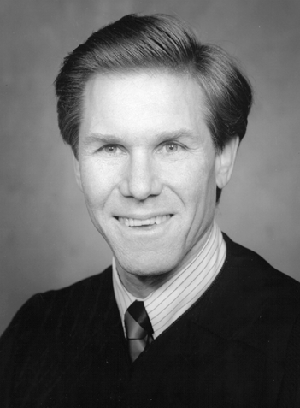
Judge Rader (at right): No, it tells one of skill in the art how to produce those libraries, and when you [have] the probe it's not so hard to do.
Rudolph: It does not tell one with skill in the art how to produce a NK cell library, and if you look at the methodology that's recited in the specification, what they [Kubin] used was a specific mixture of resting cells, resting NK cells and NK cells stimulated with a very specific cocktail of activators. That's not disclosed in Sambrook. That's not disclosed in Valiante. That's not disclosed anywhere[.]
The Court then turns the rationale of In re Deuel on it head:
More to the point, however, any putative difference in Valiante's/Sambrook's and appellants' processes does not directly address the obviousness of representative claim 73, which claims a genus of polynucleotides. The difference between Valiante's and the application's techniques might be directly relevant to obviousness in this case if Kubin and Goodwin had claimed a method of DNA cloning or isolation. But they did not. Appellants claim a gene sequence. Accordingly, the obviousness inquiry requires this court to review the Board's decision that the claimed sequence, not appellants' unclaimed cloning technique, is obvious in light of the abundant prior art.
This statement misses, or simply ignores, the evidence that performing the methods of the prior art would not have resulted in production of the claimed genus of polynucleotides.
The point, eloquently made in Deuel (and recognized by Judge Rader in oral argument as the Court's emphasis on "structure, structure, structure" for chemical obviousness) has always been:
The PTO's focus on known methods for potentially isolating the claimed DNA molecules is also misplaced because the claims at issue define compounds, not methods.
See In re Bell, 991 F.2d 781, 785, 26 USPQ2d 1529, 1532 (Fed. Cir. 1993). In Bell, the PTO asserted a rejection based upon the combination of a primary reference disclosing a protein (and its complete amino acid sequence) with a secondary reference describing a general method of gene cloning. We reversed the rejection, holding in part that "the PTO's focus on Bell's method is misplaced. Bell does not claim a method. Bell claims compositions, and the issue is the obviousness of the claimed compositions, not of the method by which they are made."
Id.
We today reaffirm the principle, stated in Bell, that the existence of a general method of isolating cDNA or DNA molecules is essentially irrelevant to the question whether the specific molecules themselves would have been obvious, in the absence of other prior art that suggests the claimed DNAs. . . . There must, however, still be prior art that suggests the claimed compound in order for a prima facie case of obviousness to be made out; as we have already indicated, that prior art was lacking here with respect to claims 5 and 7. Thus, even if, as the examiner stated, the existence of general cloning techniques, coupled with knowledge of a protein's structure, might have provided motivation to prepare a cDNA or made it obvious to prepare a cDNA, that does not necessarily make obvious a particular claimed cDNA. "Obvious to try" has long been held not to constitute obviousness. In re O'Farrell, 853 F.2d 894, 903, 7 USPQ2d 1673, 1680-81 (Fed. Cir. 1988). A general incentive does not make obvious a particular result, nor does the existence of techniques by which those efforts can be carried out. Thus, Maniatis's teachings, even in combination with Bohlen, fail to suggest the claimed invention.
Unfortunately, the panel was able to extract disclosure that supported their hindsight reconstructions of the inventive event:
In particular, appellants' arguments that Valiante and Sambrook are deficient because they do not provide "any guidance for the preparation of cell culture that will serve as a useful source of mRNA for the preparation of a cDNA library," Appellants' Br. 34, are diminished by appellants' own disclosure:
A "nucleotide sequence" refers to a polynucleotide molecule in the form of a separate fragment or as a component of a larger nucleic acid construct. The nucleic acid molecule has been derived from DNA or RNA isolated at least once in substantially pure form and in a quantity or concentration enabling identification, manipulation, and recovery of its component nucleotide sequences by standard biochemical methods (such as those outlined in Sambrook et al., Molecular Cloning: A Laboratory Manual, 2nd ed., Cold Spring Harbor Laboratory, Cold Spring Harbor, NY (1989)).
'859 Application at 16-17 (emphasis added). Thus, Kubin and Goodwin cannot represent to the public that their claimed gene sequence can be derived and isolated by "standard biochemical methods" discussed in a well-known manual on cloning techniques, while at the same time discounting the relevance of that very manual to the obviousness of their claims.
From this, it became a simple matter for the Court to have the question devolve into a factual one, so that the Court can defer to the Board's determination on the facts instead of deciding the issue (as it should) as a matter of law:
For this reason as well, substantial evidence supports the Board's factual finding that "[a]ppellants employed conventional methods, 'such as those outlined in Sambrook,' to isolate a cDNA encoding NAIL and determine the cDNA's full nucleotide sequence (SEQ NOS: 1 & 3)." Board Decision at 5.
In its consideration of the Matthew reference, which the Court characterizes as showing "the relative ease of deriving the claimed sequence following the teachings of the prior art," the Court follows the Board's lead in focusing on whether the reference taught that there would be a human homolog for the 2B4 (mouse) gene. The evidence of Matthew could have strongly supported the Court's reasoning, except for the fact that the gene identified in the Matthew reference was recognized as being the mouse homolog for human NAIL only after Kubin's filing date (which is why the Board found it to be cumulative — it wasn't properly prior art at all). If the evidence established that Kubin had done nothing more that rote recapitulation of Matthew's methods, then the Court's conclusions might have some logical merit. In fact, the evidence was that Kubin (and the worker of ordinary skill in the art) would have been unsuccessful had they merely performed what Matthew (and Valiente and Sambrook) informed them to do. The Court did not seem to appreciate this distinction.
One distinction raised in oral argument that was unavailing was Kubin's emphasis on CD48 binding and the portion of human NAIL involved in this binding. While agreeing that the prior art was silent on these aspects of NAIL biology, it was "a distinction without a difference" to the panel — "the Kubin-Goodwin application itself instructs that CD48 binding is not an additional requirement imposed by the claims on the NAIL protein, but rather a property necessarily present in NAIL." Finding that there was substantial evidence that Valiante's p38 was identical to the NAIL protein encoded by Kubin's disclosed cDNA, the Court found substantial evidence that the CD48 binding
properties were inherent (citing, appropriately, the Supreme Court's decision in General Electric Co. v. Jewel Incandescent Lamp Co., 326 U.S. 242, 249 (1945), that "It is not invention to perceive that the product which others had discovered had qualities they failed to detect").
Turning to In re Deuel, the Court focused on its reliance on when "obvious to try" can rise to the level of obviousness; as a starting point, the Court cited this portion of the Deuel decision:
[T]he existence of a general method of isolating cDNA or DNA molecules is essentially irrelevant to the question whether the specific molecules themselves would have been obvious, in the absence of other prior art that suggests the claimed DNAs. . . . "Obvious to try" has long been held not to constitute obviousness. A general incentive does not make obvious a particular result, nor does the existence of techniques by which those efforts can be carried out.
In doing so, the Court expressly followed the Board's lead: in its Ex parte Kubin decision, the Board said:
To the extent Deuel is considered relevant to this case, we note the Supreme Court recently cast doubt on the viability of Deuel to the extent the Federal Circuit rejected an '"obvious to try" test. See KSR Int'l Co. v. Teleflex Inc., 127 S. Ct. 1727, __, 82 U.S.P.Q. 2d 1385, 1394, 1396 (2007) (citing Deuel, 51, F.3d at 1559). Under KSR, it's now apparent "obvious to try" may be an appropriate test in more situations than we previously contemplated. Board Decision at 8.
Ironically, the Patent Office capitulated during oral argument regarding their long-expressed desire for the Court to overturn Deuel. Rather, Janet Gongola, arguing for the Office, distinguished Deuel, citing that portion of the decision that stated "[a] prior art disclosure of the process reciting a particular compound is another matter raising issues of anticipation and obviousness" and saying "[w]e are that other matter." In its decision, however, the Court went much further than the Board, or the Supreme Court, had gone:
Insofar as Deuel implies the obviousness inquiry cannot consider that the combination of the claim's constituent elements was "obvious to try," the Supreme Court in KSR unambiguously discredited that holding.
The key, of course, is in the "insofar": while the Deuel opinion can fairly be interpreted as overstating the principle, that decision did not (and could not) overturn the holding in In re O'Farrell that while sometimes what is obvious to try is also obvious, it is not the case that just because something is obvious to try that it must be obvious (which in fairness was the Patent Office's position in Deuel).
The Court arrived at its misinterpretation of Deuel by equally overestimating the Supreme Court's sneeze in its direction:
In fact, the Supreme Court expressly invoked
Deuel as a source of the discredited "obvious to try" doctrine. The
KSR Court reviewed this court's rejection, based on
Deuel, of evidence showing that a particular combination of prior art elements was obvious because it would have been obvious to one of ordinary skill in the art to attempt such a combination:
The only declaration offered by KSR — a declaration by its Vice President of Design Engineering, Larry Willemsen — did not go to the ultimate issue of motivation to combine prior art, i.e. whether one of ordinary skill in the art would have been motivated to attach an electronic control to the support bracket of the assembly disclosed by Asano. Mr. Willemsen did state that an electronic control "could have been" mounted on the support bracket of a pedal assembly. (Willemsen Decl. at P33, 36, 39.) Such testimony is not sufficient to support a finding of obviousness, however. See, e.g., In re Deuel, 51 F.3d 1552, 1559 (Fed. Cir. 1995) ("'Obvious to try' has long been held not to constitute obviousness.").
Ironically, the Supreme Court illuminated the proper analysis for distinguishing when something is obvious to try is also obvious by restating the standards enunciated (in slightly different form) in O'Farrell:
When there is a design need or market pressure to solve a problem and there are a finite number of identified, predictable solutions, a person of ordinary skill has good reason to pursue the known options within his or her technical grasp. If this leads to the anticipated success, it is likely the product not of innovation but of ordinary skill and common sense. In that instance the fact that a combination was obvious to try might show that it was obvious under § 103.
i.e., sometimes, but not all the time, something that is obvious to try is also obvious. Whatever effects the Supreme Court's KSR decision has had on patent law, this statement does not represent a major change.
But it certainly had an effect on this panel's judgment. While recognizing the consonance between O'Farrell's teachings on the obvious to try standard and that set forth in KSR, the panel focused on the following statement of the proper analysis under O'Farrell:
Specifically, this court observed that an obviousness finding was appropriate where the prior art "contained detailed enabling methodology for practicing the claimed invention, a suggestion to modify the prior art to practice the claimed invention, and evidence suggesting that it would be successful." 853 F.2d at 902 (emphasis added). Responding to concerns about uncertainty in the prior art influencing the purported success of the claimed combination, this court stated: "[o]bviousness does not require absolute predictability of success . . . all that is required is a reasonable expectation of success." Id. at 903-04 (emphasis added). The Supreme Court in KSR reinvigorated this perceptive analysis.
The panel then found that Kubin's claims fell within this class of situations when something that is obvious to try is also obvious. The Court enumerated the factual predicates for applying this O'Farrell standard to Kubin's claim 73:
[T]he Valiante reference discloses the very protein of appellants' interest — "p38" as per Valiante. Board Decision at 4. Valiante discloses a monoclonal antibody mAb C1.7 that is specific for p38/NAIL, and further teaches a five-step protocol for cloning nucleic acid molecules encoding p38/NAIL using mAb C1.7. Id. In fact, while stating that "[t]he DNA and protein sequences for the receptor p38 may be obtained by resort to
conventional methodologies known to one of skill in the art," '690 Patent at col.7 ll.49-51, Valiante cites to the very same cloning manual, Sambrook, cited by Kubin and Goodwin for their proposition that the gene sequence is identified and recovered "by standard biochemical methods." '859 Application at 16. Moreover, the record strongly reinforces (and appellants apparently find no room to dispute) the Board's factual finding that one of ordinary skill would have been motivated to isolate NAIL cDNA, given Valiante's teaching that p38 is "expressed by virtually all human NK cells and thus plays a role in the immune response." Board Decision at 6. The record shows that the prior art teaches a protein of interest, a motivation to isolate the gene coding for that protein, and illustrative instructions to use a monoclonal antibody specific to the protein for cloning this gene. Therefore, the claimed invention is "the product not of innovation but of ordinary skill and common sense." KSR, 550 U.S. at 421. Or stated in the familiar terms of this court's longstanding case law, the record shows that a skilled artisan would have had a resoundingly "reasonable expectation of success" in deriving the claimed invention in light of the teachings of the prior art. See O'Farrell, 853 F.2d at 904.
Stated this way, and disregarding the factual distinctions to the contrary, it is not hard to see how the panel arrived at its conclusion. And in some ways, this is actually good news for biotechnology inventions: the bases for the Court's decision was not a generic "DNA is obvious" position that the Patent Office has long sought. Instead, the Court set forth a plethora of factual grounds unlikely to be identically (or even substantially) encountered for other genes.
Elsewhere in the opinion is evidence that biotechnology has become the victim of its own success. In discussing whether the skilled worker would have had a reasonable expectation of success in cloning Kubin's cDNA in view of the cited art, the Court opined:
In fact, this record shows that one of skill in this advanced art would find these claimed "results" profoundly "predictable." The record shows the well-known and reliable nature of the cloning and sequencing techniques in the prior art, not to mention the readily knowable and obtainable structure of an identified protein. Therefore this court cannot deem irrelevant the ease and predictability of cloning the gene that codes for that protein. . . .
The record in this case shows that Valiante did not explicitly supply an amino acid sequence for NAIL or a polynucleotide sequence for the NAIL gene. In that sense, Kubin and Goodwin's disclosure represents some minor advance in the art.
The Court may be right, but it would take an attitude studiously ignorant of history not to consider that the promise of biotechnology and its fulfillment was precisely in providing genes that made it possible to produce useful quantities of erythropoietin, tissue plasminogen activator, human insulin, interferon, blood clotting factor VIII, and several other otherwise unavailable proteins. But today, in this panel's perspective, this is but "some minor advance in the art." In the Court's view, this is the equivalent of an electronic accelerator pedal or children's game.
Because the panel was able to affirm the Board's decision of unpatentability on obviousness, it declined to address the rejection based on written description. While consistent with the principle that the Court need not address secondary grounds for invalidity or unpatentability when it has reason to affirm others, the Court also sidestepped an important question on how the Office is applying the Court's rather convoluted written description jurisprudence (wherein certain members of the Court think the time ripe to consider the question en banc). It is particularly puzzling because the panel mentioned its suspicions about how the Office had changed its policies in view of Kubin (see "Kubin Panel Questions Motivation behind Reversal in New Written Description Training Materials"):
Court: I'm quoting almost out of PTO's manual on written description — verbatim — when I give my example there, am I not? The variations plus the activity Y — protein having activity Y — isn't that exactly the PTO's manual on written description?
Gongola: Are you referring to the training materials?
Court: Yes, I am.
Gongola: That language may be found in the training materials, but it is not — it's guidance. It's — each case of written description has to be decided on its own facts.
Court: The Patent Office is guiding applicants on how to do things wrong?
Gongola: No, your Honor, but guidance provided in a training document cannot be taken and applied to each case. Each case has to be decided on its own facts.
Court: So it's just guidance to examiners on how to do it wrong?
Gongola: No, your Honor — respectfully — it is guidance to the public as well, but . . .
Court: But if we take that guidance, we don't get to your result, do we?
Gongola: No, your Honor, I respectfully disagree; we do. In Carnegie Mellon, this Court has explained that when there's substantial variation within a genus, an applicant has to describe a sufficient number of species to reflect the variation. Kubin has not done that here. Kubin hasn't described any variation. If we want to look at the training materials, the Board only . . .
Court: It's interesting that this was revised immediately after Kubin — the Kubin result — wasn't it?
Gongola: That . . .
Court: Which is kind of an admission that the example did track Kubin and was detrimental to your position, wasn't it?
Gongola: No, your Honor.
Court: So, despite your smiling defense, the facts tend to give us a different conclusion.
Gongola: No, your Honor, that's not correct. The training materials were not revised post-Kubin to somehow capture Kubin. The revisions have been in the works for a very long time.
Court: I see, okay.
Gongola: So it's just coincidence that Example 11 may seem to look like the Kubin fact pattern. . . .
The Court's decision in In re Kubin reinforces the impression that, after KSR, what will be dispositive is evidence, not argument. KSR increases the tendency and risk of subjective hindsight reconstruction of an invention, based on a "totality of the circumstances" approach ("I may not know how to define what's obvious but I know it when I see it," to paraphrase Justice Potter Stewart in another context). This "gut reaction" obviousness can be defeated only by evidence refuting the construction that hindsight informs. While there was some such evidence here, the Court did not give it sufficient credence or weight, or simply chose to ignore it altogether. But the outcome here illustrates the importance of pressing these kinds of factual distinctions.
Anoth
er reason the sky will not be falling on biotechnology patenting arises from the time in the history of biotechnology in which the decision was handed down. Many (if not most) of the "known" genes in the art have been cloned and patented (or not) over the past 30 years of gene patenting, and many of these patents have expired or are nearing the ends of their terms. In addition, many of these genes were isolated at a time when the technology was much less well developed and when there are sound factual bases for concluding that there was not a reasonable expectation of successfully cloning a cognate gene even for proteins that were well known and well characterized. Turning to the present day, many (if not most) of the genes patented or that have been attempted to be patented were not known prior to their discovery (usually through homology comparisons) as a result of the Human Genome Project (HGP). A fundamental pillar of the Court's decision in Kubin was that p38 was known; that will not be the case for most of the genes identified since the late 1990's.
This leaves a class of genes and gene patents "in the middle" — granted since (and perhaps because of) the Court's decision in Deuel but prior to identification during the HGP effort. Some of these, no doubt, have been made more open to an obviousness challenge since the Court's decision in this case. However, many (if not most) of these genes will be lacking some if not several of the factual underpinnings of the Kubin decision: the existence of the protein encoded therein was not known, or there was not a commercially-available monoclonal antibody specific for the protein, or expression cloning was ineffective or unpredictable for that gene, or there was no express description in the art on how to isolate the gene, or there did not exist a cell or tissue source reliably expressing the protein. In these and perhaps other ways, the Kubin decision is sufficiently narrow that it should not provoke a sea change in the fortunes of such gene claims. Insofar as it has a tendency to have this effect in the Patent Office, factual challenges, particularly supported by expert declarations, should have the greatest persuasive punch.
As for what this decision says about the current state of the institutional integrity and fortitude at the Federal Circuit, the Court (or at least this panel) clearly believes that the Supreme Court has spoken clearly that their jurisprudence has gone severely awry. There are, no doubt, instances where the Court has struggled (no more mightily than the Supreme Court) in applying patent law principles to ever-changing subject matter. In this, the Court has (as it was intended to have) a unique position in the American federal judicial framework. That makes it all the more important that the Court make its decisions based on direction from the Supreme Court filtered through its own expertise. Indeed, even the Supreme Court, in Festo Corp. v. Shoketsu Kinzoku Kogyo Kabushiki Co., recognized that the Federal Circuit was the best place for the consistent development of patent law in the first instance (subject, of course, to Supreme Court correction). But an uncritical application of Supreme Court precedent, particularly where the Court has not mandated a change (as it did, for example, in eBay Inc. v. MercExchange, L.L.C.) fails to fulfill the Federal Circuit's Congressional mandate and its responsibility to harmonize patent law in this country. In Kubin, once again, the Federal Circuit appears to have reacted to Supreme Court guidance more with what it perceived as strict compliance than with flexibility in applying the Supreme Court's broad principles to particular cases. And in doing so, it took the occasion to unnecessarily overturn a decision that has been the basis for countless decisions made by applicants, investors, and the companies that have developed biotechnology from the laboratory bench to an industry in which America is competitive throughout the world. It is not the Federal Circuit's brief to make decisions based on these considerations, of course. But it would be consistent with their harmonization mandate (as much as it is inconsistent with some of their current jurisprudence, see, e.g., In re Bilski) if the Federal Circuit would keep such considerations in mind.

 About
About April 16, 2009 –






 Patent Docs