•     By Kevin E. Noonan

    In an otherwise unremarkable decision affirming the district court's claim construction and summary judgment of noninfringement in Abbott Laboratories v. Sandoz, Inc., the Court of Appeals for the Federal Circuit took the opportunity to reconcile a long-standing conflict in its precedent.  Deciding this portion en banc, the court expressly overruled its earlier panel decision in Scripps Clinic & Research Foundation v. Genentech, Inc. in favor or the contrary panel decision in Atlantic Thermoplastics Co. v. Faytex Corp.; the decision affirms the Atlantic Thermoplastics view that a product by process claim is infringed only if the accused infringer practices the process steps recited in the claim, not merely produces the product by any method.

    Abbott Laboratories #2 In an opinion by Judge Rader, joined by Judges Michel, Bryson, Gajarsa, Linn, Dyk, Prost, and Moore (and over a dissent by Judge Newman joined by Judges Mayer and Lourie, and a separate dissent by Judge Lourie; Judge Schall not participating in the en banc opinion), the Federal Circuit reviewed the history of the split between the separate panels in the Scripps Clinic and Atlantic Thermoplastics cases.  This portion of the opinion, Section III.A.2, was taken up en banc sua sponte but was prompted by plaintiff Abbott's argument that the District Court erred in construing claims 2-5 of U.S. Patent No. 4,935,507 as product by process claims.  The claims at issue recite:

    2.  Crystalline 7-[2-(2-aminothiazol-4-yl)-2-hydroxyiminoacetamido]-3-vinyl-3-cephem-4-carboxylic acid (syn isomer) which is obtainable by acidifying a solution containing 7-[2-(2-aminothiazol-4-yl)-2-hydroxyiminoacetamido]-3-vinyl-3-cephem-4-carboxylic acid (syn isomer) at room temperature or under warming.

    3.  Crystalline substance of claim 2, wherein a solution containing 7-[2-(2-aminothiazol-4-yl)-2-hydroxyiminoacetamido]-3-vinyl-3-cephem-4-carboxylic acid (syn isomer) is an aqueous solution of an alkali metal salt of said compound.

    4.  Crystalline substance of claim 3, wherein the acidifying of the solution is carried out at the temperature from room temperature to 40°C. at the pH from 1 to 4.

    5.  Crystalline 7-[2-(2-aminothiazol-4-yl)-2-hydroxyiminoacetamido]-3-vinyl-3-cephem-4-carboxylic acid (syn isomer) which is obtainable by dissolving 7-[2-(2-aminothiazol-4-yl)-2-hydroxyiminoacetamido]-3-vinyl-3-cephem-4-carboxylic acid (syn isomer) in an alcohol, continuing to stir the solution slowly under warming, then cooling the solution to room temperature and allowing the solution to stand.

    Abbott joined the issue directly, arguing that the District Court erred in construing the "process" claims as requiring performance of the process steps in the claims to constitute infringement according to Atlantic Thermoplastics rather than under the more inclusive Scripps Clinic test.

    Judge Rader's majority opinion cites "extensive support" for its decision in prior Supreme Court precedent, including:

    Smith v. Goodyear Dental Vulcanite Co., 93 U.S. 486, 493 (1877) ("The process detailed is thereby made as much a part of the invention as are the materials of which the product is composed."); Goodyear Dental Vulcanite Co. v. Davis, 102 U.S. 222, 224 (1880) ("[T]o constitute infringement of the patent, both the material of which the dental plate is made . . . and the process of constructing the plate . . . must be employed."); Merrill v. Yeomans, 94 U.S. 568 (1877); Cochrane v. Badische Anilin & Soda Fabrik, 111 U.S. 293 (1884) (BASF); The Wood-Paper Patent, 90 U.S. 566, 596 (1874); Plummer v. Sargent, 120 U.S. 442 (1887); [and] Gen. Elec. Co. v. Wabash Appliance Corp., 304 U.S. 364 (1938) . . .

    Federal Circuit Seal The Federal Circuit opined that in these cases, the Supreme Court had consistently held that process terms used to define a product in product by process claims constitute "enforceable limitations" in construing the claims; these canons of construing product-by-product claims were supported by numerous cases decided  by the CCPA.  The majority also turned to appellate opinions  by different courts of appeal (including the 1st Circuit (Hide-Ite Leather v. Fiber Prods., 226 F. 34, 36 (1st Cir. 1915) ("It is also a well-recognized rule that, although a product has definite characteristics by which it may be identified apart from the process, still, if in a claim for the product it is not so described, but is set forth in the terms of the process, nothing can be held to infringe the claim which is not made by the process" and the 3rd Circuit (Paeco, Inc. v. Applied Moldings, Inc., 562 F.2d 870, 876 (3d Cir. 1977) ("A patent granted on a product claim describing one process grants no monopoly as to identical products manufactured by a different process.")).  Some of this precedent had to do with ensuring that the accused product was actually the claimed product, so that the Supreme Court held that "unless it is shown that the process of [the patent claim] was followed to produce the defendant's article, or unless it is shown that that article could not be produced by any other process, the defendant's article cannot be identified as the product of the process of [the patent claim]."  Cochrane v. Badische Anilin & Soda Fabrik, Id. at 296.  The majority opinion also cited Warner-Jenkinson Co. v. Hilton Davis Chemical Co. for the proposition that "each element contained in a patent claim is deemed material in defining the scope of the patented invention."  "To the extent that Scripps Clinic is inconsistent with this rule, this court hereby expressly overrules Scripps Clinic":

    In sum, it is both unnecessary and logically unsound to create a rule that the process limitations of a product-by-process claim should not be enforced in some exceptional instance when the structure of the claimed product is unknown and the product can be defined only by reference to a process by which it can be made.  Such a rule would expand the protection of the patent beyond the subject matter that the inventor has "particularly point[ed] out and distinctly claim[ed]" as his invention, 35 U.S.C. § 112 ¶ 6 (sic).

    Judge Newman's dissent (perhaps predictably, since she wrote the Scripps Clinic decision) accuses the majority of "overturn[ing] a century of precedent and practice" in making its decision.  She reviews the history of product by process practice and precedent, as well as providing her own assessment (as she did in her In re Bilski dissent) of the cases cited by the en banc majority.  She dissents on both substantive and procedural grounds, noting that "[t]he court has given no notice of this impending en banc action," which she asserts is contrary to the Federal Rules of Appellate Procedure as well as the Federal Circuit's own procedural rules.  Her lengthy dissent focused on the en banc Court's abrogation of the (heretofore) "inviolate rule that patent claims should be construed the same way for validity and infringement" and on how the panel decision misapplied the en banc Court's product by process claim decision.

    Judge Lourie, on the other hand, was succinct, making essentially three arguments.  First, he noted that the Supreme Court cases cited by the majority in support of its decision in some instances "applied overly broad language to fact situations involving old products or used vague language that makes it difficult to determine whether the products were old or new."  Second, he cautioned that "[t]here is arguably a different situation that should apply to chemical-biological products today than to mechanical products of more than a century ago," saying that Supreme Court precedent does not foreclose treating product by process claims as product claims regardless of how the product was obtained.  Finally, he raised perhaps the most important issue (in light of recent Supreme Court disapproval of the many Federal Circuit "bright line" tests), reminding the CAFC that "there may be differing results depending upon the exact wording of a claim at issue" and that "[b]right lines have their uses, but judging should take account of differing circumstances."

    Abbott Laboratories v. Sandoz, Inc. (Fed. Cir. 2009)
    Panel: Circuit Judges Rader, Plager, and Bryson
    Chief Judge Michel and Circuit Judges Rader, Bryson, Gajarsa, Linn, Dyk, Prost, and Moore joined Section II.A.2 of opinion; dissenting opinion by Circuit Judge Newman, joined by Circuit Judges Mayer and Lourie; dissenting opinion by Circuit Judge Lourie
  • BIO International Convention The Biotechnology Industry Organization (BIO) is holding its annual BIO International Convention this week at the Georgia World Congress Center in Atlanta.  Founded in 1993, BIO is a nonprofit association seeking supportive biotechnology policies on behalf of more than 1,200 biotechnology companies, state and international affiliates, and related organizations, as well as providing business development services for many emerging biotech companies.

    As part of the Convention, more than 2,200 biotech companies, organizations, and institutions are expected to participate in the BIO Exhibition.  Patent Docs Donald Zuhn, Kevin Noonan, Sherri Oslick, Mark Chael, and Andrew Williams will also be attending BIO as part of the MBHB contingent.  Patent Docs readers who may be attending BIO this week are encouraged to stop by booth #4343 to meet the Docs and talk a little biotech patent law.

  •     By Andrew Williams

    Altana Last Thursday, the Federal Circuit affirmed the decision of the District Court for the District of New Jersey denying a request by Altana Pharma and Wyeth (collectively "Altana") for a preliminary injunction to prevent Teva Pharmaceuticals ("Teva") from marketing a generic version of the antiulcer drug Protonix®.

    Wyeth The active ingredient of Protonix® is the compound pantoprazole, which belongs to a class of compounds known as proton pump inhibitors ("PPI") that are used to treat gastric acid disorders in the stomach.  A predecessor company to AstraZeneca began commercializing the first PPI compound, omeprazole, in 1989 under the trade name Prilosec®.  After Prilosec®'s success, many drug companies, including Altana's predecessor, began to develop new PPIs to compete with omeprazole.  In conjunction with this research, and before the filing of the application that was the subject of this litigation, Altana filed an application that issued as U.S. Patent No. 4,555,518 (the '518 patent).  The '518 patent does not disclose pantoprazole and is not related to the patent-at-issue.  However, the '518 patent does contain a pharmacology section that compared the effectiveness of eighteen claimed compounds against four prior art compounds, and one of the claimed compounds (compound 12) is structurally very similar to pantoprazole.  Altana subsequently filed an application claiming pantoprazole, and this application issued on February 9, 1988 as U.S. Patent 4,758,579 (the '579 patent).  The Patent Office also granted a 5-year term extension pursuant to the Hatch-Waxman Act, and thus the '579 patent expires on July 19, 2010.

    Teva On or about April 6, 2004, Teva filed an ANDA with the FDA requesting approval to market a generic version of Protonix®.  Sun filed similarly directed ANDA applications on or about March 1, 2005 and June 25, 2005.  Both Teva and Sun filed Paragraph IV certifications in conjunction with their respective ANDAs, and Altana filed suit against both parties.  The District Court consolidated these cases.  Altana subsequently filed a motion for preliminary injunction on June 22, 2007, presumably near the expiration of the 30-month stay for FDA approval of Teva's ANDA application.  In opposition, both Teva and Sun conceded infringement, but maintained that the '579 patent was invalid because it was obvious in light of the teaching in the following prior art references:  (1) Altana's '518 patent, (2) the Sachs reference (3) the Bryson reference, and (4) the patent covering the omeprazole compound.  The District Court denied the request for preliminary injunction because the Court found that Teva had demonstrated a substantial question of invalidity and that Altana had not shown that it lacked substantial merit.  Specifically, the District Court found that one of skill in the art would have selected compound 12 from the '518 patent as a lead compound for modification, and that the additional references provided both the motivation to modify compound 12, and the teaching that such a substitution was feasible.  In addition, the District Court rejected Altana's position that allowing generic entry into the market would cause irreparable harm.  Based on these reasons, the District Court denied the motion for preliminary injunction.

    Federal Circuit Seal The Federal Circuit began its analysis by highlighting that an appellant carries a heavier burden when seeking to reverse the denial of a preliminary injunction motion than when seeking to reverse the grant of a preliminary injunction motion.  This is because the movant must show not only that one or more factors relied on by the district court was clearly erroneous, but that the denial of relief amounted to an abuse of the court's discretion.  A court examines four factors when determining whether to grant a preliminary injunction:

    (1)  a reasonable likelihood of success on the merits;
    (2)  irreparable harm if an injunction is not granted;
    (3)  a balance of hardships; and
    (4)  the impact on the public interest.

    Essentially, a movant must establish the existence of both of the first two factors to be entitled to an injunction.  Only these two first factors were at issue in the present case

    Likelihood of Success on the Merits

    At the preliminary injunction stage, an accused infringer must show a substantial question of invalidity.  This burden is lower than what is required to prove invalidity at trial.  If the accused infringer meets this requirement, the burden shifts to the patentee to show that the defense lacks substantial merit.  Altana first argued that the District Court applied an incorrect standard.  However, the Federal Circuit quickly dispensed with this argument, explaining why the District Court's standard was consistent with Federal Circuit precedent.

    Altana also challenged the District Court's obviousness analysis on the merits.  First, Altana argued that the District Court allowed defendants to select compound 12 of the '518 patent as a lead compound when the prior art suggested the availability of numerous other compounds.  The general formula of the PPI at issue, as found in the '579 patent, is reproduced below:

    Structure - '559 PPI

    The three main structural elements are the benzimidazole ring (left), the methylsulfinyl bridge (middle), and the pyridine ring (right).  The issues in this case primarily relate to the R groups located on the pyridine ring.  In fact, the only difference between pantoprazole and compound 12 of the '518 application is that
    pantoprazole has a methoxy group (–OCH3) at the R3 position, while compound 12 has a methyl group (–CH3) in the same position.  In other words, the only difference between these two compounds is the substitution of an alkoxy group for an alkyl group.  The District Court found that Teva raised a substantial argument that compound 12 was a natural choice for further development, and the Federal Circuit found that there was ample evidence supporting this finding.  First, the '518 patent asserted that its compounds, including compound 12, were improvements over the prior art, specficailly omeprazole.  In addition, the '518 patent disclosed that compound 12 was one of the more potent of the eighteen compounds provided.  Moreover, the District Court considered the opinions of qualified experts, and relied on Teva's expert, Dr. Mitscher, that one of skill in the art would have selected the eighteen exemplary compounds of the '518 patent from which to pursue further development efforts.  Finally, the District Court found that compound 12 was a natural choice for further developmental efforts because the '518 patent identified it as one of the more potent disclosed PPI compounds.  The Federal Circuit noted that while potency of a compound is not dispostive, it was not unreasonable for the District Court to use this factor to conclude that one skilled in the art would have selected compound 12 from the group for further study.  The Federal Circuit noted as apparent support for this proposition that Altana itself had selected compound 12 for further development efforts, but it is hard to see how such an observation does not amount to hindsight reasoning using the disclosure of the '518 patent to justify the obviousness determination.

    It is important to keep in mind the procedural posture of this case in determining what precedential value it has.  One clear conclusion, however, is that the Federal Circuit rejected Altana's suggestion that the prior art must point to only a single lead compound for further development efforts.  Such a restrictive view of the lead compound test, the Court reasoned, would suffer the same fate of the rigidly applied teaching-suggestion-motivation test that was explicitly rejected by the Supreme Court in KSR.  The District Court's flexible approach, therefore, concluding that Teva has raised a substantial question that one of skill in the art would have used the more potent compounds of the '518 patent, including compound 12, as a starting point was not clearly erroneous.

    Altana also challenged the District Court's findings with respect to the teachings of one of the supporting references, the Bryson article.  After focusing on the selection of compound 12 as a lead compound for modification, Teva argued that the Sachs article provided motivation to lower the pKa of a PPI to a value of 4 in order to provide better stability of the compound in the patient's body.  Altana did not challenge the determination related to the Sachs article before the Federal Circuit.  Teva further argued that the Bryson article taught that a methoxy group at the 3-position of a pyridine ring provides a lower pKa than a methyl group at the same position.  The District Court agreed, but in doing so included erroneous statements regarding the pKa values of such methoxy group substitutions.  For example, the District Court reported that Bryson stated that a methoxy group would have a pKa of 4, where in reality Bryson disclosed the values of 4.83 and 4.91.  And, because the pKa values are measured on a logarithmic scale, even an apparently small difference results in a very substantial mathematical difference.  Nevertheless, because Altana did not establish that such an error resulted in an abuse of discretion, the Federal Circuit did not disturb the District Court's decision on this ground.  The CAFC found that even though the District Court erred in its representation of the pKa values, the reference to the values correlated with the difference in magnitude of the pKa values of the substituted pyridines described in Bryson.  Moreover, the District Court relied on Teva's expert, Dr. Mitscher, who not surprisingly disclosed the correct pKa values.  The District Court understood that the obviousness position depended on Byrson's teaching of a way to substantially lower the pKa value of the pyridine ring, and therefore the Court's determination was not an abuse of discretion.

    Judge Newman concurred in the decision because of the discretionary weight that must be given to a district court's determination.  However, it was her view that the evidence presented to the District Court in this case does not establish invalidity of the patent on pantoprazole.  This just highlights the fact that the analysis and outcome of this case might have been different had it resulted from the District Court's determination of obviousness of the patent-at-issue rather than from the denial of a preliminary injunction.

    Irreparable Harm

    The Federal Circuit also found that there was no error in the District Court's determination that Altana would not suffer irreparable harm without the issuance of a preliminary injunction.  Important in this determination were the facts that there was no indication that Teva could not respond in money damages, and that it was unlikely that Altana did not have a business plan to deal with the launch of generic competition.  In fact, the District Court found it difficult to accept that Nycomed, who purchased Altana during the pendency of this case, had failed to account for potential generic launches.  Altana argued that the District Court dismissed certain harms, such as price erosion, loss of market share, loss of profits, loss of research opportunities, and possible layoffs, as not irreparable.  However, the Federal Circuit pointed out that a carful reading of the District Court's entire analysis reveals that the District Court correctly understood that these very factors can, in fact, support a finding of irreparable harm.  It is also likely that Federal Circuit's analysis was influenced by the fact that Wyeth launched a generic version of pantoprazole, which is currently being distributed by Prasco, shortly after the denial of the preliminary injunction motion.  The Federal Circuit noted that the District Court's determination that Altana's argument that its business would be crushed by the entry of a generic was exaggerated in view of the events subsequent to the expiration of the Hatch-Waxman stay.  Of course, just because Wyeth launched its own generic version of pantoprazole does not necessarily mean that its business was not crushed by the denial of the injunction.  Still, because the CAFC found that the District Court's determination was not clearly erroneous, the Federal Circuit affirmed.

    Altana Pharma AG v. Teva Pharmaceuticals USA, Inc. (Fed. Cir. 2009)
    Panel: Circuit Judges Newman and Gajarsa and District Judge Ward
    Opinion by District Judge Ward; concurring opinion by Circuit Judge Newman
  •     By Kevin E. Noonan

    ACLU The lawsuit filed by plaintiffs and represented by lawyers from the American Civil Liberties Union and the Public Patent Foundation (PUBPAT) is easy to decry in the biotechnology patent community.  Patent Docs will provide a detailed explication of the complaint, including a discussion of its many falsehoods, misstatements and half-truths in a coming post.  However, before the complaint can be properly assessed, it is illustrative to consider the patents-in-suit and the claims expressly recited in the complaint as being unpatentable and unenforceable for violating 35 U.S.C. § 101, and Article I, section 8, clause 8, and the 1st and 14th Amendments to the Constitution.

    PUBPAT The complaint identifies the following U.S. Patents:  Nos. 5,747,282; 5,837,492; 5,693,473; 5,709,999; 5,710,001; 5,753,441; and 6,033,857.  They are assigned to Myriad Genetics, the University of Utah Research Foundation, and the National Institutes of Health (the '282, '001 and '441 patents); Myriad Genetics, Centre de Recherche du Chul, and the Japanese Cancer Institute (the '473 and 999 patents); and Myriad Genetics, Endo Recherche, HCS R&D Ltd. Partnership, and the University of Pennsylvania (the '492 and '857 patents).  All but the '492 and '857 patents claim priority to an application filed August 12, 1994; all but the '473 patent (December 2014) and the '857 patent (March 2017) will expire (upon timely payment of maintenance fees) in 2015.

    The claims targeted in the complaint illustrate, on the one hand, the plaintiffs' purpose:  to have a court rule on the patentability of genes per se.  This is shown by a consideration of the claims of the '282 patent expressly called out in the complaint:

    1.  An isolated DNA coding for a BRCA1 polypeptide, said polypeptide having the amino acid sequence set forth in SEQ ID NO:2.

    5.  An isolated DNA having at least 15 nucleotides of the DNA of claim 1.

    6.  An isolated DNA having at least 15 nucleotides of the DNA of claim 2.

    7.  An isolated DNA selected from the group consisting of:
        (a)  a DNA having the nucleotide sequence set forth in SEQ ID NO:1 having T at nucleotide position 4056;
        (b)  a DNA having the nucleotide sequence set forth in SEQ ID NO:1 having an extra C at nucleotide position 5385;
        (c)  a DNA having the nucleotide sequence set forth in SEQ ID NO: 1 having G at nucleotide position 5443; and, (d) a DNA having the nucleotide sequence set forth in SEQ ID NO:1 having 11 base pairs at nucleotide positions 189-199 deleted.

    20.  A method for screening potential cancer therapeutics which comprises:  growing a transformed eukaryotic host cell containing an altered BRCA1 gene causing cancer in the presence of a compound suspected of being a cancer therapeutic, growing said transformed eukaryotic host cell in the absence of said compound, determining the rate of growth of said host cell in the presence of said compound and the rate of growth of said host cell in the absence of said compound and comparing the growth rate of said host cells, wherein a slower rate of growth of said host cell in the presence of said compound is indicative of a cancer therapeutic.

    However, the inclusion of claim 20 is curious, for several reasons.  First, this is a method of screening claim, which would encompass use of cells expressing a recombinant expression construct encoding an altered BRCA1 gene.  Such claims are recited in the '282 patent as compositions of matter (claims 8-13) but they are not named.  Moreover, this claim does not impact basic genetic research, overcoming restrictions of which are purportedly plaintiffs' purpose in filing the complaint.

    The claims recited in the complaint for the remaining patents in suit are more consistent with this purported purpose:  for the '492 patent:

    1.  An isolated DNA molecule coding for a BRCA2 polypeptide, said DNA molecule comprising a nucleic acid sequence encoding the amino acid sequence set forth in SEQ ID NO:2.

    6.  An isolated DNA molecule coding for a mutated form of the BRCA2 polypeptide set forth in SEQ ID NO:2, wherein said mutated form of the BRCA2 polypeptide is associated with susceptibility to cancer.

    7.  The isolated DNA molecule of claim 6, wherein the DNA molecule comprises a mutated nucleotide sequence set forth in SEQ ID NO:1.

    (recombinant vector and transformed recombinant cell claims are not named); the '473 patent:

    1.  An isolated DNA comprising an altered BRCA1 DNA having at least one of the alterations set forth in Tables 12A, 14, 18 or 19 with the proviso that the alteration is not a deletion of four nucleotides corresponding to base numbers 4184-4187 in SEQ. ID. NO:1.

    (nucleic acid probe claims are not recited in the complaint); the '999 patent:

    1.  A method for detecting a germline alteration in a BRCA1 gene, said alteration selected from the group consisting of the alterations set forth in Tables 12A, 14, 18 or 19 in a human which comprises analyzing a sequence of a BRCA1 gene or BRCA1 RNA from a human sample or analyzing a sequence of BRCA1 cDNA made from mRNA from said human sample with the proviso that said germline alteration is not a deletion of 4 nucleotides corresponding to base numbers 4184-4187 of SEQ ID NO:1.

    the '001 patent:

    1.  A method for screening a tumor sample from a human subject for a somatic alteration in a BRCA1 gene in said tumor which comprises gene comparing a first sequence selected form the group consisting of a BRCA1 gene from said tumor sample, BRCA1 RNA from said tumor sample and BRCA1 cDNA made from mRNA from said tumor sample with a second sequence selected from the group consisting of BRCA1 gene from a nontumor sample of said subject, BRCA1 RNA from said nontumor sample and BRCA1 cDNA made from mRNA from said nontumor sample, wherein a difference in the sequence of the BRCA1 gene, BRCA1 RNA or BRCA1 cDNA from said tumor sample from the sequence of the BRCA1 gene, BRCA1 RNA or BRCA1 cDNA from said nontumor sample indicates a somatic alteration in the BRCA1 gene in said tumor sample.

    (other method of diagnostic screening claims, including ones using antibodies to detect altered BRCA1 proteins, are not recited in the complaint); the '441 patent:

    1.  A method for screening germline of a human subject for an alteration of a BRCA1 gene which comprises comparing germline sequence of a BRCA1 gene or BRCA1 RNA from a tissue sample from said subject or a sequence of BRCA1 cDNA made from mRNA from said sample with germline sequences of wild-type BRCA1 gene, wild-type BRCA1 RNA or wild-type BRCA1 cDNA, wherein a difference in the sequence of the BRCA1 gene, BRCA1 RNA or BRCA1 cDNA of the subject from wild-type indicates an alteration in the BRCA1 gene in said subject.

    (other method of diagnostic screening claims, including ones using antibodies to detect altered BRCA1 proteins, are not recited in the complaint); and the '857 patent:

    1.  A method for identifying a mutant BRCA2 nucleotide sequence in a suspected mutant BRCA2 allele which comprises comparing the nucleotide sequence of the suspected mutant BRCA2 allele with the wild-type BRCA2 nucleotide sequence, wherein a difference between the suspected mutant and the wild-type sequences identifies a mutant BRCA2 nucleotide sequence.

    2.  A method for diagnosing a predisposition for breast cancer in a human subject which comprises comparing the germline sequence of the BRCA2 gene or the sequence of its mRNA in a tissue sample from said subject with the germline sequence of the wild-type BRCA2 gene or the sequence of its mRNA, wherein an alteration in the germline sequence of the BRCA2 gene or the sequence of its mRNA of the subject indicates a predisposition to said cancer.

    The pattern of gene claims asserted (and not asserted) indicates that plaintiffs do not intend, for now, to pursue abrogation of the Supreme Court's Diamond v. Chakrabarty decision, insofar as that case held recombinant cells expressing heterologous proteins were patentable subject matter.  Accordingly, classical biotechnology — providing cells for producing useful amounts of proteins such as erythropoietin, tissue plasminogen activator, insulin, and growth hormone, among many others — are not likely to be at risk (unless plaintiffs amend their complaint to include such claims or the Supreme Court decides to revisit Chakrabarty).  However, gene patenting claims, including methods for using gene sequences for genetic diagnosis, are clearly in plaintiffs' sights.  The motivations for the lawsuit, and a more detailed analysis of the complaint, will be presented in future posts.

    For additional information regarding this topic, please see:
    • "Court Report," May 17, 2009
    • "Court Report: Special Edition," May 13, 2009
  •     By Sherri Oslick

    Gavel_2About
    Court Report:  Each week we will report briefly on recently filed
    biotech and pharma cases, and a few interesting cases will be selected
    for periodic monitoring.


    Genzyme Corp. v. Lupin Ltd. et al.

    1:09-cv-01258; filed May 14, 2009 in the District Court of Maryland

    Infringement of U.S. Patent Nos. 5,496,545 ("Phosphate-Binding Polymers for Oral Administration," issued March 5, 1996), 5,667,775 (same title, issued on September 16, 1997), 6,509,013 ("Method of Making Phosphate-Binding Polymers for Oral Administration," issued January 21, 2003), 6,858,203 (same title, issued February 22, 2009), 7,014,846 ("Phosphate-Binding Polymers For Oral Administration," issued on March 21, 2006), and 7,459,151 (same title, issued December 2, 2008) following a Paragraph IV certification as part of Lupin's filing of an ANDA to manufacture a generic version of Genzyme's Renvela® (sevelamer carbonate, used for the control of serum phosphorus in patients with chronic kidney disease on dialysis).  View the complaint here.


    Association for Molecular Pathology et al. v. United States Patent and Trademark Office et al.

    1:09-cv-04515; filed May 12, 2009 in the Southern District of New York

    Declaratory judgment of invalidity and/or unenforceability of certain claims of U.S. Patent Nos. 5,747,282 ("17Q-Linked Breast and Ovarian Cancer Susceptibility Gene," issued May 5, 1998), 5,837,492 ("Chromosome 13-Linked Breast Cancer Susceptibility Gene," issued November 17, 1998), 5,693,473 ("Linked Breast and Ovarian Cancer Susceptibility Gene," issued December 2, 1997), 5,709,999 (same title, issued January 20, 1998), 5,710,001 ("17Q-Linked Breast and Ovarian Cancer Susceptibility Gene," issued January 20, 1998), 5,753,441 ("170-Linked Breast and Ovarian Cancer Susceptibility Gene," issued May 19, 1998), and 6,033,857 ("Chromosome 13-Linked Breast Cancer Susceptibility Gene," issued March 7, 2000) on the basis that the claims are invalid under 35 U.S.C. § 101 and are in violation of the First Amendment and Article I, section 8, clause 8 of the United States Constitution.  View the compliant here.


    Reckitt Benckiser Inc. v. Watson Laboratories, Inc. Florida et al.

    1:09-cv-04455; filed May 8, 2009 in the Southern District of New York

    Infringement of U.S. Patent Nos. 6,372,252 ("Guaifenesin Sustained Release Formulation and Tablets," issued April 16, 2002) and 6,955,821 ("Sustained Release Formulations of Guaifenesin and Additional Drug Ingredients," issued October 18, 2005) following a Paragraph IV certification as part of Watson's filing of an ANDA to manufacture a generic version of plaintiff's Mucinex® D (guaifenesin/pseudoephedrine hydrochloride, respectively, used to treat chest congestion).  View the complaint here.


    Allergan Inc. v. Barr Laboratories Inc.

    1:09-cv-00333; filed May 7, 2009 in the District Court of Delaware

    Infringement of U.S. Patent Nos. 5,688,819 ("Cyclopentane Heptanoic Acid, 2-Cycloalkyl or Arylalkyl Derivatives as Therapeutic Agents," issued November 18, 1997) and 6,403,649 ("Non-acidic Cyclopentane Heptanoic Acid, 2-Cycloalkyl or Arylalkyl Derivatives as Therapeutic Agents," issued June 11, 2002) following a Paragraph IV certification as part of Barr's filing of an ANDA to manufacture a generic version of Allergan's Lumigan® (0.03% bimatoprost ophthalmic solution, used to treat lower intraocular eye pressure in people with open-angle glaucoma or ocular hypertension).  View the complaint here.


    Public Patent Foundation, Inc v. Iovate Health Science Research Inc. et al.

    1:09-cv-04361; filed May 6, 2009 in the Southern District of New York

    False marking based on Iovate's marking of its Xenadrine® and Hyroxycut® products indicating that these products are covered by certain of U.S. Patent Nos. 6,814,986 ("Composition for Treating Obesity and Esthetic Treatment Process," issued November 9, 2004), 6,830,765 ("Green Tea Extract for Treating Obesity," issued December 14,2004), 4,923,855 ("Synthetic GTF Chromium Material and Process Therefor," issued May 8, 1990), 4,954,492 ("Synthetic GTF Chromium Material for Decreasing Blood Lipid Levels and Process Therefor," issued September 4, 1990), and 6,395,296 ("Soluble Double Metal Salt of Group IA and IIA of Hydroxycitric Acid, Process of Preparing the Same and its Use in Beverages and Other Food Products Without Effecting Their Flavor and Properties," issued May 28, 2002), two of which are expired.  View the complaint here.


    Illumina, Inc. v. Affymetrix, Inc.

    3:09-cv-00277; filed May 4, 2009 in the Western District of Wisconsin

    Infringement of U.S. Patent No. 7,510,841 ("Methods of Making and Using Composite Arrays for the Detection of a Plurality of Target Analytes," issued March 31, 2009) based on based on Affymetix's manufacture and sale of certain products, including its GeneChip® HT RG-230 PM Array Plate, GeneChip® HT Array Plate Scanner, GeneChip® HT 3' IVT Express Kit, GeneChip® Array Station, and GeneTitan® Instrument.  View the complaint here.

  • CalendarMay 18-21, 2009 – BIO International Convention (Biotechnology Industry Organization) – Atlanta, GA

    May 20, 2009 – Tafas v. Doll — Dissecting the Decision and Preparing for Resurgence of USPTO Rules Limiting Patent Claims*** (American Conference Institute) – 1:00-2:30 PM (EST)

    May 27, 2009 – Follow-on Biologics Patent Litigation: Using Additional Patents and REMS to Protect Market Share (FDA News) – 11:00 am to 12:30 pm (EST)

    June 16-17, 2009 – Biotech Patenting (C5) – Munich, Germany

    June 19, 2009 – Patent Enforcement & Early Stage Litigation (Law Seminars International) – San Francisco, CA

    June 22-27, 2009 – Innovation Week 2009 (U.S. Patent and Trademark Office) – Arlington, VA

    June 21-23, 2009 – IP Business Congress (Intellectual Asset Management magazine) – Chicago, IL

    July 14-15, 2009 – Pharma/Biotech Collaborative Agreements (American Conference Institute) – San Francisco, CA

    July 15, 2009 – Cost-Effective Patent Strategies (Law Seminars International) – Seattle, WA

    July 18-21, 2009 – National Association of Patent Practitioners (NAPP) 2009 Annual Meeting – San Diego, CA

    July 21-22, 2009 – FDA Boot Camp*** (American Conference Institute) – Chicago, IL

    ***Patent Docs is a media partner of this conference or CLE

  • FDA News FDA News will be offering a webinar entitled: "Follow-on Biologics Patent Litigation: Using Additional Patents and REMS to Protect Market Share" on May 27, 2009 from 11:00 am to 12:30 pm (EST).  Chad Landmon and Matt Becker of Axinn, Veltrop & Harkrider LLP will provide a comparison of competing follow-on biologics legislation and demonstrate the major differences between the bills, discuss the potential impact of this legislation on innovator biologics manufacturers, describe how patent challenges to biologics will be different from small molecule drugs, offer practical strategies for building the strongest possible patent portfolios, and provide information on structuring a risk evaluation and mitigation strategy (REMS) for use in keeping a generic competitor off the market.  In particular, instructors will discuss:

    • The five major differences between patent challenges to drugs and those for biologics;
    • Seven methods companies can build into their patent portfolios to maximize protection;
    • Risk assessment techniques that prepare you for possible litigation challenges;
    • How to use REMS and citizen petitions to fight follow-on biologics; and
    • A comparison of the leading legislative proposals and what provisions they have for notification, patent identification, filing of infringement action, and stay-of-approvals.

    The registration fee for this webinar ranges from $327 (webinar or audio CD/Transcript alone) to $527 (webinar plus audio CD/Transcript).  Those interested in registering for the webcast, can do so here.

    Patent Docs is a media partner of this webinar.

  • NAPP The National Association of Patent Practitioners (NAPP) will be holding its 2009 Annual Meeting on July 18-21, 2009 in San Diego, CA.  An optional short-course entitled: "The Nuts & Bolts of Patent Prosecution Practice" will be offered on July 18.  Topics to be covered during the short course include:

    San Diego • Inventorship
    • Prior Art Searching
    • Basic Claim Drafting
    • Written Specification
    • Patent Drawings
    • Responding to Office Actions
    • Examiner Interviews
    • Allowance & Issue
    • Practitioner Knowledge Tools
    • Building a Successful Solo Practice

    Following the organization's annual meeting on July 19, a two-day conference entitled: "2009 Patent Practice Update" will be held on July 20-21.  Topics to be covered during the conference include:

    • Recent Rule Changes on Practicing Before the Office;
    • Reexamination Proceeding Post KSR;
    • International Patent Prosecution: Foreign Filing;
    • Strategies – PCT – PPH – Preparing a Global Patent Application;
    • Obviating a KSR Obviousness Rejection;
    • Hot Topics at the BPAI (Board of Patent Appeals and Interferences;
    • How to Prevent a Finding of Inequitable Conduct;
     • The New Landscape of Patentable Subject Matter;
    • Under 35 U.S.C § 101 — Applying an Industrial Age;
    • Test to Information Age Innovations;
    • Invention Analysis & Claiming;
    • Federal Circuit Update;
    • Prosecution Disclaimer and Its Relationship to Prosecution History Estoppel;
    • A Prosecuting Patent Attorney's Update — Living (and Even Prospering) with KSR at the Patent Office; and
    • PPAC: Patent Public Advisory Committee.

    A program for the meeting, including an agenda, list of speakers, and registration information can be downloaded here.

    The registration fee for the short-course ranges from $595 (for NAPP members) to $795 (for non-members).  The registration fee for the annual meeting and conference is $700 (for academic members), $800 (for practitioner members), $825 (for associate members), and $1,000 (for non-members).  The registration fee for both the short-course and annual meeting/conference is $995 (for academic members), $1,095 (for practitioner members), $1,120 (for associate members), and $1,495 (for non-members).  Attendees registering by June 16 will receive a $200 discount off all of the above rates.  Those interested in registering for the meeting can do so here.

  • "Biotech/Pharma" Top 43

        By Donald Zuhn

    IPO #2 The Intellectual Property Owners Association (IPO) released its 26th annual list of the top 300 organizations receiving U.S. patents.  Patent Docs Readers may recall that the U.S. Patent & Trademark Office stopped releasing its annual list of top patent recipients in 2006 in order to "discourag[e] any perception that we believe more is better."

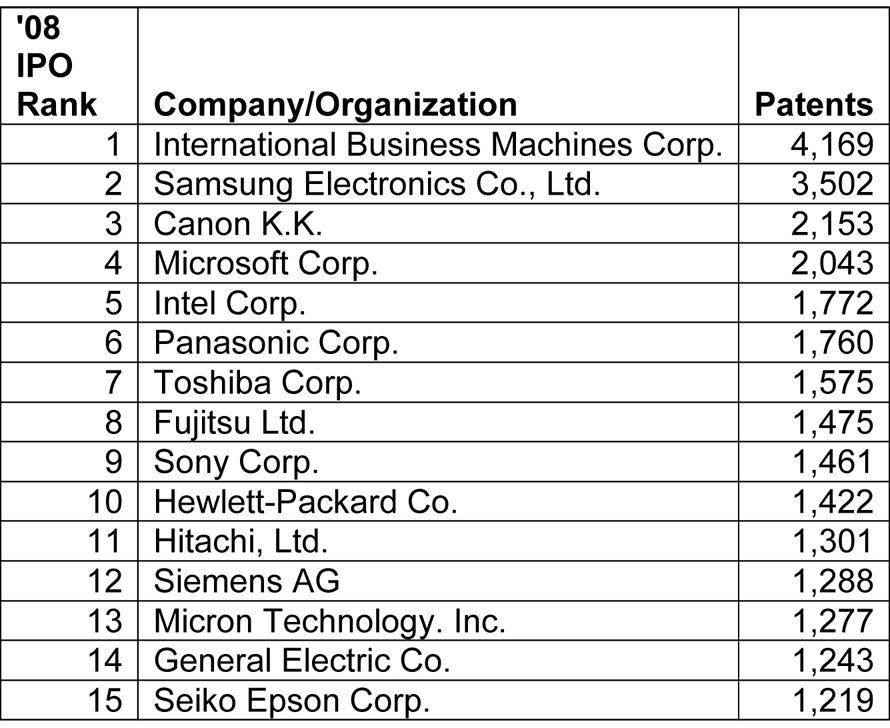
    The IPO stated that while it does not intend for the report to "encourage or discourage patenting," it would continue to publish its annual list of top recipients because "the number of patents granted is one of the few objective measures of the patent system as a whole and the patenting activities of individual industries and companies."  The IPO compiled its list by counting the number of utility patents granted during 2008 on which an organization or its subsidiary was listed as the owner on the face of the patent.  However, the IPO attributed patents that were granted to two or more organizations jointly to the organization listed first on the patent.  The IPO noted that 157,772 patents were issued in 2008, which was an increase from the 153,283 patents that issued in 2007 (but still lower than the 173,771 patents that issued in 2006).  The top fifteen companies on the IPO Top 300 are listed below.

    IPO Top 15  

    UPDATE:  The IPO has revised its list to indicate that Hitachi finished 3rd with 2,197 patents in 2008.

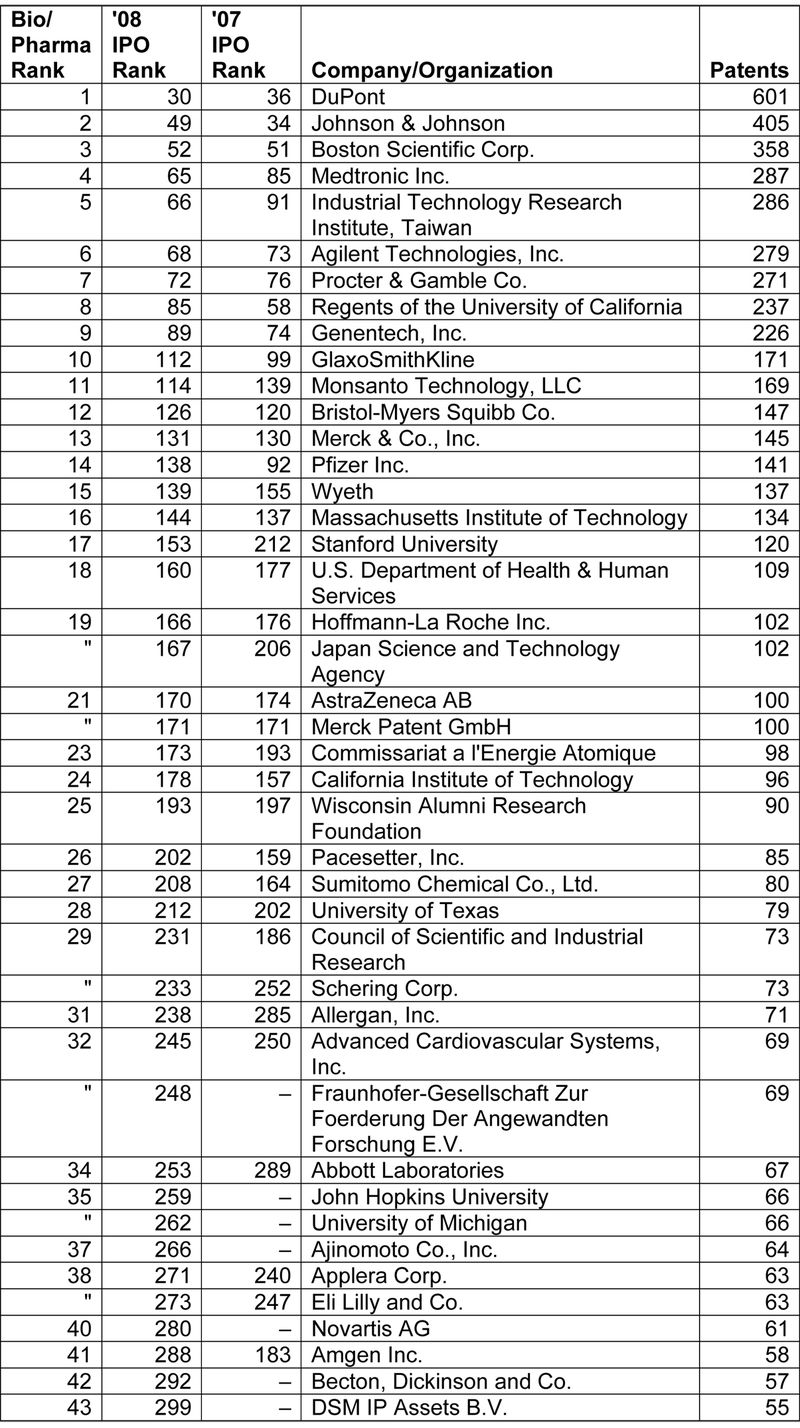
    As with the 2007 and 2008 rankings, we used the IPO's list of top patent holders to compile a list of the top "biotech and pharma" companies and organizations receiving U.S. patents in 2008.  While our list of companies and organizations numbered 51 for 2006 and 47 for 2007, we were only able to compile a list of 43 biotech and pharma companies and organizations for 2008.  Each organization's IPO top 300 ranking for 2008 is indicated in the "'08 IPO Rank" column; the IPO top 300 ranking for 2007 (if available) is indicated in the "'07 IPO Rank" column.  Please note that some of the companies and organizations listed below may be involved in non-biotech or non-pharma work, and therefore, that a portion of the patents granted to these companies may be directed to other than biotech and pharma-related inventions.  In addition, our list is a little inclusive in that we included medical device companies.

    Biotech-Pharma Top 43

    UPDATE:  The IPO has revised its list to indicate that Dow Chemical Co. finished 206th with 82 patents in 2008.  In our Biotech/Pharma Top 47 for 2007, Dow Chemical Co. finished 33rd (and 229th overall) with 76 patents.

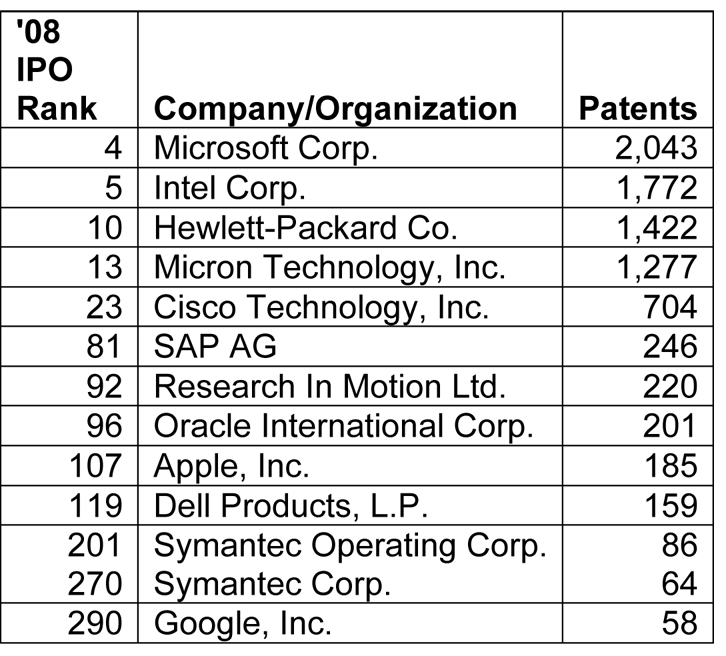
    Interestingly, the so-called Coalition for Patent Fairness, which has lobbied for substantial patent "reforms" that would arguably weaken patent rights in the U.S., placed a significant number of its corporate partners on the IPO's top 300 list.  Of the fourteen corporate partners listed on the group's website, twelve made the top 300 (only Autodesk and Palm did not), and five of these companies placed in the top 25.

    Coalition for Patent Fairness

    For additional information regarding this topic, please see:
    • "IPO Releases List of Top 300 Patent Holders," May 22, 2008
    • "IPO Posts List of Top 300 Patent Holders," April 20, 2007
  •     By Donald Zuhn

    Procter & Gamble The Federal Circuit today affirmed a determination by the District Court for the District of Delaware that U.S. Patent No. 5,583,122 was not invalid as obvious nor invalid for obviousness-type double patenting.  The '122 patent, which is owned by Plaintiff-Appellee Procter & Gamble Co. (P&G), relates to the compound risedronate, which is the active ingredient in P&G’s osteoporosis drug Actonel®.  Risedronate is a member of a class of compounds known as bisphosphonates, which are active in inhibiting bone resorption.

    Teva After Defendant-Appellant Teva Pharmaceuticals USA, Inc. notified P&G of its intent to market a generic version of risedronate, P&G filed suit against Teva for patent infringement.  In response, Teva argued that the '122 patent was invalid as obvious in view of P&G's expired U.S. Patent No. 4,761,406, and alternatively, that the '122 patent was invalid for obviousness-type double patenting.  The '406 patent relates to an intermittent dosing method for treating osteoporosis, which allows bisphosphonates to be used in the treatment of osteoporosis without the unwanted side effect of anti-mineralization.  The '406 patent specifies 36 bisphosphonates for use in the claimed method, eight of which are preferred compounds, and one of which is the compound 2-pyr EHDP.  Teva argued that the disclosure of 2-pyr EHDP in the '406 patent rendered the claims of the '122 patent obvious (risedronate and 2-pyr EHDP are positional isomers, with risedronate having a hydroxy-ethane-diphosphonate group connected to the #3 carbon of its pyridine ring, and 2-pyr EHDP having the hydroxy-ethane-diphosphonate group connected to the #2 carbon).

    Risedronate After a bench trial, the District Court determined that the '406 patent would not have led a person of ordinary skill in the art to identify 2-pyr EHDP as a lead compound, the skilled artisan would not have been motivated to modify 2-pyr EHDP to generate risedronate (at left), and unexpected results of risedronate's potency and toxicity rebutted Teva's assertion of obviousness.  As a result, the District Court found the claims of the '122 patent to be non-obvious.  The District Court also determined that the '122 patent was not invalid for obviousness-type double patenting.

    The Federal Circuit began its analysis by first noting that the evidence of record did not establish that it would have been obvious to modify 2-pyr EHDP to create risedronate, and therefore, that the Court did not need to reach the question of whether the '406 patent would have led a skilled artisan to identify 2-pyr EHDP as a lead compound.  The panel noted that Dr. Herbert Fleisch, a preeminent authority on bisphosphonates during the relevant time period, wrote in 1984 that "every compound, while remaining a bisphosphonate, exhibits its own physical-chemical, biological and therapeutic characteristics, so that each bisphosphonate has to be considered on its own," and thus, "[t]o infer from one compound the effects in another is dangerous and can be misleading."  The Federal Circuit therefore determined that the District Court had not erred in finding that a person of ordinary skill would not have been motivated to synthesize and test risedronate, and would not have had a reasonable expectation of success in synthesizing and testing risedronate.  Moreover, the panel determined that there was no credible evidence that the structural modification of 2-pyr EHDP would have been routine.  Thus, the Federal Circuit concluded that the District Court did not clearly err in finding that Teva had failed to establish a prima facie case of obviousness.

    Notwithstanding Teva's failure to establish a prima facie case of obviousness, the Federal Circuit also determined that P&G had introduced sufficient evidence of unexpected results.  Among these unexpected results were risedronate's potency at low doses and lack of toxicity at higher doses than 2-pyr EHDP could be safely used.  The Federal Circuit also determined that the District Court had not erred in considering evidence that risedronate had satisfied a long-felt but unmet need.

    With respect to the issue of obviousness-type double patenting, the Federal Circuit determined that the District Court had correctly found the '406 patent to be prior art to the '122 patent, since P&G's evidence that risedronate had been synthesized in May of 1985 was uncorroborated (i.e., laboratory notebook pages describing the synthesis were unwitnessed).  The panel noted that "the obviousness analysis applies to double patenting," with the exception that non-statutory double patenting compares claims in an earlier patent to claims in a later patent or application, double patenting does not require inquiry into a motivation to modify the prior art, and double patenting does not require inquiry into objective criteria suggesting non-obviousness.  Thus, because risedronate was deemed to be non-obvious in view of the '406 patent, the Federal Circuit concluded that the '122 patent was also not invalid for obviousness-type double patenting in view of the '406 patent.  In addition, the panel determined that Teva failed to present clear and convincing evidence of overlap between the claims of the '122 patent (directed to compounds, including risedronate) and the '406 patent (directed to an intermittent dosing regimen, with no compound claims).

    Procter & Gamble Co. v. Teva Pharmaceuticals USA, Inc. (Fed. Cir. 2009)
    Panel: Circuit Judges Mayer and Dyk, and District Judge Huff
    Opinion by District Judge Huff