• By Donald Zuhn

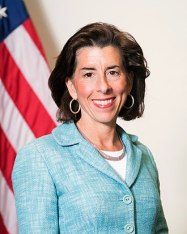
    Raimondo  GinaLast week, Senators Thom Tillis (R-NC), Tom Cotton (R-AR), and Marsha Blackburn (R-TN) sent a letter to Secretary of Commerce Gina Raimondo (at right) to express their "grave concerns with the so called 'compromise' agreement to waive global intellectual property protections for Covid-19 vaccines."  Earlier this month, Reuters reported that the United States, European Union, India, and South Africa had reached an agreement on a waiver with respect to patents for COVID-19 vaccines (see "Compromise Reportedly Reached on COVID-19 Vaccine Patent Waiver").

    The waiver compromise, if approved by World Trade Organization (WTO) members, would allow "an eligible Member [to] authoriz[e] the use of patented subject matter required for the production and supply of COVID-19 vaccines without the consent of the right holder to the extent necessary to address the COVID-19 pandemic."  The compromise defines "eligible Member" as "any developing country Member that exported less than 10 percent of world exports of COVID-19 vaccine doses in 2021," and defines "patented subject matter" as "includ[ing] ingredients and processes necessary for the manufacture of the COVID-19 vaccine" (see "More on Leaked WTO COVID-19 Vaccine Patent Waiver Compromise").

    In their letter, the three Senators call the waiver compromise proposal a "disastrous plan" that "would destroy high-paying American jobs while handicapping our nation's ability to develop life-saving medicines in the future."  They argue that waiving IP rights "would enable any company or government — including hostile actors like China and Russia — to simply steal cutting-edge American technology."  The Senators also argue that it's "no accident" that all three of the FDA-approved COVID-19 vaccines "were developed by American firms and American workers," asserting that "[s]trong intellectual property rights are the bedrock that supports the investment and innovation that has historically allowed the U.S. to lead the world."

    According to the Senators, the WTO waiver "would be a senseless gift to our foreign adversaries," but more significantly, would "not solve the problem it purports to address" (i.e., would not "increase global manufacturing of shots, which will in turn boost inoculation rates and help end the pandemic").  They note that current projections call for global COVID-19 vaccine production to reach 20 billion doses in 2022, and suggest that "[t]here will be a worldwide glut of Covid-19 shots by this summer."  They also suggest that India and South Africa, which first proposed a waiver in the fall of 2020, will face vaccine gluts as well, and point out that the Africa Centers for Disease Control and Prevention has stated that "the primary challenge for vaccinating the continent is no longer supply shortages but logistics and vaccine hesitancy" (see Payne, "Africa CDC to ask world to pause Covid-19 vaccine donations," POLITICO).

    The Senators conclude that the U.S. Trade Representative, which agreed to the waiver compromise proposal with the European Union, South Africa, and India, "appears to have acceded to an arrangement that would undermine American workers, innovation, and our economy and national security," and they ask Secretary Raimondo "to reverse Ambassador Tai's disastrous decision to enter into this agreement."

    For additional information regarding this topic, please see:

    • "The Proposed WTO IP Waiver: Just What Good Can It Do? — An Analysis," March 24, 2022
    • "IP Associations 'Concerned' by Reports of TRIPS Waiver Compromise," March 24, 2022
    • "More on Leaked WTO COVID-19 Vaccine Patent Waiver Compromise," March 21, 2022
    • "Compromise Reportedly Reached on COVID-19 Vaccine Patent Waiver," March 16, 2022
    • "Sen. Tillis Writes to U.S. Trade Representative (Again) Regarding TRIPS Waiver," December 12, 2021
    • "U.S. Trade Representative Responds to Letters from Senators Regarding TRIPS Waiver," November 14, 2021
    • "U.S. Chamber of Commerce Urges Administration to 'Double Down' on Global Vaccine Distribution," November 3, 2021
    • "Is This the WTO Waiver End Game?" July 25, 2021
    • "BIO Declaration on Global Access to COVID-19 Vaccines and Treatments and Role of IP," June 24, 2021
    • "GOP Legislators Write in Opposition to Proposed TRIPS Waiver," May 16, 2021
    • "Population of Patents at Risk from Proposed WTO Patent Waiver," May 12, 2021
    • "Sen. Daines Urges Biden Administration to Withdraw Support for COVID-19 IP Waiver," May 12, 2021
    • "Pfizer CEO Pens Open Letter on COVID-19 Vaccine IP Waiver," May 10, 2021
    • "If the Devil of the WTO IP Waiver Is in the Details, What Are the Details?" May 9, 2021
    • "The Road to Hell Is Paved with What Everybody Knows," May 6, 2021
    • "BIO & IPO Issue Statements on Biden Administration's Support for Proposed WTO Waiver," May 6, 2021
    • "Biden Administration Supports Waiver of IP Protection for COVID-19 Vaccines," May 5, 2021
    • "Suspending IP Protection: A Bad Idea (That Won't Achieve Its Desired Goals)," April 26, 2021
    • "Sen. Tillis Asks Biden Administration to Oppose WTO Waiver Proposal," April 21, 2021
    • "IP Organizations Support Continued Opposition to Waiver Proposal," April 5, 2021
    • "Industry Coalition Supports Continued Efforts to Oppose Waiver Proposal," March 29, 2021
    • "BIO and PhRMA Urge Biden Administration to Oppose Proposed WTO TRIPS Waiver," March 11, 2021
    • "IPO Sends Letter on IP Law and Policy to President-Elect and Vice President-Elect," January 4, 2021

  • By Kevin E. Noonan

    University of California-BerkleyOn November 19th, Senior Party Sigma-Aldrich filed its Substantive Preliminary Motion No. 1 in CRISPR Interference No. 106,132, asking the Board to substitute the Count pursuant to 37 C.F.R. §§ 41.121(a)(1)(iii) and 41.208(a)(1).  Junior Party the University of California, the University of Vienna, and Emmanuelle Charpentier (collectively "CVC") filed its Opposition on February 18th.

    In its Motion, Sigma-Aldrich sets forth its proposed Count 2 as, in the alternative, CVC Application No. 15/947,680, claim 164 or Sigma-Aldrich Application No. 15/456,204, claim 31 (the latter alternative Count based on Sigma-Aldrich's claim remains the same as in the Count as the interference was declared).  Claim 164 of CVC's '680 patent recites (dependent on claims 156 and 157):

    156.  A method of cleaving or editing a target DNA molecule or modulating transcription of at least one gene encoded thereon, the method comprising:
    contacting a target DNA molecule having a target sequence with an engineered and/or non-naturally-occurring Type II Clustered Regularly Interspaced Short Palindromic Repeats (CRISPR)—CRISPR associated (Cas) (CRISPR-Cas) system comprising:
        a) a single molecule DNA-targeting RNA comprising
            i) a targeter-RNA that hybridizes with the target sequence, and
            ii) an activator-RNA that hybridizes with the targeter-RNA to form a double-stranded RNA duplex of a protein-binding segment,
            wherein the targeter-RNA and the activator-RNA are covalently linked to one another with intervening nucleotides; and
        b) a Cas9 protein,
        wherein the single molecule DNA-targeting RNA forms a complex with the Cas9 protein, thereby targeting the Cas9 protein to the target DNA molecule,
        whereby said target DNA molecule is cleaved or edited or transcription of at least on gene encoded by the target DNA molecule is modulated, and
        wherein said contacting occurs in a eukaryotic cell.

    157.  The method of Claim 156, wherein, prior to the contacting step, the method comprises:
    introducing into the eukaryotic cell containing the target DNA molecule:
        1) the single molecule DNA-targeting RNA, or a DNA molecule comprising  a nucleotide sequence that
            (i) encodes the single molecule DNA-targeting RNA and
            (ii) is operably linked to a regulatory element operable in said eukaryotic cell; and
        2) the Cas9 protein, an RNA molecule comprising a nucleotide sequence encoding the Cas9 protein, or a DNA molecule comprising a nucleotide sequence that
            (i) encodes the Cas9 protein and
            (ii) is operably linked to a regulatory element operable in said eukaryotic cell.

    164.  The method of Claim 157, wherein the method comprises creation of a double strand break in the target DNA molecule which is repaired by a homology-directed repair mechanism which incorporates a sequence of a donor polynucleotide into the target DNA molecule, thereby editing the target DNA molecule [emphasis in brief].

    Sigma-Aldrich's argument in favor of substituting the Count was that the so-called McKelvey count as declared encompasses two patentably distinct inventions:  "(1) CRISPR-Cas9 in a eukaryotic cell to cleave a target DNA; and (2) CRISPR-Cas9 in a eukaryotic cell to cleave a target DNA and subsequently to integrate a donor DNA sequence into the target DNA via homology-directed repair ("HDR)" (emphasis in brief).  According to Sigma-Aldrich, this second, subsequent step is not obvious over merely cleaving a DNA target and thus claims to these embodiments are patentably distinct.  Citing 37 C.F.R. § 41.201, Sigma-Aldrich maintained that an interference count should not encompass two patentably distinct inventions, citing Ashurst v. Brugger, Int'f No. 105,482 (McK), 2008 Pat. App. LEXIS 5953, *51-52 (BPAI July 16, 2008), and Edelman v. Stomp, Int'f No. 105,261 (SGL), 2006 Pat. App. LEXIS 17, *18-19 (PTAB Apr. 14, 2006).  According to Sigma-Aldrich, the "current Count 1 permits CVC to submit proofs of invention for cleavage alone [based on its claims encompassing "cleaving or editing the target DNA molecule or modulating transcription of at least one gene encoded by the target DNA molecule"], which do not constitute proofs of invention for the separately patentable cleavage plus integration invention."  Permitting CVC to prevail on this basis would be contrary to the "fundamental purposes of a first-to-invent patent interference" as well as being "manifestly unfair to Sigma," because it would deprive Sigma-Aldrich of patent protection for "its distinct and more technically challenging invention based on CVC's proofs for a different and considerably simpler invention."  In addition, Sigma-Aldrich asserted that none of CVC's applications disclose embodiments for "cleavage plus integration" methods (even if their claims encompass such CRISPR methods in eukaryotic cells).  "CVC's evidence in CVC [U.S. Provisional Application No. 61/757,640, filed January 28, 2013] that CRISPR-Cas9 could cleave a DNA strand in a eukaryotic cell — full stop — should not entitle CVC to an invention that CVC did not demonstrate that it actually possessed, namely, preparing a donor polynucleotide, introducing that donor polynucleotide into the cell, and actually modifying the chromosomal sequence by integrating that donor polynucleotide into the cleaved DNA strand by HDR," Sigma-Aldrich argued.  CVC disclosure of potential uses of CRISPR for integrating DNA into a targeted site should not entitle CVC to claims for such embodiments that they did not possess (particularly under circumstances where Sigma-Aldrich achieved such inventive embodiments first, Sigma-Aldrich argued).  And the brief noted that there are three other interferences before the Board, none of which involve a priority dispute as to which party showed the "further technological advance of integrating a donor polynucleotide into the cleaved target DNA via HDR."

    In its Opposition, CVC contends that Sigma-Aldrich fails to satisfy the requirements for substituting the Count because, inter alia, the Senior Party has not rebutted the presumption that the Count in the interference as declared is entitled to (there is a 'presumption that the initial count is limited to a single patentable invention" CVC contends, citing Lee v. Mcintyre, 55 U.S.P.Q.2d 1406 (B.P.A.I. 2000)).  Initially (albeit in a footnote), CVC disputes Sigma-Aldrich's dichotomy between its portion of the McKelvey Count as being limited to "cleavage only" CRISPR embodiments, contending that its half of Count 1 recites "'cleaving or editing or modulating transcription,' and it is inclusive of subsequent donor integration by HDR" (emphasis in brief).  CVC cites positions Sigma-Aldrich has taken during ex parte prosecution (which CVC contends were motivated by Sigma-Aldrich's desire to "avoid an interference with CVC over the subject matter of CRISPR-Cas9 for cleaving or editing target DNA in a eukaryotic cell [that were] not limited to donor integration by HDR").  According to CVC, Sigma-Aldrich refused to introduce a "cleavage only" claim into its application expressly to avoid an interference.  Citing 37 C.F.R. § 41.202(c) for a "disclaimer doctrine" CVC argues that "when the examiner suggests a claim to an applicant for purposes of a future interference, and the applicant refuses, such refusal operates as a 'concession' that the subject matter of the suggested claim was the prior invention of another," citing In re Ogiue, 517 F.2d 1382, 1391 (C.C.P.A. 1975).  Sigma-Aldrich's current Motion No. 1 is merely an attempt, CVC contends, by Sigma-Aldrich to "engineer a priority contest limited to donor integration by HDR."  CVC asserts that such a Count would preclude it from proffering its "best proofs," which could be avoided by a two-count interference that Sigma-Aldrich refused to provoke.  CVC maintains that only 10 of its claims-in-interference are directed to "cleavage plus integration" CRISPR species, and that CVC's generic CRISPR claims do not interfere with Sigma-Aldrich's proposed Count 2.  CVC characterizes this calculus (Sigma-Aldrich trying to bootstrap interference with 10 CVC claims to win priority over the other 176 of CVC's claims-in-interference) as "flagrant manipulation" (presumably of the interference rules) and argues that CVC is entitled to a judgment of priority on its own half of the original Count and its 176 generic CRISPR claims.

    Following an explication of interference Rules and case law, and noting that double-stranded break (DSB) repair in eukaryotic cells utilizes "non-homologous end joining" (NHEJ) and "homologous recombination" (HDR) (and that these mechanisms are used in eukaryotic cells "independent of how the DSB occurred," emphasis in brief), CVC set forth its detailed arguments regarding its positions in Opposition to Sigma-Aldrich's Motion No. 1 as set forth above.  CVC asserts that "Sigma has already failed, twice, to demonstrate that [cleavage and cleavage plus integration] are two separately patentable inventions," "[f]irst, during prosecution of the application [No. 15/456,204]" and second, upon initiation of this interference when the Board's declaration contained Count 1 instead of Sigma-Aldrich's preferred Count 2 (now recited in Sigma-Aldrich's Proposed Count 2).  These circumstances raised the presumption that the two species of eukaryotic CRISPR were patentably indistinct and Sigma-Aldrich has failed to rebut that presumption, CVC contends.

    Further, CVC argues that Sigma-Aldrich is incorrect in arguing in its Motion that "[w]hen an interference is declared with a single count directed to two patentably distinct inventions, a motion to substitute the count is appropriate."  On the contrary, CVC contends, the remedy is a two-count interference, but here Sigma-Aldrich is precluded from that remedy because it refused to add a claim to generic cleavage methods earlier.  The authority Sigma-Aldrich relies upon in its motion is inapposite, CVC contends because 37 C.F.R. § 41.201 applies only in multiple count interferences and M.P.E.P. § 2309.01 and the examples therein Sigma-Aldrich relies upon instructs that a party should move to add a Count rather than substitute one.  CVC also distinguishes the case law relied upon in Sigma-Aldrich's motion, arguing that Godtfredsen v. Banner, 598 F.2d 589, 592 (C.C.P.A. 1979), relates to the purpose of an interference to resolve inventorship issues for each of the inventions at issue, and Ashurst v. Stampf, 2008 WL 2781979 (B.P.A.I. 2008), and Edelman v. Stomp, 83 U.S.P.Q.2d 1200 (B.P.A.I. 2006) each "involved situations where the movant sought to remove from the interference subject matter that it alone claimed" (emphasis in brief), as opposed to the circumstances here where (CVC contends) the subject matter sought to be removed from the Count is solely their own.

    The consequence of the history of this interference, in CVC's view, is that "Sigma has thus created a situation in which it is ineligible for the only relief supported by the rules—i.e., a two-count interference" and noting preemptively that "Sigma cannot request such relief for the first time in its reply," citing 37 C.F.R. § 41.208(b).  And no doubt to Sigma-Aldrich's chagrin and CVC's satisfaction the Opposition brief contends that under circumstances where a party (Sigma-Aldrich) has refused to include claims to a putatively separately patentable invention in an interference, that party (Sigma-Aldrich) has conceded priority to that invention under 37 C.F.R. § 41.202(c), citing In re Ogiue, 517 F.2d 1382, 1391 (C.C.P.A. 1975); In re Williams, 62 F.2d 86, 88 (C.C.P.A. 1932); In re McKellin, 529 F.2d 1324, 1328 (C.C.P.A. 1976); Ethyl Gasoline Corp. v. Coe, 139 4 F.2d 372, 373 (D.C. Cir. 1943); M.P.E.P. § 2304.04, and Fed. Reg. Vol. 69, No. 155, 8 49992 (Aug. 12, 2004), in support of this legal interpretation.  Having ensnared itself in this procedural quagmire, CVC contends that Sigma-Aldrich is entitled neither to have the Board substitute the Count nor to a two-count interference.

    CVC further asserts as a basis for the Board to deny Sigma-Aldrich's motion that the Senior Party has asserted than only 10 of CVC's claims recite "cleavage plus integration" species of eukaryotic CRISPR but nevertheless contends that all 186 CVC claims in this interference correspond to Proposed Count 2, which CVC calls "a complete perversion of the reasoned claim correspondence analysis that Sigma was obligated to perform," citing Grose v. Plank, 15 U.S.P.Q.2d 1338 (B.P.A.I. 1990).  And in addition, CVC contends, Sigma-Aldrich has "failed to make out a prima facie case" regarding "why any of CVC's 176 non-interfering claims correspond to Proposed Count 2" (despite Sigma-Aldrich's expert testifying to the contrary).

    CVC's Opposition then turns to the "best proofs" question, citing Grose v. Plank, 15 U.S.P.Q.2d 1338 (B.P.A.I. 1990), and Univ. of S. California v. DePuy Spine, Inc., 473 F. App'x 893, 895 (Fed. Cir. 2012), as authority.  For this portion of their argument, CVC cites (perhaps improvidently, in retrospect) its priority briefs in Interference No. 106,115, which showed CVC's conception and reduction to practice of "cleavage" CRISPR species first and "cleavage plus integration" species thereafter.  These constitute CVC's best proofs, which they contend Proposed Count 2 would exclude, even though claims (176 of them) encompassing cleavage species of eukaryotic CRISPR would fall within the scope of Proposed Count 2.

    In this portion of its Opposition, CVC also contends Sigma-Aldrich has failed to establish patentability of the invention recited in Proposed Count 2 over the prior art under 37 C.F.R. § 41.208(c)(2) and Louis v. Okada, 59 U.S.P.Q.2d 1073 (B.P.A.I. 2001), and the declaration of this interference was predicated on the "hypertechnicality" that permitted Sigma-Aldrich to swear behind references by ToolGen.  These circumstances do not prevent CVC from asserting that the Board can require Sigma-Aldrich to distinguish these references in this interference when deciding whether to grant the requested relief (which, should the Board require CVC contends Sigma-Aldrich will not be able to do).

    CVC sets forth an extensive discussion regarding why Sigma-Aldrich has not overcome the presumption that Count 1 recites but one invention.  According to CVC, what is required by Sigma-Aldrich is a showing that the subject matter in Proposed Count 2 is patentably distinct from the CVC portion of Count 1 as declared, citing Hester v. Allgeier, 21 687 F.2d 464, 466 (C.C.P.A. 1982), and M.P.E.P. § 2309.01(A) (wherein the subject matter of Count 1 is considered to be prior art to Proposed Count 2).  Sigma-Aldrich has not and cannot do so, CVC contends for at least these reasons:

    • HDR was known in the art by the use of several "targeted" nucleases (including zinc finger nucleases and transcription activator–like effector nucleases) to repair double-stranded breaks (DSB) in "a variety of eukaryotic cells and organisms, including nematodes, Xenopus laevis oocytes, fruit flies (Drosophila melanogaster), plants, stem cells, and mammalian cell types in culture (e.g., HEK293, HEK293T, mouse), and that these intrinsic mechanisms could be expected to operate in the CRISPR context;

    • There were express suggestions in the art to "introduce CRISPR-Cas9 and a donor sequence for integration by HDR and thereby perform precise genome editing in a eukaryotic cells," citing examples;

    • The CVC portion of Count 1 being considered prior art, the difference with Sigma-Aldrich's Proposed Count 2 is "a homology-directed repair mechanism which incorporates a sequence of a donor polynucleotide into the target DNA molecule, thereby editing the target DNA molecule," something that "occurs naturally in the cell in response to a DSB when there is a donor sequence present.

    Under these circumstances, CVC argues that any "alleged uncertainty" regarding the function of CRISPR in eukaryotic cells generally as alleged by Sigma-Aldrich is "irrelevant and misleading because Count 1 assumes the successful application of sgRNA CRISPR Cas9 in eukaryotic cells."  This conclusion is supported, CVC argues, by Sigma-Aldrich's expert's concession that the skilled artisan, taking the prior art (including ZFN, TALENs and CRISPR) would be confident that HDR could be achieved in eukaryotic cells.  Under these circumstances CVC argues that the skilled artisan would have been motivated to combine CVC's portion of Count 1 with what was known in the prior art regarding HDR, and would have had a reasonable expectation of success in achieving CRISPR-mediated HDR in eukaryotic cells.  In the absence of Sigma-Aldrich making any assertion of secondary considerations, CVC contends that the Sigma-Aldrich portion of Proposed Count 2 would have been obvious (and hence not patentably distinct) over the Count in this interference as declared, and Sigma-Aldrich has not (and cannot) make the required showing of patentable distinction for substituting the Count.  And, CVC contends, the "hypothetical concerns" (12 of them) Sigma-Aldrich raises in this regard in its Motion are "fundamentally flawed" and are "post-hoc litigation positions," setting forth its reasoning supporting this conclusion for each of these concerns.  But generally, CVC argues, "Sigma's alleged concerns, while itemized, amount to a generalized requirement that a skilled artisan have certainty.  But the law does not require "absolute certainty," citing Par Pharm.,  Inc. v. TWi Pharms., Inc., 773 F.3d 1186, 1198 (Fed. Cir. 2014), and Pfizer, Inc. v. Apotex, Inc., 480 F.3d 1348, 1364 (Fed. Cir. 2007).  Accordingly, CVC contends, Sigma-Aldrich's arguments do not support their contention that Proposed Count 2 is patentably distinct from Count 1 in the interference as declared.

    CVC also argues that Sigma-Aldrich's arguments set forth in its Motion No. 1 amount to a concession that the Senior Party is not entitled to priority to Count 1 under Rule § 41.202(c) (vide supra) and thus if the Board were to deny Sigma-Aldrich's Motion the Board should grant priority to CVC.  In the alternative, should the Board grant Sigma-Aldrich's Motion then the Board should award priority to the cleavage-only portion of the Count (based on CVC's claims) as well as the generic cleavage claims, calling this "the only logical consequence" of Sigma-Aldrich's concessions.  And CVC further contends that "in any event, CVC's 176 noninterfering claims to generic cleavage should not be designated as corresponding to Proposed Count 2, for the reasons detailed above."  Moreover, CVC argues, should the Board grant Sigma-Aldrich's Motion the Board should deny priority to the Senior Party's U.S. Provisional Application No. 61/736,527, filed December 12, 2012 (because Sigma-Aldrich failed to submit an affidavit required by 37 C.F.R. § 41.158(b)), whereas the Board should recognize CVC to be entitled to priority to its U.S. Provisional Application No. 61/757,640, filed January 28, 2013, asserting that Sigma-Aldrich's basis for their contention that CVC is not entitled to this priority amounts to a requirement for an actual reduction to practice or a working example" which is not required under Ariad Pharms., Inc. v. Eli Lilly and Co., 598 F.3d 1336, 1352 (Fed. Cir. 22 2010) (en banc), and Dana-Farber Cancer Inst., Inc. v. Ono Pharm. Co., Ltd., 964 F.3d 1365, 23 1372 (Fed. Cir. 2020) (this assertion perhaps being undermined by the Board's recent decision against CVC in Interference No. 106,115; see "PTAB Holds for Broad in CRISPR Interference: The Reasoning").  The significance of the Board resolving these  priority questions is that CVC would then be entitled to Senior Party status in this interference.

  • CalendarMarch 29, 2022 – Biotechnology/Chemical/Pharmaceutical (BCP) customer partnership meeting (U.S. Patent and Trademark Office) – 9:00 am to 5:00 pm (ET)

    March 29, 2022 – "Intellectual Property Valuation & Technology Transfer: Current Practise and Challenges" (OxFirst Limited) – 15:00 to 16:00 (GMT)

    March 30, 2022 – 2022 Women's Entrepreneurship Symposium — "From Inspiration to Commercialization" (U.S. Patent and Trademark Office) – 2:00 pm to 3:35 pm (ET)

    April 6, 2022 – "Advanced Patent Search Strategies: What to Use When All Else Fails," Part II (Patent Information Users Group, Inc.) – 11:00 am to 12:00 pm (EDT)

    April 26-27, 2022 – Paragraph IV Disputes Conference (American Conference Institute) – New York City

  • USPTO SealThe U.S. Patent and Trademark Office will be holding its next biotechnology/chemical/pharmaceutical (BCP) customer partnership meeting, as a virtual meeting, on March 29, 2022.  The agenda for the meeting is as follows:

    • Welcoming and Opening Remarks (9:00 – 9:10 am ET) — Daniel Sullivan and Gary Jones, Directors, TC1600, USPTO

    • Claim Construction and Doctrine of Equivalents — A review for the Patent Office (9:10 – 10:30 am) — Henry C. Su, Bradley Arant Boult Cummings LLP

     Break (10:30 – 10:40 am)

    • Statutory provisions governing patent infringement — A practical analysis (10:40 – 11:40 am) — Christopher J. Harnett, Maynard, Cooper & Gale

    • Deferred subject matter eligibility response (DSMER) pilot program (11:40 am – 12:00 pm) — Daniel Kolker, Supervisory Patent Examiner (SPE), TC1600, USPTO

    • Lunch (12:00 – 1:00 pm)

    • Patent Quality Metrics (1:00 – 1:30 pm) — Kathleen Bragdon, Quality Assurance Specialist (mQAS), OPQA, USPTO

    • Providing explicit rationales in rejections under 35 U.S.C. 103 (1:30 – 2:30 pm) — Lora Barnhart Driscoll, Quality Assurance Specialist (TQAS), TC1600, USPTO

    • Break (2:30 – 2:40 pm)

    • Biological Sequence Searching (2:40 – 3:10 pm) — Christopher Babic, Supervisory Patent Examiner (SPE), TC1600, USPTO

    • A systematic approach to 35 U.S.C. 112(b) (3:10 – 4:40 pm) — Gary Benzion, Supervisory Patent Examiner (SPE); Bennett Celsa, Quality Assurance Specialist (TQAS); Amjad Abraham, Supervisory Patent Examiner (SPE); Ashwin Mehta, Review Quality Assurance Specialist (RQAS) — TC1600 and OPQA, USPTO

    • Closing Remarks (4:40 – 5:00 pm) — Directors, TC1600, USPTO

    Additional information regarding the BCP customer partnership meeting, including registration information for those wishing to attend the meeting or register for online participation, can be found here.  The agenda for the BCP customer partnership meeting can be found here.

  • OxFirstOxFirst Limited will be offering a webinar entitled "Intellectual Property Valuation & Technology Transfer: Current Practise and Challenges" on March 29, 2022 from 15:00 to 16:00 (GMT).  Ronen Kreizman of the Weizmann Institute and Eli Greenbaum of Yigal Arnon & Co. will focus on strategies for technology transfer from academic research institutions to industry, with attention to current practices and challenges across Israel, provide insights into how technology transfer offices pursue optimal and sustainable commercialization strategies for early-stage academic technology, and describe Israeli government funding mechanisms for technology transfer, and how such mechanisms complicate the transfer and licensing of intellectual property by grant recipients.

    While there is no cost to participate in the program, those interested in attending the webinar can register here.

  • USPTO SealThe U.S. Patent and Trademark Office will be holding the next installment of the 2022 Women's Entrepreneurship Symposium, entitled "From Inspiration to Commercialization," on March 30, 2022, from 2:00 pm to 3:35 pm (ET).  The program will consist of two panel discussions:

    • Finding innovation: Learn how exceptional innovators discovered their inspiration for success and commercialization — Hope Shimabuku, Director of the Texas Regional Office of the USPTO will moderate a panel consisting of Georgia Grace Edwards of SheFly Apparel and Ceata E. Lash of PuffCuff LLC

    • A conversation on enabling success for the next generation of innovative women to succeed — Shirin Bidel-Niyat, Senior Advisor for the Under Secretary of Commerce for Intellectual Property and Director of the USPTO will moderate a panel consisting of Abi Olukeye of Smart Girls HQ and Gina Raimondo, U.S. Secretary of Commerce

    Additional information regarding the Symposium, including an agenda, can be found here.  Those interested in registering for the event, can do so here.

  • By Kevin E. Noonan

    WTO logoAs posted Monday, BIO (the Biotechnology Innovation Organization) provided a link to the supposed compromise agreement reached recently to permit WTO member states to waive patent protection for "subject matter required for the production and supply of COVID-19 vaccines without the consent of the right holder to the extent necessary to address the COVID-19 pandemic."  The effects of such a waiver are being debated by those against it (mostly members of industry having vaccine-related IP protection and industries making vaccines) and in favor (NGOs, such as Médecins Sans Frontières) and, of course, the governments who seek to benefit, starting with the waiver's sponsors, India and South Africa.

    The proposed waiver sounds patent-centric, but the devil as usual is in the details (see "If the Devil of the WTO IP Waiver Is in the Details, What Are the Details?").  For example, while the waiver states that a member state can permit "use of patented subject matter required for the production and supply of COVID-19 vaccines without the consent of the right holder to the extent necessary to address the COVID-19 pandemic," in a footnote the term "patented subject matter" is substantially broadened to include "ingredients and processes necessary for the manufacture of the COVID-19 vaccine" (emphasis added).  The rights the waiver gives a member state are expressly not limited to compulsory licenses of patents in the member's jurisdiction, but include "executive orders, emergency decrees, and judicial or administrative orders" as well as undefined "other acts."  These acts or decrees are themselves not limited to internal use in a member state, but also can include "any proportion of the authorized use to be exported to eligible Members and to supply international or regional joint initiatives that aim to ensure the equitable access of eligible Members to the COVID-19 vaccine covered by the authorization" (emphasis added; wherein the italicized portion of the proposal is not defined).

    But as these considerations suggest, while a dramatic development (after all, the proposal was scheduled to come to a vote last fall), patent rights waivers are not the entirety of IP-related provisions in the proposal nor ones needed if indeed the sponsors intend to remove actual impediments to more widespread vaccine distribution, particularly in low- and middle-income countries.  The details of COVID vaccine production have been set out in various news sources (see Neuberg et al., "Exploring the Supply Chain of the Pfizer/BioNTech and Moderna COVID-19 Vaccines"; Weiss et al., "A COVID-19 Vaccine Life Cycle: From DNA to Doses," USA Today, Feb. 7, 2021; King, "Why Manufacturing Covid Vaccine to at Scale Is Hard," Chemistry World, Mar. 23, 2021; Cott et al., "How Pfizer Makes Its Covid-19 Vaccine," New York Times, April 28, 2021) and in the scientific literature (see Lowe, "Myths of Vaccine Manufacturing," Science Translational Medicine, February 2021).  But these are certainly not disclosed in the detail necessary for commercial production, and the complexities of production are illustrated in graphics from the Times article, wherein the DNA is prepared in Chesterfield, MO and shipped to Andover, MA for mRNA production; then the mRNA shipped back to Chesterfield or Kalamazoo, MI for packaging into the vaccine nanoparticles; and then sent back to Andover for testing before release.  While some of this complexity may be company-specific, it also represents the different technological requirements for preparing an effective vaccine.

    It is evident that, in the relative dearth of patents involved in COVID vaccine preparation to date, the disclosures needed to reproduce these vaccines (no matter how difficult that may be in practice) are not patent protected (with some notable exceptions that have raised the specter of patent infringement litigation against major vaccine makers in the U.S.).  Most of the "know-how" necessary to implement actual vaccine production involves trade secrets, many of which are not limited to COVID-19 vaccines (for example, producing the lipid nanoparticles in which the Pfizer and Moderna mRNA vaccines are encapsulated).  Under the terms of the proposed waiver, the question will be whether the U.S. will compel disclosure of trade secrets owned by U.S. companies or that have disclosed them in confidence to the extent such secrets are part of regulatory filings.  Either action would constitute a "taking" under the Fifth Amendment ("Nor shall private property be taken for public use, without just compensation"); see Epstein et al., "The Fifth Amendment Takings Clause," Interactive Constitution: Common Interpretation.  Seemingly simple and straightforward, almost every word in the clause is open to interpretation, none perhaps as much as determining what "just compensation" entails.  It is likely that, should the government act peremptorily with regard to takings of trade secrets justified by any WTO waiver clause, the effect on trade secrets rather than patent waivers will carry the greatest consequences and cause the most controversy.  Indeed, the prospects arising therefrom are likely some of the biggest impediments towards effectuating any waiver in a manner that could have any chance of achieving the stated goal of facilitating COVID vaccine production.

    Those impediments generally involve the global inequalities in access to medicines, including vaccines. The negative consequences of the inequities between the developed world and everyone else on both global public health and the intellectual property regime are not now just being appreciated (seee.g., "A Modest Proposal Regarding Drug Pricing in Developing Countries"; "The Law of Unintended Consequences Arises in Applying TRIPS to Patented Drug Protection in Developing Countries"; "Africa (Still) Depending on the Kindness of Strangers in Anti-AIDS Drug Pricing"; and "Worldwide Drug Pricing Regime in Chaos") but like many issues the COVID-19 pandemic has raised the temperature on the debate.  And the fact is that it is unlikely that most of the countries in favor of the waiver (except perhaps India and South Africa) have the technological infrastructure for producing the vaccine.  Thus in the short term the waiver can be expected to do little to solve the actual problem of vaccinating the world (or at least that portion that are not convinced the vaccine is unnecessary, harmful, or an infringement on their freedoms).  There have been some, small measures taken to address the distribution problem; for example, both Pfizer and BioNTech agreed to work with South Africa's Biovac Institute to produce their mRNA vaccine locally (see "Is This the WTO Waiver End Game? Pfizer and BioNTech Agree to Vaccine Technology Transfer with South Africa's Biovac Institute").  There have been efforts to export doses from "have" to "have not" countries (see, for example, Evenett et al., 2021, "The COVID-19 Vaccine Production Club: Will Value Chains Temper Nationalism?", World Bank Policy Research Working Paper 9565, 2021).  But perhaps more productive routes to achieving these solutions would be better focused on 1) open and resilient global supply chains; 2) further cooperation between industry players to ramp up production; 3) strengthened financing and sharing of vaccines for middle- and low-income countries; and 4) regulatory approval of new vaccines.  The motivations for such efforts need not (and do not) rely exclusively on altruism.  As has become evident, the virus has the capacity to mutate in ways that variants can arise having unknown resistance to current vaccines.  Vaccines, particularly the mRNA-base vaccines, may not be effective against these variants and thus it is in everyone's interest to extend vaccination globally (regardless of how daunting that challenge may be) to reduce the probability of such variants arising.

    The efforts being applied globally to develop vaccines, treatments, and better tests and technology in response to COVID-19 have been impressive.  Intellectual property protection has played an important role in these efforts.  Past experience and recent developments suggest that protecting IP for vaccines, therapies, and technologies to fight COVID-19 has had and could continue to have a positive impact, and advance the cause of eradicating, or at least treating and preventing, this disease.  It would be foolish to ignore these contributions by reducing their effectiveness with the proposed waiver, particularly when the precise scope (with regard to trade secret aspects at least) is either undefined or effectively unlimited.  The pandemic has produced a great deal of anxiety about what happens "the next time" there is a pandemic.  This waiver raises the very real possibility that we will be less likely to be able to face such a future challenge because those with the capacity, incentive, and economic wherewithal to do so will have left the field to pursue other opportunities.

  • By Donald Zuhn

    Earlier today, the American Intellectual Property Law Association (AIPLA), Intellectual Property Owners Association (IPO), Licensing Executives Society (LES) International, LES USA & Canada, and New York Intellectual Property Association (NYIPLA) issued a joint statement expressing their concern regarding reports that the European Union, India, South Africa, and United States had reached a tentative compromise on a proposed TRIPS waiver of intellectual property rights (see "More on Leaked WTO COVID-19 Vaccine Patent Waiver Compromise").  The group indicated that they "strongly support equitable, widespread and successful distribution of vaccines necessary to meet the challenges of COVID-19," but argued that "the proposal currently being reported incorrectly portrays IP as a barrier to production and supply of COVID-19 vaccines," adding that they "know of no evidence to support that IP is such a barrier."  Instead, the group cites a recent statement from the World Health Organization (WHO) that "there is enough [vaccine] supply to achieve our targets . . . [and that t]his is not a supply problem; it's an allocation problem."  The group then suggests that "[s]olving the allocation problem is best accomplished by focusing on improvements to supply chain and distribution issues, rather than by concentrating on the red herring of intellectual property as an alleged barrier."

    IP Associations

    For additional information regarding this topic, please see:

    • "More on Leaked WTO COVID-19 Vaccine Patent Waiver Compromise," March 21, 2022
    • "Compromise Reportedly Reached on COVID-19 Vaccine Patent Waiver," March 16, 2022
    • "Sen. Tillis Writes to U.S. Trade Representative (Again) Regarding TRIPS Waiver," December 12, 2021
    • "U.S. Trade Representative Responds to Letters from Senators Regarding TRIPS Waiver," November 14, 2021
    • "U.S. Chamber of Commerce Urges Administration to 'Double Down' on Global Vaccine Distribution," November 3, 2021
    • "Is This the WTO Waiver End Game?" July 25, 2021
    • "BIO Declaration on Global Access to COVID-19 Vaccines and Treatments and Role of IP," June 24, 2021
    • "GOP Legislators Write in Opposition to Proposed TRIPS Waiver," May 16, 2021
    • "Population of Patents at Risk from Proposed WTO Patent Waiver," May 12, 2021
    • "Sen. Daines Urges Biden Administration to Withdraw Support for COVID-19 IP Waiver," May 12, 2021
    • "Pfizer CEO Pens Open Letter on COVID-19 Vaccine IP Waiver," May 10, 2021
    • "If the Devil of the WTO IP Waiver Is in the Details, What Are the Details?" May 9, 2021
    • "The Road to Hell Is Paved with What Everybody Knows," May 6, 2021
    • "BIO & IPO Issue Statements on Biden Administration's Support for Proposed WTO Waiver," May 6, 2021
    • "Biden Administration Supports Waiver of IP Protection for COVID-19 Vaccines," May 5, 2021
    • "Suspending IP Protection: A Bad Idea (That Won't Achieve Its Desired Goals)," April 26, 2021
    • "Sen. Tillis Asks Biden Administration to Oppose WTO Waiver Proposal," April 21, 2021
    • "IP Organizations Support Continued Opposition to Waiver Proposal," April 5, 2021
    • "Industry Coalition Supports Continued Efforts to Oppose Waiver Proposal," March 29, 2021
    • "BIO and PhRMA Urge Biden Administration to Oppose Proposed WTO TRIPS Waiver," March 11, 2021
    • "IPO Sends Letter on IP Law and Policy to President-Elect and Vice President-Elect," January 4, 2021

  • By Michael Borella

    Federal Circuit SealThere is a theme running through many patent-eligibility disputes that is analogous to baiting-and-switching.  One party has claims that recite an invention.  The other party characterizes those claims at a high level or generalizes them to the point that much of the actual claim language is largely ignored.  Then, the other party argues that the claims as generalized — their patent-eligibility alter ego — are invalid under 35 U.S.C. § 101 for whatever reason.

    This technique can be remarkably effective.  It is also intellectually dishonest, as the thing that is rendered invalid is not what the patentee has claimed, it is the alter ego.  But the alleged invalidity of a claim's alter ego is imputed to the actual claim.  Thus, a claim can be invalid if it can be made to look like something that is invalid, rather than actually being invalid itself.  In the worst case, an otherwise valid claim can be rendered invalid through this argumentative technique.

    One might think that patent challengers would not get away with such pulling of the wool over a court's eyes very often.  But that would be incorrect.  This dubious practice has been a winning argument in the Federal Circuit so many times that it is now firmly baked into § 101 jurisprudence.

    Case in point, Repifi sued Intellicentrics in the Eastern District of Texas, alleging infringement of U.S. Patent No. 10,304,268.  The District Court found the claims ineligible for patenting under § 101, and dismissed the case on the pleadings.  Repifi appealed.

    In Alice Corp. v. CLS Bank Int'l, the Supreme Court set forth a two-part test to determine whether claims are directed to patent-eligible subject matter under § 101.  One must first decide whether the claim at hand involves a judicially-excluded law of nature, a natural phenomenon, or an abstract idea.  If so, then one must further decide whether any element or combination of elements in the claim is sufficient to ensure that the claim includes an inventive concept amounting to significantly more than the judicial exclusion.  But elements or combinations of elements that are well-understood, routine, and conventional will not lift the claim over the § 101 hurdle.  While this inquiry is generally carried out as a matter of law, factual issues can come into play when determining whether something is well-understood, routine, and conventional.

    In practice, either part of the Alice test can be satisfied when a claim recites a specific, technical advance over the prior art.  The Federal Circuit made this explicitly clear for part two in Dropbox Inc. v. Synchronoss Techs. Inc., holding that "an inventive concept exists when a claim recites a specific, discrete implementation of the abstract idea where the particular arrangement of elements is a technical improvement over the prior art."  Similar reasoning can be pieced together for part one through a synthesis of Federal Circuit decisions since 2014.

    Claim 1 of the '268 patent was deemed representative.  Its actual claim language recites:

    1.  A method for credentialing visitors to an access-controlled environment by an access administrator, comprising the steps of:
        (a) providing a smart-phone based credentialing platform having global positioning system (GPS) capability;
        (b) providing an electronic badge having a display having electronically controlled and changeable indicia thereon, the badge adapted communicate with a smart-phone;
        (c) enrolling a visitor into the credentialing platform by entering visitor information based on requirements of the administrator;
        (d) approving, by the administrator, that the requirements of the step of enrolling are met;
        (e) requesting, by the visitor, at least one location for which access is desired and submitting the at least one location to the administrator via the credentialing platform, said location having a pre-defined area;
        (f) approving, by the administrator, the request for access at the at least one location;
        (g) checking in on the smart-phone, by the visitor, via the credentialing platform, to establish check-in data including check-in time and date by the visitor, wherein the check-in data is recorded by the credentialing platform;
        (h) communicating between the smart-phone and the electronic badge, indicia data for forming a display image on the display on the electronic badge;
        (i) displaying on the badge display indicia showing access by the visitor is authorized to the location during the specific time interval;
        (j) recording, by the credentialing platform, geo-location data of the visitor during the visitor's presence in the pre-defined area;
        (k) checking out of the system when the visitor departs the pre-defined area of the at least one location, establishing check-out data, including checkout time and date and geo-location;
        (l) recording, by the credentialing platform, the check-in data, the geo-location data and the checkout data of the visitor; and
        (m) removing from the badge display, the indicia showing access by the visitor is authorized.

    Right out of the gate, the Court noted that "[t]he parties agree that the claimed invention relates to the field of managing visitor access to access-controlled environments like hospitals, health care facilities, office buildings, and the like."  That characterization should send off warnings to the § 101-cautious, as it describes the invention's business and administrative contribution rather than its technical contribution.

    Nonetheless, the Federal Circuit went on to apply part one of Alice.  In doing so, it agreed with the District Court that the patent is directed to "the abstract idea of credentialing visitors and checking them in and out of an access-controlled environment."

    And there we have the alter ego.  The Court found that this alter ego of the claims was "a well-established business practice, a method for organizing human activity, and an abstract idea."  The Court went on to state "the automation of the credentialling process using existing technology such as smart phones and electronic badges . . . does not save claim 1 from targeting an abstract concept," and that "the automation of this conventional human process to make it more efficient is itself an abstract idea."

    And that was it for part one.  When viewed at such a high level, the claim's alter ego does seem abstract.  But that abstraction was introduced by the Court rather than the claim itself.  Do conventional credentialing processes include the checking in, communicating, and displaying steps as claimed?  If findings of fact were made, they are not in this decision.  Consequently, we are left with circular reasoning — the claim is abstract because the Court only considers an abstracted version of it.

    Moving on to part two of Alice, the Court — to its credit — considered at least some of the claim language.  It noted that "the '268 patent specification acknowledges that an electronic badge is a well-known device that can, for example, be implemented using a commercially available smart card" and that these devices could communicate with smartphones.  But then the Court concludes that "the claims merely recite the use of conventional abilities of a conventional electronic badge."

    On its face, the Court's reasoning is problematic and conclusory.  The mere existence of smart cards that can communicate with smartphones does not establish that that all features of the checking in, communicating, and displaying are well-understood, routine, or conventional.  The Court goes on to dismiss Repifi's arguments regarding the improvements provided by the invention stating "we agree with the district court that these advantages and improvements identified in the specification all stem from the automation of a historically human process and cannot save the claims at Alice step two."

    In other words, even if the invention does provide improvements over the prior art, the improvements are still abstract.  Or, you don't get an inventive concept from the combination of abstract ideas.

    So the Court finds the alter ego invalid, and the claim falls with it.  The suit was dismissed on a Rule 12(b)(6) motion, with the asserted claims affirmed as invalid.  Their crime?  Being able to be too easily fictionalized.

    Repifi Vendor Logistics, Inc. v. Intellicentrics, Inc. (Fed. Cir. 2022)
    Nonprecedential disposition
    Panel: Circuit Judges Taranto, Hughes, and Stoll
    Opinion by Circuit Judge Stoll

  • By Donald Zuhn –-

    USPTO SealEarlier this month, the U.S. Patent and Trademark Office announced that it was terminating engagement with officials from the Russian Federal Service for Intellectual Property (Rospatent) and Eurasian Patent Organization (EAPO), per guidance issued by the U.S. Department of State (see "USPTO Terminates Engagement with Rospatent and EAPO").  Nearly a week later, the USPTO announced that it would no longer grant requests to participate in the Global Patent Prosecution Highway (GPPH) at the USPTO when such requests are based on work performed by Rospatent as an Office of Earlier Examination under the GPPH (see "USPTO Terminates PPH with Rospatent and Terminates Engagement with NCIP").  The USPTO also announced at that time that it had terminated engagement with officials from the national intellectual property office of Belarus (i.e., the National Center of Intellectual Property (NCIP)).

    In a USPTO Alert email distributed earlier today, the Office advised stakeholders that questions regarding dealings with Rospatent should be directed to the U.S. Department of the Treasury's Office of Foreign Assets Control (OFAC) via email at OFAC_Feedback@treasury.gov.  The Office also advised Applicants filing international applications under the Patent Cooperation Treaty (PCT) to exercise caution before selecting Rospatent as an International Searching Authority (ISA) or International Preliminary Examining Authority (IPEA), explaining that "[d]oing so may prevent successful processing of international applications under the PCT, including the transmittal of fees through financial institutions."  The USPTO updated its guidance statement regarding engagement with Rospatent, EAPO, and NCIP to include the above advice.

    For additional information regarding this and other related topics, please see:

    • "Georgian and Estonian Patent Offices Join Other IP Offices in Expressing Support for Ukraine," March 13, 2022
    • "Several Law Firms Close Russian Offices," March 13, 2022
    • "Russia Permits Uncompensated Use of Certain Patents without Patentee Consent," March 11, 2022
    • "Lithuanian Patent Office and EUIPO Join Other Patent Offices in Expressing Support for Ukraine," March 10, 2022
    • "USPTO Terminates PPH with Rospatent and Terminates Engagement with NCIP," March 10, 2022
    • " Life Sciences Business Leaders Call for Immediate and Complete Economic Disengagement from Russia," March 9, 2022
    • "PRH Joins Other Patent Offices in Expressing Support for Ukraine," March 9, 2022
    • "USPTO Terminates Engagement with Rospatent and EAPO," March 7, 2022
    • "Ukrpatent Continues Normal Operations Despite Russian Aggression," March 6, 2022