• By Donald Zuhn –-

    Report CoverLast month, the U.S. Patent and Trademark Office released its Performance and Accountability Report for Fiscal Year 2021 (FY 2021).  The Report notes that in 2018 the Office issued its 2018-2022 Strategic Plan, which "outlines the framework that enables the USPTO to respond to domestic and international customers' demands for vital and timely IP products and services and builds on the agency's current organizational effectiveness and efficiency."  The Report also notes that "[t]o fulfill the mission and goals included in the 2018-2022 Strategic Plan, the USPTO developed a comprehensive Strategic Performance Framework."

    The FY 2021 Report specifies nine strategic plan key performance outcome measures that are designed to monitor progress as the Office implements initiatives to achieve its strategic goals (two of the measures are related to the Office's goal to optimize patent quality and timeliness).  According to the Report, the Office met or exceeded its targets for seven of the nine key performance metrics.  Table 3 of the Report provides data for the two patent-related performance targets (click on any table to expand):

    Table 3 - Summary of Key Strategic Goal Results
    The two patent-related performance targets relate to PTA compliance, with the Office continuing its efforts to achieve a pendency goal that 90% of both total performance (i.e., mailed actions) and total (i.e., remaining) inventory be within statutory time frames set by 35 U.S.C. § 154(b).  The Report notes that the statutory time frames (i.e., PTA categories) are as follows:

    • Fourteen months from the filing date of a patent application to the mailing date of a first office action (a statement of the Examiner's position and the primary action to establish the issues that exist)
    • Four months to respond to an amendment, which includes an RCE
    • Four months to act on a decision from the PTAB
    • Four months to issue a patent after payment of the issue fee
    • Thirty-six months from the filing date of an application to the issue date of a patent

    Table 9 of the Report provides a breakdown of the Office's performance for each of these PTA categories with respect to mailed actions and remaining inventory:
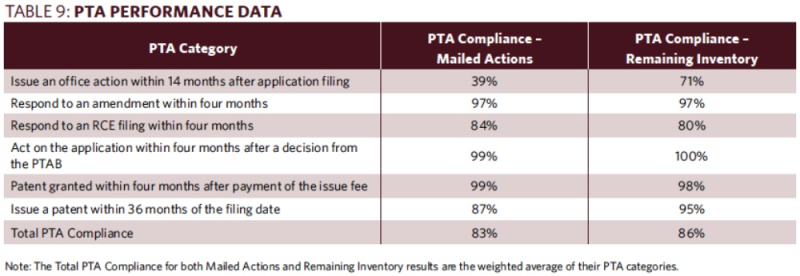
    Table 9 - PTA Performance Data
    The Report also notes that the number of utility applications filed decreased from 603,669 in FY 2020 to 593,294 in FY 2021, which constituted a 1.7% decrease in filings (see Table 1 below).  This followed a 2.5% decrease in application filings in FY 2020 and a 3.3% increase in application filings in FY 2019.

    Table 1 - Summary of Patent Examining Activities
    The Report also indicates that while the Office accepted more than 600,000 patent applications for the ninth straight year and topped 500,000 applications for the twelfth consecutive year (see Table 2 below), and despite the second consecutive drop in applications filed, the number of applications awaiting action rose from 630,873 in FY 2020 to 645,573 in FY 2021 (see Table 3 below).  It was the Office's fourth consecutive increase in the number of applications awaiting action.  The total number of pending applications also increased from 1,011,827 in FY 2020 to 1,045,177 in FY 2021.
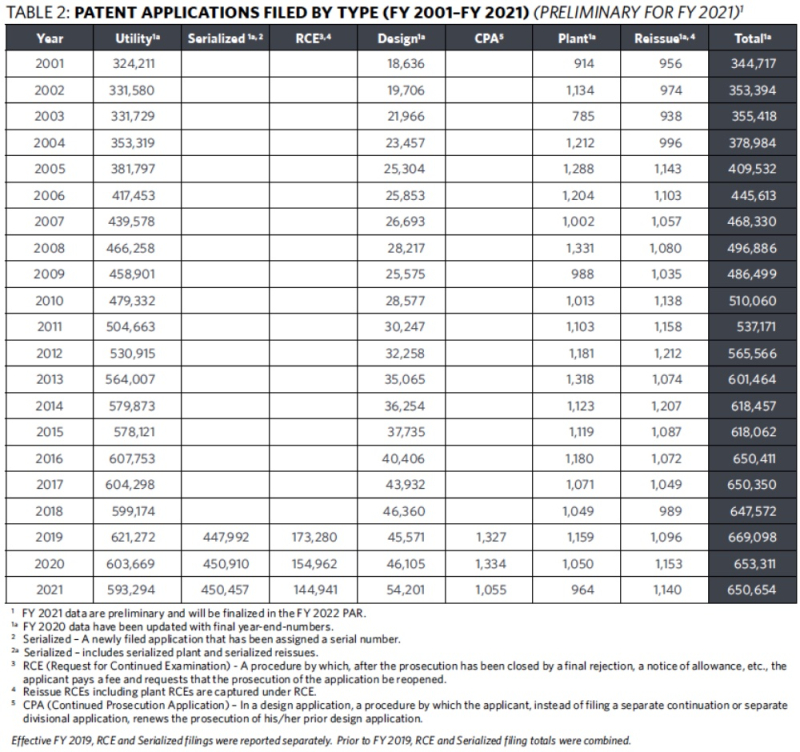
    Table 2 - Patent Applications Filed
    Table 3 - Patent Applications Pending
    After increasing from 336,846 utility patent issuances in FY 2019 to 360,784 in FY 2020, patent issuances dropped in FY 2021, falling to 338,335 (see Table 6 below).  It was the first drop in utility patent issuances since FY 2018.
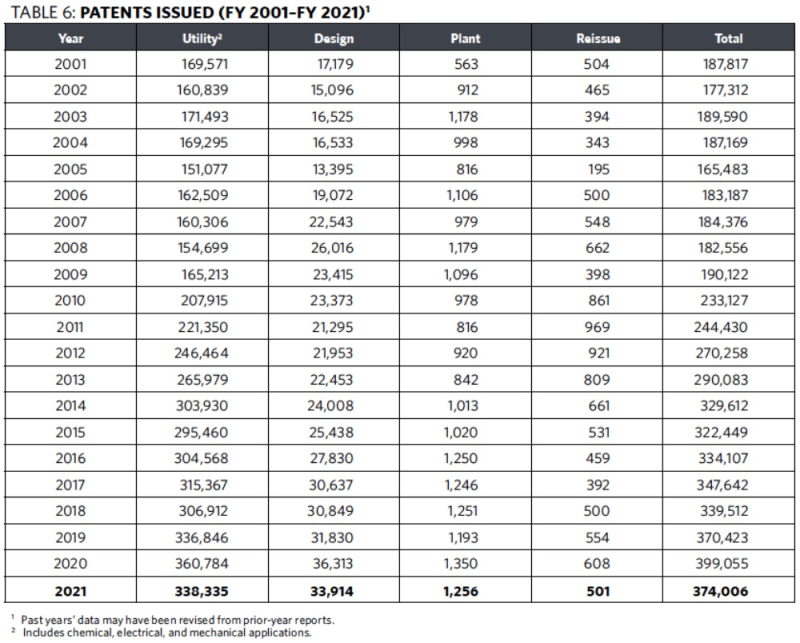
    Table 6 - Patents Issued
    As noted above, the Office now uses PTA compliance rather than first action and total pendency as patent-related performance targets.  Given the mixed results obtained for first action and total pendency, the change in patent-related performance targets was convenient.  In particular, first action pendency increased from 14.8 months in FY 2020 to 16.9 months in FY 2021 despite a drop in patent filings, and total pendency remained unchanged in FY 2021 at 23.3 months (see Table 4 below).
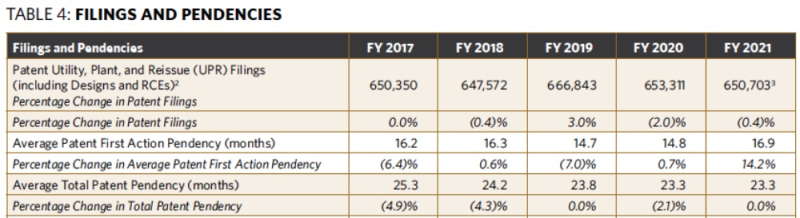
    Table 4 - Filings & Pendencies
    When comparing pendency statistics by Technology Center, Tech Center 2600 (communications) produced the best average first action pendency (13.5 months), and Tech Center 1700 (chemical and materials engineering) produced the worst average first action pendency (18.8 months) (see Table 4 below).  As for total average pendency, Tech Center 2600 also produced the best total average pendency (19.9 months), with Tech Center 1700 and Tech Center 3700 (mechanical engineering, manufacturing, and products) producing the worst total average pendency (26.7 months).
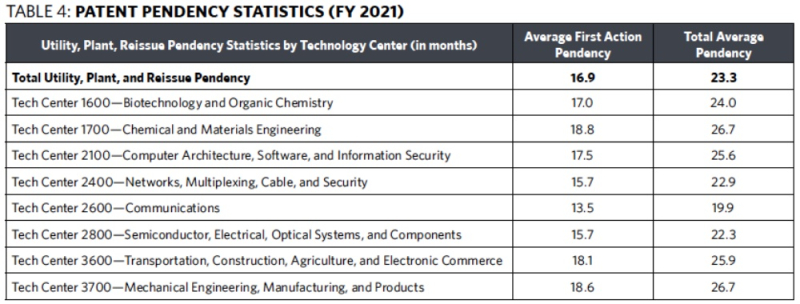
    Table 4 - Patent Pendency Statistics

    For additional information regarding this and other related topics, please see:

    • "USPTO Releases Performance and Accountability Report for FY 2018," February 6, 2019
    • "USPTO Releases Performance and Accountability Report for FY 2016," February 6, 2017
    • "USPTO Issues Performance and Accountability Report for FY 2015," March 3, 2016
    • "USPTO Issues Performance and Accountability Report for FY 2014," April 7, 2015
    • "USPTO Releases Performance and Accountability Report for FY 2013," January 9, 2014
    • "USPTO Releases Performance and Accountability Report for FY 2012," November 28, 2012
    • "USPTO Releases Performance and Accountability Report for FY 2011," November 30, 2011
    • "USPTO Releases 2010 Performance and Accountability Report," November 17, 2010
    • "USPTO Announces 'Highest Performance Levels in Agency's History' in 2008," November 18, 2008
    • "USPTO Announces 'Record Breaking' 2007 Performance," November 15, 2007
    • "Patent Office Announces Record-Breaking Year," December 27, 2006

  • By Kevin E. Noonan

    Sigma-AldrichOn December 3rd, Senior Party Sigma-Aldrich filed its Substantive Preliminary Motion No. 2 in Interference No. 106,133 (which names the Broad Institute, Harvard University, and MIT (collectively, Broad) as Junior Party), asking the Patent Trial and Appeal Board to remove Broad's U.S. Application No. 15/330,876 from the interference, pursuant to 37 C.F.R. §§ 41.121(a)(1)(iii) and 41.208(a)(2).  The basis for Sigma-Aldrich's motion is that:

    None of the claims in the '876 application recite further that the composition subsequently integrates a donor DNA sequence into the target DNA molecule, nor do they recite further that the composition alters the expression of the gene product of the cleaved target DNA molecule.  Thus, none of Broad's claims in the '876 application is substantially the same as (i.e., patentably indistinct from) Sigma's claims in the present interference, and thus none of the claims in the '876 application interferes with any of the claims of Sigma's involved Application 15/456,204.

    Broad has filed a similar motion, Preliminary Motion No. 3 that asks the Board, inter alia, for the same relief with regard to the '876 application.  Under these circumstances, Sigma-Aldrich argues that:

    While certainly not wholly reciprocal, there appears to be significant overlap in the parties' two proposed motions in this interference with respect to, inter alia, the '876 application and requiring a donor polynucleotide and [Homology Directed Repair] HDR following a DSB [Double-Stranded Break].  Addressing those overlapping issues in two parallel motions, rather than sequentially in the context of a single motion, presents the strong likelihood of significant redundancy and inefficiency, which are antithetical to the goals of USPTO interference practice and Sigma's objectives.

    Accordingly, Sigma-Aldrich asked the Board to grant its motion.

  • CalendarFebruary 22, 2022 – "Update on Plausibility" (J A Kemp) – 4:00 pm to 5:00 pm (GMT)

    February 24, 2022 – "Biopharma Patents in China: Litigation, Licensing, and Patent Linkage" (U.S. Patent and Trademark Office) – 9:30 am to 11:00 am (ET)

    February 24, 2022 -  "Damage Calculations in Patent Infringement Cases in the United States of America" (OxFirst Limited) – 15:00 to 16:00 (GMT)

    February 24, 2022 – "The Role of IP Managers in Promoting Innovation" (IPWatchdog and Similari) – 12:00 pm (EST)

    February 24, 2022 – "PTAB Year in Review" (Foley & Lardner) – 12:00 pm to 1:00 pm (CST)

    February 24, 2022 – "Patent Law Year in Review 2021" (Federal Circuit Bar Association Patent Litigation Committee) – 1:00 pm to 2:30 pm (ET)

    February 24, 2022 – Black Innovation and Entrepreneurship program (U.S. Patent and Trademark Office) – 3:00 pm to 4:30 pm (ET)

  • USPTO SealThe U.S. Patent and Trademark Office will offer a webinar entitled "Biopharma Patents in China: Litigation, Licensing, and Patent Linkage" on February 24, 2022 from 9:30 am to 11:00 am (ET).  The webinar will feature presentations by senior U.S. Patent and Trademark Office IP attorneys and seasoned practitioners with extensive China IP experience.  Topics to be covered include:

    • Challenges and opportunities for U.S. companies as licensors and licensees of biopharmaceutical technologies in China
    • An overview of recent changes to IP legislation and patent examination guidelines in China
    • China's newly implemented patent linkage system
    • Strategic considerations for licensing of biopharmaceutical patents in China
    • Biopharmaceutical patent litigation in China

    Those interested in registering for the webinar can do so here

  • OxFirstOxFirst Limited will be offering a webinar entitled "Damage Calculations in Patent Infringement Cases in the United States of America" on February 24, 2022 from 15:00 to 16:00 (GMT).  Judge Randall Rader, former Chief Judge of the U.S. Court of Appeals for the Federal Circuit, and Prof. Thomas Cotter of the University of Minnesota Law School will offer insights into damage calculations in patent infringement cases in the U.S., with an emphasis on important recent developments relating to the law of reasonable royalties, extraterritorial damages, awards of profits for design patent infringement, and enhanced damages.

    While there is no cost to participate in the program, those interested in attending the webinar can register here.

  • IPWatchdogIPWatchdog and Similari will be offering a webinar entitled "The Role of IP Managers in Promoting Innovation" on February 24, 2022 at 12:00 pm (EST).  David Kappos of Cravath Swaine & Moore, Marlene Valderrama of Halliburton, Alejandro Plazas of General Motors, Udi Cohen of Similari, and Gene Quinn of IPWatchdog, Inc. will discuss the challenges IP Managers face in today's fast-moving technology world as they seek to facilitate R&D, support innovation, derive competitive intelligence, and identify opportunity.  The panel will address the following topics:

    • Getting buy-in: Teaching the nexus between intangible assets and the intellectual property rights used to secure the assets,
    • Staying abreast of technology markets and a changing technology landscape,
    • How to augment and streamline R&D efforts, and
    • Ways to promote and encourage innovation among internal constituencies.

    There is no registration fee for this webinar.  However, those interested in registering for the webinar, should do so here.

  • Foley & LardnerFoley & Lardner will be offering a webinar entitled "PTAB Year in Review" on February 24, 2022 from 12:00 pm to 1:00 pm (CST).  Michael R. Houston and George C. Beck of Foley & Lardner will discuss the year's major developments at the Patent Trial and Appeal Board (PTAB) and how they may impact practice before the PTAB going forward.  The webinar will address the following topics:

    • PTAB proceedings in view of settlement/arbitration agreements and NDAs — decisions to date
    • Precedential opinions and implementation by PTAB, including discretionary denial considerations
    • PTO implementation of Arthrex review
    • Potential impact on PTAB AIA procedures if the Supreme Court abandons or modifies Chevron deference

    While there is no cost to participate in the program, advance registration is required.  Those interested in attending the webinar can register here.

  • Federal Circuit Bar Association_2The Federal Circuit Bar Association (FCBA) Patent Litigation Committee will be offering a remote program entitled "Patent Law Year in Review 2021" on February 24, 2022 from 1:00 pm to 2:30 pm (ET).  Andrew R. Sommer of Greenberg Traurig, LLP will moderate a panel consisting of Sharonmoyee Goswami of Cravath, Swaine & Moore LLP; Derek McCorquindale of Finnegan, Henderson, Farabow, Garrett & Dunner, LLP; Angelo Oliver of Haynes & Boone, LLP; and Jill Schmidt of Genentech, Inc.  The webinar will introduce many key decisions issued by the Supreme Court and Federal Circuit regarding potent law, including the continued development of potent eligibility case law, enablement and written description, patent venue, trials before the Patent Trial and Appeal Board, and assignor estoppel.

    The webinar is complimentary for FCBA members and students, $50 for government/academic/retired non-members, and $175 for private practitioner non-members.  Those interested in registering for the program, can do so here.

  • USPTO SealThe U.S. Patent and Trademark Office will be hosting a Black Innovation and Entrepreneurship program on February 24, 2022 from 3:00 pm to 4:30 pm (ET).  The program will feature:

    • Interviews with, and tips from, successful entrepreneurs
    • Investing in intellectual property
    • Building wealth

    Those interested in registering for the event, can do so here.

  • By Kevin E. Noonan

    Sigma-AldrichOn December 3rd, Senior Party Sigma-Aldrich filed its Substantive Preliminary Motion No. 1 in Interference No. 106,133 (which names the Broad Institute, Harvard University, and MIT (collectively, Broad) as Junior Party), asking the Patent Trial and Appeal Board to deny Broad benefit of its U.S. Provisional Application No. 61/736,527, filed December 12, 2012 (termed "P1"), pursuant to 37 C.F.R. § 41.121(a)(1) and S.O. ¶¶ 121 and 208.4.2.  The basis for Sigma-Aldrich's motion is that this application does not disclose a constructive reduction to practice of an embodiment within the scope of Count 1 of the interference as declared.  Sigma-Aldrich specifically contends that the P1 application does not show either than Broad's inventors had achieved a CRISPR-Cas9 system that cleaved a targeted DNA molecule and altered the expression of the gene product of that cleaved molecule, nor did the P1 application disclose introducing Cas9 protein into a eukaryotic cell with only one linked nuclear localization signal ("NLS") that resulted in CRISPR-mediated gene editing (Sigma-Aldrich asserts that all of the P1 disclosure involved Cas9 modified with 2 NLS sequences).

    After setting out the conventional requirements for priority benefit with regard to satisfying the written description requirement of 35 U.S.C. § 112(a), and the qualifications and characteristics of a person of ordinary skill in the art in December 2012, the brief highlights certain portions of the Count Sigma-Aldrich argue are not adequately disclosed in Broad's P1 application:

    Image 1 Image 2
    Sigma-Aldrich argues that Broad merely identified the existence of CRISPR-mediated DNA cleavage and did not establish resulting changes in gene expression.  Parsing the P1 disclosure, Sigma-Aldrich argues that the P1 specification itself sets forth definitions regarding the meaning of altering gene expression as recited in the Count, and distinguishes this from modifying the sequence of a targeted gene, quoting the specification as reciting in the alternative: " a modification in one or more nucleic acid sequences associated with a disease, or an animal or cell in which the expression of one or more nucleic acid sequences associated with a disease are altered."  These distinctions are supported by portions of the P1 specification that describe embodiments where a target polynucleotide is altered by introduction of a heterologous sequence, and other embodiments where expression of a targeted sequence is modified by increasing or decreasing its expression (i.e., without necessarily altering the targeted gene's expression).  Sigma-Aldrich further asserts that these distinctions are supported by P1 disclosure relating to the assays used to detect changes in expression that differ from assays used to detect changes in the sequence.  Sigma-Aldrich then argues that Broad's P1 application reports no "direct analyses of expression of any targeted gene product," whether with or without CRISPR-mediated editing.  And the only data presented in the P1 application relating to gene expression (Figures 1B, 6, and 13) was concerned with expression of the components of the CRISPR-Cas9 gene editing system (SpCas9 and RNase III).  Nor would the skilled worker have apprehended any demonstration of using CRISPR in a eukaryotic cell to alter gene expression:

    • "[non-homologous end joining (]NHEJ repair of Cas9-mediated cleavage created some nucleotide insertions/deletions (or "indels") to the emx1, pvalb, and th genes, which were detected indirectly by a Surveyor assay;"

    • "deletion of a 118-bp sequence of a human emx1 gene as a result of cleaving two target sites (albeit noting that "it would be impossible to predict the nature of the final mRNA or protein that could have been produced, or whether the expression of the mRNA or EMX1 protein had been altered at all, e.g., whether the expression of the gene product had increased or decreased);" and

    • "one example of gene editing where a 12-bp sequence comprising two restriction enzyme sites replaced the stop codon in the emx1 gene [but the data would have only established the ("minor") change in sequence but not necessarily expression, for which there was no experimental disclosure]."

    Sigma-Aldrich further argued that in these instances there was no experimental data in the P1 provisional application disclosing changes in the level of expression in, inter alia, the emx1 gene (Sigma-Aldrich illustrates the principle that altering sequence may or may not alter expression with regarding to producing a library of expressed proteins in yeast comprising C-terminal green fluorescent protein fusions, in which addition of this tag did not significantly alter gene expression.)

    Sigma-Aldrich also argued that the Broad P1 priority document did not disclose Cas9 proteins altered by introduction of only a single NLS sequence, as recited in the Count:
    Image 3
    Not only does the P1 provisional application not disclose Cas9 altered by introduction of only a single NLS, Sigma-Aldrich argued that the specification described failure to achieve CRISPR cleavage in a eukaryotic cell using such single NLS embodiments of Cas9.  Consequently Sigma-Aldrich notes that "all of the examples disclosed in Broad P1 use two NLSs for targeting Cas9 to the eukaryotic cell's nucleus for gene editing."  Sigma-Aldrich emphasized the P1 disclosure of experiments investigating nuclear localization of three SpCas9 constructs, wherein:

    [E]ach [was] expressed as a fusion protein with the florescent protein marker, GFP, at their C-terminus, and with: (1) an NLS attached to the N-terminus of SpCas9 (i.e., NLS-SpCas9-GFP); (2) an NLS attached to the C-terminus of the GFP (i.e., SpCas9-GFP-NLS); and (3) an NLS attached to both N- and C termini of SpCas9-GFP (i.e., NLS-SpCas9-GFP-NLS, which was referred to as 2xNLS12SpCas9)

    In these experiments, Sigma-Aldrich argued, only species (3) (having 2 NLS sequences) were successful at achieving CRISPR cleavage in a eukaryotic cell.  This conclusion was supported in the brief by illustrations that "[a]ll CRISPR-Cas gene editing examples disclosed in Broad P1 use[d] two NLSs:

    Image 4

    Image 5

    And that only constructs having 2 NLSs were functional:

    Image 6
    Sigma-Aldrich concedes that Broad's P1 application contains disclosure related to single NLS-bearing Cas9 proteins.  Sigma-Aldrich terms this disclosure "speculative," due to the absence of any experimental demonstrations showing successful CRISPR-Cas9 cleavage using single NLS-bearing Cas9 species.

    Unlike conventional Preliminary Motion practice as Senior Party Sigma-Aldrich does not need the Board to grant this motion to change any evidentiary burdens, but success would increase the time between Sigma-Aldrich's earliest priority date and its own, which could have its own advantages.