• IPWatchdogIPWatchdog will be offering a webinar entitled "US-PCT: Best Practices and Common Mistakes at the USPTO" on March 7, 2022 at 11:00 am (EST).  Michael Neas, Deputy Director of the International Patent Legal Administration (formerly PCT Legal) at the U.S. Patent & Trademark Office; John White, CEO of PCT Learning Center; and Gene Quinn of IPWatchdog, Inc. will discuss the most common mistakes made when entering the U.S. national stage through the PCT.

    There is no registration fee for this webinar.  However, those interested in registering for the webinar, should do so here.

  • IPWatchdogIPWatchdog will be offering a webinar entitled "The International IP Landscape 2022" on March 8, 2022 at 8:45 am (EST).  Patrick Kilbride of the U.S. Chamber of Commerce Global Innovation Policy Center (GIPC); Gene Quinn of IPWatchdog, Inc.; and Tobias Wuttke of Meissner Bolte will discuss the international intellectual property landscape and analyze the findings from the GIPC's 10th annual International IP Index.

    There is no registration fee for this webinar.  However, those interested in registering for the webinar, should do so here.

  • By Donald Zuhn –-

    Vidal  KathiLast week, the American Intellectual Property Organization (AIPLA) and Intellectual Property Owners Association (IPO) sent a letter to Sen. Chuck Schumer (D-NY), the Senate Majority Leader, and Sen. Mitch McConnell (R-KY), the Senate Minority Leader, to "urge the U.S. Senate to move swiftly to confirm" Kathi Vidal, the Managing Partner of Winston & Strawn's Silicon Valley office, as the next Under Secretary of Commerce for Intellectual Property and Director of the U.S. Patent and Trademark Office.  In their letter, the AIPLA and IPO declared that Ms. Vidal (at right) has "a sterling resume and is abundantly qualified for this position."

    The AIPLA and IPO also noted that "[t]his critical position has been vacant of long-term leadership for more than a year" (406 days as of March 2, 2022).  Former USPTO Director Andrei Iancu held the position until January 20, 2021, when Joe Biden was sworn in as the 46th President.  President Biden nominated Ms. Vidal for Under Secretary of Commerce for Intellectual Property and USPTO Director on October 26, 2021.  Ms. Vidal's confirmation hearing was held on December 1, 2021 and the Senate Judiciary Committee voted 17-5 on January 12, 2022 to forward her nomination to the full Senate.

    Noting that "the intellectual property system is critical to the U.S. economy and a foundation of U.S. leadership in innovation and technological advancement," the AIPLA and IPO asserted that "[t]he appointment of a qualified Director to lead the agency is particularly important to U.S. innovation."  The IP associations also argued that "[t]he lack of a presidentially appointed and Senate-confirmed Director hampers the agency's ability to effect policy and fully support stakeholders in the innovation ecosystem."

  • By Kevin E. Noonan

    USPTO SealIn an 82-page decision, the Patent Trial and Appeal Board granted priority for eukaryotic CRISPR to the Broad Institute, Harvard University, and MIT (collectively, "Broad") as Senior Party and against Junior Party the University of California/Berkeley, the University of Vienna, and Emmanuelle Charpentier (collectively, "CVC") (the Decision on Priority 37 C.F.R. § 41.125(a) can be accessed here; see Document No. 2863).  Accordingly, all of Broad's patents and applications in interference remain and CVC's applications having claims directed to eukaryotic CRISPR are finally rejected for lack of priority (see "CRISPR Battle Joined Again").

    While requiring more detailed analysis (which will be forthcoming in later posts), the Board was convinced by Broad's arguments that CVC's attempts to reduce eukaryotic CRISPR to practice were unavailing until after Broad's reduction to practice as evidenced by a manuscript submitted on October 5, 2012.  Operating on the legal principle that "priority of invention goes to the first party to reduce an invention to practice unless the other party can show that it was the first to conceive of the invention and that it exercised reasonable diligence in later reducing that invention to practice," Cooper v. Goldfarb, 154 F.3d 1321, 1327 (Fed. Cir. 1998), the Board was unconvinced that CVC's March 1, 2012 conception satisfied the requirements of "complete" conception.  Using much of the same argument (albeit for different purposes) as it had to prevail in Interference No. 106,048 (see "PTAB Decides CRISPR Interference in Favor of Broad Institute — Their Reasoning"), the Broad persuasively argued that the evidence of CVC's attempts to reduce eukaryotic CRISPR to practice showed sufficient uncertainty and failures for the Board to conclude that CVC did not satisfy the requirements for conception.  On this evidence the Board was unpersuaded that all that had been needed was the application of routine experimentation using the sgRNA detailed in CVC's March 1st priority statement.  Nor was the Board convinced that Broad derived the embodiments of eukaryotic CRISPR that they reduced to practice embodying sgRNA only after Dr. Marraffini obtained it from CVC and disclosed it to the Broad inventors (see "CVC Files Reply to Broad's Opposition to CVC's Priority Motion").

    It must be said that this decision is not particularly surprising in light of the tenor of questioning by the Board in the Oral Hearing on February 4th (see "PTAB Hears Oral Argument in Interference No. 106,115") or by reading the hearing transcript.

    In addition to the decision on priority, the Board denied CVC's motion for improper inventorship under 35 U.S.C. § 102(f) (see "CVC Files Substantive Motion No. 3 (for Improper Inventorship) and Broad Opposes") for evidentiary deficiencies, and in their discretion refused to consider CVC's allegations of inequitable conduct against the Broad (see "Inequitable Conduct by Senior Party Broad Alleged in Interference No. 106,115 (and PTAB May Finally Hear Evidence About It)").

    Thus, the status of eukaryotic CRISPR is where the parties left it after the '048 Interference decision but with Broad in a decidedly better position, having been granted priority on the merits here.

    Having lost its priority to Broad, it is possible that Interferences Nos. 106,127 and 106,132 naming CVC as Junior Party in each will be dissolved but those decisions remain to be rendered (see "Separate Interferences Declared between Toolgen and Broad and CVC over CRISPR Priority Question" and "Sigma-Aldrich Joins the CRISPR Interference Fray").

    The Board was careful to note that CVC retained its patents on CRISPR without any cell-specific limitations but that is almost certainly ephemeral with regard to eukaryotic CRISPR; CVC should be estopped from asserting those claims against Broad's licensees (or anyone else) practicing eukaryotic CRISPR.  Whether CVC's inequitable conduct allegations provide a roadmap for anyone challenging Broad's eukaryotic CRISPR estate remains speculative, and interferences involving Broad against both ToolGen (No. 106,126) and Sigma-Aldrich (No. 106,133) remain pending.

    It can be expected that CVC will ask for reconsideration from the Board and when denied appeal to the Federal Circuit.

    All this meaning the provenance of eukaryotic CRISPR has not been settled for good by the Board's decision today.

  • ABAThe American Bar Association (ABA) Standing Committee on Ethics and Professional Responsibility will be offering a live webinar entitled "Ethics and Professional Responsibility: How to Comply with ABA's New Language Access Guidance" from 2:00 pm to 3:00 pm on February 28, 2022.  Deepika Ravi and Hilary Gerzhoy of Harris, Wiltshire & Grannis LLP will discuss how the American Bar Association's Standing Committee on Ethics and Professional Responsibility views a lawyer's obligations when working with clients with whom the lawyer does not share a common language or with clients with whom the lawyer's communication may be impeded due to a client's hearing, speech, or vision disability.  The program will go through the ABA's recent guidance and analyze some of the relevant Rules of Professional Conduct implicated — Rules 1.4, 1.1, 8.4 and 5.3, and will also analyze ethics opinions that have grappled with a lawyer's obligation to supervise experts and provide practical tips for compliance.

    The registration fee for the webinar is $129.  Those interested in registering for the webinar, can do so here.

  • J A KempJ A Kemp will be offering a webinar entitled "How and When to Prepare for the Arrival of the Unitary Patent" on March 1, 2022 from 4:00 pm to 5:00 pm (GMT).  Martin Jackson and Stephen Hodsdon of J A Kemp will explain the changes from the introduction of the Unitary Patent and set out a timetable for decisions which patentees, applicants, and their attorneys will need to make.  The webinar will address the following topics:

    • Introduction to the Unitary Patent and the Unified Patent Court
    • What decisions will need to be made on existing European patents and when
    • What decisions will need to be made on existing European patent applications and when
    • How to obtain a Unitary Patent
    • What are the pros and cons of obtaining a Unitary Patent

    There is no registration fee for this webinar.  However, those interested in registering for the webinar, should do so here.

  • IPWatchdogIPWatchdog and Barash Law will be offering a webinar entitled "Pharmaceutical Salts and Other Complexes — A Solid Form Strategy" on March 1, 2022 at 12:00 pm (ET).  Eyal Brash of Barash Law LLC and Gene Quinn of IPWatchdog, Inc. will discuss the patentability of solid-form salts and their use in industry, and explore novelty, obviousness, and section 112 issues with elements of European patent law as well.

    There is no registration fee for this webinar.  However, those interested in registering for the webinar, should do so here.

  • Strafford #1Strafford will be offering a webinar entitled "Patent Drafting for Machine Learning: Claim Strategy, Patent Eligibility, and Disclosure Requirements for the U.S. and Europe" on March 1, 2022 from 1:00 to 2:30 pm (EST).  Peter Arrowsmith of Gill Jennings & Every, Michael S. Borella of McDonnell Boehnen Hulbert & Berghoff, and Linda J. Thayer of Finnegan Henderson Farabow Garrett & Dunner will assist patent practitioners in drafting high quality patent applications for machine learning inventions, and discuss different claim styles and framings that may be appropriate for different machine learning inventions, how to anticipate and minimize the risks of §§ 101 or 112 rejections, and best practices for success before the European Patent Office (EPO).  The webinar will review the following issues:

    • What is the appropriate way to claim machine learning inventions?
    • How can patent counsel meet the requirements under Sections 101 and 112 in machine learning patent applications?
    • How does the EPO treat patent applications for machine learning technologies differently than the USPTO?
    • What steps should patent counsel take to satisfy patent eligibility and disclosure requirements?

    The registration fee for the webcast is $347.  Those interested in registering for the webinar, can do so here.

  • By Kevin E. Noonan

    Federal Circuit SealIn a crowded pharmaceutical art, the deficiencies thereof being so patent that the FDA encouraged industry to address and correct them, concerning a formulation developed to address the opioid crisis raging earlier in this century (see "Empire of Pain"), when is a resulting formulation obvious over that prior art and in view of the objective indicia of nonobviousness?  This was the question facing the Federal Circuit in Adapt Pharma Operations Ltd. v. Teva Pharmaceuticals USA, Inc., the panel majority affirming a District Court decision that the claimed invention was indeed obvious.

    The suit arose over Teva's submission of an ANDA for a generic version of Adapt's Narcan® product having a Paragraph IV certification over the Adapt's Orange Book Listed patents.  Adapt asserted U.S. Patent Nos. 9,468,747; 9,561,177; 9,629,965; and 9,775,838 in this litigation, which are directed to methods for treating opioid addiction by intranasal administration of naloxone (using a revised formulation of Adapt's Narcan® medication for preventing opioid overdoses).  The use of naloxone was well-known in the art at the time the patents-in-suit were filed, and there were several alternative pharmaceutical products used for this purpose.  In addition to intravenous Narcan® administration, the art also recognized intranasal administration routes using an FDA-approved atomization device (termed MAD in the opinion).  In addition, the opinion notes that Narcan® doses of 2 mg, 8 mg, and 16 mg were known in the art to be effectively administered intranasally.  These administration routes and methods had the disadvantage of being amenable for use only to trained medical personnel (for the intravenous injection route) and for requiring assembly of the MAD device which even then could deliver too much fluid in the nose.

    The trial was limited to a subset of the claims of the asserted patents, specifically "claims 7 and 9 of the '747 patent; claim 4 of the '177 patent; claims 21, 24, and 25 of the '965 patent; and claims 2, 24, 33, and 38 of the '838 patent."  The District Court considered dependent claim 9 of the '747 patent to be representative, but the Federal Circuit, understanding the issues on appeal to relate to claims 1 and 2, reproduced these claims in the opinion:

    1.  A method of treatment of opioid overdose or a symptom thereof, comprising nasally administering to a patient in need thereof a dose of naloxone hydrochloride using a single-use, pre-primed device adapted for nasal delivery of a pharmaceutical composition to a patient by one actuation of said device into one nostril of said patient, having a single reservoir comprising a pharmaceutical composition which is an aqueous solution of about 100 μL comprising:
        about 4 mg naloxone hydrochloride or a hydrate thereof;
        between about 0.2 mg and about 1.2 mg of an isotonicity agent;
        between about 0.005 mg and about 0.015 mg of a compound which is at least one of a preservative, a cationic surfactant, and a permeation enhancer;
        between about 0.1 mg and about 0.5 mg of a stabilizing agent; and
        an amount of an acid sufficient to achieve a pH of 3.5-5.5.

    2.  The method as recited in claim 1 wherein: the isotonicity agent is NaCl;
    the preservative is benzalkonium chloride; the stabilizing agent is disodium edetate; and the acid is hydrochloric acid.

    (where italicized limitations are relevant to the outcome).

    The District Court found that the asserted claims were invalid as being obvious over the disclosures of either of two sets of prior art references:  PCT Pub. No. WO 2000/62757 in view of U.S. Patent No. 5,866,154 and a scientific reference (designated Kerr 2009) directed to a clinical trial of intranasal versus intramuscular naloxone treatment for heroin overdose (termed "the Davies combination"); or PCT Pub. No. WO 2012/15317 in view of a first scientific review of nasal drug delivery devices and a second scientific review article on nasal spray formulations (termed the "Strang combination").  According to the Federal Circuit opinion, the '757 PCT application sets forth detailed drawings and disclosure of spray applicators for intranasal administration and particularly naloxone, wherein administration "can be carried out by an unskilled person, rapidly and with a good chance of successfully reviving a patient suffering from opioid over-dosage."  Naloxone formulations for use with the disclosed applicators can include isotonic salt solutions (specifically 0.9% NaCl) and have a "slightly acidic" pH (with pH 6.5 being exemplary).  The reference disclosed that such formulations could also include preservatives including benzalkonium chloride (BZK).  The Kerr 2009 reference disclosed specifically that intranasal of naloxone was beneficial, inter alia to reduce the risk of needlesticks in intravenous administration, and provided a comparison between administering 2 mg/mL naloxone intranasally with intramuscular naloxone injections.  The '154 patent provided evidence that including EDTA enabled naloxone formulations to be sterilized without significant degradation.

    The second set of references considered by the District Court, the Strang combination, included various naloxone formulations for intranasal administration in the '317 PCT application, including 4 mg/mL concentrations of the drug in aqueous saline solution and a pH of 5.5, administered in small (100 µL) volumes.  This reference was considered in combination with a first review article regarding drug formulations for nasal naloxone administration and the effects of various excipients, including benzalkonium chloride as a preservative, EDTA as a chelating agent, and sodium chloride as a tonicity agent, having an optimal pH of between 4.5 and 6.5; and a second review article disclosing various delivery devices.  In particular, the latter article advised that drugs like naloxone are advantageously administered using single- or double-dose devices.

    The parties having stipulated to infringement, the District Court entered judgment that the asserted claims were invalid and this appeal followed.

    The Federal Circuit affirmed, in an opinion by Judge Stoll joined by Judge Prost; Judge Newman dissented.  Adapt based its appeal on three of the District Court's factual findings:

    (1) its finding that a skilled artisan would have been motivated to combine the prior art references to arrive at the claimed invention; (2) its finding that the prior art, as a whole, does not teach away from the claimed invention; and (3) its findings related to Adapt's proffered objective indicia of nonobviousness.

    With regard to the motivation to combine question, the majority expressly disagreed with Adapt's argument that the District Court erred in 'fail[ing] to articulate a reason why a skilled artisan would have been motivated to combine the prior art references to arrive at the claimed invention."  According to the opinion, the District Court's reasoning, that the skilled worker would have been motivated to "(1) formulate an intranasal naloxone product that would improve upon the MAD Kit; (2) select the claimed excipients—sodium chloride, BZK, EDTA, and hydrochloric acid for adjusting the pH—and [a prior art] device for intranasal delivery; (3) select a 4 mg dose of naloxone; and, accordingly, (4) combine the prior art references themselves" was supported by substantial evidence (the Federal Circuit noted that "the district court issued a nearly 100-page, comprehensive opinion setting forth its findings of fact and conclusions of law . . . , as well as making specific credibility determinations as to each of the witnesses that testified").  That motivation was based on the shortcomings of the prior art being sufficiently "well-known" that the FDA had encouraged industry to develop improved intranasal delivery methods (which had prompted co-plaintiff Opiant's predecessor Lightlake to develop the invention encompassed in the patents-in-suit).  These deficiencies were further supported by the prior art references Teva asserted against Adapt's patents and by expert testimony at trial.  The appropriate motivation extended, in the majority's view, to the components of the claimed formulation, based on testimony from both parties' experts and specific reference in the cited art to each claimed excipient and formuation conditions (i.e., pH).  Similarly, the majority found support in the art and evidence for the 4 mg dose.  Taken together, the majority found substantial evidence that the skilled worker would have been properly and sufficiently motivated to combine these features and elements (as part of the "interrelated teachings") to arrive at the invention claimed in the patents-in-suit, considering the Davies or Strang combination of references.

    Next, the majority addressed Adapt's argument that the prior art, as a whole, taught away from the claimed invention, in particular a reference that taught against BZK as a preservative.  This reference was not relied upon otherwise and, the majority noted, was published after the earliest priority date of the patents-in-suit.  Expert testimony countered this argument at trial based on the higher (8.5-fold) BZK concentration taught in the reference, which testimony the District Court credited.  This was not error, according to the majority, and agreed the teachings of a single reference would not satisfy the teaching away standard, which depends on the rubric that an obviousness determination is made over the prior art "as a whole," citing Medichem, S.A. v. Rolabo, S.L., 437 F.3d 1157, 1165 (Fed. Cir. 2006) (emphasis in opinion), further asserting that "[t]he district court, sitting as the fact finder, was entitled to consider the teachings of the prior art as a whole in finding that the prior art did not teach away from the claimed invention."

    Adapt's final argument, regarding the objective indicia of nonobviousness was no more availing.  Adapt's argument on the order in which the District Court made its determinations (finding the claims to be obvious before considering evidence for the objective indicia) was not supported by In re Cyclobenzaprine Hydrochloride Extended-Release Capsule Pat. Litig., 676 F.3d 1063, 1075–76, 1079 (Fed. Cir. 2012), in the majority's view.  That decision had been predicated on the District Court not considering all the evidence relating to the obviousness question, whereas here the District Court had not so err (indeed, the majority cited KSR Int'l Co. v. Teleflex Inc., 550 U.S. 398, 418 (2007), for the principle that the order in which the obviousness analysis is performed is not controlling).  The majority then considered the District Court's findings on unexpected results, copying by others, industry skepticism, and long-felt but unmet need, and failure of others (again, noting the extensiveness, over twenty pages, of the District Court's analysis in its opinion).  The majority agreed with the District Court's holding that the evidence adduced at trial did not support Adapt's contentions that the District Court had erred in not finding these objective indicia to have overcome its holding that the asserted claims were obvious (although the majority did criticize the District Court's performance of the analysis regarding long-felt need, being focused "almost entirely" of the prior art MAD kit, but said it was harmless error).

    While admitting that this was a "close case," the majority concluded that the District Court's opinion was supported by substantial evidence and affirmed on that basis.

    Judge Newman dissented, based in large part on her assessment of the objective indicia and in particular the long-felt but unmet need and failure of others to satisfy it.  In the Judge's opinion, the prior art contained no teaching nor suggestion for the claimed invention, all the components of which were separately known.  And Judge Newman was not convinced by the evidence that there was a sufficient motivation to combine these several elements; in the Judge's view this is "a classical example of judicial hindsight, where the invention itself is the only guide to the selections from the prior art."  The majority's error was, in the Judge's view, in taking the "existence of the separate components [to] suffice[] to find obviousness of this specific [claimed] combination" when the prior art "gave no direction as to which of the many possible combination choices were likely to be successful," citing Leo Pharm. Prods., Ltd. v. Rea, 726 F.3d 1346 (Fed. Cir. 2013).  Judge Newman also considered the majority to have provided the motivation to combine the references from "the known need for a better product" and that this was error, saying that "[t]he artisan's knowledge that the available products are deficient does not render the remedy obvious when it is eventually discovered" and that "[a] motivation to improve a product does not render the successful improvement obvious."  In addition, the prior art teachings "against" using BZK were persuasive to Judge Newman as a teaching away.  Finally, unlike the majority Judge Newman found procedural error in the District Court's assessment of the objective indicia of nonobviousness after determining the claims were obvious, and that on the merits these considerations should have led the Court to a conclusion that the claims were nonobvious.

    Adapt Pharma Operations Ltd. v. Teva Pharmaceuticals USA, Inc. (Fed. Cir. 2022)
    Panel: Circuit Judges Newman, Prost, and Stoll
    Opinion by Circuit Judge Stoll; dissenting opinion by Circuit Judge Newman

  • By Donald Zuhn –-

    Report CoverLast month, the U.S. Patent and Trademark Office released its Performance and Accountability Report for Fiscal Year 2021 (FY 2021).  The Report notes that in 2018 the Office issued its 2018-2022 Strategic Plan, which "outlines the framework that enables the USPTO to respond to domestic and international customers' demands for vital and timely IP products and services and builds on the agency's current organizational effectiveness and efficiency."  The Report also notes that "[t]o fulfill the mission and goals included in the 2018-2022 Strategic Plan, the USPTO developed a comprehensive Strategic Performance Framework."

    The FY 2021 Report specifies nine strategic plan key performance outcome measures that are designed to monitor progress as the Office implements initiatives to achieve its strategic goals (two of the measures are related to the Office's goal to optimize patent quality and timeliness).  According to the Report, the Office met or exceeded its targets for seven of the nine key performance metrics.  Table 3 of the Report provides data for the two patent-related performance targets (click on any table to expand):

    Table 3 - Summary of Key Strategic Goal Results
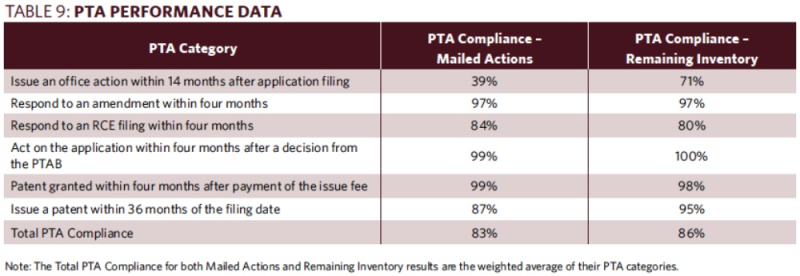
    The two patent-related performance targets relate to PTA compliance, with the Office continuing its efforts to achieve a pendency goal that 90% of both total performance (i.e., mailed actions) and total (i.e., remaining) inventory be within statutory time frames set by 35 U.S.C. § 154(b).  The Report notes that the statutory time frames (i.e., PTA categories) are as follows:

    • Fourteen months from the filing date of a patent application to the mailing date of a first office action (a statement of the Examiner's position and the primary action to establish the issues that exist)
    • Four months to respond to an amendment, which includes an RCE
    • Four months to act on a decision from the PTAB
    • Four months to issue a patent after payment of the issue fee
    • Thirty-six months from the filing date of an application to the issue date of a patent

    Table 9 of the Report provides a breakdown of the Office's performance for each of these PTA categories with respect to mailed actions and remaining inventory:

    Table 9 - PTA Performance Data
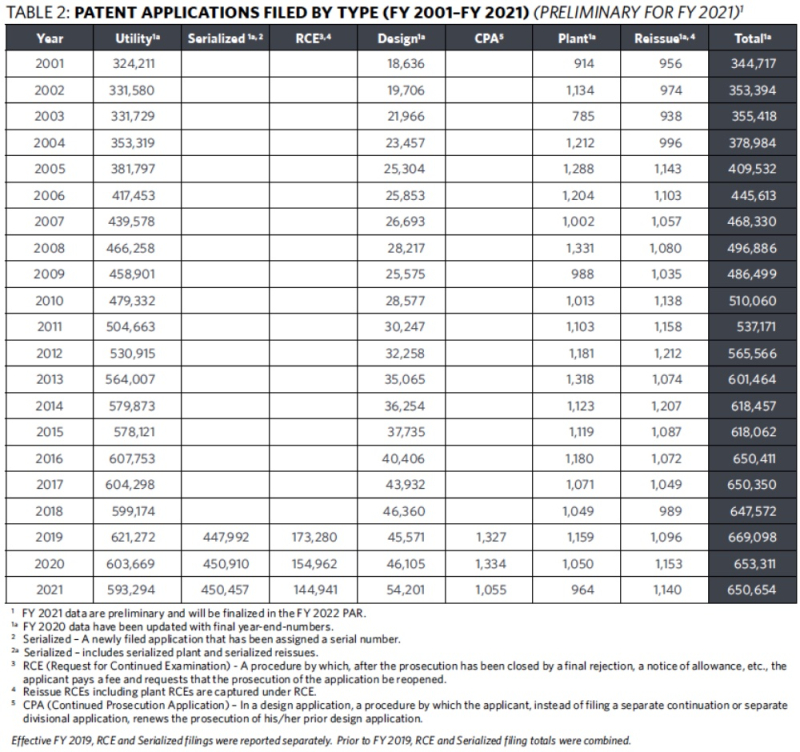
    The Report also notes that the number of utility applications filed decreased from 603,669 in FY 2020 to 593,294 in FY 2021, which constituted a 1.7% decrease in filings (see Table 1 below).  This followed a 2.5% decrease in application filings in FY 2020 and a 3.3% increase in application filings in FY 2019.

    Table 1 - Summary of Patent Examining Activities
    The Report also indicates that while the Office accepted more than 600,000 patent applications for the ninth straight year and topped 500,000 applications for the twelfth consecutive year (see Table 2 below), and despite the second consecutive drop in applications filed, the number of applications awaiting action rose from 630,873 in FY 2020 to 645,573 in FY 2021 (see Table 3 below).  It was the Office's fourth consecutive increase in the number of applications awaiting action.  The total number of pending applications also increased from 1,011,827 in FY 2020 to 1,045,177 in FY 2021.

    Table 2 - Patent Applications Filed
    Table 3 - Patent Applications Pending
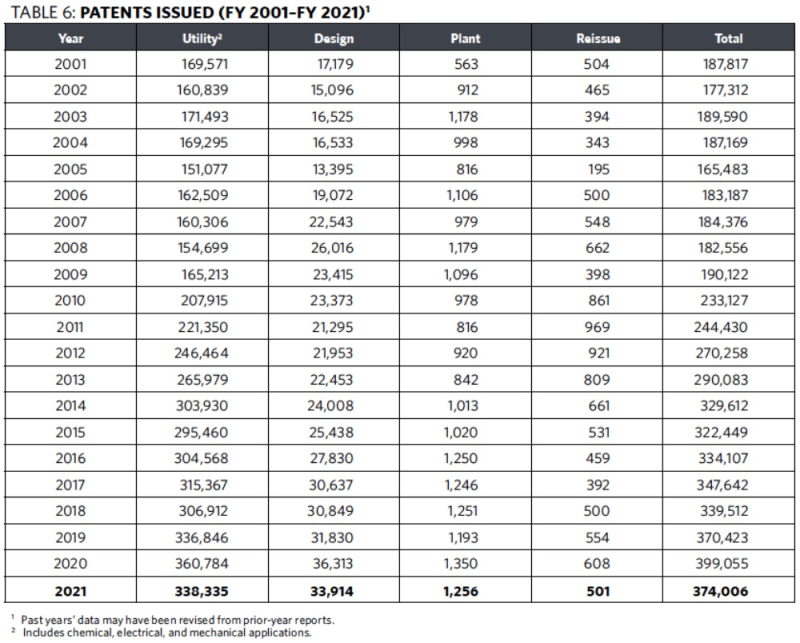
    After increasing from 336,846 utility patent issuances in FY 2019 to 360,784 in FY 2020, patent issuances dropped in FY 2021, falling to 338,335 (see Table 6 below).  It was the first drop in utility patent issuances since FY 2018.

    Table 6 - Patents Issued
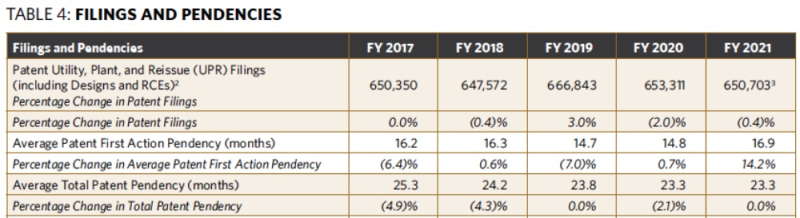
    As noted above, the Office now uses PTA compliance rather than first action and total pendency as patent-related performance targets.  Given the mixed results obtained for first action and total pendency, the change in patent-related performance targets was convenient.  In particular, first action pendency increased from 14.8 months in FY 2020 to 16.9 months in FY 2021 despite a drop in patent filings, and total pendency remained unchanged in FY 2021 at 23.3 months (see Table 4 below).

    Table 4 - Filings & Pendencies
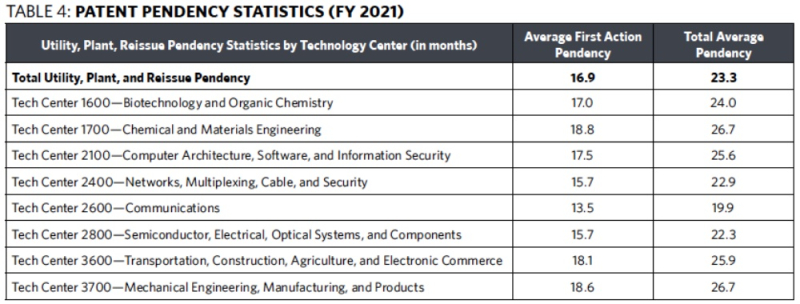
    When comparing pendency statistics by Technology Center, Tech Center 2600 (communications) produced the best average first action pendency (13.5 months), and Tech Center 1700 (chemical and materials engineering) produced the worst average first action pendency (18.8 months) (see Table 4 below).  As for total average pendency, Tech Center 2600 also produced the best total average pendency (19.9 months), with Tech Center 1700 and Tech Center 3700 (mechanical engineering, manufacturing, and products) producing the worst total average pendency (26.7 months).

    Table 4 - Patent Pendency Statistics

    For additional information regarding this and other related topics, please see:

    • "USPTO Releases Performance and Accountability Report for FY 2018," February 6, 2019
    • "USPTO Releases Performance and Accountability Report for FY 2016," February 6, 2017
    • "USPTO Issues Performance and Accountability Report for FY 2015," March 3, 2016
    • "USPTO Issues Performance and Accountability Report for FY 2014," April 7, 2015
    • "USPTO Releases Performance and Accountability Report for FY 2013," January 9, 2014
    • "USPTO Releases Performance and Accountability Report for FY 2012," November 28, 2012
    • "USPTO Releases Performance and Accountability Report for FY 2011," November 30, 2011
    • "USPTO Releases 2010 Performance and Accountability Report," November 17, 2010
    • "USPTO Announces 'Highest Performance Levels in Agency's History' in 2008," November 18, 2008
    • "USPTO Announces 'Record Breaking' 2007 Performance," November 15, 2007
    • "Patent Office Announces Record-Breaking Year," December 27, 2006