•     By
    Donald Zuhn

    Congress On
    Tuesday, ten Governors sent a
    letter to Congressional leaders expressing
    their support for Congress' efforts to pass legislation that would create a
    follow-on biologics regulatory pathway. 
    Noting that "[t]his critically important issue has a direct
    economic impact on our states, our nation's public health, our economic
    success, and our global leadership in biomedical research," the Governors
    stated that "the balance struck in the Senate Health, Education, Labor and
    Pensions Committee on 12 years of data exclusivity for biologics represents a
    critical element needed to ensure appropriate incentives for continued
    biomedical innovation."  In
    July, the Senate Health, Education, Labor and Pensions (HELP) Committee approved
    an amendment providing a 12-year data exclusivity period for biologic drug
    makers (see "
    Senators
    Champion 12-Year Data Exclusivity in Senate
    ").  The Governors also noted that the House
    Energy and Commerce Committee had voiced its "overwhelming" support
    for a 12-year data exclusivity period (see
    "House Committee Approves Health Care Reform Bill Calling for 12-Year
    Exclusivity Period
    ").

    In
    their letter, the Governors assert that "[i]nnovator companies must be
    provided with at least 12 years of non-patent data exclusivity to allow for
    recovery of their original investment and to ensure licensing payments to our
    research institutions."  The
    Governors also contend that "[i]n order to assure these companies continue
    to make investments in medical progress and take the risks necessary to bring
    these important products to patients, innovators should be provided with
    appropriate incentives, including data exclusivity and protections for their
    patents."

    The
    letter, which was sent by Governors Deval Patrick of
    Massachusetts, M. Jodi Rell of Connecticut, Bill Ritter, Jr. of Colorado, John
    Markell of Delaware, Martin O'Malley of Maryland, Beverly Perdue of North
    Carolina, Theodore Kulongoski of Oregon, Donald Carcieri of Rhode Island, Luis
    Fortuño of Puerto Rico, and Christine Gregoire of Washington (Governors
    Patrick, Ritter, Markell, O'Malley, Perdue, Kulongoski, and Gregoire are
    Democrats, and Governors Rell, Carcieri, and Fortuño are Republicans — Gov.
    Fortuño is also a member of the New Progressive Party of Puerto Rico), was addressed
    to Speaker of the House Nancy Pelosi (D-CA), House minority leader John Boehner
    (R-OH), Senate majority leader Harry Reid (D-NV), and Senate minority leader
    Mitch McConnell (R-KY).

  •     By Donald Zuhn

    USPTO Seal On Wednesday, U.S. Patent and Trademark Office Director David Kappos announced a number of proposals
    for changing the examiner "count system," the methodology for determining
    the amount of time an examiner is given to complete a patent examination and the
    amount of credit an examiner is given for completing various stages of an
    examination.  The count system,
    which was created in the 1960's, was last revised in 1976.

    POPA The proposals announced by Director Kappos were developed by a task
    force consisting of USPTO senior managers and leadership from the Patent Office
    Professional Association (POPA) — the examiner's union.  Pursuant to a directive from Secretary
    of Commerce Gary Locke to "adopt an ambitious agenda to address the
    significant challenges at USPTO," Director Kappos stated that USPTO senior
    management had "worked closely with labor representatives to propose a
    long-overdue transformation of the count system."  During his nomination hearing before
    the Senate Judiciary Committee in July, Director Kappos testified that he
    planned to raise morale by completely remaking the count system, which he said
    "needs to be fixed" (see
    "Senate Judiciary Committee Hears from Director Nominee").  During the hearing, Director Kappos stated
    that "as I understand it, the examining corps hates the count system the
    way it is," and "the applicant community . . . hates the count system
    the way it is because it results in dysfunctional behavior."  He also informed the Committee that
    Secretary of Commerce Gary Locke had specifically asked him to fix the count
    system.

    The count system has been long been the target of criticism by many in
    the patent community.  In a BIO 2009
    panel session in Atlanta last May, Q. Todd Dickinson, the Executive Director
    for the American Intellectual Property Law Association (AIPLA) and former
    Director of the USPTO, contended that the count system was in need of an update
    (he also advised session attendees that such an update would not come cheap, as
    the 1976 update of the system cost $20 million) (see "Docs at BIO: Panel Offers Suggestions for Fixing the
    USPTO
    ").  A year earlier at a BIO 2008 panel
    session, Esther Kepplinger, the Director of Patent Operations for Wilson
    Sonsini Goodrich & Rosati and a former USPTO Deputy Commissioner, noted
    that a George Mason study found that while divisional and continuation filings
    had remained fairly stable over the past seven years, RCEs had increased from
    8.3% to 19.6% of total filings. 
    Ms. Kepplinger asserted that this result was an indication that some
    examiners had been "gaming the count system" (see "Docs at BIO: Panel Discusses Impact of USPTO Rules
    Changes and Patent Reform Legislation on Biotech Patenting
    ").  During an oversight hearing on the
    USPTO held by the House Subcommittee on Courts, the Internet, and Intellectual
    Property in February 2008, the count system also drew criticism from POPA President Robert
    Budens (see "POPA President
    Critical of USPTO During House Subcommittee Oversight Hearing
    ").  Earlier
    today, Hal Wegner, a partner at Foley & Lardner LLP and professor at George
    Washington University Law School, noted in his e-mail newsletter that the proposed changes come
    "[a]fter more than a generation

    of recognition by all insiders in the patent field that the 'count' system is
    at the very heart of the backlog problem at the PTO with a ripple effect that
    has led to desperate measures such as the notorious 'Continuation Rules' and
    the Tafas litigation."

    According to the USPTO release, the proposed changes are intended to:

    • Set the foundation for long-term pendency improvements.
    • Increase customer satisfaction by incentivizing quality work at the
    beginning of the examination process.

    • Encourage examiners to identify allowable subject matter earlier in
    the examination process.

    • Rebalance incentives both internally and externally to decrease
    rework.

    • Increase examiner morale and reduce attrition.

    The Office announcement also notes that the proposed changes are "intended
    to be part of an iterative process of improvements to the count system,"
    and that "[t]he task force will measure the effects of these changes and
    gather internal and public feedback, and will meet on a regular basis to
    monitor progress and consider additional changes."

    A 25-page presentation regarding the task force's proposal can be found
    here.  The proposed changes discussed in the presentation include:

    • Shifting more credit to a First Action on the Merits (FAOM) to support
    compact prosecution.

    • Reducing credit for Requests for Continued Examination (RCEs).
    • Allotting more examination time per application (adding 2 hours per
    "Balanced Disposal").

    Among the many details provided in the presentation is a comparison of
    the current count system with the system being proposed (see p. 6 of presentation; click on table to enlarge):

     Current vs. Proposed Count System

  • Implications for Patent Protection for Avonex®
    Anti-Multiple Sclerosis Drug

        By Kevin E. Noonan

    Biogen Idec

    There is a tendency to blame the process when an
    undesired outcome occurs.  That is
    happening in the wake of regulatory filings with the Securities and Exchange
    Commission regarding U.S. Patent 7,588,755 (the '755 patent), issued on
    September 15, 2009, and owned by Biogen Idec.  The undesired outcome (by some) is the possibility that this
    patent will protect Biogen Idec's blockbuster multiple sclerosis drug, Avonex®
    (human interferon beta 1a), from generic competition for an additional 13 years
    (until September 15, 2026) after expiration of current patents in May 2013.  That may happen, but a review of the
    history of the application shows that the patenting process worked as it is
    supposed to, with no evidence that Biogen Idec was not diligent in prosecuting
    this application within Patent Office rules.  If anything, it is the diligence with which the Office
    examined the application that resulted in the delay that may extend Biogen Idec's
    exclusivity period.

    The '755 patent claims priority to a first
    application filed in 1981 and a divisional application filed in 1989, both
    abandoned.  The application that
    resulted in the '755 patent was filed on May 25, 1995, and thus has a patent
    term of 17 years from issue, determined by U.S. law prior to the adoption of
    the GATT provision limiting U.S. patent term to 20 years from the earliest
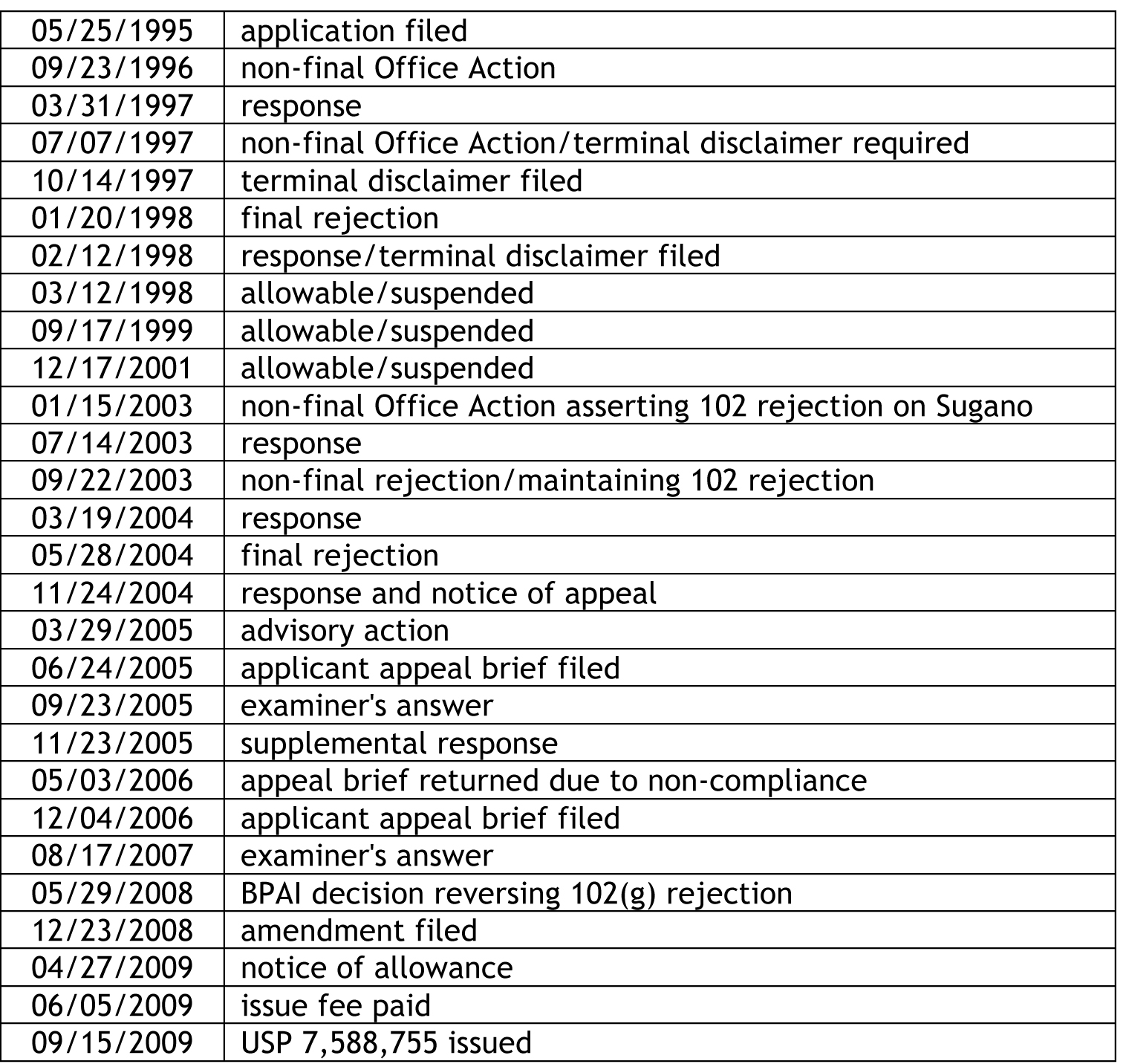
    priority date.  A history of
    patent prosecution reveals "why it took so long" for this patent to
    issue:

    Table

    The longest period of delay extended from March 12,
    1998 to January 15, 2003 — almost five years — while prosecution was suspended
    because of a potential interference.  (For those uninitiated in the arcane world of interferences, the most
    likely reason for this delay was to give a potential interfering application
    time to be prosecuted until interfering claims were deemed allowable.)  As it turns out, no interference was
    declared, and the Examiner renewed prosecution by asserting anticipation
    rejections based on two patents to Sugano (U.S. Patent Nos. 5,514,567 or
    5,326,859).  (Ironically, '755
    patent applicant Fiers was involved in an earlier interference against Sugano,
    and a second party, Revel, almost 20 years ago, in which Sugano prevailed in
    claims for human ß-interferon.)  The second extensive period of delay involved the appeal of the asserted
    anticipation rejection, which was complicated by the new formalities rules for
    appeal briefs promulgated (and strictly enforced) by the Office.  This delayed prosecution of the
    application to allowance by another 3 years, from June 24, 2005 to May 29,
    2008.  Ultimately, the Board of
    Patent Appeals and Interferences reversed the rejections based on the Sugano
    patents, paving the way for allowance and issue of the '755 patent (a process
    that took another 16 months).

    Avonex

    In addition to these Patent Office delays, the
    extended term of this patent is, of course, an artifact of the change in patent
    term in the U.S. — the reason the term seems so long today is that we have
    become accustomed to a 20-year maximum from the earliest priority date, and the
    prior norm of 17 years from grant date seems anomalous, especially when the
    term is as extended as it is in this case (31 years from the application filing
    date, and 45 years from the earliest priority date).  Something like this could not occur today.

    Besides these procedural aspects, whether the '755
    patent will be useful for preventing generic competition for Avonex® will
    depend on the scope of the granted claims.  The '755 patent has but three claims, set forth below:

    1.  A method for
    immunomodulation or treating a viral conditions, a viral disease, cancers or
    tumors comprising the step of administering to a patient in need of such
    treatment a therapeutically effective amount of a composition comprising:
        a
    recombinant polypeptide produced by a non-human host transformed by a
    recombinant DNA molecule comprising a DNA sequence selected from the group
    consisting of:
        (a) DNA sequences which are capable of hybridizing to any of the
    DNA inserts of G-pBR322(Pst)/HFIF1, G-pBR322(Pst)/HFIF3 (DSM 1791),
    G-pBR322(Pst)/HFIF6 (DSM 1792), and G-pBR322(Pst)/HFIF7 (DSM 1793) under
    hybridizing conditions of 0.75 M NaCl at 68.degree. C. and washing conditions
    of 0.3 M NaCl at 68.degree. C., and which code for a polypeptide displaying
    antiviral activity, and (b) DNA sequences which are degenerate as a result of
    the genetic code to the DNA sequences defined in (a);
        said DNA sequence being
    operatively linked to an expression control sequence in the recombinant DNA
    molecule.

    2.  The method according
    to claim 1, wherein said DNA sequence is selected from DNA sequences of the
    formulae:

    ATGACCAACAAGTGTCTCCTCCAAATTGCTCTCCTGTTGTGCTTCTCCACTA
    CAGCTCTTTCCATGAGCTACAACTTGCTTGGATTCCTACAAAGAAGCAGCAA
    TTTTCAGTGTCAGAAGCTCCTGTGGCAATTGAATGGGAGGCTTGAATACTGC
    CTCAAGGACAGGATGAACTTTGACATCCCTGAGGAGATTAAGCAGCTGCAGC
    AGTTCCAGAAGGAGGACGCCGCATTGACCATCTATGAGATGCTCCAGAACAT
    CTTTGCTATTTTCAGACAAGATTCATCTAGCACTGGCTGGAATGAGACTATT
    GTTGAGAACCTCCTGGCTAATGTCTATCATCAGATAAACCATCTGAAGACAG
    TCCTGGAAGAAAAACTGGAGAAAGAAGATTTCACCAGGGGAAAACTCATGAG
    CAGTCTGCACCTGAAAAGATATTATGGGAGGATTCTGCATTACCTGAAGGCC
    AAGGAGTACAGTCACTGTGCCTGGACCATAGTCAGAGTGGAAATCCTAAGGA
    ACTTTTACTTCATTAACAGACTTACAGGTTACCTCCGAAAC
    ,

    and

    ATGAGCTACAACTTGCTTGGATTCCTACAAAGAAGCAGCAATTTTCAGTGTC
    AGAAGCTCCTGTGGCAATTGAATGGGAGGCTTGAATACTGCCTCAAGGACAG
    GATGAACTTTGACATCCCTGAGGAGATTAAGCAGCTGCAGCAGTTCCAGAAG
    GAGGACGCCGCATTGACCATCTATGAGATGCTCCAGAACATCTTTGCTATTT
    TCAGACAAGATTCATCTAGCACTGGCTGGAATGAGACTATTGTTGAGAACCT
    CCTGGCTAATGTCTATCATCAGATAAACCATCTGAAGACAGTCCTGGAAGAA
    AAACTGGAGAAAGAAGATTTCACCAGGGGAAAACTCATGAGCAGTCTGCACC
    TGAAAAGATATTATGGGAGGATTCTGCATTACCTGAAGGCCAAGGAGTACAG
    TCACTGTGCCTGGACCATAGTCAGAGTGGAAATCCTAAGGAACTTTTACTTC
    ATTAACAGACTTACAGGTTACCTCCGAAAC
    .

    3.  The method according
    to claim 1 wherein the polypeptide is selected from polypeptides of the
    formulae:

    Met-Thr-Asn-Lys-Cys-Leu-Leu-Gln-Ile-Ala-Leu-Leu-
    Leu-Cys-Phe-Ser-Thr-Thr-Ala-Leu-Ser-Met-Ser-Tyr-
    Asn-Leu-Leu-Gly-Phe-Leu-Gln-Arg-Ser-Ser-Asn-Phe-
    Gln-Cys-Gln-Lys-Leu-Leu-Trp-Gln-Leu-Asn-Gly-Arg-
    Leu-Glu-Tyr-Cys-Leu-Lys-Asp-Arg-Met-Asn-Phe-Asp-
    Ile-Pro-Glu-Glu-Ile-Lys-Gln-Leu-Gln-Gln-Phe-Gln-
    Lys-Glu-Asp-Ala-Ala-Leu-Thr-Ile-Tyr-Glu-Met-Leu-
    Gln-Asn-Ile-Phe-Ala-Ile-Phe-Arg-Gln-Asp-Ser-Ser-
    Ser-Thr-Gly-Trp-Asn-Glu-Thr-Ile-Val-Glu-Asn-Leu-
    Leu-Ala-Asn-Val-Tyr-His-Gln-Ile-Asn-His-Leu-Lys-
    Thr-Val-Leu-Glu-Glu-Lys-Leu-Glu-Lys-Glu-Asp-Phe-
    Thr-Arg-Gly-Lys-Leu-Met-Ser-Ser-Leu-His-Leu-Lys-
    Arg-Tyr-Tyr-Gly-Arg-Ile-Leu-His-Tyr-Leu-Lys-Ala-
    Lys-Glu-Tyr-Ser-His-Cys-Ala-Trp-Thr-Ile-Val-Arg-
    Val-Glu-Ile-Leu-Arg-Asn-Phe-Tyr-Phe-Ile-Asn-Arg-
    Leu-Thr-Gly-Tyr-Leu-Arg-Asn
    ,

    and

    Met-Ser-Tyr-Asn-Leu-Leu-Gly-Phe-Leu-Gln-Arg-Ser-
    Ser-Asn-Phe-Gln-Cys-Gln-Lys-Leu-Leu-Trp-Gln-Leu-
    Asn-Gly-Arg-Leu-Glu-Tyr-Cys-Leu-Lys-Asp-Arg-Met-
    Asn-Phe-Asp-Ile-Pro-Glu-Glu-Ile-Lys-Gln-Leu-Gln-
    Gln-Phe-Gln-Lys-Glu-Asp-Ala-Ala-Leu-Thr-Ile-Tyr-
    Glu-Met-Leu-Gln-Asn-Ile-Phe-Ala-Ile-Phe-Arg-Gln-
    Asp-Ser-Ser-Ser-Thr-Gly-Trp-Asn-Glu-Thr-Ile-Val-
    Glu-Asn-Leu-Leu-Ala-Asn-Val-Tyr-His-Gln-Ile-Asn-
    His-Leu-Lys-Thr-Val-Leu-Glu-Glu-Lys-Leu-Glu-Lys-
    Glu-Asp-Phe-Thr-Arg-Gly-Lys-Leu-Met-Ser-Ser-Leu-
    His-Leu-Lys-Arg-Tyr-Tyr-Gly-Arg-Ile-Leu-His-Tyr-
    Leu-Lys-Ala-Lys-Glu-Tyr-Ser-His-Cys-Ala-Trp-Thr-
    Ile-Val-Arg-Val-Glu-Ile-Leu-Arg-Asn-Phe-Tyr-Phe-
    Ile-Asn-Arg-Leu-Thr-Gly-Tyr-Leu-Arg-Asn
    .

    The relevance of these claims to Avonex® will
    depend on whether Avonex® administration falls within the ambit of the method
    claim, which requires:

    a)  immunomodulation or
    b)  treating a viral condition, a viral
    disease, cancers or tumors
    c)  administering to a patient in need of
    such treatment
    d)  a therapeutically effective amount of a
    composition comprising:
    e)  a recombinant polypeptide
    f)  produced by a non-human host
    transformed by a recombinant DNA molecule comprising a DNA sequence
    g)  encoding human ß-interferon or sequence
    homolog thereof
    h)  which code for a polypeptide displaying
    antiviral activity

    While elements e)
    through h) are apparently encompassed by
    Avonex®, whether these
    claims will be useful for precluding generic entry will depend on whether
    treatment of MS involves immunomodulation or viral disease (since it is
    self-evidently neither cancer or a tumor).  In this regard the scientific literature is littered with
    reports linking MS with a variety of viral infections (including Epstein-Barr
    virus and measles virus), but no definitive linkage has been established.  While MS treatment is likely to involve some type of immunomodulation, Biogen Idec would have the burden of establishing such a mechanism should they sue an ANDA filer for infringement.

    The importance of the
    question about the scope of this patent, and its effects on generic competition
    over
    Avonex® can be appreciated from the sales figures for the drug
    in the second quarter of 2009, which amount to almost $600 million (or $2.4
    billion per year), according to an Associated Press article cited in Forbes magazine.

    As the Forbes article suggests, the outcome of the Avonex® patent regime has
    relevance to the current follow-on biologics legislation, at least because of
    the emotional appeal regarding the length of patent protection.  Understanding the history of this
    patent defuses any apprehension about the likelihood of similar outcomes going
    forward, and the Avonex® patent estate can be seen to be nothing more than a
    historical accident that cannot be replicated.  However, the tendency for dissatisfaction with outcomes like
    this one to guide political activity, and legislation, should not be
    underestimated.

  •     By
    Donald Zuhn

    Last
    week, a divided panel of the Federal Circuit affirmed a determination by the
    District Court for the District of Delaware that the claims of U.S. Patent No. 4,663,318 were invalid for lack of enablement.  The
    '318 patent, which issued on May 5, 1987 from U.S. Application No. 06/819,141, is directed to a method for treating
    Alzheimer’s disease with galanthamine. 
    The lone independent claim of the '318 patent recites:

    1.  A method of treating Alzheimer's
    disease and related dementias which comprises administering to a patient
    suffering from such a disease a therapeutically effective amount of
    galanthamine or a pharmaceutically-acceptable acid addition salt thereof.

    Galantamine

    The
    majority opinion notes that at the time the '141 application was filed (January 1986), researchers had
    observed a correlation between Alzheimer’s disease symptoms and a reduced level
    of the neurotransmitter acetylcholine in the brain (acetylcholine is released by a transmitting neuron and binds
    to nicotinic receptors and muscarinic receptors on a receiving neuron).  The majority opinion also notes that at the
    time the '141 application was filed, the small molecule galanthamine (at right; also known as galantamine) was known
    to inhibit acetylcholinesterase, an enzyme that breaks down acetylcholine.  The majority opinion states that the
    specification for the '318 patent is "only just over one page in length"
    and provides "almost no basis for its stated conclusion that it was
    possible to administer 'an effective Alzheimer's disease cognitively-enhancing
    amount of galanthamine.'"  The
    majority opinion also states that the specification provides "short summaries"
    of six scientific papers in which galanthamine had been administered to humans
    or animals, but "did not provide analysis or insight connecting the
    results of any of these six studies to galanthamine's potential to treat
    Alzheimer's disease in humans" or "refer to any then-existing animal
    test results involving the administration of galantamine in connection with
    this animal model of Alzheimer's disease."

    During
    prosecution of the '318 patent, the examiner rejected the claims for
    indefiniteness and obviousness.  In
    attempting to overcome the rejection, the inventor, Dr. Bonnie Davis, informed
    the Patent Office that "experiments [are] underway using animal models
    which are expected to show that treatment with galanthamine does result in an
    improvement in the condition of those suffering from Alzheimer's disease,"
    and that it was "expected that data from this experimental work will be
    available in two to three months and will be submitted to the Examiner promptly
    thereafter."  The majority opinion
    notes that the results of these experiments were not known until July 1987, after
    the '318 patent issued, that the studies "required several months and
    considerable effort by researchers at the Johns Hopkins University," and
    that the results were never submitted to the Patent Office.  In November 1995, Dr. Davis licensed
    the '318 patent to Plaintiffs-Appellants Janssen Pharmaceutica N.V., Janssen
    L.P., and Synaptech, Inc. (Janssen).

    Razadyne

    Seeking
    approval to market a generic version of Janssen's galanthamine-based therapeutic
    for treating mild to moderate Alzheimer's disease, several generic drug
    manufacturers filed Abbreviated New Drug Applications (ANDAs) with the
    FDA.  In response, Janssen filed
    infringement suits against each ANDA filer.  These infringement suits were consolidated.

    Following
    a bench trial, the District Court determined that the '318 patent was invalid
    for lack of enablement.  The
    District Court based its determination on two grounds:  (1) the specification of the '318
    patent did not demonstrate utility because relevant animal testing experiments
    were "not finished . . . by the time the '318 patent was allowed" and
    the specification provided only "minimal disclosure" of utility, and
    (2) the specification and claims did not "teach one of skill in the art
    how to use the claimed method" because the application "only
    surmise[d] how the claimed method could be used" without providing
    sufficient galanthamine dosage information.

    Federal Circuit Seal

    Writing
    for the majority, Judge Dyk, joined by Judge Mayer, cites Process Control Corp. v. HydReclaim Corp., 190 F.3d 1350, 1358
    (Fed. Cir. 1999), for the proposition that "a patent claim [that] fails to
    meet the utility requirement because it is not useful or operative, . . . also
    fails to meet the how-to-use aspect of the enablement requirement."  Judge Dyk observes that "[t]ypically,
    patent applications claiming new methods of treatment are supported by test
    results," adding that "[o]ur predecessor court held in Krimmel
    [292 F.2d 948, 954 (CCPA 1961)] that animal tests showing that a new nonobvious
    compound 'exhibits some useful pharmaceutical property' are sufficient to
    demonstrate utility" and that "under appropriate circumstances, . . .
    the first link in the screening chain, in vitro testing, may establish a
    practical utility for the [pharmaceutical] compound in question," citing Cross v. Iizuka, 753 F.2d 1040, 1051
    (Fed. Cir. 1985).

    In
    affirming the District Court's judgment of invalidity for lack of enablement, Judge
    Dyk states that:

    In
    this case, however, neither in vitro test results nor animal test results
    involving the use of galantamine to treat Alzheimer's-like conditions were
    provided.  The results from the
    '318 patent's proposed animal tests of galantamine for treating symptoms of
    Alzheimer's disease were not available at the time of the application, and the
    district court properly held that they could not be used to establish
    enablement.

    In
    addition, Judge Dyk notes that Janssen did not contend, either during
    prosecution or at trial, that the six scientific papers discussed in the
    specification of the '318 patent established utility.  Instead, Janssen argued on appeal that utility may be
    established by analytic reasoning. 
    In particular, Janssen argued that the specification "set[] forth
    the evidence from existing studies demonstrating galantamine's effects on
    central nicotinic as well as muscarinic receptors and connect[ed] it to a model
    for Alzheimer's therapy rendering
    those effects therapeutically relevant."  Judge Dyk, however, states that
    "[t]hese insights . . . are nowhere described in the specification."  He also states that "at the end of the
    day, the specification, even read in the light of the knowledge of those
    skilled in the art, does no more than state a hypothesis and propose testing to
    determine the accuracy of that hypothesis," which is "not
    sufficient."  Judge Dyk,
    therefore, concludes that "[t]he '318 patent's description of using
    galantamine to treat Alzheimer’s disease thus does not satisfy the enablement
    requirement because the '318 patent's application did not establish utility."

    Writing
    in dissent, Judge Gajarsa contends that District Court's determination of
    non-enablement should have been vacated because the lower court "did not
    undertake the required legal analysis to determine whether an ordinarily
    skilled artisan reading the patent would understand it to reveal a credible
    utility for the invention," and further, "failed to make the factual
    findings necessary to support the ultimate legal conclusion regarding
    enablement."  Noting that
    "[t]he parties do not dispute that Dr. Davis's insight regarding
    galantamine's utility for treating Alzheimer's Disease (AD) was correct,"
    Judge Gajarsa states that "[t]he relevant question here is whether, at the
    time Dr. Davis filed her application, the patent's written description would
    have credibly revealed to an ordinarily skilled artisan galantamine's utility
    for AD treatment."

    With
    respect to the issues of obviousness and enablement, Judge Gajarsa argues that:

    In
    terms of the present case, if Dr. Davis used her unique neuroendocrine
    perspective to examine the prior art and arrive at a novel insight about
    galantamine based on selected prior art findings, then the invention may be
    nonobvious; and if her patent disclosed those selected findings in such a
    manner that a person of ordinary skill would credit her insight regarding
    galantamine's utility, then the invention is enabled.

    However, in the instant case:

    [T]he
    district court committed error . . . by focusing generally on what the prior
    art does or does not teach — the primary factual consideration underlying
    obviousness — while neglecting to consider what the patent text discloses to
    an ordinarily skilled artisan — the primary factual consideration underlying enablement.

    In
    particular, Judge Gajarsa contends that the District Court failed to "determine
    how one of ordinary skill would understand [the findings of the six prior art studies
    described in the specification], either independently or in combination with
    one another."

    Judge
    Gajarsa also finds fault with "the majority opinion's emphasis on the
    sufficiency of the evidence presented by Janssen."  Stating that "the majority fails
    to establish the defendants' burden and instead focuses almost exclusively on
    the sufficiency of Janssen's showing and the merit of Janssen's arguments,"
    Judge Gajarsa argues that such focus is improper.  Moreover, "[b]ecause the district court erred as a
    matter of law and failed to make certain required factual
    findings," Judge Gajarsa contends that "we cannot defer to the
    district court's legal conclusion or fact-findings, and thus, it is
    particularly problematic for the majority to require Janssen to demonstrate on
    appeal that its patent is valid."

    In re '318 Patent
    Infringement Litigation
    (Fed. Cir. 2009)
    Panel:
    Circuit Judges Mayer, Gajarsa, and Dyk
    Opinion
    by Circuit Judge Dyk; dissenting opinion by Circuit Judge Gajarsa

  • Sometimes, Sins of Omission Are Not Inequitable
    Conduct

        By Kevin E. Noonan

    St. Thomas Aquinas recognized two types of
    sin:  those of omission and those
    of commission.  In patent law,
    inequitable conduct comes closest to this concept of sin, where frequently the
    accused behavior is the failure to submit to a patent examiner during
    prosecution information that is material to patentability.  However, mere failure to submit is not
    enough; there must be some evidence of deceptive intent. 
    Kingsdown Medical Consultants, Ltd. v.
    Hollister Inc.
    , 863 F.2d 867 (Fed. Cir. 1988) (en
    banc).
      These principles were reaffirmed last Friday by
    the Federal Circuit in AstraZeneca
    Pharmaceuticals LP v. Teva Pharmaceuticals USA, Inc
    .

    AstraZeneca_small

    AstraZeneca sued Teva and Sandoz pursuant to 35
    U.S.C. § 271(e)(2)(A) for filing ANDAs for a generic version of
    Seroquel®, an antipsychotic agent.  Each ANDA contained a Paragraph IV certification that AstraZeneca's U.S.
    Patent No. 4,879,288 (the '288 patent), its Orange Book-listed patent for
    Seroquel®, was invalid and/or not
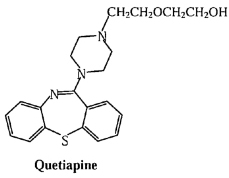
    infringed.  The patent claims
    quetiapine (the generic name for Seroquel®), an atypical antipsychotic having
    the chemical structure:

    Quetiapine

    (An "atypical" antipsychotic agent is
    characterized by what it does not do:  it does not cause involuntary body movements such as "torsion
    spasms, muscle spasms . . . dystonia's of the face neck or back with protrusion
    of the tongue and tonic spasms of the limbs (dyskinesias).")  The District Court granted summary
    judgment that AstraZeneca was not guilty of inequitable conduct in obtaining
    the '288 patent.

    The Federal Circuit agreed, in an opinion by Judge
    Newman, joined by Judges Rader and Prost.  The material information asserted by Teva and Sandoz to have been
    omitted by AstraZeneca concerned a number of quetiapine analogs, including the
    following:

    Compounds

    AstraZeneca submitted several prior art references
    relating to these compounds, specifically a German-language publication
    (Compound 210786), U.S. Patent No. 3,389,139 to Schmutz ("Schmutz
    I"; Perlapine), U.S. Patent No. 3,539,573 to a second Schmutz reference ("Schmutz
    II"; Compound 24028), and U.S. Patent No. 4,308,207 to Hunzikerr
    (Fluperlapine).

    Horrom Compound & Schmutz X

    The Examiner issued an obviousness rejection on
    chemical structural obviousness grounds over the Schmutz II compound in view of
    additional references, including U.S. Patent No. 4,097,597 to Horrom disclosing
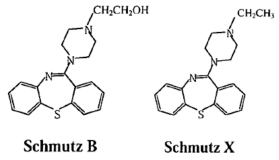
    the Horrom Compound, and another species from the Schmutz II reference, termed
    Schmutz X by the parties.

    AstraZeneca responded to the rejection with
    argument regarding the unpredictability of "the critical physiological
    property of atypicality," wherein the prior art did not provide a
    rationale for choosing the substitutions resulting in quetiapine.  These arguments proved unavailing, with
    the Examiner demanding that AstraZeneca "provide proof that the prior art
    compounds do not necessarily or inherently posses the characteristics of the
    claimed compounds."  Specifically, the Examiner required that AstraZeneca overcome his
    structural obviousness rejection "by a side-to-side comparison with the
    closest prior art compound(s)."  The Examiner required this evidence for the Horrom compound and the
    Schmutz X compound but none of the other compounds disclosed by AstraZeneca.

    The patent applicant responded with a declaration
    by one of the inventors, Dr. Migler, with data for each of the asserted
    compounds.  In his declaration, Dr.
    Migler attested to the antipsychotic activity not of the Schmutz X compound but
    a related compound termed Schmutz B:

    Schmutz B & Schmutz X

    The reason for this substitution provided to the Examiner by AstraZeneca was that data for Schmutz X did not exist and "would
    be very expensive to generate right now."  The data Dr. Migler submitted with his declaration showed
    that the antipsychotic behavior of these compounds was "typical."  In addition, Dr. Miglar attested in his
    declaration that another compound, termed "Schmutz A," showed no
    antipsychotic behavior; this compound differed from the quetiapine compound in
    having a chlorine atom substitution in the left benzene ring of the
    heterocyclic structure and having a methyl group as a side chain.

    Teva

    Defendants argued at trial, and before the Federal
    Circuit, that what AstraZeneca did not disclose to the Patent Office was
    internal data showing atypical antipsychotic behavior for perlapine,
    fluperlapine, Compound 21076, and Compound 24028, and that withholding this data
    was "deliberately misleading."  The essence of Defendants' argument, according to Judge Newman's
    opinion, was that "AstraZeneca presented internal test data about similar
    compounds that were typical while omitting internal test data about similar
    compounds that were potentially atypical."  This argument did not convince the District Court, which
    ruled that AstraZeneca had disclosed the closest prior art and had addressed
    the arguments and provided the evidence required by the Examiner.

    Sandoz

    Judge Newman's opinion noted that there was no
    assertion that AstraZeneca withheld any "relevant" reference.  The art AstraZeneca did cite (the
    Hunzinger patent, for example) disclosed atypical antipsychotics including
    fluperlapine, and any internal data possessed by AstraZeneca was thus
    cumulative.  The Federal Circuit rejected the Defendants' allegations that AstraZeneca made material misrepresentations during prosecution (such as it being "too expensive"
    to provide data for the Schmutz X compound) as being without evidence, nor was
    there evidence that, had AstraZeneca made and tested the Schmutz X compound,
    material evidence would have been produced, said the Court.  The Court said that the unpredictability of whether a
    particular analog had atypical antipsychotic properties was "undisputed,"
    and that "the record demonstrates that structural similarity is not a
    predictor of whether antipsychotic behavior would be typical or atypical."  The Court also assessed
    whether the compounds having data regarding antipsychotic behavior that
    AstraZeneca did not disclose were "equally close" in chemical
    structure to the compounds whose data was disclosed and to quetiapine.  In its analysis, the Court found that
    substitution of the Schmutz B compound data for Compound 24028 data was not a
    material representation, based on structural grounds (and despite evidence that
    their antipsychotic behavior differed in ways that did not support AstraZeneca's
    argument).  The Court's analysis
    rested on its assessment that AstraZeneca submitted data for the "structurally
    closest" compounds, and the compounds asserted by the Examiner.  The Court opined:

    A reasonable examiner would not have
    understood the Migler declaration as stating that no prior art product had the
    atypical property shown by quitiapine, for it was known that other atypical
    antipsychotics existed . . . .  A reasonable examiner would understand AstraZeneca's
    statements to refer to the closest prior art compounds, not all prior art
    compounds.

    Thus, according to the opinion, the evidence did
    not support a finding that AstraZeneca misrepresented or omitted material
    information, despite AstraZeneca's failure to disclose all its data for several
    of these prior art compounds.

    Similarly, the Court found that the Defendants did
    not establish deceptive intent by clear and convincing evidence.  Defendants' argument suffered because
    it suggested that, due to the "high degree of materiality" it had shown
    regarding the withheld information, "they therefore need a proportionally lesser showing of intent to
    deceive to establish the requisite threshold level of intent."  The Court was succinct in its
    evaluation of this argument:  "[t]hat
    is incorrect," it said, and "[e]vidence of mistake or negligence,
    even gross negligence, is not sufficient to support inequitable conduct . . .,"
    citing Kingsdown Medical.  A court must balance evidence of
    materiality and deceptive intent, said the Federal Circuit, but only after threshold levels of materiality and deceptive intent have
    been shown by clear and convincing evidence.  The Defendants' evidence of deceptive intent was merely the
    existence of the undisclosed data showing that some of the prior art compounds
    had atypical antipsychotic behavior and AstraZeneca's failure to expressly
    disclose this evidence to the Patent Office.  Intent to withhold, however, is not the same as intent
    to deceive, according to the Court, and "[i]ntent to deceive cannot be
    inferred simply from the decision to withhold [information] where the reasons
    given for withholding are plausible," citing Dayco Products Inc. v. Total Containment, Inc.  In the absence of any evidence of
    bad faith, the Court found AstraZeneca "presented plausible reasons for its
    presentation of arguments and data during the prosecution" which did not
    support a finding of deceptive intent.

    Regardless of the soundness of the Federal Circuit's opinion,
    the case illustrates how difficult making an inequitable conduct determination
    can be.  Even in situations where no affirmative sins of commission appear to have been committed, omissions that are sinful can be devilishly difficult to discern, and their
    motivations even more so.

    AstraZeneca Pharmaceuticals LP v. Teva
    Pharmaceuticals USA, Inc.
    (Fed. Cir. 2009)

    Panel: 
    Circuit Judges Newman, Rader, and Prost
    Opinion by Circuit Judge Newman

  •     By Kevin E. Noonan

    Amgen

    Although Amgen's erythropoietin franchise has
    weathered its most recent challenge by F. Hoffmann-La Roche's pegylated EPO analog,
    Mircera® (see Amgen Inc. v. F. Hoffman-La Roche Ltd. (Fed. Cir. 2009)), the victory was not
    absolute.  The status of three of
    the patents-in-suit —
    U.S. Patent Nos. 5,547,933
    (the '933 patent), 5,955,422
    (the '422 patent, claim 1) and 5,756,349
    (the '349 patent, claim 7) — were put in jeopardy by the Federal Circuit's
    reversal of summary judgment and remand to the District Court on the question
    of whether these patents are invalid for obviousness-type double
    patenting.  If the District Court
    were to make a determination that they are invalid, Amgen's EPO patent estate
    will expire almost two years earlier than expected, with loss of at least a
    portion of the company's significant revenues from its flagship product.  The likelihood of this outcome will
    depend on the parties' reaction to the latest installment of Federal Circuit
    jurisprudence on obviousness-type double patenting following its decision last
    year in Pfizer, Inc. v. Teva Pharmaceuticals USA,
    Inc.

    The ultimate parent application, which matured into
    U.S. Patent No. 4,703,008, was subject to a restriction requirement identifying
    the following groups of claims:

    I.  Claims
    1–13, 16, 39–41, 47–54, and 59, drawn to polypeptide, classified in Class 260, subclass
    112.
    II.  Claims
    14, 15, 17–36, 58, and 61–72, drawn to DNA, classified in Class 536, subclass
    27.
    III.  Claims
    37–38, drawn to plasmid, classified in Class 435, subclass 317.
    IV.  Claims
    42–46, drawn to cells, classified in Class 435, subclass 240.
    V.  Claims
    55–57, drawn to pharmaceutical composition, classified in Class 435, subclass
    177.
    VI.  Claim
    60, drawn to assay, classified in Class 435, subclass 6.

    Pursuant to the restriction requirement, each of
    these claim groupings defined an independently-patentable invention, and as
    such would entitle Amgen to a separate patent unfettered by obviousness-type
    double patenting.  It is
    undisputed that Amgen prosecuted the claims of Group II in the '008
    patent.  Thereafter, Amgen filed
    two applications claiming priority to the '008 patent, the '178
    application and the '179 application; these applications are
    related to the patents-in-suit according to the following schematic diagram:

    Family Tree

    The Court characterized "in broad strokes"
    the claims of the three patents under consideration:

    [T]he '933 patent claims recombinant EPO, a
    pharmaceutical composition comprising recombinant EPO, and methods of treating
    kidney dialysis patients by administering pharmaceutical compositions
    comprising recombinant EPO . . . .  The '422 patent claims a pharmaceutical
    composition comprising recombinant EPO . . . .  The '349 patent claims the process
    of producing recombinant EPO in vertebrate cells capable of producing EPO at a
    specific rate.

    At first blush, the claims of the '933 patent would appear
    to correspond to Groups I and V from the '008 restriction requirement, and the
    claims of the '422 patent correspond to Group V.  Two other patents-in-suit — U.S. Patent Nos. 5,441,868 (the '868 patent) and 5,618,698
    (the '698 patent) — recite claims for methods of making EPO.

    Roche

    Roche's position, unpersuasive at the District Court, was that the claims of the '933, '422, and '394 patents were invalid for
    obviousness-type double patenting over the claims of the '868 and '698 patents,
    and in turn the claims of the '868 and '698 patents were invalid for
    obviousness-type double patenting over the claims of the '008 patent.  This question depends on the meaning of
    35 U.S.C. § 121, which sets forth a "safe harbor" provision protecting
    claims subject to a restriction requirement (and thus determined by the Patent
    Office to define separately-patentable inventions) from a determination of
    obviousness-type double patenting:

    A patent
    issuing on an application with respect to which a requirement for restriction
    under this section has been made, or on an application filed as a result of
    such a requirement, shall not be used as a reference either in the Patent and
    Trademark Office or in the courts against a divisional application or against
    the original application or any patent issued on either of them, if the
    divisional application is filed before the issuance of the patent on the other
    application.

    35 U.S.C.
    § 121, third sentence; see also
    Applied Materials, Inc. v. Advanced
    Semiconductor Materials Am., Inc.
    , 98 F.3d 1563 (Fed. Cir. 1996
    ),
    cited in the Court's opinion.  The District Court held that the '933, '422, and '349 patents were immunized from
    obviousness-type double patenting, since they had issued from applications in
    the chain back to the '178 and '179 applications, which were filed pursuant to
    a Patent Office-imposed restriction requirement.  However, these applications when filed were not designated
    as "divisional applications," the language of the statute, but rather
    as "continuation applications," and Roche argued that this difference
    precluded the '933, '422, and '349 patents from the § 121 safe harbor.

    Federal Circuit Seal

    The Federal Circuit agreed, to the extent that
    summary judgment and JMOL granted by the District Court was improper.  In its opinion, by Judge Schall and
    joined by Judges Mayer and Clevenger, the CAFC granted no deference to the District Court's decision, first applying its own standard of review regarding
    summary judgment, next using the 1st Circuit's standard of review
    for JMOL, and last for the substantive question of obviousness-type double
    patenting, which it interpreted as being analogous to claim construction, as a "matter
    of what is claimed" and thus subject to the Federal Circuit's de novo review
    precedent.  Using these standards,
    the Federal Circuit held that the '933, '422, and '349 patents were not entitled to the
    § 121 safe harbor because the '178 and '179 applications were filed as
    continuation applications and not divisional applications.  In interpreting the statute so
    literally, the CAFC noted that, unlike the claims in the Pfizer case that arose from a continuation-in-part application,
    each of the '933, '422, and '349 patents may have satisfied the substantive
    requirements for divisional application status — being limited to the subject
    matter disclosed in the prior parent application, reciting claims determined to
    define a patentably-distinct invention, and being filed during the pendency of
    the earlier-filed parent application.  Nonetheless, the Court held that "[t]his
    distinction . . . does not justify departing from a strict application of the
    plain language of §121, which affords its [safe harbor] benefits to 'divisional
    applications.'"  In making
    this decision, the CAFC distinguished both its Applied Materials and Symbol
    Technologies, Inc. v. Opticon, Inc.
    , 935 F.2d 1569 (Fed.
    Cir. 1991)
    precedent, because in those cases the "continuation"
    application was filed ultimately from a properly-designated divisional
    application.

    The CAFC reached a different conclusion with regard
    to the '868 and '698 patents, because the parties litigated the
    obviousness-type double patenting question on the merits before the District Court.  As characterized in the
    Federal Circuit's opinion, the claims of the '008 patent recite a recombinant
    cell that expresses human EPO, and the claims of the '868 and '698 patents
    recite methods of producing recombinant EPO using such cells, either in vitro or in vivo.  The District Court distinguished the method claims of the '868 and '698 patents and the recombinant
    cell (product or composition) claims of the '008 patent because:

    none of the '008 claims require:  (1) that the
    recited host cell actually express any EPO polypeptide; (2) that the recited
    host cell actually express a glycosylated EPO polypeptide; (3) that the host
    cell be capable of producing an isolatable amount of a glycosylated EPO
    polypeptide; and (4) that any glycosylated EPO isolated from cells grown in
    culture have the stated in vivo function.

    The District Court relied on expert testimony for
    the proposition that, even if in possession of the recombinant cell disclosed
    in the '008 patent, at the priority date claims to methods for making EPO were
    novel, useful, and non-obvious.  (The lower court also noted that the Patent Office had found these claims to
    be patentably-distinct.)  The
    Federal Circuit agreed with this distinction, that while the recombinant cells
    claimed in the '008 patent might be "capable of producing"
    recombinant EPO having in vivo biological function, the claim did not recite a
    limitation that such cells actually produce functional EPO.  This requirement is affirmatively found
    in the '868 and '698 patent claims, rendering them patentably distinct.

    In making this determination, the Federal Circuit invoked a
    number of recent, post-KSR decisions
    on obviousness under 35 U.S.C. § 103, the standard used without using the '008
    patent as prior art, including In re
    Kubin
    , In re O'Farrell (where the
    application, not the case, is recent), and Pharmastem
    Therapeutics, Inc. v. Viacell Inc.
      The CAFC opined that the skilled artisan would not have reasonably expected to
    produce recombinant, glycosylated EPO having the properties — biological
    activity, post-translational modifications and amount — required by the claims
    of the '868 and '698 patents at the time of the invention.  In making this determination, the Federal Circuit
    rejected Roche's argument that the capacity for making recombinant EPO was
    inherent in the claimed cells (and did not address the issue of whether the
    claims of the expired '008 patent would have satisfied the utility or
    enablement requirements if the claimed cells did not inherently produce
    functional recombinant EPO).  The CAFC applied the Supreme Court's KSR warning against hindsight in refusing to consider the actuality
    that the cells claimed in the '008 patent produced biologically-active EPO in
    determining whether the skilled worker would have had an expectation that they
    would do so.

    Finally, the Federal Circuit clarified the application of the
    principles it enunciated in Takeda
    Pharmaceutical Co. v.  Doll

    regarding the availability of later-disclosed (or discovered) methods to
    overcome obviousness-type double patenting invalidation of a process claim over
    an earlier-issued product claim.  In Takeda,
    the Federal Circuit held that art used by a patentee to support patentable
    distinctiveness of process claims filed after grant of product claims was
    limited to art-recognized processes known at the time the later (or "secondary"
    in the Takeda court's parlance)
    patent application was filed.  Roche argued that Amgen should not be permitted to introduce evidence
    relating to processes for producing recombinant EPO after the 1984 filing date
    of the '008 patent where Roche was precluded from asserting art available after
    the 1984 priority date.

    Here, the Federal Circuit held that Roche's
    arguments "collide" with 35 U.S.C. § 120, wherein Amgen's later-filed
    applications are entitled to the benefit of priority to the '008 patent.  The CAFC found that interpreting its Takeda precedent as Roche advocated
    would "violate the plain language" of § 120, which entitles all of
    Amgen's patents-in-suit to the priority benefit of the '008 patent and
    accordingly prevents any of Amgen's patents-in-suit from being invalidated
    based on art available after the November 30, 1984 priority date of the '008
    patent.  The Court's opinion
    acknowledged (and asserted that the Takeda court recognized) that this rule "could
    'provide the patentee with the best of both worlds:  the applicant can use the
    filing date as a shield, enjoying the earlier priority date in order to avoid
    prior art, and rely on later-developed alternative processes as a sword
    to defeat double patenting challenges.'"  Nonetheless, the Federal Circuit characterized this seeming
    one-sidedness as being limited and hence not inequitable.  However, the CAFC noted that the
    '349 patent could not benefit from the application of the principles in the
    Takeda opinion, since it (unlike the '933 and '422 patents) recited claims to
    methods and not products.  Thus:

    Takeda will permit Amgen, if it
    wishes to do so, to rely on alternative processes for making the products
    claimed in the '933 and '422 patents up to their filing dates to prove that the
    claims of those patents and the claims of the '868 and '698 patents are
    patentably distinct.  If Amgen pursues
    that course, Roche will be free to rely on subsequent developments in the art
    up to the filing dates of the '933 and '422 patents to prove that any
    alternative processes put forth by Amgen do not render the claims of the '933
    and '422 patents and the claims of the '868 and '698 patents patentably
    distinct.

    Unless the parties settle, on remand it can be
    expected that the District Court will be compelled to find the asserted claims
    of the '933, '422, and '349 patents invalid for obviousness-type double patenting,
    unless Amgen can establish patentable distinctiveness on the merits (i.e., outside the § 121 safe
    harbor).  Until such time
    (including any further appeals to the Federal Circuit or the Supreme Court),
    the significant holding in this decision is that whether a claim is entitled to
    the § 121 safe harbor depends, in the first instance, on whether the application
    reciting that claim is designated as a "divisional" and not a "continuation"
    application.  (Such claims must
    also satisfy the requirements for divisional applications.)  The Federal Circuit's opinion is
    stringent, harsh, and unyielding, and provides another "trap for the unwary"
    for which patent law is infamous.  It also raises the specter of malpractice liability in designating
    follow-on applications accurately, a practice tip that
    the
    patent bar
    ignores at its peril.

  •     By Sherri Oslick

    Gavel_2About
    Court Report:  Each week we will report briefly on recently filed
    biotech and pharma cases, and a few interesting cases will be selected
    for periodic monitoring.


    Eurand Inc. et al. v. Anchen Pharmaceuticals Inc. et al.
    1:09-cv-00715; filed September 23, 2009 in the
    District Court of Delaware

    • Plaintiffs:  Eurand Inc.; Anesta AG
    • Defendants:  Anchen Pharmaceuticals Inc.; Anchen Inc.

    Infringement of U.S. Patent Nos. 7,387,793 ("Modified
    Release Dosage Forms of Skeletal Muscle Relaxants," issued July 17, 2008)
    and 7,544,372 (same title, issued June 9, 2009), licensed to Cephalon,
    following a Paragraph IV certification as part of Anchen's filing of an ANDA to
    manufacture a generic version of Cephalon's Amrix® (cyclobenzaprine
    hydrochloride, used for relief of muscle spasm associated with acute, painful
    musculoskeletal conditions).  View
    the complaint
    here.


    Astellas Pharma Inc. et al. v. Teva Pharmaceuticals USA, Inc.
    et al.

    1:09-cv-08100; filed September 22, 2009 in the
    District Court of New Jersey

    • Plaintiffs:  Astellas Pharma Inc.; Astellas Pharma US, Inc.
    • Defendants:  Teva Pharmaceuticals USA, Inc.; Teva Pharmaceuticals
    Industries, Ltd.

    Infringement of U.S. Patent No. 6,017,927 ("Quinuclidine
    Derivatives and Medicinal Composition Thereof," issued January 25, 2000),
    following a Paragraph IV certification as part of Teva's filing of an ANDA to
    manufacture a generic version of Astellas' VESIcare® (solifenacin succinate,
    used to treat overactive bladder with symptoms of urge urinary incontinence, urgency, and urinary
    frequency).  View the complaint
    here.


    Life Technologies Corp. et al. v. Illumina Inc. et al.
    1:09-cv-00706; filed September 21, 2009 in the
    District Court of Delaware

    • Plaintiffs:  Life Technologies Corp.; Applied Biosystems LLC;
    Institute for Protein Research; Alexander Chetverin; Helena Chetverina; William
    Hone
    • Defendants:  Illumina Inc.; Solexa Inc.

    Infringement of U.S. Patent Nos. 5,616,478 ("Method
    for Amplification of Nucleic Acids in Solid Media," issued April 1, 1997),
    5,958,698 ("Method for Amplification and Expression of Nucleic Acids in
    Solid Media and its Application for Nucleic Acid Cloning and Diagnostics,"
    issued September 28, 1999), and 6,001,568 ("Solid Medium for Amplification
    and Expression of Nucleic Acids as Colonies," issued December 14, 1999)
    based on Defendants' manufacture and sale of its DNA sequencing products and
    services, including Defendants' Genome Analyzer and Genome Analyzer II.  View the compliant
    here.


    Research Foundation of State University of New York et al. v.
    Impax Laboratories Inc.

    1:09-cv-00703; filed September 18, 2009 in the
    District Court of Delaware

    • Plaintiffs:  Research Foundation of State University of New York; New York
    University; Galderma Laboratories Inc.; Galderma Laboratories LP
    • Defendant:  Impax Laboratories Inc.

    Infringement of U.S. Patent Nos. 7,232,572 ("Methods
    of Treating Rosacea," issued June 19, 2007), 7,211,267 ("Methods of
    Treating Acne" issued May 1, 2007), 5,789,395 ("Method of Using
    Tetracycline Compounds for Inhibition of Endogenous Nitric Oxide Production"
    issued Augst 4, 1998), and 5,919,775 ("Method for Inhibiting Expression of
    Inducible Nitric Oxide Synthase with Tetracycline," issued April 16,
    1998), all either assigned or licensed to Galderma, following a Paragraph IV
    certification as part of Mylan's filing of an ANDA to manufacture a generic
    version of Galderma's Oracea® (doxycyline delayed release capsules, used to
    treat inflammatory lesions of rosacea).  View the complaint
    here.


    Life Technologies Corp. et al. v. Biosearch Technologies,
    Inc.

    2:09-cv-00283; filed September 18, 2009 in the
    Eastern District of Texas

    • Plaintiffs:  Life Technologies Corp.; Applied Biosystems, LLC
    • Defendant:  Biosearch Technologies, Inc.

    Infringement of U.S. Patent Nos. 5,538,848 ("Method
    for Detecting Nucleic Acid Amplification Using Self-Quenching Fluorescence
    Probe," issued July 23, 1996), 5,723,591 ("Self-Quenching
    Fluorescence Probe," issued March 3, 1998), 5,876,930 ("Hybridization
    Assay Using Self-Quenching Fluorescence Probe," issued March 2, 1999),
    6,030,787 (same title, issued February 29, 2000), and 6,258,569 (same title,
    issued July 10, 2001) based on Biosearch's manufacture and sale of dual-labeled
    probes incorporating a quencher and fluorophore reporter covalently linked to
    the 3' or 5' ends of an oligonucleotide that are used to monitor DNA
    amplification in real-time.  View
    the complaint
    here.


    Bayer Schering Pharma AG et al. v. Teva Pharmaceuticals USA
    Inc. et al.

    1:09-cv-00682; filed September 15, 2009 in the
    District Court of Delaware

    • Plaintiffs:  Bayer Schering Pharma AG; Bayer HealthCare Pharmaceuticals
    Inc.; Schering Corp.
    • Defendants:  Teva Pharmaceuticals USA Inc.; Teva Pharmaceutical Industries
    Ltd.

    Infringement of U.S. Patent No. 6,362,178 ("2-phenyl
    Substituted Imidazotriazinones as Phosphodiesterase Inhibitors," issued
    March 26, 2002) following a Paragraph IV certification as part of Teva's filing
    of an ANDA to manufacture a generic version of plaintiffs' Levitra® (vardenafil
    hydrochloride, used to treat erectile dysfunction).  View the complaint
    here.


    Boehringer Ingelheim Pharma GmbH
    & CO. KG et al. v. Kappos

    1:09-cv-01729; filed September 11, 2009 in the
    District Court of the District of Columbia

    • Plaintiffs:  Boehringer Ingelheim Pharma GmbH & Co. KG; Boehringer
    Ingelheim International GmbH; Boehringer Ingelheim Pharmaceuticals, Inc.
    • Defendant:  David Kappos

    Review and correction of the patent term adjustment
    calculation made by the U.S. Patent and Trademark Office for U.S. Patent No.
    7,504,378 ("Macrocyclic Peptides Active Against the Hepatitis C Virus,"
    issued March 17, 2009).  View the
    complaint
    here.


    Warner Chilcott Co., LLC v. Lupin Ltd. et al.
    1:09-cv-02394; filed September 11, 2009 in the
    District Court of Maryland

    • Plaintiff:  Warner Chilcott Co., LLC
    • Defendants:  Lupin Ltd.; Lupin Pharmaceuticals, Inc.

    Infringement of U.S. Patent No. 5,552,394 ("Low
    Dose Oral Contraceptives with Less Breakthrough Bleeding and Sustained
    Efficacy," issued September 3, 1996) following a Paragraph IV
    certification as part of Lupin's filing of an ANDA to manufacture a generic
    version of Warner Chilcott's Loestrin® 24 Fe (norethindrone acetate and ethinyl
    estradiol tablets, and ferrous fumarate tablets, used for oral
    contraception).  View the complaint
    here.


    Warner Chilcott Co., LLC v. Lupin Ltd. et al.
    1:09-cv-02399; filed September 11, 2009 in the
    District Court of Maryland

    • Plaintiff:  Warner Chilcott Co., LLC
    • Defendants:  Lupin Ltd.; Lupin Pharmaceuticals, Inc.

    Infringement of U.S. Patent No. 6,667,050 ("Chewable
    Oral Contraceptive," issued December 23, 2003) following a Paragraph IV
    certification as part of Lupin's filing of an ANDA to manufacture a generic
    version of Warner Chilcott's Femcon Fe® (formerly Ovcon® 35 Fe, norethindrone
    and ethinyl estradiol tablets, and ferrous fumarate tablets, used for oral
    contraception).  View the complaint
    here.


    Astellas US LLC et al. v. Wockhardt Ltd. et al.
    2:09-cv-04654; filed September 10, 2009 in the
    District Court of New Jersey

    • Plaintiffs:  Astellas US LLC; Astellas Pharma US, INC.; Item Development
    AB
    • Defendants:  Wockhardt Ltd.; Wockhardt USA, Inc.

    Infringement of U.S. Patent No. 5,731,296 ("Selective
    Vasodilation by Continuous Adenosine Infusion," issued March 24, 1998),
    licensed to Astellas, following a Paragraph IV certification as part of
    Wockhardt's filing of an ANDA to manufacture a generic version of Astellas'
    Adenoscan® product (adenosine injection, used as a diagnostic for myocardial
    reperfusion injury).  View the
    complaint
    here.


    Albany Molecular Research, Inc. v. Sandoz, Inc. et al.
    2:09-cv-04639; filed September 9, 2009 in the
    District Court of New Jersey

    • Plaintiff: 
    Albany Molecular Research, Inc.
    • Defendants:  Sandoz, Inc.; Dr. Reddy's Laboratories, Ltd.

    Infringement of U.S. Patent No. 7,390,906 ("Piperidine
    Derivatives and Process for Their Production," issued June 24, 2008) based
    on Defendants' intended commercial manufacture of fexofenadine hydrochloride,
    the active ingredient in Aventis' Allegra® and Allegra-D® (used to treat
    allergies).  View the complaint
    here.


    Albany Molecular Research, Inc. v. Dr. Reddy's Laboratories,
    Ltd. et al.

    2:09-cv-04638; filed September 9, 2009 in the
    District Court of New Jersey

    • Plaintiff:  Albany Molecular Research, Inc.
    • Defendants:  Dr. Reddy's Laboratories, Ltd.; Dr. Reddy's Laboratories,
    Inc.

    Infringement of U.S. Patent No. 7,390,906 ("Piperidine
    Derivatives and Process for Their Production," issued June 24, 2008) based
    on Reddy's current and intended commercial manufacture and sale of products
    containing fexofenadine hydrochloride, the active ingredient in Aventis'
    Allegra® and Allegra-D® (used to treat allergies).  View the complaint
    here.


  • CalendarSeptember 30-October 1, 2009 – Biotech Patents*** (American Conference Institute) – Boston, MA

    October 5-6, 2009 – Patent Litigation 2009 (Practising Law Institute) – McLean, VA

    October 7-8, 2009 – Maximizing Pharmaceutical Patent Lifecycles*** (American Conference Institute) – New York, NY

    October 14, 2009 – Developments in Pharmaceutical and Biotech Patent Law (Practising Law Institute) – San Francisco, CA

    October 15-16, 2009 – Patent Litigation 2009 (Practising Law Institute) – Chicago, IL

    October 20-21, 2009 – 17th Forum on Biotech Patenting (C5) – London,
    United Kingdom

    October 22-23, 2009 – Pharmaceutical Congress on Paragraph IV Disputes*** (Center for Business Intelligence) – Philadelphia, PA

    October 26-28, 2009 – Intellectual Property Counsels' Committee (IPCC) Fall Conference & Meeting (Biotechnology Industry Organization) – Washington, DC

    November 9-10, 2009 – Patent Litigation 2009 (Practising Law Institute) – Atlanta, GA

    November 9-11, 2009 – Developing
    IP Strategies for Crystalline Forms
    *** (
    International
    Quality & Productivity Center) –
    London,
    England

    November 10, 2009 – The Patent Cooperation Treaty (PCT): Important Tool for Small and Medium-Sized Enterprises (SMEs) and Independent Inventors (World Intellectual Property Organization) – Baltimore, MD

    November 12-13, 2009 – Paragraph IV on Trial*** (American Conference
    Institute) – New York, NY

    November 13, 2009 – The Patent Cooperation Treaty (PCT): Important Tool for Small and Medium-Sized Enterprises (SMEs) and Independent Inventors (World Intellectual Property Organization) – Las Vegas, NV

    November 16-17, 2009 – Patent Litigation 2009 (Practising Law Institute) – New York, NY

    November
    17-18, 2009 –
    Structuring,
    Negotiating, and Managing Pharma/Biotech Collaborative Agreements
    (
    American Conference
    Institute) – New York, NY

    December 7-8, 2009 – Foreign Patent Law &
    Regulation
    ***
    (American Conference
    Institute) – New York, NY

    ***Patent Docs is a media partner of this conference or CLE

  •     By
    Donald Zuhn

    ARIPO

    The
    U.S. Patent and Trademark Office announced today
    that it had signed a Workplan for Bilateral Cooperation on intellectual
    property issues with the African Regional Intellectual Property Organization
    (ARIPO).  The Workplan, which will serve
    to promote the development of effective intellectual property systems in ARIPO
    member countries, was signed by Under Secretary of Commerce for Intellectual
    Property David Kappos and Director General of ARIPO Dr. Gift Huggins Sibanda on
    Thursday in Geneva.  ARIPO is an
    intergovernmental organization consisting of 16 African countries that operates
    as a central intellectual property filing system.  The USPTO press release noted that the Workplan would strengthen
    the bilateral relationship between ARIPO and USPTO and increase public
    awareness about the importance of intellectual property issues.  Under the Workplan, the USPTO will also
    train ARIPO patent and trademark examiners to further develop their technical
    expertise and capacity to respond to increasing workloads.

  •     By
    Donald Zuhn

    USPTO Seal

    The
    U.S. Patent and Trademark Office recently published a notice in the Federal
    Register inviting public comment regarding the Requirements for Patent
    Applications Containing Nucleotide Sequence and/or Amino Acid Sequence
    Disclosures (74 Fed. Reg. 40163).  David Boundy, the Vice President of
    Intellectual Property for Cantor Fitzgerald L.P. and one of the architects of
    the campaigns against the USPTO's claims and continuations, IDS, Markush, and appeals rules packages,
    brought the six-week-old notice to our attention.  Earlier today, we had an opportunity to discuss the sequence
    listing notice with Mr. Boundy, Dr. Richard Belzer (a former civil service
    staff economist in the Office of Information and Regulatory Affairs within the
    OMB and another architect of the aforementioned campaigns), and Stephen
    Albainy-Jenei (author of the Patent
    Barristas
    weblog).  While Mr.
    Boundy and Dr. Belzer agreed that the sequence listing notice was fairly
    noncontroversial, they wanted to remind patent practitioners about the
    importance of providing comments, if for no other reason then to let the Patent
    Office know that the patent community was paying attention.

    As
    for the notice itself, it briefly describes the ways in which a sequence
    listing may be submitted to the USPTO (i.e., in paper form, on electronic
    media, or via the EFS-Web) and the types of statements that may be required
    depending on the form of the submission. 
    In the notice, the Office also proposes adding a new sequence
    listing-related form — a Request for Transfer of a Computer Readable Form
    Under 37 CFR 1.821(e) (PTO/SB/93) — to be used when the computer-readable form
    (CRF) of an application's sequence listing is identical to the CRF of a
    sequence listing submitted in another application.

    The
    part of the notice most likely to trigger comment concerns the USPTO's
    paperwork burden calculations.  The
    notice estimates that it will take the public approximately 6 to 80 minutes to
    gather the necessary information, prepare the Request for Transfer form or a
    sequence listing, and submit either to the USPTO (see second table below). 
    Dr. Belzer and Mr. Boundy note that by law, these estimates are required
    to be objectively supported (i.e.,
    not based on guesswork or the opinion of agency staff), and they must include
    everything in the expansive list given at 5 C.F.R. § 1320.3(b)(1):

    (b)(1)  Burden means the total time, effort, or financial resources expended by persons
    to generate, maintain, retain, or disclose or provide information to or for a
    Federal agency, including:
        (i)  Reviewing
    instructions;
        (ii)[-(iv)]  Developing, acquiring, installing, and utilizing technology and systems for the
    purpose of collecting, validating, verifying [, processing, maintaining,
    disclosing and providing] information;
        (v)   Adjusting the
    existing ways to comply with any previously applicable instructions and
    requirements;
        (vi)  Training
    personnel to be able to respond to a collection of information;
        (vii)  Searching data
    sources;
        (viii)  Completing
    and reviewing the collection of information; and
        (ix)  Transmitting,
    or otherwise disclosing the information.

    less
    the time that would be expended on managing the information in the usual and
    customary course of business.

    Mr.
    Boundy has also provided us with the table of estimates that the USPTO gave in
    2006:

    Sequence Listing Burden -2006

    which
    can be compared with the USPTO's current estimates (he notes that the time
    required to request and assemble the information, format it, burn it onto a CD,
    and retain all records for the life of the application and patent has dropped
    from one hour to 15 minutes):

    Sequence Listing Burdens

    Members
    of the public wishing to comment on the accuracy of the agency's estimate of
    the burden (including hours and cost) of the proposed collection of information
    are encouraged to do so.  The
    notice also invites comment regarding whether the proposed collection of
    information is necessary for the proper performance of the functions of the
    agency; ways to enhance the quality, utility, and clarity of the information to
    be collected; and ways to minimize the burden of the collection of information
    on respondents.
      Written
    comments can be submitted by e-mail to Susan.Fawcett@uspto.gov (include
    A0651-0024 comment@ in the subject line of the message), by facsimile to 571-273-0112
    (marked to the attention of Susan K. Fawcett), by mail to Susan K. Fawcett,
    Records Officer, Office of the Chief
    Information Officer, Administrative Management Group, United States Patent and
    Trademark Office, P.O. Box 1450, Alexandria, VA 22313-1450, or using the
    Federal Rulemaking Portal at http://www.regulations.gov, Docket ID: PTO-P-2009-0035
    (link).  All comments must be submitted on or
    before October 13, 2009.

    Mr. Boundy predicted that patent practitioners could expect to
    see more of these types of notices as the Patent Office begins to revise many
    of its old rulemaking habits — habits that helped lead to the demise of the
    claims and continuations, IDS, Markush,
    and appeals rules packages.  Dr.
    Belzer noted that the USPTO must comply with these Paperwork Reduction Act
    procedures in order to obtain a valid OMB Control Number, and that without that
    number, it could not compel anyone to provide the demanded information.  He also noted that the USPTO had historically
    complied as minimally as possible with these statutory requirements, and in
    some cases had not complied at all. 
    In Dr. Belzer's opinion, this was made possible by the fact that few
    members of the public understand the Paperwork Reduction Act and fewer still
    are willing to engage in the public comment process.  It is Mr. Boundy's and Dr. Belzer's hope that the events of
    the past two years have changed the patent community's willingness to engage in
    a constructive and timely manner. 
    They also stressed that the new USPTO administration appears to be very
    interested in working with members of the patent community to improve all
    aspects of the examination process. Thus, participating now is the best way to
    ensure that the patent community's interests and concerns are known and
    understood as early in the process as possible, thereby making serious
    controversies unlikely in the future.

    Sequence Listing

    Patent Docs
    thanks Mr. Boundy and Dr. Belzer for their helpful comments and suggestions
    regarding today's article.