•     By
    James DeGiulio —

    Burrilll, Steven Industry
    investor and analyst Steven Burrill (at right), CEO of Burrill & Co., reports that a record
    $55.8 billion was raised by the biotech industry in 2009, which constitutes an 85 percent
    increase over the $30.1 billion recorded in 2008.  Mr. Burrill noted that these results were driven by $37 billion
    in financial partnerships between large drug companies and biotech startups,
    but warned startups that licensing their most promising developments will
    ultimately lead to long-term limits on company growth.  "You're not going to
    grow a lot more Genentechs or Amgens," Mr. Burrill said.  His comments regarding 2009 biotech funding were reported in an article appearing in the San Francisco Chronicle ("'Big Pharma' feed biotech startups record funds").

    Smaller
    biotech firms hope to use partnerships to fund the development of a biomedical
    breakthrough while retaining enough control to preserve the growth potential of
    the company.  In order to survive a
    tough year, biotech startups have increasingly been forced to turn to
    partnerships and licensing for revenue production.  Though smaller biotech firms
    have had success in developing marketable drugs, these firms have typically
    struggled to meet the cost of developing drug sales efforts.  Partnerships and buyouts have become an
    easier way to raise the necessary capital than initial stock offerings.

    James DeGiulio has a doctorate in molecular biology and genetics from Northwestern University and is a third-year law
    student at the Northwestern University School of Law.  Dr. DeGiulio
    was a member of MBHB's 2009 class of summer associates.

  • Now, L.A. Times Gets It Wrong on Gene Patenting

        By Kevin E. Noonan

    Los Angeles Times Maybe it is just the state of newspapers in the 21st Century — a 19th Century medium supplanted by technology that is
    more immediate, extensive, comprehensive, and relevant.  Or maybe it is the pressure of
    deadlines and "getting the story," although "getting" it
    correctly seems to be an anachronism.  Or finally, maybe it's just being named "The Times," whether
    on the right or left coasts, that makes it impossible to render a rational
    opinion on patenting.

    But Sunday, in an editorial entitled "Genes and patents," the L.A. Times joined its East Coast
    cousin in taking an inaccurate and irrational position on an important
    question:  patents on diagnostic
    methods involving genetic information.

    "According to the Patent Office," the editorial reads, "patents can be obtained for 'practically
    everything which is made by man and the processes for making the products,' but
    not naturally occurring substances."  Not exactly, of course.  It
    is the U.S. Supreme Court that determined that the patent statute (and the
    constitutional basis thereof) is to grant patents on "anything under the
    sun made by man," in
    Diamond v. Chakrabarty.  As the Court
    explained,
    quoting Kewanee Oil Co. v. Bicron Corp."[t]he authority of Congress is
    exercised in the hope that '[the] productive effort thereby fostered will have
    a positive effect on society through the introduction of new products and
    processes of manufacture into the economy, and the emanations by way of
    increased employment and better lives for our citizens.'"  The Office has followed the Court's instructions with regard to isolated
    human DNA, as the editorial says by granting patents on "isolated [and]
    purified" DNA.

    While acknowledging
    that the period of exclusivity is limited, the editorial cannot avoid the "m"
    (for monopoly) word, and then repeats the falsehood that patenting isolated
    human DNA for BRCA1 and BCRA2 stop researchers "not only from conducting
    the tests but from doing more research into the genes' links to breast cancer
    and other diseases."  This
    will come as a surprise, we expect, to the authors of the 7,200 peer-reviewed
    scientific journal articles listed on the PubMed database in response to the
    search term "brca1 or brca2" (you would think newspapermen would
    understand the value of such a simple check on such a serious claim).

    On the subject of the
    importance of the exclusivity incentive for developing these tests, the
    editorial says that:

    [I]t doesn't necessarily follow
    that barring patents for gene sequences would lead to fewer breakthroughs on
    genes and their correlations with disease.  There is a virtually insatiable
    demand for better diagnostic tools and more efficient and effective treatments.  The amount we know about health and disease pales in comparison to what we don't
    know.  This demand for advancement provides a powerful incentive for companies
    to seek their fortunes in discoveries.  Even if a gene can't be patented, its
    discovery can lead to diagnostic and treatment techniques that can be.

    Insofar as these
    sentiments speak to the drive to innovate and develop diagnostic tests, they
    are correct.  What the editorial
    writers miss is that such tests will not necessarily have the other important
    (and typically neglected) feature of patented tests, i.e., that they are
    disclosed to the public and available to all once the patents expire.  Unlike other types of technology (who
    wants to practice a patent on a 1980's vintage answering machine?), the value
    of genetic diagnostic tests will not diminish with time, and they will be
    valuable far longer than the exclusivity term for patents protecting them.  This public benefit is not an
    inevitable consequence, however — it is patenting that mandates disclosure as
    the quid pro quo of the exclusive
    grant.  In their absence, it won't
    be universities and other now-common sources of genetic information that are
    involved in discovering genetic information commercialized as diagnostic tests
    (since university professors will still need to publish their work).  It will be private companies, that will
    have no incentive to publish or disclose the genetic bases for their diagnostic
    tests.  In the world envisioned by
    the editorial writers at The Times, throwing off the yoke of patenting will
    lead to unfettered genetic diagnostic test development.  In the real world, no one will
    undertake the expense of perfecting such testing just to see larger or
    better-financed companies out-compete them.  (Have we learned nothing from the
    1980's in this regard?)  Rather, it
    will be companies capable of developing tests for the kinds of multigenic
    diseases that are most prevalent (diabetes and most cancers, for example) and
    then keep the genetic information underlying these tests as their trade secret
    in perpetuity (or at least much longer than the 20 year maximum for patented
    technology).

    The remainder of the
    editorial is full of similarly fantastical statements — praise for Congressman
    Xavier Becerra's benighted attempt to ban "gene patenting" by statute
    (that, as the editorial states, never made it out of the Judiciary
    Committee), for example.  The editorial also states, without
    attribution or reasoning, that Congressman Becerra's bill would not "undermine
    the biotechnology or pharmaceutical industries — in fact, it could help them
    do the research needed to develop their products," a stance opposed by, inter alia, the Biotechnology Industry
    Organization (which no doubt knows more about what would undermine their
    members' industry than does The Times).

    The Times editorial
    writers clearly accept the allegations of the ACLU and others that patenting
    human DNA is "wrong," but like plaintiffs in the AMP v. USPTO lawsuit, they base their arguments on overstatements,
    misstatements, and downright falsifications.  It's unfortunate that such an important issue is being
    argued on this level.  With luck,
    Judge Sweet in New York will see past the posturing and understand where the
    public's true interests lie.

  •     By
    Donald Zuhn

    USPTO Seal Last
    Thursday, the Federal Circuit determined in Wyeth
    v. Kappos
    that the U.S. Patent and Trademark Office had erred in making PTA
    calculations for two patents owned by Wyeth and Elan Pharma International Ltd.
    (see Patent Docs report).  Since the appellate court rendered its
    decision, many patent practitioners and applicants have been wondering what
    steps the Office might take in response. 
    The Office provided an initial glimpse when it posted an announcement on its
    website regarding the Federal Circuit's decision in the Wyeth case.  The notice states:

    On
    January 7, 2010, the Federal Circuit issued a decision in Wyeth v. Kappos, No.
    2009-1120, regarding the calculation of patent term adjustments under 35 U.S.C.
    154(b).  The Federal Circuit's
    decision rejects the USPTO's interpretation of the "overlap" limitation
    in Section 154(b)(2)(A).  The
    Solicitor General will determine whether to seek further review of this
    decision.  Pending that
    determination, the USPTO is in the process of changing the manner it will
    calculate patent term adjustments under Section 154(b) to conform with the
    Federal Circuit's decision.

    Applicants
    and Patent Owners dissatisfied with a patent term adjustment determination by
    the agency are reminded of the requirement to seek review of that determination
    within 180 days of patent issuance and the time periods set in the implementing
    regulations.  See 35 USC 154(b)(4)
    and 37 CFR 1.705.

    The
    Office's notice is interesting in at least two respects.  First, there is the Office's reminder
    about the 180-day time limit for seeking review of PTA determinations; under 35
    U.S.C. § 154(b)(4)(A), "[a]n applicant dissatisfied with a [PTA]
    determination made by the Director . . . shall have remedy by a civil action
    against the Director filed in the United States District Court for the District
    of Columbia within 180 days after the grant of the patent."  While this reminder is fine for
    patentees who have yet to encounter the 180-day deadline for a particular
    patent, what about patents for which the deadline has long since passed?

    In
    February 2009, we discussed an approach that one patentee had tried under such
    circumstances (see "More § 154(b)(4)(A) Actions Filed against Director")
    .  In particular, General Hospital Corp.
    filed a complaint against the Director on January 16, 2009, requesting
    correction of a PTA determination with respect to U.S. Patent No. 7,367,341,
    which issued on May 6, 2008.  For a
    patent issuing on that date, a complaint should have been filed by November 2,
    2008.  Thus, General Hospital
    missed the deadline for filing its complaint by 76 days.  Nevertheless, General Hospital contended
    in its complaint that "[the District Court for the District of Columbia's]
    decision in Wyeth v. Dudas
    constituted a change in the law sufficient to invoke the doctrine of equitable
    tolling to allow for the filing of this complaint at this time."  The doctrine of equitable tolling
    preserves a plaintiff's claims when strict application of the statute of
    limitations would be inequitable.

    A
    recent check of PACER shows that the District Court stayed General Hospital's
    case on March 30, 2009, pending the outcome of the Wyeth appeal. 
    Therefore, whether the doctrine of equitable tolling will prove useful
    in this case remains an open question. 
    Interestingly, General Hospital's deadline for filing its complaint was 34
    days after the District Court decided Wyeth
    v. Dudas
    .  Therefore, even if
    the District Court determines that the doctrine is inapplicable for patentees such as General Hospital, the doctrine still may work where a
    patentee relied on the USPTO's 2004 guidance regarding A- and B-delay overlap and
    was granted a patent more than 180 days before the District Court issued its decision
    in Wyeth v. Dudas.

    The
    Office's notice is also interesting in that it indicates that the Office will
    be changing the manner in which it calculates PTA to conform with the Federal
    Circuit's decision.  Again, while
    this is fine for patentees who have yet to encounter the deadlines specified in
    37 C.F.R. § 1.705(b) and (d), what about applicants for whom these deadlines
    have long since passed?  As a
    reminder, 37 C.F.R. § 1.705(b) states that:

    Any
    request for reconsideration of the patent term adjustment indicated in the
    notice of allowance, except as provided in paragraph (d) of this section, and
    any request for reinstatement of all or part of the term reduced pursuant to §
    1.704(b) must be by way of an application for patent term adjustment.  An application for patent term
    adjustment under this section must be filed no later than the payment of the
    issue fee but may not be filed earlier than the date of mailing of the notice
    of allowance.

    And
    37 C.F.R. § 1.705(d) states that:

    If
    the patent indicates or should have indicated a revised patent term adjustment,
    request for reconsideration of the patent term adjustment indicated in the
    patent must be filed within two months of the date the patent issued and must
    comply with the requirements of paragraphs (b)(1) and (b)(2) of this
    section.  Any request for
    reconsideration under this section that raises issues that were raised, or
    could have been raised, in an application for patent term adjustment under
    paragraph (b) of this section shall be dismissed as untimely as to those
    issues.

    Neither
    the issue fee payment deadline of § 1.705(b) nor the two-months after issuance
    deadline of § 1.705(d) are statutory, so it's possible that the Office could waive
    these deadlines for patents that were granted before the Wyeth case was decided. 
    However, patent practitioners and applicants will have to wait to see how the Office decides to handle patents that issued before Wyeth.

  •     By
    Sarah Fendrick

    USPTO Seal The
    U.S. Patent and Trademark Office has created a PCT task force to explore methods for improving the Office's
    role as a Receiving Office, an International Searching Authority (ISA), and an
    International Preliminary Examination Authority (IPEA).  To support the newly
    created task force, a public meeting is being held on January 13, 2010 from 2
    p.m. to 5 p.m. (EST) to solicit public opinions on improvement of the USPTO's
    efficiency, operation, and utilization of the PCT.  The Office announced the meeting in a Federal Register notice (74 Fed. Reg. 65101) published on December 9, 2009.

    WIPO To
    facilitate improvement of the PCT system, the USPTO is soliciting public
    comment on overall change of the PCT system, the advantages and disadvantages
    of the PCT system versus direct foreign filing, contracting out international
    searching for international applications, potential use of worksharing
    mechanisms, and possible improvements in the USPTO's role as a Receiving Office.

    The
    January 13th meeting will be made available via webcast with
    details to be posted on the USPTO website.  Written comments submitted in advance of the meeting and a list of the
    meeting participants and their associations will be made available on the USPTO's website
    prior to the meeting.

  • What Does It Tell Us About the Relationship between the Court and the Agency?

        By Kevin E. Noonan

    Federal Circuit Seal The Federal Circuit last week affirmed the D.C. District Court's decision contradicting the Patent Office interpretation of 35 U.S.C. § 1.54(b) regarding patent term adjustment (see Patent Docs report).  This decision is worthy of some thought regarding the status and nature of the Federal Circuit's supervisory role over Patent Office rules and decisions, and what motivates the Office when it interprets and implements the patent statutes.

    USPTO Seal The almost plenary nature of the Federal Circuit's supervisory role over the Patent Office was severely limited by the Supreme Court's Dickinson v. Zurko decision ten years ago.  The Court held that the Federal Circuit's review of factual determinations by the Patent Office was governed by the Administrative Procedures Act, wherein such decisions were reviewed for substantial evidence.  Until today, the only other opportunity for the Federal Circuit to opine on the scope of Patent Office authority was in Tafas v. Doll, where a divided panel found that the infamous claims and continuation rules were procedural in nature and thus within the scope of 35 U.S.C. § 2(b).  In the Tafas decision, only Rule 78 (limiting the number of continuations that could be filed even in currently-pending applications) was held to be outside the scope of Patent Office authority, because it was in direct conflict with 35 U.S.C. § 120.  However, this decision was mooted by joint motion between the Office and GlaxoSmithKline to have the panel opinion vacated.

    The Federal Circuit's decision in Wyeth was written by the next Chief Judge (Judge Rader) and joined by a senior status judge (Judge Plager) and the newest member of the Court (Judge Moore), joining together the past, present, and future of the Federal Circuit bench.  In affirming the District Court, the panel agreed with that lower court's succinct characterization of the problem with the Patent Office's approach:  "[t]he problem with the PTO's interpretation is that it considers the application delayed under [the B guarantee] during the period before it has been delayed" (emphasis in original).  The panel held that under the plain meaning of the statute, the "B" delay period cannot begin until three years after an application's filing date, and thus any "A" delay prior to that date cannot overlap with "B" delay and must be added to it in determining the proper length of any patent term adjustment.

    The panel focused on the change in interpretation made by the Office in 2004, where the term "period of adjustment" was changed to "period of delay" in the rule (37 C.F.R. § 1.703(b)) implementing the statute.  For applications entitled to periods of "B" adjustment, the Office interpreted the rule to define "overlap" of the "A"-delay and "B"-delay periods to extend from the filing date, rather than from 3 years after the filing date.  As a consequence, beginning in 2004 the Office chose the greater of the "A" delay period or the "B" delay period in determining the length of the PTA period, and defined any "A" delay within the first three years after filing as overlapping (and thus not available for patent term adjustment).

    While certainly not particularly noteworthy in outcome, the decision hies back to the time when the Federal Circuit was assertive in deciding "what the law is" when it comes to the patent statute.  There is not a single citation in the opinion to a Supreme Court case on substantive patent law, and the panel forthrightly asserts its interpretation of the statute and its authority to make this determination in the face of a contrary view by the Office.

    From the Office's perspective, it may be instructive to assess the reasons behind its parsimonious interpretation of the rule.  According to the panel opinion, the plain language of the statute, as well as the legislative history, evinced a Congressional intention to restore to patent holders term lost as a result of the change in U.S. law implementing the provisions of the GATT treaty.  The legislation implementing the patent provisions of the GATT treaty changed the term of a U.S. patent from 17 years from grant to 20 years from its earliest priority date.  (The opinion quotes the legislative history, that "[t]hus, no patent applicant diligently seeking to obtain a patent will receive a term of less than the 17 years as provided under the pre-GATT standard; in fact, most will receive considerably more," citing H.R. Rep. No. 106-464, at 125 (1994) (emphases added).)  Despite this clear evidence that the purpose of the statute requires an expansive reading, the Office chose (four years after the fact) to implement the rules so that patentees would not receive the benefit of "considerably more" patent term adjustment, by deciding to choose between the greater of the length of "A" delay and "B" delay, rather than adding both types of delay together and subtracting any "A" delay periods that occurred more than three years after the patent filing date (i.e., during the "B" delay period as interpreted by the Court).

    Of course, the initial impetus for the Office's interpretation can be understood as a bureaucratic response intended to reduce the extent to which the Office could be criticized for delay in granting patents and prolonged patent application pendency.  Under the statute, "A" delay periods are the direct result of Office failure to meet the timing requirements for promulgating a first substantive Office Action, for responding to Applicant's amendments and arguments submitted in response to Office Actions, and to issue a patent timely after payment of the issue fee.  These periods are set by statute, not by the Office, and thus are not amenable to adjustment by the agency in response to changed conditions.  Indeed, the Office argued that the statute was based on the average patent prosecution pendency times — about 25 months — that existed at the time the statute was enacted into law.  The panel rejected this contention, saying there was no basis for this interpretation in the language of the statute.

    In view of the timing of the Office's change in its interpretation of how the statute should be implemented, one would do well to remember the sea change the Office experienced during this period.  Spurred by the influx of patent applications relating inter alia to the Human Genome Project and of business method patents as a result of the Court's State Street decision, the number of patents pending, and the pendency times for those applications, escalated rapidly in the 2000-2004 time period.  This formed the beginnings of the infamous "backlog" of pending applications that motivated productive (large increases in patent examiner hiring) and unproductive (the claims/continuations rules) responses by the Office.  Under these circumstances, the amount of "A" delay accumulating during the first three years of patent pendency also rapidly escalated:  the Office simply did not have the resources to handle the increased number of applications according to the statutory timetable.  Also during these years (2000-2004), Congress continued to raid Patent Office coffers to fund other government programs (including, inter alia, two wars and a large increase in national security-related expenditures in response to the 9/11 tragedy).  Thus, it was understandable (if not justifiable) that the Office bureaucracy would believe that patent term adjustment due to "A" delay was a reflection on its inability to timely prosecute pending applications, and to interpret the statute in a way that would minimize the contribution of "A" delay periods to patent term adjustment times.

    There is also a political aspect to the Office's decision to reduce PTA by effectively eliminating "A" delay during the first three years of application pendency.  The years between 2000-2004 coincided with several studies (notably, by the Federal Trade Commission and National Academies of Science) that identified problems and inefficiencies with the U.S. patent system.  In addition, commentators, academics, and the "high technology" community joined in this chorus, contending that the U.S. patent system was "broken" and in need of reform (allegations that prompted the perennial and so far unsuccessful efforts in Congress to pass patent reform legislation).  Also during this time, Jon Dudas became Director, politicizing the Office (recall for example allegations of improper influence by the Canadian government on the NTP v. RIM case and re-examination of the NTP patents) and fostering an "us against them" stance regarding patent practitioners (and their clients, to a large extent).  Under these circumstances, the political motivation to reduce patent term was strong, thus avoiding yet another ground for critics to castigate Office personnel (and more importantly, management) for inefficiency and incompetence.  This motivation also appears to have been sufficient to provide an understandable (if reprehensible) basis for an interpretation of the statute so totally contrary to its plain language.

    But all that has changed, of course, with the installation of Director Kappos (evidenced for example by cancellation of the claims and continuation rules and abandonment of the appeal of Tafas v. Kappos to the en banc Federal Circuit, among other things).  That sentiment will face a test of its veracity (or whether it is just wishful thinking) when the Office announces its response to the Federal Circuit's decision in Wyeth.

  •     By Sherri Oslick

    Gavel_2About
    Court Report:  Each week we will report briefly on recently filed
    biotech and pharma cases, and a few interesting cases will be selected
    for periodic monitoring.


    Genzyme Corp. v. Cobrek Pharmaceuticals, Inc.
    1:10-cv-00112; filed January 7, 2009 in the
    Northern District of Illinois

    Infringement of U.S. Patent Nos. 5,602,116 ("Method
    for Treating and Preventing Secondary Hyperparathyroidism," issued
    February 11, 1997) and 7,148,211 ("Formulation For Lipophilic Agents,"
    issued December 12 2006) following a Paragraph IV certification as part of
    Cobrek's filing of an ANDA to manufacture a generic version of plaintiffs'
    Hectorol® (doxercalciferol, used to treat secondary hyperparathyroidism in
    patients with chronic kidney disease).  View the complaint
    here.


    Cephalon, Inc. et al. v. Watson Pharmaceuticals, Inc. et al.
    2:10-cv-00016; filed January 7, 2009 in the
    District Court of Nevada

    • Plaintiffs:  Cephalon, Inc.; Cephalon France
    • Defendants:  Watson Pharmaceuticals, Inc.; Watson
    Laboratories Inc.; Watson Pharma Inc.

    Cephalon Inc. et al. v. Watson Pharmaceuticals Inc. et al.
    1:10-cv-00007; filed January 5, 2010 in the
    District Court of Delaware

    • Plaintiffs:  Cephalon Inc.; Cephalon France
    • Defendants:  Watson Pharmaceuticals Inc.; Watson
    Laboratories Inc.; Watson Pharma Inc.

    The complaints in these cases are substantially
    identical.  Infringement of U.S.
    Patent No. 7,132,570 ("Method for the Production of Crystalline Forms of
    Optical Enantiomers of Modafinil," issued November 7, 2006) following a
    Paragraph IV certification as part of Watson's filing of an ANDA to manufacture
    a generic version of Cephalon's Nuvigil® (armodafinil, used to improve
    wakefulness in patients with excessive sleepiness associated with obstructive
    sleep apnea/hypopnea syndrome, narcolepsy, and shift work sleep disorder).  View the Delaware complaint
    here.

  • CalendarJanuary 20-21, 2010 – Life Sciences IP
    Due Diligence
    (American Conference
    Institute) – New York, NY

    January 25-26, 2010 – European Pharmaceutical Regulatory Law Boot
    Camp
    (American Conference
    Institute) – New York, NY

    January 26-27,
    2010 –
    Advanced In-House Counsel Forum on China IP Law (C5) – Shanghai, China

    January 27-30, 2010 – Mid-Winter Institute (American
    Intellectual Property Law Association) –
    La Quinta, CA

    January 27-28, 2010 – Pharma & Biotech Patent Litigation (C5) – Amsterdam, Netherlands

    February 9, 2010 – Patent
    Prosecution: Best Practices for Reducing Costs While Improving Patent
    Quality
    (
    Technology
    Transfer Tactics) –
    1:00 – 2:30 PM (EST)

    February
    17-18, 2010 –
    Biotech & Pharmaceutical Patenting (IIR) – Munich, Germany

    February 24-25, 2010 – 2nd Expert Forum on ITC Litigation &
    Enforcement
    (
    American Conference
    Institute) –
    New York, NY

    March 1-2, 2010 – 4th Annual Patent Law Institute (Practising
    Law Institute) –
    New York, NY

    March 2-4, 2010 – 6th Annual Biosimilars Conference (Visiongain) – Boston,
    MA

    March 22-23, 2010 4th Annual Patent Law Institute (Practising
    Law Institute) –
    San Francisco,
    CA

    ***Patent Docs is a media partner of this conference or CLE

  • New York #3 Practising
    Law Institute (PLI) will be holding its 4th Annual Patent Law Institute on
    March 1-2, 2010 in New York, NY and on March 22-23, 2010 in San Francisco,
    CA.  A live webcast of the San
    Francisco session will also be available. 
    The two-day conference consists of six one-hour plenary sessions of
    broad interest to patent lawyers and a separate breakout track consisting of
    six one-hour sessions focusing on one of three patent practice sub-groups:
    patent prosecution; patent litigation; and patent transactions.  The plenary sessions will cover:


    Keynote:  The state of the
    PTO:  Where we are, where we’re
    headed, what we need from you — Director David Kappos;

    Recent Cases — Tafas, Abbott v. Sandoz, Princo v. ITC, and Ariad v. Eli
    Lilly
    ;

    The Bilski effect:  Recent and potential sea changes for
    statutory subject matter;

    PTO goals:  PTO performance:  A statistical assessment:  Trends and other data from the PTO;

    What’s keeping corporate counsel awake at night; and

    Judges panel.

    San Francisco #4 Breakout
    tracks will cover:


    Prosecution:

    • PTO
    doings I:  Rules and regs that
    are/are not changing for 2010;

    • PTO doings II:  More rules
    and regs that are/are not changing;

    • Statutory changes (what’s up and what’s happening for 2010?);
    • All things chemical and biotechnical at the PTO (or, why we’re special);
    • Practical practice tips for modern prosecution; and

    PTO prosecution ethics.


    Litigation:


    Managing patent litigation;


    Effective use of alternative dispute resolution;


    International patent enforcement;


    Practice before the Federal Circuit;


    Facts and figures on forum selection;


    Ethical issues in discovery.


    Strategic & transactional:


    Inter partes reexamination — Earning
    its way in the litigator’s toolbox;


    The state of patent exhaustion after Quanta;


    Section 112 in flux — Critical strategic issues for preparing and litigating
    patents;


    The continuing importance of opinions of counsel in light of recent court
    decisions;


    Report from the corporate front line: 
    How recent decisions have affected the IT industry and patent licensing;
    and


    The shifting tide of inequitable conduct: 
    What you need to know — ethics panel.

    Practising Law Institute (PLI) #2 A
    program schedule and list of speakers for the New York Patent Law Institute can
    be found here, and a
    program schedule and list of speakers for the San Franscisco Patent Law
    Institute can be found here.

    The
    registration fee for the conference is $1,595.  Those interested in registering for the conference can do so
    at the PLI website.

  • Brochure IIR will be holding
    its 18th annual Biotech & Pharmaceutical Patenting conference from February
    17-18, 2010 in Munich, Germany. 
    The conference will allow attendees to:

    • Prepare for
    upcoming changes with updates directly from the decision-makers at key patent
    offices;
    • Examine the
    effect of recent case law on patent term extensions and paediatric data
    exclusivity;
    • Increase your
    success in cases relating to single enantiomers, biosimilars, and second medical
    use claims with a critical review of the latest decisions of courts around the
    world;
    • Update on latest
    developments in DNA patenting with insights from the agrochemical sector;
    • Overcome the
    challenges of patenting diagnostic methods now and in the future; and
    • Select your
    litigation forum wisely with a comparative examination of litigation across Europe, the U.S.,
    and the BRIC territories.

    In particular,
    IIR's faculty will offer presentations on the following topics:

    • Patent filing and
    prosecutions:  What you need to
    know!
    • Top competition
    law concerns;
    • Patenting single
    enantiomers;
    • Patent term
    extensions and paediatric data exclusivity;
    • Second medical
    use claims;
    • Stem cells
    revisited;
    • Patenting
    biosimilars:  Global perspectives
    from industry — panel discussion;
    • What is going on
    in the pharmaceutical patents in Brazil?
    • Key issues to be
    aware of when patenting pharmaceutical and biotech products in the BRIC
    territories;
    • How to protect
    your innovations in emerging markets: 
    An industry perspective;
    • Latest challenges
    in patenting diagnostic methods;
    • Inventor
    Compensation:  A Comparative
    Approach;
    • Litigating
    patents in Europe:  A comparative
    viewpoint;
    • Litigating
    patents in the U.S. courts; and
    • No performance —
    No protection?  Protection of DNA
    sequences under Directive 98/44/EC.

    A complete brochure
    for this conference, including an agenda, list of speakers, and registration
    form can be downloaded here.  The registration fee for the conference
    is £1,499.00 ($2,392.36).  Those
    registering by January 15, 2010 will receive a £100 ($160.24) discount off the
    registration fee.  Those interested
    in registering for the conference can do so here,
    by e-mailing professionalcustserv@informa.com, or by faxing a registration form
    to +44 (0)20 7017 4746.

  •     By
    Donald Zuhn

    Federal Circuit Seal In a decision that will significantly impact the amount
    of patent term adjustment ("PTA") that many patentees can expect to obtain under
    U.S. Patent Law, the Court of Appeals for the Federal Circuit determined today that the U.S. Patent and Trademark Office had erred in making PTA calculations for two patents owned by Plaintiffs-Appellees Wyeth and Elan Pharma
    International Ltd. ("Wyeth").  In Wyeth v. Kappos, the Federal Circuit affirmed
    an order by the District Court for the District of Columbia granting summary
    judgment in favor of Wyeth, in which the lower court found that the USPTO had
    misconstrued 35 U.S.C. § 154(b)(2)(A), and as a result, had denied Wyeth a
    portion of the patent term to which it was entitled.  In an opinion
    authored by Judge Rader and joined by Judges Plager and Moore, the panel
    determined that § 154(b) "expressly permits" the legal relief requested by
    Wyeth, and that Wyeth was therefore entitled to "extended patent term
    adjustments" under § 154(b).

    Wyeth The
    case concerns the interplay between two of the three patent term guarantee
    provisions of § 154(b)(1), which were introduced into Title 35 as a result of
    the enactment of the American Inventors Protection Act (AIPA) in 1999.  The two guarantee provisions at issue provide
    a one-day extension of patent term for every day that issuance of a patent is
    delayed by a failure of the USPTO to comply with various enumerated statutory
    deadlines (see § 154(b)(1)(A)) and a
    one-day extension of patent term for every day greater than three years after
    the filing date that it takes a patent to issue (see § 154(b)(1)(B)).  The
    above guarantee provisions (often referred to as A or B delays, periods, or
    guarantees) are subject to the limitations of § 154(b)(2)(A), which states that
    "[t]o the extent that periods of delay attributable to grounds specified
    in paragraph (1) overlap, the period of any adjustment granted under this
    subsection shall not exceed the actual number of days the issuance of the
    patent was delayed."

    USPTO Seal In
    2000, the Patent Office promulgated 37 C.F.R. § 1.703(f), which stated that
    "[t]o the extent that periods of adjustment attributable to the
    [guarantees] overlap, the period of adjustment granted under this section shall
    not exceed the actual number of days the issuance of the patent was
    delayed."  The Office amended
    § 1.703(f) in 2004 to replace "period of adjustment" with
    "period of delay" in order to clarify the regulation, explaining that:

    The language of former § 1.703(f)
    misled applicants into believing that [periods of A-delay] and [periods of
    B-delay] were overlapping only if the [period of A-delay] occurred more than
    three years after the actual filing date of the application.  If an application is entitled to a
    [B-]adjustment . . . the entire period during which the application was
    pending before the [PTO]
    . . ., and not just the period beginning three
    years after the actual filing date of the application; is the period of delay
    under 35 U.S.C. 154(b)(1)(B) in determining whether periods of delay overlap
    under 35 U.S.C. 154(b)(2)(A).

    69
    Fed. Reg. 21706

    (emphasis and changes by panel).

    As Judge Rader writes in his opinion, "the 'period of delay,' according to the PTO's
    new definition, caused the B guarantee to start with the filing of the
    application, not three years later," and therefore, "[u]sing this
    framework, the PTO uses either the greater of the A delay or B delay to
    determine the appropriate adjustment but never combines the two."

    As
    we noted in our summary of the District Court decision (see "Wyeth v. Dudas
    (D.D.C. 2008)
    "), the
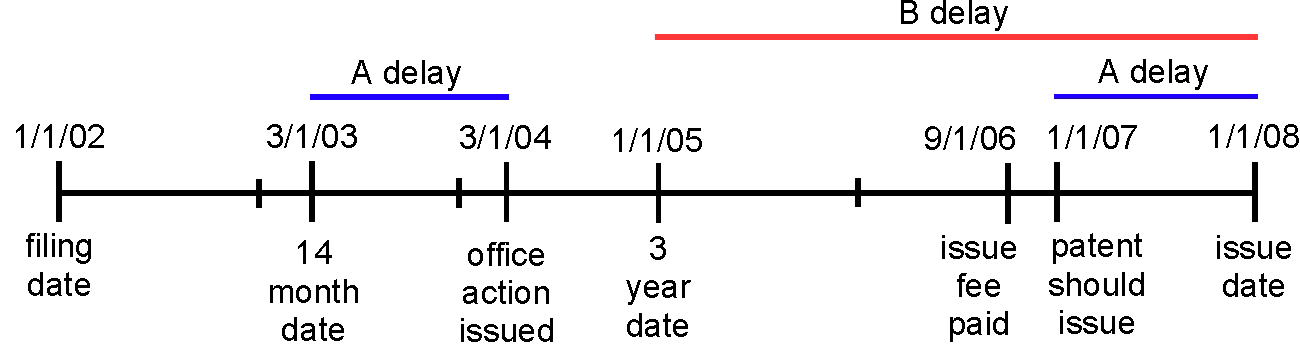
    differences between Wyeth's and the USPTO's perspectives on an exemplary PTA
    calculation can be represented schematically as follows (using the example
    presented in District Judge Robertson's opinion):

    Wyeth v. Dudas - USPTO Timeline
    The
    USPTO's view (shown above):  the
    patentee is entitled to three years of PTA.
    Wyeth v. Dudas - Wyeth Timeline
    Wyeth's
    view (shown above):  the patentee
    is entitled to four years of PTA.

    In
    affirming the District Court's grant of summary judgment for Wyeth, the Federal
    Circuit states:

    This court detects no ambiguity in the
    terms "periods of delay" and "overlap" [of § 154(b)(2)(A)].  Each term has an evident meaning within
    the context of section 154(b).  The
    limitation in section 154(b) only arises when "periods of delay"
    resulting from violations of the three guarantees "overlap."  35 U.S.C. § 154(b)(2)(A).  Significantly, the A and B guarantees
    expressly designate when and for what period they each respectively apply.

    In
    particular, the Court found that "[t]he 'period of delay' for purposes of
    the A clause therefore runs from the date the PTO misses the specified deadline
    to the date (past the deadline) of response to the underlying action," and
    "[t]he 'period of delay' under the express language of the B clause
    therefore runs from the three-year mark after filing until the application issues."

    As
    for the "overlap," the panel states that it is clear that "no
    'overlap' happens unless the violations occur at the same time," adding
    that "[b]efore the three-year mark, no 'overlap' can transpire between the
    A delay and the B delay because the B delay has yet to begin or take any effect."  However, "[u]nder the PTO’s
    strained interpretation, B delay can occur anytime after the application
    is filed," which the Court determined "cannot be reconciled with the
    language of the statute (emphasis by panel).

    While
    the USPTO offered several arguments in defense of its interpretation of the
    statute, the panel found none to be persuasive.  With respect to the Office's double-counting argument (i.e., A delays during the first three
    years of prosecution ultimately lead to B delays after the three-year mark from
    filing), the Court responded that "the statute requires as
    much."  As to the Office's
    suggestion that its statutory interpretation prevents situations in which one patentee
    might receive a windfall adjustment while a similarly positioned patentee might
    receive no adjustment, the Federal Circuit replied that it "perceives
    potential perverse results as well under the PTO's suggested interpretations."  The Court added:

    Regardless of the potential of the
    statute to produce slightly different consequences for applicants in similar
    situations, this court does not take upon itself the role of correcting all
    statutory inequities, even if it could. 
    In the end, the law has put a policy in effect that this court must enforce,
    not criticize or correct.

    The
    panel also found nothing in the legislative history of the statute that would support
    the Office's interpretation, stating that "legislative history — always a
    very dull instrument for extracting the essence of statutory meaning — provides
    no reason to depart from the language of section 154(b)."  Finally, in response to the Office's
    assertion that it was entitled to deference under either Chevron U.S.A., Inc. v. Natural Resources Defense Council, Inc.,
    467 U.S. 837 (1984), or Skidmore v. Swift
    & Co.
    , 323 U.S. 134 (1944), the Court stated that "[b]ecause
    the language of the statute itself controls this case and sets an unambiguous
    rule for overlapping extensions, this court detects no reason to afford special
    deference to the PTO's interpretation."  As a result, the Federal Circuit concluded that:

    Section
    154(b)'s language is clear, unambiguous, and intolerant of the PTO's suggested
    interpretation.  For that reason,
    this court accords no deference to the PTO’s greater-of-A-or-B rubric.

    Wyeth
    v. Kappos
    (Fed. Cir. 2010)

    Panel:
    Circuit Judges Rader, Plager, and Moore
    Opinion
    by Circuit Judge Rader

    For
    additional information regarding this and other related topics, please see:


    "Patent Term Adjustment: 37 C.F.R. § 1.704(b)'s Three-Month Provision,"
    November 17, 2009

    "USPTO Says Some Requests for PTA Reconsideration Are Premature,"
    September 7, 2009

    "Fish & Richardson Catches Error in Patent Office's PTA Calculation,"
    July 30, 2009

    "More § 154(b)(4)(A) Actions Filed against Director," February 8,
    2009

    "Three More Patentees File § 154(b)(4)(A) Actions against Director Dudas,"
    January 12, 2009

    "More Patentees Follow Wyeth's Lead in Seeking Additional PTA,"
    December 3, 2008

    "USPTO to Appeal Wyeth v. Dudas," December 2, 2008

    "Two Patentees Follow Wyeth's Lead in Seeking Additional PTA,"
    November 12, 2008

    "Wyeth v. Dudas (D.D.C. 2008)," October 16, 2008