• By Kevin E. Noonan —

    Broad InstituteOn December 3rd, Junior Party the Broad Institute, Harvard University, and MIT (collectively, Broad) filed its Substantive Preliminary Motion No. 1 in Interference No. 106,133 (which names Sigma-Aldrich as Senior Party), asking the Patent Trial and Appeal Board (PTAB) to substitute the interference Count, pursuant to the provisions of 37 C.F.R. §§ 41.121(a)(1)(i) and 41.208(a)(2).  On March 16th Senior Party Sigma-Aldrich filed its Opposition to Broad's Motion and on April 26th Broad filed its Reply.

    As a reminder, Broad's Proposed Substitute Count takes the "McKelvey" format (comprising in the alternative a claim from one of each Party's applications in interference); the proposed change is in the portion of the Count reciting Broad's claims:

    Proposed Count No. 3 (numbered presumably for consistency with other pending CRISPR-related interferences):

    Sigma-Aldrich Application No. 15/456,204 (as declared)

    or

    Claim 2 of Broad Application No. 16/177,403:

    52.  A method comprising: introducing into, or expressing in, a eukaryotic cell having a DNA molecule,
        (I) a Cas9 protein or one or more nucleotide sequences encoding the Cas9 protein;
        (II) an RNA or one or more nucleotide sequences encoding the RNA, the RNA comprising: (a) a first RNA comprising a first ribonucleotide sequence and a second ribonucleotide sequence, and (b) a second RNA;
    and
        (III) a template polynucleotide;
        wherein, the second RNA forms an RNA duplex with the second ribonucleotide sequence, and
        wherein, in the eukaryotic cell, the first ribonucleotide sequence directs the Cas9 protein to a target sequence of the DNA molecule, whereby the Cas9 cleaves both strands of the DNA  molecule and the cleavage is repaired by integration of the template polynucleotide into the DNA molecule in the eukaryotic cell.

    In proposing this Substitute Count, Broad emphasized Sigma-Aldrich's contentions during prosecution that its invention comprised "cleave + insertion" CRISPR methods in eukaryotic cells which were patentably distinct from embodiments comprising "cleavage only" followed by non-homologous end joining of the cleaved DNA target.  In making this Motion, Broad clearly intended to cabin Broad's claims at risk in the interference to a small subset of those claims.

    In support of its Motion, Broad relied heavily on Sigma-Aldrich's arguments taking substantially the same position in Interference No. 106,132 against Junior Party the University of California, Berkeley; the University of Vienna; and Emmanuelle Charpentier (collectively, "CVC") (see "Sigma-Aldrich Files Substantive Preliminary Motion 1 to Change the Count in Interference No. 106,132"), including arguments Sigma-Aldrich has made regarding the propriety of its claims not being part of other interferences having interfering subject matter limited to "cleavage only" eukaryotic CRISPR methods:

    Sigma is properly not a party to those pending 'cleavage only' interferences because all of Sigma's involved claims are directed solely to the patentably distinct 'cleavage plus integration' technological advance in the art.

    The first argument in Sigma-Aldrich's Opposition asking the Board to deny Broad's Motion No. 1 was procedural, that Claim 52 of U.S. Application No. 16/177,403 (the '403 application) had not been determined to be allowable when Broad filed its motion (complete with a timeline produced from the '403 application's prosecution history).  In addition, Sigma-Aldrich contended "Broad's Claim 52 is exceedingly broad for at least eight reasons" (as well as being properly subject to the first-inventor-to-file requirements under the Leahy-Smith America Invents Act (AIA) and thus ineligible for consideration in an interference).  Sigma-Aldrich also contended that "Broad never even asserts, let alone demonstrates, that 'cleavage plus altering gene expression' is patentably distinct from 'cleavage plus integration by [Homology-Dependent Recombination] HDR'" (in a footnote providing a tally that "[o]f Broad's 461 involved patent claims, 340 claims are directed to 'cleavage plus altering gene expression' (or an analogous recital), 42 claims are directed to insertion of a 'template,' and 8 dependent claims are directed to 'cleavage plus integration by HDR'").  Finally, Sigma-Aldrich asserted that Broad has neglected to "explain how Claim 52 is patentable over Sigma P1."  Citing Louis v. Okada, 2011 Pat. App. 21 LEXIS 24048, at *10 (BPAI May 25, 2011), Sigma-Aldrich contended that a party in an interference must show that there is a genuine need to change the Count and not make a "change for change's sake."

    In its Reply, Broad tells the Board that Sigma-Aldrich's Opposition must fail because the Senior Party did not "meaningfully dispute" any of Broad's three reasons for moving to substitute the Count, particularly with regard to the issue that the Count as declared encompasses two distinct inventions (i.e, "cleavage + altering gene expression" and "cleavage + integration" of heterologous DNA).  Broad defines this scope (of the "commonly-claimed interfering subject matter") as "use of a CRISPR-Cas9 system in a eukaryotic cell to target and cleave both strands of a DNA molecule, with the cleavage being repaired by integrating a donor polynucleotide sequence ("Donor Template Integration")(an interpretation that would liberate most (340) of Broad's claims corresponding to Count 1 of the interference as declared).  Broad's arguments are directed to some degree to the nature of the McKelvey Count itself, wherein distinct aspects of patentably indistinct inventions are combined (the latter characterization forming the core of Broad's dispute).  Broad also argues regarding the similarity between Sigma Claim 31 and claim 18 from an involved CDC patent in the '115 interference (in which Broad mentions in passing it the Board granted them priority).  The Count as declared "[will] work a tremendous injustice" upon Broad should the Board deny its Motion No. 1 and Sigma-Aldrich be deemed entitled to priority on the half of the Count Broad contends it is entitled, the Reply asserts.  Broad also argues that Sigma-Aldrich has not "explain[ed] away" its statements agreeing with the patentable distinction Broad argues exists between the two portions of the McKelvey Count as declared in this interference.  And Broad reiterates its argument that the position Sigma-Aldrich takes in its Opposition is contrary to positions it has taken during ex parte prosecution of its applications-in-interference (including U.S. Application  15/456,204) and in Interference No. 106,132.  Finally, Broad argues that both its dual-molecule and single-molecule proofs will be excluded if the Board maintains Count 1 as declared, the latter set of proofs having been the basis for Broad prevailing in the '115 Interference and hence (according to Broad) be unjust.

    Sigma-Aldrich's procedural arguments are relegated to a shorter portion of the Reply, regarding whether Claim 52 was in condition for allowance and whether the '403 application is entitled to the provisions of the 1952 Patent Act and thus properly within the purview of an interference.  Broad dissects the former argument allegation-by-allegation with regard to what Claim 52 recites.  And regarding the '403 application's status as a pre-AIA application, Broad argues that AIA §§ 3(n)(1) and 3(n)(2) (the statutory basis for Sigma-Aldrich's argument) do not apply to priority claims to a provisional application under 35 U.S.C. § 119(e)(although a fair reading of the statute would appreciate that the basis for the distinctions under the AIA relate to the claims in a pre-AIA priority application and provisional applications have no claims, at least not formally).  And Broad reminds the Board that Sigma-Aldrich attempted to broach this issue in its own Preliminary Motion but the Board denied that request.  On the merits, Broad also contends that any differences between what is disclosed in the '403 application and the priority applications, including the Zhang application, do not satisfy the standard to qualify as new matter and hence prohibit pre-AIA status.  Broad also rejects Sigma-Aldrich's attempts to incorporate arguments by reference from its Oppositions to other Broad Preliminary Motions, understanding these efforts to be a way for Sigma-Aldrich's arguments to exceed the page limit for its Opposition here.  Finally, Broad argues that its Claim 52 is patentable to Broad over Sigma's earliest priority application, U.S. Application No. 61/734,256.

    For all these reasons Broad asks the Board to grant its Preliminary Motion No. 1.

  • CalendarMay 23, 2022 – "Patent Eligibility, Prior Art, Obviousness and Disclosure 2022: Current Trends in Sections 101, 102, 103 and 112" (Practising Law Institute)

    May 24, 2022 – Examination practices and procedural guidance for 35 U.S.C. § 103 obviousness rejections (Part 2) – virtual Instructor-Led Training (vILT) series (U.S. Patent and Trademark Office) – 9:00 am to 11:00 am (ET)

    May 25, 2022 – "The True Cost of IDS: Time, Money, and Your Sanity" (Juristat) – 1:00 pm (ET)

    May 25, 2022 – Examination practices and procedural guidance for 35 U.S.C. § 103 obviousness rejections (Part 2) – virtual Instructor-Led Training (vILT) series (U.S. Patent and Trademark Office) – 1:00 pm to 3:00 pm (ET)

    May 26, 2022 – "A Practical Guide to Litigation Funding" (Woodsford) – 12:00 pm (ET)

    May 26, 2022 – Examination practices and procedural guidance for 35 U.S.C. § 103 obviousness rejections (Part 2) – virtual Instructor-Led Training (vILT) series (U.S. Patent and Trademark Office) – 5:00 pm to 7:00 pm (ET)

    June 2-3, 2022 – Life Sciences Patents (American Conference Institute) – New York

    June 28, 2022 – UPC Masterclass — Session 3: "The UPC Approach to Damages Actions and Compensation Claims" (Hoffmann Eitle)

    June 30, 2022 – UPC Masterclass — Session 3: "The UPC Approach to Damages Actions and Compensation Claims" (Hoffmann Eitle)

    July 8, 2022 – UPC Masterclass — Session 4: "The New Regime on the Revocation of European Patents/ The 'Long-arm Jurisdiction'" (Hoffmann Eitle)

  • PLI #1Practising Law Institute (PLI) will be offering an online program entitled "Patent Eligibility, Prior Art, Obviousness and Disclosure 2022: Current Trends in Sections 101, 102, 103 and 112" on May 23, 2022.  The program is geared to patent lawyers who have some familiarity with existing 35 U.S.C. Sections 101/102/103 and regularly work with the statute in either litigation or patent prosecution.  The course will advance the knowledge of all attendees from their respective starting points and provide new insights into the statute, recent amendments, and case law.  The program will address the following topics:

    • Section 101: What to do?
    • 102 and its dates: Is the "grace period" real?
    • Understanding the "effective filing date" in global terms
    • Analyzing 102 — pre- and post-AIA
    • A comprehensive review of post-KSR 103 via CAFC and PTAB precedent
    • Impact of benefit claims on the prior art date of an "effectively filed" reference and the "effective filing date" of the application being examined

    PLI faculty will offer presentations on the following topics:

    • 35 USC 101: What Can Be Patented in 2022?
    • Section 102 Conditions for Obtaining a Patent; Novelty: Inside and Outside the PTO – Cases and Decisions
    • KSR and 103: Conditions for Obtaining a Patent; Non-Obvious Subject Matter
    • 35 USC 112 Patent Specifications – Decisions on Disclosure and Claiming: Some Case Studies
    • The 102(b) Exceptions to Prior Art Against Patents – Made Simple!

    The registration fee for program is $1,850.  Those interested in registering, can do so here.

  • JuristatJuristat will offer a one-hour webinar entitled "The True Cost of IDS: Time, Money, and Your Sanity" on May 25, 2022 at 1:00 pm (ET).  The webinar will discuss:

    • The benefits of IDS automation
    • How to determine the true cost of IDS prep and filing for your firm
    • How supplementing with AI can improve staff satisfaction and retention rates
    • And tackle some FAQs we hear from clients

    Those interested in registering for the webinar can do so here.

  • WoodsfordWoodsford will be offering a live webinar entitled "A Practical Guide to Litigation Funding" on May 26, 2022 at 12:00 pm (ET).  Russell Tonkovich of Kramer Day, and Alex Lempiner and Robin M. Davis of Woodsford will address a number of common questions raised by those seeking litigation funding, including:

    • What benefits can funding offer?
    • What are the criteria for a case to be eligible for funding?
    • What are the necessary diligence and transactional processes required to secure funding?

    The webinar will also shed some light on these common inquiries by:

    • Providing a brief overview of litigation funding and its benefits
    • Identifying the fundamental criteria of a viable funding opportunity
    • Detailing the mechanics of the funder's underwriting process
    • Examining the principal sections of a litigation funding agreement.

    Those wishing to register for the webinar can do so here.

  • ACIAmerican Conference Institute (ACI) will be holding its 20th Anniversary of its Life Sciences Patents conference on June 2-3, 2022 at the Harvard Club of New York.

    The conference will offer presentations on the following topics:

    • The current state of patent eligibility in view of recent case law and the effect on investment, innovation and efficiency
    • Federal Circuit guidance on written description and enablement
    • Obviousness: statutory, inherent, and obviousness-type double patenting
    • International coordination of global patent portfolios
    • Retrospective understanding of efficiency and success
    • Ethical considerations for life sciences patenting
    • Practical insights into exemptions, extensions, and carve-outs
    • Drug price regulation and relevance of patent law
    • Cannabis and psychedelics: IP and regulatory challenges in the US and abroad
    • Strengthening CRISPR patent portfolios
    • Digital health, artificial intelligence, and data mining: the role of high tech in life sciences patents
    • Diversity, equity, inclusion, and implicit bias in IP: promoting bias-reducing strategies

    There will also be a keynote address by Vice Chief Administrative Judge, Hon. Jacqueline Wright-Bonilla.

    The registration fee for the conference is $2,395.  There is a live-stream option costing $2,095 and an on-demand option at $1,095 (although not all sessions may be available). Patent Docs readers are entitled to a 10% discount off of registration using discount code D10-762-762EX03.  Those interested in registering for the conference can do so here, by e-mailing CustomerService@AmericanConference.com, or by calling 1-888-224-2480.

    Patent Docs is a media partner of ACI's 20th Anniversary Life Sciences Patents Conference.

  • By Kevin E. Noonan —

    Sigma-AldrichOn December 3rd, Senior Party Sigma-Aldrich filed its Preliminary Motion No. 1 that asked the Board to deny the Broad Institute, Harvard University, and MIT (collectively, Broad) benefit of its U.S. Provisional Application No. 61/736,527, filed December 12, 2012 (termed "P1"), pursuant to 37 C.F.R. § 41.121(a)(1) and S.O. ¶¶ 121 and 208.4.2.  On March 16th, Broad filed its Opposition, and on April 26th, Sigma-Aldrich filed its Reply.

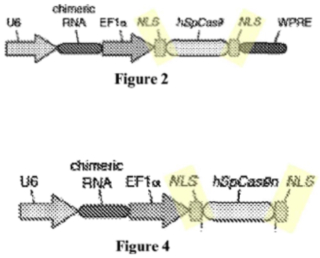
    The basis for Sigma-Aldrich's Motion was that Broad's P1 application did not disclose a constructive reduction to practice of an embodiment within the scope of the Count of the interference as declared.  Sigma-Aldrich specifically contended that the P1 application does not show that Broad's inventors had achieved a CRISPR-Cas9 system that cleaved a targeted DNA molecule and altered the expression of the gene product of that cleaved molecule.  Sigma-Aldrich argued that Broad merely identified the existence of CRISPR-mediated DNA cleavage in a eukaryotic cell and did not establish changes in gene expression as a result of such cleavage.  Sigma-Aldrich further argued that Broad's P1 application did not disclose introducing Cas9 protein into a eukaryotic cell with only one linked nuclear localization signal ("NLS") that resulted in CRISPR-mediated gene editing, Sigma-Aldrich asserting that all of the P1 disclosure involved Cas9 modified with 2 NLS sequences, as illustrated by Figures from that application:

    Image 1

    Image 2
    In its Opposition, Broad first asked the Board to dismiss Sigma-Aldrich's Motion for being moot should the Board grant Broad’s Motion No 1 to change the Count.  On the merits, Broad argued that it was within the skill of the ordinary artisan to alter gene expression in eukaryotic cells in light of prior art methods, specifically zinc-finger nucleases ("ZFNs") and transcription activator-like effector nucleases ("TALENs").  The distinction that CRISPR provided was that it is a system that could be "easily  and quickly designed, in practice, to specifically modify any sequence of any genome; having more than one technology available will help achieve this goal" (emphasis added), and that once its inventors had reduced eukaryotic cell CRISPR to practice they provided the capacity to alter gene expression as well.  Broad also argued that the Board should grant Sigma-Aldrich's Motion No. 1 only if it establishes that P1 does not show possession of either half of the Count of this interference as declared, pursuant to 37 C.F.R. §§ 41.121(b), 41.208(b); S.O. ¶ 121.3; Bd.R. 201; and S.O. ¶ 208.4.2.  But of course Broad argued the Board should not do so, because (in a recurrent theme) P1 disclosed "a eukaryotic CRISPR-Cas9 system capable of programmable, generalizable, site-specific DNA cleavage, including for both donor template integration (which can be used for inserting sequences into the DNA) and multiplexing (introducing multiple concurrent breaks in DNA to cause large deletions)."  But Broad's definition of the term "altering gene expression" included altering the sequence of the gene, whereas Sigma-Aldrich contended that the term meant altering gene expression levels.  Broad asserted that the term "altering gene expression" should be not limited to changing gene expression levels, which Broad contends is "an overly narrow and erroneous understanding of what altering expression means" under a broadest reasonable interpretation standard.  Finally, Broad contended that P1 disclosed embodiments falling within the "other half" of the McKelvey Count, relating to Cas9 specific having a single nuclear localization sequences (NLS).

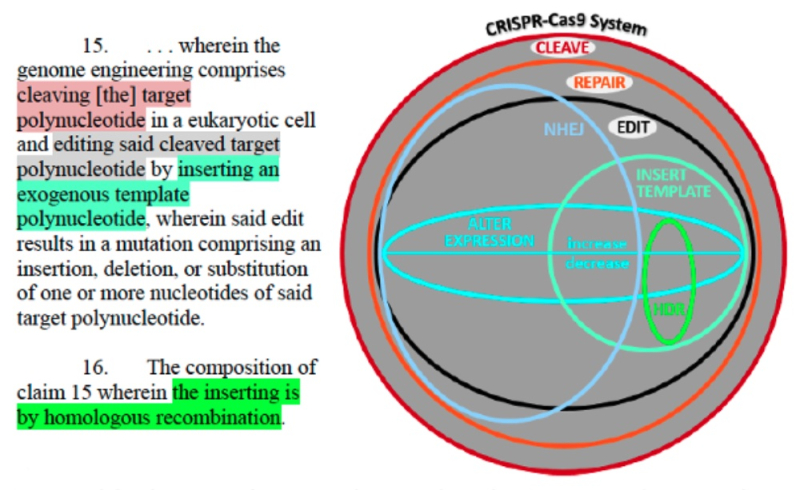
    In its Reply, Sigma-Aldrich begins by stating that Broad has not refuted its argument that the P1 application is limited to disclosing altering the sequence of a target gene, and that Broad cited to no disclosure expressly relating to altering gene expression (making this definitional dispute a focus for the Board's consideration).  Sigma-Aldrich asserts Broad's is an inherent disclosure position, and that there is no basis for the Board to consider altering a target gene sequence to be equivalent to altering gene expression (except for the fact that altering a gene sequence could be considered to reduce gene expression of the unaltered gene to zero and creating de novo expression of the sequence-altered gene).  Sigma-Aldrich characterizes the Broad arguments in this regard as "hand-waiving and conclusory assumptions."  Sigma-Aldrich cites Broad's arguments in earlier Interferences Nos. 105,048 and 106,115 "acknowledging and affirmatively arguing" that "altering gene expression" is an affirmative limitation and, in any event, the phrase is limiting because it imparts a further functional requirement on the Count, illustrating this point colorfully using Broad’s claims as an example:

    Image 3
    The brief further illustrates the effect of this limitation graphically:

    Image 4
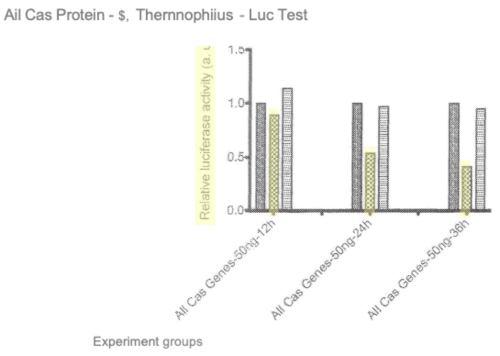
    Further, Sigma-Aldrich notes that Broad argued in the '115 Interference that P1 disclosed CRISPR cleavage and not altered gene expression, raising an inconsistency in Broad's position if not an explicit estoppel (in light of the fact that Broad has also taken the position that the Board should rely on its Decision on Priority in Broad’s favor in the '115 Interference in this interference.  Also in this regard Sigma-Aldrich argues that the distinction it is drawing in this interference between altering gene sequence and gene expression is one Broad made in the P1 application.  Sigma-Aldrich then turns to prosecution history of Broad patents, in particular U.S. Patent No 8,697,359, to support the distinction it is drawing between altering gene sequence and altering gene expression, reproducing one such argument and supporting graphical data:

    Image 5
    illustrating a reduction in luciferase activity.  Sigma-Aldrich also argues that the plain and ordinary meaning of the phase "altering gene expression" means just that (changing gene expression levels) and does not encompass merely altering a sequence.  Sigma-Aldrich follows these arguments with others, amounting in total over a dozen instances where the term "altering gene expression levels" makes the distinction is argues here with altering gene sequence.  While acknowledging that Broad's patents and applications contain conventional "boilerplate" disclosure comprising "laundry lists" of methods for detecting alterations in gene expression levels Sigma-Aldrich asserts that "Broad P1 nowhere conducts any of those well-known and conventional analyses to evaluate gene product expression" and "never even mentions altering expression of a gene product."

    Turning to the NLS element of the Count, Sigma-Aldrich argues that Broad is asserting "fictitious embodiments" and that Broad’s attempt to "mix and match" different embodiments between one- and two-NLS embodiments do not anticipate Sigma-Aldrich's Claim 31 (noting that Broad criticized CVC for making similar arguments in the '115 Interference) and that "a single NLA does not anticipate [constructs comprising] 2 NLSs."

  • By Kevin E. Noonan —

    University of California-BerkleyPursuant to the Patent Trial and Appeal Board Order issued November 29, 2021, Junior Party the University of California, Berkeley; the University of Vienna; and Emmanuelle Charpentier (collectively, "CVC") on December 17, 2021 filed its Responsive Preliminary Motion No. 1 in Interference No. 106,132 (which names Sigma-Aldrich as Senior Party), asking the Board for benefit of priority to U.S. Provisional Application No. 61/652,086, filed May 25, 2012 ("P1"), or in the alternative either U.S. Provisional Application No. 61/716,256, filed October 19, 2012 ("P2"); U.S. Provisional Application No. 61/757,640, filed January 28, 2013 ("P3"); U.S. Application No. 13/842,859, filed March 15, 2013; U.S. Application No. 14/685,504, filed April 13, 2015; or U.S. Application No. 15/138,604, filed April 26, 2016, pursuant to 37 C.F.R. §§ 41.121(a)(1)(ii) and 41.208(a)(3) and Standing Order ¶ 208.4.1, contingent on the Board granting Sigma-Aldrich's Substantive Preliminary Motion No. 1 to Substitute the Count.  Sigma-Aldrich filed its Opposition to this Motion on February 18th and CVC filed its Reply on April 7th.

    The relationships between the patents and applications in the '132 interference are set forth in this chart (filed in CVC's earlier preliminary motion in Interference No. 106,115):

    Image 1
    The significance of the Board granting this motion with regard to the P1 or P2 provisional applications would be that CVC would be Senior Party, with all the presumptions benefitting Senior Party status.

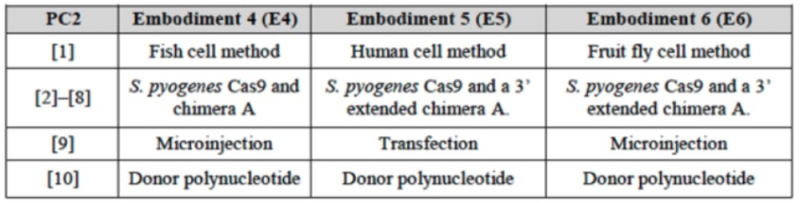
    CVC has filed similar motions in earlier Interferences (in the '115 Interference and in Interference No. 106,127) without (at least complete) success (as to the '115 Interference; the Board has not yet ruled on the corresponding motion in the '127 Interference) and in this Interference with regard to the Count as declared.  Unlike in each of these cases, however, in this Responsive Motion CVC sought priority benefit to the earliest of its priority documents which focuses the argument to what was disclosed therein.  Specifically, the brief referenced the disclosure for using sgRNA in a pre-assembled ribonucleoprotein complex with Cas9 microinjected into fish embryos, human cells, and fruit fly cells that produced double-stranded breaks at specific target sequences followed by homology-directed repair using endogenous cellular machinery.  Because these functions comprise the elements of CRISPR as recited in Sigma-Aldrich's Proposed Substitute Count, CVC argued they are entitled to P1's May 26, 2012 priority date (or in the alternative the filing dates of the P2, P3, or other utility applications set forth in the brief).

    The brief set forth arguments falling in line with its arguments for priority in each of the Interferences involving CRISPR where it has been a (always Junior) Party, that its disclosures were sufficient in the absence of an actual reduction to practice to be entitled to priority benefit as a constructive reduction to practice under the legal requirements (i.e., describing one embodiment falling within the scope of the Count; Falkner v. Inglis, 448 F.3d 1357, 1362 (Fed. Cir. 2006)) as understood by one of ordinary skill in the art.  These disclosures CVC relied upon include the level of skill in the art at the priority date, specifically with regard to ZFN- and TALEN-mediated methods for site-specific DNA cleavage in eukaryotic cells, as models for CRISPR-Cas9 mediated cleavage.  In making these arguments, CVC disparages (gently) the Board's decision in the '115 Interference granting their Preliminary Motion No. 1 only in part (i.e., to confer priority benefit to their P3 provisional application only).  The brief contained a chart showing correspondence between 10 elements of the proposed substitute count and the three embodiments CVC argued were disclosed in the priority applications corresponding thereto:

    Table 1
    The brief then set forth the details of this correspondence for each of these embodiments as disclosed in the P1 specification (following the same template for this argument regarding the P1 disclosure that CVC had used in similar Motions in other Interferences, for both written description and enablement), stating "[i]n light of general knowledge in the art and the POSA's high degree of skill, P1 conveys possession of at least one embodiment within the scope of PC2 and all the detail needed to practice it."

    In its Opposition, Sigma-Aldrich followed a pattern of argument used in its Opposition to CVC's Motion No. 1 for priority benefit for these three provisional applications regarding the Count as declared in the '132 Interference.  (In a footnote the brief asserted that Sigma-Aldrich is not opposing CVC's request for priority benefit for U.S. Application Nos. 13/842,859; 14/685,504; or 15/138,604, all of which have later filing dates than CVC's P3 application.)  Initially however, Sigma-Aldrich argued that Responsive Motion No. 1 is redundant over CVC Preliminary Motion No. 1.  On the merits, CVC failed to adequately describe or enable in these applications the invention described in the Substitute Count, according to Sigma-Aldrich, for the reasons set forth in its Opposition to CVC's Motion No. 1 (supported by expert testimony).  Sigma-Aldrich pointed out that both CVC Claim 164 and Sigma-Aldrich Claim 31 (comprising together their proposed Substitute Count) affirmatively recite a limitation regarding repair of a CRISPR-induced double strand break by a "homology-directed repair mechanism/process."  But none of the P1, P2, or P3 applications describe or enable an embodiment within the scope of Sigma-Aldrich's Proposed Substitute Count 2 according to the Opposition brief.
    The Opposition then set forth the basis for its assertion that this Motion is redundant over CVC Motion No. 1 and Sigma-Aldrich's Motion No. 1, and in detail why the three priority applications at issue do not satisfy the requirement for priority benefit (following the arguments in Sigma-Aldrich's Opposition to CVC's Motion No. 1).  Sigma-Aldrich contended that "the proper place for CVC to argue why CVC should, in its view, receive the priority benefit of CVC P3 for Sigma Proposed Count 2 is in CVC's opposition to Sigma Motion 1, not in a wholly separate responsive motion."  Sigma-Aldrich characterized CVC's filing of Responsive Motion No. 1 as "essentially an improper procedural maneuver to skirt the Board's page limits for motions" (which Sigma-Aldrich asserted was "surprising" in view of the Board granting CVC an increased page limit of 45 pages for its Motion No 1).  Much of the remainder of the Opposition is a reiteration of the arguments Sigma-Aldrich made in its Opposition to CVC Motion No. 1 and its own Motion No. 1.  And with regard to the three later-filed applications about which Sigma-Aldrich is not contesting CVC's priority benefit request the Opposition stated that it was:

    [B]ased on basic procedural considerations for patent interference proceedings, not for substantive reasons.  Because the Board has repeatedly admonished practitioners that patent interferences are fundamentally priority contests, a motion challenging patentability would typically not be authorized absent a showing that such a motion would challenge every involved claim.  See CVC v. Broad, Int'f No. 106,115, Decision on Motions at 7 (PTAB Aug. 26, 2019) ("Authorization for a proposed motion regarding unpatentability under 35 U.S.C. § 112 is DENIED because it will not further the inquiry into priority of invention of a count.  This ground[] of unpatentability would not address all of CVC's claims and, therefore, even if decided in favor of Broad, would not be dispositive of the interference.").

    In this case, according to the Opposition, the involved applications in this interference constitute 412 claims, which Sigma-Aldrich termed "a daunting endeavor" for challenging patentability for sheer volume.  While "all of CVC's involved claims likely suffer from written description deficiencies," Sigma-Aldrich stated, it had concluded that reasons of efficiency counseled that "those issues [were] better left for another day."

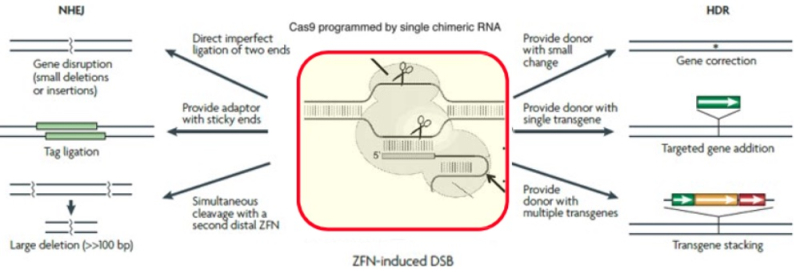
    Unique to Sigma-Aldrich's Opposition argument is a comparison between Figure 4 in CVC's provisional applications:

    Image 2
    with a diagram from a 2010 Urnov reference directed to zinc-finger nuclease (ZFN) cleavage:

    Image 3
    (a comparison supporting Sigma-Aldrich's argument that CVC's disclosure was "simply speculat[ion].")

    The Opposition concluded with a long litany of contemporaneous statements supporting Sigma-Aldrich's position that CRISPR-mediated HDR was thought to be "unpredictable," "[not] controllable," and plagued by eukaryotic cell-specific difficulties that exist even at the present time and, on this basis, required more disclosure than was in any of CVC's P1, P2, or P3 provisional applications.

    CVC's Reply reiterates it position that P1, P2, and P3 provisionals satisfy the requirements for providing a constructive reduction to practice, because the "level of ordinary skill in the art was high," based on the evidence that "numerous independent groups successfully and near-simultaneously demonstrated the claimed invention," and that a "POSA reading P1 would have immediately understood P1 explains how to apply the system in a fish cell (E4), human cell (E5), and fruit-fly cell (E6) using the well-known molecular biology techniques P1 described."  Their disclosure did not require a working example or to "dispel hypothetical [or "fabricated, post-hoc"] concerns posited by Sigma" (addressing them if not overcoming all of them specifically in the Reply).  The Reply then repeats the arguments from its Motion regarding what the P1 (and P2 and P3) applications disclose and that this would have been sufficient to satisfy the constructive reduction to practice requirements needed to entitle benefit of priority to Sigma-Aldrich's proposed Substitute Count.  And CVC reiterates its arguments that the Board was wrong in deciding against its similar motion for priority in the '115 Interference (see "PTAB Denies Broad Motion No. 2 to Substitute the Interference Count"), and it is not controlling here, and was also incorrect (indeed, it's decision "has no relevance") in deciding that interference by granting priority to Senior Party Broad (see "PTAB Holds for Broad in CRISPR Interference: The Reasoning").  Finally, CVC defends the propriety of filing Responsive Motion No. 1, in the face of its own Substantive Motion No. 1 and Sigma-Aldrich's Motion No. 1, because CVC's Substantive Motion was directed at priority benefit for Count 1 while its Responsive Motion is directed at Count 2.

    CVC thus asks the Board for priority benefit to the P1 application or alternatively "P2/P3."

  • By Kevin E. Noonan —

    University of California-BerkleyOn November 19th, Junior Party the University of California, Berkeley; the University of Vienna; and Emmanuelle Charpentier (collectively, "CVC") filed Substantive Preliminary Motion No. 4* in Interference No. 106,132, wherein CVC moved to add Senior Party Sigma-Aldrich's U.S. Patent Nos. 10,731,181 and 10,745,716 to the interference and designate claims 1-17 of the '181 patent and claims 2-4, 11, 14, 21, and 22 of the '716 patent as corresponding to the Count, pursuant to 37 C.F.R. §§ 41.121(a)(1)(i) and 41.208(a)(2) and Standing Order ("SO") 203.2.  On February 18th, Senior Party Sigma-Aldrich filed its Opposition to this Motion and on April 7th CVC filed its Reply.

    The basis for CVC's Motion No. 4 was that these claims would have been obvious over Count 1 and the Jinek 2012 reference (Jinek et al., 2012, "A Programmable Dual-RNA–Guided DNA Endonuclease in Adaptive Bacterial Immunity," Science 337(6096): 816-21) in light of the Krebber 2000 reference (Krebber and Silver, 2000, "Directing Proteins to Nucleus by Fusion to Nuclear Localization Signal Tags," Methods in Enzymology 327: 283-96) or the Lange 2007 reference (Lange, 2007, "Classical Nuclear Localization Signals: Definition, Function, and Interaction with Importin α," J. Biol. Chem. 282(8): 5101–05).  CVC identified what it characterized as only "nominal differences" between the Count and the claims to be designated in these two patents as "the recitation of the well-established Cas9 protein (from S. pyogenes), a well-known nuclear localization signal (a C-terminal SV40 NLS), and the natural and previously disclosed location for the DNA-targeting region (at the 5' end of the guide RNA)."  None of these differences rendered these claims patentably distinct from the Count, CVC argued, as evidenced by "highly similar claims already being involved in this proceeding as part of Sigma's U.S. Application No. 15/456,204."  These claims satisfy the test set forth under 37 C.F.R. § 41.207(b)(2) and Standing Order ¶ 208.3.1 that claims correspond to the Count where "the subject matter of the count, if treated as prior art, would have anticipated or rendered obvious the subject matter of [each] claim."  This test is satisfied if additional references are relied upon to make out a prima facie case of obviousness CVC argued, citing Desjardins v Wax, Interference No. 105,915, Paper 125, 17-20 (P.T.A.B. Jan. 21, 2014).  The basis for CVC's argument that the distinctions set forth above do not render these clams patentably distinct was that these distinctions are found in the cited prior art or were otherwise "well known," the brief setting forth reasons for the Board to reach this conclusion.  Finally, CVC argued there are no objective indicia (or secondary considerations) that would provide the missing distinctions.

    Sigma-Aldrich's Opposition contended that CVC failed to apply the proper "two-way test" for determining whether a claim corresponds to an interference Count.  Sigma-Aldrich cited a decision from the PTAB's predecessor, the Board of Patent Appeals and Interferences, for the definition of "the same patentable invention" as requiring a "two-way obviousness test," citing Winter v. Fujita, 1999 Pat. App. LEXIS 7, *49-50, 53 U.S.P.Q.2d (BNA) 1234, 1248 (BPAI Nov. 16, 1999).  Noting that the rules for patent interferences were changed in 2004, Sigma-Aldrich sets forth the current rules and illustrated application of these rules in Ledenev v. Adest, 2020 Pat. App. LEXIS 6912, *35-36, Decision on Motions, at 31, 35 (PTAB Mar. 25, 2020) (JTM) (in moving to add patents to an interference, "[t]he standard to be applied is whether the claim is patentably distinct from the Count . . . .  [T]he burden placed upon movant [is] to compare the claims to the count in the required two-way analysis.").  Sigma-Aldrich also noted (in a footnote) in this regard that "[t]he authority cited by CVC [37 C.F.R. § 41.207(b)(2) ("Claim correspondence"); Standing Order 208.3.1 ("Claim correspondence")] is directed to the analysis of whether a claim of an already involved patent or application corresponds to the interference count."  Such a one-way test would be appropriate, Sigma-Aldrich argued, only for showing claim correspondence to an interference Count for claims of an already-involved patent or application.  Sigma-Aldrich further argued in this regard that what CVC set forth in its Motion No. 4 is whether the narrower interference Count would render obvious the '181 or '716 patent claims.  What CVC failed to do was the converse assessment, whether "the broader claim render[s] obvious the narrower Count" (emphasis in brief) according to Sigma-Aldrich.  Finally, Sigma-Aldrich contended that CVC's Motion No. 4 would become moot should the Board grant its Preliminary Motion No. 1 to change the Count.

    In its Reply, CVC justified its reliance on the one-way analysis for claim correspondence on 37 C.F.R. § 41.207(b)(2), which CVC contends is used by the Board in deciding to add a claim to an existing interference, citing Ledenev v. Adest, No. 106,112, Paper 137, Decision on Motions, at 30 (P.T.A.B. Mar. 25, 2020) and Ritzberger v. Durschang, No. 106,012, Paper 210, Decision on Priority and Other Motions, at 17-25 (P.T.A.B. Sept. 29, 2016).  Moreover, according to CVC, Sigma-Aldrich relies on outdated interference rules (37 C.F.R. § 1.642 (2004)) and authority relying on those rules, Winter v. Fujita.  With regard to Sigma-Aldrich's citation of more current rules, § 41.202(a), § 41.203(a), and § 41.203(d), CVC argues (somewhat curiously) that "[n]o matter what these rules state, Ledenev and Ritzberger both applied a one-way count vs. claim analysis under Rule 41.207(b)(2) when deciding motions to add a patent to an interference" (emphasis added), albeit further stating that "[t]he PTAB's analysis in these cases was correct and dictated by the only logical reading of the rules Sigma cites."  The brief goes on to explicate for the Board why the Board's reasoning was "the only logical reading" of these rules.

    Having set forth the propriety of the one-way test under the rules as the Board construed them under Ledenev and Ritzberger, CVC then recounts how in its motion it applied the rules to the claims at issue in this motion.  Regarding Sigma-Aldrich's attempt to distinguish these claims with regard to "Element 13" CVC argues that Sigma-Aldrich admits that this element is limited to HDR, which is found as a limitation in its "half" of the McKelvey Count in the interference.  And even if the Board grants Sigma-Aldrich's Motion No. 1 to substitute the Count CVC argues that because this substitute count contains Sigma-Aldrich's portion of the count these claims would satisfy the proper, one-way test.

    Finally, CVC rebuts Sigma-Aldrich's assertion that this motion would become moot should the Board grant Sigma-Aldrich's Motion No. 1 to substitute the Count, by saying that should the Board grant that motion and redeclare the interference these claims should be designated as corresponding to the Count ab initio.

    For all these reasons CVC asks the Board to grant its Motion No. 4.

    * CVC captioned this as a Miscellaneous Motion.

  • CalendarMay 17, 2022 – "Are you Prepared for the Unified Patent Court?" (J A Kemp) – 16:00 pm to 17:00 pm (GMT)

    May 17, 2022 – "Patent Term Extensions in Emerging Markets" (Moeller IP) – 12:30 pm (ET)

    May 17, 2022 – "IP Ethics Semi-Annual Review" (Intellectual Property Owners Association) – 1:00 pm (ET)

    May 18, 2022 – Asian American and Native Hawaiian/Pacific Islander Innovation and Entrepreneurship program (U.S. Patent and Trademark Office) – 2:00 pm to 3:30 pm (ET)

    May 17, 2022 – UPC Masterclass — Session 2: "Inspection and Evidence Proceedings/Double Protection and the Strategic Implications under the UPC System" (Hoffmann Eitle)

    May 18, 2022 – Asian American and Native Hawaiian/Pacific Islander Innovation and Entrepreneurship program (U.S. Patent and Trademark Office) – 2:00 pm to 3:30 pm (ET)

    May 18, 2022 – UPC Masterclass — Session 2: "Inspection and Evidence Proceedings/Double Protection and the Strategic Implications under the UPC System" (Hoffmann Eitle)

    May 19, 2022 – "Evolving Case Law: Approaching Apportionment in Reasonable Royalty Damages" (Fox Forensic Accounting) – 1:00 pm (ET)

    May 24, 2022 – Examination practices and procedural guidance for 35 U.S.C. § 103 obviousness rejections (Part 2) – virtual Instructor-Led Training (vILT) series (U.S. Patent and Trademark Office) – 9:00 am to 11:00 am (ET)

    May 25, 2022 – Examination practices and procedural guidance for 35 U.S.C. § 103 obviousness rejections (Part 2) – virtual Instructor-Led Training (vILT) series (U.S. Patent and Trademark Office) – 1:00 pm to 3:00 pm (ET)

    May 26, 2022 – Examination practices and procedural guidance for 35 U.S.C. § 103 obviousness rejections (Part 2) – virtual Instructor-Led Training (vILT) series (U.S. Patent and Trademark Office) – 5:00 pm to 7:00 pm (ET)

    June 28, 2022 – UPC Masterclass — Session 3: "The UPC Approach to Damages Actions and Compensation Claims" (Hoffmann Eitle)

    June 30, 2022 – UPC Masterclass — Session 3: "The UPC Approach to Damages Actions and Compensation Claims" (Hoffmann Eitle)

    July 8, 2022 – UPC Masterclass — Session 4: "The New Regime on the Revocation of European Patents/ The 'Long-arm Jurisdiction'" (Hoffmann Eitle)