• By Kevin E. Noonan

    University of California-BerkleyOn November 19th, Junior Party the University of California, Berkeley; the University of Vienna; and Emmanuelle Charpentier (collectively, "CVC") filed Substantive Preliminary Motion No. 4* in Interference No. 106,132, wherein CVC moved to add Senior Party Sigma-Aldrich's U.S. Patent Nos. 10,731,181 and 10,745,716 to the interference and designate claims 1-17 of the '181 patent and claims 2-4, 11, 14, 21, and 22 of the '716 patent as corresponding to the Count, pursuant to 37 C.F.R. §§ 41.121(a)(1)(i) and 41.208(a)(2) and Standing Order ("SO") 203.2.  On February 18th, Senior Party Sigma-Aldrich filed its Opposition to this Motion and on April 7th CVC filed its Reply.

    The basis for CVC's Motion No. 4 was that these claims would have been obvious over Count 1 and the Jinek 2012 reference (Jinek et al., 2012, "A Programmable Dual-RNA–Guided DNA Endonuclease in Adaptive Bacterial Immunity," Science 337(6096): 816-21) in light of the Krebber 2000 reference (Krebber and Silver, 2000, "Directing Proteins to Nucleus by Fusion to Nuclear Localization Signal Tags," Methods in Enzymology 327: 283-96) or the Lange 2007 reference (Lange, 2007, "Classical Nuclear Localization Signals: Definition, Function, and Interaction with Importin α," J. Biol. Chem. 282(8): 5101–05).  CVC identified what it characterized as only "nominal differences" between the Count and the claims to be designated in these two patents as "the recitation of the well-established Cas9 protein (from S. pyogenes), a well-known nuclear localization signal (a C-terminal SV40 NLS), and the natural and previously disclosed location for the DNA-targeting region (at the 5' end of the guide RNA)."  None of these differences rendered these claims patentably distinct from the Count, CVC argued, as evidenced by "highly similar claims already being involved in this proceeding as part of Sigma's U.S. Application No. 15/456,204."  These claims satisfy the test set forth under 37 C.F.R. § 41.207(b)(2) and Standing Order ¶ 208.3.1 that claims correspond to the Count where "the subject matter of the count, if treated as prior art, would have anticipated or rendered obvious the subject matter of [each] claim."  This test is satisfied if additional references are relied upon to make out a prima facie case of obviousness CVC argued, citing Desjardins v Wax, Interference No. 105,915, Paper 125, 17-20 (P.T.A.B. Jan. 21, 2014).  The basis for CVC's argument that the distinctions set forth above do not render these clams patentably distinct was that these distinctions are found in the cited prior art or were otherwise "well known," the brief setting forth reasons for the Board to reach this conclusion.  Finally, CVC argued there are no objective indicia (or secondary considerations) that would provide the missing distinctions.

    Sigma-Aldrich's Opposition contended that CVC failed to apply the proper "two-way test" for determining whether a claim corresponds to an interference Count.  Sigma-Aldrich cited a decision from the PTAB's predecessor, the Board of Patent Appeals and Interferences, for the definition of "the same patentable invention" as requiring a "two-way obviousness test," citing Winter v. Fujita, 1999 Pat. App. LEXIS 7, *49-50, 53 U.S.P.Q.2d (BNA) 1234, 1248 (BPAI Nov. 16, 1999).  Noting that the rules for patent interferences were changed in 2004, Sigma-Aldrich sets forth the current rules and illustrated application of these rules in Ledenev v. Adest, 2020 Pat. App. LEXIS 6912, *35-36, Decision on Motions, at 31, 35 (PTAB Mar. 25, 2020) (JTM) (in moving to add patents to an interference, "[t]he standard to be applied is whether the claim is patentably distinct from the Count . . . .  [T]he burden placed upon movant [is] to compare the claims to the count in the required two-way analysis.").  Sigma-Aldrich also noted (in a footnote) in this regard that "[t]he authority cited by CVC [37 C.F.R. § 41.207(b)(2) ("Claim correspondence"); Standing Order 208.3.1 ("Claim correspondence")] is directed to the analysis of whether a claim of an already involved patent or application corresponds to the interference count."  Such a one-way test would be appropriate, Sigma-Aldrich argued, only for showing claim correspondence to an interference Count for claims of an already-involved patent or application.  Sigma-Aldrich further argued in this regard that what CVC set forth in its Motion No. 4 is whether the narrower interference Count would render obvious the '181 or '716 patent claims.  What CVC failed to do was the converse assessment, whether "the broader claim render[s] obvious the narrower Count" (emphasis in brief) according to Sigma-Aldrich.  Finally, Sigma-Aldrich contended that CVC's Motion No. 4 would become moot should the Board grant its Preliminary Motion No. 1 to change the Count.

    In its Reply, CVC justified its reliance on the one-way analysis for claim correspondence on 37 C.F.R. § 41.207(b)(2), which CVC contends is used by the Board in deciding to add a claim to an existing interference, citing Ledenev v. Adest, No. 106,112, Paper 137, Decision on Motions, at 30 (P.T.A.B. Mar. 25, 2020) and Ritzberger v. Durschang, No. 106,012, Paper 210, Decision on Priority and Other Motions, at 17-25 (P.T.A.B. Sept. 29, 2016).  Moreover, according to CVC, Sigma-Aldrich relies on outdated interference rules (37 C.F.R. § 1.642 (2004)) and authority relying on those rules, Winter v. Fujita.  With regard to Sigma-Aldrich's citation of more current rules, § 41.202(a), § 41.203(a), and § 41.203(d), CVC argues (somewhat curiously) that "[n]o matter what these rules state, Ledenev and Ritzberger both applied a one-way count vs. claim analysis under Rule 41.207(b)(2) when deciding motions to add a patent to an interference" (emphasis added), albeit further stating that "[t]he PTAB's analysis in these cases was correct and dictated by the only logical reading of the rules Sigma cites."  The brief goes on to explicate for the Board why the Board's reasoning was "the only logical reading" of these rules.

    Having set forth the propriety of the one-way test under the rules as the Board construed them under Ledenev and Ritzberger, CVC then recounts how in its motion it applied the rules to the claims at issue in this motion.  Regarding Sigma-Aldrich's attempt to distinguish these claims with regard to "Element 13" CVC argues that Sigma-Aldrich admits that this element is limited to HDR, which is found as a limitation in its "half" of the McKelvey Count in the interference.  And even if the Board grants Sigma-Aldrich's Motion No. 1 to substitute the Count CVC argues that because this substitute count contains Sigma-Aldrich's portion of the count these claims would satisfy the proper, one-way test.

    Finally, CVC rebuts Sigma-Aldrich's assertion that this motion would become moot should the Board grant Sigma-Aldrich's Motion No. 1 to substitute the Count, by saying that should the Board grant that motion and redeclare the interference these claims should be designated as corresponding to the Count ab initio.

    For all these reasons CVC asks the Board to grant its Motion No. 4.

    * CVC captioned this as a Miscellaneous Motion.

  • CalendarMay 17, 2022 – "Are you Prepared for the Unified Patent Court?" (J A Kemp) – 16:00 pm to 17:00 pm (GMT)

    May 17, 2022 – "Patent Term Extensions in Emerging Markets" (Moeller IP) – 12:30 pm (ET)

    May 17, 2022 – "IP Ethics Semi-Annual Review" (Intellectual Property Owners Association) – 1:00 pm (ET)

    May 18, 2022 – Asian American and Native Hawaiian/Pacific Islander Innovation and Entrepreneurship program (U.S. Patent and Trademark Office) – 2:00 pm to 3:30 pm (ET)

    May 17, 2022 – UPC Masterclass — Session 2: "Inspection and Evidence Proceedings/Double Protection and the Strategic Implications under the UPC System" (Hoffmann Eitle)

    May 18, 2022 – Asian American and Native Hawaiian/Pacific Islander Innovation and Entrepreneurship program (U.S. Patent and Trademark Office) – 2:00 pm to 3:30 pm (ET)

    May 18, 2022 – UPC Masterclass — Session 2: "Inspection and Evidence Proceedings/Double Protection and the Strategic Implications under the UPC System" (Hoffmann Eitle)

    May 19, 2022 – "Evolving Case Law: Approaching Apportionment in Reasonable Royalty Damages" (Fox Forensic Accounting) – 1:00 pm (ET)

    May 24, 2022 – Examination practices and procedural guidance for 35 U.S.C. § 103 obviousness rejections (Part 2) – virtual Instructor-Led Training (vILT) series (U.S. Patent and Trademark Office) – 9:00 am to 11:00 am (ET)

    May 25, 2022 – Examination practices and procedural guidance for 35 U.S.C. § 103 obviousness rejections (Part 2) – virtual Instructor-Led Training (vILT) series (U.S. Patent and Trademark Office) – 1:00 pm to 3:00 pm (ET)

    May 26, 2022 – Examination practices and procedural guidance for 35 U.S.C. § 103 obviousness rejections (Part 2) – virtual Instructor-Led Training (vILT) series (U.S. Patent and Trademark Office) – 5:00 pm to 7:00 pm (ET)

    June 28, 2022 – UPC Masterclass — Session 3: "The UPC Approach to Damages Actions and Compensation Claims" (Hoffmann Eitle)

    June 30, 2022 – UPC Masterclass — Session 3: "The UPC Approach to Damages Actions and Compensation Claims" (Hoffmann Eitle)

    July 8, 2022 – UPC Masterclass — Session 4: "The New Regime on the Revocation of European Patents/ The 'Long-arm Jurisdiction'" (Hoffmann Eitle)

  • J A KempJ A Kemp will be offering a webinar entitled "Are you Prepared for the Unified Patent Court?" on May 17, 2022 from 16:00 pm to 17:00 pm (GMT).  Ravi Srinivasan and Stephen Hodsdon of J A Kemp will provide an overview of the expected procedure before the UPC in typical scenarios, explore similarities and differences relative to EPO opposition proceedings, and present some thoughts about planning to work efficiently with the UPC from the start.  The webinar will address the following topics:

    • Introduction to the UPC and UP
    • UP and EPO oppositions: similarities and differences
    • How to leverage EPO opposition experience at the UPC
    • Assembling an optimal team for UPC litigation in different scenarios

    There is no registration fee for this webinar.  However, those interested in registering for the webinar, should do so here.

  • Moeller IPMoeller IP will be offering a webinar entitled "Patent Term Extensions in Emerging Markets" (with a special focus on Latin America) on May 17, 2022 at 12:30 pm (ET).  Marco Euroza and Mariano Municoy of Moeller IP will address the following topics:

    • Revision of existing formal administrative procedures available in Latin American jurisdictions.
    • Detailed knowledge about where, when, and how to request patent term extensions or compensations for unreasonable delays in:
        – the prosecution of a patent, and
        – the sanitary approval of pharmaceutical or agrochemical regulated products.

    While there is no cost to participate in the program, those interested in attending the webinar can register here.

  • IPO #2The Intellectual Property Owners Association (IPO) will offer an "IP Ethics Semi-Annual Review" on May 17, 2022 at 1:00 pm (ET).  John Steele of JohnSteeleLaw will provide an overview of ethics issues arising from cases in the last 12 months for intellectual property attorneys.

    The registration fee for the webinar is $150 for non-members or free for IPO members (government and academic rates are available upon request).  Those interested in attending the webinar should register here.

  • USPTO programThe U.S. Patent and Trademark Office will be hosting an Asian American and Native Hawaiian/Pacific Islander Innovation and Entrepreneurship program on May 17 and May 18, 2022 from 2:00 pm to 3:30 pm (ET) each day.  Part one of the program will feature the following sessions:

    • Welcome to part one: Find pathways to breakthroughs
    • Fireside conversation: How innovative thinking leads to innovative results
    • Panel discussion: Pathways to ground-breaking discoveries

    Part two of the program will feature the following sessions:

    • Welcome to part two: Innovating for real-world solutions
    • Panel discussion: Engineering solutions to real-world bio-medical problems
    • Panel discussion: Innovators making a mark on the world

    Those interested in registering for the event, can do so here (part one) and here (part two).

  • Fox Foresenic AccountingFox Forensic Accounting will be offering a webinar entitled "Evolving Case Law: Approaching Apportionment in Reasonable Royalty Damages" on May 19, 2022 at 1:00 pm (ET).  Shawn Fox and Cliff Porter of Fox Forensic Accounting and Mark Nielsen of Scheef & Stone, LLP will discuss:

    • Unique Unjust Enrichment Considerations (Infringer's Total Profits Made from Manufacture or Sale of the Infringing Product) in the Infringement of Design Patents
    • Royalty base — The Impact of the Entire Market Value and the Smallest Salable Unit Principles
    • Reasonable Royalty Rate Methodologies
    • The Current Landscape in Apportionment in Reasonable Rate Cases
    • The Impact of COVID-19 on IP Damages

    Those wishing to register for the webinar can do so here.

  • By Kevin E. Noonan

    University of California-BerkleyOn November 19th, Junior Party the University of California, Berkeley; the University of Vienna; and Emmanuelle Charpentier (collectively, "CVC") filed its Substantive Preliminary Motion No. 3 in Interference No. 106,132 (which names Sigma-Aldrich as Senior Party), asking the Patent Trial and Appeal Board to substitute the Count of the interference pursuant to 37 C.F.R. §§ 41.121(a)(1)(iii) and 41.208(a)(1).  On February 18th, Senior Party Sigma-Aldrich filed its Opposition, and on April 7th CVC filed its Reply.

    The basis for CVC's motion was to change the Count to be limited to so-called "single (RNA) molecule guide RNA (sgRNA) species."  CVC argued that substituting this Count is more symmetrical with CVC's portion of the Count and "avoids inconsistency" with the Counts in related interferences (see "CRISPR Battle Joined Again"; "The CRISPR Chronicles: Enter ToolGen"; and "Sigma-Aldrich Joins the CRISPR Interference Fray").

    Sigma-Aldrich responded in its Opposition that, contrary to any nebulous (and "self-serving") "inconsistency," what CVC is actually trying to accomplish is to prevent Sigma-Aldrich from asserting its "best proofs" in the interference.  Sigma-Aldrich contended it is the only party in any of the pending interferences — CVC, ToolGen, and Broad — having proofs of reducing to practice CRISPR in eukaryotic cells having both single-molecule RNA (sgRNA) and dual-molecule ("dgRNA") RNA species.  CVC's proposed motion on its face and according to its arguments in its Motion No. 3 would change the Count to exclude dual-molecule RNA-comprising eukaryotic CRISPR.  Sigma-Aldrich argues that any concerns CVC asserted regarding "inconsistency" and "the public interest" would be served by the Board granting its own Motion No. 1 (while characterizing CVC's concerns in this regard as being "á la Chicken Little's dire predictions, . . . highly remote and purely speculative at best").  Also raising questions about CVC's "ulterior motives," Sigma-Aldrich contended that CVC's proposed Count would "not []enable CVC to better make out CVC's priority case, but instead [would] hamstring Sigma from making out Sigma's priority case" which "is not a legitimate basis to seek to change the count."  And CVC had not carried its burden in making a showing that they are entitled to the relief sought, Sigma-Aldrich argued, because they have failed to assert the conventional basis for such a motion — that it would enable CVC to proffer its best proofs in the interference but rather is a "strategic maneuver to try to prejudice Sigma's ability to proffer its proofs of invention."  Sigma-Aldrich also argued that CVC's Motion No. 3 would be moot should the Board grant Sigma-Aldrich's own motion (No. 1) to change the Count.

    In its Reply, CVC argues that the Count "should reflect the common invention defining multiple pending, related interferences — single-guide CRISPR-Cas9 systems useful in eukaryotic cells."  CVC identifies Sigma-Aldrich's portion of the McKelvey Count in this interference as an outlier amongst the CVC portion of the Count (and the Counts in interference with Broad and ToolGen) because it is "not aligned with CVC's half or any other parties' halves."  CVC cites the Board's decision to challenge Sigma-Aldrich's arguments that its disclosure of dgRNA CRISPR species mandates a generic-guide Count, based on the Board's decision in the '115 Interference, citing Regents of the University of California v. The Broad Institute, Int. No. 106,115 Paper 877 (Decision on Motions) at 39:22-40:8 (P.T.A.B. Sept. 10, 2020).  Following Board rules setting out the proper structure of Reply brief in an interference (§ 41.122 and S.O. ¶122.3.2), CVC sets out it responses and rebuttals of each of Sigma-Aldrich's arguments in its Opposition.  For example, to Sigma-Aldrich's argument that CVC's Motion No. 3 will be mooted if the Board grants Sigma-Aldrich's Motion No. 1 to change the Count, CVC argues that the subject of Sigma-Aldrich's Motion No. 1 is different (being directed to "whether or not the scope of the interference is limited to cleavage plus donor integration") than the question here regarding limiting the Count to sgRNA CRISPR embodiments.

    CVC also argues that whether to change the scope of the Count in this interference to be consistent with the Counts in related interferences is within the Board's sound discretion, citing Hitzeman v. Rutter, 243 F.3d 1345, 1359 (Fed. Cir. 2001), generally for the principle and In re Vivint, Inc., 14 F.4th 1342, 1351 (Fed. Cir. 2021), specifically in support of this argument.  In this regard, CVC also refutes Sigma-Aldrich's claim that it is the only party in these interferences to assert dgRNA CRISPR species, reminding the Board that Broad asserted similar "best proof" arguments in motions in the '115 interference (which the Board denied; see "PTAB Denies Broad Motion No. 2 to Substitute the Interference Count").  And CVC argues that granting its Motion No. 3 is consistent with fairness and would "limit the inherent prejudice to CVC that results from arbitrarily giving Sigma special treatment" in an interference that "Sigma requested."  CVC also argues that Sigma-Aldrich has not established that its "best proofs" are outside the scope of the CVC's proposed substitute Count, and that "substituting the Count will streamline the issues in the Interference," inter alia, by not "impact[ing]the designation of claims, priority benefit, or patentability over the [prior] art."

    For all these reasons CVC asks the Board to grant its Motion No 3.

  • By Donald Zuhn

    Department of the TreasuryOn March 2, 2022, the Office of Foreign Assets Control ("OFAC") of the U.S. Department of the Treasury issued General License No. 13, which authorized "U.S. persons . . . to pay taxes, fees, or import duties, and purchase or receive permits, licenses, registrations, or certifications" for a limited time when such activities relate to transactions involving the Central Bank of the Russian Federation ("Bank of Russia") and to the extent that such activities would otherwise be prohibited by Directive 4 under Executive Order (E.O.) 14024 (see "Treasury Department Authorizes Transactions Involving Bank of Russia Until June 24, 2022").  According to General License No. 13, transactions that "are ordinarily incident and necessary to such persons' day-to-day operations in the Russian Federation" were authorized "through 12:01 a.m. eastern daylight time, June 24, 2022."

    Directive 4 of the OFAC, which was issued on February 2, 2022, indicates that "the Director of the Office of Foreign Assets Control has determined, in consultation with the Department of State, that the Central Bank of the Russian Federation, the National Wealth Fund of the Russian Federation, and the Ministry of Finance of the Russian Federation are political subdivisions, agencies, or instrumentalities of the Government of the Russian Federation."  As a result, the Directive states that:

    [T]he following activities by a United States person are prohibited, except to the extent provided by law, or unless licensed or otherwise authorized by the Office of Foreign Assets Control:

    any transaction involving the Central Bank of the Russian Federation, the National Wealth Fund of the Russian Federation, or the Ministry of Finance of the Russian Federation, including any transfer of assets to such entities or any foreign exchange transaction for or on behalf of such entities.

    The Directive also prohibits the following:

    (1) any transaction that evades or avoids, has the purpose of evading or avoiding, causes a violation of, or attempts to violate any of the prohibitions of this Directive; and (2) any conspiracy formed to violate any of the prohibitions of this Directive.

    In a USPTO Alert email distributed to stakeholders and posted on the Office's website last week, the U.S. Patent and Trademark Office noted that the OFAC has published General License No. 31, which the USPTO indicated "authorizes certain intellectual property-related transactions in Russia, including the filing and prosecution of any application to obtain a patent, trademark, or copyright, as well as renewal and maintenance fees."  The Office also noted that any questions regarding General License No. 31 should be directed to the OFAC at OFAC_Feedback@treasury.gov.

    General License No. 31 states that the following transactions related to the protection of intellectual property in the United States or the Russian Federation — that would be otherwise be prohibited under the Russian Harmful Foreign Activities Sanctions Regulations, 31 C.F.R. part 587 — are authorized (except as provided in part (b) of the General License):

    (1) The filing and prosecution of any application to obtain a patent, trademark, copyright, or other form of intellectual property protection;

    (2) The receipt of a patent, trademark, copyright, or other form of intellectual property protection;

    (3) The renewal or maintenance of a patent, trademark, copyright, or other form of intellectual property protection; and

    (4) The filing and prosecution of any opposition or infringement proceeding with respect to a patent, trademark, copyright, or other form of intellectual property protection, or the entrance of a defense to any such proceeding.

    Part (b) of General License No. 31 does not authorize:

    (1) The opening or maintaining of a correspondent account or payable-through account for or on behalf of foreign financial institutions determined to be subject to the prohibitions of Directive 2 under Executive Order (E.O.) 14024, Prohibitions Related to Correspondent or Payable-Through Accounts and Processing of Transactions Involving Certain Foreign Financial Institutions;

    (2) Any debit to an account on the books of a U.S. financial institution of the Central Bank of the Russian Federation, the National Wealth Fund of the Russian Federation, or the Ministry of Finance of the Russian Federation; or

    (3) Any transactions prohibited by E.O. 14066 or E.O. 14068.

    According to the Treasury Department's Directive 2 under Executive Order (E.O.) 14024, the prohibitions of that Directive "apply only with respect to a U.S. financial institution's opening or maintaining of a correspondent account or payable-through account for or on behalf of, or processing of a transaction involving, a foreign financial institution."  A copy of Executive Order 14066, which is entitled "Prohibiting Certain Imports and New Investments With Respect to Continued Russian Federation Efforts To Undermine the Sovereignty and Territorial Integrity of Ukraine," can be found here.  A copy of Executive Order 14068, which is entitled "Prohibiting Certain Imports, Exports, and New Investment With Respect to Continued Russian Federation Aggression," can be found here.

    In its Daily News email last Friday, the Intellectual Property Owners Association (IPO) noted that General License No. 31 "clarifies previously issued General License No. 13, which left unresolved whether such payments constituted permissible 'payments for registrations, certifications, and licenses to conduct day-to-day operations' or were prohibited by Russian Harmful Foreign Activities Sanctions Regulations."

    For additional information regarding this and other related topics, please see:

    • "Treasury Department Authorizes Transactions Involving Bank of Russia Until June 24, 2022," April 10, 2022
    • "USPTO News Briefs," April 4, 2022
    • "USPTO Provides Advice Regarding Dealings with Rospatent," March 22, 2022
    • "Georgian and Estonian Patent Offices Join Other IP Offices in Expressing Support for Ukraine," March 13, 2022
    • "Several Law Firms Close Russian Offices," March 13, 2022
    • "Russia Permits Uncompensated Use of Certain Patents without Patentee Consent," March 11, 2022
    • "Lithuanian Patent Office and EUIPO Join Other Patent Offices in Expressing Support for Ukraine," March 10, 2022
    • "USPTO Terminates PPH with Rospatent and Terminates Engagement with NCIP," March 10, 2022
    • " Life Sciences Business Leaders Call for Immediate and Complete Economic Disengagement from Russia," March 9, 2022
    • "PRH Joins Other Patent Offices in Expressing Support for Ukraine," March 9, 2022
    • "USPTO Terminates Engagement with Rospatent and EAPO," March 7, 2022
    • "Ukrpatent Continues Normal Operations Despite Russian Aggression," March 6, 2022

  • By Kevin E. Noonan

    University of California-BerkleyOn November 19th, Junior Party the University of California, Berkeley; the University of Vienna; and Emmanuelle Charpentier (collectively, "CVC") filed its Substantive Preliminary Motion No. 1 in Interference No. 106,132 (which names Sigma-Aldrich as Senior Party), asking the Patent Trial and Appeal Board for benefit of priority to U.S. Provisional Application No. 61/652,086, filed May 25, 2012 ("P1"), U.S. Provisional Application No. 61/716,256, filed October 19, 2012, ("P2"), and U.S. Provisional Application No. 61/757,640, filed January 28, 2013 ("P3"), pursuant to 37 C.F.R. §§ 41.121(a)(1)(ii) and 41.208(a)(3) and Standing Order ¶ 208.4.1.  On February 18th, Sigma-Aldrich filed its Opposition, and on April 7th CVC filed its Reply.

    The relationships between CVC's patents and applications in the '132 interference are set forth in this chart (filed in CVC's earlier preliminary motion in Interference No. 106,115):

    Image
    CVC argued it was entitled to priority because it had "invented a eukaryotic cell comprising a single-molecule guide RNA ("sgRNA") CRISPR-Cas9 system capable of cleaving or editing target DNA, as defined by the count" (an argument that may have lost most of its persuasive force after the PTAB held that inventors from the Broad Institute and colleagues were entitled to priority for this invention; see "PTAB Grants Priority for Eukaryotic CRISPR to Broad in Interference No. 106,115").  CVC further argued that developments (not the one just cited) in the '115 Interference provided additional evidence to support its motion (CVC having made a similar argument in the '127 Interference having ToolGen as Senor Party; see "The CRISPR Chronicles: Enter ToolGen").

    Most of CVC's arguments will be familiar to anyone following parallel motions in the '115 and '127 interferences.  These include CVC's contention that once its breakthrough of using sgRNA-containing CRISPR embodiments had been achieved, adapting CRISPR to the eukaryotic cell environment would have been "pretty straightforward" (quoting Dr. Luciano Marraffini, who purportedly informed the Broad inventors of the sgRNA embodiment in June, 2012; see "CVC Files Motion in Opposition to Broad Priority Motion").  CVC supported this assertion with contemporaneous consistent statements from Rodolphe Barrangou, Erik Sontheimer, Samuel Sternberg, and Dana Carroll, as well as Jennifer Doudna; by the existence of "existing platforms that had already been successfully used with the two incumbent systems: zinc-finger nucleases ("ZFNs") and transcription activator-like effector nucleases ("TALENs")"; and by the successful practice of CRISPR by several groups (including Sigma-Aldrich) "[j]ust months after CVC presented this work" and the absence in the reports from any of these groups of "any 'special' adaptations or conditions needed" to achieve CRISPR gene editing in eukaryotic cells.  CVC also argued that the Board's contrary conclusion in denying CVC's motion for priority benefit to the P1 and P2 provisional applications in the '115 Interference was made "without the benefit of the now well-developed evidentiary record," specifically, that "[t]he prior decision credited assertions that have been seriously undermined by evidence presented during the priority phase of the '115 interference."  That evidence was presented in CVC's Motion, which will not be recapitulated here; subsequently, of course, the Board held that none of this new evidence was sufficiently more persuasive for the Board to arrive at CVC's conclusion.

    Sigma-Aldrich's Opposition countered CVC's assertions using the same approach successfully used by Broad in persuading the Board to find priority of invention in their favor in the '115 interference (see "PTAB Holds for Broad in CRISPR Interference: The Reasoning"):  that the two provisional applications (filed on May 25, 2012 and October 19, 2012) did not disclose an operative embodiment of CRISPR that could be successfully practiced in eukaryotic cells.  (Sigma-Aldrich does not challenge CVC's motion with regard to the P3 provisional application, no doubt because inter alia its status as Senior Party in this interference would not change should the Board do so.)  Harkening back to the Board's decision on a similar CVC motion in the '115 interference, Sigma-Aldrich argued that the Board was correct in its prior determination that those applications only disclosed in vitro CRISPR methods in a "cell-free" environment.  The cornerstone of Sigma-Aldrich's motion was that neither the P1 nor P2 provisional applications disclosed any "specific instructions or conditions" required for the practice of CRISPR in eukaryotic cells and that such instructions and/or conditions were necessary in view of the several obstacles required (tracking the same distinctions between CRISPR in eukaryotic cells and under other conditions recited by Broad in the '115 interference and Interference No. 105,048; see "PTAB Decides CRISPR Interference in Favor of Broad Institute — Their Reasoning").  According to Sigma-Aldrich, nothing has changed that would have the Board render a decision different from their refusal in the '115 interference to accord CVC benefit to P1 and P2 provisional application, and the Board should come to the same conclusion.  (Sigma-Aldrich contended that most if not all the evidence CVC asserts in its brief supporting its priority benefit motion in this interference had been asserted in the corresponding brief in the '115 motion.")

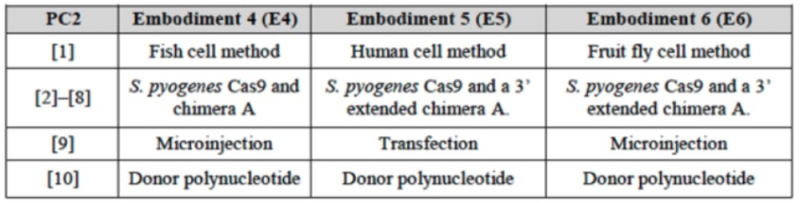
    CVC's Reply (filed after the Board's ruling against it in the '115 Interference, which CVC contends is not controlling here), reiterates its position that its P1 and 2 priority documents "describe[] and enable[] a eukaryotic cell comprising a sgRNA CRISPR-Cas9 system that is capable of modifying target DNA" because "[t]he level of ordinary skill in the art was high, as numerous independent groups successfully and near simultaneously demonstrated the claimed system in eukaryotes" and "[a] POSA reading P1 would have immediately understood that P1 explains how to apply the system in a fish cell (E1), human cell (E2), and fruit-fly cell (E3) using the well-known molecular biology techniques P1 described."  Moreover, CVC contends that a constructive reduction to practice does not require a working example or that CVC "dispel the hypothetical concerns that CVC's opponents have alleged."  To hold CVC to this higher standard was wrong as a matter of law by the Board and for Sigma-Aldrich to oppose CVC's Motion No. 1 on this basis, a strong statement encapsulating the burden CVC will likely need to sustain not only to prevail in this motion (which is unlikely given the Board's other decisions against CVC in other interferences) but in trying to overcome the Board's priority determination in the '115 Interference.

    CVC then recites the disclosure in the P1 and P2 provisional applications in detail that would have enabled the skilled worker to achieve CRISPR cleavage in eukaryotic cells (none of which will be new to the Board and none of which has been persuasive before), asserting that "no element of Count 1 is missing from P1's description."  The brief contains several citations such as "'acknowledgment of the complexities of the science does not negate the disclosure,' where the disclosure itself does not 'fail[] to teach any essential step,' but rather describes how to obtain the subject matter by 'following the general procedure disclosed,'" citing Frazer v. Schlegel, 498 F.3d 1283, 1288-89 (Fed. Cir. 2007), supporting the principle that CVC's constructive reduction to practice in these provisional applications satisfied the factual predicate for receiving priority benefit.  CVC relies on the "new" evidence in its brief, "from six different declarants," and boldly states that "[t]he Board may not simply recycle its '115 Decision on Motions here."  These include that "[i]n vitro studies have predictive value" and "[a] POSA reading P1 would immediately envisage E1, E2, and E3."  Further, CVC argues that a reasonable expectation of success from such disclosure is not required but "even if it were, the contemporaneous evidence overwhelmingly shows that those in the field expected sgRNA CRISPR-Cas9 to function in a eukaryotic environment."  CVC also addresses Sigma-Aldrich's recitation of the various hypothetical concerns," "challenges and uncertainties" that have so far proven to be persuasive to the Board in other interferences.

    In further support for its position, CVC cites interference practice principles, for example that Sigma-Aldrich did not contest any of the Material Facts in CVC's Motion No. 1, citing Zhang v. Amsel, asserting for this reason alone the Board can grant its motion.  Interference 105,550, Paper 26 at *10 (BPAI March 24, 2008).

    In CVC's boldest argument (which may presage the arguments CVC makes in its appeal of the Board's decision against it in the '115 Interference), the Reply argues that the Board's Decision on Motions in the prior interference is not controlling here and that it was wrong.  CVC supports the former argument by reciting "evidence that [purportedly] was either not addressed in the '115 Interference or new evidence uncovered during the priority phase."  For its latter argument, CVC limits its contentions here to a difference in the question at issue in this Motion and the Board's decision (priority based on conception and reduction to practice versus the adequacy of the written description of the P1 and P2 applications); the Board's reliance on documents not available to a POSA on P1's filing date; the Board's refusal to consider the "viewpoint" of a POSA; and that the Board's decision in the '115 interference is not final and will be appealed (CVC asserting optimistically that "the Federal Circuit can be expected to conclude the Decision reached an incorrect legal conclusion on conception."

    CVC thus asserts that the Board should accord them benefit to the P1 or P2 application filing date.