• By Kevin E. Noonan

    University of California-BerkleyOn November 19th, Junior Party the University of California, Berkeley; the University of Vienna; and Emmanuelle Charpentier (collectively, "CVC") filed its Substantive Preliminary Motion No. 3 in Interference No. 106,132 (which names Sigma-Aldrich as Senior Party), asking the Patent Trial and Appeal Board to substitute the Count of the interference pursuant to 37 C.F.R. §§ 41.121(a)(1)(iii) and 41.208(a)(1).  On February 18th, Senior Party Sigma-Aldrich filed its Opposition, and on April 7th CVC filed its Reply.

    The basis for CVC's motion was to change the Count to be limited to so-called "single (RNA) molecule guide RNA (sgRNA) species."  CVC argued that substituting this Count is more symmetrical with CVC's portion of the Count and "avoids inconsistency" with the Counts in related interferences (see "CRISPR Battle Joined Again"; "The CRISPR Chronicles: Enter ToolGen"; and "Sigma-Aldrich Joins the CRISPR Interference Fray").

    Sigma-Aldrich responded in its Opposition that, contrary to any nebulous (and "self-serving") "inconsistency," what CVC is actually trying to accomplish is to prevent Sigma-Aldrich from asserting its "best proofs" in the interference.  Sigma-Aldrich contended it is the only party in any of the pending interferences — CVC, ToolGen, and Broad — having proofs of reducing to practice CRISPR in eukaryotic cells having both single-molecule RNA (sgRNA) and dual-molecule ("dgRNA") RNA species.  CVC's proposed motion on its face and according to its arguments in its Motion No. 3 would change the Count to exclude dual-molecule RNA-comprising eukaryotic CRISPR.  Sigma-Aldrich argues that any concerns CVC asserted regarding "inconsistency" and "the public interest" would be served by the Board granting its own Motion No. 1 (while characterizing CVC's concerns in this regard as being "á la Chicken Little's dire predictions, . . . highly remote and purely speculative at best").  Also raising questions about CVC's "ulterior motives," Sigma-Aldrich contended that CVC's proposed Count would "not []enable CVC to better make out CVC's priority case, but instead [would] hamstring Sigma from making out Sigma's priority case" which "is not a legitimate basis to seek to change the count."  And CVC had not carried its burden in making a showing that they are entitled to the relief sought, Sigma-Aldrich argued, because they have failed to assert the conventional basis for such a motion — that it would enable CVC to proffer its best proofs in the interference but rather is a "strategic maneuver to try to prejudice Sigma's ability to proffer its proofs of invention."  Sigma-Aldrich also argued that CVC's Motion No. 3 would be moot should the Board grant Sigma-Aldrich's own motion (No. 1) to change the Count.

    In its Reply, CVC argues that the Count "should reflect the common invention defining multiple pending, related interferences — single-guide CRISPR-Cas9 systems useful in eukaryotic cells."  CVC identifies Sigma-Aldrich's portion of the McKelvey Count in this interference as an outlier amongst the CVC portion of the Count (and the Counts in interference with Broad and ToolGen) because it is "not aligned with CVC's half or any other parties' halves."  CVC cites the Board's decision to challenge Sigma-Aldrich's arguments that its disclosure of dgRNA CRISPR species mandates a generic-guide Count, based on the Board's decision in the '115 Interference, citing Regents of the University of California v. The Broad Institute, Int. No. 106,115 Paper 877 (Decision on Motions) at 39:22-40:8 (P.T.A.B. Sept. 10, 2020).  Following Board rules setting out the proper structure of Reply brief in an interference (§ 41.122 and S.O. ¶122.3.2), CVC sets out it responses and rebuttals of each of Sigma-Aldrich's arguments in its Opposition.  For example, to Sigma-Aldrich's argument that CVC's Motion No. 3 will be mooted if the Board grants Sigma-Aldrich's Motion No. 1 to change the Count, CVC argues that the subject of Sigma-Aldrich's Motion No. 1 is different (being directed to "whether or not the scope of the interference is limited to cleavage plus donor integration") than the question here regarding limiting the Count to sgRNA CRISPR embodiments.

    CVC also argues that whether to change the scope of the Count in this interference to be consistent with the Counts in related interferences is within the Board's sound discretion, citing Hitzeman v. Rutter, 243 F.3d 1345, 1359 (Fed. Cir. 2001), generally for the principle and In re Vivint, Inc., 14 F.4th 1342, 1351 (Fed. Cir. 2021), specifically in support of this argument.  In this regard, CVC also refutes Sigma-Aldrich's claim that it is the only party in these interferences to assert dgRNA CRISPR species, reminding the Board that Broad asserted similar "best proof" arguments in motions in the '115 interference (which the Board denied; see "PTAB Denies Broad Motion No. 2 to Substitute the Interference Count").  And CVC argues that granting its Motion No. 3 is consistent with fairness and would "limit the inherent prejudice to CVC that results from arbitrarily giving Sigma special treatment" in an interference that "Sigma requested."  CVC also argues that Sigma-Aldrich has not established that its "best proofs" are outside the scope of the CVC's proposed substitute Count, and that "substituting the Count will streamline the issues in the Interference," inter alia, by not "impact[ing]the designation of claims, priority benefit, or patentability over the [prior] art."

    For all these reasons CVC asks the Board to grant its Motion No 3.

  • By Donald Zuhn

    Department of the TreasuryOn March 2, 2022, the Office of Foreign Assets Control ("OFAC") of the U.S. Department of the Treasury issued General License No. 13, which authorized "U.S. persons . . . to pay taxes, fees, or import duties, and purchase or receive permits, licenses, registrations, or certifications" for a limited time when such activities relate to transactions involving the Central Bank of the Russian Federation ("Bank of Russia") and to the extent that such activities would otherwise be prohibited by Directive 4 under Executive Order (E.O.) 14024 (see "Treasury Department Authorizes Transactions Involving Bank of Russia Until June 24, 2022").  According to General License No. 13, transactions that "are ordinarily incident and necessary to such persons' day-to-day operations in the Russian Federation" were authorized "through 12:01 a.m. eastern daylight time, June 24, 2022."

    Directive 4 of the OFAC, which was issued on February 2, 2022, indicates that "the Director of the Office of Foreign Assets Control has determined, in consultation with the Department of State, that the Central Bank of the Russian Federation, the National Wealth Fund of the Russian Federation, and the Ministry of Finance of the Russian Federation are political subdivisions, agencies, or instrumentalities of the Government of the Russian Federation."  As a result, the Directive states that:

    [T]he following activities by a United States person are prohibited, except to the extent provided by law, or unless licensed or otherwise authorized by the Office of Foreign Assets Control:

    any transaction involving the Central Bank of the Russian Federation, the National Wealth Fund of the Russian Federation, or the Ministry of Finance of the Russian Federation, including any transfer of assets to such entities or any foreign exchange transaction for or on behalf of such entities.

    The Directive also prohibits the following:

    (1) any transaction that evades or avoids, has the purpose of evading or avoiding, causes a violation of, or attempts to violate any of the prohibitions of this Directive; and (2) any conspiracy formed to violate any of the prohibitions of this Directive.

    In a USPTO Alert email distributed to stakeholders and posted on the Office's website last week, the U.S. Patent and Trademark Office noted that the OFAC has published General License No. 31, which the USPTO indicated "authorizes certain intellectual property-related transactions in Russia, including the filing and prosecution of any application to obtain a patent, trademark, or copyright, as well as renewal and maintenance fees."  The Office also noted that any questions regarding General License No. 31 should be directed to the OFAC at OFAC_Feedback@treasury.gov.

    General License No. 31 states that the following transactions related to the protection of intellectual property in the United States or the Russian Federation — that would be otherwise be prohibited under the Russian Harmful Foreign Activities Sanctions Regulations, 31 C.F.R. part 587 — are authorized (except as provided in part (b) of the General License):

    (1) The filing and prosecution of any application to obtain a patent, trademark, copyright, or other form of intellectual property protection;

    (2) The receipt of a patent, trademark, copyright, or other form of intellectual property protection;

    (3) The renewal or maintenance of a patent, trademark, copyright, or other form of intellectual property protection; and

    (4) The filing and prosecution of any opposition or infringement proceeding with respect to a patent, trademark, copyright, or other form of intellectual property protection, or the entrance of a defense to any such proceeding.

    Part (b) of General License No. 31 does not authorize:

    (1) The opening or maintaining of a correspondent account or payable-through account for or on behalf of foreign financial institutions determined to be subject to the prohibitions of Directive 2 under Executive Order (E.O.) 14024, Prohibitions Related to Correspondent or Payable-Through Accounts and Processing of Transactions Involving Certain Foreign Financial Institutions;

    (2) Any debit to an account on the books of a U.S. financial institution of the Central Bank of the Russian Federation, the National Wealth Fund of the Russian Federation, or the Ministry of Finance of the Russian Federation; or

    (3) Any transactions prohibited by E.O. 14066 or E.O. 14068.

    According to the Treasury Department's Directive 2 under Executive Order (E.O.) 14024, the prohibitions of that Directive "apply only with respect to a U.S. financial institution's opening or maintaining of a correspondent account or payable-through account for or on behalf of, or processing of a transaction involving, a foreign financial institution."  A copy of Executive Order 14066, which is entitled "Prohibiting Certain Imports and New Investments With Respect to Continued Russian Federation Efforts To Undermine the Sovereignty and Territorial Integrity of Ukraine," can be found here.  A copy of Executive Order 14068, which is entitled "Prohibiting Certain Imports, Exports, and New Investment With Respect to Continued Russian Federation Aggression," can be found here.

    In its Daily News email last Friday, the Intellectual Property Owners Association (IPO) noted that General License No. 31 "clarifies previously issued General License No. 13, which left unresolved whether such payments constituted permissible 'payments for registrations, certifications, and licenses to conduct day-to-day operations' or were prohibited by Russian Harmful Foreign Activities Sanctions Regulations."

    For additional information regarding this and other related topics, please see:

    • "Treasury Department Authorizes Transactions Involving Bank of Russia Until June 24, 2022," April 10, 2022
    • "USPTO News Briefs," April 4, 2022
    • "USPTO Provides Advice Regarding Dealings with Rospatent," March 22, 2022
    • "Georgian and Estonian Patent Offices Join Other IP Offices in Expressing Support for Ukraine," March 13, 2022
    • "Several Law Firms Close Russian Offices," March 13, 2022
    • "Russia Permits Uncompensated Use of Certain Patents without Patentee Consent," March 11, 2022
    • "Lithuanian Patent Office and EUIPO Join Other Patent Offices in Expressing Support for Ukraine," March 10, 2022
    • "USPTO Terminates PPH with Rospatent and Terminates Engagement with NCIP," March 10, 2022
    • " Life Sciences Business Leaders Call for Immediate and Complete Economic Disengagement from Russia," March 9, 2022
    • "PRH Joins Other Patent Offices in Expressing Support for Ukraine," March 9, 2022
    • "USPTO Terminates Engagement with Rospatent and EAPO," March 7, 2022
    • "Ukrpatent Continues Normal Operations Despite Russian Aggression," March 6, 2022

  • By Kevin E. Noonan

    University of California-BerkleyOn November 19th, Junior Party the University of California, Berkeley; the University of Vienna; and Emmanuelle Charpentier (collectively, "CVC") filed its Substantive Preliminary Motion No. 1 in Interference No. 106,132 (which names Sigma-Aldrich as Senior Party), asking the Patent Trial and Appeal Board for benefit of priority to U.S. Provisional Application No. 61/652,086, filed May 25, 2012 ("P1"), U.S. Provisional Application No. 61/716,256, filed October 19, 2012, ("P2"), and U.S. Provisional Application No. 61/757,640, filed January 28, 2013 ("P3"), pursuant to 37 C.F.R. §§ 41.121(a)(1)(ii) and 41.208(a)(3) and Standing Order ¶ 208.4.1.  On February 18th, Sigma-Aldrich filed its Opposition, and on April 7th CVC filed its Reply.

    The relationships between CVC's patents and applications in the '132 interference are set forth in this chart (filed in CVC's earlier preliminary motion in Interference No. 106,115):

    Image
    CVC argued it was entitled to priority because it had "invented a eukaryotic cell comprising a single-molecule guide RNA ("sgRNA") CRISPR-Cas9 system capable of cleaving or editing target DNA, as defined by the count" (an argument that may have lost most of its persuasive force after the PTAB held that inventors from the Broad Institute and colleagues were entitled to priority for this invention; see "PTAB Grants Priority for Eukaryotic CRISPR to Broad in Interference No. 106,115").  CVC further argued that developments (not the one just cited) in the '115 Interference provided additional evidence to support its motion (CVC having made a similar argument in the '127 Interference having ToolGen as Senor Party; see "The CRISPR Chronicles: Enter ToolGen").

    Most of CVC's arguments will be familiar to anyone following parallel motions in the '115 and '127 interferences.  These include CVC's contention that once its breakthrough of using sgRNA-containing CRISPR embodiments had been achieved, adapting CRISPR to the eukaryotic cell environment would have been "pretty straightforward" (quoting Dr. Luciano Marraffini, who purportedly informed the Broad inventors of the sgRNA embodiment in June, 2012; see "CVC Files Motion in Opposition to Broad Priority Motion").  CVC supported this assertion with contemporaneous consistent statements from Rodolphe Barrangou, Erik Sontheimer, Samuel Sternberg, and Dana Carroll, as well as Jennifer Doudna; by the existence of "existing platforms that had already been successfully used with the two incumbent systems: zinc-finger nucleases ("ZFNs") and transcription activator-like effector nucleases ("TALENs")"; and by the successful practice of CRISPR by several groups (including Sigma-Aldrich) "[j]ust months after CVC presented this work" and the absence in the reports from any of these groups of "any 'special' adaptations or conditions needed" to achieve CRISPR gene editing in eukaryotic cells.  CVC also argued that the Board's contrary conclusion in denying CVC's motion for priority benefit to the P1 and P2 provisional applications in the '115 Interference was made "without the benefit of the now well-developed evidentiary record," specifically, that "[t]he prior decision credited assertions that have been seriously undermined by evidence presented during the priority phase of the '115 interference."  That evidence was presented in CVC's Motion, which will not be recapitulated here; subsequently, of course, the Board held that none of this new evidence was sufficiently more persuasive for the Board to arrive at CVC's conclusion.

    Sigma-Aldrich's Opposition countered CVC's assertions using the same approach successfully used by Broad in persuading the Board to find priority of invention in their favor in the '115 interference (see "PTAB Holds for Broad in CRISPR Interference: The Reasoning"):  that the two provisional applications (filed on May 25, 2012 and October 19, 2012) did not disclose an operative embodiment of CRISPR that could be successfully practiced in eukaryotic cells.  (Sigma-Aldrich does not challenge CVC's motion with regard to the P3 provisional application, no doubt because inter alia its status as Senior Party in this interference would not change should the Board do so.)  Harkening back to the Board's decision on a similar CVC motion in the '115 interference, Sigma-Aldrich argued that the Board was correct in its prior determination that those applications only disclosed in vitro CRISPR methods in a "cell-free" environment.  The cornerstone of Sigma-Aldrich's motion was that neither the P1 nor P2 provisional applications disclosed any "specific instructions or conditions" required for the practice of CRISPR in eukaryotic cells and that such instructions and/or conditions were necessary in view of the several obstacles required (tracking the same distinctions between CRISPR in eukaryotic cells and under other conditions recited by Broad in the '115 interference and Interference No. 105,048; see "PTAB Decides CRISPR Interference in Favor of Broad Institute — Their Reasoning").  According to Sigma-Aldrich, nothing has changed that would have the Board render a decision different from their refusal in the '115 interference to accord CVC benefit to P1 and P2 provisional application, and the Board should come to the same conclusion.  (Sigma-Aldrich contended that most if not all the evidence CVC asserts in its brief supporting its priority benefit motion in this interference had been asserted in the corresponding brief in the '115 motion.")

    CVC's Reply (filed after the Board's ruling against it in the '115 Interference, which CVC contends is not controlling here), reiterates its position that its P1 and 2 priority documents "describe[] and enable[] a eukaryotic cell comprising a sgRNA CRISPR-Cas9 system that is capable of modifying target DNA" because "[t]he level of ordinary skill in the art was high, as numerous independent groups successfully and near simultaneously demonstrated the claimed system in eukaryotes" and "[a] POSA reading P1 would have immediately understood that P1 explains how to apply the system in a fish cell (E1), human cell (E2), and fruit-fly cell (E3) using the well-known molecular biology techniques P1 described."  Moreover, CVC contends that a constructive reduction to practice does not require a working example or that CVC "dispel the hypothetical concerns that CVC's opponents have alleged."  To hold CVC to this higher standard was wrong as a matter of law by the Board and for Sigma-Aldrich to oppose CVC's Motion No. 1 on this basis, a strong statement encapsulating the burden CVC will likely need to sustain not only to prevail in this motion (which is unlikely given the Board's other decisions against CVC in other interferences) but in trying to overcome the Board's priority determination in the '115 Interference.

    CVC then recites the disclosure in the P1 and P2 provisional applications in detail that would have enabled the skilled worker to achieve CRISPR cleavage in eukaryotic cells (none of which will be new to the Board and none of which has been persuasive before), asserting that "no element of Count 1 is missing from P1's description."  The brief contains several citations such as "'acknowledgment of the complexities of the science does not negate the disclosure,' where the disclosure itself does not 'fail[] to teach any essential step,' but rather describes how to obtain the subject matter by 'following the general procedure disclosed,'" citing Frazer v. Schlegel, 498 F.3d 1283, 1288-89 (Fed. Cir. 2007), supporting the principle that CVC's constructive reduction to practice in these provisional applications satisfied the factual predicate for receiving priority benefit.  CVC relies on the "new" evidence in its brief, "from six different declarants," and boldly states that "[t]he Board may not simply recycle its '115 Decision on Motions here."  These include that "[i]n vitro studies have predictive value" and "[a] POSA reading P1 would immediately envisage E1, E2, and E3."  Further, CVC argues that a reasonable expectation of success from such disclosure is not required but "even if it were, the contemporaneous evidence overwhelmingly shows that those in the field expected sgRNA CRISPR-Cas9 to function in a eukaryotic environment."  CVC also addresses Sigma-Aldrich's recitation of the various hypothetical concerns," "challenges and uncertainties" that have so far proven to be persuasive to the Board in other interferences.

    In further support for its position, CVC cites interference practice principles, for example that Sigma-Aldrich did not contest any of the Material Facts in CVC's Motion No. 1, citing Zhang v. Amsel, asserting for this reason alone the Board can grant its motion.  Interference 105,550, Paper 26 at *10 (BPAI March 24, 2008).

    In CVC's boldest argument (which may presage the arguments CVC makes in its appeal of the Board's decision against it in the '115 Interference), the Reply argues that the Board's Decision on Motions in the prior interference is not controlling here and that it was wrong.  CVC supports the former argument by reciting "evidence that [purportedly] was either not addressed in the '115 Interference or new evidence uncovered during the priority phase."  For its latter argument, CVC limits its contentions here to a difference in the question at issue in this Motion and the Board's decision (priority based on conception and reduction to practice versus the adequacy of the written description of the P1 and P2 applications); the Board's reliance on documents not available to a POSA on P1's filing date; the Board's refusal to consider the "viewpoint" of a POSA; and that the Board's decision in the '115 interference is not final and will be appealed (CVC asserting optimistically that "the Federal Circuit can be expected to conclude the Decision reached an incorrect legal conclusion on conception."

    CVC thus asserts that the Board should accord them benefit to the P1 or P2 application filing date.

  • By Kevin E. Noonan

    Sigma-AldrichOn November 19th, Senior Party Sigma-Aldrich filed its Substantive Preliminary Motion No. 1 in CRISPR Interference No. 106,132, asking the Board to substitute the Count pursuant to 37 C.F.R. §§ 41.121(a)(1)(iii) and 41.208(a)(1).  Junior Party the University of California, the University of Vienna, and Emmanuelle Charpentier (collectively "CVC") filed its Opposition on February 18th.  And on April 7th, Sigma-Aldrich filed its Reply.

    In its Motion, Sigma-Aldrich set forth its proposed Count 2 as, in the alternative, CVC Application No. 15/947,680, claim 164 or Sigma-Aldrich Application No. 15/456,204, claim 31 (the latter alternative Count based on Sigma-Aldrich's claim remains the same as in the Count as the interference was declared).  Claim 164 of CVC's '680 patent recites (dependent on claims 156 and 157):

    156.  A method of cleaving or editing a target DNA molecule or modulating transcription of at least one gene encoded thereon, the method comprising:
    contacting a target DNA molecule having a target sequence with an engineered and/or non-naturally-occurring Type II Clustered Regularly Interspaced Short Palindromic Repeats (CRISPR)—CRISPR associated (Cas) (CRISPR-Cas) system comprising:
    a) a single molecule DNA-targeting RNA comprising
            i) a targeter-RNA that hybridizes with the target sequence, and
            ii) an activator-RNA that hybridizes with the targeter-RNA to form a double-stranded RNA duplex of a protein-binding segment,
            wherein the targeter-RNA and the activator-RNA are covalently linked to one another with intervening nucleotides; and
        b) a Cas9 protein,
        wherein the single molecule DNA-targeting RNA forms a complex with the Cas9 protein, thereby targeting the Cas9 protein to the target DNA molecule,
        whereby said target DNA molecule is cleaved or edited or transcription of at least on gene encoded by the target DNA molecule is modulated, and
        wherein said contacting occurs in a eukaryotic cell.

    157.  The method of Claim 156, wherein, prior to the contacting step, the method comprises:
    introducing into the eukaryotic cell containing the target DNA molecule:
    1) the single molecule DNA-targeting RNA, or a DNA molecule comprising  a nucleotide sequence that
            (i) encodes the single molecule DNA-targeting RNA and
            (ii) is operably linked to a regulatory element operable in said eukaryotic cell; and
        2) the Cas9 protein, an RNA molecule comprising a nucleotide sequence encoding the Cas9 protein, or a DNA molecule comprising a nucleotide sequence that
            (i) encodes the Cas9 protein and
            (ii) is operably linked to a regulatory element operable in said eukaryotic cell.

    164.  The method of Claim 157, whereinthe method comprises creation of a double strand break in the target DNA molecule which is repaired by a homology-directed repair mechanism which incorporates a sequence of a donor polynucleotide into the target DNA molecule, thereby editing the target DNA molecule [emphasis in brief].

    Sigma-Aldrich's argument in favor of substituting the Count was that the so-called McKelvey count as declared encompasses two patentably distinct inventions:  "(1) CRISPR-Cas9 in a eukaryotic cell to cleave a target DNA; and (2) CRISPR-Cas9 in a eukaryotic cell to cleave a target DNA and subsequently to integrate a donor DNA sequence into the target DNA via homology-directed repair ("HDR)" (emphasis in brief).  According to Sigma-Aldrich, this second, subsequent step is not obvious over merely cleaving a DNA target and thus claims to these embodiments are patentably distinct.  Sigma-Aldrich maintained that the "current Count 1 permits CVC to submit proofs of invention for cleavage alone [based on its claims encompassing "cleaving or editing the target DNA molecule or modulating transcription of at least one gene encoded by the target DNA molecule"], which do not constitute proofs of invention for the separately patentable cleavage plus integration invention."  Permitting CVC to prevail on this basis would be contrary to the "fundamental purposes of a first-to-invent patent interference" as well as being "manifestly unfair to Sigma," because it would deprive Sigma-Aldrich of patent protection for "its distinct and more technically challenging invention based on CVC's proofs for a different and considerably simpler invention."  In addition, Sigma-Aldrich asserted that none of CVC's applications disclose embodiments for "cleavage plus integration" methods (even if their claims encompass such CRISPR methods in eukaryotic cells).

    In its Opposition, CVC contended that Sigma-Aldrich failed to satisfy the requirements for substituting the Count because, inter alia, the Senior Party has not rebutted the presumption to which the Count in the interference as declared is entitled. CVC cited positions Sigma-Aldrich has taken during ex parte prosecution (which CVC contended were motivated by Sigma-Aldrich's desire to "avoid an interference with CVC over the subject matter of CRISPR-Cas9 for cleaving or editing target DNA in a eukaryotic cell [that were] not limited to donor integration by HDR").  Citing 37 C.F.R. § 41.202(c) for a "disclaimer doctrine" CVC argued that "when the examiner suggests a claim to an applicant for purposes of a future interference, and the applicant refuses, such refusal operates as a 'concession' that the subject matter of the suggested claim was the prior invention of another."  CVC further asserted that the Count Sigma-Aldrich proposed would preclude it from proffering its "best proofs," which could be avoided by a two-count interference (that Sigma-Aldrich had refused to provoke).  CVC argued that Sigma-Aldrich was trying to bootstrap an interference with 10 CVC claims to win priority over the other 176 of CVC's claims-in-interference, calling this a "flagrant manipulation" (presumably of the interference rules) and argued that CVC is entitled to a judgment of priority on its own half of the original Count and its 176 generic CRISPR claims.  CVC asserted that "Sigma has already failed, twice, to demonstrate that [cleavage and cleavage plus integration] are two separately patentable inventions," "[f]irst, during prosecution of the application [in which this interference had been provoked, No. 15/456,204]" and second, upon initiation of this interference when the Board's declaration contained Count 1 instead of Sigma-Aldrich's preferred Count 2 (now recited in Sigma-Aldrich's Proposed Count 2).  These circumstances raised the presumption that the two species of eukaryotic CRISPR were patentably indistinct and Sigma-Aldrich has failed to rebut that presumption, CVC contended.  Rather than granting Sigma-Aldrich's motion CVC argued that the Board should redeclare the interference as a two Count interference, one Count directed to "cleavage" embodiments and the other Count directed to "cleavage + integration" embodiments.

    In its Reply, Sigma-Aldrich begins its argument by reiterating its position that the Count in the Interference as declared "encompasses two patentably distinct inventions: (1) CRISPR-Cas9-mediated cleavage only in a eukaryotic cell; and (2) CRISPR-Cas9-mediated cleavage plus integration of a donor polynucleotide via HDR ("cleavage plus integration") in a eukaryotic cell" (wherein later in the brief Sigma-Aldrich characterizes these two processes as DNA destruction and DNA reconstruction, and that the latter would not have been obvious over the former) (emphasis in brief).  According to Sigma-Aldrich, its Motion No. 1 "sets forth a dozen reasons why in early December 2012 a POSITA would have had considerable uncertainty whether a double-stranded break ("DSB") cleaved by CRISPR-Cas9 would be successfully repaired by donor integration via HDR in a eukaryotic cell."  In view of the understanding in the art in 2012, Sigma-Aldrich argues that at best "a POSITA could do very little but sit back and hope that HDR might work with this new prokaryotic-derived system [in eukaryotic cells]" (emphasis in brief).  Sigma-Aldrich recites its continued contention that there were at least twelve reasons set forth in its Motion No. 1 why a POSITA would not have had a reasonable expectation of success in achieving HDR in a eukaryotic cell merely because eukaryotic CRISPR embodiments had been shown to produce DSBs in such cells.  Indeed, Sigma-Aldrich contends that HDR was appreciated in the art in 2012 as being "the most challenging part of [CRISPR-mediated] genome engineering" because, inter alia, HDR was a "disfavored repair pathway" (setting forth scientific bases for this assertion).  Sigma-Aldrich disparages CVC's arguments based on HDR in yeast, which it contends "relied on different repair factors and is not representative of eukaryotes" and further contends that blunt-ended non-homologous end joining (NHEJ) would be preferred over HDR and could inhibit the HDR pathway.  Sigma-Aldrich recites characteristics of eukaryotic cell biology (chromatin, off-target CRISPR cleavage, Cas9 remaining bound to CRISPR-cleaved ends in eukaryotic cells) as reasons the skilled worker could not have had any reasonable expectation of success in achieving HDR provoked by CRISPR cleavage in a eukaryotic cell and the further history in the field post-2012 (including expressions of skepticism in contemporary prior art documents).  Moreover, Sigma-Aldrich contends that experience with other targeted nucleases (ZFP, TALENs) would not have overcome these obstacles to reasonable expectations for successful CRISPR-mediated HDR in eukaryotic cells.

    Having made its principle argument in favor of the Board substituting the Count, Sigma-Aldrich then more briefly sets forth its further criticisms of CVC's Opposition and its contentions in that Motion not disputed by CVC.  These included the correspondence of all Sigma-Aldrich's involved claims corresponding to proposed Count 2; "no substantive analysis" of the disputed correspondence of CVC's involved claims to the substitute Count; and no substantive challenge to Sigma-Aldrich's entitlement to benefit to its P1 priority document, U.S. Provisional Application No. 61/734,256, filed December 6, 2012, under proposed Substitute Count 2.  Sigma-Aldrich then challenges CVC's contention that its P3 application, U.S. Provisional Application No. 61/757,640, filed January 28, 2013, is entitled to priority benefit under Sigma-Aldrich's Proposed Substitute Count 2, for failing to provide "any substantive evidence that the CVC inventors actually possessed the invention of Proposed Count 2" (emphasis in brief).  Instead, Sigma-Aldrich contends, "CVC relies on the basic textbook and boilerplate disclosures in CVC P3 regarding HDR, but fails to address the glaring omission of any discussion of a donor or integration of any kind in CVC's experimental endeavors."  Sigma-Aldrich further criticizes CVC for failing to rebut its prima facie showing that its Proposed Count No. 2 is patentable.  Sigma-Aldrich also contends that CVC's argument regarding its best proofs for "cleavage only" eukaryotic CRISPR embodiments were "wholly irrelevant" when CVC "nowhere even suggests that its best proofs to the parties' commonly claimed cleavage plus integration invention would counsel for an alternative formulation of Proposed Count 2."  Finally, Sigma-Aldrich argues CVC's contentions regarding 37 C.F.R. § 41.202(c) and that Sigma-Aldrich is seeking an interference directed to "generic cleavage" are either incorrect, nonsensical, or both, that CVC's proposal for a two-count interference ignores Sigma-Aldrich's "rational" explanation that in such an interference Sigma-Aldrich would have no claims corresponding to the "cleavage-only" Count, and that the Board should disregard CVC's proposal that the Board grant CVC judgment on Count 1 and grant Sigma-Aldrich's Motion No. 1 to substitute the existing Count for its Proposed Count 2.

  • CalendarMay 11, 2022 – Trade Secret Symposium (Global Intellectual Property Academy of the Office of Policy and International Affairs of U.S. Patent and Trademark Office) – 1:00 pm to 4:00 pm (ET)

    May 12, 2022 – Trade Secret Symposium (Global Intellectual Property Academy of the Office of Policy and International Affairs of U.S. Patent and Trademark Office) – 8:00 am to 10:00 am (ET)

    May 17, 2022 – UPC Masterclass — Session 2: "Inspection and Evidence Proceedings/Double Protection and the Strategic Implications under the UPC System" (Hoffmann Eitle)

    May 18, 2022 – UPC Masterclass — Session 2: "Inspection and Evidence Proceedings/Double Protection and the Strategic Implications under the UPC System" (Hoffmann Eitle)

    May 24, 2022 – Examination practices and procedural guidance for 35 U.S.C. § 103 obviousness rejections (Part 2) – virtual Instructor-Led Training (vILT) series (U.S. Patent and Trademark Office) – 9:00 am to 11:00 am (ET)

    May 25, 2022 – Examination practices and procedural guidance for 35 U.S.C. § 103 obviousness rejections (Part 2) – virtual Instructor-Led Training (vILT) series (U.S. Patent and Trademark Office) – 1:00 pm to 3:00 pm (ET)

    May 26, 2022 – Examination practices and procedural guidance for 35 U.S.C. § 103 obviousness rejections (Part 2) – virtual Instructor-Led Training (vILT) series (U.S. Patent and Trademark Office) – 5:00 pm to 7:00 pm (ET)

    June 28, 2022 – UPC Masterclass — Session 3: "The UPC Approach to Damages Actions and Compensation Claims" (Hoffmann Eitle)

    June 30, 2022 – UPC Masterclass — Session 3: "The UPC Approach to Damages Actions and Compensation Claims" (Hoffmann Eitle)

    July 8, 2022 – UPC Masterclass — Session 4: "The New Regime on the Revocation of European Patents/ The 'Long-arm Jurisdiction'" (Hoffmann Eitle)

  • USPTO SealThe Global Intellectual Property Academy of the Office of Policy and International Affairs (OPIA) of the U.S. Patent and Trademark Office will be holding the USPTO's biennial trade secret symposium from 1:00 pm to 4:00 pm (ET) on May 11, 2022 and from 8:00 am to 10:00 am (ET) on May 12, 2022.  The symposium will address the details of trending cross-border issues affecting the protection of trade secrets, bringing together experienced practitioners from government, industry, and academia to lead panels on:

    • Balance and tension between patents and trade secrets as forms of intellectual property (IP) protection
    • Current risks associated with overseas talent recruitment programs and cyber theft risk mitigation strategies
    • Cross-border issues and coordination of civil enforcement with criminal prosecutions
    • Views from the USPTO's IP attachés posted overseas

    Those interested in registering for the symposium can do so here.

  • By Kevin E. Noonan

    Sigma-AldrichOn December 3rd, Junior Party the Broad Institute, Harvard University, and MIT (collectively, Broad) filed its Contingent Preliminary Motion No. 3 in Interference No. 106,133 (which names Sigma-Aldrich as Senior Party), asking the Patent Trial and Appeal Board to designate certain claims deemed in the Declaration as corresponding to the Interference Count as not having such correspondence, under 37 C.F.R. §§ 41.121(a)(1)(i) and 41.207(b)(2).  Senior Party Sigma-Aldrich filed its Opposition on March 16th.

    As argued by Broad, these claims fell into five discrete categories:

    Category A:      Staphylococcus aureus Cas9 protein ("SaCas9");
    Category B:      Cas9 chimeric CRISPR enzyme;
    Category C:      Cas9 with two or more nuclear localization signals ("NLSs");
    Category D:      Cas9 fused to specified protein domains; and
    Category E:      Claims that are generic as to RNA and also do not specify integration of a donor polynucleotide sequence ("Donor Template Integration" claims), i.e., the only claims that should remain designated as corresponding to Count 1 are those that are either (i) limited to single molecule RNA ("sgRNA"), or (ii) require Donor Template Integration and are not otherwise separately patentable.

    Broad made as a basis for its motion the distinction that the Broad portion of "McKelvey" Count 1 is directed to CRISPR-mediated cleavage in a eukaryotic cell (that "cover[s] many different inventions that are separately patentable from Count 1") while Sigma-Aldrich's portion of the Count recites CRISPR-mediated cleavage coupled with integration of a heterologous DNA molecule, termed "Donor Template Integration."  The brief argued that Broad's claims "that are both generic as to RNA [CRISPR components, i.e., single- or dual-molecule embodiments] and not limited to Donor Template Integration" should be de-designated as not corresponding to Count 1 of the '133 Interference as declared (in addition to the categories of claims set forth above).  "The only claims that should correspond to Count 1 are those that either are limited to use of sgRNA (and so correspond to the Broad half of Count 1) or recite Donor Template Integration (and so correspond to the Sigma half of Count 1)," Broad argued.

    Specifically, the claims in each category Broad argued should be de-designated as not corresponding to the Count were:

    Category A:  All of the Involved claims of U.S. Patent No. 8,865,406, U.S. Patent No. 8,895,308, and Application No. 15/330,876;

    Category B:  All of the involved claims of Broad's U.S. Patent No. 8,889,418 ("418 patent") reciting Cas9 chimeric CRISPR enzymes;

    Category C:  All of the claims of U.S. Patent No. 8,871,445, U.S. Patent No. 8,932,814, claim 7 of U.S. Patent No. 8,993,233, claims 9-11 of U.S. Patent Application No. 14/704,551, and claim 34 of U.S. Patent Application No. 15/330,876, which recite Cas9 with two or more nuclear localization signals ("NLSs");

    Category D:  All of the claims (1-43) of Broad's U.S. Patent No. 8,993,233, all claims (1-28) of U.S. Patent No. 8,999,641, claims 18, 19, 25, 29-30, and 36 of U.S. Patent No. 9,840,713, and claim 21 of U.S. Patent Application No. 15/330,876, having claims reciting Cas9 fused to specified protein domains; and

    Category E:  Claims 15, 17-26, and 28-41 of U.S. Patent No. 9,840,713; claims 1-24 of U.S. Patent No. 8,889,418; claim 13 of U.S. Patent No. 8,871,445; claims 1, 2, 5, and 30 of U.S. Patent No. 8,906,616; claims 1, 8, 9, and 14 of U.S. Patent No. 9,840,713; claims 1, 4, 8, 11, 15, and 18 of U.S. Patent No. 8,697,359; claims 1 and 5 of U.S. Patent No. 8,771,945; claims 1, 6, 10, 25, 29, and 30 of U.S. Patent No. 8,895,308.

    In its Opposition, Sigma-Aldrich argues that Broad failed to carry its burden to de-designate claims, inter alia, for failing to apply the "one-way obviousness" test or address the effect of prior art, including the Jinek 2012 paper, on obviousness of these claims.  Nevertheless, Sigma-Aldrich asserts that it "endeavored to review 461 of Broad's involved claims in all 16 of Broad's involved patents and applications" and, consistent with positions Senior Party has taken in Interference No 106,132 against CVC deign not to contest de-designation of the following claim types:

    (a) claims reciting more than 1 targeting RNA (aka "multiplexing");
    (b) claims reciting a Cas9 protein that includes a Protein Transduction Domain (PTD);
    (c) claims reciting one or more mutation(s) in the Cas9 RuvC/HNH domain(s);
    (d) claims a nickase for a creating a "nick" or a single stranded break in the target DNA; and
    (e) claims reciting a chimeric Cas9 protein.

    In addition, Sigma-Aldrich does not contest Broad's motion to de-designate claims directed to "(a) SaCas9; (b) a chimeric Cas9; (c) two or more NLSs; and (d) a Cas9 protein fused to one or more protein domains."

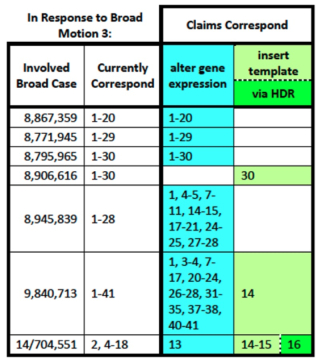
    Turning to those claims Sigma-Aldrich does contest de-designation, the brief set forth a table:

    Image 1
    which represents pictorially Sigma-Aldrich's parsing out the various CRISPR embodiments to which these claims are directed.  According to Sigma-Aldrich's Opposition, Broad fails to show whether claims directed to a generic guide RNA would have been obvious in view of the Count (setting forth extensive arguments regarding the capacity of the prior art in the December 2012 timeframe to have done so).  Sigma-Aldrich also notes inconsistencies between Broad's argument in Motion No. 3 with its arguments in its Motion No. 2, directed to adding claims 52-54 of the '403 application to the interference, where these claims, that recite different guide RNA species (generic guide RNA, claim 52; dgRNA, claim 53; and sgRNA, claim 54) should (according to Broad's prior motion) all be designated as corresponding to the Count.

    Sigma-Aldrich also contends that claims reciting merely "guide RNA" should be construed (as this term was in Interference No. 106,115) to be directed to sgRNA/chimeric RNA claims, providing a comparison chart between the claims designated to the Count in the '115 and '133 Interferences.  Accordingly, "the Board's conclusions in in the CVC v. Broad interference (Int'f No. 106,115) regarding Broad's 'guide RNA' claim recitals apply equally here," Broad argues.

    The brief also sets out an extensive "Claim Correspondence Table" to illustrate Sigma-Aldrich's position:

    Image 2
    providing footnotes (set forth below).  As Sigma-Aldrich explains:

    [T]he Broad claims in the two right-hand columns labeled "Claims Correspond" should remain designated as corresponding to Count 1, and thus should remain involved in this interference.  On this motion, Sigma does not contest that the Broad claims in the middle columns labeled "Claims Do Not Correspond" and "FN3" should be de-designated from corresponding to Count 1.

    Having provided these arguments, Sigma-Aldrich asks the Board to deny Broad Preliminary Motion No. 3.

    1 Of Broad's 461 involved patent claims, 340 of those claims are directed to "cleavage plus altering gene expression" (or an analogous recital).  See Ex. 1518 (Cannon Supp'l Decl.), Appx. C.

    2 Of Broad's 461 involved patent claims, 42 of those claims are directed to insertion of a "template."  Id.

    3 Of Broad's 461 involved patent claims, 8 of those claims are dependent claims directed to cleavage plus integration by HDR.  Id.

    4 The claims recite "a chimeric RNA" or "a guide sequence fused to the tracr sequence."  Id. ¶ 43.

    5 The claims do not recite "RNA" (not a recital of generic RNA).  Id. ¶ 44.

    6 The claims recite "displays a phenotype or carries DNA to display a phenotype of the genetic modification", analogous to altering gene expression.  Id. ¶ 45.

    7 The claims recite "a CRISPR‐Cas system chimeric RNA (chiRNA)".  Id. ¶ 46.

    8 Because Sigma does not dispute Broad's request that the '876 patent be removed from this interference (albeit for different reasons), the authorized Sigma Motion 2 to remove the '876 application from the interference is rendered moot by Broad Motion 3.  See Sigma Notice Re: Sigma Motion 2 (to Remove Application 15/330,876 from the Interference) (Paper 52).

    9 Claim 35 also does not correspond to Count 1 because it recites "the vector comprises a U6 promoter operably linked to a nucleotide sequence encoding the chiRNA", which would not have been obvious in view of the count.  Ex. 1518 (Cannon Supp'l Decl.) ¶ 47.

  • By Donald Zuhn

    USPTO SealIn a notice published last week in the Federal Register (87 Fed. Reg. 25226), the U.S. Patent and Trademark Office announced that it will allow Applicants to submit an applicant-generated PDF version of applications filed in DOCX format along with the DOCX file when filing an application using the Office's Patent Center interface.

    In August of 2020, the Office announced that for applications that are not filed in DOCX format after January 1, 2022, such filings would carry a surcharge of $400 for large entities under 37 C.F.R. § 1.16(u).  Last November, the Office announced that the effective date for assessment of the surcharge would be delayed until January 1, 2023 (see "USPTO News Briefs").

    The Office has been encouraging Applicants to begin filing patent applications in DOCX format, and by allowing Applicants to submit an applicant-generated PDF version of applications filed in DOCX format, the Office hopes to help address concerns some Applicants have raised about the DOCX format, as well as allow Applicants to get acclimated to the process of filing applications in DOCX format.  The Office notes that the option of providing an applicant-generated PDF version of applications is being offered on a temporary basis, beginning on April 28, 2022 and ending (at least as of now) on December 31, 2022.  Applicants who submit an applicant-generated PDF version of applications filed in DOCX format will not be required to pay any additional fees, such as application size fees, for the PDF version.

    The Office has created a new document description for the optional applicant-generated PDF ("Auxiliary PDF of application") and a new document code ("AUX.PDF").  The Office also notes that the option of providing an applicant-generated PDF version of applications will not be available for applications filed via the EFS-Web.

    The notice indicates that the new option will "safeguard the applicant should any conversion discrepancies have taken place" when filing applications in DOCX format.  In particular, Applicants who submit an applicant-generated PDF version of applications filed in DOCX format will be able to rely on that PDF if a discrepancy occurs during the filing process.  The notice also indicates that if an error or discrepancy in the record that resulted from filing an application in DOCX format is identified, Applicants should promptly notify the Patent Electronic Business Center (EBC) at 866–217–9197 (toll-free), 571–272–4100, or ebc@uspto.gov so the EBC can investigate the issue.  For corrections to the record that are supported by the validated DOCX version of the application, the Office notes that Applicants can file a petition under 37 C.F.R. § 1.181.  For corrections to the record that are supported by the applicant-generated PDF, the Office notes that Applicants should file a petition under 37 C.F.R. § 1.182.  For petitions filed under § 1.182, the Office will be waiving the fee under 37 C.F.R. § 1.17(f) during the option's temporary period.  According to the notice, the applicant-generated PDF that accompanies a DOCX filing will not become part of the permanent record unless a petition is filed requesting that the Office correct the record in view of the applicant-generated PDF.

    The Office concludes the notice by stating that:

    Applicants are strongly encouraged to review their applications, including the USPTO-generated PDF, shortly after filing the application to identify any errors or discrepancies in the record, as discussed above.  The applicant should file any necessary petition to correct the record early in prosecution and promptly after discovering any errors or discrepancies.

    For additional information regarding this topic, please see:

    • "USPTO News Briefs," November 22, 2021
    • "USPTO Support for Filing in DOCX Format Still a Work in Progress," January 7, 2020
    • "USPTO News Briefs," November 12, 2019

  • By Michael Borella

    USPTO Building FacadePatent examiners have a hard job.  They are given a relatively short amount of time in which they are supposed to thoroughly review a patent application, search for relevant prior art, and write a well-reasoned Office action.  Given the challenges of doing so, each of these tasks — reviewing, searching, and writing — may not get the attention that it needs.  Further, examiners are sometimes asked to examine applications from technology areas in which they lack the appropriate expertise.  Moreover, relatively few examiners are attorneys and thus may struggle to apply the relevant law in a cogent fashion.

    With all of this, it is not surprising that the quality of patent examination can vary dramatically.  Just based on examination statistics, the average allowance rate across all examiners is 76% but some examiners have an allowance rate of less than 10% and others have an allowance rate of greater than 90%.[1]  It is highly unlikely that all of this variability can be attributed to technology area or chance — every patent attorney has stories of interactions with both notably cooperative and notably difficult examiners from different groups and art units within the USPTO.[2]

    I'll have to admit that I generally enjoy interactions with competent, thoughtful examiners even when the ultimate outcome is not what I was hoping for.  When an examiner can clearly articulate a solid factual and legal basis for rejecting claims — and better yet, is willing to make suggestions that would advance prosecution — that makes my job easier, simplifies prosecution, and reduces applicant cost.  A win all around.

    But what about examiners at the other end of the spectrum and the tactics they employ — perhaps intentionally, perhaps not — to reject claims without sufficient basis?  Here are a few common techniques that I've seen used over the years, and how to counter them.  I am not just talking about poor spelling and grammar, or fuzzy reasoning.  These examination annoyances are more fundamental.

    Before we get started, let me reiterate the importance of examiner interviews.  Even when faced with the most confusing or seemingly incorrect Office action, a conversation with the examiner can often help, sometimes in a major way, and will rarely if ever hurt the application's chances for allowance.  Interviews can be crucial when faced with any of the annoyances below, with the caveat that some annoyances do take place during interviews.

    1.  The Low-Effort First Office Action

    Some experienced examiners will provide these Office actions because they know how the game is played.  They put as little effort as possible into the application review and search, typically just reading the claims without consideration of much of the specification, and finding 1-2 (maybe 3) references that "seem close."  The resulting Office action is typically very short and very wrong, with a § 102 or § 103 rejection of all pending claims based on the same set of references.

    The good news is that the low-effort first Office action is usually followed by the examiner putting more time and thought into subsequent Office actions, once they have a sense of the applicant's commitment.  The key is to convince the examiner that you are going to make them work.  This may involve rebutting the rejection of the independent claims on multiple grounds, as well as arguing separately for some of the dependent claims.  Schedule as many interviews as you can and in them casually state that the applicant believes that the invention is important and plans on seeing it through.  Most of the time, the examiner will eventually come around and either provide a more reasonable grounds for rejection or negotiate an allowance.

    2.  The <Ctrl>-F Rejection

    As the cliché goes, it can be hard to see the forest for the trees.  Here, the examiner focuses entirely on the trees rather than the forest.  This type of rejection is based on the examiner selecting certain keywords from the claims, finding prior art references that contain the same keywords, and stitching these references together, usually into an obviousness rejection.  Of course, the context in which the keywords are used in the claim is lost.  The prior art may contain the same language as the claims but is often not otherwise related.  It is not unusual to have a strong ground for rebutting the examiner's application of the prior art to most if not all claim elements.

    In addition to rebutting the examiner on an element-by-element basis, the lack of a more contextual approach usually results in the examiner's motivation to combine references being weak at best.  So this motivation may be rebutted as well.  When applicable, it may also be helpful to quote the stated goals of the prior art references back to the examiner to further illustrate how far off they are from the applicant's claimed invention.

    3.  The Over-Reliance on Broadest Reasonable Interpretation

    It is axiomatic that claims are given their broadest reasonable interpretation (BRI) during examination.  But some examiners take this to mean that they can come up with an alleged BRI that is a purely literal reading of each word or phrase in the claim.  That is not what BRI is all about.

    BRI is tempered by how claimed elements fit into the overall structure of the claims and how they relate to other claim elements, as well as how the constituent words and phrases are defined in the specification and drawings.  There is a helpful section of the MPEP to quote back to examiners when rebutting an examiner's misuse of BRI:

    The broadest reasonable interpretation does not mean the broadest possible interpretation.  Rather, the meaning given to a claim term must be consistent with the ordinary and customary meaning of the term (unless the term has been given a special definition in the specification), and must be consistent with the use of the claim term in the specification and drawings.  Further, the broadest reasonable interpretation of the claims must be consistent with the interpretation that those skilled in the art would reach.[3]

    Pointing out where the examiner's interpretation of claim language conflicts with how it is used in the claims or the specification can be helpful.  During interviews, it can also help to ask the examiner for the basis of their claim construction — if it is faulty, that will often become readily apparent.

    4.  The Hand-Wave over Dependent Claims

    Let's say the examiner provides reasonable grounds for rejecting the independent claims.  In some cases, substantive examination more or less stops there, with the examiner using the same references to improperly reject all of the dependent claims as well.  Often (but not always) used in conjunction with the Low-Effort First Office Action, this type of rejection typically ignores the actual features of the dependent claims.

    In these situations, it is likely that you will end up amending the claims but it may not be clear what amendment should be made.  If multiple dependent claims are rejected on sketchy grounds, which one should be incorporated into the independent claims?  Or should you select a previously-unclaimed feature from the specification?

    One approach is to find one or more dependent claims that appear to distinguish over the references, and present arguments on each to the examiner during an interview.  Tell the examiner that you are not sure which one to amend into the independent claims and therefore would appreciate the examiner's opinion on each.  Another approach would be to file a response with no amendments that argues for allowance of the favorable dependent claims.  This latter tactic might result in reception of a final rejection that again ignores the dependent claims and your arguments as well.  Thus, the interview might bear more fruit.

    5.  The Kitchen Sink Rejection

    "These claim features can be found in Reference A at paragraphs [0003]-[0117] and figures 1-18."  I wish I was kidding, but this quote is not far off from what I've seen in actual Office actions (I've paraphrased to protect the guilty).  The kitchen sink rejection fails to pinpoint exactly what in the reference allegedly teaches the claim elements, taking an "it's in there somewhere" approach.

    The catch here is that sometimes the cited reference does disclose at least some claim elements, so it cannot be dismissed out of hand.  But rather than play "Where's Waldo?", one strategy is to argue that the examiner has not established a prima facie case for the rejection due to a lack of compliance with 37 C.F.R. § 1.104(c)(2).  That regulation states "When a reference is complex or shows or describes inventions other than that claimed by the applicant, the particular part relied on must be designated as nearly as practicable.  The pertinence of each reference, if not apparent, must be clearly explained and each rejected claim specified."

    Nonetheless, interviewing the examiner is the most efficient way to vet these rejections.  In the interview, try to get the examiner on your side by explaining that you are confused, that you need to provide the applicant with a specific rationale for narrowing the claims, and that you have been unable to find one in the Office action as mailed.  Ask the examiner to at least narrow the cited sections down to a few specific paragraphs and/or figures.

    6.  The No-Preparation Interview

    Every so often an examiner does not properly prepare for an interview.  I certainly can empathize, as we all lead busy lives.  But some examiners are quite insistent that it is okay for them to do this.  It is not.

    There are two flavors of no-preparation interview.  The more common is that the examiner clearly has no idea what the invention is, what the claims recite, or what the cited references disclose.  The interview quickly becomes a waste of time.  As a next step, ask the examiner for a follow up interview "to give you more time to fully consider the case."  Sometimes this works.  But when it does not, it is time to get the examiner's supervisor involved.  Doing so in a polite fashion is often the most effective, such as "I have attempted to conduct an interview with Examiner Jones on multiple occasions but they have not been ready to discuss the application.  My client really wants to move this case forward — what should I do?"  Sometimes requesting that the supervisor sit in on the interview can ultimately result in a more productive discussion.

    The second flavor is rarer — the examiner states that interviews are only for a high-level discussion of the claims.  This is not the case, and is usually a sign that the examiner is not interested in conducting the interview and just wants to get out of it quickly.  Nonetheless, sometimes useful information can be gleaned from these examiners by just jumping into discussion of the claim elements and the prior art.  This at least gives the examiner a chance to respond to your questions and arguments.  Once the examiner learns that you are not going to just give up, they may decide that it is in their interest to put effort into the interview.

    7.  The "I Know of Better Art" Dodge

    Here's the pattern:  the examiner's written rejections are not great, and you make your point successfully during an interview that this is the case.  The examiner admits that the rejection could have been better but then contends that it does not matter because "I know of better art that will maintain the rejection."

    This is the examiner saving face, so let them do so.  But follow up by asking the examiner to put this new art on the record in the next Office action.  Tell the examiner that you can only respond to the rejections that appear in writing and not to uncited references — though you will be happy to do so when they are used in a formal rejection.  Sometimes the examiner will provide patent or application numbers of these references, which you can then enter into the record in an information disclosure statement.  Still, remind the examiner that the burden of proof remains with the USPTO to provide a rejection based on these references.

    8.  The "Expert" Examiner

    This does not happen often, but every few years I find myself discussing a case with an examiner who takes the position that they are a bona-fide expert in the field of the invention.  For example, they might state in an interview, "I worked in the industry for 15 years on the same type of technology, and there is nothing innovative about what you are claiming — the claims are entirely obvious."  This stance regarding the invention may or may not be the case, but such a statement is almost always attached to an Office action that is poorly reasoned and cites prior art that is off-base.

    The examiner's self-aggrandizing is of limited relevance since any alleged obviousness of the claimed invention must be from the point of view of a person of ordinary skill at the time of the invention.[4]  If the examiner has stated that they are a person of exceptional skill, then their position is by definition not that of one of ordinary skill in the art.  This is different from when an examiner relies on common knowledge to take official notice of facts not in the record.[5]

    Dealing with this sort of examiner can be tricky, but first try to get them to put as much as possible in writing for the next Office action.  This will give you something more substantial to rebut.  Or, you can appeal to their ego and point out that their expertise goes beyond the "person of ordinary skill at the time of the invention" and that they should reconsider their rejection by putting themselves in the shoes of a less experienced and knowledgeable individual.

    Conclusion

    These eight examination annoyances are just a few of the most common.  There certainly are more.  But the main point is that each requires a slightly different style of legal jiu-jitsu to get the best outcome for your client.  Good luck.

    [1] Juristat’s Prosecution Metrics dashboard, accessed April 23, 2022.

    [2] To be fair, just about any profession has a similar distribution of individual worker quality — plumbers, electricians, rideshare drivers, and yes, even patent attorneys. 

    [3] MPEP § 2111.

    [4] See, e.g., MPEP § 2141(II).

    [5] MPEP § 2144.03.

  • CalendarMay 3, 2022 – "Leveraging Artificial Intelligence in the Invention Disclosure Process" (IPWatchdog and IP.com) – 12:00 pm (ET)

    May 5, 2022 – UPC Masterclass — Session 1: "A New Era of Pharma Litigation? — Preliminary Injunction Proceedings National vs. UPC" (Hoffmann Eitle)

    May 6, 2022 – UPC Masterclass — Session 1: "A New Era of Pharma Litigation? — Preliminary Injunction Proceedings National vs. UPC" (Hoffmann Eitle)

    May 17, 2022 – UPC Masterclass — Session 2: "Inspection and Evidence Proceedings/Double Protection and the Strategic Implications under the UPC System" (Hoffmann Eitle)

    May 18, 2022 – UPC Masterclass — Session 2: "Inspection and Evidence Proceedings/Double Protection and the Strategic Implications under the UPC System" (Hoffmann Eitle)

    May 24, 2022 – Examination practices and procedural guidance for 35 U.S.C. § 103 obviousness rejections (Part 2) – virtual Instructor-Led Training (vILT) series (U.S. Patent and Trademark Office) – 9:00 am to 11:00 am (ET)

    May 25, 2022 – Examination practices and procedural guidance for 35 U.S.C. § 103 obviousness rejections (Part 2) – virtual Instructor-Led Training (vILT) series (U.S. Patent and Trademark Office) – 1:00 pm to 3:00 pm (ET)

    May 26, 2022 – Examination practices and procedural guidance for 35 U.S.C. § 103 obviousness rejections (Part 2) – virtual Instructor-Led Training (vILT) series (U.S. Patent and Trademark Office) – 5:00 pm to 7:00 pm (ET)

    June 28, 2022 – UPC Masterclass — Session 3: "The UPC Approach to Damages Actions and Compensation Claims" (Hoffmann Eitle)

    June 30, 2022 – UPC Masterclass — Session 3: "The UPC Approach to Damages Actions and Compensation Claims" (Hoffmann Eitle)

    July 8, 2022 – UPC Masterclass — Session 4: "The New Regime on the Revocation of European Patents/ The 'Long-arm Jurisdiction'" (Hoffmann Eitle)