• UIC LawThe Center for Intellectual Property, Information & Privacy Law at the University of Illinois Chicago School of Law will be holding its 13th Annual Ethics in the Practice of IP Law program from 11:45 am to 3:45 pm on June 10, 2022.  The program will consist of the following panel discussions:

    • Mental Health and Wellness
    • Diversity, Equity & Inclusion

    Additional information about the program, including an agenda and list of panelists, can be found here.  Those interested in registering for the conference online can do so here.  The registration fee is $85 (CLE admission).  Those not seeking CLE credit; UIC faculty, students, and staff; and government employees can register for free.

    Patent Docs is an Institutional Partner of the UIC School of Law IP Center.

  • ACIAmerican Conference Institute (ACI) will be holding is 13th Annual Summit on Biosimilars & Innovator Biologics: Legal, Regulatory, and Commercial Strategies for the Innovator and Biosimilars Marketplace on June 28-29, 2022 at the Hyatt Regency Boston.  ACI faculty will offer presentations on the following topics:

    • Regulatory and Legislative Developments Impacting the Biopharmaceutical Industry
    • Satisfying Section 112 Requirements and the Future of Genus Claims
    • The "Skinny Label" Post-GSK v Tevaregarding Biosimilar Carve-Outs
    • Litigation Strategies for Challenging Reference Drug Patents in IPRs
    • The Role of ITC in Biotech Litigation
    • The Future of Patent Thicket on the Balance of Innovation and Competition in the Biologic Ecosystem
    • Global Strategies from patent protection to cost and market access Naming, Labeling, Interchangeability, and Promotion: Regulatory Considerations
    • Naming, Labeling, Interchangeability, and Promotion: Regulatory Considerations
    • The Economics of Biosimilars regarding Market Access, Sustainable Prices, and Reimbursement
    • Forward-Thinking Portfolio Strategies

    Keynote talks include the FDA's insights on implementing interchangeability for biosimilar products.  Other talks include FTC perspectives on antitrust considerations involving innovator biologic companies and biosimilar competitors and PTAB Live! with the Hon Michelle Ankenbrand.  There will also be an interactive ethics drill, and a panel on advocating for diversity in IP.  Time for interactive networking is included each day.

    The conference includes two pre-conference workshops on Monday June 27th.  The first, "Patenting mRNA, CRISPR, and Emerging Biotechnological Inventions" will be presented by Kevin E. Noonan and Bart Newland; and a "Biosimilar Patent Litigation Settlement Master Class," presented by Rob Cerwinski.

    An agenda for the conference can be found here.  A complete brochure for this conference, including an agenda, detailed descriptions of conference sessions, list of speakers, and registration form can be obtained here.

    The registration fee is $1,895 for in-house counsel and $2,395 otherwise.  The in-person workshops are $600 apiece.  There is also a livestream option, costing $1,595 for in-house counsel and $2,095 for others.  Patent Docs readers are entitled to a 10% discount off registration using discount code D10-658-658EX08.  Those interested in registering for the conference can do so here, by e-mailing CustomerService@AmericanConference.com, or by calling 1-888-224-2480.

    Patent Docs is a media partner of ACI's 13th Annual Summit on Biosimilars.

  • By Kevin E. Noonan

    Sigma-AldrichOn December 3rd, Junior Party the Broad Institute, Harvard University, and MIT (collectively, Broad) filed its Contingent Preliminary Motion No. 3 in Interference No. 106,133 (which names Sigma-Aldrich as Senior Party), asking the Patent Trial and Appeal Board to designate certain claims deemed in the Declaration as corresponding to the Interference Count as not having such correspondence, under 37 C.F.R. §§ 41.121(a)(1)(i) and 41.207(b)(2).  Senior Party Sigma-Aldrich filed its Opposition on March 16th and Broad filed its Reply on April 26th.

    As argued by Broad, these claims fell into five discrete categories:

    Category A:      Staphylococcus aureus Cas9 protein ("SaCas9");
    Category B:      Cas9 chimeric CRISPR enzyme;
    Category C:      Cas9 with two or more nuclear localization signals ("NLSs");
    Category D:      Cas9 fused to specified protein domains; and
    Category E:      Claims that are generic as to RNA and also do not specify integration of a donor polynucleotide sequence ("Donor Template Integration" claims), i.e., the only claims that should remain designated as corresponding to Count 1 are those that are either (i) limited to single molecule RNA ("sgRNA"), or (ii) require Donor Template Integration and are not otherwise separately patentable.

    Broad made as a basis for its motion the distinction that the Broad portion of "McKelvey" Count 1 is directed to CRISPR-mediated cleavage in a eukaryotic cell (that "cover[s] many different inventions that are separately patentable from Count 1") while Sigma-Aldrich's portion of the Count recites CRISPR-mediated cleavage coupled with integration of a heterologous DNA molecule, termed "Donor Template Integration."

    In its Opposition, Sigma-Aldrich argued that Broad failed to carry its burden to de-designate claims, inter alia, for failing to apply the "one-way obviousness" test or address the effect of prior art, including the Jinek 2012 paper, on obviousness of these claims.  Sigma-Aldrich further asserted that it "endeavored to review 461 of Broad's involved claims in all 16 of Broad's involved patents and applications" and, consistent with positions Senior Party has taken in Interference No 106,132 against CVC deign not to contest de-designation of the following claim types:

    (a) claims reciting more than 1 targeting RNA (aka "multiplexing");
    (b) claims reciting a Cas9 protein that includes a Protein Transduction Domain (PTD);
    (c) claims reciting one or more mutation(s) in the Cas9 RuvC/HNH domain(s);
    (d) claims a nickase for a creating a "nick" or a single stranded break in the target DNA; and
    (e) claims reciting a chimeric Cas9 protein.

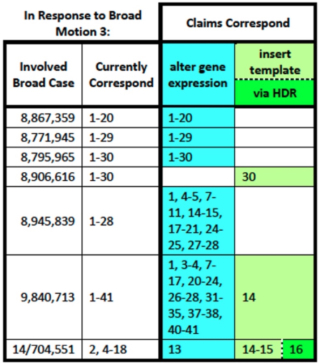
    And for the claims Sigma-Aldrich did contest the Opposition set forth these tables:

    Image 1
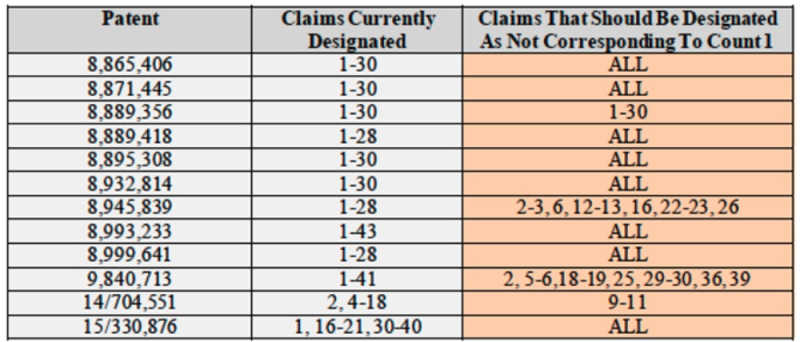
    In its Reply, Broad sets forth its own table of what it characterizes as Sigma-Aldrich's "concessions" for claims the Board should de-designate:

    Image 2
    Regarding the remaining claims still in dispute, Broad argues that continuing the designation of any of the claims in Category E would be inequitable because, inter alia, the "one-way" obviousness test urged by Sigma-Aldrich as a standard is not a per se rule that must be applied when the outcome would be unfair to one party.  The unfairness, as Broad argued in its Motion, is that its proofs using dual-molecule RNA CRISPR embodiments without a donor template are excluded by Count 1 despite that Count encompassing such embodiments.  Broad asserts that it "should not be excluded from using its earliest dual-molecule proofs for Count 1 while simultaneously putting at risk claims with the same scope."  Citing Eli Lilly & Co. v. Board of Regents of University of Washington, 334 10 F. 3d 1264, 1268 (Fed. Cir. 2003), Broad argued that "the PTAB [has] the discretion to adopt a two-way test to prevent 'the proliferation of unnecessary, wasteful interference proceedings concluding that both parties are entitled to patents in situations in which the claimed inventions do not define the same patentable invention, but merely overlap in scope.'"  Broad further argues that Sigma-Aldrich did not address much less refute their arguments in Motion No. 3, nor that the term "guide RNA" encompasses both single- and dual-molecule RNA components of CRISPR-Cas9 embodiments encompassed by the Count.

    As it has in other Replies Broad argues that Sigma-Aldrich has improperly incorporated by reference arguments in its Opposition that were made in other Oppositions, thus achieving an expanded length of its arguments to avoid page limits, in violation of Standing Order ¶ 106.2.  Broad also argues that some of Sigma-Aldrich's arguments so incorporated from its Oppositions and ex parte prosecution are contradictory to arguments made in this Opposition.  The example most relevant to Broad's arguments here are Sigma-Aldrich's purported arguments elsewhere that "Donor Template Integration and other forms of cleavage and repair were separately patentable inventions, and that a POSA would not have reasonably expected success in integrating a donor template even if the art showed recognition of successful cleavage and repair in a eukaryotic cell."  In sum Broad asserts that "Sigma thus repeatedly argued that Donor Template Integration and other forms of cleavage and repair were separately patentable inventions in securing its claims.  Accordingly, Broad's claims that require neither sgRNA nor Donor Template Integration should be designated as not corresponding to Count 1."

    For these reasons Broad asks the Board to grant its Contingent Motion No. 3 should the Board deny its Preliminary Motion No. 1.

  • By Kevin E. Noonan

    Broad InstituteOn December 3rd, Junior Party the Broad Institute, Harvard University, and MIT (collectively, Broad) filed its Contingent Preliminary Motion No. 2 in Interference No. 106,133 (which names Sigma-Aldrich as Senior Party), asking the Patent Trial and Appeal Board to add claims 52-54 of Broad Application No. 16/177,403 to the interference, pursuant to the provisions of 37 C.F.R. §§ 41.121(a)(1)(i) and 41.208 and Standing Order ¶ 203.2.  The motion was contingent on the Board granting Broad's Substantive Preliminary Motion No. 1 to substitute the Count.  On March 16th, Sigma-Aldrich filed its Opposition and on April 26th Broad filed its Reply.

    The claims that were the subject of Broad's Motion recite a CRISPR method in eukaryotic cells that cleaves both strands and repairs the break by integration of a template polynucleotide.  Claim 52 is generic with regard to the guide RNA species, comprising dual-molecule and single-molecule (sgRNA) species:

    52.  A method comprising: introducing into, or expressing in, a eukaryotic cell having a DNA molecule,
        (I) a Cas9 protein or one or more nucleotide sequences encoding the Cas9 protein,
        (II) an RNA or one or more nucleotide sequences encoding the RNA, the RNA comprising:
            (a) a first RNA comprising a first ribonucleotide sequence and a second ribonucleotide sequence, and
            (b) a second RNA, and
        (III) a template polynucleotide,
        wherein, the second RNA forms an RNA duplex with the second ribonucleotide sequence, and wherein, in the eukaryotic cell, the first ribonucleotide sequence directs the Cas9 protein to a target sequence of the DNA molecule, whereby the Cas9 cleaves both strands of the DNA molecule and the cleavage is repaired by integration of the template polynucleotide into  the DNA molecule in the eukaryotic cell.

    Claim 53 (dual molecule RNA species) and claim 54 (single-molecule RNA species) recite the two alternative species.  Broad asserted that these claims were deemed allowable by the U.S. Patent and Trademark Office Examiner on November 15, 2021.

    Sigma-Aldrich's Opposition noted that this motion will become moot should the Board deny Broad's Preliminary Motion No. 1 to change the Count.  Sigma-Aldrich also asserted that none of the claims in the '403 application have been allowed (or considered in condition for allowance) by the Examiner, prosecution of that application having been suspended with the Declaration of this Interference.  Should the Board reach the merits, Sigma-Aldrich contended that Broad has not applied the one-way obviousness test to address whether these claims 52-54 satisfy the written description requirement of 35 U.S.C. § 112(a).  Sigma-Aldrich also accused Broad of not satisfying the Board's requirements for leave to file Contingent Motion No. 2, characterizing Broad's position as being "misleading" and citing several assertions from the Contingent Motion that state or imply that the Examiner has made an allowability determination.  And on the merits Sigma-Aldrich asserted that under the one-way test for obviousness Claims 53 and 54 are not patentable over Proposed Count 3.

    In its Reply, Broad first addresses Sigma-Aldrich's incorporation by reference of what Broad states is over 25 pages from its Opposition to Broad's Preliminary Motion No. 1, which besides being improper under Standing Order ¶ 106.2 was the only basis for several arguments.  Accordingly, Broad states that these arguments should be considered waived.  Broad also argues that Claim 52 "was and is allowable" because the Examiner sua sponte indicated these claims were allowable (and remained so upon entry of further amendments).  Allowability follows for dependent claims 53 and 54, which recite species of the RNA component of the claimed CRISPR-Cas9 complexes recited in Claim 52.  Broad further sets forth the basis for adequate written description of Claims 52-54 in the Zhang B1 priority document, because the disclosure in that document is identical in the specification of the '403 application (which incorporates the B1 application by reference, providing "an unbroken chain of identical disclosures supporting the subject matter of claims 52-54").

    As in other Replies, Broad sets forth the basis for the Board to find claims 52-54 to be patentable over Sigma-Aldrich's earliest priority disclosure and why the '403 application is entitled to the benefit of pre-AIA status.  Regarding the latter argument, Broad argues that AIA §§ 3(n)(1) and 3(n)(2) (the statutory basis for Sigma-Aldrich's argument) do not apply to priority claims to a provisional application under 35 U.S.C. § 119(e) (although a fair reading of the statute would appreciate that the basis for the distinctions under the AIA relate to the claims in a pre-AIA priority application and provisional applications have no claims, at least not formally).  And Broad reminds the Board that Sigma-Aldrich attempted to broach this issue in its own Preliminary Motion but the Board denied that request.  On the merits, Broad also contends that any differences between what is disclosed in the '403 application and the priority applications, including the Zhang application, do not satisfy the standard to qualify as new matter and hence prohibit pre-AIA status.

    For all these reasons, Broad asks the Board to grant this Motion if it grants Broad's Preliminary Motion No. 2.

  • By Kevin E. Noonan

    Supreme Court Building #1The faintest glimmer of hope crept over the clouded patent law horizon today, when the Solicitor General provided the government's views to the Supreme Court in an amicus brief in American Axle & Manufacturing, Inc., Petitioner v. Neapco Holdings LLC.  A simple synopsis is provided in the first sentences of the Discussion section of the brief:  "The court of appeals held that claim 22 of the '911 patent, which claims a method of manufacturing automobile driveshafts that uses specific mechanical structures and calibrates particular physical properties, is patent-ineligible under Section 101.  That holding is incorrect."  The Solicitor General expresses the government's view that the Court should grant certiorari with respect to Question 1 of the Questions Presented.  Hallelujah.

    The first portion of the brief sets forth the background of the invention, the patent, the litigation, and both Federal Circuit panel (1 and 2) and en banc opinions (the latter deciding not to rehear the case en banc).  In summary, a divided panel (Judges Dyk and Taranto) affirmed the District Court's summary judgment decision that the claims below are ineligible for patenting under the Supreme Court's decisions in Mayo Collaborative Servs. v. Prometheus Labs., Inc. and Alice Corp. Pty. Ltd. v. CLS Bank International.

    1.  A method for manufacturing a shaft assembly of a driveline system, the driveline system further including a first driveline component and a second driveline component, the shaft assembly being adapted to transmit torque between the first driveline component and the second driveline component, the method comprising:
        providing a hollow shaft member;
        tuning at least one liner to attenuate at least two types of vibration transmitted through the shaft member; and
        positioning the at least one liner within the shaft member such that the at least one liner is configured to damp shell mode vibrations in the shaft member by an amount that is greater than or equal to about 2%, and the at least one liner is also configured to damp bending mode vibrations in the shaft member, the at least one liner being tuned to within about ±20% of a bending mode natural frequency of the shaft assembly as installed in the driveline system.

    22.  A method for manufacturing a shaft assembly of a driveline system, the driveline system further including a first driveline component and a second driveline component, the shaft assembly being adapted to transmit torque between the first driveline component and the second driveline component, the method comprising:
        providing a hollow shaft member;
        tuning a mass and a stiffness of at least one liner, and
        inserting the at least one liner into the shaft member;
        wherein the at least one liner is a tuned resistive absorber for attenuating shell mode vibrations and
        wherein the at least one liner is a tuned reactive absorber for attenuating bending mode vibrations.

    The majority's rationale, which the Solicitor General argues was erroneous, was based on the claims reciting nothing more than a "natural law" (Hooke's Law), despite this physics concept appearing nowhere in the claims.  Judge Moore strongly dissented in both the original panel decisions and the decision not to rehear the matter en banc.

    The Solicitor General's brief is directed to the first of the Questions Presented:

    Section 101 of the Patent Act of 1952, 35 U.S.C. 1 et seq., provides that "any new and useful process, machine, manufacture, or composition of matter, or any new and useful improvement thereof," is eligible for a patent.  35 U.S.C. 101.  The questions presented are as follows:

    1.  Whether claim 22 of petitioner's patent, which claims a process for manufacturing an automobile driveshaft that simultaneously reduces two types of driveshaft vibration, is patent-eligible under Section 101.

    2.  Whether patent-eligibility under Section 101 is a question of law for the court based on the scope of the claims or a question of fact for the jury based on the state of the art at the time of the patent.

    The Solicitor General's (SG) argument is based on traditional concepts of patent-eligible subject matter.  The SG states that "[h]istorically, [later specified as "for more that 150 years"] such industrial techniques have long been viewed as paradigmatic examples of the 'arts' or 'processes' that may receive patent protection if other statutory criteria are satisfied."

    The brief states in several places that it is the Mayo/Alice framework itself that has "given rise to substantial uncertainty."  It is perhaps a not-so-subtle signal that the SG's brief cites for many of these historical principles the Court's decision in Diamond v. Diehr, perhaps signaling to the Court that in making its rhetorical choice in Mayo, the Court would have been better served to follow Diehr rather than Parker v. Flook, which was decided earlier.  The SG's brief sets forth four "relevant considerations" that "supply useful guideposts" in properly applying the Mayo/Alice test.  These are:

    First, a fundamental distinction between patents that "claim the 'building blocks' of human ingenuity" and those that "integrate the building blocks into something more," and "thereby 'transforming' them into a patent-eligible invention."  The brief characterizes the purpose of the test to "distinguish between those two types of claimed inventions."  The brief cites again Diehr to be illustrative of the difference between patent-eligible and -ineligible claims.

    Second, that the Court has equally recognized that "[a]t some level, 'all inventions . . . embody, use, reflect, rest upon, or apply laws of nature, natural phenomena, or abstract ideas,' " citing (ultimately) Mayo, and that this recognition produced on the Court an obligation to "tread carefully in construing th[e] exclusionary principle lest it swallow all of patent law," and that "an invention is not rendered ineligible for patent simply because it involves" a patent-ineligible concept, citing Diehr and providing as an example Eibel Process Co. v. Minnesota & Ontario Paper Co., 261 U.S. 45, 52-69 (1923).

    Third, the SG implicates the importance (and restrictions) that "the Section 101 inquiry is guided by historical practice and judicial precedent," citing Bilski v. Kappos, 561 U.S. 593 (2010), for this reliance (and obligation) on history.  These obligations are particularly relevant here, according to the SG, because "[c]ourts thus should be skeptical of any assertion that a claim for the sort of process that has long been held patent-eligible, such as an industrial manufacturing process, is unpatentable under the 'law of nature' exception."

    Finally, the SG raises the Court's concern regarding preemption (as a justification for the exclusionary exceptions with regard to the constitutional limitations of Congress's power to grant patents).

    The SG advocates that the Federal Circuit erred in the applications of these principles, in particular comparing American Axle's claims and the claims in Mayo and Alice.  In the SG's view, the claims at issue here are an application of natural law (such as Hooke's law) that are eligible "because all useful inventions that operate in the physical world depend for their efficacy on natural laws (whether known or unknown), such dependence by itself cannot render claim 22 patent-ineligible" (the SG making explicit favorable comparisons again with the claims in Diehr).  The SG in similar fashion sees the claims here to be consistent with the Supreme Court's eligibility principles as illustrated herein.

    The SG also distinguishes Claim 22 here from Claim 8 in Morse's patent invalidated by the Court in O'Reilly v. Morse, 56 U.S. (15 How.) 62 (1854).  The SG's basis for this distinction is that Claim 22 does not merely recite a "goal" (analogous to Morse's claim) but rather "recites a specific sequence of steps to achieve that goal."  The brief makes an important argument regarding the panel majority's reasoning in this regard, saying that the majority committed fundamental error in its "premise that conventional claim elements could be disregarded at step two of the Mayo/Alice test."  And the SG traces that error to the language in both Mayo and Alice that "a claim must include more than steps or elements that are 'well-understood, routine, conventional activities' in the relevant field."  But the SG apprehends that the Court "did not intend to endorse a categorical rule that conventional claim elements should be disregarded in determining whether particular claims reflect an " inventive concept, " or "add enough" to natural laws or phenomena, so as to warrant patent protection."  The basis for this apprehension is that the Court "did not question the long-settled understanding that the patent eligibility of a process claim turns on 'the process as a whole, and that 'an application of a law of nature or mathematical formula' may be patent-eligible even if the law or formula is applied 'to a known structure or process,'" again citing Diehr.

    And this question is "especially important" according to the SG because its answer is relied upon in addressing the second step of the Mayo/Alice test.  In view of this importance, the SG states that "the step-two analysis should be performed in accordance with the longstanding principle that a combination of claim elements may reflect a patent-eligible invention even though each individual element was part of the prior art" (emphasis added).  The SG suggests that what cannot happen is for a court to be foreclosed in step two of the Mayo/Alice test from considering claim elements that have "traditionally been viewed as relevant to patent-eligibility" (because they are "routine, conventional, and well-understood," for example), then those considerations would need to be "incorporated in some fashion into the step-one inquiry."

    The SG also takes the opportunity to review the somewhat bedraggled ("fractured") state of eligibility jurisprudence at the Federal Circuit, citing specifically Athena Diagnostics, Inc. v. Mayo Collaborative Servs., LLC, 915 F.3d 743 (Fed. Cir. 2019), and Ariosa Diagnostics, Inc. v. Sequenom, Inc., 788 F.3d 1371 (Fed. Cir. 2015) (and noting in each instance that rehearing was denied).  This "ongoing uncertainty" has caused "every judge" on the Federal Circuit to ask for Supreme Court clarification of the standard (citing Judge Moore's dissent below).  The SG also notes and calls out the particular problems that have arisen regarding the proper scope of eligibility in fields such as medical diagnostics (again citing Judge Moore).  But, the SG notes, the problem of "inconsistency and unpredictability of adjudication" extend to "all fields," citing Judge Newman's dissent in Yu v. Apple Inc., 1 F.4th 1040, 1049 (Fed. Cir. 2021), and Chamberlain Grp., Inc. v. Techtronic Indus. Co., 935 F.3d 1341, 1348 (Fed. Cir. 2019).  Also garnering mention is the commentary accompanying the 2019 Guidance on Subject Matter Eligibility at the USPTO, which asserted that interpreting the Supreme Court's and Federal Circuit's jurisprudence on subject matter eligibility has been "in a consistent manner has proven to be difficult"; "has caused uncertainty in this area of the law"; has made it difficult for "inventors, businesses, and other patent stakeholders to reliably and predictably determine what subject matter is patent eligible"; and "poses unique challenges for the USPTO" itself.

    The brief concludes with the SG's opinion that this case is a suitable vehicle for the Court to provide the requested "greater clarity," and rebuts each of Respondent's reasons why the Court should not grant certiorari.  As for the second of the Questions Presented, the SG states that the Court must clarify eligibility by addressing the first Question because the procedural answer to the Second ("satellite") Question depends on the Court's answer to the first.

    Whether due to the change of administrations, or the mounting number of certiorari petition denials on subject matter eligibility, or the facial egregiousness of finding claims to methods for reducing vibration in a truck axle ineligible as being nothing more than a natural law, the SG's brief raises the possibility that the Court will reduce if not refute some of the more worrisome extensions by lower courts of its Mayo/Alice precedent.  While Respondents and others have urged the Court to consider eligibility cases from the life sciences or computer technologies, it is perhaps better for a simpler technology to be the basis for the Court's reconsideration, in the same way that patent practitioners just starting out learn their craft by drafting simple mechanical claims.  Without the distraction of the technology, perhaps, the foundational principles that patent laws have traditionally relied upon may become easier to discern and produce a more consistent, reliable test that has fewer anomalous results and that restores the ability to patent American innovation in important technological areas.  A patent practitioner can dream, after all.

  • By Kevin E. Noonan

    Broad InstituteOn December 3rd, Junior Party the Broad Institute, Harvard University, and MIT (collectively, Broad) filed its Substantive Preliminary Motion No. 1 in Interference No. 106,133 (which names Sigma-Aldrich as Senior Party), asking the Patent Trial and Appeal Board (PTAB) to substitute the interference Count, pursuant to the provisions of 37 C.F.R. §§ 41.121(a)(1)(i) and 41.208(a)(2).  On March 16th Senior Party Sigma-Aldrich filed its Opposition to Broad's Motion and on April 26th Broad filed its Reply.

    As a reminder, Broad's Proposed Substitute Count takes the "McKelvey" format (comprising in the alternative a claim from one of each Party's applications in interference); the proposed change is in the portion of the Count reciting Broad's claims:

    Proposed Count No. 3 (numbered presumably for consistency with other pending CRISPR-related interferences):

    Sigma-Aldrich Application No. 15/456,204 (as declared)

    or

    Claim 2 of Broad Application No. 16/177,403:

    52.  A method comprising: introducing into, or expressing in, a eukaryotic cell having a DNA molecule,
        (I) a Cas9 protein or one or more nucleotide sequences encoding the Cas9 protein;
        (II) an RNA or one or more nucleotide sequences encoding the RNA, the RNA comprising: (a) a first RNA comprising a first ribonucleotide sequence and a second ribonucleotide sequence, and (b) a second RNA;
    and
        (III) a template polynucleotide;
        wherein, the second RNA forms an RNA duplex with the second ribonucleotide sequence, and
        wherein, in the eukaryotic cell, the first ribonucleotide sequence directs the Cas9 protein to a target sequence of the DNA molecule, whereby the Cas9 cleaves both strands of the DNA  molecule and the cleavage is repaired by integration of the template polynucleotide into the DNA molecule in the eukaryotic cell.

    In proposing this Substitute Count, Broad emphasized Sigma-Aldrich's contentions during prosecution that its invention comprised "cleave + insertion" CRISPR methods in eukaryotic cells which were patentably distinct from embodiments comprising "cleavage only" followed by non-homologous end joining of the cleaved DNA target.  In making this Motion, Broad clearly intended to cabin Broad's claims at risk in the interference to a small subset of those claims.

    In support of its Motion, Broad relied heavily on Sigma-Aldrich's arguments taking substantially the same position in Interference No. 106,132 against Junior Party the University of California, Berkeley; the University of Vienna; and Emmanuelle Charpentier (collectively, "CVC") (see "Sigma-Aldrich Files Substantive Preliminary Motion 1 to Change the Count in Interference No. 106,132"), including arguments Sigma-Aldrich has made regarding the propriety of its claims not being part of other interferences having interfering subject matter limited to "cleavage only" eukaryotic CRISPR methods:

    Sigma is properly not a party to those pending 'cleavage only' interferences because all of Sigma's involved claims are directed solely to the patentably distinct 'cleavage plus integration' technological advance in the art.

    The first argument in Sigma-Aldrich's Opposition asking the Board to deny Broad's Motion No. 1 was procedural, that Claim 52 of U.S. Application No. 16/177,403 (the '403 application) had not been determined to be allowable when Broad filed its motion (complete with a timeline produced from the '403 application's prosecution history).  In addition, Sigma-Aldrich contended "Broad's Claim 52 is exceedingly broad for at least eight reasons" (as well as being properly subject to the first-inventor-to-file requirements under the Leahy-Smith America Invents Act (AIA) and thus ineligible for consideration in an interference).  Sigma-Aldrich also contended that "Broad never even asserts, let alone demonstrates, that 'cleavage plus altering gene expression' is patentably distinct from 'cleavage plus integration by [Homology-Dependent Recombination] HDR'" (in a footnote providing a tally that "[o]f Broad's 461 involved patent claims, 340 claims are directed to 'cleavage plus altering gene expression' (or an analogous recital), 42 claims are directed to insertion of a 'template,' and 8 dependent claims are directed to 'cleavage plus integration by HDR'").  Finally, Sigma-Aldrich asserted that Broad has neglected to "explain how Claim 52 is patentable over Sigma P1."  Citing Louis v. Okada, 2011 Pat. App. 21 LEXIS 24048, at *10 (BPAI May 25, 2011), Sigma-Aldrich contended that a party in an interference must show that there is a genuine need to change the Count and not make a "change for change's sake."

    In its Reply, Broad tells the Board that Sigma-Aldrich's Opposition must fail because the Senior Party did not "meaningfully dispute" any of Broad's three reasons for moving to substitute the Count, particularly with regard to the issue that the Count as declared encompasses two distinct inventions (i.e, "cleavage + altering gene expression" and "cleavage + integration" of heterologous DNA).  Broad defines this scope (of the "commonly-claimed interfering subject matter") as "use of a CRISPR-Cas9 system in a eukaryotic cell to target and cleave both strands of a DNA molecule, with the cleavage being repaired by integrating a donor polynucleotide sequence ("Donor Template Integration")(an interpretation that would liberate most (340) of Broad's claims corresponding to Count 1 of the interference as declared).  Broad's arguments are directed to some degree to the nature of the McKelvey Count itself, wherein distinct aspects of patentably indistinct inventions are combined (the latter characterization forming the core of Broad's dispute).  Broad also argues regarding the similarity between Sigma Claim 31 and claim 18 from an involved CDC patent in the '115 interference (in which Broad mentions in passing it the Board granted them priority).  The Count as declared "[will] work a tremendous injustice" upon Broad should the Board deny its Motion No. 1 and Sigma-Aldrich be deemed entitled to priority on the half of the Count Broad contends it is entitled, the Reply asserts.  Broad also argues that Sigma-Aldrich has not "explain[ed] away" its statements agreeing with the patentable distinction Broad argues exists between the two portions of the McKelvey Count as declared in this interference.  And Broad reiterates its argument that the position Sigma-Aldrich takes in its Opposition is contrary to positions it has taken during ex parte prosecution of its applications-in-interference (including U.S. Application  15/456,204) and in Interference No. 106,132.  Finally, Broad argues that both its dual-molecule and single-molecule proofs will be excluded if the Board maintains Count 1 as declared, the latter set of proofs having been the basis for Broad prevailing in the '115 Interference and hence (according to Broad) be unjust.

    Sigma-Aldrich's procedural arguments are relegated to a shorter portion of the Reply, regarding whether Claim 52 was in condition for allowance and whether the '403 application is entitled to the provisions of the 1952 Patent Act and thus properly within the purview of an interference.  Broad dissects the former argument allegation-by-allegation with regard to what Claim 52 recites.  And regarding the '403 application's status as a pre-AIA application, Broad argues that AIA §§ 3(n)(1) and 3(n)(2) (the statutory basis for Sigma-Aldrich's argument) do not apply to priority claims to a provisional application under 35 U.S.C. § 119(e)(although a fair reading of the statute would appreciate that the basis for the distinctions under the AIA relate to the claims in a pre-AIA priority application and provisional applications have no claims, at least not formally).  And Broad reminds the Board that Sigma-Aldrich attempted to broach this issue in its own Preliminary Motion but the Board denied that request.  On the merits, Broad also contends that any differences between what is disclosed in the '403 application and the priority applications, including the Zhang application, do not satisfy the standard to qualify as new matter and hence prohibit pre-AIA status.  Broad also rejects Sigma-Aldrich's attempts to incorporate arguments by reference from its Oppositions to other Broad Preliminary Motions, understanding these efforts to be a way for Sigma-Aldrich's arguments to exceed the page limit for its Opposition here.  Finally, Broad argues that its Claim 52 is patentable to Broad over Sigma's earliest priority application, U.S. Application No. 61/734,256.

    For all these reasons Broad asks the Board to grant its Preliminary Motion No. 1.

  • CalendarMay 23, 2022 – "Patent Eligibility, Prior Art, Obviousness and Disclosure 2022: Current Trends in Sections 101, 102, 103 and 112" (Practising Law Institute)

    May 24, 2022 – Examination practices and procedural guidance for 35 U.S.C. § 103 obviousness rejections (Part 2) – virtual Instructor-Led Training (vILT) series (U.S. Patent and Trademark Office) – 9:00 am to 11:00 am (ET)

    May 25, 2022 – "The True Cost of IDS: Time, Money, and Your Sanity" (Juristat) – 1:00 pm (ET)

    May 25, 2022 – Examination practices and procedural guidance for 35 U.S.C. § 103 obviousness rejections (Part 2) – virtual Instructor-Led Training (vILT) series (U.S. Patent and Trademark Office) – 1:00 pm to 3:00 pm (ET)

    May 26, 2022 – "A Practical Guide to Litigation Funding" (Woodsford) – 12:00 pm (ET)

    May 26, 2022 – Examination practices and procedural guidance for 35 U.S.C. § 103 obviousness rejections (Part 2) – virtual Instructor-Led Training (vILT) series (U.S. Patent and Trademark Office) – 5:00 pm to 7:00 pm (ET)

    June 2-3, 2022 – Life Sciences Patents (American Conference Institute) – New York

    June 28, 2022 – UPC Masterclass — Session 3: "The UPC Approach to Damages Actions and Compensation Claims" (Hoffmann Eitle)

    June 30, 2022 – UPC Masterclass — Session 3: "The UPC Approach to Damages Actions and Compensation Claims" (Hoffmann Eitle)

    July 8, 2022 – UPC Masterclass — Session 4: "The New Regime on the Revocation of European Patents/ The 'Long-arm Jurisdiction'" (Hoffmann Eitle)

  • PLI #1Practising Law Institute (PLI) will be offering an online program entitled "Patent Eligibility, Prior Art, Obviousness and Disclosure 2022: Current Trends in Sections 101, 102, 103 and 112" on May 23, 2022.  The program is geared to patent lawyers who have some familiarity with existing 35 U.S.C. Sections 101/102/103 and regularly work with the statute in either litigation or patent prosecution.  The course will advance the knowledge of all attendees from their respective starting points and provide new insights into the statute, recent amendments, and case law.  The program will address the following topics:

    • Section 101: What to do?
    • 102 and its dates: Is the "grace period" real?
    • Understanding the "effective filing date" in global terms
    • Analyzing 102 — pre- and post-AIA
    • A comprehensive review of post-KSR 103 via CAFC and PTAB precedent
    • Impact of benefit claims on the prior art date of an "effectively filed" reference and the "effective filing date" of the application being examined

    PLI faculty will offer presentations on the following topics:

    • 35 USC 101: What Can Be Patented in 2022?
    • Section 102 Conditions for Obtaining a Patent; Novelty: Inside and Outside the PTO – Cases and Decisions
    KSR and 103: Conditions for Obtaining a Patent; Non-Obvious Subject Matter
    • 35 USC 112 Patent Specifications – Decisions on Disclosure and Claiming: Some Case Studies
    • The 102(b) Exceptions to Prior Art Against Patents – Made Simple!

    The registration fee for program is $1,850.  Those interested in registering, can do so here.

  • JuristatJuristat will offer a one-hour webinar entitled "The True Cost of IDS: Time, Money, and Your Sanity" on May 25, 2022 at 1:00 pm (ET).  The webinar will discuss:

    • The benefits of IDS automation
    • How to determine the true cost of IDS prep and filing for your firm
    • How supplementing with AI can improve staff satisfaction and retention rates
    • And tackle some FAQs we hear from clients

    Those interested in registering for the webinar can do so here.

  • WoodsfordWoodsford will be offering a live webinar entitled "A Practical Guide to Litigation Funding" on May 26, 2022 at 12:00 pm (ET).  Russell Tonkovich of Kramer Day, and Alex Lempiner and Robin M. Davis of Woodsford will address a number of common questions raised by those seeking litigation funding, including:

    • What benefits can funding offer?
    • What are the criteria for a case to be eligible for funding?
    • What are the necessary diligence and transactional processes required to secure funding?

    The webinar will also shed some light on these common inquiries by:

    • Providing a brief overview of litigation funding and its benefits
    • Identifying the fundamental criteria of a viable funding opportunity
    • Detailing the mechanics of the funder's underwriting process
    • Examining the principal sections of a litigation funding agreement.

    Those wishing to register for the webinar can do so here.