• By Donald Zuhn —

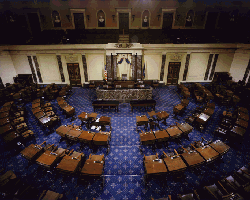
    Senate Floor After considering three amendments, rejecting two and tabling a third, the Senate today voted 89 to 9 in favor of H.R. 1249, the House version of the Leahy-Smith America Invents Act.  Opposing passage of the bill were Senators Barbara Boxer (D-CA), Maria Cantwell (D-WA), Tom Coburn (R-OK), Jim DeMint (R-SC), Ron Johnson (R-WI), Mike Lee (R-UT), John McCain (R-AZ), Claire McCaskill (D-MO), and Rand Paul (R-KY); Senators John Rockefeller IV (D-WV) and Marco Rubio (R-FL) did not vote; a list of Senators voting for passage can be found here.  While proponents of the bill secured a wide margin in favor of passage of the legislation, the margin was not as overhwelming as the Senate's 95-5 vote in favor of S. 23 in March (see "Senate Passes S. 23").

    Before voting on H.R. 1249, the Senate considered three amendments to the legislation.  The first amendment to be considered, SA 600 (Congressional Record (September 7, 2011) p. S5392), was submitted by Sen. Jeff Sessions (R-AL).  This amendment, which would have struck Section 37 concerning the calculation of the 60-day period for application of patent term extension (the so-called MedCo amendment), was rejected by a narrow 51-47 vote.  The second amendment to be considered, SA 595 (Congressional Record (September 7, 2011) p. S5390), was submitted by Sen. Cantwell.  This amendment, which offered a replacement for Section 18 providing a transitional program for covered business-method patents, was rejected by a 85-13 vote (with one Senator voting present).  The third and final amendment to be considered, SA 599 (Congressional Record (September 7, 2011) p. S5391), was submitted by Sen. Coburn.  This amendment, which would have replaced Section 22 of the House bill concerning USPTO funding with the USPTO funding provisions of S. 23, was tabled by a close 50-48 vote.  Under Senate rules, the agreement to table the third amendment was equivalent to defeating the amendment tabled.

    H.R. 1249 will now be sent to the President for his signature (based on the President's schedule, any signing is unlikely to occur tomorrow).

  • By James DeGiulio —

    Teva's Patents Covering Copaxone Upheld in Infringement Suit

    Teva #2 Mylan failed in its efforts to dismiss Teva's patent suit over the multiple-sclerosis drug Copaxone when the patents directed to the active pharmaceutical ingredient (API) in the drug, glatiramer acetate, were upheld as valid.  In September 2008, Teva brought suit in the Southern District of New York against Sandoz, and in 2009 against Mylan, after both companies filed Abbreviated New Drug Applications (ANDAs) for Copaxone (see "Court Report," September 7, 2008 and November 8, 2009).  Teva asserted four patents in its infringement suits:  U.S. Patent Nos. 7,199,098, 6,939,539, 6,054,430, and 6,620,847.  Among other defenses, Mylan and Sandoz argued that the patents were invalid.  The defendants argued during claim construction that the claims were indefinite because the molecular weight of the compound was not described sufficiently, and both defendants moved for summary judgment on this issue.  Sandoz' motion was denied, while Mylan's motion was pending.  In October 2010, Teva attempted to force the defendants to provide advance notice of their intent to launch the generic.  This attempt was not successful.  On July 5, the District Court again denied Teva's request for an order directing the generic drug makers to provide the Court and Teva with 10 days notice prior to the launch of their generic Copaxone products, ruling that the defendants "are under no legal obligation" to provide such notice.  The trial was scheduled to begin today.

    Mylan #1 On August 29, Judge Barbara S. Jones issued a Memorandum and Order denying Mylan's summary judgment motion that the patents are invalid under 35 U.S.C. § 112 for not explicitly defining the molecular weight of the glatiramer acetate.  Mylan's main objection was that the definition focused on how the chemical compound is made.  The defendants also argued that the term "molecular weight" as it is used in the asserted patents was merely a "random amino acid composition" because it was made up of molecules with average molecular weights.  Judge Jones rejected this definition, adopting Teva's claim that the "copolymer-1" that makes up the drug is a mixture of molecules, all with different molecular weights.  The parties also disputed the term "average molecular weight," which Sandoz and Mylan asserted as subject to several interpretations, thus rendering term invalid.  However, Judge Jones noted that Teva had successfully argued during the prosecution of the patent that a person of ordinary skill would understand its meaning.  This was found to produce a presumption that the description complies with the provisions of 35 U.S.C. § 112.


    Mylan Found to Infringe One of Galderma's Oracea Patents

    Galderma Mylan was found to infringe one of five patents asserted against it, but managed to invalidate two of the five patents, in Galderma's suit against the generic drug maker for infringement of patents directed to the rosacea drug Oracea.  On October 19, 2010, Galderma filed suit in the District of Delaware, asserting that Mylan's ANDA infringed U.S. Patent Nos. 5,789,395, 5,919,775, 7,211,267, 7,232,572, and 7,749,532, which are directed to a once-daily administration of doxycycline for the treatment of acne rosacea.  Galderma launched two suits, which were later consolidated.  Mylan answered by asserting that the patents were invalid and unenforceable, and that its product did not infringe any of the claims of the five patents.  Mylan's ANDA was approved in July 2010, and Galderma quickly secured a preliminary injunction against Mylan, blocking the company from entering the market with its generic Oracea product.

    Mylan #2 On August 26, Judge Leonard P. Stark, in a detailed Opinion, determined that Galderma had proved by a preponderance of the evidence that Mylan's proposed generic rosacea drug infringed all of the asserted claims of the '532 patent (the "Chang" patent), which is not set to expire until on December 19, 2027.  The Chang patent, which was upheld in the face of anticipation, obviousness, inventorship, and written description challenges, covers the formulation for Oracea.  Judge Stark also ruled that Galderma had failed to prove that Mylan had infringed any claims of the other four patents, and that Mylan successfully demonstrated that the '395 and '775 patents were invalid.  These patents were invalidated due to inherent anticipation, where the prior art disclosed the use of a high dose of tetracycline to treat periodontitis or rheumatoid arthritis, diseases with similar properties as rosacea.

    Despite finding that Mylan's proposed product would infringe the Chang patent, Judge Stark declined to adopt the remedy suggested by Galderma, which was to convert the preliminary injunction in place into a permanent injunction.  Further, Galderma requested to change the effective date of FDA approval of Mylan's ANDA to a date no earlier than the expiration of the latest asserted, valid patent.  Judge Stark stated that while Galderma is entitled to some relief, neither party had prevailed in the entirety of its positions.  He also said it was noteable that the only patent Mylan was found to have infringed issued well after the company filed its ANDA.  As such, he said he would require the parties to submit briefs addressing the appropriate remedy and would leave the preliminary injunction in place for now.


    Shire Avoids Dismissal in Patent Suit over Generic Intuniv

    Shire Pharmaceuticals Impax and Watson were unsuccessful in their attempt to dismiss a patent infringement suit brought by Shire over a generic version of Shire's ADHD drug Intuniv.  On December 2, 2010, Shire and the inventors brought suit in the Northern District of California for patent infringement and a declaratory judgment against defendants Impax and Watson (see "Court Report," December 12, 2010).  Impax and Watson had both filed ANDAs for a generic form of guanfacine hydrochloride extended release tablets, and Shire asserted that this filing infringed U.S. Patent Nos. 5,854,290, 6,287,599, and 6,811,794.  Plaintiffs moved to dismiss all of defendants' counterclaims under Rule 12(b)(6) and to strike all their affirmative defenses Impax Laboratories under Rule 12(f).  Following Shire's motions, the defendants countered with a motion to dismiss the suit.  Impax and Watson argued that their answers to Shire's complaint are pleaded in the same fashion as the complaint itself.  Following this logic, defendants concluded that if the District Court dismissed their counterclaims and defenses, it should dismiss the complaint as well.

    Watson Pharmaceuticals On August 29, in an Order Denying Motions to Dismiss, Judge Richard Seeborg denied both plaintiffs' and defendants' motions.  Judge Seeborg noted that there would be little benefit in requiring parties to replead their claims and counterclaims with additional factual allegations.  Shire has been aggressively litigating its patent rights to Intuniv over the past year, having also brought suit against Mylan and Sandoz in West Virginia and Colorado federal court, respectively.

  • By Donald Zuhn —

    Senate Seal Earlier today, the Senate voted 93-5 to invoke cloture on a motion to proceed to H.R. 1249, the House version of the Leahy-Smith America Invents Act.  Opposing the motion were Senators Tom Coburn (R-OK), Jim DeMint (R-SC), Ron Johnson (R-WI), Mike Lee (R-UT) and Rand Paul (R-KY); Senators John Rockefeller IV (D-WV) and Marco Rubio (R-FL) did not vote on the motion; a list of Senators voting in favor of the motion can be found here.  The motion required a three-fifths majority vote of the Senate (i.e., 60 votes) to pass.

    As a result of the passage of the cloture motion, further consideration of H.R. 1249 by the Senate will now be limited to thirty hours (which includes the time used for roll call votes, quorum calls, reading of amendments, points of order, and inquiries to and responses by the Chair), no Senator will be allowed to speak on the legislation for more than one hour (Senators wishing to speak on the bill will be permitted to do so on a "first come, first served" basis), and only amendments to the bill presented prior to the cloture vote will be permitted.  According to the Senate Calendar of Business for Wednesday, September 7, the Senate will resume consideration of the motion to proceed to H.R. 1249 upon the conclusion of tomorrow's morning business.

    Coburn, Tom In a press release posted on his website today, Sen. Coburn (at left) provided a reason for his opposition to the cloture motion, declaring that "[f]ee diversion saps the lifeblood of the American economy — innovation and invention — in order to subsidize the desire of career politicians and appropriators in Congress to avoid hard choices," and adding that "[f]ee diversion operates like a tax on innovation, because it requires entrepreneurs to spend more money and time on activities than they would otherwise if patent fees remained fees."  Reviewing the history of the fee diversion provisions in the Senate version of the America Invents Act, Sen. Coburn states that:

    The Senate has already voted to end fee diversion, by a margin of 95 to 5.  That version of the bill the Senate passed included my amendment that sets up a new revolving fund at the Treasury in which user fees that are paid to the Patent and Trademark Office for a patent or a trademark go directly into the revolving fund for the office to use to cover its operating expenses.  Congress would no longer have the ability to take those fees and divert them to other programs; fee diversion would be ended once and for all — no more games, no more gimmicks.  My amendment was also in the bill that was passed by the House Judiciary Committee by a vote of 32 to 3.

    Unfortunately, the House gutted my amendment after negotiations with the House Appropriations Committee.  The appropriators are insisting, of course, that they have no intention of diverting fees.  History suggests they are not to be trusted.  They promised to end this practice in the past and kept doing it.

    There have been some reports that Sen. Coburn introduced a pre-cloture amendment to restore his previous anti-fee diversion provisions to H.R. 1249.  The Senator gives some credence to those reports by stating that:

    I intend to give Senate appropriators the chance to back up that claim by voting on my amendment to end fee diversion.  If my amendment fails, I will do everything in my power to slow the bill and highlight this egregious tax on innovation.

  • By Kevin E. Noonan —

    Classen Immunotherapies The Federal Circuit majority decision in Classen Immunotherapies, Inc. v. Biogen IDEC engendered a strong dissent from Judge Moore on almost every aspect of that decision.  Judge Moore disagreed with the majority's opinion that the claims were patent-eligible, that the issue of inherent anticipation was not properly before the Court, and that certain activities by defendant GlaxoSmithKline fell within the "safe harbor" provisions of 35 U.S.C. § 271(e)(1).  While all of her arguments warrant consideration, the importance of the question of patent-eligibility (particularly in view of Judge Moore's role in Association for Molecular Pathology v. U.S. Patent & Trademark Office, aka the Myriad case) compels this part of her dissenting opinion be discussed first.

    Judge Moore contends in her dissent that the claims in all of the patents-in-suit are ineligible because they are directed to a "fundamental scientific principle" and are "so basic and abstract" as to provide "a monopoly over the scientific method itself."  The dissenting opinion begins by comparing the claims at issue here with the claims in Prometheus Laboratories, Inc. v. Mayo Collaborative Services, agreeing with the majority that the Prometheus claims were "inapt"; the opinion disagrees with the majority's conclusion because, in Prometheus the Court provided a detailed analysis that distinguished the Prometheus claims from the principles enunciated in the earlier In re Grams case, and requires the conclusion that the transforming step (administering 6-thiopurine) was not a mere data gathering or insignificant post-solution activity, concluding that the administration step in the Prometheus claims "not preempt broadly the use of [the] natural correlation, but rather recited specific treatment steps with specific drugs."

    Judge Moore In contrast, Judge Moore (at left) contends in her dissent that the majority gave "no consideration of the extent of preemption by these staggeringly broad and abstract claims" in the instant case.  This included no specificity for treatment steps, "drugs" (including immunogens) or ("even") specific chronic immune disorders.  In addition, the dissent fails to discern the distinctions between the claims of the '283 patent that the majority found patent-ineligible and the claims of the '139 and '739 patents that the majority find patent-eligible.  In Judge Moore's analysis, claim 1 of the '283 patent has two steps:  immunizing mammals according to a schedule and comparing the incidence of chronic immune mediated disorder (CIMD) to a control group:

    A method of determining whether an immunization schedule affects the incidence or severity of a chronic immune-mediated disorder in a treatment group of mammals, relative to a control group of mammals, which comprises immunizing mammals in the treatment group of mammals with one or more doses of one or more immunogens, according to said immunization schedule, and comparing the incidence, prevalence, frequency or severity of said chronic immune-mediated disorder or the level of a marker of such a disorder, in the treatment group, with that in the control group.

    (In a footnote, she says that she is "perplexed" that the majority sees this as reciting one step, when she clearly sees two, i.e., the immunizing step and the comparison step).  She contrasts this with claim 1 of the '739 patent, which she says requires the steps of "comparing the incidence of [CIMD] between two groups of mammals . . . immunized according to different schedules and immuniz[ing] a mammal according to the lower risk schedule":

    1.  A method of immunizing a mammalian subject which comprises:
        (I)  screening a plurality of immunization schedules, by

            (a)  identifying a first group of mammals and at least a second group of mammals, said mammals being of the same species, the first group of mammals having been immunized with one or more doses of one or more infectious disease-causing organism-associated immunogens according to a first screened immunization schedule, and the second group of mammals having been immunized with one or more doses of one or more infectious disease-causing organism-associated immunogens according to a second screened immunization schedule, each group of mammals having been immunized according to a different immunization schedule, and
            (b)  comparing the effectiveness of said first and second screened immunization schedules in protecting against or inducing a chronic immune-mediated disorder in said first and second groups, as a result of which one of said screened immunization schedules may be identified as a lower risk screened immunization schedule and the other of said screened schedules as a higher risk screened immunization schedule with regard to the risk of developing said chronic immune mediated disorder(s),

        (II)  immunizing said subject according to a subject immunization schedule, according to which at least one of said infectious disease-causing organism-associated immunogens of said lower risk schedule is administered in accordance with said lower risk screened immunization schedule, which administration is associated with a lower risk of development of said chronic immune-mediated disorder(s) than when said immunogen was administered according to said higher risk screened immunization schedule.

    She sees "virtually no difference" between the claims with regard to the § 101 analysis:  immunizing and then comparing (the '238 patent) versus comparing and immunizing (the '139 and '739 patents).

    For Judge Moore, "this case is not even close" regarding patent-eligibility.  In her view, the '283 patent "claims the scientific method as applied to the field of immunization," since there are no limits on "the type of drug used to immunize[], the schedules that should be used for immunization, the type of [CIMD] to look for, or any limitation on the control group":

    It is hard to imagine broader claims.  It is harder to imagine a more conceptually abstract claim in the immunization area.  Classen's claims are directed to a thought apart from any concrete realities, specific objects or actual instances.  This is very much like patenting E=mc2.  Compare any two schedules to determine which one has fewer instances of immune disorders.  Compare two substances to determine which one tastes sweeter.  Compare two cups of coffee to determine which one is stronger.  Actually these examples are more concrete than the Classen claims in that I tell you what to look for — sweetness or strength.  The Classen claims do not even specify which immune disorder should be studied.  Likewise the representative claim from the '139 and '739 patents specifies no specific immune disease, drug, or schedule.  These claims cover any kind of comparison between any two schedules, using any drugs and comparing the incidence of any chronic immune disease.  After the user performs this completely abstract mental comparison, then the user should immunize the subject with the drug they choose on the schedule they deem lower risk.

    Citing Diamond v. Diehr for the principle that claims must be considered as a whole, Judge Moore also opines that these claims are "exactly the type of 'abstract intellectual concepts' that 'are the basic tools of scientific and technological work,'" citing Gottschalk v. Benson, 408 U.S. 63, 67 (1972).  And she rejects the idea that the claims are patent-eligible because they are limited to a single field of use, citing Parker v. Flook as cited with approval in Bilski v. Kappos, 130 S. Ct. 3218, 3230 (2010).

    In Judge Moore's view, the very simplicity of the claims (requiring only two steps, immunizing and comparing regardless of the order), mandates the conclusion that they impermissibly preempt a fundamental principle, which the dissent illustrates with scenarios of infringement.n  The opinion contends that "any researcher seeking to investigate new immunogens or immunization schedules relevant to chronic immune-mediated disorders would infringe," as would a doctor who "immuniz[es] a patient and compar[es] the patient's outcome to another patient's" (regarding the '283 patent) or "compar[es] well known schedules and then immuniz[es] according to the one he thinks best" (regarding the '739 patent).  Even a patient could be jointly liable for infringement, the opinion suggests, if the patient receives an immunization and then "wonder[s]" why a friend got sick even though he got the same immunization (this is a reach).  Even Judge Moore realizes there are "[m]any other examples, more absurd than the last" that could be envisioned — for her this is additional evidence that the claims should not be eligible for patenting.  In words reminiscent of Justice Frankfurter in Funk Bros. Seed Co. v. Kalo Inoculant Co., 333 U.S. 127 (1948), the claim's principal defect is that:

    Having discovered a principle — that changing the timing of immunization may change the incidence of chronic immune mediated disorders — Classen now seeks to keep it for himself.

    Compare:

    Insofar as the court below concluded that the packaging of a particular mixture of compatible strains is an invention and as such patentable, I agree, provided not only that a new and useful property results from their combination, but also that the particular strains are identifiable and adequately identified.  I do not find that Bond's combination of strains satisfies these requirements.  The strains by which Bond secured compatibility are not identified and are identifiable only by their compatibility . . .  [The patentee] appears to claim that since he was the originator of the idea that there might be mutually compatible strains and had practically demonstrated that some such strains exist, everyone else is forbidden to use a combination of strains whether they are or are not identical with the combinations that Bond selected and packaged together.  It was this claim that, as I understand it, the District Court found not to be patentable, but which, if valid, had been infringed . . . The consequences of such a conclusion call for its rejection.  Its acceptance would require, for instance in the field of alloys, that if one discovered a particular mixture of metals, which when alloyed had some particular desirable properties, he could patent not merely this particular mixture but the idea of alloying metals for this purpose, and thus exclude everyone else from contriving some other combination of metals which, when alloyed, had the same desirable properties.  In patenting an alloy, I assume that both the qualities of the product and its specific composition would need to be specified.  The strains that Bond put together in the product which he patented can be specified only by the properties of the mixture.

    Id. at 133-34.

    In Judge Moore's view, because the '283 patent claims "the use of the scientific method to study the incidence of [CIMD]," the entire field of study is preempted, which "prevents any investigation into any immunogen, known or unknown, and to any disease, known or unknown, over any period of time."  Again citing Gottschalk, the dissent concludes that this is the same as patenting "the idea itself."

    The dissent also cites (somewhat unfortunately) Justice Breyer for the idea that patent law "seeks to avoid the dangers of overprotection just as surely as it seeks to avoid the diminished incentive to invent that underprotection can threaten," Laboratory Corp. v. Metabolite Labs., Inc. ("LabCorp"), because if Classen's claims are patent-eligible "nobody else can search for new immunogens, for use of new immunizations, to treat either existing or currently unknown chronic immune-mediated disorders without infringing."  Returning to the language of Parker v. Flook, the dissent characterizes the immunizing step recited in the '283 claim as "mere data-gathering" and compares the immunization step in claim 1 of the '739 patent with "updating the alarm limit" in Flook as insignificant post-solution activity."  In doing so, the dissent apparently ignores the distinction that Flook involved an algorithm for resetting the alarm limit, and that the Court was concerned with permitting patent protection for a purely mathematical formula.  Ironically, the dissent then cites the very portion of the Supreme Court opinion that illustrates this distinction:

    The notion that post-solution activity, no matter how conventional or obvious in itself, can transform an unpatentable principle into a patentable process exalts form over substance.  A competent draftsman could attach some form of post-solution activity to almost any mathematical formula; the Pythagorean theorem would not have been patentable, or partially patentable, because a patent application contained a final step indicating that the formula, when solved could be usefully applied to existing survey techniques.

    For Judge Moore, it appears that Classen's claims are similar to the claims in LabCorp, and that her reasoning parallels Justice Breyer's that "one can reduce any process to a series of steps.  The question is what those steps embody.  And here, aside from the unpatented test, they embody only the correlation between [immunization and the chronic immune-mediated disorder] . . . that the researchers uncovered," citing LabCorp, 548 U.S. at 137-38.

    The dissent characterizes this case as "illustrat[ing] the challenge our patent system faces 'in striking the balance between protecting inventors and not granting monopolies over procedures that others would discover by independent, creative application of general principles," citing Bilski.  And that is an analytical error, because Judge Moore (and some Supreme Court Justices) seems to consider invention to be continuous, in that "someone would otherwise have discovered any invention 'by independent, creative application of general principles.'"  However, the only honest assessment of this statement can be "maybe," because invention tends to be sporadic and "lumpy" rather than continuous.  In addition, the sentiment removes the temporal element:  yes, someone may discover the same invention using these "general principles," but then the question is, when?  There are many inventions that seem self-evident once they are arrived at that are not arrived at as quickly or as timely as would be expected — hence the phrase "why didn't I think of that?"  Finally, even if this other mythical inventor would arrive at the same invention "by independent, creative application of general principle" in a timely fashion (i.e., at about the same time as the patentee), prohibiting patent protection disincentives disclosure of the invention (particularly in view of the soon to be enacted "prior user rights "provisions of the Leahy-Smith America Invents Act).  Judge Moore believes that the inventor here (and ones like him) "are not without incentives to innovate in this area," setting forth a variety of potential alternative inventions that could be claimed ("a method of treating a chronic immune-mediated disorder by using a new and specific immunization schedule" or "new therapeutic immunogens which were identified as potential compounds of interest" or (even) "specific testing methods to assay and explore his new discovery").  While Judge Moore is concerned with the inventor choosing instead to claim "the study of" immunization schedules and their relationship to CIMD, and that this is thus too broad to be patent-eligible, her dissent ignores the alternative that the correlation is valuable in itself and potentially protectable as a trade secret, with equally (or greater) deleterious effects on "the Progress of Science and the Useful Arts."  This is not to say that the Classen claims are not overbroad, just that the "blunt tool" of patent-eligibility may not be the best implement to restrict their scope.

    Nevertheless, Judge Moore ultimately believes that the claims embody a law of nature and thus are not patent-eligible:  "[w]hen, as here, the claims so clearly offend the constitutional imperative to promote the useful arts, where they preempt all application of a principle or idea, it is entirely appropriate to hold them unpatentable subject matter before reaching anticipation, obviousness, or any other statutory section that might also prove invalidity."  And the step of immunizing post rather than ante that the majority uses to distinguish the claims of the '283 patent from the '139 and '739 patents is unpersuasive, since in her view the claims nonetheless preempt the "scientific method" for discovering the correlation between immunization schedule and CIMD.

    Turning to the § 102 issue, Judge Moore believes that Merck had provided "alternative grounds for affirming" the District Court, and she believes the Court should have considered them.

    Regarding infringement and whether the activities of some of the defendants fell within the ambit of the "safe harbor" provisions of 35 U.S.C. § 271(e)(1), Judge Moore believes that the scope of the safe harbor is broader than simply "pre-approval" activities, citing Merck KGAA v. Integra Lifesciences I, Ltd., 545 U.S. 193 (2005), for an expansive reading of the statute.  In doing so, Judge Moore focuses on the several times the Merck opinion emphasized that the statute provided a safe harbor against infringement liability for "all" activities related to submitting information under "any" federal law regulating "the manufacture, use, or distribution of drugs."  For Judge Moore, this interpretation includes activities related to post-approval activities, such as monitoring drugs to detect adverse event.  This is a textual argument, sounding very much like the arguments used by the Supreme Court in deciding not only Merck v. Integra but many other statutory construction cases (including, for example, Stanford v. Roche earlier this summer).  However, the dissent draws a distinction between post-approval activities that do not fall within the safe harbor, specifically where "[defendants] are not required by law or regulation to perform such post-approval vaccinations in order to generate data," which are thus not "reasonably related to the development and submission of data to the FDA and therefore do not fall within § 271(e)(1)'s safe harbor exception."  Thus, the dissent would have vacated dismissal of Counts I, II, and IV against GlaxoSmtithKline and Biogen and remanded to the District Court.

    Judge Moore's dissent illustrates the difficulties the Federal Circuit, and the Supreme Court, can have with drawing the distinctions between patent-eligible and patent–ineligible claims.  Part of this difficulty has to do with the vagaries of claim drafting, and (frankly) the expansive scope for these claims advanced by the inventor.  Perhaps the Court would have had less difficulty if the claims were drawn to specific activities informed by the correlation rather than focusing on methods for developing the correlation in the first place; for example:

    For the '283 patent claim:

    A method for immunizing a mammal with a vaccine effective in provoking a desired immune response in the mammal, according to an immunization schedule that minimizes chronic immune-mediated disorder or the incidence, severity, prevalence or frequency thereof, wherein said immunization schedule is produced by a) immunizing a treatment group of mammals with one or more doses of one or more immunogens according to a first immunization schedule, and b) determining whether the incidence, prevalence, frequency or severity of said chronic immune-mediated disorder or the level of a marker of such a disorder, is higher or lower than the incidence, prevalence, frequency or severity of said chronic immune-mediated disorder or the level of a marker of such a disorder that occurs when a control group of mammals is immunized with said one or more doses of one or more antigens according to a second, control immunization schedule, and
    immunizing said mammal according to said first immunization schedule when the incidence, prevalence, frequency or severity of said chronic immune-mediated disorder or the level of a marker of such a disorder is lower in said first immunization schedule than in said control immunization schedule.

    For the '739 patent claim:

    1.  A method of immunizing a mammalian subject with a vaccine specific for an infectious disease-causing organism, the method comprising:
        (I) immunizing each of a plurality of treatment groups of mammals with an vaccine effective in provoking a desired immune response according to a plurality of immunization schedules; and
        (II) immunizing said mammalian subject according to the immunization schedule in step (i) that produces the lowest incidence, prevalence, frequency or severity of a chronic immune-mediated disorder in said treatment groups.

    Classen Immunotherapies, Inc. v. Biogen IDEC (Fed. Cir. 2011)
    Panel:  Chief Judge Rader and Circuit Judges Newman and Moore
    Opinion for the court by Circuit Judge Newman; additional views by Chief Judge Rader; dissenting opinion by Circuit Judge Moore

  • By Donald Zuhn —

    Senate Floor Tomorrow, the Senate will vote to invoke cloture on a motion to proceed to H.R. 1249, the House version of the Leahy-Smith America Invents Act.  The vote to invoke cloture is scheduled to take place immediately after the Senate considers Bernice Bouie Donald for U.S. Circuit Judge for the Sixth Circuit and then votes on Judge Donald's nomination.  Debate on Judge Donald's nomination is scheduled to begin at 5:00 pm (ET) and last for 30 minutes with her confirmation vote to follow.

    The cloture motion was made by Sen. Harry Reid (D-NV) on August 2.  The Senate cloture rule (Rule XXII) provides the only process for imposing limits on further consideration of an issue, and requires that a cloture motion (or petition) be supported by at least sixteen Senators.  In the case of Sen. Reid's motion, Senators Patrick Leahy (D-VT), Thomas Carper (D-DE), Joseph Lieberman (I-CT), Richard Blumenthal (D-CT), Charles Schumer (D-NY), Amy Klobuchar (D-MN), Robert Menendez (D-NJ), Jeanne Shaheen (D-NH), John Kerry (D-MA), Mark Udall (D-CO), Mark Warner (D-VA), Ben Nelson (D-NE), Jeff Bingaman (D-NM), Max Baucus (D-MT), Mark Begich (D-AK), and Robert Casey, Jr. (D-PA) joined Sen. Reid in signing the cloture petition.  If cloture is invoked, which requires a three-fifths majority vote of the Senate, debate on H.R. 1249 will be limited to thirty hours, no Senator will be allowed to speak on the legislation for more than one hour, and only amendments to the bill presented prior to the cloture vote will be permitted.

    Patent Docs will provide updates regarding the cloture vote on the Patent Docs Twitter account, which can be reached at http://www.twitter.com/PatentDocs.

  • By Sherri Oslick —

    Gavel About Court Report:  Each week we will report briefly on recently filed biotech and pharma cases.

    Par Pharmaceutical, Inc. et al. v. TWi Pharmaceuticals, Inc.
    1:11-cv-02466; filed September 1, 2011 in the District Court of Maryland

    • Plaintiffs:  Par Pharmaceutical, Inc.; EDT Pharma Holdings Ltd.
    • Defendant:  TWi Pharmaceuticals, Inc.

    Par Pharmaceutical, Inc. et al. v. TWI Pharmaceuticals, Inc.
    1:11-cv-06134; filed September 2, 2011 in the Northern District of Illinois

    • Plaintiffs:  PAR Pharmaceutical, Inc.; EDT Pharma Holdings Ltd.
    • Defendant:  TWI Pharmaceuticals, Inc.

    The complaints in these cases are substantially identical.  Infringement of U.S. Patent No. 7,101,576 ("Nanoparticulate Megestrol Formulations," issued September 5, 2006) following a Paragraph IV certification as part of TWi's filing of an ANDA to manufacture a generic version of Par's Megace ES® (megestrol acetate, used for the treatment of appetite loss, severe malnutrition, or unexplained, significant weight loss in AIDS patients).  View the Maryland complaint here.


    Warner Chilcott Co., LLC v. Lupin Ltd. et al.

    3:11-cv-05048; filed September 1, 2011 in the District Court of New Jersey

    • Plaintiff:  Warner Chilcott Co., LLC
    • Defendants:  Lupin Ltd.; Lupin Pharmaceuticals, Inc.

    Infringement of U.S. Patent Nos. 5,552,394 ("Low Dose Oral Contraceptives with Less Breakthrough Bleeding and Sustained Efficacy," issued September 3, 1996) and 7,704,984 ("Extended Estrogen Dosing Contraceptive Regimen" issued April 27, 2010) following a Paragraph IV certification as part of Lupin's filing of an ANDA to manufacture a generic version of Warner Chilcott's Lo Loestrin® Fe (norethindrone acetate and ethinyl estradiol tablets, and ethinyl estradiol and ferrous fumarate tablets, used for oral contraception).  View the complaint here.


    Avanir Pharmaceuticals Inc. et al. v. Impax Laboratories Inc.

    1:11-cv-00757; filed August 29, 2011 in the District Court of Delaware

    • Plaintiffs:  Avanir Pharmaceuticals Inc.; Avanir Holding Co.; Center for Neurologic Study
    • Defendant:  Impax Laboratories Inc.

    Avanir Pharmaceuticals Inc. et al. v. Wockhardt Ltd. et al.
    1:11-cv-00758; filed August 29, 2011 in the District Court of Delaware

    • Plaintiffs:  Avanir Pharmaceuticals Inc.; Avanir Holding Co.; Center for Neurologic Study
    • Defendants:  Wockhardt Ltd.; Wockhardt USA LLC

    The complaints in these cases are substantially identical.  Infringement of U.S. Patent Nos. 7,659,282 ("Pharmaceutical Compositions Comprising Dextromethorphan and Quinidine for the Treatment of Neurological Disorder," issued February 9, 2010) and RE38,115 ("Dextromethorphan and an Oxidase Inhibitor for Treating Intractable Conditions," issued May 6, 2003) following a Paragraph IV certification as part of defendants' filing of an ANDA to manufacture a generic version of Avanir's Nuedexta® (dextromethorphan hydrobromide/quinidine sulfate, used to treat pseudobulbar affect).  View the Impax complaint here.


    Gilead Sciences, Inc. et al. v. Natco Pharma Ltd. et al.

    2:11-cv-04969; filed August 29, 2011 in the District Court of New Jersey

    • Plaintiffs:  Gilead Sciences, Inc.; Hoffmann-La Roche Inc.; F. Hoffmann-La Roche Ltd.; Genentech, Inc.
    • Defendants:  Natco Pharma Ltd.; Natco Pharma Inc.

    Infringement of U.S. Patent No. 5,763,483 ("Carbocyclic Compounds," issued June 9, 1998) following a Paragraph IV certification as part of Natco's filing of an ANDA to manufacture a generic version of Genentech's Tamiflu® (oseltamivir phosphate, used to treat uncomplicated acute illness due to influenza infection in patients one year or older who have been symptomatic for no more than two days and for the prophylaxis of influenza in patients one year or older).  View the complaint here.


    Abbott Laboratories et al. v. Mylan Pharmaceuticals Inc. et al.

    2:11-cv-04966; filed August 26, 2011 in the District Court of New Jersey

    • Plaintiffs:  Abbott Laboratories; Laboratories Fournier S.A.
    • Defendants:  Mylan Pharmaceuticals Inc.; Mylan Inc.

    Infringement of U.S. Patent Nos. 6,277,405 ("Fenofibrate Pharmaceutical Composition Having High Bioavailability and Method for Preparing It," issued August 21, 2001), 7,037,529 (same title, issued May 2, 2006), and 7,041,319 ("Fenofibrate Pharmaceutical Composition Having High Bioavailabilty," issued May 9, 2006) following a Paragraph IV certification as part of Mylan's filing of an ANDA to manufacture a generic version of Abbott's Tricor® (fenofibrate, used in the treatment of increased triglyceride levels).  View the complaint here.


    EDT Pharma Holdings Ltd. et al. v. Mylan Pharmaceuticals Inc. et al.

    2:11-cv-04967; filed August 26, 2011 in the District Court of New Jersey

    • Plaintiffs:  EDT Pharma Holdings Ltd.; Fournier Laboratories Ireland Ltd.
    • Defendants:  Mylan Pharmaceuticals Inc.; Mylan Inc.

    Infringement of U.S. Patent Nos. 7,276,249 ("Nanoparticulate Fibrate Formulations," issued October 2, 2007) and 7,320,802 ("Methods of Treatment Using Nanoparticulate Fenofibrate Compositions," issued January 22, 2008), all licensed to Abbott, following a Paragraph IV certification as part of Mylan's filing of an ANDA to manufacture a generic version of Abbott's Tricor® (fenofibrate, used in the treatment of increased triglyceride levels).  View the complaint here.


    Allergan, Inc. v. Sandoz Inc
    .
    6:11-cv-00441; filed August 26, 2011 in the Eastern District of Texas

    Infringement of U.S. Patent Nos. 7,851,504 ("Enhanced Bimatoprost Ophthalmic Solution," issued December 14, 2010) and 5,688,819 ("Cyclopentane Heptanoic Acid, 2-Cycloalkyl or Arylalkyl Derivatives as Therapeutic Agents," issued November 18, 1997) following a Paragraph IV certification as part of Sandoz's filing of an ANDA to manufacture a generic version of Allergan's Lumigan® (0.03% bimatoprost ophthalmic solution, used to treat lower intraocular eye pressure in people with open-angle glaucoma or ocular hypertension).  View the complaint here.

  • Calendar

    September 6-7, 2011 – Pharmaceutical Law Academy (IBC Legal Conferences) – London, UK

    September 8, 2011 – Patents and the Written Description Requirement: Lessons Learned Since Ariad v. Lilly (Strafford) – 1:00 – 2:30 PM (EDT)

    September 11-13, 2011 – 2011 Annual Meeting (Intellectual Property Owners Association) – Los Angeles, CA

    September 13, 2011 – Biotechnology/Chemical/ Pharmaceutical (BCP) Customer Partnership Meeting (U.S. Patent and Trademark Office) – Alexandria, VA (and webcast)

    September 14, 2011 – Compulsory Licensing as an Emerging Global IP Issue (Intellectual Property Owners Association) – Los Angeles, CA

    September 14-16, 2011 – 85th Annual Meeting (Intellectual Property Institute of Canada) – Chicago, IL

    September 15, 2011 – Patent reform: prepare for the new post grant system (Managing Intellectual Property) – 12:00 – 1:30 PM (EDT)

    September 18-20, 2011 – Accelerating Intellectual Property and Innovation in South Africa*** (South African Department of Science and Technology) – Cape Town, South Africa

    September 18-20, 2011 – 2011 Annual Meeting (Association of Intellectual Property Firms) – Chicago, IL

    September 19-20, 2011 – Tech Transfer Summit Europe*** (Tech Transfer Summit Ltd.) – Paris, France

    September 19-21, 2011 – Business of Biosimilars & Biobetters*** (Institute for International Research) – Boston, MA

    September 21-22, 2011 – Forum on European Pharmaceutical Regulatory Law*** (C5) – Brussels, Belgium

    September 22-23, 2011 – FDA Boot Camp*** (American Conference Institute) – Boston, MA

    September 26-27, 2011 – Biosimilars and Biobetters*** (SMi Group) – London, UK

    September 26-27, 2011 – Life Sciences Business Development & Acquisitions in Emerging Markets (American Conference Institute) – New York, NYNew York, NY

    October 3-4, 2011 – Tech Transfer Summit North America*** (Tech Transfer Summit Ltd.) – Bethesda, MD

    October 4-5, 2011 – Maximizing Pharmaceutical Patent Lifecycles*** (ACI) –

    October 5-6, 2011 – Biotech Patenting*** (C5) – London, UK

    October 24-26, 2011 – Developing IP Strategies for Crystalline Forms*** (International Quality & Productivity Center) – London, UK

    October 25-26, 2011 – FDA Boot Camp Devices Edition*** (American Conference Institute) – Chicago, IL

    October 25, 2011 – Innovation and Commerce — Global Legal Considerations (U.S. Patent and Trademark Office and Federal Circuit Bar Association) – Tokyo, Japan

    October 26, 2011 – A Discussion with Robert Stoll of the USPTO (Association of Intellectual Property Firms) – 1:00 – 2:00 PM (EDT)

    October 26-27, 2011 – Joint Judicial Conference (U.S. Court of Appeals for the Federal Circuit and Tokyo Intellectual Property High Court) – Tokyo, Japan

    ***Patent Docs is a media partner of this conference or CLE

  • ABA Journal Last month, the ABA Journal began work on its 5th annual list of the 100 best legal blogs (or blawgs) and announced that it is seeking the advice of its readers, via the ABAJournal.com website, on which blawgs and practice areas to include on this year's Blawg 100.  Readers interested in nominating a particular blog or practice area should use the blawg 100 amici form provided on the ABA Journal website.  Additional information about the Blawg 100 can also be found on the blawg 100 amici form.  The form requires that anyone making a nomination provide a name, employer or law school, city, and e-mail address.  The nomination period for the ABA Blawg 100 closes on Friday, September 9th.

  • South Africa FlagThe South African Department of Science and Technology is sponsoring a conference on Accelerating IP and Innovation in South Africa on September 18-20, 2011 in Cape Town, South Africa.  The event is being organized by co-chairs Sherry Knowles of Knowles Intellectual Property Strategies (and former Chief Patent Counsel at GlaxoSmithKline); Jonathan Youngleson, Chief Director of the National IP Management Organization; and McLean Sibanda, Chief Executive Officer of The Innovation Hub (who was instrumental in drafting and facilitating the new IPR legislation providing for private ownership of federally funded research).

    Conference Logo The conference has an exceptional agenda of world class speakers from Africa, China, India, Argentina, the United States, and the United Kingdom, who will discuss pressing issues concerning how to best position developing countries, and in particular South Africa, to build their economies through innovation.  The conference is one of the first international patent conferences in Africa to bring together global leaders to discuss innovation.  The conference also provides an opportunity to celebrate the substantial accomplishment by South Africa, which recently became the first developing country in the world to pass transformational legislation allowing publicly funded universities and scientific research councils to own the IP they generate and to commercialize it for the benefit of the country and the world.  The newly promulgated "Intellectual Property Rights from Publicly Financed Research and Development Act" (51 of 2008) also establishes a new office to administer the legislation, the National IP Management Office.  The U.S. Bayh Dole Act fundamentally changed the landscape of the biotechnology industry in this country, and now South Africa has designed its own unique path to create and grow innovator companies, becoming an inspiring model for other developing countries.

    Scheduled conference speakers currently include:

    • Ms. Naledi Pandor, Minister of the Department of Science and Technology of South Africa
    • Chief Judge Randall Rader of the U.S. Court of Appeals for the Federal Circuit
    • Judge Louis Harms, Deputy President, Supreme Court of Appeal of South Africa; Chair, Advisory Committee on Intellectual Property
    • Mahama Ouedraogo, Executive Secretary, African Union Science, Technology and Research Commission, Lagos, Nigeria
    • Judge Brian Southwood, Gauteng High Court, Pretoria South Africa
    • Teresa Rea, Deputy Director of the U.S. Patent and Trademark Office
    • Phil Mjwara, Director General of Department of Science and Technology of South Africa
    • Todd Dickinson, Executive Director of the AIPLA
    • The impending Chief Director, National IP Management Office of South Africa
    • James Pooley, Deputy Director General for Innovation and Technology, World Intellectual Property Organization
    • Ms. Konji Sebati, Global Challenges Division, World Intellectual Property Organization
    • Gordon I. Myers, Chief Counsel, International Finance Corporation, World Bank
    • John Whealan, Associate Dean for IP, George Washington Law School
    • Roy F. Waldron, Chief IP Counsel, Pfizer Corporation
    • Dr. Frank Grassler, VP, Intellectual Property
    • Clifford Samuel, VP of Gilead International Access Operations, Gilead Sciences, Inc.
    • Representative of the Director General, African Regional IP Office (ARIPO)
    • Homi R Khusrokhan, Senior Advisor, Private Equity, Tata Capital Ltd., India
    • Jeffrey Q. Ke, WinTwin Capital, Shanghai, China and Los Angeles, California
    • Professor Tana Pistorious, University of South Africa, Professor of Mercantile Law
    • Guobin Cui, Associate Professor, Tsinghua University, School of Law, Beijing, China
    • Professor Dr. Dres. h.c. Joseph Straus, Director Emeritus, Marshall B. Coyne Visiting Professor of International and Comparative Law, George Washington University Law School, Washington D.C., Visiting Fellow Hoover Institution, Stanford University, Max Planck Institute for Intellectual Property and Competition Law (Munich, Germany)
    • Dr. Anthony E. Lockett, Medical Director and Regulatory Consultant, Information Change Ltd.
    • McLean Sibanda, CEO of The Innovation Hub, Pretoria, ZA
    • Sherry Knowles, Knowles Intellectual Property Strategies, Atlanta, GA

    A Welcome Reception will be held Sunday evening, September 18.  The conference dinner Tuesday, September 20 will serve as the formal introduction of South Africa's new legislation.  The Honorable Ms. Pandor, who reports directly to South African President Jacob Zuma, and is also a Member of Parliament and the National Executive Committee of the African National Congress (ANC) as well as the Deputy Chairperson of the Joint Education Trust Board and the National Director of the Black Management Forum, will be the keynote speaker at the Gala Dinner.

    The Agenda includes the following panels and sessions over two days:

    Panel 1: The Role of the Judiciary and the Court System in Shaping IP Policy

    Panel 2:  Private Ownership and Commercialization of Publically Funded Research: Implementation Goals and Challenges in Developing Countries

    Panel 3: Accelerating Commercialization and Attracting Foreign Direct Investment

    Panel 4: Education and Capacity Development for Intellectual Property and Innovation in Developing Countries

    Personal Reflections on Recent Decisions and Challenges at the U.S. Court of Appeals for the Federal Circuit – Chief Judge Randall Rader of the U.S. Court of Appeals for the Federal Circuit

    Panel 5: Creating a Model Patent Office for Developing Countries

    Panel 6: Entrepreneurial Approaches to Creating IP and Innovation in Developing Countries

    Panel 7: Implications of Governmental Policies on the Rate of Innovation and Investment

    Panel 8: Regulatory Aspects of Product Development: Data Exclusivity and Acceleration of Approvals in Developing Countries

    Those wishing to register for the conference can do so here.

    Patent Docs, which is a media sponsor for the conference, intends to provide remote coverage of a few selected sessions.

  • AIPF The Association of Intellectual Property Firms (AIPF) will be offering a webinar entitled "A Discussion with Robert Stoll of the USPTO" on October 26, 2011 from 1:00 – 2:00 PM (EDT).  The webinar features USPTO Commissioner for Patents Robert L. Stoll and Stuart S. Levy of Sughrue Mion, PLLC.  Those interested in attending the webinar can register here.