• By Donald Zuhn —

    EPO

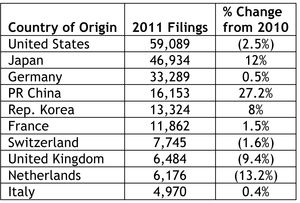
    On Tuesday, the European Patent Office announced that it received 243,000 applications in 2011, which constituted a 3% increase from the 237,500 applications the EPO received in 2010.  The EPO granted 62,115 patents, which was 7% more than the number of patent grants in 2010.  With regard to the geographic origin of filings, the EPO noted that EP filings from China rose from 5% of all filings to 7%, filings from Japan rose from 18% of all filings to 19%, and filings from the U.S. fell from 26% of all filings to 24%.  The Top 10 countries of origin for European filings were:

    EPO Filings

    A more complete list of filings by country of origin can be found here.

    EPO President Benoît Battistelli stated that "[c]ontinued patent filings growth and the high percentage of non-European applicants are clear evidence of great confidence in Europe as a place for business," adding that "[t]he EPO will continue to play a leading role in the global patent system."

    IFI Claims

    Earlier this month, IFI Claims Patent Services, a company that produces global patent databases, announced that 224,505 utility patents were issued in the U.S. last year, an increase of 2% over the 219,614 patents that were issued in 2010.  IFI also released a list of the Top 50 companies receiving U.S. patents last year.  IFI's Top 10 were:

    IFI Top 10

    The only life sciences company making the list was Du Pont de Nemours, E I & Co.  IFI noted that Asian companies accounted for 25 of the top 50 U.S. patent recipients, with U.S. firms capturing 17 slots.

    Reuters

    Last month, Reuters reported that China surpassed the U.S. in terms of application filings in 2010 (figures for 2011 were not yet available).  Citing a Thomson Reuters research report, the article noted that published applications in China had risen by an average of 16.7% annually from 171,000 in 2006 to 314,000 in 2010.  According to the report, published applications are expected to top 500,000 in 2015, with filings in the U.S. and Japan amounting to 400,000 and 300,000, respectively.

    WIPO

    In December, the World Intellectual Property Organization announced the release of its 2011 World Intellectual Property Indicators report.  The WIPO report noted that after a considerable decline in worldwide patent application filings in 2009 (a 3.6% decline), filings rose 7.2% in 2010, with China and the U.S. accounting for the greatest share of all filings.  The 7.2% increase constituted the highest growth rate in five years, and the 1.98 million worldwide applications that were filed in 2010 was an all-time high.  The report noted that some 5.17 million worldwide applications were "potentially pending" in 2010.

    The WIPO report showed that the U.S. maintained the top spot for patent application filings, with 490,226, and that China slipped past Japan to capture second place with 391,177 filings.  Japan had 344,598 filings.  With regard to technology field, biotechnology filings rose 0.4% between 2005 and 2009 (the latest years for which data was available), pharmaceutical filings were down 0.1%, organic fine chemistry was down 1.3%.

  • By Donald Zuhn —

    USPTO Selects Site of Detroit Satellite Office

    300 River Place

    In a press release issued earlier this month, the U.S. Patent and Trademark Office announced that it had entered into a five-year lease agreement on a 31,000 square foot space at 300 River Place Drive in Detroit, where the Elijah J. McCoy USPTO will be located.  The Detroit satellite office was so designated pursuant to § 24 of the Leahy-Smith America Invents Act (see "USPTO News Briefs," December 15, 2011).  According to the announcement, the Office intends to open the Detroit satellite office no later than July 2012, and the satellite office is expected to create more than 100 new jobs during its first year.  The Office asks prospective employees to send e-mail inquiries to detroithiring@uspto.gov for more information.  The Office also reminded applicants and practitioners that it is currently in the process of collecting information on potential locations for future satellite offices.  Written comments regarding possible locations must be submitted by January 30, 2012 (see "USPTO News Briefs," December 15, 2011, for information regarding the Office's Federal Register notice requesting comments).

     
    USPTO to Hold Seven AIA Roadshows

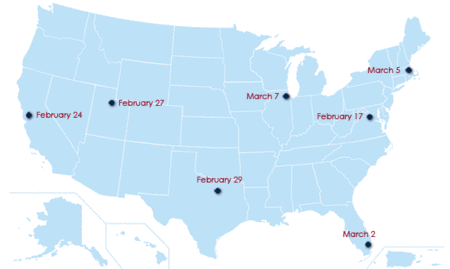
    In a press release issued on January 9, the U.S. Patent and Trademark Office announced that it would be hosting a public series of educational "roadshows" regarding the Leahy-Smith America Invents Act.  The roadshows will allow the public to speak with USPTO officials about the new patent law and its implementation.  Seven roadshows have been scheduled, to be held at the following locations:

    Friday, February 17
    USPTO Campus
    Alexandria, VA

    Friday, February 24
    Sunnyvale Public Library
    Sunnyvale, CA

    Monday, February 27
    Marriott Library, University of Utah
    Salt Lake City, UT

    Wednesday, February 29
    Dallas Public Library
    Dallas, TX

    Friday, March 2
    Broward County Main Library
    Ft. Lauderdale, FL

    Monday, March 5
    Boston Public Library
    Boston, MA

    Wednesday, March 7
    Chicago Public Library
    Chicago, IL

    USPTO Patent Reform Coordinator Janet Gongola commented that "[t]he USPTO hopes that the public will find the roadshows to be an ideal forum to engage with the Office about our various proposed rules implementing provisions of the America Invents Act," adding that "[t]he roadshows also give the agency the opportunity to visit members of the patent community in different parts of the country as part of our ongoing effort to create a 21st century patent and trademark office."

    According to the USPTO's Leahy-Smith America Invents Act Implementation webpage, the agenda of the roadshows will be as follows:

    Welcoming Remarks — 10:00 – 10:30 am
    Patent Related Provisions — 10:30 – 11:15 am
    Break — 11:15 – 11:30 am
    Patent Related Provisions — 11:30 am – 12:30 pm
    Lunch — 12:30 – 1:30 pm
    Contested Case Provisions — 1:30 – 3:00 pm
    Break — 3:00 – 3:15 pm
    Contested Case Provisions — 3:15 – 4:30 pm 

    Patent Docs intends to attend and report on the Chicago roadshow.

    Roadshow Map


    USPTO Issues AIA-Mandated Reports

    Report Cover

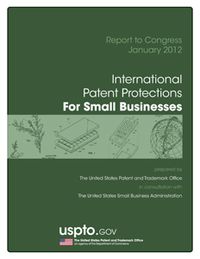
    In a press release issued yesterday, the U.S. Patent and Trademark Office announced that it had submitted to Congress two reports mandated by the Leahy-Smith America Invents Act.  The first report concerns the scope of prior user rights defense in industrialized countries (see "USPTO Issues Report on Prior User Rights"), and the second report (prepared pursuant to AIA § 31) concerns international patent protections for small businesses.

    According to the Office's announcement, the International Patent Protections for Small Businesses Report "considers how to best help small businesses with patent protection overseas, including whether a loan or grant program should be established to help small businesses cover the costs of application, maintenance, and enforcement fees or related technical assistance."

    The Office noted that the AIA mandates that the USPTO conduct five more studies in the coming months.  Next on the Office's agenda is the report on secondary genetic testing; the Office will be hosting public hearings and seeking written public comments as it did for the first two reports.

  • By Kevin E. Noonan —

    Report Cover

    The U.S. Patent and Trademark Office on Friday released a "Report on the Prior User Rights Defense" provisions of the Leahy-Smith America Invents Act.  This Report was prepared as part of a mandate by Congress in §§ 3(m) and 31 of the Act that the Office perform studies relating to the effects of the Prior User Rights Defense (PURD) of the Act including:

    (1)  comparison(s) between the patent laws of the U.S. and the laws of other industrialized countries;

    (2)  the effect of prior user rights on innovation rates;

    (3)  the correlation, if any, between prior user rights and start-up enterprises as well as the ability to attract venture capital to start new companies;

    (4)  the effect of prior user rights, if any, on small businesses, universities, and individual inventors;

    (5)  legal and constitutional issues with placing trade secret law in patent law; and

    (6)  whether or not the change to a first-to-file patent system creates any particular need for prior user rights.

    The Report, attributed to Director David Kappos and Assistant Director Teresa Stanek Rea, addresses these questions, making a number of findings and recommendations.

    Findings:

    1. The AIA strikes the right balance by limiting the prior user rights defense to those parties that can prove commercial use at least one year prior to the filing date of the patent application by clear and convincing evidence.

    2. The scope of the prior user rights defense includes limitations on the type of continued activities, the transfer of the personal rights, and the enforcement of said right, such that the patentee's rights are not unjustly impinged and the university community may benefit, since the defense is not available in patent actions by universities.

    3. There is not substantial evidence that prior user rights as established in the AIA will have a negative impact on innovation.

    4. There is no substantial evidence showing that prior user rights as established in the AIA will have a disproportionately negative impact on venture-capital investments to small businesses and start-ups.

    5. There is an insufficient basis to recommend a change to the scheme chosen by Congress with respect to the application of prior user rights to universities.

    6. There is no substantial evidence that the limited prior user right defense as established by the AIA will have a negative impact on small businesses or independent inventors.

    7. A prior use defense to patent infringement is both Constitutional and lawful and the defense is consistent with the Constitution and Supreme Court precedent recognizing that trade secret law and patent law can, and do, legally co-exist in the United States, and indeed have co-existed since our Constitution was created.

    8. Trade secret protection is of considerable value to United States businesses and the United States economy, and as such, there are compelling economic and policy justifications for providing a prior user rights defense to patent infringement.

    9. Providing limited prior user rights in a first-inventor-to-file system addresses the inherent inequity such a system creates between an earlier commercial user of the subject matter and a later patentee. A prior user rights defense is pro-manufacturing and pro-jobs, as it rewards businesses that put new technology promptly into commercial use, and provides protection for early commercial use when challenged by the later filing of patent applications by other entities.

    10. Because the availability of a prior user rights defense to patent infringement is a fundamental aspect of many patent regimes throughout the industrialized world, there is a strong preference that United States businesses be afforded the same advantages in terms of prior use protections in the United States that their competitors enjoy abroad.

    Recommendations:

    1. The prior user rights defense provisions set forth in the AIA are generally consistent with those of major trading partners and need not be altered at this time.

    2. The prior user right defense under the AIA should be maintained with no change at the present time because there is no substantial evidence that it will have a negative impact on innovation, venture funding, small businesses, universities, or independent inventors.

    3. The USPTO should reevaluate the economic impacts of prior user rights as part of its 2015 report to Congress on the implementation of the AIA, when better evidence as to these impacts might be available.

    4. United States patent law should provide for a prior user rights defense as an appropriate balance between trade secret protection and patent law, which legally co-exist to provide competitive advantages for United States businesses.

    5. United States patent law should provide for a prior user rights defense to patent infringement in order to address a systemic inequity inherent in a first-inventor-to-file system and to ensure United States businesses are (i) able to protect their investments in the event of a later issued patent, and (ii) placed on similar footing as competitors in other jurisdictions.

    The Report, in Section III, contains a detailed comparison of the prior user rights defense in Japan, Canada, Australia, and countries in the European Union (Denmark, France, Germany, and the UK), as well as Korea, Brazil, Mexico, China, and Russia.  The results are contained in an informative table comparing these rights across these different countries:
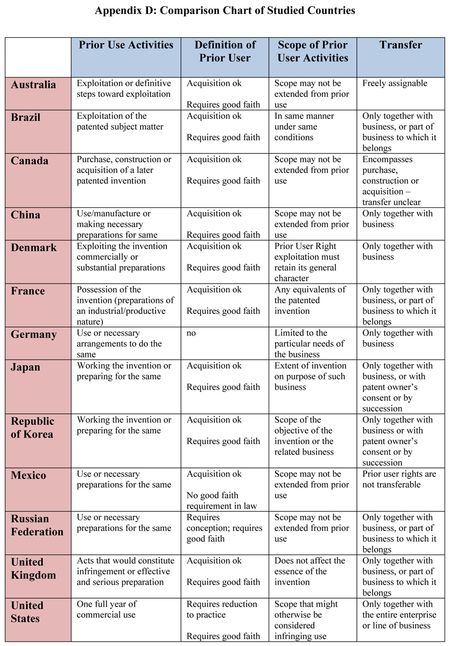
    Appendix D

    The Report was based on testimony at an October 25, 2011 hearing and written comments; testimony was provided by Gary Griswold (on his own behalf; Mr. Griswold is a long time supporter of these provisions, see, Gary L. Griswold & F. Andrew Ubel, Prior User Right—A Necessary Part of a First-to-File System, 26 J. MARSHALL L. REV. 567, 572 (1993)); Alan Kasper (from the American Intellectual Property Law Association); Thomas Kurkowski (on his own behalf); Dan Lang (Cisco) and MaCharri Vorndran-Jones (American Bar Association-IP Group).  In addition, Intellectual Property Organizations (including the AIPLA, ABA-IP Group, Coalition for Patent Fairness, Computer and Communications Industry Association, Institute of Patent and Trade Mark Attorneys of Australia, International Federation of Intellectual Property Attorneys (FICPI), Japan Intellectual Property Association Innovation Alliance, Japan Patent Attorneys Association, and New Zealand Institute of Patent Attorneys), Academic and Research Institutions (including the Wisconsin Alumni Research Foundation, Berkeley Center for Law and Technology and Greentech Industries, Regents of University of California Board and Higher Education Associations); companies (including Belz Consulting, Cisco, Google and Verizon (Joint Comments), Hospira, Inc., Lex Machina, Microsoft Corp., Space Exploration Technologies Corp., and Telstra Corporation) and individuals (including Stephan Freischem, Asamichi Kato, Thomas E. Kelley, Thomas Kowalski, Paul Morgan, Tony Tether, and Neil Thomas) provided written comments.  Conspicuously absent from this list are biotechnology or innovative pharmaceutical companies.

    While comprehensive, some of the language of the Report seems to bear little logical relationship to the Findings and Recommendations.  For example, regarding the impact on the PURD on "innovation, start-up enterprises, small businesses, individual inventors and universities," the Report notes that "[t]he extent of benefits and harm flowing from the availability in the U.S. of a prior user rights defense is, in the end, an empirical question best answered by comprehensive data on the true impacts revealed over time" and that "[u]nfortunately, formal statistical study of prior user rights has been extremely limited, largely because the full effect of this type of policy change is inherently difficult to measure."  In view of these circumstances, and despite the admittedly limited experience with the assertion of the PURD both under 35 U.S.C. § 273 and in foreign jurisdictions, the Report finds (Finding 3) that "[t]here is no substantial evidence that prior user rights as established in the AIA will have a negative impact on innovation."  Of course, there is just as clearly no substantial evidence that prior user rights as established in the AIA will not have a negative impact on innovation, making the nature of the finding a political, rather than a factual, statement.

    Similarly, while acknowledging the mixed nature of the written comments and testimony ("the potential for secret uses in a market would make it more difficult for investors to estimate markets and value invention, thereby depressing the attractiveness of a later patenting start-up to venture-capital funding" versus "without the prior user rights defense, the company which lost the 'race to the USPTO' in a first-to-file environment would lose all investment returns for that project") and the lack of any empirical evidence ("[a] search of the existing economic literature yielded no empirical study of the impact of prior user rights within the U.S. venture-capital investment context"), the Report concludes that "[t]he best available evidence shows, however, that the U.S. venture-capital investment environment has grown and thrived in a context of uncertainty over property rights in innovation, especially as regards patents and trade secrets" and "if prior user rights are likely to be rarely exercised in the U.S. (as is suggested by the European experience), then it is reasonable to conclude that 'switching' from patent to trade secret protection as a result of the availability of this defense may be limited in nature."  Thus, Finding 4 states that "[t]here is no substantial evidence that prior user rights as established in the AIA will have a disproportionately negative impact on venture-capital investments to small businesses and start-ups" and on equally absent evidence, Finding 5 states that "[t]here is an insufficient basis to recommend a change to the scheme chosen by Congress with respect to the application of prior user rights to universities," a finding that at least properly recognizes the "first make no recommendation for change" attitude adopted by the Office in the Report.  Throughout the Report, the Office concedes that there is no evidence one way or the other on an issue (such as whether the PURD will harm innovation), or on the other hand postulates scenarios where patenting would not be important to an innovator (without much supporting evidence of the likelihood of such scenarios), and concludes that the absence of evidence supports the conclusion that no changes are necessary in the statutory scheme.

    The question of constitutionality of the PURD provisions is answered almost entirely by citation of Kewanee Oil Co. v. Bicron Corp., 416 U.S. 470 (1974), which held that the existence of patent and trade secret protection was not contradictory or incompatible with one another.  (Interestingly, the Report notes that the Court's conclusion was based on the idea that "the ideas protected by trade secrets will likely be discovered by others in a similar time frame," wherein the Court stated that "[n]or does society face much risk that scientific or technological progress will be impeded by the rare inventor with a patentable invention who chooses trade secret protection over patent protection [because] if a particular person had not made a discovery others would have, and in probably a relatively short period of time."  The basis for the Court's thinking is this regard is unexplained.)

    The Report also states that the PURD existed between 1839 and 1952, citing (anomalously) Eldred v. Ashcroft, 537 U.S. 186, 199-205 (2002), in support of this proposition.  Specifically, the Report cites Act of 1839, ch. 88, § 7, 5 Stat. 353, 354 (repealed 1952), "[t]hat every person or corporation who has, or shall have purchased or constructed any newly-invented machine, manufacture, or composition of matter, prior to the application by the inventor or discoverer of a patent, shall be held to possess the right to use and vend to others to be used, the specific machine, manufacture, or composition of matter, so made or purchased, without liability therefore to the inventor, or any other person interested in such invention; and no patent shall be held invalid by reason of such purchase, sale, or use prior to the application for a patent as aforesaid, except on proof of abandonment of such invention to the public, or that such purchase, sale, or prior use has been for more than two years prior to such application for a patent" and McClurg v. Kingsland, 42 U.S. 202, 208-09 (1843), wherein the Court held that "[t]he object of this provision is evidently twofold; first, to protect the person who has used the thing patented, by having purchased, constructed, or made the machine, etc., to which the invention is applied, from any liability to the patentee or his assignee.  Second, to protect the rights, granted to the patentee, against any infringement by any other persons.  . . .  [I]t puts the person who has had such prior use on the same footing as if he had a special license from the inventor to use his invention; which, if given before the application for a patent, would justify the continued use after it issued without liability."  Of course, each example is clearly directed to continued use of a "newly-invented machine, manufacture, or composition of matter" prior to the patenting thereof, and not the continued practice of methods, including methods for producing the patented machine, manufacture, or composition of matter.  While patent law and trade secret law may be compatible, the citations do not support the contention that U.S. patent law ever contained a PURD of the type embodied in the AIA.

    The "real" reason behind the PURD may be contained in one paragraph of the Report:

    A related issue is the consequence that, by filing a patent application, the technology is disclosed to competitors in other countries where the innovator may not, for lack of resources, have sought patent protection, or where patents are difficult to enforce.  Several comments pointed out that this can have drastic effects on American businesses and jobs.  A representative from a small United States company commented that the company's use of trade secret protection enables it to provide services at a price level that its Chinese competitors admitted they cannot match.  Several representatives of "green" technology companies based in the United States noted that disclosure of new technologies via a patent application would allow foreign competitors to copy the innovation, using cheaper labor and with the assistance of foreign government subsidies, to undercut their businesses, at the expense of "creating much-needed jobs for American workers."

    While these sentiments are powerful incentives for establishing the PURD, and it is understandable that the Office would want to fulfill the statutory mandate, presumably Congress wanted something more than a rubberstamp.  If in the exercise of its "special expertise" the Office was unable to find evidence supporting the PURD (or not), it seems that this is the conclusion:  it is too early to tell, not that "all is well" in the absence of any evidence.  While the Report's conclusions may reflect political realities, they serve Congressional purposes only facially and do not provide any basis for deciding whether the PURD will support or inhibit innovation.  The public (and those members of the public whose representatives are not satisfied with the rhetoric of job creation that swept the bill through this Congress after several years of failure to enact "patent reform") are not well served by such facile conclusions.  Perhaps we will all have to wait to assess whether the PURD has these predicted beneficial effects or inhibits innovation to our detriment.  But it should not be too much to ask that policymakers face that fact and simply say so.

  • By Donald Zuhn —

    USPTO Seal

    Earlier this month, the U.S. Patent and Trademark Office published four Federal Register notices as part of its efforts to implement the Leahy-Smith America Invents Act.  Last week, we discussed the Office's notice regarding implementation of the AIA's miscellaneous post patent provisions and preissuance submissions provision (see links below).  Today, we address the Office's notice regarding "Implementation of Statute of Limitations Provisions for Office Disciplinary Proceedings" (77 Fed. Reg. 457).

    Section 32 of Title 35, which concerns the suspension or exclusion from practice, reads as follows

    The Director may, after notice and opportunity for a hearing, suspend or exclude, either generally or in any particular case, from further practice before the Patent and Trademark Office, any person, agent, or attorney shown to be incompetent or disreputable, or guilty of gross misconduct, or who does not comply with the regulations established under section 2(b)(2)(D) of this title, or who shall, by word, circular, letter, or advertising, with intent to defraud in any manner, deceive, mislead, or threaten any applicant or prospective applicant, or other person having immediate or prospective business before the Office.  The reasons for any such suspension or exclusion shall be duly recorded.  The Director shall have the discretion to designate any attorney who is an officer or employee of the United States Patent and Trademark Office to conduct the hearing required by this section.  The United States District Court for the District of Columbia, under such conditions and upon such proceedings as it by its rules determines, may review the action of the Director upon the petition of the person so refused recognition or so suspended or excluded.

    Section 2(b)(2)(D) permits the Office to require "agents, attorneys, or other persons representing applicants or other parties before the Office,  . . . to show that they are of good moral character and reputation and are possessed of the necessary qualifications to render to applicants or other persons valuable service, advice, and assistance in the presentation or prosecution of their applications or other business before the Office."

    Section 3(k) of the AIA amends § 32 by adding the following sentence before the last sentence:

    A proceeding under this section shall be commenced not later than the earlier of either the date that is 10 years after the date on which the misconduct forming the basis for the proceeding occurred, or 1 year after the date on which the misconduct forming the basis for the proceeding is made known to an officer or employee of the Office as prescribed in the regulations established under section 2(b)(2)(D).

    Prior to the AIA's amendment of § 32, disciplinary actions for violations of the USPTO Code of Professional Responsibility were generally understood to be subject to a five-year statute of limitations pursuant to 28 U.S.C. § 2462.  The Office notes that with passage of the AIA, "Congress provided the Office with five additional years to bring an action, thus ensuring that the Office had additional flexibility to initiate 'a [disciplinary] proceeding for the vast bulk of misconduct that is discovered, while also staying within the limits of what attorneys can reasonably be expected to remember'" (quoting the Congressional Record S1372–1373 (daily ed. March 8, 2011) (statement of Sen. Kyl)).  The Office also notes that "[t]he one-year limitation period in the AIA reflects that disciplinary actions should be filed in a timely manner from the date when misconduct forming the basis of a disciplinary complaint against a practitioner is made known to 'that section of PTO charged with conducting section 32 proceedings.'"

    The Office's Federal Register notice implementing the statute of limitations provisions set forth in AIA § 3(k) specifies the date on which the one-year statute of limitations period begins for the three types of disciplinary complaints:

    1.  Complaints predicated on the receipt of a probable cause determination from the Committee on Discipline — the one-year period begins on the date on which the Director for the Office of Enrollment and Discipline (OED Director) receives a complete, written response to a request for information and evidence from the practitioner.

    2.  Complaints seeking reciprocal discipline — the one-year period begins on the date on which the OED Director receives a certified copy of the record or order regarding the practitioner being publicly censured, publicly reprimanded, subjected to probation, disbarred, suspended, or disciplinarily disqualified.

    3.  Complaints seeking interim suspension based on a serious crime conviction — the one-year period begins on the date on which the OED Director receives a certified copy of the record, docket entry, or judgment demonstrating that the practitioner has been convicted of a serious crime.

    Additional discussion of the rules changes, as well as revised versions of the affected rules, can be found in the Office's Federal Register notice (77 Fed. Reg. 457).

    Comments regarding this notice can be submitted by e-mail to OED_SOL@uspto.gov; by regular mail addressed to:  Mail Stop OED — Ethics Rules, U.S. Patent and Trademark Office, P.O. Box 1450, Alexandria, Virginia 22313–1450, marked to the attention of William R. Covey, Deputy General Counsel for Enrollment and Discipline and Director of the Office of Enrollment and Discipline; or via the Federal eRulemaking Portal.  The deadline for submitting comments is March 5, 2012.  Additional information regarding the submission of comments can be found in the Office's Federal Register notice (77 Fed. Reg. 457).

    For information regarding the Office's implementation of other AIA provisions, please see:

    • "USPTO Proposes Rules Changes for Implementing AIA Provisions — Preissuance Submissions Provision," January 12, 2012
    • "USPTO Proposes Rules Changes for Implementing AIA Provisions — Miscellaneous Post Patent Provisions," January 11, 2012

  • By Sherri Oslick —

    Gavel About Court Report:  Each week we will report briefly on recently filed biotech and pharma cases.

    Shire LLC et al. v. Sandoz Inc.
    1:12-cv-00040; filed January 6, 2012 in the District Court of Colorado

    • Plaintiffs:  Shire LLC; Supernus Pharmaceuticals, Inc.; Shire Development Inc.; Shire International Licensing B.V.; Amy F.T. Arnsten; Pasko Rakic; Robert D. Hunt
    • Defendant:  Sandoz Inc.

    Infringement of U.S. Patent Nos. 5,854,290 ("Use of Guanfacine in the Treatment of Behavioral Disorders," issued December 19, 1998), 6,287,599 ("Sustained Release Pharmaceutical Dosage Forms with Minimized pH Dependent Dissolution Profiles," issued September 11, 2001), and 6,811,794 (same title, issued November 2, 2004) based on Sandoz's amendment of its ANDA (adding additional dosage forms) to manufacture a generic version of Shire's Intuniv® (guanfacine, used to treat attention-deficit hyperactivity disorder).  View the complaint here.


    Takeda Pharmaceutical Co. et al v. Mylan, Inc. et al
    .
    2:12-cv-00026; filed January 6, 2012 in the Western District of Pennsylvania

    • Plaintiffs:  Takeda Pharmaceutical Co.; Takeda Pharmaceuticals North America, Inc.; Takeda Global Research and Development Center, Inc.; Watson Pharmaceuticals, Inc.; Andrx Labs, LLC
    • Defendants:  Mylan, Inc.; Mylan Pharmaceuticals, Inc.

    Infringement of U.S. Patent Nos. 5,965,584 ("Pharmaceutical Composition," issued October 12, 1999), 6,166,043 (same title, issued December 26, 2000), 6,172,090 (same title, issued January 9, 2001), 6,099,859 ("Controlled Release Oral Tablet Having a Unitary Core," issued August 8, 2000), 6,495,162 (same title, issued December 17, 2002), 6,790,459 ("Methods for Treating Diabetes Via Administration of Controlled Release Metformin," issued September 14, 2004), 6,866,866 ("Controlled Release Metformin Compositions," issued March 15, 2005), 7,785,627 ("Pharmaceutical Formulation Containing a Biguanide and a Thiazolidinedione Derivative," issued August 31, 2010), 7,919,116 ("Controlled Release Metformin Composition," issued April 5, 2011), and 7,959,946 ("Pharmaceutical Formulation Containing a Biguanide and a Thiazolidinedione Derivative," issued June 14, 2011) following a Paragraph IV certification as part of Mylan's filing of an ANDA to manufacture a generic version of Takeda's ACTOplus met® XR (pioglitazone and metformin, used an adjunct to diet and exercise to improve glycemic control in patients with Type 2 diabetes).  View the complaint here.

  • Calendar

    January 18, 2012 – Making the Move to First-to-File (Intellectual Property Owners Association) – 2:00 pm (ET)

    January 20, 2012 – Prosecution Strategies: Tackling USPTO Obviousness Rejections (American Bar Association) – 1:00 – 2:30 pm (Eastern)

    January 25-26, 2012 – Biosimilars Forum 2012 (C5) – London, UK

    January 26, 2012 – Life Under AIA: Anticipating and Surviving Post Grant Challenges (Technology Transfer Tactics) – 1:00 – 2:00 pm (Eastern)

    January 31, 2012 – Obviousness Standard for Patents: Approaches to Withstand USPTO Obviousness Rejections and Attacks on Patent Validity (Strafford) – 1:00 – 2:30 pm (EST)

    January 31 – February 1, 2012 – Patent Reform for Life Sciences Companies*** (American Conference Institute) – New York, NY

    January 31 – February 1, 2012 – Pharma & Biotech Patent Litigation (C5) – Amsterdam, The Netherlands

    February 13-14, 2012 – China IP Counsel Forum (C5) – Shanghai, China

    February 21-22, 2012 – Biotech & Pharmaceutical Patenting*** (IBC Legal) – Munich, Germany

    February 22-23, 2012 – EU Pharma Law & Regulation*** (C5) – London, England

    February 22-24, 2012 – Intensive Patent Law Training Seminar (Chisum Patent Academy) – New York, NY

    February 27-29, 2012 – Life Sciences Collaborative Agreements and Acquisitions*** (American Conference Institute) – New York, NY

    February 28-29, 2012 – Medical Device Patents*** (American Conference Institute) – Boston, MA

    March 14-15, 2012 – Biotech Patenting (C5) – Munich, Germany

    March 20-21, 2012 – FDA Boot Camp*** (American Conference Institute) – New York, NY

    March 26-27, 2012 – PTO Procedures under the America Invents Act*** (American Conference Institute) – New York, NY

    ***Patent Docs is a media partner of this conference or CLE

  • New York #2

    American Conference Institute (ACI) a conference on PTO Procedures under the America Invents Act on March 26-27, 2012 in New York, NY.  Topics of discussion at the conference will include:

    • Prepare for the release of the final regulations governing PTO procedures and analyze the significance of the draft regulations and comments;
    • Explore the new priority landscape and derivation proceedings under first to file system protocols;
    • Understand the purpose of supplemental proceedings and their relationship to inequitable conduct
    • Evaluate the choice of proceeding and forum in which to bring a third party patent challenge;
    • Examine the mechanics, protocols and procedures for post grant review, transitional post grant review for business method patents and inter partes review; and
    • Comprehend the scope of estoppel in post-issuance proceedings.

    Brochure2

    In particular, ACI's faculty will offer presentations on the following topics:

    • Overview and implementation timeline of PTO procedures: Anticipating the regulatory schematic and understanding what's new, what has evolved and what has stayed the same — to be presented by Janet Gongola, Patent Reform Coordinator of the U.S. Patent and Trademark Office and Michael Tierney, Lead Administrative Patent Judge, Trial Section, Board of Patent Appeals and Interferences of the U.S. Patent and Trademark Office;
    • The new prior art and priority landscapes — First-to-file with grace and derivation;
    • Supplemental proceedings: Considerations for patent holder starting anew and thoughts on curing inequitable conduct;
    • Third party patent challenges: Assessing all your options for challenging a competitor's patents;
    • An in depth look at post grant review and transitional post grant review for business method patents;
    • Of inter partes reexamination and inter partes review: Preparing for the transition;
    • Exploring the scope of estoppel in post grant proceedings before the PTO.

    A pre-conference workshop entitled "Patent Reform Boot Camp for PTO Practice: Laying the Foundation for New and Amended PTO Procedures under the America Invents Act" will be offered from 8:30 to 11:30 am on March 26, 2012.  The workshop will provide attendees with an in-depth overview of the America Invents Act (AIA) as well as critical insights into nuances, which will help attendees understand the dynamics of the new U.S. patent system which this law has created.  In addition, a post-conference master class entitled "Parallel Proceedings: Strategies for Preserving Causes of Action and Your Case in Chief in Multiple" will be offered from 2:45 to 5:45 pm on March 27, 2012.  The master class will provide you with critical strategies for steering the course of proceedings in multiple forums.

    An agenda for the conference can be found here.  A program for this conference, including an agenda and detailed descriptions of conference sessions can be obtained here.

    ACI - American Conference Institute

    The registration fee for the conference is $2,295 (conference and workshop or master class) or $2,795 (conference, workshop, and master class).  Those registering by January 30, 2012 will receive a $300 discount and those registering by February 27, 2012 will receive a $200 discount.  In addition, Patent Docs readers who reference the discount code "PD 200" will receive $200 off the current price tier when registering.  Those interested in registering for the conference can do so here, by calling 1-888-224-2480, or by faxing a registration form to 1-877-927-1563.

    Patent Docs is a media partner of the conference on PTO Procedures under the America Invents Act.

  • New York #1

    American Conference Institute (ACI) will be holding the next session of its FDA Boot Camp conference on March 20-21, 2012 in New York, NY.  ACI faculty will help attendees:

    • Master the basics of the application and approval processes for drugs, biologics, and devices;
    • Comprehend the structure of the FDA and the roles of the three major agency centers:  CDER, CBER, and CDHR;
    • Develop a practical working knowledge of clinical trials for drugs and biologics and the clearance process for devices;
    • Learn how devices are classified, monitored, and regulated;
    • Appreciate the complexities of pharmaceutical IP and the regulatory balance between brand name and generic products;
    • Recognize the pivotal role of labeling in the drug and biologics approval process;
    • See the importance of cGMPs to the post-approval regulatory process; and
    • Navigate the protocols of adverse events monitoring, signal detection, product withdrawals, and recalls.

    Brochure

    In particular, ACI's faculty will offer presentations on the following topics:

    • The basics:  Understanding and working with the FDA — Jurisdiction, functions, organization, and operations;
    • The nature of the approval process;
    • Understanding the clinical trial process for drugs and biologics;
    • IP overview for drugs and biologics:  Hatch-Waxman, BPCIA, trade dress, and more:
    • Part 1 — Overview of patent and trademark issues;
    • Part 2 — Hatch-Waxman and BPCIA overview;
    • Drugs and biologics:  Labeling;
    • cGMPs:  Drugs and biologics (current good manufacturing practices);
    • Adverse events monitoring, pharmacovigilance and risk management;
    • Medical devices:  Classifications, the essentials of the premarket review process, and post-market requirements and concerns; and
    • Recall guidance for drugs, biologics, and medical devices:  What you need to know.

    A pre-conference workshop on the "Fundamentals of FDA Regulatory Law," will be offered on March 19, 2012.  The workshop will provide a basic overview of FDA regulations and will prepare attendees for the in-depth discussions that will take place throughout the conference.

    Two post-conference master classes will be offered on March 21, 2012.  The first master class, entitled "Hatch-Waxman and BPCIA: Overview of Biosimilars and Life Cycle Planning for Drugs and Biologics," will provide an in-depth overview of biosimilars as well as analyses of bioequivalence and exclusivities and their role in patent and product life cycle management.  The second master class, entitled "Post-Approval Marketing Guidance and Preemption Protocols," will address issues that arise post-approval, including advertising, promotion, and off-label promotion and enforcement, as well as preemption fundamentals.

    An agenda for the conference can be found here.  A complete brochure for this conference, including an agenda, detailed descriptions of conference sessions, list of speakers, and registration form can be obtained here.

    ACI - American Conference Institute

    The registration fee is $2,295 (conference alone), $2,895 (conference and workshop or conference and one master class), or $3,295 (conference, workshop, and one master class).  Those registering by January 20, 2012 will receive a $300 discount and those registering by February 17, 2012 will receive a $200 discount.  In addition, Patent Docs readers who reference the discount code "PD 200" will receive $200 off the current price tier when registering.  Those interested in registering for the conference can do so here, by calling 1-888-224-2480, or by faxing a registration form to 1-877-927-1563.

    Patent Docs is a media partner of ACI's FDA Boot Camp conference.

  • IPO #2

    The Intellectual Property Owners Association (IPO) will offer a one-hour webinar entitled "Making the Move to First-to-File" on Wednesday, January 18, 2012 beginning at 2:00 pm (ET).  A panel consisting of Ned Israelsen of Knobble Martens Olson & Bear, LLP; Stuart Watt of Amgen Inc.; and Harold Wegner of Foley & Lardner, LLP will:

    • Give recommendations on how companies can restructure their invention disclosure and priority filing systems, including consideration of trade secret protection;
    • Consider how the new U.S. first-to-file system will be different than those that now exist internationally, and how those differences should be dealt with operationally;
    • Focus in detail on the advantages and risks of provisional applications, particularly in light of the recent more-stringent requirements regarding description and enablement required by courts and the USPTO;
    • Discuss the special challenges FTF poses for biotech and other life sciences companies; and
    • Suggest strategies for investors with relatively limited R&D resources, such as inventors and universities.

    The registration fee for the webinar is $120 (government and academic rates are available upon request).  Those interested in registering for the webinar can do so here.

  • Statistics Illustrate Costs of Generic Drugs to Innovation

        By Kevin E. Noonan —

    11.cover

    The question of whether the Hatch-Waxman generic drug regime is a net positive for innovation and drug development has been the subject of recent study, particularly in view of the costs attendant on litigation between branded ("innovator") drug makers and their generic counterparts.  See Higgins & Graham, 2009, Intellectual property: balancing innovation and access; patent challenges tip the scales. Science 326: 370–71 (see "Maybe Hatch-Waxman Data Exclusivity Isn't So Good For Traditional Drugs After All").  Recently, the question was addressed again, this time by Professor Henry Grabowski at Duke University and colleagues from the Toulouse School of Economics in France and Analysis Group in Boston.  Grabowski et al., 2011, "Evolving Brand-Name and generic Drug Competition May Warrant a Revision of the Hatch-Waxman Act," Health Affairs 30: 2157-66.  In this study, Professor Grabowski provides evidence of increasing challenge by generic drug makers and the effects of these challenges on pharmaceutical innovation, while acknowledging the beneficial effects of generic alternatives to branded drugs for consumers and drug providers/payors (citing a study by the Generic Pharmaceuticals Association published by IMS Health that generic drugs saved consumers $800 billion from 2000-2009; see "Savings Achieved Through the Use of Generic Pharmaceuticals").

    The data was compiled by IMS Health and compared a variety of parameters regarding generic drugs and their effects on their branded counterparts.  The study was based on 332 branded drugs (200 new drugs/132 new formulations) experiencing first generic entry between 1995 and 2008, and included such drugs as Prozac, Imitrex, Zocor, Neurontin, and Ambien.  In particular, the study compared these parameters for all drugs in the dataset and drugs having greater than $100 million (and in some instances, greater than $250 million) in annual sales.  The data showed that the average number of generic entrants within one year of the first generic drug to enter the marketplace has risen for all drugs, but most dramatically for drugs having greater than $100 million in annual sales, increasing from 6 in 1995 to 10.1 in 2008.  There was a smaller reduction during this time period in the average period of data exclusivity, which fell from 13.5 years in 1995 to 12.4 years in 2008 (bearing in mind that for drugs with greater than $100 million in annual sales this represented a revenue loss of greater than $100 million).  The study also noted that 95% of generic drug entrants were for drugs with greater than $100 million in annual sales.  Paragraph IV challenges also rose during the period, with 9% of all drugs (and 17% of drugs with greater than $100 million in annual sales) being challenged in 1995 and 64% of all drugs (75% of drugs with greater than $100 million in annual sales) being challenged under Paragraph IV in 2008.  The time between initial launch of a branded drug and the first challenge under Hatch-Waxman has also greatly reduced, going from 18.7 years in 1995 to 8.7 years in 2008.

    The study also looked at the percent of the market retained by the branded drug maker at various times after marketplace entry of the first generic competitor:

    • % of market retained by innovator first month after first generic: 68% in 1995, 37% in 2008
    • % of market retained by innovator first 12 months after first generic: 44% in 1995, 15% in 2008
    • % of market retained by innovator first month after first generic for drugs with greater than 100 million in annual sales: 33% in 2008
    • % of market retained by innovator 12 months after first generic for drugs with greater than 100 million in annual sales: 13% in 2008

    For drugs with greater than $250 million in annual sales, 92% challenged under Paragraph IV, and the average time from launch to first challenge was 7.7 yrs.

    The study also cites evidence that "a disproportionate share of high-revenue drugs" were subject to Paragraph IV challenges, with generic drug companies "winning" "slightly more than half of the 72 district court decisions" studied.  Panattoni, 2011, "The effect of Paragraph IV decisions and generic entry before patent expiration on brand pharmaceutical firms," J. Health Econ. 30: 126–45.  As annual sales of a branded drug increases, there was a greater likelihood that generic challenge subject to "prospecting strategy" by generic drug companies, "because even a low likelihood of success typically yields a large expected return on the investment necessary to challenge a patent."

    Citing the longer data exclusivity period for biosimilar drugs under Section 7002 of the Affordable Care Act of 2010 (also known as he Patient Protection and Affordable Care Act (PPACA)), as well as the European system where both biologic and small molecule drugs enjoy 10 years of data exclusivity, Professor Grabowsky suggests that Congress revise (increase) the data exclusivity periods in the Hatch-Waxman Act:

    In light of the changing competitive dynamics between innovative and generic drugs, Congress should review whether Hatch-Waxman is achieving its intended balance of cost savings and innovative incentives.  For example, a recent article suggests amending Hatch-Waxman along the lines of the new law governing biosimilars by eliminating the reward for patent challenges and the automatic stay on generic entry, while also harmonizing the data exclusivity periods for new drugs with the twelve-year period that now exists for new biologics.

    (And Professor Grabowski cites Goldman et al. for the proposition that such a change "would increase drug innovation and societal welfare over the long run but would also have short-run distributional effects."  Goldman et al., 2011, "The benefits from giving makers of conventional "small-molecule" drugs longer exclusivity over clinical trial data," Health Affairs 30: 84–90; see "Academic Study Supports Longer Data Exclusivity Term for Conventional Drugs")

    While the likelihood that these changes will be enacted are small (particularly in view of President Obama's continued opposition to the data exclusivity provisions of the PPACA; see "President's Deficit Reduction Plan Seeks to Reduce Exclusivity Period for Biologics and Prohibit Pay-for-Delay Deals"), this study and others bolster the common-sense sentiment that generic drug challenges to branded drugs increase uncertainty in the development of new drugs and are a cost that squanders resources better spent developing new drugs.  They also provide misplaced incentives for innovator companies to reformulate ("evergreen") established drugs rather than assume the risks of new drug development in the face of heightened uncertainties on the ability to obtain sufficient return on investment.  While these factors are not solely responsible for the apparent decline in new drug development over the past 10-15 years they have not helped, and studies such as this one support the notion that the Hatch-Waxman regime may need serious reconsideration.