• By Donald Zuhn —

    USCLast month, in University of Southern California v. DePuy Spine, Inc., the Federal Circuit vacated and remanded a decision by the Board of Patent Appeals and Interferences awarding priority to Appellee DePuy Spine, Inc. in an interference between DePuy's U.S. Patent No. 6,812,211 and U.S. Patent Application No. 10/230,671.  Appellants University of Southern California and Ampac Biotechnology, Inc. ("USC") filed the '671 application on August 29, 2002, and in 2005, copied claims from the '211 patent into their application.

    The Board declared an interference, defining Count 1 as claim 1 of the '211 patent, which recites:

    1.  A method of treating in a living being an intervertebral disc having a nucleus pulposus, comprising the step of:
        a) injecting a composition consisting essentially of a crosslinking agent into the nucleus pulposus,
        wherein the crosslinking agent is injected in an effective amount to cause in-situ crosslinking of native proteins present in the nucleus pulposus.

    DePuy SpineThe Board originally designated USC as the senior party, according the '671 application the benefit of U.S. Provisional Application No. 60/316,287, which was filed on August 31, 2001 (the '211 patent issued from an application filed on March 19, 2002).  The Board then determined that the specification of the '287 application did not expressly disclose one of the limitations in Count 1, and granted DePuy's motion to deny USC the benefit of the '287 application's filing date.  USC responded by moving to substitute a new count (Count 2) that omitted the undisclosed limitation, but the Board rejected the count as invalid over the prior art.  After finding DePuy's claim 1 to be obvious over the prior art, the Board proposed a new count (Count 3), which it defined as claim 24 of the '671 application.  Claim 24 recites:

    24.  A method of improving the resistance of an intervertebral disc to mechanical degradation by treating in a living being the intervertebral disc having a nucleus pulposus which is degraded or subject to ongoing degradation, comprising the step of:
        a) injecting a composition consisting essentially of a crosslinking agent into the nucleus pulposus,
        wherein the crosslinking agent is injected in an effective amount to cause in-situ crosslinking of native proteins present in the nucleus pulposus.

    In response to the Board's request for comments regarding the proposed count, USC noted that the proposed count retained the undisclosed limitation, and therefore, that it would be prevented from relying on the '287 application as proof of priority.  USC proposed claim 7 of the '671 application as an alternative count.  Claim 7 recites:

    7.  A method of improving the resistance of a collagenous tissue having pyridinoline cross links to mechanical degradation comprising the steps of:
        contacting at least a portion of a load bearing collagenous tissue within a human body with an effective amount of a crosslinking reagent having at least one crosslinking agent under conditions    within physiologic limits to prevent tissue overheating,
        wherein the collagenous tissue is an intervertebral disc.

    The Board rejected USC's request to modify the count as well as USC's request for authorization to file a motion to change the count, and awarded priority to DePuy.
    Federal Circuit SealWhile the Federal Circuit found that the Board did not err in determining that the phrase "in a living being" in the preamble of Count 3 constituted a limitation, the Court vacated the Board's decision awarding priority to DePuy because the Board "adopted a count that prevented USC from relying on its provisional application — which USC argues is its best proof of priority — and repeatedly rejected USC's requests to modify the count."  The Board did so even though it "has recognized that allowing a party to rely on its best proofs of priority 'is an accepted reason in interference practice for granting' a motion to modify the count," citing Grose v. Plank, 15 U.S.P.Q.2d 1338, 1341 (B.P.A.I. 1990).

    The Court noted that the Board failed to "offer any coherent justification for declining to modify the count so USC could rely on its provisional application," and "perplexingly stated that USC 'only suggested a new count in a comment, but never actually moved for the new count,' despite the fact that the Board denied USC authorization to file such a motion."  The Federal Circuit concluded that "[t]he Board erred by insufficiently explaining its decision not to modify Count 3 to allow USC to claim priority to its provisional application," adding that "[t]his failure is particularly troublesome because a party typically should be allowed to rely on its best priority proofs."  In remanding the case back to the Board, the Court stated that USC should be afforded the opportunity to file a motion to change the count, and that "[t]he Board's decision must, at the very least, squarely address the issues USC raises and set out the reasoning supporting the Board’s conclusions in sufficient detail to permit meaningful review."

    University of Southern California v. DePuy Spine, Inc. (Fed. Cir. 2012)
    Nonprecedential disposition
    Panel: Circuit Judges Bryson, Dyk, and Moore
    Opinion by Circuit Judge Moore
  • By Donald Zuhn —

    Inovia-2012-US-Global-Patent-IP-Trends-Indicator-1Patent services provider inovia announced the release of its 2012 report on global patent and IP trends today.  In compiling the report, inovia, which produces products for PCT national phase entry, European patent validation, and patent translations, surveyed nearly 150 U.S. companies to identify the trends having the greatest impact on the foreign filing strategies of U.S. patentees.

    The 2012 report notes that 22% of survey respondents are involved in the pharmaceuticals/biotech industry.  Other sectors or groups represented in the survey include chemicals/materials (16%), electrical/electronics (15%), mechanical/engineering (10%), IT/software/media (3%), and university/association/non-profit (22%).  The report also indicates that more than a third of survey respondents (37%) had no in-house patent attorneys or agents, 46% had one to four in-house patent attorneys or agents, and the remainder (17%) had five or more attorneys or agents.

    The report states that among survey respondents, "the mood for 2011 was cautiously optimistic" (the 2011 report noted that the mood in 2010 was "mixed"), with fewer respondents experiencing IP budget cuts and a greater percentage bringing in in-house support or outsourcing IP tasks.  Nevertheless, respondents did not expect to increase the number of patent families filed in 2012.  A majority of respondents cited passage of the Leahy-Smith America Invents Act, and the upcoming move to a first-to-file system, as the most important trend of 2012.  Other key trends for 2012 included cost containment (a repeat trend from last year's survey) and the maximization of IP revenue potential.

    Reflecting their cautious optimism, 18% of survey respondents said they filed more patent applications in 2011 than they expected (up from 9% in 2010) and 15% said they filed fewer patent applications (down from 19% in 2010) — 67% of respondents said they filed as many patent applications in 2011 as they expected (down from 72% in 2010).  The 2012 results were a significant improvement over those from inovia's first survey (released in 2010), where 41% of respondents said they filed fewer applications than expected in 2009.

    The 2012 report indicates a growing need for international patent protection, as 42% of respondents filed more than half of their patent applications abroad.  Respondents, however, continue to be selective with their filings abroad, with 37% of respondents filing corresponding applications in only 1-3 foreign countries and another 42% filed internationally in only 4-8 countries.  With regard to the countries in which respondents regularly filed, 21% added new countries to their list (up from 17% in 2010), with 28% adding China and smaller percentages adding India, Brazil, Russia, Taiwan, Chile, Korea, and South Africa (the latter four being new to the "newly added" list).  Only 17% of respondents dropped countries from their lists (down from 25% in 2010), with China and Europe each being dropped by 24% of respondents who pared down their lists, and a small percentage of respondents dropping Canada, Australia, India, and Italy from their lists.  Respondents who dropped China cited enforcement concerns as the primary reason, and those who dropped Europe cited the high cost of filing there.

    Interest in a unified European patent system rose again, with 93% of respondents in favor of the concept (as opposed to 88% in 2010).  In addition, the report notes that a large majority of respondents (99%) continue to rely on the PCT for foreign filing.  Of these respondents, 72% selected the EPO as an International Searching Authority (down from 89% in 2010), 42% selected the Korean IP Office (KIPO) (down from 43% in 2010), and 12% selected the Japan Patent Office (JPO) (down from 17% in 2010).

    With regard to IP budgets, fewer respondents reported budget cuts in the 2012 survey.  Only 20% of respondents said their IP budgets had been reduced in 2011, as opposed to 38% and 60% of respondents who noted that their budgets were cut in 2010 and 2009, respectively.  Respondents who experienced budget cuts, saw cuts that were less severe than in the past, with 15% losing more than 30% of their budget in 2011 as compared with the 18% who lost more than 30% of their IP budget in 2010.

    The report concludes by predicting that "[t]he cautious optimism identified in last year’s survey seems likely to continue in 2012."

  • By Donald Zuhn —

    Federal Circuit SealLast month, the Federal Circuit affirmed a decision by the District Court for the District of New Jersey dismissing Plaintiff-Appellant Dr. George Pieczenik's complaint for failing to state a claim on which relief could be granted, as well as dismissing his charge of copyright infringement and denying his request for compulsory mediation and motion for recusal.

    Dr. Pieczenik is the inventor and owner of U.S. Patent No. 5,866,363, which is entitled "Method and means for sorting and identifying biological information, and which is directed to, inter alia, populations of oligonucleotides encoding peptide sequences of about 4 to about 12 L-amino acid residues, populations of peptides of about 4 to about 12 amino acid residues, and methods of producing a population of epitopic peptide sequences.  Dr. Pieczenik initiated the suit that led to the appeal by filing four separate complaints against 88 defendants, asserting infringement of the '363 patent as well as violation by some of the defendants of the Racketeer Influenced and Corrupt Organizations (RICO) statute.  The District Court dismissed the complaints sua sponte for failure to meet the minimum pleading requirements under the Federal Rules of Civil Procedure, and provided Dr. Pieczenik with an opportunity to correct the defects in a single consolidated amended complaint.  Following Dr. Pieczenik's filing of the consolidated amended complaint, all 88 defendants moved to dismiss the second complaint for failure to meet the requirements of Rule 12(b)(6) of the Federal Rules of Civil Procedure.  The District Court granted the motion, and Dr. Pieczenik appealed.

    The Federal Circuit begins by noting that while pro se litigants are generally held to a lesser standard than lawyers with regard to whether a complaint should be dismissed for failure to state a claim, a complaint must still contain sufficient factual matter, accepted as true, to state a claim to relief that is plausible on its face (citing Hughes v. Rowe, 449 U.S. 5 (1980), and Ashcroft v. Iqbal, 556 U.S. 662 (2009)).  With respect to Dr. Pieczenik's infringement claim, which the District Court dismissed, the Federal Circuit explained that:

    The complaint states that the '363 patent is infringed by defendant Invitrogen's sale of "vectors for the display of combinatorial libraries" and "DynaBeads for Phage Display and BioPanning," id. at 40; and by the purchase of combinatorial libraries produced by New England Biolabs by forty-one named defendants, namely: Abbott Laboratories, Abbott Laboratories, Inc., Amgen Inc., Amgen USA, Inc., AstraZeneca LP, AstraZeneca Pharmaceuticals LP, Baxter Diagnostics, Inc. (now Baxter Healthcare Corp.), Bayer Cropscience Inc., Biogen Idec Inc., Biogen Idec U.S. Corp., Boehringer Ingelheim Vetmedica, Inc., Boehringer Ingelheim Roxane, Inc., Bracco Diagnostics, Inc., Canon, U.S.A., Centocor Ortho Biotech Products, L.P., Centocor Ortho Biotech Services, LLC, Centocor Ortho Biotech, Inc., Daiichi Sankyo, Inc., E.I. du Pont de Nemours & Co., Dyax Corp., GE Healthcare Biosciences Bioprocess Corp., GE Healthcare Bio-Sciences Corp., GE Healthcare Inc., GE Healthcare Strategic Sourcing Corp., GlaxoSmithKline LLC, Howard Hughes Medical Institute, IDEXX Reference Laboratories, Inc., Invitrogen Corp., Millennium Pharmaceuticals, Inc., Monsanto Ag Products LLC, Monsanto Co., Novartis Corp., Novartis Pharmaceutical Corp., Novartis Vaccines and Diagnostics, Inc., OSI Pharmaceuticals, Inc., Shionogi Pharma Sales, Inc., Shionogi Pharma, Inc., Shionogi USA Holdings, Inc., Shionogi USA, Inc., Syngenta Crop Protection, Inc., and Syngenta Seeds, Inc.

    On appeal, Dr. Pieczenik argued that the District Court erred in dismissing his counts of patent infringement, suggesting that "[t]he fact that amino acid sequence SER-VAL-SER-VAL-GLY-MET-LYS-PRO-SER-PRO-ARG-PRO was isolated and made by several defendants [and that this] came out of the combinatorial library claimed in Plaintiff-Appellant's '363 patent" was sufficient "evidence of infringement."  However, the Federal Circuit noted that Dr. Pieczenik did "not discuss the criteria of patent infringement or identify which of the named defendants isolated or made the asserted sequence."  (Dr. Pieczenik also failed to specify which of the 92 claims of the '363 patent the defendants had infringed, arguing that each defendant infringed "one or more claims of the '363 patent.")  The Court therefore concluded that:

    No error has been shown in the district court's rulings as to the inadequacy of the complaint's recitation of the basis for the charges that any or all of the forty-one listed defendants infringed the '3[6]3 patent by purchasing libraries from NEB; that Invitrogen infringed the '3[6]3 patent through its sale of vectors for the display of combinatorial libraries and DynaBeads; or that any other defendant infringed the '3[6]3 patent by making, using, or selling any other product or process covered by the patent's claims.

    While not directly related to the patent infringement claims, Dr. Pieczenik's arguments that the District Court erred by denying his motion for recusal and determining that he failed to state the premises of a claim for copyright infringement are somewhat interesting.  With respect to the motion for recusal, the Federal Circuit explained that:

    Dr. Pieczenik recited seven grounds for recusal: (1) the possibility that Judge Pisano holds shares in any of the defendant public companies; (2) Judge Pisano's alleged favoritism toward opposing counsel; (3) Judge Pisano's denial of requested discovery; (4) Judge Pisano's failure to hold a Markman hearing; (5) Judge Pisano's "hidden agenda" as evidenced by consolidation of the four original actions into a single action; (6) Judge Pisano's failure to remove Milbank Tweed Hadley McCloy LLP as pro hac vice counsel in this matter; and (7) Judge Pisano's prejudices against pro se litigants, against Jewish litigants, against "scientists acting as lawyers," against inventors who litigate their patents, and against science generally.

    In affirming the District Court's denial of the recusal motion, the Federal Circuit concluded, however, that "Dr. Pieczenik has not shown any basis for questioning Judge Pisano’s impartiality . . . or that Judge Pisano is or may be personally biased or prejudiced against Dr. Pieczenik."

    In his motion in limine on the copyright claim, Dr. Pieczenik argued that the defendants violated his copyright by quoting, in their brief, statements made by him during a lecture to a biochemistry class at Rutgers University, relating to the ease and benefits of pro se litigation in federal court.  The Federal Circuit determined that to the extent that Dr. Pieczenik held a copyright to the lecture material, "this was a fair use of the quotation."

    The Federal Circuit concluded by affirming the District Court's refusal to grant Dr. Pieczenik 's request for compulsory mediation, finding that the District Court did not abuse its discretion in declining to compel mediation.

    Pieczenik v. Bayer Corp. (Fed. Cir. 2012)
    Nonprecedential disposition
    Panel: Circuit Judges Newman, Mayer, and Plager
    Opinion by Circuit Judge Newman

  • By Donald Zuhn —

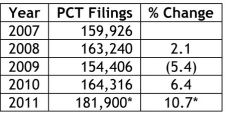
    WIPOEarlier this year, the World Intellectual Property Organization (WIPO) announced that International patent filings under the Patent Cooperation Treaty (PCT) were back on the rise following the 2007-09 recession (see "PCT and EP Filings on the Rise Again").  In particular, WIPO noted that filings had risen 4.8% from 2009 to 2010.  Last month, WIPO announced that filings would be up again in 2011, and that the number of international patent filings would set a new record.  According to the WIPO announcement, an estimated 181,900 PCT applications were filed last year.  Over the past five years, PCT filings look like this:

    Table                                 * estimate

    The United States is expected to hold onto the top ranking with 48,596 2011 filings, a 8% increase from the 45,008 applications that were filed in 2010.  China again saw the strongest growth in PCT filings, with applications up 33.4% to 16,406 in 2011.  Japan, Germany, and South Korea again rounded out the remainder of the top five with filings numbering 38,888 (up 21%); 18,568 (up 5.7%); and 10,447 (up 8.0%), respectively.

    When sorted by technical field, the top five fields for PCT filings in 2011 were:

    (1) Electrical machinery, apparatus, energy: 11,296 applications
    (2) Digital communication – 11,574
    (3) Medical technology: 10,753
    (4) Computer technology: 10,455
    (5) Pharmaceuticals: 7, 683

    The fields of biotechnology and organic fine chemistry each had more than 5,000 filings, with 5,232 and 5,283, respectively.  While the number of biotech filings rose slightly in 2011 from the 5,219 applications that were filed in 2010, the number of filings for organic fine chemistry was down in 2011 from the 5,511 applications filed in that field in 2010.  Organic fine chemistry was one of only four of the PCT's 35 technical fields that saw filings go down in 2011 (at least as far as WIPO's 2011 estimates are concerned).

    According to WIPO's figures, the top ten corporate PCT filers in 2011 were:

    (1) ZTE Corp. (China) – 2,826 applications
    (2) Panasonic Corp. (Japan) – 2,463
    (3) Huawei Technologies Co., Ltd. (China): 1,831
    (4) Sharp Kabushiki Kaisha (Japan): 1,755
    (5) Robert Bosch GmbH (Germany): 1,518
    (6) Qualcomm Inc. (U.S.): 1,494
    (7) Toyota Jidosha Kabushiki Kaisha (Japan): 1,417
    (8) LG Electronics Inc. (South Korea): 1,336
    (9) Koninklijke Philips Electronics N.V. (Netherlands): 1,148
    (10) Telefonaktiebolaget LM Ericsson (Sweden): 1,116

    Biotech/pharma companies making WIPO's Top 100 filers list included:  Procter & Gamble Co. (#24, 488 applications), Sumitomo Chemical Co. Ltd. (#27, 446), E.I. DuPont de Nemours & Co. (#29, 424), Dow Global Technologies Inc. (#34, 399), Novartis AG (#71, 200), F. Hoffmann-La Roche AG (#75, 189), Merck Patent GmbH (#94, 171), Sanofi-Aventis Deutschland GmbH (#96, 170), and Bayer CropScience AG (#99, 166).

    The five university PCT filers in 2011 were:

    (1) University of California (U.S.): 277 applications
    (2) Massachusetts Institute of Technology (U.S.): 179
    (3) University of Texas System (U.S.): 127
    (4) Johns Hopkins University (U.S.): 111
    (5) Korea Advanced Institute of Science and Technology (South Korea): 103

    The top three university filers in 2011 were identical to last year's top three.

  • Calendar

    April 3, 2012 – Contested Proceedings Before the New Patent Trial and Appeal Board: Navigating PTO Practice Under the New Procedures (Strafford) – 1:00 – 2:30 pm (EDT)

    April 5, 2012 – Personalized Medicine after Prometheus: Exploring the Limits of Patent-Eligibility (Intellectual Property Owners Association) – 2:00 pm (ET)

    April 9, 2012 – Mayo v. Prometheus (Law Seminars International) – 2:30 – 3:30 pm (Eastern)

    April 16-18, 2012 – Intellectual Property Counsels Committee (IPCC) Spring Conference & Meeting (Biotechnology Industry Organization) – Austin, TX

    April 17, 2012 – 28th Annual Joint Patent Practice Seminar (Connecticut, New Jersey, New York, and Philadelphia Intellectual Property Law Associations) – New York, NY

    April 18, 2012 – European Biotech Patent Law Update (D Young & Co.) – 7:00 am and 12:00 pm (EDT)

    April 18, 2012 – Patent Term Adjustments and Extensions: Recent Developments (Strafford) – 1:00 – 2:30 pm (EDT)

    April 24-25, 2012 – Paragraph IV Disputes*** (American Conference Institute) – New York, NY

    April 26, 2012 – Moving From First to Invent to First to File: Understanding the Opportunities and Challenges (Technology Transfer Tactics) – 1:00 – 2:00 pm (Eastern)

    May 22-23, 2012 – Biosimilars*** (American Conference Institute) – New York, NY

    ***Patent Docs is a media partner of this conference or CLE

  • IPO #2The Intellectual Property Owners Association (IPO) will offer a one-hour webinar entitled "Personalized Medicine after Prometheus: Exploring the Limits of Patent-Eligibility" on April 5, 2012 beginning at 2:00 pm (ET).  A panel consisting of Patent Docs author Dr. Kevin Noonan of McDonnell Boehnen Hulbert & Berghoff; Jonathan Singer of Fish & Richardson, who has represented the Mayo Clinic in its patent litigation with Prometheus; and Bryan Zielinski, Vice President, Assistant General Counsel, and Head of Pfizer's Business Unit IP group, will examine ways forward after the Mayo decision.

    The registration fee for the webinar is $120 (government and academic rates are available upon request).  Those interested in registering for the webinar can do so here.

  • LSI - Law Seminars International - blueLaw Seminars International (LSI) will be offering a one-hour analysis on "Mayo v. Prometheus" on April 9, 2012 from 2:30 – 3:30 pm (Eastern).  Gregory A. Castanias of Jones Day will moderate a panel including Prof. Joshua D. Sarnoff, Associate Professor of Law at DePaul University College of Law, who will provide the Petitioner's perspective, and Dr. Hansjorg Sauer, Deputy General Counsel for Intellectual Property for the Biotechnology Industry Organization (BIO), who will discuss the practical Implications of the decision for the biotechnology industry.  The panel will discuss the Mayo decision and its implications for patent litigation, patent procurement, personalized medicine, and the biotechnology industry as a whole.  Among the topics to be covered are:

    • How the Mayo decision is likely to reshape the biotechnology industry;
    • The likelihood that this decision will encourage new developments in personalized medicine to be hidden from the public and protected as trade secrets;
    • How the USPTO is reacting to this ruling;
    • How the Federal Circuit's Section 101 jurisprudence is likely to be affected by the Mayo decision;
    • How to litigate a Section 101 challenge after Mayo; and
    • Whether further amendments to the Patent Act might be on the horizon after Mayo.

    A Q&A will follow the presentation and last for up to 30 minutes.

    The registration fee is $125 per caller and $50 each additional person on the same line who desires continuing education credit.  Those interested in registering for the telebriefing, can do so here.

  • By Donald Zuhn —

    PPH Pilot Program between USPTO and IMPI Extended

    Mexican Patent Office - Instituto Mexicano de la Propiedad IndustrialOn March 7th, the U.S. Patent and Trademark Office announced that the Office would be extending its Patent Prosecution Highway (PPH) pilot program with the Mexican Institute of Industrial Property (IMPI).  The pilot program, which commended on March 1, 2011 (see "USPTO News Briefs," February 28, 2011), permits an applicant having an application whose claims have been allowed in the IMPI to fast track the examination of an application in the USPTO, or vice versa, such that the latter application is examined out of turn.  In particular, an applicant receiving a ruling from the USPTO (or the IMPI) that at least one claim in an application is patentable may request that the IMPI (or USPTO) fast track the examination of corresponding claims in the corresponding application in that office.  The USPTO-IMPI PPH pilot program has been extended until August 31, 2012, at which time the USPTO and IMPI will determine whether the program should be fully implemented.

    Since implementing its first Patent Prosecution Highway (PPH) program with the Japan Patent Office (JPO) on July 3, 2006, the U.S. Patent and Trademark Office has established a total of twenty PPH programs with other patent offices.  Currently the USPTO has PPH programs (full or pilot) in place with the Japan Patent Office (JPO), the Korean Intellectual Property Office (KIPO), the United Kingdom Intellectual Property Office (UK IPO), the Canadian Intellectual Property Office (CIPO), IP Australia (IP AU), the European Patent Office (EPO), the Danish Patent and Trademark Office (DKPTO), the Intellectual Property Office of Singapore (IPOS), the German Patent and Trade Mark Office (DPMA), the National Board of Patents and Registration of Finland (NBPR), the Hungarian Patent Office (HPO), the Russian Federal Service for Intellectual Property, Patents and Trademarks (ROSPATENT), the Spanish Patent and Trademark Office (SPTO), the Austrian Patent Office (APO), the Mexican Institute of Industrial Property (IMPI), and the Israel Patent Office (ILPO), the Taiwan Intellectual Property Office (TIPO), the Norwegian Industrial Property Office (NIPO), China's State Intellectual Property Office (SIPO), and the Icelandic Patent Office (IPO).  The USPTO has also established eleven PCT-PPH programs with other patent offices:  IP Australia, APO, SIPO, EPO, NBPR, JPO, KIPO, the Nordic Patent Institute (NPI), ROSPATENT, SPTO, and the Swedish Patent and Registration Office (PRV).  Additional information regarding the various PPH and PCT-PPH programs can be found here.


    USPTO and KIPO Provide Update on SHARE Program

    KIPO #2On March 1st, the U.S. Patent and Trademark Office and Korean Intellectual Property Office (KIPO) reported on the progress of the offices' Strategic Handling of Applications for Rapid Examination (SHARE) pilot program.  The pilot program, which ran from September 2009 to December 2010, was developed to ascertain the views of examiners in each office regarding the usefulness of the other office’s work products.

    A study of the pilot program indicated that each office viewed the search and examination results generated by the Office of First Filing (OFF) to be useful to the Office of Second Filing (OSF).  The two offices agreed that regardless of the procedure being used in the offices, the prior art identified by the offices seemed to be mutually agreeable and frequently to overlap.  The information garnered from the study will now be used to develop the next phase of the program.


    USPTO and AUTM Launch Examiner Training Initiative

    AUTMEarlier this month, the U.S. Patent and Trademark Office announced that it would be working with the Association of University Technology Managers (AUTM) to implement a joint patent examiner training program.  Under the program, AUTM members working in university technology transfer offices will identify key faculty members who will provide specialized training to patent examiners.  The program is intended to enhance the Office's Patent Examiner Technical Training Program (PETTP) by offering examiners additional training opportunities.  USPTO Director David Kappos said the initiative "represents an important step in partnering with the petri dish of creativity and research: the American university."  AUTM President Robin Rasor stated that the program "will help to improve the strength and quality of patents," and better protect the discoveries and inventions of the group's members, which "will lead to further scientific research and ultimately advance technology transfer and commercialization efforts."

  • By Sherri Oslick —

    Gavel About Court Report:  Each week we will report briefly on recently filed biotech and pharma cases.

    United Therapeutics Corp. v. Sandoz, Inc.
    3:12-cv-01617; filed March 14, 2012 in the District Court of New Jersey

    Infringement of U.S. Patent Nos. 5,153,222 ("Method of Treating Pulmonary Hypertension with Benzidine Prostaglandins," issued October 6, 1992), 6,765,117 ("Process for Stereoselective Synthesis of Prostacyclin Derivatives," issued July 20, 2004), and 7,999,007 ("Buffer Solutions Having Selective Bactericidal Activity Against Gram Negative Bacteria," issued August 16, 2011) following a Paragraph IV certification as part of Sandoz's filing of an ANDA to manufacture a generic version of United's Remodulin® (treprostinil sodium injection, used to treat pulmonary arterial hypertension).  View the complaint here.


    Forest Laboratories, Inc. et al v. Indchemie Health Specialties PVT. LTD. et al
    .
    1:12-cv-01855; filed March 14, 2012 in the Northern District of Illinois

    • Plaintiffs:  Forest Laboratories, Inc.; Forest Laboratories Holdings, LTD.; Janssen Pharmaceutica, N.V.
    • Defendants:  Indchemie Health Specialties PVT. LTD.; Alkem Laboratories, Ltd.

    Forest Laboratories Inc. et al v. Torrent Pharmaceuticals Ltd. et al.
    1:12-cv-00305; filed March 13, 2012 in the District Court of Delaware

    • Plaintiffs:  Forest Laboratories Inc.; Forest Laboratories Holdings Ltd.; Janssen Pharmaceutica N.V.
    • Defendants:  Torrent Pharmaceuticals Ltd.; Torrent Pharma Inc.; Watson Laboratories Inc.; Watson Laboratories Inc.; Watson Laboratories Inc.; Watson Laboratories Inc.; Watson Pharma Inc.; Watson Pharmaceuticals Inc.; Amerigen Pharmaceuticals Inc.; Amerigen Pharmaceuticals Ltd.; Glenmark Generics Inc.; Glenmark Generics Inc USA; Glenmark Generics Ltd.; Glenmark Pharmaceuticals Ltd.; Hetero USA Inc.; Hetero Labs Ltd.

    The complaints in these cases are substantially identical.  Infringement of U.S. Patent No. 6,545,040 ("Method of Lowering the Blood Pressure," issued April 8, 2003) following a Paragraph IV certification as part of defendants' filing of an ANDA to manufacture a generic version of Forest's Bystolic® (nebivolol hydrochloride, used to treat hypertension).  View the Torrent complaint here.


    Precision BioSciences, Inc. v. Cellectis SA et al
    .
    5:12-cv-00124; filed March 13, 2012 in the Eastern District of North Carolina

    • Plaintiff:  Precision BioSciences, Inc.
    • Defendants:  Cellectis SA ; Cellectis bioresearch; Cellectis bioresearch Inc.

    Infringement of U.S. Patent No. 8,133,697 ("Methods of Cleaving DNA with Rationally-Designed Meganucleases," issued March 13, 2012) based on Cellectis' manufacture, use, and sale of engineered I-CreI meganucleases.  View the complaint here.


    Allergan, Inc. v. Apotex Inc., et al
    .
    1:12-cv-00247; filed March 13, 2012 in the Middle District of North Carolina

    • Plaintiff:  Allergan, Inc.
    • Defendants:  Apotex Inc.; Apotex Corp.; Sandoz, Inc.; Hi-Tech Pharmacal Co., Inc.

    Infringement of U.S. Patent Nos. 8,038,988 ("Method of Enhanced Hair Growth," issued October 18, 2011) and 8,101,161 (same title, issued  January 24, 2012) based on defendants' filing of an ANDA to manufacture a generic version of Allergan's Latisse® (bimatoprost topical solution/drops, 0.03%, used to treat inadequate or not enough eye lashes).  View the complaint here.

  • By Donald Zuhn —

    USPTO SealOne day after the Supreme Court reversed the Federal Circuit in Mayo Collaborative Services v. Prometheus Laboratories, Inc., finding Prometheus' diagnostic method claims to be invalid for "effectively claim[ing] underlying laws of nature," the U.S. Patent and Trademark Office issued a memorandum to its examining corps providing the Office's preliminary guidance regarding the High Court's decision.  The three-page memo, sent by Associate Commissioner for Patent Examination Policy Andrew Hirshfeld, notes that the guidance provided is preliminary and that "[a]dditional guidance on patent subject matter eligibility under 35 U.S.C. § 101 will be issued soon."

    Under the heading "Claims to Law of Nature Itself Are Not Patent-Eligible," the memo begins by reciting claim 1 of Prometheus' U.S. Patent No. 6,355,623.  In summarizing the Court's decision, the memo states that:

    The Supreme Court found that because the laws of nature recited by the patent claims — the relationships between concentrations of certain metabolites in the blood and the likelihood that a thiopurine drug dosage will prove ineffective or cause harm — are not themselves patent-eligible, the claimed processes are likewise not patent-eligible unless they have additional features that provide practical assurance that the processes are genuine applications of those laws rather than drafting efforts designed to monopolize the correlations.  The additional steps in the claimed processes here are not themselves natural laws, but neither are they sufficient to transform the nature of the claims.

    In this case, the claims inform a relevant audience about certain laws of nature.  Any additional steps consist of well-understood, routine, conventional activity already engaged in by the scientific community.  Those steps, when viewed as a whole, add nothing significant beyond the sum of their parts taken separately.  The Court has made clear that to transform an unpatentable law of nature into a patent-eligible application of such a law, one must do more than simply state the law of nature while adding the words "apply it."  Essentially, appending conventional steps, specified at a high level of generality, to laws of nature, natural phenomena, and abstract ideas cannot make those laws, phenomena, and ideas patent-eligible.

    (emphasis in original).

    In a second part of the memo, the Office lays out its preliminary guidance regarding examination procedure in light of the Court's decision.  The memo notes that "examiners should continue to examine patent applications for compliance with section 101 using the existing Interim Bilski Guidance" along with some additional considerations set out in the memo.  In particular, the memo states that:

    Examiners must continue to ensure that claims, particularly process claims, are not directed to an exception to eligibility such that the claim amounts to a monopoly on the law of nature, natural phenomenon, or abstract idea itself.  In addition, to be patent-eligible, a claim that includes an exception should include other elements or combination of elements such that, in practice, the claimed product or process amounts to significantly more than a law of nature, a natural phenomenon, or an abstract idea with conventional steps specified at a high level of generality appended thereto.

    (emphasis in original).

    The memo advises examiners to reject claims that are "effectively directed to the exception itself (a law of nature, a natural phenomenon, or an abstract idea)" as being directed to non-statutory subject matter, and provide applicants with an opportunity "to explain why the claim is not drawn solely to the exception and point to limitations in the claim that apply the law of nature, natural phenomena or abstract idea."

    The memo concludes by noting that the Office continues to study the Supreme Court's decision in Mayo, and is "developing further detailed guidance on patent subject matter eligibility under 35 U.S.C. § 101."

    For additional information regarding this topic, please see:

    • "Mayo Collaborative Services v. Prometheus Laboratories — What Should We Do? (or Can These Claims Be Saved?)," March 26, 2012
    • "Mayo Collaborative Services v. Prometheus Laboratories — What the Court's Decision Means," March 22, 2012
    • "Mayo Collaborative Services v. Prometheus Laboratories — What the Supreme Court Said," March 21, 2012
    • "Early Reaction to Supreme Court Decision in Mayo v. Prometheus," March 20, 2012
    • "Mayo Collaborative Services v. Prometheus Laboratories, Inc. (2012)," March 20, 2012
    • "Deciphering the Patent-Eligibility Message in Prometheus, Myriad and Classen," March 20, 2011