• By Daniel Boehnen
    —

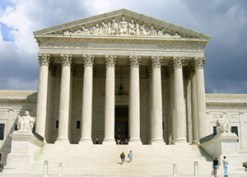
    Supreme Court Building #2Last week, The
    Supremes once again stepped into an area of science/law where their limited knowledge
    of both fields will create more harm than good.  The Supremes' say that
    the problem with isolated and purified DNA is that it is not chemically
    distinct from naturally occurring DNA, like cDNA, but persons of skill in the
    art recognize their reasoning is wrong.  At a minimum, the bonding
    structure at the ends of the isolated and purified DNA have been inherently and
    unavoidably changed.  Thus, the distinction between cDNA and purified and
    isolated DNA is a difference of degree not of kind as reasoned by The Supremes.

    The Supremes'
    deeper mistake is they have, once again, been persuaded by those who conflate
    the concepts of prior art patentability with the concept of statutory
    patentability in order to get short term benefit in trade for long term
    progress.  It is perhaps true that isolating and purifying DNA is no
    longer patentable today.  But that situation is because the science of
    molecular biology has progressed to the point where such advancements are now
    relatively obvious to persons skilled in the art.  That situation
    certainly was not true in 1983 when an Amgen scientist isolated and purified
    the DNA for erythropoietin and forever changed the world for patients with
    kidney failure.  And "but for" that earth changing event by Fu
    Kwen Lin, who can say whether any of the subsequent discoveries by other Amgen
    scientists would have occurred.

    MyriadTherein lays the
    future mischief that will result from The Supremes' latest decision.  In
    modern parlance, a core aspect of the patent system is to encourage the capital
    formation which is needed to tackle the ever-increasingly-difficult challenges
    that our society faces.  Without the incentive to form the capital pools
    necessary to tackle increasingly sophisticated and complex problems, technical
    advances will slow to lower pace.  Perhaps that's a good thing.  Perhaps we have achieved such rapid technical advance over the past 30+ years
    that we need to slow down for a while, i.e., to give the world a chance to
    digest all that has been accomplished.

    But
    that slower pace will provide little comfort to patients having a decision
    whose treatment lies hidden in the leaves of a plant growing in the Amazon
    forest or inside an insect trapped in an amber rock buried in an African
    mine.  We have, today, many companies and scientists whose existence
    is devoted to unlocking such compounds so that they can be used as
    medicines.  A core mischief of The Supremes' latest decision is that it
    virtually assures that enormous work of isolating, identifying, and making
    these compounds available for society will no longer be rewarded with patent
    protection.  That result won't deter scientists from trying to continue
    their work; many scientist will still work hard, devoting their energy
    to unlocking these secrets of nature.  But The Supremes' decision will
    most definitely deter the money-people, those who provide the money that
    supports the efforts of those scientists.  The money-people will look elsewhere,
    and many of them will find other opportunities.  With less monetary support,
    there will be fewer scientists looking.  And with fewer scientists
    looking, there will be fewer discoveries.  It's particularly unfortunate
    that this decision comes at a time when the government, too, is cutting support
    for science.

  • By Grantland Drutchas —

    Supreme Court Building #3Perhaps one of
    the most intriguing issues coming out of the Supreme Court's Myriad
    decision
    is whether it leaves any room for the "inventive concept"
    test raised by earlier Supreme Court decisions, including Mayo v. Prometheus.  Or is inventive concept merely limited to method claims?  Compare the
    mental gymnastics that the Federal Circuit had to go through for the CLS
    Bank v. Alice
    decision.  Where is any of that in this Supreme Court
    decision?

    For cDNA
    claims, Justice Thomas issued nothing more than the following terse statement:

    cDNA
    does not present the same obstacles to patentability as naturally occurring,
    isolated DNA segments.  As already explained, creation of a cDNA sequence from
    mRNA results in an exons-only molecule that is not naturally occurring.  Petitioners concede that cDNA differs from natural DNA in that "the
    non-coding regions have been removed."  Brief for Petitioners 49.  They nevertheless argue that cDNA is not patent eligible because "[t]he
    nucleotide sequence of cDNA is dictated by nature, not by the lab technician."  Id., at 51.  That may be so, but the lab technician unquestionably creates
    something new when cDNA is made.  cDNA retains the naturally occurring exons of
    DNA, but it is distinct from the DNA from which it was derived.  As a result,
    cDNA is not a "product of nature" and is patent eligible under §101,
    except insofar as very short series of DNA may have no intervening introns to
    remove when creating cDNA.  In that situation, a short strand of cDNA may be
    indistinguishable from natural DNA.

    Op. at pp.
    16-17.  Although he dropped a footnote stating that "[w]e express no
    opinion whether cDNA satisfies the other statutory requirements of
    patentability" (Id., p. 17 n. 9), none of the types of "inventive
    concept" analyses the Federal Circuit wrestled over in the CLS case
    was provided.

    Justice Scalia's
    equally terse concurrence also does not address the "inventive concept"
    issue as it relates to cDNA.  "[T]he portion of DNA isolated from its
    natural state sought to be patented is identical to that portion of the DNA in
    its natural state; and that complementary DNA (cDNA) is a synthetic creation
    not normally present in nature."  Scalia Concurrence, p. 1.

    There is no
    question that producing cDNA is and was a well-understood, routine, conventional
    activity, but that didn't seem to trouble Justice Thomas or the rest of the
    Supreme Court.  If it is enough that the lab technician is, as Justice
    Thomas notes, "unquestionably creat[ing] something new,"
    regardless of how routine such a step is during the relevant time period, what
    does that mean for the "inventive concept" concept?  Or is it
    that the Supreme Court believes the "inventive concept" test is
    limited to method claims, and these claims are directed to compounds?

    Note, too, that
    not all cDNA may be patentable:  A "very short series of DNA may have
    no intervening introns to remove when creating cDNA. In that situation, a short
    strand of cDNA may be indistinguishable from natural DNA."  Op. at
    17.

  • By Sherri Oslick —

    Gavel About Court Report:  Each week we will report briefly on recently filed biotech and pharma cases.

    Fresenius Kabi USA, LLC v. Watson Laboratories Inc. et al.
    1:13-cv-01015; filed June 6, 2013 in the District
    Court of Delaware

    • Plaintiff: 
    Fresenius Kabi USA, LLC
    • Defendants: 
    Watson Laboratories Inc.; Actavis Inc.

    Infringement
    of U.S. Patent Nos. 5,714,520 ("Propofol Compostion [sic] Containing
    Edetate," issued February 3, 1998), 5,731,355 ("Pharmaceutical
    Compositions of Propofol and Edetate," issued March 24, 1998), 5,731,356 ("Pharmaceutical
    Compositions of Propofol and Edetate," issued March 24, 1998) and
    5,908,869 ("Propofol Composition Containing Edetate," issued June 1,
    1999) following a Paragraph IV certification as part of Watson's filing of an
    ANDA to manufacture a generic version of Fresenius' Diprivan® (propofol
    injectable emulsion, used for the induction and maintenance of general
    anesthesia and sedation in certain patient populations).  View the complaint here.


    Everett
    Laboratories, Inc. v. Acella Pharmaceuticals, LLC

    2:13-cv-03529;
    filed June 6, 2013 in the District Court of New Jersey

    Infringement of U.S. Patent Nos. 6,814,983 ("Compositions
    and Methods for Nutrition Supplementation," issued November 9, 2004) and
    7,390,509 (same title, issued June 24, 2008) based on Acella's manufacture and
    sale of its PNV – OB with DHA product, an alleged copy of Everett's Vitafol®-OB+DHA
    (prescription prenatal nutritional supplement). 
    View the complaint here.


    AbbVie Inc. et al. v. Dr. Reddy's Laboratories Ltd. et al.

    1:13-cv-01012; filed June 5, 2013 in the District
    Court of Delaware

    • Plaintiffs: 
    AbbVie Inc.; Wisconsin Alumni Research Foundation
    • Defendants: 
    Dr. Reddy's Laboratories Ltd.; Dr. Reddy's Laboratories Inc.

    Infringement
    of U.S. Patent Nos. 6,136,799 ("Cosolvent Formulations," issued
    October 24, 2000), 6,361,758 (same title, issued March 26, 2002), and 5,597,815
    ("Prevention of Hyperphosphatemia in Kidney Disorder Patients,"
    issued January 28, 1997) following a Paragraph IV certification as part of Dr.
    Reddy's filing of an ANDA to manufacture a generic version of AbbVie's Zemplar®
    (paricalcitol, used to treat secondary hyperparathyroidism in patients with
    kidney failure).  View the complaint here.


    Everett
    Laboratories, Inc. v. Acella Pharmaceuticals, LLC

    1:13-cv-03487;
    filed June 5, 2013 in the District Court of New Jersey

    Infringement of U.S. Patent No. 8,197,855 ("Compositions
    and Methods for Nutrition Supplementation," issued June 12, 2012) based on
    Acella's manufacture and sale of its Choice-OB+DHA product, an alleged copy of
    Everett's Select-OB®+DHA (prescription prenatal nutritional supplement).  View the complaint here.


    Merck & Cie et al. v. Watson Laboratories Inc. et al.

    1:13-cv-00978; filed June 4, 2013 in the District
    Court of Delaware

    • Plaintiffs: 
    Merck & Cie; Bayer Pharma AG; Bayer HealthCare Pharmaceuticals Inc.
    • Defendants: 
    Watson Laboratories Inc.; Actavis Inc.

    Merck & Cie et al. v. Watson Laboratories, Inc. et al.
    2:13-cv-00990; filed June 4, 2013 in the District
    Court of Nevada

    • Plaintiffs: 
    Merck & Cie; Bayer Pharma AG; Bayer Healthcare Pharmaceuticals Inc.
    • Defendants: 
    Watson Laboratories, Inc.; Actavis, Inc.

    The complaints in these cases are substantially identical.  Infringement of U.S. Patent No. 6,441,168 ("Stable
    Crystalline Salts of 5-methyltetrahydrofolic Acid," issued August 27,
    2002), licensed to Bayer, following a Paragraph IV certification as part of
    Watson's filing of an ANDA to manufacture a generic version of Bayer's Safyral®
    (drospirenone, 17α-ethinyl estradiol, and levomefolate calcium, used for oral
    contraception).  View the Delaware complaint here.


    Pfizer Inc. et al. v. Dr. Reddy's Laboratories, Ltd. et al.

    1:13-cv-00989; filed June 4, 2013 in the District
    Court of Delaware

    • Plaintiffs: 
    Pfizer Inc.; Wyeth LLC; Wyeth Pharmaceuticals Inc.; PF Prism CV
    • Defendants: 
    Dr. Reddy's Laboratories, Ltd.; Dr. Reddy's Laboratories, Inc.

    Infringement of U.S. Patent Nos. 6,673,838 ("Succinate
    Salt of O-Desmethyl-Venlafaxine," issued January 6, 2004) and 8,269,040 ("Derivatives
    of Venlafaxine and Methods of Preparing and Using the Same," issued
    September 18, 2012) following a Paragraph IV certification as part of
    defendants' filing of an ANDA to manufacture a generic version of Pfizer's
    Pristiq® (desvenlafaxine, used to treat depression).  View the complaint here.


    Everett Laboratories, Inc. v. Acella Pharmaceuticals, LLC

    2:13-cv-03470; filed June 4, 2013 in the District
    Court of New Jersey

    Infringement of U.S. Patent No. 8,183,227 ("Compositions,
    Kits and Methods for Nutrition Supplementation," issued May 22, 2012)
    based on Acella's manufacture and sale of its PNV-First product, an alleged
    copy of Everett's Vitafol®-One (prescription prenatal nutritional
    supplement).  View the complaint here.


    Vertex Pharmaceuticals Inc. v. Rea

    1:13-cv-00653; filed May 31, 2013 in the Eastern
    District of Virginia

    Review and correction of the patent term adjustment
    calculation made by the U.S. Patent and Trademark Office for U.S. Patent No.
    8,324,242 ("Viscous Budesonide for the Treatment of Inflammatory Diseases
    of the Gastrointestinal Tract," issued December 4, 2012).  View the complaint here.


    Avanir Pharmaceuticals Inc. et al. v. Sandoz Inc.

    1:13-cv-00961; filed May 30, 2013 in the District
    Court of Delaware

    • Plaintiffs: 
    Avanir Pharmaceuticals Inc.; Avanir Holding Co.; Center for Neurologic
    Study
    • Defendant: 
    Sandoz Inc.

    Infringement of U.S. Patent Nos. 7,659,282 ("Pharmaceutical
    Compositions Comprising Dextromethorphan and Quinidine for the Treatment of
    Neurological Disorder," issued February 9, 2010), 8,227,484 (same title,
    issued July 24, 2012), and RE38,115 ("Dextromethorphan and an Oxidase
    Inhibitor for Treating Intractable Conditions," issued May 6, 2003) in
    conjunction with Sandoz's purchase of an ANDA filed by Watson Pharmaceuticals,
    Inc., which included a Paragraph IV certification relating to Avanir's
    Nuedexta® (dextromethorphan hydrobromide/quinidine sulfate, used to treat
    pseudobulbar affect).  View the complaint here.


    Regents of the University of California v. Rea

    1:13-cv-00647; filed May 30, 2013 in the Eastern
    District of Virginia

    Review and correction of the patent term adjustment
    calculation made by the U.S. Patent and Trademark Office for U.S. Patent No.
    8,324,192 ("Viscous Budesonide for the Treatment of Inflammatory Diseases
    of the Gastrointestinal Tract," issued December 4, 2012).  View the complaint here.

  • CalendarJune 18, 2013 – Myriad: Implications of
    the U.S. Supreme Court Opinion
    (Intellectual Property Owners Association) – 2:00 to 3:00
    pm (ET)

    June 25, 2013 – AIA Impact on Section 103 and Non-Obviousness:
    Navigating Timing Changes, Post-AIA Treatment of KSR, and Secondary Considerations to Meet Patent Validity
    Requirements
    (Strafford) – 1:00 – 2:30 pm (EDT)

    June 25-26, 2013 – Maximising
    Pharma Patents
    (C5 (UK)) – London, England

    June 26, 2013 – The Supreme
    Court Decision(s) in Myriad: What Did
    the Justices Say? What Does It Mean for Industry?
    (Foley
    & Lardner) – 12:00
    to 1:15 pm (Eastern)

    July 1-2, 2013 – TTS Europe (TTS Ltd. and Wellcome Trust) – London, UK

    July 10, 2013 – CLS Bank v. Alice Corp.: Navigating Patent
    Eligibility of Software-Related Inventions Absent Clear Guidance
    (Strafford) – 1:00 to 2:30 pm (EDT)

    July
    10-12, 2013 – Fundamentals of Patent Prosecution
    2013: A Boot Camp for Claim Drafting & Amendment Writing
    (Practising
    Law Institute) – San Francisco, CA

    July 11, 2013 – Biotechnology Patents at the U.S. Supreme
    Court: 2012-2013 Term
    (McDonnell
    Boehnen Hulbert & Berghoff LLP) – 10:00 to 11:15 am
    (CT)

    July 15-16, 2013 – Global Patenting Strategy and Practice (American Conference
    Institute) – New
    York, NY

    July 15-19, 2013 – Patent Law Summer
    Intensive
    (Benjamin N. Cardozo School of Law) – New York, NY

    July 28-30, 2013 – 2013 Annual Meeting & Conference (National Association of Patent Practitioners) – San
    Diego, CA

    July 31 to August 2, 2013 – Advanced Patent Law Seminar (Chisum Patent Academy) – Seattle, WA

    August 5-7, 2013 – Advanced Patent Law Seminar (Chisum Patent Academy) – Seattle, WA

    ***Patent Docs is a media partner of this conference or CLE

  • IPO #2The
    Intellectual Property Owners Association (IPO) will offer a one-hour webinar
    entitled "Myriad: Implications of
    the U.S. Supreme Court Opinion" on June 18, 2013 beginning at 2:00
    pm (ET).  A panel consisting of Gregory Castanias of Jones Day (who argued
    for Myriad at the Federal Circuit and before the U.S. Supreme Court); Patent Docs author Dr. Kevin Noonan of
    McDonnell Boehnen Hulbert & Berghoff; and Paul Golian, Assistant General
    Counsel at Bristol-Myers Squibb Company will consider such questions as:

    •
    How many and which existing gene patents will be challenged in post-grant
    proceedings at the USPTO?
    •
    Will holders of gene patents seek reissue?
    •
    What does the decision mean for protein therapeutics, and other products that
    are arguably "found in nature"?
    •
    Are claims to isolated polypeptide sequences covering human proteins that are
    in therapeutic use no longer valid?
    •
    Where do comparative diagnostic claims stand after both Myriad and Prometheus?

    The
    registration fee for the webinar is $120 (government and academic rates are
    available upon request).  Those
    interested in registering for the webinar can do so here.

  • Europe2013_logoTTS Ltd. and the
    Wellcome Trust will be holding its 2013 edition of TTS Europe on July 1-2, 2013
    at the Welcome Trust in London, UK.  The
    TTS Global Initiative is the leading international meeting for biotech sector Industry-academia
    licensing, partnering, and technology transfer. 
    TTS Europe is not an IP Counsel meeting, but a multi-stakeholder meeting
    where IP and early-stage biotech are front and center and where Tech Transfer
    Officers and IP professionals discuss and debate issues, models, and strategy
    directly with other key stakeholders in early-stage biotech and bio-pharma
    innovation.

    A full program for
    TTS Europe, including an agenda of each event's sessions and list of speakers
    can be obtained here.  Patent
    Docs
    author Dr. Kevin Noonan of McDonnell Boehnen Hulbert & Berghoff
    LLP will provide a presentation on "The most important trends &
    developments in global biotech IP, or what the hell is happening in the
    US?"

    The registration
    fee for TTS Europe is £599
    (academic Innovators, university or Institute Technology Transfer Officers,
    non-governmental or non-profit organizations, and start-ups) or £999 (multinational, corporate, legal
    & consulting, and government).  Patent Docs readers who register using
    the Code CJS13 will be able to secure a reduced registration fee of £399 (academic Innovators, university
    or Institute Technology Transfer Officers, non-governmental or non-profit
    organizations, and start-ups) or £699
    (multinational, corporate, legal & consulting, and government).  Details regarding registration for the event
    can be found here.

    Patent Docs and McDonnell Boehnen Hulbert & Berghoff LLP are partners of TTS
    Europe.

    TTSbanner-Europe2013-728

  • Foley & LardnerFoley
    & Lardner will be offering a web conference entitled "The Supreme
    Court Decision(s) in Myriad: What Did
    the Justices Say? What Does It Mean for Industry?" on June 26, 2013 from 12:00
    to 1:15 pm (Eastern).  Featured panelists
    for the web conference will include The Honorable Paul R. Michel (ret.), U.S
    Court of Appeals for the Federal Circuit; Dr. Hans Sauer, Associate General
    Counsel for Intellectual Property for the Biotechnology Industry Organization;
    and Patent Docs author Dr. Kevin
    Noonan of McDonnell Boehnen Hulbert & Berghoff LLP.  The web conferenced will be moderated by
    Courtenay C. Brinckerhoff and hosted by Harold C. Wegner of Foley & Lardner.  The panel will discuss the intricacies and likely impact of the Supreme
    Court's decision in Association for Molecular Pathology v. Myriad Genetics,
    Inc.
    , as well as analyze
    the decision and discuss what it means for the life sciences industry and the
    evolving area of patent-eligibility jurisprudence as a whole.

    While there is no cost to participate in the
    program, pre-registration is required.  Those
    interested in attending the webinar can register here.

  • San DiegoThe National Association of Patent Practitioners (NAPP) will be
    holding its 2013 Annual Meeting & Conference on July 28-30, 2013 in San
    Diego, CA.  An optional short-course
    entitled: "The Nuts & Bolts of Patent Prosecution Practice for Solo
    Practitioners and Small Firms," will be offered on July 28.  Topics to be covered during the short course
    include:

    • Client Intake, Inventorship, Ownership, and Assignments
    • Client Engagements and Nuances of Legal Representation including
    Ethical Considerations
    • Patent Application Preparation
    • Provisional Patent Practice post-AIA
    • Fundamentals of Amendment Practice
    • USPTO Examiner Interviewing Techniques and Tips in the Era of
    Hoteling, WebEx and Videoconferencing

    Topics to be discussed during the July 29-30 conference will include:

    • Federal Circuit Update
    • Working with In-House Counsel
    • Strategies for Managing, Protecting and Enforcing Your Intellectual Property
    Rights in China
    • Liability Insurance and Ethical Considerations for Patent Practitioners
    • Important Considerations When Filing PCT Applications
    • Recent and future developments in the Patent Cooperation Treaty
    (PCT)
    • Right to practice & Novelty search strategies
    • Drafting Solid Business Method Claims
    • Subject Matter Eligibility: AMP v. Myriad Genetics
    • Managing your Docket: A review of docketing system options and strategies
    for avoiding misconduct
    • Ex Parte Appeal PTAB Practice
    • Rainmaking & the Business of Patent Practice
    • Prosecution Update: 102 & 103 post-AIA
    • Cooperative Patent Classification (CPC)

    A program for the meeting, including an agenda and registration
    information can be found here.

    NAPPThe registration fee for the short-course is $495 (for NAPP members)
    or $695 (for non-members).  The
    registration fee for the annual meeting and conference is $795 (for NAPP
    members) or $995 (for non-members).  NAPP
    members or non-members registering by June 26 will receive a $100 discount off
    the above rates.  Those interested in
    registering for the meeting can do so here.

  • By Kevin E. Noonan —

    Supreme Court Building #2The Supreme Court rendered its opinion in Association for Molecular
    Pathology v. Myriad Genetics, Inc
    .
    ("the Myriad
    case"), and in many ways it was anticlimactic:  the Court adopted the
    Department of Justice's position (thankfully, sans "magic microscope") by deciding that cDNA was patent
    eligible but genomic DNA (and fragments thereof including oligonucleotides) was
    not.  While the biotechnology industry
    avoided a categorical ban on patenting DNA (which was the goal of the ACLU) or,
    worse, on "products of nature" no matter how altered, the Court's
    carefully focused opinion contains enough worrisome dicta to permit plaintiffs
    to declare victory even though the Court expressly disclaimed any decision on
    genetic diagnostic methods (which, after all, was the purported basis for the
    litigation in the first place).

    The claims at issue are the following
    (remembering that claims, not inventions, are the basis for determining
    compliance with the patent statute):

    1.  An isolated DNA coding
    for a BRCA1 polypeptide, said polypeptide having the amino acid sequence set
    forth in SEQ ID NO:2.

    5.  An isolated DNA having at least
    15 nucleotides of the DNA of claim 1.

    6.  An isolated DNA having at least
    15 nucleotides of the DNA of claim 2.

    7.  An isolated DNA selected from the
    group consisting of:
        (a)  a DNA having
    the nucleotide sequence set forth in SEQ ID NO:1 having T at nucleotide
    position 4056;
        (b)  a DNA having
    the nucleotide sequence set forth in SEQ ID NO:1 having an extra C at
    nucleotide position 5385;
        (c)  a DNA having
    the nucleotide sequence set forth in SEQ ID NO: 1 having G at nucleotide
    position 5443; and, (d) a DNA having the nucleotide sequence set forth in SEQ
    ID NO:1 having 11 base pairs at nucleotide positions 189-199 deleted.

    U.S. Patent No. 5,747,282;

    1.  An isolated DNA molecule
    coding for a BRCA2 polypeptide, said DNA molecule comprising a nucleic acid
    sequence encoding the amino acid sequence set forth in SEQ ID NO:2.

    6.  An isolated DNA molecule coding
    for a mutated form of the BRCA2 polypeptide set forth in SEQ ID NO:2, wherein
    said mutated form of the BRCA2 polypeptide is associated with susceptibility to
    cancer.

    7.  The isolated DNA molecule of
    claim 6, wherein the DNA molecule comprises a mutated nucleotide sequence set
    forth in SEQ ID NO:1.

    U.S. Patent No. 5,837,492
    (recombinant vector and transformed recombinant cell claims are not named);

    1.  An isolated DNA
    comprising an altered BRCA1 DNA having at least one of the alterations set
    forth in Tables 12A, 14, 18 or 19 with the proviso that the alteration is not a
    deletion of four nucleotides corresponding to base numbers 4184-4187 in SEQ.
    ID. NO:1.

    U.S. Patent No. 5,693,473
    (nucleic acid probe claims are not recited in the complaint).

    The Court's unanimous opinion by Justice Thomas,
    with a concurring opinion by Justice Scalia, began with a recitation of the "facts"
    as established below; while important this portion of the opinion raises as
    many issues as it purports to resolve and will be addressed below.  More
    important to the issue before the Court (and the answer to the Question
    Presented, "Are human genes patentable?") is the legal rationale
    Justice Thomas sets forth based on these facts.  The Court in a footnote also puts the standing issue to bed, stating
    that the only plaintiff found by the Federal Circuit to have standing, Dr.
    Harry Ostrer, "has alleged sufficient facts 'under all the circumstances,
    [to] show that there is a substantial controversy, between parties having
    adverse legal interests, of sufficient immediacy and reality to warrant the issuance
    of a declaratory judgment'" under the Court's MedImmune v. Genentech decision.

    MyriadThe opinion begins in the canonical way,
    reciting the Constitutional basis of the patent grant, Congress' decision to
    define patent eligibility broadly, and the Court's imposition of limitations on
    this breadth (wherein laws of nature, natural phenomena and abstract ideas are
    excluded).  The opinion then provides the
    rationale for these exceptions, relying heavily on its recent opinion in Mayo v. Prometheus.  These include that such "basic tools of
    scientific and technological work" should "lie beyond the domain of
    patent protection" because if they did not, "there would be
    considerable danger that the grant of patents would 'tie up' the use of such
    tools and thereby 'inhibit future innovation premised upon them.'"  In so basing its decision on this principle
    in this case, the Court ignores the extensive evidence that, with regard to the
    BRCA genes and Myriad's patents, there has not been such a tying up of isolated
    BRCA DNA (including evidence of more than 10,000 scientific research reports in
    peer-reviewed journals regarding research on BRCA).  The Court's apprehension of a "tying up"
    problem does not exist in this case, regardless of whether it is ever a
    realistic deleterious outcome of patenting.

    The Court is careful to ensure that its decision
    is not interpreted as being a categorical ban on "naturally occurring
    things," reminding us that "all inventions at some level embody, use,
    reflect, rest upon, or apply laws of nature, natural phenomena, or abstract
    ideas," and "too broad an interpretation of this exclusionary principle
    could eviscerate patent law," a concept also taken from its Mayo decision.  The decision solidifies
    the Court's precept that patenting must achieve a "balance" between too
    little patenting or too much patenting, either of which the Court believes can
    harm innovation and thus not "promote the Progress . . . of the useful Arts."

    Turning to Myriad's claims, the Court terms its Diamond
    v. Chakrabarty
    decision as being
    "central" to the inquiry of whether claims to isolated DNA are
    patent-eligible.  Comparing Myriad's
    claims to this standard the Court opines that "Myriad did not create
    anything" (the limitations of this statement are discussed below).  The Court then announces that "[g]roundbreaking,
    innovative, or even brilliant discovery does not by itself satisfy the §101 inquiry";
    the only saving grace in this statement is the qualifier "by itself,"
    which prevents the sentence from being interpreted to mean that "[g]roundbreaking,
    innovative, or even brilliant discovery" per se would categorically be outside the scope of patenting (an
    interpretation that, inter alia,
    would be contrary to the express language of the statute).  Support for this statement is, not
    surprisingly, Funk Bros. Seed Co. v. Kalo Inoculant Co., which the opinion describes as a case involving claims
    to a "mixture of naturally occurring strains of bacteria that helped
    leguminous plants take nitrogen from the air and fix it in the soil."  The basis for the Court's decision that these
    claims were unpatentable is that "the composition was not patent eligible
    because the patent holder did not alter the bacteria in any way," and the
    Court analogizes the "discovery" that certain bacteria could be
    combined with Myriad's "discovery" of the "location of the BRCA1
    and BRCA2 genes in the chromosomes."  This analysis ignores several distinctions between these inventions,
    including (as set forth in the opinion) that the existence of the bacteria in Funk Bros. was known, and that the bacteria had
    been isolated and used by farmers to "inoculate" their crops to
    improve the level of nitrogen fixation in the soil.  In the words of the Court's Mayo decision, the bacteria were "well-known,
    established and conventional," in contrast with the BRCA genes isolated by
    Myriad into a composition of matter "having a distinctive name, character
    [and] use."

    Part of the problem, however, is the
    specification of the '282 patent and the way it can be (and has been)
    misinterpreted; the Court calls out portions of the specification that it reads
    as being an assertion by Myriad that its invention was the identification of
    the location of the BRCA genes and the association of mutations with increased
    breast cancer risk.  The Court interprets
    this disclosure as "simply detail[ing] the 'iterative process' of
    discovery by which Myriad narrowed the possible locations for the gene
    sequences that it sought," and then ascribes to Myriad an attempt to "import
    these extensive research efforts into the §101 patent-eligibility inquiry"
    (finding these efforts to be unavailing).  The Court also does not credit isolation of the BRCA genes as being
    anything more than cleaving chemical bonds of the BRCA gene from the other
    portions of the chromosome.  In a portion
    of the opinion that seemingly fails to recognize how the chemical compound that
    is an isolated DNA molecule is claimed in English words, the opinion states
    that "Myriad's claims are simply not expressed in terms of chemical
    composition, nor do they rely in any way on the chemical changes that result from
    the isolation of a particular section of DNA.  Instead, the claims
    understandably focus on the genetic information encoded in the BRCA1 and BRCA2
    genes."  It is unlikely that the
    Court is implying that the claim should have used chemical structures to identify
    the isolated DNA or that such a representation would have satisfied the 101
    inquiry.  But by the plain meaning of the
    language in this sentence of the opinion, the Court ignores the well-recognized
    convention that a claim to "an isolated DNA
    coding for a BRCA1 polypeptide, said polypeptide having the amino acid sequence
    set forth in SEQ ID NO:2" is understood to be a representation of the
    chemical composition that depends on the chemical changes that differentiate
    the isolated DNA from the DNA as it exists in the chromosome.  The opinion also
    prompts the conclusion that the ACLU's position that "DNA is information"
    was successful, despite the fact that DNA sequence information is not patented.  This conclusion is reinforced by the next
    sentence in the opinion, that:

    If the patents depended upon the
    creation of a unique molecule, then a would-be infringer could arguably avoid
    at least Myriad's patent claims on entire genes (such as claims 1 and 2 of the '282
    patent) by isolating a DNA sequence that included both the BRCA1 or BRCA2 gene
    and one additional nucleotide pair.  Such a molecule would not be chemically
    identical to the molecule "invented" by Myriad.  But Myriad obviously
    would resist that outcome because its claim is concerned primarily with the
    information contained in the genetic sequence, not with the specific chemical
    composition of a particular molecule.

    The Justices have passed through the looking
    glass to have come to these conclusions based on the evidence presented by
    Myriad and its amici.

    The Court dealt easily and summarily with the
    policy question of whether calling into question thousands of patents granted
    by the U.S. Patent and Trademark Office would deny the Executive the deference it
    deserves as a co-equal branch of the Federal government.  While this is not surprising from a Court
    where one Justice believes the PTO is "patent-happy," the position
    taken by the Obama administration's Justice Department "weigh[ed] against
    deferring to the PTO's determination" that isolated DNA claims encompassing
    genomic DNA were eligible for patenting.  Insofar as reliance interests are relevant, the Court directs Myriad to
    Congress in a footnote.

    The Court came to the same conclusion of
    patent-ineligibility for claims to oligonucleotides, despite their synthetic
    nature and based on the identity of the sequence of these (albeit single-stranded) molecules with the corresponding sequence in chromosomal DNA.  On the other hand, the Court found that
    claims to cDNA "do[] not present the same obstacles to patentability as
    naturally occurring, isolated DNA segments," based on the "creation"
    by man of a "non-naturally occurring" DNA molecule.  The Court rejected the sequence-based
    objections argued by Petitioners, stating that while "[t]he nucleotide
    sequence of cDNA is dictated by nature, not by the lab technician," "the
    lab technician unquestionably creates something new when cDNA is made."  The only exception would be for "very
    short series (sic) of DNA [having] no
    intervening introns to remove when creating cDNA" which "may be
    indistinguishable from natural DNA."  In another footnote, the Court rejects the argument that the existence
    of pseudogenes (reverse transcription copies of genes reintroduced into human
    chromosomes) requires cDNA to be treated as a natural product like genomic DNA,
    saying that "[t]he possibility that an unusual and rare phenomenon might randomly create a molecule similar
    to one created synthetically through human ingenuity does not render a
    composition of matter nonpatentable" (emphasis
    in opinion
    ).

    The Court in its recent patent decisions has
    been careful to craft them to the issue at hand and to avoid broad,
    precedential decisions that could implicate future technology in unpredictable
    ways.  Justice Thomas's opinion does that
    here, in the final section of the opinion:

    First, there are no method claims
    before this Court.  Had Myriad created an innovative method of manipulating
    genes while searching for the BRCA1 and BRCA2 genes, it could possibly have
    sought a method patent.

    [Second], this case does not involve patents on
    new applications of knowledge about the BRCA1 and BRCA2 genes.  Judge Bryson
    aptly noted that, "[a]s the first party with knowledge of the [BRCA1 and
    BRCA2] sequences, Myriad was in an excellent position to claim applications of
    that knowledge. Many of its unchallenged claims are limited to such
    applications."

    Nor do we consider the patentability of
    DNA in which the order of the naturally occurring nucleotides has been altered.  Scientific alteration of the genetic code presents a different inquiry, and we
    express no opinion about the application of §101 to such endeavors.

    And the Court set forth succinctly its only
    holding:

    We merely hold that genes
    and the information they encode are not patent eligible under §101 simply
    because they have been isolated from the
    surrounding genetic material.

    There are some troubling aspects to the decision,
    not the least of which is the failure of the Court to recognize what in fact
    was claimed.  The Court's opinion begins
    with the assertion that Myriad "discovered the precise location and
    sequence of two human genes, mutations of which can substantially increase the
    risks of breast and ovarian cancer.  Myriad obtained a number of patents based
    upon its discovery."  The Court also
    opines that:

    It is undisputed that Myriad did not
    create or alter any of the genetic information encoded in the BRCA1 and
    BRCA2 genes.  The location and order of the nucleotides existed in
    nature before Myriad found them.  Nor did Myriad create or alter the genetic
    structure of DNA.  Instead, Myriad's principal contribution was uncovering the
    precise location and genetic sequence of the BRCA1 and BRCA2 genes within
    chromosomes 17 and 13.  The question is whether this renders the genes
    patentable.

    Of course, that is not how the claims at issue
    read nor how those claims would be construed in an infringement action.  This failure is significant because it
    influences the Court's appreciation of the scope of Myriad's claims and their
    preclusive effects.  Indeed, the
    information disclosed by Myriad, including the chromosomal location of the BRCA
    genes, their genetic sequence, and the residues that when mutated enable an
    increased risk of developing breast and ovarian cancer do not fall within
    the scope of the claims and using this information does not infringe the
    composition of matter claims at issue.  Accordingly, the Court from the outset approaches the question of
    whether these claims do not promote the progress of the useful arts from a
    false premise, which colors and distorts the remainder of the decision.

    The Court also goes astray in stating that "isolation
    is necessary to conduct genetic testing" when discussing the preclusive
    effect vel non of Myriad's isolated
    DNA claims.  Petitioners labored mightily
    to conflate the effects of the genetic diagnostic method claims they challenged
    and the isolated DNA claims, and they were clearly successful in convincing the
    Court that these claims could be asserted against competitors practicing Myriad's
    claimed methods.  That was not the case
    when the patents were filed and was even less the case after Myriad disclosed
    the positions of the diagnostic mutations in its patent specification.  Once these positions were known, isolation was
    no longer necessary.

    It is important to recognize what this opinion
    does not do:  it does not establish a categorical "product of nature"
    preclusion and thus should not be interpreted as mandating that other products
    of nature (such as those identified by Judge Moore in her concurring opinion)
    are categorically unpatentable.  Those
    cases are to come (and those inventions will be the subject of future
    posts).  Despite the glaring scientific
    and technological weaknesses of the Court's opinion, it does not (fortunately)
    invalidate thousands of existing patents or sufficiently upset the "settled
    expectations" of the biotechnology community.  But the opinion is another data point on a
    trend of the Court imposing its opinion of what is patent eligible on grounds
    that come perilously close to "we know it when we see it," a standard
    that works even less well for patenting than it did a generation ago for
    pornography.

    Finally, Justice Scalia's concurrence is
    remarkable for its intellectual humility and honesty; the Justice refuses to
    join the portions of the opinion "going into fine details of molecular
    biology," the Justice stating that he is "unable to affirm those details
    on my own knowledge or even my own belief."  Would that the remainder of the Court had
    come to this realization.

  • By Donald Zuhn —

    USPTO SealOn the same day that the
    Supreme Court handed down its decision in Association for Molecular
    Pathology v. Myriad Genetics, Inc
    .
    , the U.S. Patent and Trademark Office issued a one-page memorandum to its Patent Examining Corps to provide
    preliminary guidance on the decision. 
    The memo from Andrew Hirshfeld, the Deputy Commissioner for Patent
    Examination Policy, notes that in Myriad,
    "the Supreme Court held that claims to isolated DNA are not
    patent-eligible
    under 35 U.S.C. § 101," and that the decision "significantly
    changes the Office's examination policy regarding nucleic acid-related
    technology" (emphasis in original). 
    The memo advises the examining corps that:

    As of today,
    naturally occurring nucleic acids are not patent eligible merely because they have
    been isolated.  Examiners should now
    reject product claims drawn solely to naturally occurring nucleic acids or
    fragments thereof, whether isolated or not,
    as being ineligible subject
    matter under 35 U.S.C. § 101.  Claims
    clearly limited to non-naturally-occurring nucleic acids, such as a cDNA or a
    nucleic acid in which the order of the naturally-occurring nucleotides has been
    altered (e.g., a man-made variant sequence), remain eligible.  Other claims, including method claims, that
    involve naturally occurring nucleic acids may give rise to eligibility issues
    and should be examined under the existing guidance in MPEP 2106, Patent Subject Matter Eligibility.

    (emphasis in original).

    The memo concludes by
    noting that "[t]he USPTO is closely reviewing the decision in Myriad and will issue more comprehensive
    guidance on patent subject matter eligibility determinations, including the role
    isolation plays in those determinations."

    Patent Docs thanks Hal Wegner for alerting the patent community to the memorandum.