• CalendarOctober 1, 2013 – 2013 Intellectual Property
    Continuing Legal Education Seminar
    (DuPont and the Widener
    University School of Law) – Wilmington, DE

    October 3, 2013 – Patent
    Owner Strategy in Post-grant Proceedings
    (Intellectual Property Owners Association) – 2:00 to 3:00 pm (ET)

    October 3,
    2013 – Resolving
    IP Disputes: Calling for an Alternative Paradigm
    (University of Missouri School of Law's Center
    for the Study of Dispute Resolution and Journal of Dispute Resolution) – University of Missouri
    School of Law

    October
    3-4, 2013 – Paragraph IV Disputes*** (American Conference
    Institute) – Chicago, IL

    October
    9, 2013 – Biosimilars: Navigating FDA's Evolving
    Approval Pathway, Protecting Patents and Trade Secrets
    (Strafford) – 1:00 to 2:30 pm (EDT)

    October 10, 2013 – Recent Judicial Decisions
    Impacting Technology Licensing
    (McDonnell
    Boehnen Hulbert & Berghoff LLP) – 10:00
    to 11:15 am (CT)

    October 15-17, 2013 – Business of
    Biosimilars
    *** (Institute for
    International Research) – Boston, MA

    October 22, 2013 – Patent 'Trolls' Under Fire: Strategies,
    Tactics and Legislation Impacting University Patents & Licensing
    (Technology
    Transfer Tactics) – 1:00 to 2:00 pm (Eastern)

    October
    23, 2013 – European biotech patent law update (D
    Young & Co) – 4:00 am, 7:00 am, 12:00 pm (EDT)

    October 29, 2013 – IP Due Diligence in M&A Transactions —
    Conducting IP Investigations and Leveraging Results During Deal Negotiations
    (Strafford) – 1:00 to 2:30 pm (EDT)

    October
    31, 2013 – Strategic Use of Patent Reissue After the AIA
    — Correcting Errors in Patents, Determining Whether and When to Pursue a
    Reissue Application, and Mastering the Recapture Rule
    (Strafford) – 1:00 to 2:30 pm (EDT)

    November 4-5, 2013 – FDA Boot Camp Devices Edition*** (American Conference
    Institute) – Chicago, IL

    November 4-5, 2013 – Trade Secrets: Protecting Your Intellectual Capital and Confidential
    Business Information
    *** (American Conference
    Institute) – Chicago, IL

    November 6-8, 2013 – 2013 Fall Intellectual Property
    Counsels Committee (IPCC) Conference
    (Biotechnology
    Industry Organization) – Washington, DC

    November 17-20, 2013 – Creating and Leveraging Intellectual Property in Developing Countries: A Power Tool for Social and
    Economic Growth
    *** (Companies and IP Commission and National
    IP Management Office of South Africa) – Durban, South Africa

    December 9-10, 2013 – Patent Infringement Litigation Summit (Legal iQ (IQPC)) – San Francisco, CA

    December 10-11, 2013 – Advanced
    Forum on Patent Litigation
    *** (American Conference
    Institute) – New York, NY

    ***Patent Docs is a media partner of this conference or CLE

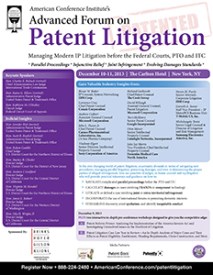
  • New York #2American Conference Institute (ACI) will be holding its Advanced Forum on Patent Litigation — Managing Modern IP Litigation before the Federal Courts, PTO and ITC on December 10-11, 2013 in New York, NY.  The conference will allow attendees to:

    • Navigate complicated parallel proceedings before the PTO and ITC;
    • Calculate damages in cases involving FRAND's or component technology;
    • Litigate or defend a case involving joint or extra-territorial infringement;
    • Incorporate the use of international forums in protecting domestic interests; and
    • Streamline discovery, avoid spoliation, and identify inequitable conduct.

    BrochureIn particular, ACI's faculty will offer presentations on the following topics:

    • PTO Keynote Address — Hon. Rama G. Elluru, Administrative Patent Judge, Patent Trial and Appeal Board, U.S. Patent and Trademark Office;
    • Parallel proceedings under the AIA — Managing litigation in the new inter partes review, covered business methods, re-examination, and post-grant review proceedings;
    • Administrative Judge's spotlight — The inside perspective on parallel proceedings;
    • Damages in a post-Uniloc world — Expert tools for determining reasonable damages and obtaining further relief from infringement;
    • ITC Keynote Address — Hon. Charles E. Bullock, Chief Administrative Law Judge, International Trade Commission;
    • The effects of parallel litigation at the International Trade Commission;
    • In-house perspective — Managing litigation costs and budgets; adapting to the post-AIA litigation world; dealing with discovery dilemmas;
    • Views from the benches — Insights from multiple judicial venues on the effects of parallel proceedings, managing discovery, construing claims, assessing damages, and more;
    • Separating fact from fiction in litigation by "non-practicing entities" — The debate over promoting innovation, protecting patent holders, policing frivolous suits, and avoiding chilling the filing of meritorious claims;
    • Handling claims occurring along the chain of commerce — Joint infringement and extra-territoriality issues in the modern economy;
    • Protecting intellectual property rights by enforcing patent rights abroad and understanding the impact of judicial determinations by foreign courts; and
    • Inequitable conduct, streamlining discovery, and ethical requirements for data storage.

    In addition, two pre-conference workshops will be offered on December 9, 2013.  The first, entitled "Patent Reform Primer: Analyzing the Implementation of the America Invents Act and Investigating Unresolved Issues on the Forefront of Litigation" will take place from 9:00 am to 12:00 pm, and the second, entitled "Working Group Session: Patent Litigation Case Law Year in Review — An In-Depth Analysis of Major Cases and Their Effects on Patent Eligibility, Enablement, Pleading Requirements, Claim Construction, and Mores" will take place from 3:00 to 5:00 pm.

    The agenda for the Advanced Forum on Patent Litigation can be found here.  More information regarding the workshops can be found here.  A complete brochure for this conference, including an agenda, detailed descriptions of conference sessions, list of speakers, and registration form can be obtained here.

    ACI - American Conference InstituteThe registration fee for the conference is $2,295 (conference alone), $2,895 (conference and one workshop), or $3,295 (conference and two workshops).  Those registering by October 4, 2013 will receive a $300 discount, and those registering by November 8, 2013 will receive a $200 discount.  Patent Docs readers who reference the discount code "PD 200" will receive $200 off the current price tier when registering.  Those interested in registering for the conference can do so here, by e-mailing CustomerService@AmericanConference.com, by calling 1-888-224-2480, or by faxing a registration form to 1-877-927-1563.

    Patent Docs is a media partner of the Advanced Forum on Patent Litigation.

  • IPO #2The
    Intellectual Property Owners Association (IPO) will offer a one-hour webinar on
    "Patent
    Owner Strategy in Post-grant Proceedings" on October 3, 2013
    beginning at 2:00 pm (ET).  A panel
    consisting of Matthew Cutler of Harness, Dickey & Pierce, PLC; Jeanne
    Suchodolski of Intellectual Ventures; and Jon Wright of Sterne, Kessler,
    Goldstein & Fox, PLLC will consider the options open to the patent owner at
    every stage of the post-grant proceeding process, including:

    •
    What steps should patent owners now take before asserting a patent to better
    position themselves for a post-grant proceeding?  Prior to the AIA, some patentees would
    preemptively challenge their own patents in an ex parte reexamination
    proceeding in the hope that the same art would be deemed cumulative in a later inter
    partes
    reexamination.  Is this tactic
    still effective for patentees facing the imminent threat of an inter partes
    review?  Should patentees choose ex
    parte
    reexam or reissue?

    •
    Should patent owners accept the opportunity to make a preliminary response to a
    petition and, if yes, how to make the most of it?

    •
    What scope of claim amendments has the PTAB allowed in the new post-grant
    proceedings?

    •
    What are the best tactics for patent owners in settlement discussions involving
    post-grant proceedings?

    The
    registration fee for the webinar is $120 (government and academic rates are
    available upon request).  Those
    interested in registering for the webinar can do so here.

  • D Young & CoD
    Young & Co will be offering its next European biotech patent law update on October
    23, 2013.  The 45-minute webinar will be
    offered at three times: 4:00 am, 7:00 am, 12:00 pm (EDT). D Young & Co
    European Patent Attorneys Robert Dempster and Simon O'Brien will provide an
    essential update and live Q&A on EPO biotechnology case law.

    While
    there is no fee to participate, attendees must register in advance.  Those wishing to register can do so here.

  • CLIPDCThe Companies and IP Commission (CIPC) and National
    IP Management Office (NIPMO) of South Africa will be co-sponsoring a conference
    on "Creating and Leveraging Intellectual Property in Developing Countries: A Power Tool for Social and
    Economic Growth" on November 17-20, 2013 in Durban, South Africa.  The conference follows on from the successful
    meeting of the BRICS Heads of Patent Offices in Durban in May 2013, and comes
    at an important time — not just in the progress of South Africa, but
    throughout all of Africa, as well as the BRICS nations, as the countries work
    to shape the future of IP.

    Highlights of the conference include:

    • An opening Ministerial Round Table on "The
    Strategic Use of IP in Emerging Economies," featuring two Ministers in the
    cabinet of President Jacob Zuma: Rob Davies, Minister of Trade and Industry, Republic
    of South Africa, and Derek Hanekom, Minister of Science and Technology

    • Representatives of the BRICS Head of IP Offices
    will discuss "The Effect of the National Patent System on the Perceived
    Investment Value of a Patent."

    • In addition to senior officials from the South
    African government, the conference will be attended by international key
    government, organization, industrial and academic leaders from Africa and other
    BRICS countries, as well as the U.S. and Europe, to form a fertile environment
    for discussion, networking, and relationships.

    Additional information regarding the conference can
    be found here or at the conference website.

    Patent Docs is a media partner of the conference on Creating and Leveraging Intellectual Property in Developing Countries.

  • By Andrew Williams —

    SunovionSaying
    "But I won't do it" is not sufficient to avoid infringement in a
    Hatch-Waxman litigation, according to the Federal Circuit in the recently
    decided Sunovion Pharmaceuticals, Inc. v.
    Teva Pharmaceuticals USA, Inc
    .  The
    ANDA applicant in that case was applying to market a generic version of Lunesta®,
    a chiral drug sold as a sleep medication.  The lower court had construed one of the claims to require "less
    than 0.25%" of an unwanted chemical entity.  However, the ANDA applicant was seeking to
    market a drug with "not more than 0.6%" of this chemical entity,
    which as the Court pointed out, is between 0.0-0.6%.  Therefore, even though the ANDA applicant had
    submitted a declaration to the District Court (but not the FDA) vowing that it
    would only market its generic product with levels of this chemical entity at
    0.3-0.6%, the Federal Circuit still found that the ANDA application had
    infringed for purposes of 35 U.S.C. § 271(e)(2).  "What a generic applicant asks for and receives approval to market,
    if within the scope of a valid claim, is an infringement."  As the Federal Circuit suggested, instead of
    telling a Court that it would not infringe a patent should it get approval to
    market it generic product, an ANDA applicant in such a case should instead
    amend its ANDA application to avoid infringement.

    As
    background, Sunovion owns the rights in U.S. Patent No. 6,444,673 ("the '673
    patent"), which claims the single-enantiomer drug eszopiclone.  For those readers not up on chiral chemistry,
    chemical entities with, for example, a carbon atom and four different
    substituent atoms can assume two different structures that look similar but are
    not superimposable.  The classic example
    used to illustrate this is your left and right hands.  Instead of being superimposable, they are
    mirror images of each other.  For
    chemical entities, the two different entities are called stereoisomers, and
    each individual stereoisomer is referred to as an enantiomer.  One enantiomer is termed the dextrorotatory
    or (S)-enantiomer, while the other is
    termed the levorotatory or (R)-enantiomer.  In the case of the '673 patent, the
    dextrorotatory entity is claimed, as shown in representative claim 1:

    1.    6-(5-chloro-2-pyridyl)-5-[(4-methyl-1-piperazinyl)carbonyloxy]-7-oxo-6,7-dihydro-5H-pyrrolo[3,4-b]pyrazine,
    or a pharmaceutically acceptable salt thereof, in the form of its
    dextrorotatory isomer and essentially free of its levorotatory isomer.

    Lunestra®
    is, of course, the dextrorotatory isomer, and the FDA required it contain no
    more than 0.3% of levorotatory isomer, referred to as (R)-zopiclone.

    Dr. Reddy'sDr.
    Reddy's Laboratories, Ltd. and Dr. Reddy's Laboratories, Inc. (collectively "Dr.
    Reddy") submitted an ANDA to market a generic version of Lunestra®,
    which included a Paragraph IV certification to the '673 patent.  In turn, Sunovion sued Dr. Reddy pursuant to
    35 U.S.C. § 271(e)(2).  The District Court construed the claim term "essentially free" to mean "less
    than 0.25% of [the] levorotatory isomer."  Dr. Reddy's initial ANDA application included the levels of the
    levorotatory isomer to be "[n]ot less than 0.3% and [n]ot more than 1.0%."  The FDA required Dr. Reddy to tighten this
    limit to not more than 0.3%.  Instead,
    Dr. Reddy amended its application to recite not more than 0.6% of the
    levorotatory isomer.  The Federal Circuit
    opinion suggested that Dr. Reddy's generic product had not yet received
    approval.  Nevertheless, as indicated
    above, Dr. Reddy "certified" to the lower court that it would not
    market any drug product that contained less than 0.3% of the levorotatory
    isomer, even though the FDA had suggested that it would not allow approval of
    such a limitation.  In addition, the
    lower court accepted the fact that Dr. Reddy's internal manufacturing
    guidelines resulted in a level of levorotatory isomer that was more than 0.3%.  Therefore, the lower court granted a summary
    judgment motion of noninfringement.

    Sunovion
    first challenged the construction of the term "essentially free,"
    which it thought should be defined as "largely but not wholly free"
    of the levorotatory isomer.  This claim
    term was not defined in the specification, but according to the Court it was
    used more than once in the prosecution history to mean "less than 0.25%."  One of these times, the applicants had stated
    that the disclosure of Example 1 was evidence of material that "consists
    essentially of" the dextrorotatory isomer.  Of course, even though this phase does have the word "essentially"
    in it, the phrase "consists essentially of" has a particularized
    meaning in patent parlance.  It should,
    therefore, not be evidence of what the applicants' thought to term "essentially"
    meant, at least with regard to the levorotatory isomer.  However, the applicants also submitted a
    declaration during prosecution in which it was stated that the "pure form"
    of the dextrorotatory isomer "as described in Example 1" contained "lower
    than 0.25%" of the unwanted stereoisomer.  This declaration was used in a subsequent interference as support for the
    term "essentially free" to be equated with containing less than 0.25%
    levorotatory isomer.  The Federal Circuit
    found that the "applicants' repeated and consistent attribution of the
    purity level of less than 0.25% levorotatory isomer to 'the invention' and the 'the
    instant invention' thus gives meaning to the term 'essentially free.'"  Accordingly, the Court affirmed the lower
    court's claim construction.

    Sunovion,
    nevertheless, also argued that even with the lower court's construction of this
    claim term, Dr. Reddy also infringed.  As
    indicated above, the Federal Circuit agreed, because Dr. Reddy was seeking
    approval to market a generic version of the drug that could fall within the scope
    of the asserted claims.  The Court was
    not impressed with the internal manufacturing guidelines or the "certification"
    made to the court below.  Instead, "the
    ultimate infringement question is determined by traditional patent law
    principles . . . ."  The Court
    believed that allowing an ANDA applicant to avoid infringement based on "unconventional
    and unenforceable 'guarantee[s]'" while seeking to market a product that
    fell with the scope of asserted claims "would be incompatible" with
    those principles.

    Dr.
    Reddy tried to rely on the Federal Circuit cases of Bayer AG v. Elan Pharmacetuical Research Corp., 212 F.3d 1241 (Fed.
    Cir. 2000), and Glaxo, Inc. v. Novopharm,
    Ltd.
    , 110 F.3d 1562 (Fed. Cir. 1997).  However, in both of those cases, the Court had found that the ANDA
    product described in the application fell outside the scope of the patents at
    issue.  In fact, in Bayer, the NDA holder had based its infringement contention on a
    particular biobatch received from the ANDA applicant, which when tested fell
    within the scope of the claims.  However,
    the Court in that case noted that the biobatch did not fall within the
    specification of the ANDA application, and therefore was irrelevant for
    purposes of infringement under § 271(e)(2).  The present case presents almost the converse issue — the ANDA applicant
    is asserting that the product it will market will fall outside the scope of the
    claim, but this is contrary to what the ANDA application teaches.  "[Dr.] Reddy's ANDA specification clearly
    describes a product that meets the limitations of the asserted claims."  Correspondingly, the Federal Circuit reversed
    the lower court's judgment of noninfringement.

    Sunovion
    Pharmaceuticals, Inc. v. Teva Pharmaceuticals USA, Inc.
    (Fed. Cir. 2013)

    Panel:
    Circuit Judges Lourie, Schall, and Reyna
    Opinion
    by Circuit Judge Lourie

  • Stanek Rea, TeresaActing Director Teresa Stanek Rea (at right) sent the
    following memo to USPTO employees regarding the possibility that the government
    will be shut down if Congress fails to agree to a continuing resolution to fund
    government agencies for the rest of this year:

    Dear
    Colleagues,

    As you know, the Obama administration is working
    diligently with Congress to try to ensure that the federal government remains
    open and continues to do its work on behalf of the American people. However, I
    wanted to inform you that even in the event of a government shutdown on
    October 1, 2013, the United States Patent and Trademark Office will
    remain open, using prior year reserve fee collections to operate as usual for
    at least a few weeks. We continue to assess our fee collections compared to our
    operating requirements to determine how long we would be able to operate during
    a government shutdown; we will update you as more definitive information becomes
    available.

    Because the USPTO maintains sufficient carryover
    funding from prior fiscal years, our agency can and will stay open for business
    for a period of time using these available reserves. During that time we will
    all continue to conduct our duties and serve our Nation, by processing the
    patent and trademark applications that drive our country's innovative economy.
    Should we exhaust these reserve funds before the government shutdown comes to
    an end, USPTO would have to shut down at that time, although a very small staff
    would continue to work to accept new applications and maintain IT
    infrastructure, among other functions.

    I realize you likely have many more questions. As
    new information becomes available, we will inform you promptly and thoroughly.
    Your respective business unit managers will also be reaching out to you to
    provide further clarification, as needed.

    I thank you for your hard work, and the
    continuing dedication you demonstrate to the American people.

    Sincerely,

    Terry Rea

    Hat tip to Hal Wegner for
    alerting us to this memo.

  • By Donald Zuhn —

    IPO #2A white paper authored
    by two members of the Intellectual Property Owners Association (IPO) U.S.
    Patent Office Practice Committee argues that the current patent examination
    system "has run its course," and needs to be changed.  In its place, the paper proposes a revised examination
    system that would "offer[] a break from the past system . . . and
    provide[] a new path to accomplishing the twin goals of reducing the unexamined
    new case backlog and expeditiously concluding the examination process once it
    is started."

    The paper, authored by
    William F. Smith, a former
    Administrative Patent Judge at the U.S. Patent and Trademark Office with over
    30 years of experience with the USPTO, and Dr. Joseph Mallon,
    and entitled "In Order to Form A
    More Perfect Patent Examination System — It Is Time to Update Compact
    Prosecution to Compact Prosecution 2.0," notes that for the past 40 years, the U.S. patent examination system has been operating under the tenets
    of "compact prosecution," which the authors refer to as "Compact
    Prosecution 1.0."  The authors
    explain that "[t]he key to Compact Prosecution 1.0 is the PTO policy that,
    normally, the prosecution of every patent application can be carried out in a
    single round consisting of an office action and an applicant response, such
    that, in the event that the applicant response does not place the application
    in condition for allowance, every second office action on the merits should be
    a final rejection."  However,
    because the landscape of patent examination has changed so dramatically since
    the implementation of Compact
    Prosecution 1.0, the authors argue for "a makeover
    of the current patent examination system to transition from Compact Prosecution
    1.0 to Compact Prosecution 2.0."

    The paper's Compact Prosecution 2.0 proposal is based on
    the authors' identification of "two significant dead zones in
    Compact Prosecution 1.0 that needlessly delay the ultimate disposition of a
    patent application once examination on the merits is initiated — final
    rejections and the manner in which RCEs are docketed."  In place of the current examination system,
    in which the second office action on the merits may be a final rejection, the
    authors propose an initial examination period in which the applicant will be
    given two actions on the merits (with an opportunity to present evidence or
    amendments as a matter of right) and, if needed, a third action.  In response to the third action, however, the
    applicant must pay the RCE fee, which will give the applicant two additional
    actions (with an opportunity to present evidence or amendments as a matter of
    right).  In response to the second action
    after an RCE, the applicant will have to pay an increased RCE fee.  Under the Compact Prosecution 2.0 proposal, third actions in the initial
    examination phase and second actions after an RCE filing would have to be
    approved, preferably by a conference consisting of the examiner and two neutral
    conferees.  The authors also suggest that
    interviews after third actions in the initial examination phase and after the
    first action following an RCE filing would be "expected."  Finally, in Compact Prosecution 2.0, the
    applicant would be allowed to attend appeal conferences in which the Office
    considers applicant's appeal brief, and the applicant would have the option of
    choosing mediation after briefing is completed (with an individual APJ serving
    as the mediator).

    In
    addition to outlining the Compact Prosecution 2.0 proposal, the paper also
    proposes changes to examiner productivity metrics.  The authors note that:

    PTO management makes changes to the patent
    examiners' docket management criteria based in large part of which cases have
    policy priority.  For example, when the
    current administration began its focus on reducing the number of unexamined
    patent applications, it changed the docketing system for RCEs so the examiners
    were no longer required to take an RCE up for action within two months of its
    filing.  Instead RCEs are docketed such that a patent examiner need only take
    one RCE up for action every 1-2 months.

    According to the authors,
    under the current system, "the examiner is actually 'rewarded' for
    stopping and then re-starting the examination."  In place of this system, the paper suggests assigning
    each examiner an expectation of initially examining "X" number of
    unexamined cases per fiscal year, wherein "X" is based on such
    factors as the complexity of the technology and of the application, the
    experience level of the examiner, and historic analysis of the number of claims
    examined in the first action on the merits in a particular art area.  The paper also suggests that "office
    actions should be submitted for mailing/review no later than two-three months
    from the filing date of applicant's response, not by the end of the pay period
    where that date falls as is the present case," thereby eliminating the "so-called
    'Count Monday' where SPEs are inundated with work to review and approve."

    In addition to the above
    docket management changes, the authors propose that first continuations and
    divisional applications be docketed based on priority date, which will "avoid
    needless term loss in continuations and term extension in divisionals,"
    and provide examiners with an "opportunity to pick these cases up while
    the parent examination is fresh, thus, providing more efficiency in the patent
    examination process."  As for
    continuation-in-part applications and subsequent continuation and divisional
    applications, the paper proposes that such applications be docketed based upon
    their filing dates because CIPs are essentially new applications, and therefore
    should not receive priority in the examination queue, and subsequent
    continuation and divisional applications "have by definition already
    obtained a complete examination of at least one application."

  • By Andrew Williams —

    Washington - Capitol #5In order to combat the perceived "patent troll" problem, members of Congress in both the House and the Senate introduced bills last spring aimed at addressing abusive patent litigation tactics.  One of the more comprehensive "discussion drafts" was released on May 23, 2013 by Rep. Bob Goodlatte (R-VA), the Chairman of the House Committee on the Judiciary (see "Congress Continues Efforts to 'Reform' U.S. Patent Law").  Even though this discussion draft was not technically "introduced," it contained many provisions that were covered in other pieces of legislation that had been introduced, as well some of the various recommendations coming from the White House (see "'When the Patent System is Attacked!' — The White House Task Force on High-Tech Patent Issues").  As Rep. Goodlatte (below) explained at the time:  "This bill helps to address the issues that businesses of all sizes and industries face from patent troll-type behavior and aims to correct the current asymmetries surrounding abusive patent litigation."  A second version of this discussion draft was released in the past few days, although it was dated September 6, 2013, and several changes were made as compared to the May 23 version.  Because it is possible that some version of this bill has might be passed in the upcoming year or so, we highlight below some of the major provisions of this discussion draft.

    Patent Infringement Actions

    Goodlatte, BobThe section of the discussion draft that will probably result in the most significant changes to the current system if passed is the one that suggests changes to how patent infringement actions are conducted.  Some of the more significant proposals are highlighted below.  This section begins by proposing changes to the pleading requirements for patent cases.  Instead of the notice pleading that is currently required by Form 18 for patent infringement complaints, requiring little more than a statement of jurisdiction and notice as to the patent being asserted and the alleged infringing product or action, the new proposal would require something more akin to the infringement contentions of the party that are generally not required until much later in a case.  For example, the new proposal would not only require an identification of each patent allegedly infringed, but also each claim of each patent alleged to be infringed.  In addition, for each "accused instrumentality," the new proposal would require in the complaint an explanation as to where each element of each claim is found, whether each element is infringed literally or under the doctrine of equivalents, and how the terms of each claim correspond to the functionality of the accused instrument.  Also, the pleadings will require a description of the direct infringement, the person or persons alleged to be directly infringing, and the acts of any alleged indirect infringer that contribute or induce the direct infringement.  Finally, the complaint will require a description of the right of the party to assert the patent, a list of complaints already filed which identify the same patent, and whether the patent is subject to any licensing terms or pricing commitments.  The good news for the pharmaceutical industry, however, is that this heightened pleading standard would not be required for any Hatch-Waxman type cases that claim infringement under 35 U.S.C. § 271(e)(2).

    This "patent litigation" section of the discussion draft also proposes a significant change to 35 U.S.C. § 285, which currently provides for the possibility of awarding attorney's fees to the prevailing party in "exceptional circumstances."  Many commentators have suggested that altering this section of the patent act might be the best way to allow courts to combat patent litigation abuses.  Indeed, the original discussion draft had proposed removing the "exceptional circumstances" requirement, making it easier for the courts award such fees.  However, the new draft goes further.  Instead of attorney's fees being a possibility in certain cases, the new proposal requires that the court "shall award" reasonable fees to the prevailing party "unless the court find that the position of the nonprevailing party or parties was substantially justified or that special circumstances make an award unjust."  As a result, even though the outcome of the two approaches might be similar, the default as to whether fees are to be awarded would shift to the affirmative in all cases.

    In another part of this section of the discussion draft, changes to discovery in patent litigation are proposed.  For example, the proposal provides that if a court determines that any claims need to be construed, discovery shall be limited to the information required for such construction until the court has ruled on the issue.  Because discovery can be one of the most protracted parts of patent litigation, and the claim construction process can also be time-consuming, such a proposal could have the effect of severely extending the time to trial in patent infringement cases.  This is probably one of the reasons why the proposal would exclude cases where timely resolution is essential, such as Hatch-Waxman type cases, which ideally should conclude before the expiration of the 30-month stay.

    Transparency of Patent Ownership

    The Goodlatte discussion draft also tackles the issue of patent ownership, which was also the subject of several other pieces of introduced legislation, and has been suggested by commentators as a mechanism to prevent PAEs from using shell companies to hide the true parties-in-interest.  The proposal would require a plaintiff to disclose to the Patent Office, the court, and every adverse party, the assignee of the patents at issue, any party with the right to sublicense or enforce the patents at issue, any entity that has a financial interest in the patents at issue (or the plaintiff), and the ultimate parent of any assignees.  Again, there is good news for the pharmaceutical industry because causes of action brought pursuant to § 271(e)(2) would be exempt from this requirement.  The proposal would also create an on-going duty to notify the patent office of any changes to the assignee of the patents.  If a plaintiff does not comply with these requirements, that party will not be entitled to recover attorney's fees or increased damages for willfulness during the period of noncompliance.  The Court will also have the ability to award fees to the accused infringer for any expenses incurred to discover any updated assignment.

    Customer-Suit Exception

    The discussion draft would amend 35 U.S.C § 296 to allow a stay of an infringement action against a customer if the same or a similar suit has been initiated against the manufacturer of the accused product.  Such as stay would only be allowed if both the covered manufacturer and the covered customer consent in writing.  Also, the covered customer would need to agree to be bound by any judgment to the extent any issues are in common.  This proposal appears to be in response to the "anti-troll" sentiment that blames PAEs for targeting end-users instead of the companies that manufacture the alleged infringing products.  Interestingly, the revised draft does not include a provision that allows a manufacturer to intervene in cases where the downstream customers and retailers are targeted, as could have been found in the previous discussion draft.

    Improvements and Technical Corrections to the Leahy-Smith America Invents Act

    The discussion draft also includes some proposals to improve or correct the recently enacted America Invents Act.  One proposal would be to remove the estoppel effect of the post-grant review process as to issues the party "reasonably could have raised."  Another proposal would require the PTAB to construe claims in the same manner as district courts by using the "ordinary and customary meaning of such claim as understood by one of ordinary skill in the art and the prosecution history pertaining to the patent."  Moreover, if the claims have already been construed in Federal court, the Patent Office would be required to consider such construction.  The discussion draft also includes a proposal to expand Covered Business Method Reviews.  However, as we reported yesterday, many organization and companies, across the technological spectrum, oppose any such expansion of these reviews (see "Coalition Opposes Expansion of AIA § 18").

    Finally, the discussion draft includes several other provisions, including recommendations to the Judicial Conference, providing for small business education and outreach, and tasking the director and the GAO to study issues related to patent transactions, patent quality, and patent examination.  We will, of course, continue to follow and report on the progress of this discussion draft, as well any comparable bills that are introduced in either the House or the Senate.

  • By Donald Zuhn —

    Washington - Capitol #3Last week, a coalition of
    more than 100 companies and organizations including the Biotechnology Industry
    Organization (BIO), the California Healthcare Institute (CHI), and Eli Lilly
    & Company, sent a letter to Congressional leaders to express their "opposition
    to recent legislative proposals expanding the America Invents Act's 'covered
    business method patent' program." 
    The letter contends that "[t]hese proposals could harm U.S.
    innovators — a driving force of economic growth and job creation in this
    country — by unnecessarily undermining the rights of patent holders."  The make-up of the coalition was interesting
    in that it included industry groups, organizations, and companies in the medical
    devices, pharmaceuticals, and biotechnology industries, as well as expected
    representatives from the technology, communications, manufacturing, financial services, and software
    industries.

    The Transitional Program for
    Covered Business Method Patents, which was established by § 18 of the
    Leahy-Smith America Invents Act, provides a transitional post-grant review
    proceeding for reviewing the validity of covered business method patents, which
    the section defines as "a patent that claims a method or corresponding
    apparatus for performing data processing or other operations used in the
    practice, administration, or management of a financial product or service,
    except that the term does not include patents for technological inventions."  To date, bills "to make improvements to
    the transitional program for covered business method patents" have been
    introduced in both the House (H.R. 2766)
    and Senate (S. 866).
    The Senate bill, entitled the Patent Quality Improvement Act of 2013, was
    introduced in May by Sen. Charles Schumer (D-NY), and the House bill, entitled
    the Stopping the Offensive Use of Patents (STOP) Act, was introduced in July by
    Rep. Darrell Issa (R-CA).  Both bills
    would change the definition of a covered business method patent to "a
    patent that claims a method or corresponding apparatus for performing data
    processing or other operations used in the practice, administration, or management
    of an
    enterprise, product, or
    service, except that the term does not include
    patents for technological inventions" (change in bold and italics).  H.R. 2766 would also eliminate the sunset
    provision of the transitional program (as well as establish a pro bono program at the USPTO "to
    assist financially under-resourced resellers, users, implementers,
    distributors, or customers of an allegedly infringing product or process").  H.R. 2766 has been referred to the House
    Committee on the Judiciary, and S. 866 has been referred to the Senate Subcommittee
    on Courts, Intellectual Property, and the Internet.

    The coalition letter, which
    was sent to Sen. Patrick Leahy (D-VT), Chairman of the Senate Committee on the
    Judiciary; Sen. Chuck Grassley (R-IA), Ranking Member of the Senate Committee
    on the Judiciary; Rep. Bob Goodlatte (R-VA), Chairman of the House Committee on
    the Judiciary; and Rep. John Conyers, Jr. (D-MI), Ranking Member of the House
    Committee on the Judiciary, argues that the above legislation proposes to make
    the transitional proceedings of § 18 permanent and expand the definition of
    'covered business method patent' such that "any party sued for or charged
    with infringement can always challenge an extremely broad range of
    patents at the USPTO" (emphasis in original).  The letter suggests that the proposed change
    to the program "would have far-reaching implications, because data
    processing is integral to everything from cutting-edge cancer therapies to
    safety systems that allow cars to respond to road conditions in real time to
    prevent crashes," and contends that "[s]ubjecting data processing
    patents to the CBM program would thus create uncertainty and risk that
    discourage investment in any number of fields where we should be trying to spur
    continued innovation."  The
    coalition letter also notes that the change could also impact the relationship
    of the United States with its trading partners, because "it is clear that if this
    discriminatory treatment of a select category of patents opposed by special
    interests in the United States were to be made a permanent feature of U.S. law,
    it would create a harmful precedent for our trading partners to enact
    exceptions in their laws to protect special interests in their countries."