• American University Washington College of Law #2As part of its ongoing Supreme Court series, the American University Washington College of Law Program on Information Justice & Intellectual Property will be hosting a post argument discussion on the Nautilus Inc. v. Biosig Instruments Inc. case from 4:15 to 5:45 pm (Eastern) on April 28, 2014 at the American University Washington College of Law in Washington, DC.  The Nautilus Inc. panel discussion will be moderated by Prof. Michael Carroll, American University Washington College of Law, with a panel consisting of James E. Geringer of Klarquist Sparkman LLP, Counsel for Petitioner, Nautilus, Inc.; Charles Duan, Director, Patent Reform Project, Public Knowledge, Counsel for Amici Curiae Supporting Petitioner, Electronic Frontier Foundation and Public Knowledge; and Gregory Dolin, Associate Professor and Co-Director of the Center for Medicine and Law, University of Baltimore.

    Additional information about the post argument discussion, including registration/CLE information and information about the live and archived webcast, can be found here.

  • Strafford #1Strafford will be offering a webinar/teleconference entitled "Patent Subject Matter Eligibility: Navigating the New 'Myriad' Guidelines — Analyzing Subject Matter and Avoiding Rejection Under the USPTO's Detailed Framework" on May 15, 2014 from 1:00 to 2:30 pm (EDT).  Donna M. Meuth, Associate General Counsel of Eisai, and Leslie McDonnell and Dr. Amelia Feulner Baur of Finnegan Henderson Farabow Garrett & Dunner will examine the new USPTO guidelines and the analysis for determining patent eligibility, and provide best practices for applying the new guidelines and avoiding § 101 rejection.  The webinar will review the following questions:

    • How do the new Guidelines change the landscape for patentable subject matter?
    • How can counsel show "significant difference" from a natural material, law or phenomenon?
    • How will examiners apply the new Guidelines?

    The registration fee for the webinar is $297 ($362 for registration and CLE processing).  Those registering by May 2, 2014 will receive a $50 discount.  Those interested in registering for the webinar, can do so here.

  • By Michael Greenfield —

    SanofiOn April 21, 2014, a Federal Circuit panel reiterated its interpretation and application to the chemical arts of the KSR obviousness standard.  Although applicable more broadly than the chemical arts, the opinion may be of particular interest to patent prosecutors in this technology field.  A jury found the patent at issue not obvious and the Federal Circuit affirmed.

    In this Hatch-Waxman litigation, the plaintiffs (patent owners and licensees) brought suit after the defendants filed an ANDA with a paragraph IV certification alleging that the claims of plaintiffs' patent 5,721,244 ("'244 patent") were obvious.  The drug that was the subject of the ANDA was Tarka®, a single dosage form anti-hypertensive medication comprising a combination of the angiotensin converting enzyme (ACE) inhibitor trandolapril and the calcium antagonist verapamil hydrochloride.  There was evidence that the combination provided benefits not previously known for anti-hypertension treatment:  a single daily dosage form providing longer lasting control and improved kidney function and blood vessel structure.

    Claim 3 of the ’244 patent was at issue:

    1.  A pharmaceutical composition comprising:
        (a)  an angiotensin-converting enzyme inhibitor (ACE inhibitor) . . . , and
        (b)  a calcium antagonist or a physiologically acceptable salt thereof; wherein said ACE inhibitor and said calcium antagonist are present in said composition in amounts effective for treating hypertension; . . .

    3.  A composition according to claim 1, wherein said ACE inhibitor is trandolapril . . . or a physiologically acceptable salt thereof, or quinapril … or a physiologically acceptable salt thereof.

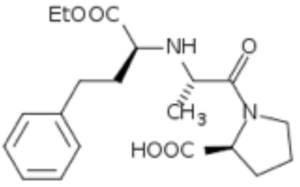
    Combinations of ACE inhibitors and calcium antagonists were known in the art, although the art taught the use of so-called "single ring" ACE inhibitors like enalapril,

    Structure 1whereas trandolapril of the claimed composition is a "double ring" ACE inhibitor,

    Structure 2
    The defendants argued that the claim was obvious because it merely substituted one type of ACE inhibitor for another.

    Glenmark PharmaceuticalsAt trial, the defendants' expert acknowledged that the art had not suggested using a double ring ACE inhibitor in combination with a calcium antagonist but opined that the number of rings in the ACE inhibitor was unimportant to the analysis.  Of course, the plaintiffs' expert disagreed, opining that those of ordinary skill in the art generally believed that the double ring compounds were not more effective than the single ring compounds because the single ring compounds fit into the "pocket" of the ACE inhibitors better than the double ring compounds.  Furthermore, the plaintiffs' expert opined that combination treatments were not favored at the time of the invention.

    Although there were these disagreements, what was not in dispute was that the advantages provided by the claimed combination were real and not present in, nor predicted or suggest by, the prior art.

    The defendants argued that, given the prior art teaching of combinations of ACE inhibitors and calcium antagonists, (1) claim 3 was unpatentable as a matter of law because it would have been "obvious to try" other combinations of agents, and (2) because the claim was unpatentable as a matter of law, the fact that the combination was later shown to have unexpectedly advantageous properties was irrelevant.  This is where the Court's opinion gets interesting.

    The Court rejected the defendants' arguments.  The Court first noted that the "obvious to try" standard is qualified and applicable only when "there are a finite number of identified, predictable solutions" to a known problem.  This "finite number" language is frequently encountered as a basis for rejecting chemical compound claims as obvious modifications of prior art compounds and appears often to be used merely in contradistinction to "infinite."  But the Court reiterated its opinion in Ortho-McNeil Pharm., Inc. v. Mylan Labs., Inc., 520 F. 3d 1358, 1364 (Fed. Cir. 2008), where it stated that "finite" means that the number of options is small in the context of the art and easily traversed.  Elaborating on "easily traversed," the Court cited In re O’Farrell, 853 F.2d 894, 903 (Fed. Cir. 1988), for the proposition that a claim is not "obvious to try" (and therefore obvious) where "the prior art gave either no indication of which parameters were critical or no direction as to which of many possible choices is likely to be successful."

    The Court also rejected the defendants' argument that the later-discovered unexpected advantages of the claimed composition cannot be considered in an obviousness analysis.  Referring to prior Federal Circuit case law and distinguishing case law cited by the defendants, the Court stated, "patentability may consider all of the characteristics possessed by the claimed invention, whenever those characteristics become manifest."

    As this was an appeal from a jury verdict, the Court did not give its opinion as to application of the law to the facts, i.e., whether under the facts of the case there were a finite number of identified, predictable solutions to a known problem or even whether the (undisputed) unexpected advantages of the claimed composition were sufficient to render the composition obvious.  Rather, the Court finally merely held that the jury could have reasonably found that the art "would not have predicted the longer-lasting hypertension control demonstrated by the double-ring structures of quinapril and trandolapril in combination with calcium antagonists, because of the widespread belief that double-ring inhibitors would not fit the pocket structure of the ACE."  But if this is the sole and sufficient basis of non-obviousness, this holding is consistent with the proposition dating back at least to In re Papesch that an otherwise obvious invention is rendered non-obvious by unexpected properties.

    Sanofi-Aventis Deutschland GmbH v. Glenmark Pharmaceuticals Inc. (Fed. Cir. 2014)
    Panel: Circuit Judges Newman, Linn, and Wallach
    Opinion by Circuit Judge Newman

  •         By Sherri Oslick —

    Gavel About Court Report:  Each week we will report briefly on recently filed biotech and pharma cases.

    Eli Lilly and Company et al. v. Apotex Corp. et al.
    1:14-cv-00586; filed April 16, 2014 in the Southern District of Indiana

    • Plaintiffs: Eli Lilly and Company; Daiichi Sankyo Co., Ltd.; Daiichi Sankyo, Inc.; Ube Industries, Ltd.
    • Defendants: Apotex Corp.; Apotex Inc.

    Infringement of certain of U.S. Patent Nos. 8,404,703 ("Medicinal Compositions Containing Aspirin," issued March 26, 2013) and 8,569,325 ("Method of Treatment with Coadministration of Aspirin and Prasugrel," issued October 29, 2013) following a Paragraph IV certification as part of Apotex’s filing of an ANDA to manufacture a generic version of Lilly's Effient® (prasugrel hydrochloride, to be used in combination with aspirin for the reduction of thrombotic cardiovascular events in certain patients with acute coronary syndrome (ACS) who are to be managed with percutaneous coronary intervention).  View the complaint here.

    The Medicines Company v. Aurobindo Pharma Ltd. et al.
    3:14-cv-02367; filed April 11, 2014 in the District Court of New Jersey

    • Plaintiff:  The Medicines Company
    • Defendants:  Aurobindo Pharma Ltd.; Aurobindo Pharma USA, Inc.

    Infringement of U.S. Patent Nos. 7,582,727 ("Pharmaceutical Formulations of Bivalirudin and Process of Making the Same," issued September 1, 2009) and 7,598,343 (same title, issued October 6, 2009) following a Paragraph IV certification as part of Aurobindo’s filing of an ANDA to manufacture a generic version of The Medicines Company's Angiomax® (bivalirudin, used as an anticoagulant in patients with unstable angina undergoing percutaneous translurninal coronary angioplasty).  View the complaint here.

    Glenmark Generics Ltd. et al. v. Sanofi-Aventis U.S. LLC et al.
    2:14-cv-02374; filed April 11, 2014 in the District Court of New Jersey

    • Plaintiffs:  Glenmark Generics Ltd.; Glenmark Generics Inc., USA
    • Defendants:  Sanofi-Aventis U.S. LLC; Ferring B.V.

    Declaratory judgment of non-infringement and invalidity of U.S. Patent No. 7,022,340 (“Pharmaceutical Composition as Solid Dosage Form and Method for Manufacturing Thereof,” issued April 4, 2006) in conjunction with Glenmark’s Paragraph IV certification as part of its filing of an ANDA to manufacture a generic version of Sanofi-Aventis’ DDAVP® Tablets (desmopressin acetate, used as antidiuretic replacement therapy in the management of central diabetes insipidus and for the management of the temporary polyuria and polydipsia following head trauma or surgery in the pituitary region).  View the complaint here.

    Novartis Pharmaceuticals Corp. et al. v. Dr. Reddys Laboratories, Ltd. et al.
    2:14-cv-02329; filed April 10, 2014 in the District Court of New Jersey

    • Plaintiffs:  Novartis Pharmaceuticals Corp.; Novartis AG
    • Defendants:  Dr. Reddys Laboratories, Ltd.; Dr. Reddys Laboratories, Inc.

    Infringement of U.S. Patent No. RE43,932 ("Crystal Modification of a N-phenyl-2-pyrimidineamine Derivative, Processes for Its Manufacture and Its Use," issued January 15, 2013) following a Paragraph IV certification as part of Dr. Reddy's filing of an ANDA to manufacture a generic version of Novartis' Gleevec® (imatinib mesylate, used for various indications, including treatment of myeloid leukemia).  View the complaint here.

    Kowa Company, Ltd. et al. v. Aurobindo Pharma Ltd. et al.
    3:14-cv-02290; filed April 10, 2014 in the District Court of New Jersey

    • Plaintiffs: Kowa Company, Ltd.; Kowa Pharmaceuticals America, Inc.; Nissan Chemical Industries, Ltd.
    • Defendants: Aurobindo Pharma Ltd.; Aurobindo Pharma USA Inc.

    Kowa Company, Ltd. et al. v. Aurobindo Pharma Limited et al.
    1:14-cv-02497; filed April 9, 2014 in the Southern District of New York

    • Plaintiffs:  Kowa Co.; Kowa Pharmaceuticals America, Inc.; Nissan Chemical Industries, Ltd.
    • Defendants:  Aurobindo Pharma Ltd.; Aurobindo Pharma USA Inc.

    The complaints in these cases are substantially identical.  Infringement of U.S. Patent Nos. 5,856,336 ("Quinoline Type Mevalonolactones," issued January 5, 1999) and 8,557,993 ("Crystalline Forms of Pitavastatin Calcium," issued October 15, 2013) following a Paragraph IV certification as part of Aurobindo’s filing of an ANDA to manufacture a generic version of Kowa’s Livalo® (pitavastatin, used as an adjunctive therapy to diet to reduce elevated total cholesterol, lowdensity lipoprotein cholesterol, apolipoprotein B, triglycerides, and to increase high-density lipoprotein cholesterol).  View the SDNY complaint here.

    St. Jude Children's Research Hospital, Inc. v. Amgen Inc.
    2:14-cv-02254; filed April 8, 2014 in the Western District of Tennessee

    Infringement of U.S. Patent Nos. 5,529,925 (“Nucleic Acid Sequences and Fusion Proteins Present in Human T(2;5) Lymphoma,” issued June 25, 1996), 5,770,421 (“Human ALK Protein Tyrosine Kinase,” issued June 23, 1998), and 6,696,548 (“Antibodies for Recognition of ALK Protein Tyrosine/Kinase Receptor,” issued February 24, 2004) based on Amgen’s activities to research, develop, and evaluate small molecule tyrosine kinase inhibitors, including making or using ALK nucleic acids, proteins, polypeptides, and/or antibodies in a manner allegedly infringing the patents-in-suit.  View the complaint here.

  •         By Sherri Oslick —

    Gavel About Court Report:  Each week we will report briefly on recently filed biotech and pharma cases.

    Helsinn Healthcare S.A. et al. v. Cipla Ltd. et al.
    1:14-cv-00427; filed April 7, 2014 in the District Court of Delaware

    • Plaintiffs:  Helsinn Healthcare S.A.; Roche Palo Alto LLC
    • Defendants:  Cipla Ltd.; Cipla USA Inc.

    Infringement of U.S. Patent Nos. 8,598,218 ("Liquid Pharmaceutical Formulations of Palonosetron," issued December 3, 2013) and 8,598,219 (same title, issued December 3, 2013) following a Paragraph IV certification as part of Cipla's filing of an ANDA to manufacture a generic version of Helsinn's Aloxi® (palonosetron hydrochloride intravenous solution, used to prevent chemotherapy induced nausea and vomiting).  View the complaint here.

    Sanofi et al. v. Alembic Pharmaceuticals Ltd. et al.
    1:14-cv-00424; filed April 4, 2014 in the District Court of Delaware

    • Plaintiffs:  Sanofi; Sanofi-Aventis US LLC
    • Defendants:  Alembic Pharmaceuticals Lt; Alembic Ltd.d.

    Infringement of U.S. Patent Nos. 7,323,493 ("Solid Pharmaceutical Composition Containing Benzofuran Derivatives," issued January 29, 2008), 8,318,800 ("Solid Pharmaceutical Compositions Containing Benzofuran Derivatives," issued November 27, 2012), 8,410,167 ("Use of Dronedarone for the Preparation of a Medicament for Use in the Prevention of Cardiovascular Hospitalization or of Mortality," issued April 2, 2013), and 8,602,215 ("Methods for Reducing the Risk of an Adverse Dronedarone/Beta-Blockers Interaction in a Patient Suffering from Atrial Fibrillation," issued December 10, 2013) following a Paragraph IV certification as part of Alembic's filing of an ANDA to manufacture a generic version of Sanofi's Multaq® (dronedarone, used to reduce the risk of hospitalization for atrial fibrillation in patients in sinus rhythm with a history of paroxysmal or persistent atrial fibrillation).  View the complaint here.

    Otsuka Pharmaceutical Co. Ltd. v. Hetero USA Inc. et al.
    1:14-cv-00421; filed April 4, 2014 in the District Court of Delaware

    • Plaintiff:  Otsuka Pharmaceutical Co. Ltd.
    • Defendants:  Hetero USA Inc.; Hetero Labs Ltd.; Hetero Labs Ltd. Unit V

    Infringement of U.S. Patent No. 8,501,730 ("Process for Preparing Bezazepine Compounds or Salts Thereof," issued August 6, 2013) following a Paragraph IV certification as part of Hetero's filing of an ANDA to manufacture a generic version of Otsuka's Samsca® (tolvaptan, used hyponatremia).  View the complaint here.

    Reckitt Benckiser Pharmaceuticals Inc. et al. v. Par Pharmaceutical Inc. et al.
    1:14-cv-00422; filed April 4, 2014 in the District Court of Delaware

    • Plaintiffs:  Reckitt Benckiser Pharmaceuticals Inc.; RB Pharmaceuticals Limited; MonoSol Rx LLC
    • Defendants:  Par Pharmaceutical Inc.; IntelGenX Technologies Corp.

    Infringement of U.S. Patent Nos. 8,475,832 ("Sublingual and Buccal Film Compositions," issued July 2, 2013), 8,017,150 ("Polyethylene Oxide-Based Films and Drug Delivery Systems Made Therefrom," issued on September 13, 2011), and 8,603,514 ("Uniform Films for Rapid Dissolve Dosage Form Incorporating Taste-Masking Compositions," issued December 10, 2013) following a Paragraph IV certification as part of Par's filing of an ANDA to manufacture a generic version of Reckitt Benckiser's Suboxone® (buprenorphine hydrochloride and naloxone hydrochloride sublingual film, used for the maintenance treatment of opioid dependence).  View the complaint here.

    Purdue Pharma L.P. et al. v. Teva Pharmaceuticals USA, Inc. et al.
    1:14-cv-02357; filed April 3, 2014 in the Southern District of New York

    • Plaintiffs:  Purdue Pharma L.P.; P.F. Laboratories, Inc.; Purdue Pharmaceuticals L.P.; Board of Regents of the University of Texas System
    • Defendants:  Teva Pharmaceuticals USA, Inc.

    Infringement of U.S. Patent No. 6,488,963 ("Hot-Melt Extrudable Pharmaceutical Formulation," issued December 3, 2002) following a Paragraph IV certification as part of Teva's amendment of its ANDA to manufacture a generic version of Purdue Pharma's OxyContin® (controlled release oxycodone hydrochloride, used to treat pain).  View the complaint here.

    Bayer Pharma AG et al. v. Par Pharmaceutical, Inc. et al.
    2:14-cv-02065; filed April 2, 2014 in the District Court of New Jersey

    • Plaintiffs:  Bayer Pharma AG; Bayer Intellectual Property GmbH; Bayer Healthcare Pharmaceuticals Inc.
    • Defendants:  Par Pharmaceutical, Inc.; Par Pharmaceutical Companies, Inc.

    Infringement of U.S. Patent No. 8,613,950 ("Pharmaceutical Forms With Improved Pharmacokinetic Properties," issued December 4, 2013) following a Paragraph IV certification as part of Par's filing of an ANDA to manufacture a generic version of Bayer's Staxyn® (vardenafil hydrochloride, used to treat erectile dysfunction).  View the complaint here.


    Arizona Board of Regents v. Seattle Genetics Inc.
    2:14-cv-00653; filed March 31, 2014 in the District Court of Arizona

    Infringement of U.S. Patent No. 5,635,483 ("Tumor Inhibiting Tetrapeptide Bearing Modified Phenethyl Amides," issued June 3, 1997) based on Seattle Genetics' manufacture and sale of its Adcetris® product (brentuximab vedotin, an antibody drug conjugate comprising monomethyl Auristatin E, used to treat Hodgkin lymphoma after failure of autologous stem cell transplant or in patients who are not autologous stem cell transplant candidates after failure of at least 2 multiagent chemotherapy regimens, and systemic anaplastic large cell lymphoma after failure of at least 1 multiagent chemotherapy regimen).  View the complaint here.

  •         By Sherri Oslick —

    Gavel About Court Report:  Each week we will report briefly on recently filed biotech and pharma cases.

    Celltrion Healthcare Co. et al. v. Janssen Biotech, Inc.
    1:14-cv-11613; filed March 31, 2014 in the District Court of Massachusetts

    • Plaintiffs:  Celltrion Healthcare Co., Ltd.; Celltrion, Inc.
    • Defendant:  Janssen Biotech, Inc.

    Declaratory judgment of invalidity and unenforceability of U.S. Patent Nos. 5,919,452 ("Methods of Treating TNFα‐Mediated Disease Using Chimeric Anti‐TNF Antibodies," issued July 6, 1999), 6,284,471 ("Anti‐TNFa Antibodies And Assays Employing Anti‐TNFa Antibodies," issued September 4, 2001) and 7,223,396 ("Methods of Treatment of Fistulas in Crohn's Disease with Anti‐TNF Antibodies," issued May 29, 2007) based on Celltrion's anticipated manufacture and sale of its Remsima® product, a biosimilar to Janssen's Remicade® (infliximab, used to treat rheumatoid arthritis, ulcerative colitis, Crohn's disease, ankylosing spondylitis, psoriatic arthritis, and plaque psoriasis).  View the complaint here.

    Celltrion Healthcare Co. et al. v. Kennedy Trust for Rheumatology Research
    1:14-cv-02256; filed March 31, 2014 in the Southern District of New York

    • Plaintiffs:  Celltrion Healthcare Co., Ltd.; Celltrion, Inc.
    • Defendant:  Kennedy Trust for Rheumatology Research

    Declaratory judgment of invalidity of U.S. Patent Nos. 7,846,442 ("Methods of Treating Rheumatoid Arthritis with an Anti-TNF-alpha Antibodies and Methotrexate," issued December 7, 2010), 8,298,537 ("Concomitant Treatment of Rheumatoid Arthritis with Anti-TNF-α Antibodies and Methotrexate," issued October 30, 2012) and 8,383,120 (same title, issued February 26, 2013) based on Celltrion's anticipated manufacture and sale of its Remsima® product, a biosimilar to Janssen's Remicade® (infliximab, used to treat rheumatoid arthritis, ulcerative colitis, Crohn's disease, ankylosing spondylitis, psoriatic arthritis, and plaque psoriasis).  View the complaint here.

    Supernus Pharmaceuticals, Inc. v. Actavis Inc. et al.
    1:14-cv-01981; filed March 28, 2014 in the District Court of New Jersey

    • Plaintiffs:  Supernus Pharmaceuticals, Inc.
    • Defendants:  Actavis Inc.; Watson Laboratories, Inc. – Florida; Actavis Pharma, Inc.; Watson Laboratories, Inc.; Anda, Inc.

    Infringement of U.S. Patent No. 8,617,600 ("Modified Release Preparations Containing Oxcarbazepine and Derivatives Thereof," issued December 31, 2013) following a Paragraph IV certification as part of Actavis' filing of an ANDA to manufacture a generic version of Supernus' Oxtellar XR (oxcarbazepine extended-release tablets, used for adjunctive therapy in the treatment of partial seizures in adults and in children 6 to 17 years of age).  View the complaint here.

    Bausch & Lomb Incorporated et al. v. Micro Labs Limited et al.
    1:14-cv-01974; filed March 28, 2014 in the District Court of New Jersey

    • Plaintiffs:  Bausch & Lomb Inc.; Bausch & Lomb Pharma Holdings Corp.; Mitsubishi Tanabe Pharma Corp.; Ube Industries, Ltd.
    • Defendants:  Micro Labs Ltd.; Micro Labs USA, Inc.

    Bausch & Lomb Inc. et al. v. Apotex Inc. et al.
    1:14-cv-01975; filed March 28, 2014 in the District Court of New Jersey

    • Plaintiffs:  Bausch & Lomb Inc.; Bausch & Lomb Pharma Holdings Corp.; Mitsubishi Tanabe Pharma Corp.; Ube Industries, Ltd.
    • Defendants:  Apotex Inc.; Apotex Corp.

    The complaints in these cases are substantially identical.  Infringement of U.S. Patent No. 6,780,877 ("Acid Addition Salt of Optically Active Piperidine Compound and Process for Preparing the Same," issued August 24, 2004) following a Paragraph IV certification as part of defendants' filing of an ANDA to manufacture a generic version of Bausch & Lomb's Bepreve® (bepotastine besilate ophthalmic solution, used for the treatment of itching associated with allergic conjunctivitis).  View the Micro Labs complaint here.

    Otsuka Pharmaceutical Co. v. Wockhardt Bio AG et al.
    1:14-cv-01979; filed March 28, 2014 in the District Court of New Jersey

    • Plaintiff:  Otsuka Pharmaceutical Co., Ltd.
    • Defendants:  Wockhardt Bio AG; Wockhardt USA LLC; Wockhardt Ltd.

    Infringement of U.S. Patent Nos. 8,017,615 ("Low Hygroscopic Aripiprazole Drug Substance and Process for the Preparation Thereof," issued September 13, 2011) and 8,580,796 (same title, issued November 12, 2013) following a Paragraph IV certification as part of Wockhardt's filing of an ANDA to manufacture a generic version of Otsuka's Abilify® (aripiprazole, used to treat bipolar disorder and schizophrenia).  View the complaint here.

    Mallinckrodt LLC et al. v. Amneal Pharmaceuticals LLC
    1:14-cv-00389; filed March 27, 2014 in the District Court of Delaware

    • Plaintiffs:  Mallinckrodt LLC; Mallinckrodt Inc.; Nuvo Research Inc.
    • Defendant:  Amneal Pharmaceuticals LLC

    Infringement of U.S. Patent Nos. 8,217,078 ("Treatment of Pain with Topical Diclofenac," issued July 10, 2012), 8,546,450 (same title, issued October 1, 2013), and 8,618,164 (same title, issued December 31, 2013) following a Paragraph IV certification as part of Amneal's filing of an ANDA to manufacture a generic version of Mallinckrodt's Pennsaid® (diclofenac sodium topical solution, used for the treatment of signs and symptoms of osteoarthritis of the knee(s)).  View the complaint here.

  • CalendarApril 22, 2014 – China Pharmaceutical Regulatory Law Boot Camp (American Conference Institute) – New York, NY

    April 22, 2014 – "International Trade Secret Misappropriation Update 2014" (McDonnell Boehnen Hulbert & Berghoff LLP) 10:00 am to 11:15 am (CT)

    April 23, 2014 – European biotech patent law update (D Young & Co) – 4:00 am, 7:00 am, and 12:00 pm (ET)

    April 23, 2014 – "Advanced AIA Issues for Patent Claim Construction: Best Practices Absent Clear Court Guidance" (Strafford) – 1:00 to 2:30 pm (EDT)

    April 23-25, 2014 – 2014 Spring Intellectual Property Counsels Committee (IPCC) Conference (Biotechnology Industry Organization) – Palm Springs, CA

    April 24, 2014 – Ethics in the Practice of Intellectual Property Law (John Marshall Law School Center for Intellectual Property, Information & Privacy Law) – Chicago, IL

    April 24, 2014 – "The Supreme Court’s Medtronic Ruling: Practical Guidance for Protecting University IP" (Technology Transfer Tactics) – 1:00 – 2:00 pm (Eastern)

    April 28-29, 2014 – Paragraph IV Disputes*** (American Conference Institute) – New York, NY

    May 6, 2014  – GW Law Symposium on Intellectual Property (George Washington University Law School, Mayer Brown, and Pillsbury) – George Washington University Law School

    May 13-15, 2014 – Fundamentals of Patent Prosecution 2014: A Boot Camp for Claim Drafting & Amendment Writing (Practising Law Institute) – Chicago, IL

    May 14-15, 2014 – EU Pharmaceutical Law Forum*** (Informa Life Sciences) – Brussels, Belgium

    May 22, 2014 – "Patent Infringement: Structuring Opinions of Counsel: Leveraging Opinion Letters to Reduce the Risks of Liability and Enhanced Damages" (Strafford) – 1:00 to 2:30 pm (EDT)

    June 4-6, 2014 – Biosimilars*** (American Conference Institute) – New York, NY

    June 11-13, 2014 – Fundamentals of Patent Prosecution 2014: A Boot Camp for Claim Drafting & Amendment Writing (Practising Law Institute) – New York, NY

    July 9-11, 2014 – Fundamentals of Patent Prosecution 2014: A Boot Camp for Claim Drafting & Amendment Writing (Practising Law Institute) – San Francisco, CA

    August 13-15, 2014 – Advanced Patent Law Seminars (Chisum Patent Academy) - Seattle, WA

    August 18-20, 2014 – Advanced Patent Law Seminars (Chisum Patent Academy) - Seattle, WA

    ***Patent Docs is a media partner of this conference or CLE

  • JMLSThe John Marshall Law School Center for Intellectual Property, Information & Privacy Law will be holding a program on Ethics in the Practice of Intellectual Property Law on April 24, 2014 in Chicago, IL.  The conference will consist of the following sessions:

    • What IP Lawyers Should Know About ARDC Proceedings and Client Complaints
    • Movie Lawyer Ethics: Hollywood's Lessons for IP Lawyers
    • Spoliation Issues in IP Cases
    • Ethical Issues in Biotechnology Patent Law — to be presented by Patent Docs contributor Andrew Williams of McDonnell Boehnen Hulbert & Berghoff LLP
    • Conflicts and Waivers in Patent Law
    • Ethical Issues in Patent and Copyright Trolling Litigation

    Additional information about the conference, including a complete list of speakers, can be found here.  Those interested in registering for the conference online can do so here; the registration fee is $195 (general registration); current JMLS Students, Faculty, Staff, and IP Advisory Board Members can register for free.

  • Strafford #1Strafford will be offering a webinar/teleconference entitled "Patent Infringement: Structuring Opinions of Counsel: Leveraging Opinion Letters to Reduce the Risks of Liability and Enhanced Damages" on May 22, 2014 from 1:00 to 2:30 pm (EDT).  Thomas J. Scott, Jr., Senior Vice President and General Counsel, Personalized Media Communications; and Eleanor M. Yost of Goodwin Procter will provide patent counsel with an analysis of the evolving standard for patent infringement claims and the use of opinions of counsel, and discuss the issue of waiver of the attorney-client privilege and provide best practices for leveraging opinions of counsel.  The webinar will review the following questions:

    • What is the practical impact of recent Federal Circuit decisions on utilizing opinions of counsel?
    • How does the "objective recklessness" standard impact legal advice on proactive clearance analysis for product planning and strategic portfolio development?
    • Under what circumstances should corporate counsel seek outside opinions of counsel to protect their client from infringement claims?

    The registration fee for the webinar is $297 ($362 for registration and CLE processing).  Those registering by April 25, 2014 will receive a $50 discount.  Those interested in registering for the webinar, can do so here.

  • By Andrew Williams —

    USPTO SealThis week, the Patent Trial and Appeal Board began hosting a month-long series of roundtables devoted to sharing information about the new AIA trials.  These include inter partes reviews, covered business method reviews, and the soon-to-be experienced post grant review and derivation proceedings.  The inaugural event took place on Tuesday, April 15, 2014, in Alexandria Virginia, with the event being webcast (an archival copy is accessible here).

    Janet Gongola, Patent Reform Coordinator at the USPTO, introduced and moderated Tuesday's event.  The first item on the agenda was a presentation by Acting Vice Chief Judge Scott Boalick, which included an overview of trials, review of statistics, and observations of lessons learned.  A copy of the presentation can be found here.  Judge Boalick pointed out that over 1,151 petitions had been filed with the PTAB since its inception, and that even though activity had appeared to slow in the past few months, 76 petitions had already been filed in the month of April.  He noted that as the petition volume has increased, the Board has more motivation to deny petitions.  Therefore, he recommended that if you are filing a petition, it would behoove you to pay more attention to the details.  For example, if your petition is based on an obviousness challenge, it should include an explanation as to why one of ordinary skill in the art would combine the references, and it definitely should not rely on conclusory statements.

    After Judge Boalick's presentation, the floor was opened for questions.  Chief Judge James Smith was present and responded to a large number of the questions.  At the forefront of most practitioners' minds was the subject of claim amendments, likely due to the fact that no motions to amend have been granted to date.  Chief Judge Smith did not think that would be the situation much longer, and in fact he advised those in attendance not to gamble on the issue.  The reason provided for the apparent strict standards for amending claims is that, if included in the patent, they would be so without a search of the prior art.  Therefore, it is essential that the patentee explains the patentable distinctions of the amendment.  This is especially true when the additional element was not previously examined.  In such cases, it was advised that the patent holder should disclose as much about the art as they are aware (although without necessarily listing potential prior art).  The Board explained, however, that the substitution of claims could be made contingent on the petitioner's success in rendering the existing claim unpatentable.  This would be useful in cases, such as when damages might be at issue.

    One of the more interesting questions was directed to Chief Judge Smith, when he was asked whether the PTAB was a patent death squad.  It is likely that the asker was alluding to Chief Judge Rader's recent comments about the PTAB.  Chief Judge Smith seemed genuinely surprised by the question, suggesting that he has not considered the question before.  Nevertheless, he stated with certainty that the PTAB was absolutely not a death squad.  He cited to the record of petitions terminated to date (specifically as of April 2, 2014), pointing out that for the 167 patent review petitions which reached termination, only 28 had at least one claim removed.  The support for these statistics was made available after the presentation, and suggests that the Chief Judge's characterization of the record was somewhat misleading.  Of the 167 petitions terminated, only 28 had reached the final written decision stage, while the remainder have either settled or that patent holder requested an adverse judgment.  Thus, the 28 cases to which Chief Judge Smith referred made up the universe of cases for which there was a final written decision.  In other words, he essentially acknowledged that for every case not terminated by the parties (as of April 2, 2014), at least one claim was removed (and the statistics would also suggest that 20 of the 28 cases had every claim reviewed found unpatentable).  It was suggested that the reason that this number was so high was because petitioners are motivated to mount a strong challenge.  It was also pointed out that the Board only institutes reviews when there is sufficient evidence, so it stands to reason that if a review is instituted, the likely outcome is for the claims to be found unpatentable.

    The second item on the agenda was a mock conference call with Lead Judge Grace Obermann playing the part of the petitioner, Judge Justin Arbis playing the part of the patent holder, and Judge Michael Kim playing the part of the Judge.  The topics for this call included addressing a motion to amend the claims and a motion for additional discovery.  This was probably the most useful segment of the afternoon, even though the script was a little strained in spots, such that anyone with even a minimal knowledge of the rules could see through the issues.  It was announced that the script will likely be made available via the website, but only after the last of the roundtables next month.  The Board appears to be equally concerned about the lack of success with motions to amend, as the majority of time spent during this mock call dealt with that issue.  Any patent holder facing an IPR challenge would be advised to watch this section of the webcast if claim amendments are desired.  The panel did provide some guidance on the issue, suggesting that instead of providing an inventory of prior art, it would instead be advisable to tell a story in the motion.  Moreover, it would probably be advisable to include an expert opinion to support the narrative outlined in the motion.  Chief Judge Smith did suggest during the question and answer session that more guidance would be coming very shortly, so stay tuned.

    The roundtables may be coming to a city near you.  The rest of the schedule is available on the Patent Office's PTAB AIA Trial Roundtables webpage, and will take place between 1:00 pm and 5:00 pm local time.  Next week is the Midwest leg, with stops in Chicago, IL and Detroit, MI.  The following week, the roundtables will be on the west coast, in Silicon Valley, CA and Settle, WA.  Finally, the last week will take place in Dallas, TX and Denver, CO.  This last event in Denver will also be webcast.  The website promises that at least five administrative patent judges will be present at each of the locations and will be available for questions, so you should definitely try to attend if you are able.