• By Michael Borella

    Supreme Court Building #1On Monday, March 31, the Supreme Court heard oral arguments in the closely-watched Alice Corp. v. CLS Bank Int'l case.  The question presented was "[w]hether claims to computer-implemented inventions — including claims to systems and machines, processes, and items of manufacture — are directed to patent-eligible subject matter within the meaning of 35 U.S.C. § 101 as interpreted by this Court?"  Thus, the viability of many so-called software and business method patents are once again potentially up for review.

    This case was likely destined for the Supreme Court once the Federal Circuit released its six-opinion en banc decision last May, demonstrating a severe intra-circuit split.  Judge Lourie's concurrence read Justice Breyer's 2012 Mayo v. Prometheus opinion in view of former Justice Stevens' 1978 Parker v. Flook decision, the latter a case that some thought had been in part overturned by 1980's Diamond v. Diehr and 2010's Bilski v. Kappos.  In Mayo, however, Justice Breyer resurrected the "inventive concept" analysis of Flook, and its propensity to blur the lines between the inquiries of patent-eligible subject matter, anticipation, and obviousness.

    Alice CorporationArguing for Alice was Carter Phillips, for CLS Bank was Mark Perry, and for the U.S. government, as amicus, was Donald Verrilli.

    As Mr. Phillips began, the Justices honed in on one of Alice's major obstacles — the similarity between the claims under review and those in Bilski that were found to be invalid just four years ago.  Justices Ginsburg and Breyer, in particular, made analogies between Alice's claims for an intermediate settlement system to mental and pencil-and-paper accounting techniques.  While Mr. Phillips attempted to draw the conversation closer to the language of the claims, the Justices indicated their concern that Alice was essentially taking a well-known accounting technique and merely implementing it on a computer.

    Justice Kennedy seemed troubled over whether a computer was actually required to implement the claimed methods (Alice's method claims do not explicitly require a computer, but the parties stipulated that the methods were computer-implemented in district court proceedings).  On the other hand, Justice Scalia wondered why implementing the claimed method on a computer was not enough for Alice to overcome the § 101 bar.  He asked whether "the cotton gin not an invention because it just means you're doing through a machine what people used to do by hand?"  Justice Scalia also stated, however, that the issue seemed to be the novelty of the program, not whether a computer was used.

    Justice Ginsburg brought up the question that has been in many of our minds since Mayo, of whether that case held that novelty overlapped with patent-eligibility.  Naturally, Mr. Phillips argued that Diehr limited the extent to which novelty was part of the § 101 analysis.  However, none of the parties or Justice Breyer directly addressed this issue again.

    Justice Breyer, nonetheless, seemed to acknowledge that the rule he set forth in Mayo had not been as easy to apply as he would have liked.  He stated to Mr. Phillips, "you realize I couldn't figure out much in Prometheus to go beyond what I thought was an obvious case, leaving it up to you and your colleagues to figure out how to go further."  Later, to Mr. Perry, Justice Breyer characterized Mayo and Bilski as "sketch[ing] an outer shell of the content, hoping that the experts, you and the other lawyers and the . . . circuit court, could fill in a little better than we had done the content of that shell."

    CLSJustices Breyer and Sotomayor pushed Mr. Perry to help them fill in this shell.  Justice Breyer sought "the right words or [an] example" of how to tie a software or business method to a computer.  Justice Sotomayor wondered how Mr. Perry would write Alice's claims to make the invention patent-eligible.  Instead of directly answering these questions, Mr. Perry gave the general examples of data compression and data encryption as software technologies that are likely to be patent-eligible because they address "a business problem, a social problem, or a technological problem."

    Chief Justice Roberts brought up the issue of claims that are broad enough to be done without a computer, but require calculations of such complexity that it would take a prohibitively long time to perform the invention by hand.  In Mr. Perry's view, such claims are not at issue in this case, and if they were, the claims would need to explicitly recite a computer performing the calculations.  But Justice Breyer was concerned that such an approach would lead to the computer being added to the claims as a way of saying "apply it" to an otherwise abstract idea.

    Justice Kagan also requested that Mr. Perry help the Court formulate a test for "how sufficiently does [a patent] have to describe [how a computer will implement an idea]."  Mr. Perry indicated that claiming a desired outcome is insufficient, but then he fell back on Justice Breyer's Mayo procedure as providing a means for separating the § 101 wheat from chaff.  In doing so, he advocated against barring all software patents — instead indicating that some should be valid, some should not, and that the Court has traditionally looked at these matters in a robust and nuanced fashion rather than as a black and white issue.

    Justice Ginsburg asked Mr. Perry why the Federal Circuit split so badly on this case if Bilski and Mayo were clear.  Mr. Perry indicated that the Mayo test is sufficient, but that the Federal Circuit has failed to apply it properly.

    Mr. Verrilli, arguing on behalf of the United States, also took the position that some software patents are eligible, such as those that are "used to improve another technology."  He also stated that the Court need not address the patentability of software in general to resolve this case.  However, Mr. Verrilli also believed that the abstract idea exception to § 101 was "the only tool left to deal with . . . a significant problem, the proliferation of patents of business methods."

    He went on to contend that novelty and non-obviousness analyses would not be able to "deal with the problem effectively."  His example to support this notion, however, was more than a little strained, as he claimed that a § 103 analysis would be "totally divorced from the question of technology at that point."

    There are two main take-home points from these proceedings.  First, none of the parties, including CLS Bank, think that the Justices need decide the ultimate question of whether software is patentable.  All parties seem to agree that some software is patentable, some is not, and that the dispute is where to draw the line.

    Second, the Court is searching for a test to apply when determining whether claims that incorporate an abstract idea meet the § 101 requirements.  At least five Justices asked for guidance in this regard, but none of the parties were able to answer the question without falling back on Mayo or a similar high-level analysis.  This goes to demonstrate the complexity of the issue, and may be a signal that the Court decides this case narrowly.

  • CalendarApril 16, 2014 – "Patent Subject Matter Eligibility: Navigating the New "Myriad" Guidelines — Analyzing Subject Matter and Avoiding Rejection Under the USPTO's Detailed Framework" (Strafford) – 1:00 to 2:30 pm (EDT)

    April 22, 2014 – China Pharmaceutical Regulatory Law Boot Camp (American Conference Institute) – New York, NY

    April 23, 2014 – European biotech patent law update (D Young & Co) – 4:00 am, 7:00 am, and 12:00 pm (ET)

    April 23, 2014 – "Advanced AIA Issues for Patent Claim Construction: Best Practices Absent Clear Court Guidance" (Strafford) – 1:00 to 2:30 pm (EDT)

    April 23-25, 2014 – 2014 Spring Intellectual Property Counsels Committee (IPCC) Conference (Biotechnology Industry Organization) – Palm Springs, CA

    April 24, 2014 – "The Supreme Court’s Medtronic Ruling: Practical Guidance for Protecting University IP" (Technology Transfer Tactics) – 1:00 – 2:00 pm (Eastern)

    April 28-29, 2014 – Paragraph IV Disputes*** (American Conference Institute) – New York, NY

    May 6, 2014  – GW Law Symposium on Intellectual Property (George Washington University Law School, Mayer Brown, and Pillsbury) – George Washington University Law School

    May 13-15, 2014 – Fundamentals of Patent Prosecution 2014: A Boot Camp for Claim Drafting & Amendment Writing (Practising Law Institute) – Chicago, IL

    May 14-15, 2014 – EU Pharmaceutical Law Forum*** (Informa Life Sciences) – Brussels, Belgium

    June 11-13, 2014 – Fundamentals of Patent Prosecution 2014: A Boot Camp for Claim Drafting & Amendment Writing (Practising Law Institute) – New York, NY

    July 9-11, 2014 – Fundamentals of Patent Prosecution 2014: A Boot Camp for Claim Drafting & Amendment Writing (Practising Law Institute) – San Francisco, CA

    August 13-15, 2014 – Advanced Patent Law Seminars (Chisum Patent Academy) - Seattle, WA

    August 18-20, 2014 – Advanced Patent Law Seminars (Chisum Patent Academy) - Seattle, WA

    ***Patent Docs is a media partner of this conference or CLE

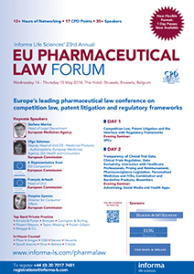
  • BrochureInforma Life Sciences will be holding its 23rd Annual EU Pharmaceutical Law Forum on May 14-15, 2014 in Brussels, Belgium.  The conference will offer presentations on the following topics:

    • Feedback from the EU Commission on competition law (keynote presentation) — to be presented by a representative from DG Competition, European Commission;
    • Reverse payment patent settlements;
    • Examining parallel trade: Imports and exports;
    • Relationship between pharmaceutical companies and wholesales/distributors: Assessing the competition law aspects;
    • Review of high profile national cases/decisions in competition law;
    • Unified Patent Court: Feedback from the European Commission (keynote presentation) — to be presented by François Arbault, Head of Unit, European Commission;
    • Interface between competition law, IP and the regulatory frameworks;
    • Understanding European patent and SPC litigation: Changes ahead (evening seminar discussion and dinner);
    • Implementation of the EU regulatory framework for medicinal products for human use (keynote presentation) — to be presented by Olga Solomon, Deputy Head of Unit D5 – Medicinal Products – Authorisations, European Medicines Agency, DG Health and Consumers, European Commission;
    • Transparency of pre-clinical and clinical trial data and other regulatory data;
    • Review of the clinical trials regulation;
    • Evaluating data exclusivity/Regulatory Data Protection (RDP) in the pharmaceutical industry;
    • Interaction with healthcare professionals – challenges and changes;
    • New trends in pricing and reimbursement and revisions to the EU Transparency Directive: Main focus on France, Germany, Spain, Italy and the UK;
    • Practical experience of the new pharmacovigilance legislation;
    • Feedback from the EU Commission on the EU regulatory framework for medical devices (keynote presentation) — to be presented by Despina Spanou, Director for Consumer Affairs, European Commission;
    • Examining the use of medical devices;
    • Overcoming challenges surrounding personalised medicines and IVDs;
    • Reviewing combination and borderline products;
    • Biosimilars and the regulatory frameworks; and
    • Examining pharmaceutical advertising, social media and health apps (evening seminar discussion and dinner).

    A complete brochure for this conference, including an agenda, detailed descriptions of conference sessions, list of speakers, and registration form can be obtained here.

    Informa Life SciencesThe registration fee for the conference is £1632.29 (1 Day Pass — conference and evening seminar for day 1 or 2), £2055.79 (2 Day Pass — conference only), £2660.79 (2 Day Pass — conference and one evening seminar), or £3023.79 (Full Pass — conference and evening seminar for days 1 and 2.  Those registering by April 11, 2014 will receive a £100 discount.  Those interested in registering for the conference can do so here, by e-mailing registrations@informa-ls.com, by calling +44(0) 20 7017 7481, or by faxing a registration form to +44(0) 20 7017 7823.

    Patent Docs is a media partner of the EU Pharmaceutical Law Forum.

  • PLI #1Practising Law Institute (PLI) will be holding its Fundamentals of Patent Prosecution 2014: A Boot Camp for Claim Drafting & Amendment Writing seminar on May 13-15, 2014 in Chicago, IL, on June 11-13, 2014 in New York, NY, and on July 9-11, 2014 in San Francisco, CA.  The three-day program, which is directed to patent prosecuting and litigating attorneys and patent agents with or without a Patent Office registration number or little patent experience, will focus on teaching the basics of claim drafting, patent application preparation and prosecution, as well as a review of recent developments in the law.  A litigator's perspective is also presented to show how drafting and prosecution can influence the development, and often the outcome, of subsequent patent litigation.  The seminar will feature lectures in the morning followed by small clinic sessions in the afternoon, with day 1 focusing on invention disclosures and patent preparation, day 2 on prosecution and issuance, and day 3 on litigation and opinion drafting.  Lectures will explain:

    • How to decide what elements of the invention should be included in the patent;
    • How to prosecute an application to result in allowance of an enforceable patent;
    • How to interview an Examiner;
    • How to use reissues, reexaminations, and other post-issuance proceedings;
    • How to anticipate patent litigation issues during the patent prosecution process; and
    • How to approach patent opinion drafting.

    PLI faculty will offer presentations on the following topics:

    • Taking Invention Disclosures;
    • Overview of Claim Drafting and Preparation of Patent Application;
    • Claim Drafting;
    • Review of Model Claims;
    • Patent Prosecution;
    • Conducting the Examiner Interview;
    • Review of Model Amendment; and
    • Litigation Issues.

    A program schedule and list of speakers for each of the locations can be found herePatent Docs authors Kevin Noonan (Chicago co-chair) and Donald Zuhn will be presenting on day 1 at the Chicago seminar.

    The registration fee for the conference is $1,895.  Those interested in registering for the conference can do so at the PLI website.

  • George Washington University Law SchoolThe George Washington University Law School (with Mayer Brown and Pillsbury) will be holding its annual GW Law Symposium on Intellectual Property on May 6, 2014 at The George Washington University Law School, 2000 H Street NW, Washington, DC.  The Symposium will offer presentations on the following topics:

    • Keynote Address — Nathan Kelley, Deputy General Counsel for Intellectual Property Law and Solicitor, United States Patent & Trademark Office

    • Beginning of A New Era: Post Issuance PTO Proceedings

    • Tips and Trends for Litigating Patent Cases in the Federal Courts

    • ITC: Recent Developments and Current Trends

    • Defensive Strategies: Patent Litigation

    Additional information about the Symposium, including a program, list of speakers, and directions can be found at the Symposium's website.  A cocktail reception will take place following the Symposium.

    The registration fee for the Symposium is $25 (Student Registration) or $75 (General Registration).  Those interested in registering for the Symposium can do so here.

  • Technology Transfer Tactics will be offering a webinar entitled "The Supreme Court’s Medtronic Ruling: Practical Guidance for Protecting University IP" on April 24, 2014 from 1:00 – 2:00 pm (Eastern).  Brian D. Gildea, Executive Director, IP & Licensing, Boston University Technology Development, and Charles R. Macedo of Amster, Rothstein and Ebenstein, LLP will dissect the Supreme Court's decision in Medtronic, Inc. v. Mirowski Family Ventures, LLC while giving practical guidance on how to manage and fortify patent portfolios in light of the decision.  The webinar will:

    • Review the Medtronic v Mirowski Family Ventures case specifics;
    • Address the three notions the Supreme Court's decision was based upon;
    • Provide expert tips on drafting and negotiating future patent licenses in light of Medtronic;
    • Address how to respond to declaratory judgment petitions — and what will meet "burden of proof";
    • Provide practical guidance for prepare burden of proof evidence; and
    • Provide best practices for dealing with licensees who file for declaratory judgment.

    The registration fee for the webinar is $197.  Those interested in registering for the webinar, can do so here.

    Technology Transfer Tactics

  • Strafford #1Strafford will be offering a webinar/teleconference entitled "Advanced AIA Issues for Patent Claim Construction: Best Practices Absent Clear Court Guidance" on April 23, 2014 from 1:00 to 2:30 pm (EDT).  Thomas L. Irving of Finnegan Henderson Farabow Garrett & Dunner, Colin G. Sandercock of Perkins Coie, and Lauren L. Stevens of the Global Patent Group provide guidance to patent counsel regarding the impact of the Leahy-Smith America Invents Act (AIA) on claim construction and offer best practices for addressing claim construction issues in light of the AIA.  The webinar will review the following questions:

    • What are the changes resulting from the AIA and the implications for claim construction?
    • What is the impact of claim construction on choice of law?
    • What are the benefits of new claims in a continuation application regarding choice of law in view of transitional applications?
    • Can the choice of law change when a district court judge construes the claim in such a way that the EFD changes?

    The registration fee for the webinar is $297 ($362 for registration and CLE processing).  Those interested in registering for the webinar, can do so here.

  • By Andrew Williams

    Senate SealThe Senate Committee on the Judiciary was set to consider the Patent Transparency and Improvements Act of 2013 (S. 1720) earlier today during an Executive Business Meeting.  Instead, the Committee again tabled the bill, this time until next Tuesday (April 8, 2014).  In his statement on the issue, Chairman Leahy suggested that it was Senator Hatch's "bonding" provision that was the sticking point necessitating the delay.  However, it was clear that the Committee had been receiving feedback from stakeholders, which may have been slowing the process.  For example, Sen. Leahy's statement included the observation:

    Even casual observers may have noticed that the Senate does not operate like the House of Representatives.  Not only do Senators like to talk.  Senators listen to those who oppose their ideas.  There has been a lot of talk about the need for patent reform.  And over the past several weeks, I actually think there has been a lot of listening.  We have heard concerns about unintended consequences; for instance, this having an impact outside of the context of patent law.  We have heard concerns about pending Supreme Court cases, like the case they heard this week about the patentability of software patents.  We have heard concerns from businesses on Main Street and the tech community that reforms must be meaningful to address the problems they face.

    Nevertheless, he did sound optimistic that the few remaining issues could be nailed down in the next day or so.  Sen. Grassley echoed those sentiments, indicating that staff discussions have been productive and that they are moving in the right direction.

    The key words used by many of the Senators that provided a statement were "optimism" and "unintended consequences."  It was heartening to hear supporters on both sides of the issue express concern over the potential impact that the proposed provisions might have on the legitimate assertion of patents.  For example, Sen. Lee, co-sponsor of the above-referenced bill, indicated that he was addressing concerns from both sides regarding the consumer stay and demand letter provisions, so to "appropriately and narrowly target patent troll behavior."  He stressed that he was seeking to take into account the legitimate concerns of patent holders and trying to minimize any unintended consequences.  Sen. Lee's stated goal was to have a patent system that serves its Constitutional purpose, by encouraging, not hindering, innovation.  Of course, the unintended consequences of the proposed legislation that we are most concerned about is just that, a hindering of innovation.

    Sen. Schumer also expressed optimism that the Committee could reach an agreement.  As he did the other day in his event with the Internet Association, Sen. Schumer compared patent trolls to hookworms (or tapeworms), because "they do nothing, they attach themselves to the insides of the body, and eat the food that other people have worked to cultivate and digest."  Sen. Franken was not fond of this analogy (maybe it was too close to lunch), and Sen. Leahy quipped that they would hold the biology mark-up right after this.  But to his credit, Sen. Schumer did identify one of the most serious unintended consequences of the fee-shifting provision — even with the prospect that fees might be recouped, younger companies will not be able to survive the potential five plus years of litigation to get them.  He reiterated his desire to expand CBM patent review, but acknowledged that it was unlikely to be accepted.  Finally, he welcomed the delay if it would ensure a better bill, because a good bill is better than passing ineffective legislation.

    It was not until Sens. Durbin and Feinstein provided their statements that a sense of the opposition to the legislation was truly felt.  Sen. Durbin began by pointing out that the extent of the "patent troll" problem may have been exaggerated.  He quoted from the GAO report that determined that only 19% of the patent infringement suits were brought by non-practicing entities.  The overwhelming majority, therefore, were brought by non-"trolls."  He criticized the House of Representatives for hurriedly passing the Innovation Act, expressing concern that they did not engage in thoughtful deliberation.  He explained that many of the House members were probably not aware that "universities, manufacturers, biotech companies, venture capital groups and independent inventors had serious concerns about this House bill."  Sen. Durbin continued by stating the concerns have not gone away, and then read from the letter delivered by the Innovation Alliance and others, which we reported on yesterday.  He was shocked by the diversity of organizations that signed that letter, and was surprised by its content.  Instead of the policy concerns he was expecting, the letter addressed a fundamental question — that some of the measures go far beyond what is necessary to address the threat of abusive litigation, and instead "would do serious damage to the patent system."  He concluded by pointing out that because this legislation will be more controversial than anticipated, Congress needs to make sure to protect the legitimate patent holders.

    Sen. Feinstein also described a letter that she received, this one from medical device manufactures.  She expressed gratitude that this letter listed all of the concerns with the various bills clearly and distinctly.  She pointed out that letters that only cite generalities were not very useful.  In making this comment, could she have been responding to Sen. Schumer's comments on messaging from the other day, in which he urged people to ignore the details and instead just focus on the fact that "trolls" are sucking the vitality of America (see "Stopping Bad Patents — Senator Schumer Takes on the 'Patent Trolls'")?

    A copy of the webcast of the committee meeting can be found here.  As always, we will continue to monitor and report on the progress of this bill.

  •         By Sherri Oslick

    Gavel About Court Report:  Each week we will report briefly on recently filed biotech and pharma cases.

    Bristol-Myers Squibb Company v. Apotex Inc. et al.
    1:14-cv-00351; filed March 19, 2014 in the District Court of Delaware

    • Plaintiff:  Bristol-Myers Squibb Co.
    • Defendants:  Apotex Inc.; Apotex Corp.

    Infringement of U.S. Patent No. 5,206,244 ("Hydroxymethyl (Methylenecyclopentyl) Purines and Pyrimidines," issued April 27, 1993) following a Paragraph IV certification as part of Apotex's filing of an ANDA to manufacture a generic version of BMS's Baraclude® (entecavir, used to treat chronic hepatitis B virus infectrion).  View the complaint here.

    Sanofi et al. v. Alkem Laboratories, Ltd. et al.
    1:14-cv-01957; filed March 19, 2014 in the Northern District of Illinois

    • Plaintiffs:  Sanofi; Sanofi-Aventis U.S. LLC
    • Defendants:  Alkem Laboratories, Ltd.; Ascend Laboratories, LLC

    Sanofi et al. v. Sun Pharma Global FZE et al.
    1:14-cv-01844; filed March 14, 2014 in the Northern District of Illinois

    • Plaintiffs:  Sanofi; Sanofi-Aventis U.S. LLC
    • Defendants:  Sun Pharma Global FZE; Sun Pharmaceutical Industries Ltd.; Caraco Pharmaceutical Laboratories, Ltd.

    The complaints in these cases are substantially identical.  Infringement of U.S. Patent Nos. 7,323,493 ("Solid Pharmaceutical Composition Containing Benzofuran Derivatives," issued January 29, 2008), 8,318,800 ("Solid Pharmaceutical Compositions Containing Benzofuran Derivatives," issued November 27, 2012), 8,410,167 ("Use of Dronedarone for the Preparation of a Medicament for Use in the Prevention of Cardiovascular Hospitalization or of Mortality," issued April 2, 2013), and 8,602,215 ("Methods for Reducing the Risk of an Adverse Dronedarone/Beta-Blockers Interaction in a Patient Suffering from Atrial Fibrillation," issued December 10, 2013) following a Paragraph IV certification as part of Sun's filing of an ANDA to manufacture a generic version of Sanofi's Multaq® (dronedarone, used to reduce the risk of hospitalization for atrial fibrillation in patients in sinus rhythm with a history of paroxysmal or persistent atrial fibrillation).  View the Sun complaint here.


    Pfizer Inc. et al. v. Torrent Pharmaceuticals Limited et al.
    3:14-cv-01704; filed March 17, 2014 in the District Court of New Jersey

    • Plaintiffs:  Pfizer Inc.; Pfizer Ltd.; Pfizer Ireland Pharmaceuticals
    • Defendants:  Torrent Pharmaceuticals Ltd.; Torrent Pharma Inc.

    Pfizer Inc. et al. v. Torrent Pharmaceuticals Limited et al.
    1:14-cv-01831; filed March 17, 2014 in the Southern District of New York

    • Plaintiffs:  Pfizer Inc.; Pfizer Ltd.; Pfizer Ireland Pharmaceuticals
    • Defendants:  Torrent Pharmaceuticals Ltd.; Torrent Pharma Inc.

    The complaints in these cases are substantially identical.  Infringement of U.S. Patent No. 6,469,012 ("Pyrazolopyrimidinones for the Treatment of Impotence," issued October 22, 2002) following a Paragraph IV certification as part of Torrent's filing of an ANDA to manufacture a generic version of Pfizer's Viagra® (sildenafil citrate, used to treat erectile dysfunction).  View the New Jersey complaint here.

    Cephalon, Inc. v. Emcure Pharmaceuticals Ltd. et al.
    3:14-cv-01705; filed March 17, 2014 in the District Court of New Jersey

    • Plaintiff:  Cephalon, Inc.
    • Defendants:  Emcure Pharmaceuticals Ltd.; Emcure Pharmaceuticals USA, Inc.

    Infringement of U.S. Patent No. 8,445,524 ("Solid Forms of Bendamustine Hydrochloride," issued May 21, 2013) following a Paragraph IV certification as part of Emcure's filing of an ANDA to manufacture a generic version of Cephalon's Treanda® (bendamustine hydrochloride, used to treat chronic lymphocytic leukemia and non-Hodgkin's lymphoma).  View the complaint here.

    Otsuka Pharmaceutical Co., Ltd. v. Amneal Pharmaceuticals, LLC et al.
    3:14-cv-01688; filed March 14, 2014 in the District Court of New Jersey

    • Plaintiff:  Otsuka Pharmaceutical Co., Ltd.
    • Defendants:  Amneal Pharmaceuticals, LLC; Amneal Pharmaceuticals of New York, LLC; Amneal Pharmaceuticals Co. India Private Ltd.

    Infringement of U.S. Patent No. 7,053,092 ("5-HT1A Receptor Subtype Agonist," issued May 30, 2006) following a Paragraph IV certification as part of Amneal's filing of an ANDA to manufacture a generic version of Otsuka's Abilify® (aripiprazole, used to treat bipolar disorder and schizophrenia).  View the complaint here.

    Astellas US LLC et al. v. Emcure Pharmaceuticals USA, Inc. et al.
    2:14-cv-01665; filed March 14, 2014 in the District Court of New Jersey

    • Plaintiffs:  Astellas US LLC; Astellas Pharma US, Inc.; Item Development AB
    • Defendants:  Emcure Pharmaceuticals USA, Inc.; Emcure Pharmaceuticals, Ltd.

    Infringement of U.S. Patent No. 5,731,296 ("Selective Vasodilation by Continuous Adenosine Infusion," issued March 24, 1998), licensed to Astellas, following a Paragraph IV certification as part of Emcure's filing of an ANDA to manufacture a generic version of Astellas' Adenoscan® product (adenosine injection, used as a diagnostic for myocardial reperfusion injury).  View the complaint here.

  • By Andrew Williams

    Innovation AllianceOn the day before the Senate Judiciary Committee is scheduled to take up S. 1720 (The Patent Transparency and Improvements Act), the Innovation Alliance delivered a letter to Chairman Leahy and Ranking Member Grassley concerning the committee's legislative efforts.  The Alliance was joined on the letter by a host of additional entities and organization, "representing thousands of innovative companies, universities, and organizations and millions of workers in the United States."  These included individual companies, such as 3M, Caterpillar, and Novartis, as well as organizations, such as the Association of University Technology Managers ("AUTM"), the Biotechnology Industry Organization ("BIO"), and the Pharmaceutical Research and Manufacturers of America ("PhRMA").  The letter begins by acknowledging the hard work the Committee has undertaken in crafting a "bill to target abusive practices in patent litigation."  However, it quickly points out that some of the measures are not narrowly tailored to address the perceived problem, "and, in fact, would do serious damage to the patent system."  In essence, the letter explains, every patent holder is treated as though they are a "troll" by many of the pending provisions.  "This approach clearly favors a business model that does not rely on patents and tilts the balance in favor of patent infringers, thereby discouraging investment in innovation."  Specifically, the letter calls out the current provisions on discovery, customer stay, fee shifting, pleadings, and enforcement by the FTC.  The letter concludes by suggesting that if an appropriate balance is not met, the undersigned "will oppose the legislation."

    The letter comes a day after Senator Charles Schumer of New York "Hung Out" with the Internet Association.  As we pointed out yesterday, when asked how to get the anti-troll message across, Sen. Schumer stressed that it is not necessary to worry about the details.  However, it is the details that the Innovation Alliance thinks are crucial.  Much like the Internet Association's site "Stop Bad Patents," the Innovation Alliance hosts the "Save the Inventor" website, which also encourages visitors to contact their Senators.  But instead of speaking in generalities with unsupported statistics, the "Save the Inventor" site provides facts, including the sources for any numbers or statistics cited.  In fact, several of these sources are from U.S. governmental organizations, such as the Government Accountability Office and the Department of Commerce.  The Innovation Alliance states that patent reform must be targeted and balanced for an innovation ecosystem that drives the American economy to thrive.  And while acknowledging that there is a litigation abuse problem, the Alliance believes that the key to solving it is improving patent quality, which includes vigorous pre-grant review.

    Today's letter is not the Innovation Alliance's only recent communication with Congress.  On March 13, they released a statement supporting Senator Feinstein for introducing the "Patent Fee Integrity Act," aimed at preventing fee-diversion from the Patent Office.  In addition, on March 4, 2014, the Alliance sent a letter to Senate Committee on Commerce, Science, & Transportation in response to S. 2049 (The Transparency in Assertion of Patents Act).  As we reported at the time, this bill would provide the FTC with enforcement power to curb the sending of demand letters.  The Alliance's letter complained that the bill is not targeted at the abusive behavior, but rather applies to all patent enforcement, even though "the vast majority [of patent holders] are engaging in perfectly reasonable and appropriate economic activity."  The letter also pointed out the First Amendment concerns of that particular bill.

    We will continue to monitor the progress of S. 1720.  As Sen. Schumer suggested yesterday, it is unlikely that the committee will vote on the bill tomorrow.  Nevertheless, every indication is that something will happen soon.  When it does, we will report on any significant advances.