•         By Sherri Oslick

    Gavel About Court Report:  Each week we will report briefly on recently filed biotech and pharma cases.

    Novartis Pharmaceuticals Corp. et al. v. Dr. Reddy's Laboratories Ltd. et al.
    1:14-cv-00387; filed March 26, 2014 in the District Court of Delaware

    • Plaintiffs:  Novartis Pharmaceuticals Corp.; Novartis AG
    • Defendants:  Dr. Reddy's Laboratories Ltd.; Dr. Reddy's Laboratories Inc.

    Infringement of U.S. Patent No. RE43,932 ("Crystal Modification of a N-phenyl-2-pyrimidineamine Derivative, Processes for Its Manufacture and Its Use," issued January 15, 2013) following a Paragraph IV certification as part of Dr. Reddy's filing of an ANDA to manufacture a generic version of Novartis' Gleevec® (imatinib mesylate, used for various indications, including treatment of myeloid leukemia).  View the complaint here.

    AbbVie Inc. v. Gilead Sciences Inc. et al.
    1:14-cv-00379; filed March 25, 2014 in the District Court of Delaware

    • Plaintiff:  AbbVie Inc.
    • Defendants:  Gilead Sciences Inc.; Gilead Pharmasset LLC; Gilead Sciences Ltd.

    Infringement of U.S. Patent No. 8,680,106 ("Methods for Treating HCV," issued March 25, 2014) based on Gilead's anticipated manufacture and sale of its combination therapy for the treatment of HCV using sofosbuvir and ledipasvir.  View the (redacted) complaint here (original filed under seal).

    Bausch & Lomb Inc. et al. v. Akorn, Inc. et al.
    1:14-cv-01866; filed March 24, 2014 in the District Court of New Jersey

    • Plaintiffs:  Bausch & Lomb Inc.; Bausch & Lomb Pharma Holdings Corp.; Mitsubishi Tanabe Pharma Corp.; Ube Industries, Ltd.
    • Defendants:  Akorn, Inc.; Akorn Ophthalmics, Inc.

    Infringement of U.S. Patent No. 6,780,877 ("Acid Addition Salt of Optically Active Piperidine Compound and Process for Preparing the Same," issued August 24, 2004) following a Paragraph IV certification as part of Akorn's filing of an ANDA to manufacture a generic version of Bausch & Lomb's Bepreve® (bepotastine besilate ophthalmic solution, used for the treatment of itching associated with allergic conjunctivitis).  View the complaint here.

    ViiV Healthcare UK Ltd. et al. v. Lupin Ltd. et al.
    1:14-cv-00369; filed March 21, 2014 in the District Court of Delaware

    • Plaintiffs:  ViiV Healthcare UK Ltd.; ViiV Healthcare Co.
    • Defendants:  Lupin Ltd.; Lupin Pharmaceuticals Inc.

    Infringement of U.S. Patent Nos. 6,417,191 ("Synergistic Combinations of Zidovudine, 1592U89 and 3TC," issued July 9, 2002) and 6,294,540 ("Carbocyclic Nucleoside Hemisulfate and its Use in Treating Viral Infections," issued September 25, 2001) following a Paragraph IV certification as part of Lupin's filing of an ANDA to manufacture a generic version of Viiv's Epzicom® (abacavir sulfate and lamivudine, used to HIV infection in humans).  View the complaint here.

    Bayer Pharma AG et al. v. Watson Laboratories, Inc. et al.
    2:14-cv-01804; filed March 21, 2014 in the District Court of New Jersey

    • Plaintiffs:  Bayer Pharma AG; Intellectual Property GmbH; Bayer Healthcare Pharmaceuticals, Inc.
    • Defendants:  Watson Laboratories, Inc.; Actavis, Inc.; Actavis Pharma, Inc.

    Infringement of U.S. Patent No. 8,613,950 ("Pharmaceutical Forms With Improved Pharmacokinetic Properties," issued December 4, 2013) following a Paragraph IV certification as part of Watson's filing of an ANDA to manufacture a generic version of Bayer's Staxyn® (vardenafil hydrochloride, used to treat erectile dysfunction).  View the complaint here.

    Novartis Pharmaceuticals Corp. v. Gland Pharma Ltd.
    2:14-cv-01841; filed March 21, 2014 in the District Court of New Jersey

    Infringement of U.S. Patent No. 8,052,987 ("Method of Administering Bisphosphonates," issued November 8, 2011) following a Paragraph IV certification as part of Gland's filing of an ANDA to manufacture a generic versions of Novartis' Reclast® (zoledronic acid injection, once-yearly treatment for postmenopausal osteoporosis).  View the complaint here.

    UCB, Inc. et al. v. CorePharma, L.L.C.
    2:14-cv-01788; filed March 20, 2014 in the District Court of New Jersey

    • Plaintiffs:  UCB, Inc.; UCB Manufacturing, Inc.
    • Defendant:  CorePharma, L.L.C.

    Infringement of U.S. Patent No. 6,344,215 ("Methylphenidate Modified Release Formulations," issued February 5, 2005) following a Paragraph IV certification as part of CorePharma's filing of an ANDA to manufacture a generic version of UCB's Metadate CD® (methylphenidate hydrochloride, used to treat attention deficit hyperactivity disorder).  View the complaint here.

  • CalendarApril 16, 2014 – "Patent Subject Matter Eligibility: Navigating the New "Myriad" Guidelines — Analyzing Subject Matter and Avoiding Rejection Under the USPTO's Detailed Framework" (Strafford) – 1:00 to 2:30 pm (EDT)

    April 16, 2014 – Biotechnology/Chemical/Pharmaceutical (BCP) Customer Partnership Meeting (U.S. Patent and Trademark Office) – 9:00 am to 4:00 pm

    April 22, 2014 – China Pharmaceutical Regulatory Law Boot Camp (American Conference Institute) – New York, NY

    April 22, 2014 – "International Trade Secret Misappropriation Update 2014" (McDonnell Boehnen Hulbert & Berghoff LLP) 10:00 am to 11:15 am (CT)

    April 23, 2014 – European biotech patent law update (D Young & Co) – 4:00 am, 7:00 am, and 12:00 pm (ET)

    April 23, 2014 – "Advanced AIA Issues for Patent Claim Construction: Best Practices Absent Clear Court Guidance" (Strafford) – 1:00 to 2:30 pm (EDT)

    April 23-25, 2014 – 2014 Spring Intellectual Property Counsels Committee (IPCC) Conference (Biotechnology Industry Organization) – Palm Springs, CA

    April 24, 2014 – "The Supreme Court’s Medtronic Ruling: Practical Guidance for Protecting University IP" (Technology Transfer Tactics) – 1:00 – 2:00 pm (Eastern)

    April 28-29, 2014 – Paragraph IV Disputes*** (American Conference Institute) – New York, NY

    May 6, 2014  – GW Law Symposium on Intellectual Property (George Washington University Law School, Mayer Brown, and Pillsbury) – George Washington University Law School

    May 13-15, 2014 – Fundamentals of Patent Prosecution 2014: A Boot Camp for Claim Drafting & Amendment Writing (Practising Law Institute) – Chicago, IL

    May 14-15, 2014 – EU Pharmaceutical Law Forum*** (Informa Life Sciences) – Brussels, Belgium

    June 4-6, 2014 – Biosimilars*** (American Conference Institute) – New York, NY

    June 11-13, 2014 – Fundamentals of Patent Prosecution 2014: A Boot Camp for Claim Drafting & Amendment Writing (Practising Law Institute) – New York, NY

    July 9-11, 2014 – Fundamentals of Patent Prosecution 2014: A Boot Camp for Claim Drafting & Amendment Writing (Practising Law Institute) – San Francisco, CA

    August 13-15, 2014 – Advanced Patent Law Seminars (Chisum Patent Academy) - Seattle, WA

    August 18-20, 2014 – Advanced Patent Law Seminars (Chisum Patent Academy) - Seattle, WA

    ***Patent Docs is a media partner of this conference or CLE

  • USPTO Building FacadeThe U.S. Patent and Trademark Office will be holding its next biotechnology/chemical/pharmaceutical (BCP) customer partnership meeting on Wednesday, April 16, 2014.  The agenda for the meeting is as follows:

    Morning Session

    • Welcoming Remarks (9:00 – 9:10 am ET) — Andy Faile, Deputy Commissioner for Patent Operations

    • Opening Remarks/Overview of TC/Collecting Feedback from Participants (in person and online (online participants can submit comments/feedbacks through the chat function in WebEx or email to USPTOBCP1600@USPTO.GOV) (9:10 – 9:40 am):  Wanda Walker, Jerry Lorengo, and Jeffrey Stucker (Acting), Directors, TC1600

    • Patent Law Treaties (PLT) Implementation Act (9:40 – 10:40 am):  Eugenia Jones, Senior Legal Advisor, Office of the Deputy Commissioner for Patent

    • Break (10:40 – 11:00 am)

    • FITF Overview and Tips on Responding to Prior Art Rejections (11:00 am – 12:00 pm):  Kathleen Fonda, Senior Legal Advisor, Office of Patent Legal Administration (OPLA)

    • Lunch (12:00 – 1:15 pm)

    Afternoon Session

    • An Overview of the Myriad Guidance (1:15 – 3:45 pm):  Dan Sullivan, TC1600; June Cohan and Ali Salimi, Office of Patent Legal Administration (OPLA)

    • Closing Remarks/Discussion (3:45 – 4:00 pm):  Wanda Walker, Jerry Lorengo, and Jeffrey Stucker (Acting), Directors, TC1600

    The meeting can be viewed online here.  The event number is 995 652 820 and the event password is 12345.  Additional information regarding the BCP customer partnership meeting can be found here.

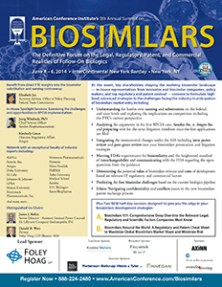
  • New York #2American Conference Institute (ACI) will be holding a conference on Biosimilars on June 4-6, 2014 in New York, NY.  ACI faculty will help attendees:

    • Understand the battles over naming and substitution on the federal and state levels and exploring the implications on competition including the FTC's current perspective;
    • Analyzing the arguments in the first BPCIA case, Sandoz Inc. v. Amgen Inc., and preparing now for the strict litigation timelines once the first applications are filed;
    • Integrating the monumental changes under the AIA including inter partes review and post-grant review into your biosimilars prosecution and litigation strategies;
    • Meeting FDA's requirements for biosimilarity and the heightened standard of interchangeability and communicating with the FDA regarding the open questions from the guidance;
    • Determining the potential value of biosimilars revenue and costs of development based on relevant IP, regulatory, and commercial factors;
    • Predicting the first biosimilar challenges based on the current biologics pipeline; and
    • Ethics: Navigating confidentiality and conflicts issues in the new biosimilars patent exchange process.

    BrochureIn particular, ACI's faculty will offer presentations on the following topics:

    • Minimizing the Uncertainty Surrounding the Untested Pathway: Insight into FDA's Current Position and Initiatives Regarding Biosimilars
    • Predicting Follow-On Entry and Evaluating the Risk and Commercial Opportunity in the Emerging Biosimilar Landscape
    • In-house Keynote: New Kid No More: Evolution in Biosimilars Science and Regulations
    • The Holy Grail for Biosimilars: Meeting FDA's Requirements for Biosimilarity and the Heightened Standard of Interchangeability
    • FTC Keynote: Revisiting Competition Issues in the Follow-on Biologics Arena: Substitution and Naming Conventions
    • Framing the State Law Issues: Attributing Adverse Events and Applying Interchangeability on the Pharmacy Level
    • Industry Round Table: Weighing in on the Emerging Controversy on Biosimilars Naming and State Substitution Laws
    • The EU Experience: Regulatory and IP Lessons Learned So Far from the First Biosimilar Antibody Approval in Europe
    • Analyzing the Arguments in the First BPCIA Case, Sandoz Inc. v. Amgen Inc.: Immediate Action Plans for Innovators and Biosimilars to Prepare Before the First Application is Public
    • The Most Powerful Tool in Your Arsenal: Using Inter-Partes Review at the PTO to Revamp Branded and Biosimilar Litigation Strategies
    • Going Beyond the Hatch Waxman Comparisons: Delving into Pre-Suit Due Diligence and Pre-Litigation Tactics for Evaluating Patent Strength and Assertion Strategies
    • Platform Patents and Antibodies: Specific Action Plans to Protect or Defend Patents Most Ripe for a Biosimilars First Wave Challenge
    • Key IP Case Law Through the Biosimilars Lens: Top 5 Patent Battles to Consider When Updating Your Biosimilars Prosecution and Litigation Strategies
    • Case Spotlight: Momenta v. Amphastar and Bioequivalence: Understanding the Implications for the Future of Biosimilars — to be presented in part by Patent Docs author Kevin Noonan
    • Timing is Everything: Managing the Logistics of the BPCIA Exchange Process and Preparing for "Early" and "Late" Phase Litigation
    • Ethics in the Biosimilars Realm: Avoiding Conflicts and Maintaining Confidentiality in the Brave New World

    Two pre-conference primers will be held on June 4, 2014.  The first, entitled "Biosimilars 101: Comprehensive Deep Dive Into the Relevant Legal, Regulatory and Scientific Factors Companies Must Know," will be offered from 9:00 am to 12:00 pm, and the second, entitled " Biosimilars Around the World: A Regulatory and Patent Cheat Sheet to Maximize Global Biosimilars Market Share and Minimize Risk," will be offered from 1:30 pm to 4:30 pm.

    The agenda for the Biosimilars conference can be found here (Day 1) and here (Day 2), and additional information about the pre-conference primers can be found here.  A complete brochure for this conference, including an agenda, detailed descriptions of conference sessions, list of speakers, and registration form can be obtained here.

    ACI - American Conference InstituteThe registration fee for the conference is $2,295 (conference alone), $2,895 (conference and one pre-conference primer), or $3,295 (conference and both pre-conference primers).  Those registering by May 16, 2014 will receive a $200 discount.  Those interested in registering for the conference can do so here, by calling 1-888-224-2480, or by faxing a registration form to 1-877-927-1563.

    Patent Docs is a media partner of the Biosimilars conference.

  • MBHB Logo 2McDonnell Boehnen Hulbert & Berghoff LLP will be offering a live webinar entitled "International Trade Secret Misappropriation Update 2014" on April 22, 2014 from 10:00 am to 11:15 am (CT).  MBHB attorney Joshua R. Rich will address the steps that have been taken (and those recently undertaken) to combat international trade secret misappropriation.  The webinar will address the following topics:

    • Federal and State legislative enactments and proposals
    • The Federal Joint Strategic Plan on Intellectual Property Enforcement
    • Private and public proposals for limiting trade secret misappropriation
    • Recent developments in criminal enforcement of trade secret rights

    While there is no fee to participate, attendees must register in advance.  Those wishing to register can do so here.  CLE credit is pending for the states of California, Illinois, New Jersey, New York, North Carolina, and Virginia.

  • By Donald Zuhn

    IndianaOn March 25, Indiana Governor Mike Pence signed legislation (Senate Bill 262) that will allow pharmacists in Indiana to substitute an interchangeable biosimilar product for a prescribed biological product if certain conditions are met.  Senate Bill 262, which was authored by Sen. Brandt Hershman (R) and Ronald Grooms (R) and co-Authored by Sen. Jean Breaux (D), was passed by the Indiana Senate in January by a 38-11 vote and by the Indiana House in February by a 92-5 vote before the bill was signed by Governor Pence.

    The legislation will allow a pharmacist to substitute a biosimilar product for a prescribed biological product if five conditions are met: (1) the biosimilar product has been determined by the U.S. Food and Drug Administration to be interchangeable with the prescribed biological product, (2) the practitioner prescribing the biological product has included the instruction "May substitute" on the prescription, (3) the pharmacist has informed the customer of the substitution, (4) the pharmacist notifies the practitioner within five days of the substitution, and (5) the pharmacy and practitioner retain a record of the interchangeable biosimilar substitution for at least five years.  The legislation enacted in Indiana is very similar to the California bill that Governor Jerry Brown vetoed last fall as being "premature" because the FDA had not determined the standards required for biosimilars to meet the higher threshold for interchangeability (see "Governor Brown Vetoes California Biosimilar Bill").

    In the Indiana legislation, biological products are defined as including viruses, therapeutic serums, toxins, antitoxins, vaccines, blood, blood components, blood derivatives, allergenic products, proteins (except any chemically synthesized polypeptides), products analogous to the above products, arsphenamine, arsphenamine derivatives, or any other trivalent organic arsenic compound, wherein the product is applicable to the prevention, treatment, or cure of a disease or condition for human beings.  Biosimilars are defined in the bill, in part, as being licensed as such under 41 U.S.C. § 262(k) (which appears to be a typographical error as the section on the "Licensure of biological products as biosimilar or interchangeable" appears in Title 42).  Finally, the legislation defines "interchangeable" as meaning that the FDA has determined that a given biosimilar product may be substituted for a reference biological product without the intervention of the healthcare provider that prescribed the biological product.

    In a statement issued last month, the Biotechnology Industry Organization (BIO) and Indiana Health Industry Forum (IHIF) commended Governor Pence for signing Senate Bill 262, and called the bill "a model for legislation necessary in all 50 states to address this cutting-edge technology."  BIO noted that it would "continue to advocate for full transparency in the substitution process as patients and their physicians should have the right to know what biologic medicine the patient receives from the pharmacy."

    Flag map of Indiana by Wapcaplet, from the Wikipedia Commons under the Creative Commons Attribution-Share Alike 3.0 Unported license.

  • By Kevin E. Noonan

    Shire PharmaceuticalsClaim construction in patent cases, and the propensity for the Federal Circuit to disagree with a district court's conclusions regarding the scope and meaning of claim terms, remains one of the most vexing aspects of patent litigation (yes, even more so than the vaunted "troll" problem; and if you think the Supreme Court will improve the situation in deciding Teva Pharmaceuticals v. Sandoz, you haven't been paying attention).  The problems with the current jurisprudential situation regarding claim construction are nicely illustrated by the Court's decision in Shire Development, LLC v. Watson Pharmaceuticals, Inc., which doesn't appear to be anything more than an exercise in exegesis with little seeming relevance to the ultimate question of whether Watson's generic drug does or does not infringe Shire's claims.

    Watson PharmaceuticalsThe lawsuit involved Watson's ANDA filing seeking approval for a generic version of Shire's controlled-release oral pharmaceutical composition for the treatment of inflammatory bowel disease, Crohn's disease and ulcerative colitis, sold by Shire under the brand name LIALDA®.  Shire listed U.S. Patent No. 6,773,720 in the Orange Book having claims for is patented formulations of the active pharmaceutical ingredient mesalamine (5-amino salicylic acid).  These formulations were characterized as having high concentrations (85-90% by weight) of the API.  The formulations contain an "inner hydrophobic matrix" and an "outer hydrophilic matrix," as used in the following representative claims of the '720 patent:

    1.  Controlled-release oral pharmaceutical compositions containing as an active ingredient 5- amino-salicylic acid, comprising:
        a) an inner lipophilic matrix consisting of sub- stances selected from the group consisting of unsaturated and/or hydrogenated fatty acid, salts, esters or amides thereof, fatty acid mono-, di- or triglycerid[e]s, waxes, ceramides, and cholesterol derivatives with melting points below 90° C., and wherein the active ingredient is dispersed both in said the lipophilic matrix and in the hydrophilic matrix;
        b) an outer hydrophilic matrix wherein the lipophilic matrix is dispersed, and said outer hydrophilic matrix consists of compounds selected from the group consisting of polymers or copolymers of acrylic or methacrylic acid, alkylvinyl polymers, hydroxyalkyl celluloses, carboxyalkyl celluloses, polysaccharides, dextrins, pectins, starches and derivatives, alginic acid, and natural or synthetic gums;
        c) optionally other excipients;
        wherein the active ingredient is present in an amount of 80 to 95% by weight of the total composition, and wherein the active ingredient is dispersed both in the lipophilic matrix and in the hydrophilic matrix.

    The claimed formulations provide the "sustained and uniform manner" by which the mesalamine API is released as the drug passes through the gut.

    The District Court construed the term ""inner hydrophobic matrix" to mean "a matrix including at least one lipophilic excipient, where the matrix is located within one or more substances," and construed "outer hydrophilic matrix" to mean "a matrix of at least one hydrophilic excipient, where the matrix is located outside the inner lipophilic matrix."

    The Federal Circuit disagreed, in an opinion by Judge Hughes joined by Chief Judge Rader and Judge Prost.  The Court held that these constructions did not comport with the "ordinary and customary" meanings of the claim terms (which, while each word in each phrase may have such a meaning as used in the claim each phrase would seem to have a particular meaning as defined by the specification) because these constructions were "impermissibly broad."  Specifically, the panel held that the District Court had properly construed the term "matrix" in each instance as "a macroscopically homogeneous structure in all its volume."  The panel's disagreement with the lower court's construction was prompted by its construction of a "lipophilic matrix" as "a matrix that includes at least one lipophilic excipient."  According to the Court, this was error because "[it] erroneously focuses on the lipophilic properties of an excipient in the matrix, rather than the properties of the matrix itself."  The intrinsic evidence in the Court's view mandates a construction wherein lipophilicity (or, for that matter the hydrophilicity) is a characteristic of the matrix, not the excipient in the matrix.  The opinion finds support for these distinctions in the specification.

    The Court also reviewed the District Court's rejection of Watson's contention that the two matrices must be "separate and distinct."  At trial, Watson had argued that the claims should be limited to matrices that were separate and distinct due to prosecution disclaimer, i.e., as a consequence of arguments advanced during prosecution to overcome inter alia claim rejections based on certain cited prior art.  The grounds for the District Court's decision not to construe Shire's claims to be encumbered by this limitation was that "no where in the prosecution history, claims, or specification does the term 'separate and distinct' appear," and that the nature of patent prosecution limits a conclusion that there was prosecution disclaimer to instances where there is "a clear and unambiguous disavowal" of the disputed claims scope.  The Federal Circuit agreed in an interesting display of semantics:  according to the opinion, "[d]uring prosecution, Shire carefully characterized the prior art as not having separate matrices but never actually stated that the claimed invention does have separate matrices" (emphasis in opinion).  Nevertheless, this same prosecution history, as well as "the structure of the claim itself, the ordinary meaning of the claim terms, including the Markush group limitations, and the patent's description of the invention compel a claim construction which requires that the inner lipophilic matrix is separate from the outer hydrophilic matrix" (and the opinion notes that the "separateness" of the two matrices was admitted by Shire's counsel at oral argument).  Apparently wishing there to be no doubt on remand by the District Court on this point, the opinion further notes that a matrix cannot be both "inner" and "outer" nor "lipophilic" and "hydrophilic" and thus the matrices must under a "logical reading" be separate.  It is here that a possible basis for the panel's dissatisfaction with the District Court's construction becomes evident, the opinion stating that "a matrix comprised of only one lipophilic substance and several hydrophilic substances — and thus capable of exhibiting hydrophilic properties — would meet the District Court's construction of "lipophilic matrix" which would be contrary to the requirement that the matrices be separate.

    Accordingly, with these instructions the panel reversed the judgment below of infringement and remanded the case back to the District Court for trial on the merits using the panel's claim construction.  There is no evidence in the record whether any of the distinctions drawn by the Federal Circuit in its opinion can be expected to (or even capable of) changing the District Court's determination of infringement on remand.

    Shire Development, LLC v. Watson Pharmaceuticals, Inc. (Fed. Cir. 2014)
    Panel: Chief Judge Rader and Circuit JudgesProst and Hughes
    Opinion by Circuit Judhe Hughes

  • By Donald Zuhn

    Washington - Capitol #3Last month, Sen. Richard Blumenthal (D-CT) and Rep. Joaquin Castro (D-TX) introduced legislation in the Senate and House, respectively, that would extend the term of certain patents claiming a method of using a biological product.  The companion bills, entitled the "Independent Innovator and Repurposing Act" (S. 2150 and H.R. 4287), profess "[t]o advance the public health by encouraging independent innovators to pursue drug repurposing research and develop new treatments and cures by providing appropriate intellectual property protections for those innovations, and for other purposes."

    The legislation would extend by five years the term of a patent claiming a method of using a biological product provided that the patent has not already been extended under 35 U.S.C. § 156.  To secure an extension, the patentee must apply for the extension before the patent expires and establish, inter alia, that the patent was issued to an "independent innovator," the owner of record is the independent innovator or a qualified small business in which the independent innovator has an ownership interest, and a commercial marketing application under 42 U.S.C. § 262(a) for a method of use claimed in the patent has been filed.

    The legislation defines a biological product by reference to 42 U.S.C. § 262(a)(i)(1) as meaning "a virus, therapeutic serum, toxin, antitoxin, vaccine, blood, blood component or derivative, allergenic product, protein (except any chemically synthesized polypeptide), or analogous product, or arsphenamine or derivative of arsphenamine (or any other trivalent organic arsenic compound), applicable to the prevention, treatment, or cure of a disease or condition of human beings."  According to the companion bills, an "independent innovator" is any person or entity that obtains a method of use patent for a biological product and is not, at the time of invention or patent filing, affiliated with the holder of an approved commercial marketing application under 42 U.S.C. § 262(a) for the biological product.

  • By Kevin E. Noonan

    Endo PharmaceuticalsThe Federal Circuit's decision in the consolidated appeals of Endo Pharmaceuticals Inc. v. Actavis, Inc. and Endo Pharmaceuticals Inc. v. Roxane Laboratories, Inc. amply demonstrates the concept that you should be careful what you bargain for, wherein the Court held that a prior ANDA settlement agreement provides neither express or implied licenses to newly issued patents.  As a consequence, the Court reversed the District Court's denial of a preliminary injunction against the generic defendants and remanded for continuation of the current (ANDA) litigation.

    The case involved Endo's Opana® ER (extended release) tablet for the opioid painkiller oxymorphone.  Prior ANDA litigation between Endo and the generic defendants settled with an agreement between the parties independently, the relevant provisions of the Roxane Agreement that define "Licensed Patents" as:

    (a) any [U.S.] patents that are both (i) now owned by Endo . . . and (ii) issued as of the Effective Date of this Agreement, including the Opana® ER Patents,
    (b) any [U.S.] patent applications that claim priority to the Opana® ER Patents, including any continuation, continuation-in-part and divisional patent applications that claim priority to Opana® ER Patents, and
    (c) any patents resulting from the reissue or reexamination of patents or patent application of pa- tents or patent applications comprised within clauses (a) and (b) . . .  [emphasis in opinion]

    where the Agreement defines "Opana® ER patents" to be U.S. Patent Nos. 5,662,933, 5,958,456, and 7,276,250.  The Agreement also contained a "covenant not to sue" with regard to the Licensed Patents, and a "No Implied Rights" provision stating that Endo did not grant any other license or right "whether by implication, estoppel or otherwise, other than as expressly granted herein."  (The Federal Circuit opinion characterizes the Actavis Agreement as being "similar" but that it grants the license, covenant not to sue, and contains the No Implied Right section with regard to an additional patent not at issue in the appeal.)

    ActavisThe patents now at issue between the parties granted after settlement of the earlier litigation (U.S. Patent Nos. 8,309,122 and 8,329,216) or were acquired by Endo (U.S. Patent No. 7,851,482); the latter patent is only at issue between Endo and Actavis.  The District Court denied Endo's motion for preliminary injunction, the Court stating that "this is a highly unfair and unjust situation if . . . infringement of the new patents would stop the marketing and permitting process that was going on by Actavis and Roxane."  The District Court stated in its decision that "as a matter of law . . . Endo is estopped from claiming that the activity of Actavis and Roxane, which has gone on for a substantial period of time, is now suddenly barred because of these new patents."

    Roxane LaboratoriesThe Federal Circuit reversed, in an opinion by Judge Moore joined in full by Judge Newman and in part by Judge Dyk, who also dissented in part.  With regard to the generic defendant Roxane's contention that they had an express license under the Agreement for the asserted patents, Judge Moore was blunt, stating that this argument is "meritless."  This argument is based on the relationship between the patents-in-suit and licensed patents, wherein the '122 and '216 patents claim priority to a provisional patent application that was the priority document for one of the Licensed Patents (specifically, U.S. Patent No. 7,276,250).  Roxane contended that the language of the license, wherein the licensed patents "included continuation, continuation-in-part, and divisional applications that claim priority to the Opana® ER Patents" indicated that the provision was not limited to those species but would include inter alia patents such as the '122 and '216 patents by virtue of their common priority document with the expressly licensed patents.  Judge Moore based her analysis on the definition of "continuation, continuation-in-part, and divisional applications," stating (in a footnote) that "[t]he '122 and '216 patents do not have the same disclosure as the '250 patent, nor do they claim priority to the application that issued as the '250 patent.  To be continuations of the '250 patent, the '122 and '216 patents would have to, on their face, expressly indicate that they are continuations of the application that issued as the '250 patent [and] unequivocally, they do not."  Nor, according to the opinion, do the '122 and '216 patents cross-reference or otherwise expressly claim priority to any of the Licensed Patents.  Judge Moore was also not persuaded that the word "including" in the license "somehow broadens what it means to 'claim priority to' another patent," stating that "[t]here is no reading of this language that extends coverage to patents that merely have a provisional application in common with the licensed patents."  The opinion illustrates this with a graphic showing the relationships between the various patents:

    FigureAs for the '492 patent, the opinion characterizes this patent as being "completely unrelated to any of the previously licensed patents, and is likewise not covered by the agreement."

    Turning to the generic defendants' implied license argument, the Court was equally unpersuaded (at least regarding Roxane's allegations).  The opinion specifically distinguishes the situation before it in this case with the Court's prior decision in TransCore, LP v. Electronic Transaction Consultants Corp., 563 F.3d 1271, 1279 (Fed. Cir. 2009), where the patentee was legally estopped from bringing a second infringement action even though the earlier settlement agreement stated that it "shall not apply to any other patents."  The opinion states that no one, not even a patentee, has an "absolute right" to "make, use and sell" a product.  Thus, no license agreement from a patentee can confer (or transfer) a right the patentee does not have.  The concept of estoppel, according to the Court, is "a narrow category of conduct encompassing scenarios where a patentee has licensed or assigned a right, received consideration, and then sought to derogate from the right granted" (emphasis in opinion).  One distinction the opinion notes with the TransCore case is that there, the patentee was "asserting a patent whose claim scope fully encompassed that of the claims of one of the licensed patents" and that "the asserted patent claims were broader than the licensed claims."  According to the opinion, the narrowness of this exception was consistently adhered to by the Court in later applications of the doctrine, for example, General Protecht Group, Inc. v. Leviton Manufacturing Co., Inc., 651 F.3d 1355, 1361 (Fed. Cir. 2011) (where the asserted patents had "[t]he same inventive subject matter [as that] disclosed in the licensed patents" and "[t]he same products were accused), and Intel Corp. v. Negotiated Data Solutions, Inc., 703 F.3d 1360, 1366 (Fed. Cir. 2012), both cases involving continuation applications claiming priority to a licensed patent.  The opinion expressly refuses to "expand the implied license doctrine," stating "You get what you bargain for."  Endo has not granted a license to "an idea" but rather to "specific patents and patent applications."  Citing Spindelfabrik Suessen- Schurr, Stahlecker & Grill GmbH v. Schubert & Salzer Maschinefabrik Aktiengesellschaft, 829 F.2d 1075, 1081 (Fed. Cir. 1987), the opinion concludes that ""patent license agreements can be written to convey different scopes of promises not to sue, e.g., a promise not to sue under a specific patent or, more broadly, a promise not to sue under any patent the licensor now has or may acquire in the future."  "Having agreed to licenses that do not cover the patents at issue in these appeals, Appellees will not now be heard to complain."

    Judge Dyk dissented only with regard to whether Actavis had an implied license under its Agreement to the '122 and '216 patents.  In this regard Judge Dyk cites the factual distinction between the generic parties that Endo had obtained the '122 and '216 patent applications while negotiating with Actavis and did not disclose their existence for Actavis (but did disclose them to Roxane), as well as differences in the language in the two Agreements that have (to him) significance with regard to the scope of the licenses.  Under his appreciation of the facts, the relationship between the priority document for the '250 patent and the '122 and '216 patents is enough to create an implied license under the Activis Agreement in view of the Court's TransCore and General Protecht Group precedents, and he would affirm the District Court as to this defendant and these patents.

    Endo Pharmaceuticals Inc. v. Actavis, Inc. & Endo Pharmaceuticals Inc. v. Roxane Laboratories, Inc. (Fed. Cir. 2014)
    Panel: Circuit Judges Newman, Dyk, and Moore
    Opinion by Circuit Judge Moore; dissenting-in-part opinion by Circuit Judge Dyk

  • By Kevin E. Noonan

    Senju PharmaceuticalApplying the doctrine of claim preclusion (previously termed res judicata), a fractured majority of the Federal Circuit held that prior ANDA litigation to final judgment precluded reassertion of amended claims in the same patents against the same products after reexamination that narrowed the scope of the claims to avoid an obviousness determination.

    The case involved patentee Senju Pharmaceutical's (joined by Kyorin Pharmaceutical Co. and Allergan, Inc.) suit against Apotex in response to a Paragraph IV certification against Senju's patented ocular antimicrobial agent containing the drug Gatifloxacin as claimed in U.S. Patent No. 6,333,045.  The patent claimed an ophthalmic formulation of the drug containing disodium edetate (EDTA) that improved delivery of the drug across the cornea of the eye.

    Apotex #1In the first round of litigation, the District Court found that Apotex's formulation infringed but that the asserted claims were invalid for obviousness.  Post-trial motions took more than a year to resolve, and more that 18 months elapsed from the Court's original determination and entry of final judgment.  During that time, the patentee submitted a request for ex parte reexamination which resulted in cancellation of all but one of the claims asserted against Apotex and a reexamination certificate in which the claims contained additional limitations that overcame the grounds of obviousness found by the District Court (and was issued by the U.S. Patent and Trademark office prior to entry of final judgment).

    Senju and co-plaintiffs filed the lawsuit that is the subject of this appeal within a month of the PTO issuing the reexamination certificate and almost a month before entry of final judgment in the initial action.  The District Court granted Apotex's motion to dismiss under Fed. R. Civ. Pro. 12(b)(6) for failure to state a justiciable claim, on the grounds that Senju's claim was barred under res judicata.

    The Federal Circuit affirmed, in an opinion by Judge Plager joined by Judge Newman, with Judge O'Malley dissenting.  The majority set out the black letter law, that "under the doctrine of res judicata, a judgment 'on the merits' in a prior suit involving the same parties or their privies bars a second suit based on the same cause of action," citing the Supreme Court's decision in Lawlor v. Nat'l Screen Serv. Corp., 349 U.S. 322, 326 (1955).  Their review being plenary on this issue, the Court applied Third Circuit law in assessing whether Senju's cause of action was barred under these circumstances.  In the Third Circuit, the majority asserted, there were three requirements for issue preclusion:  "(1) a final judgment on the merits in a prior suit involving[ ] (2) the same parties or their [privies]; and (3) a subsequent suit based on the same cause of action," citing CoreStates Bank, N.A. v. Huls Am., Inc., 176 F.3d 187, 194 (3d Cir. 1999).

    Here, the first two prongs of the test were clearly met, and the issue devolved to deciding whether the instant lawsuit was based on the same "cause of action."  Under Federal Circuit law (which the majority applies to determining the features of a cause of action sounding in patent law), the Court looks at the "transaction facts from which [the cause of action] arises" and "the extent of the factual overlap" between a prior and pending case.  With regard to the extent of the overlap, the majority cited as factors the "product or process" at issue in the two cases (emphasis in opinion).  Claim preclusion may apply where the products or processes at issue are "essentially the same," citing Acumed LLC v. Stryker Corp., 525 F.3d 1319, 1323 (Fed. Cir. 2008).  Another consideration is whether the same patent or patents are asserted, because "[o]rdinarily, '[e]ach patent asserted raises an independent and distinct cause of action,"' according to Kearns v. Gen. Motors Corp., 94 F.3d 1553, 1555 (Fed. Cir. 1996).  Stated another way, "[c]laim preclusion will generally apply when a patentee seeks to assert the same patent against the same party and the same subject matter."

    Applying these precepts to the case before them, the majority held that issue preclusion applied and the District Court was correct in dismissing the second lawsuit against Apotex.  First, the panel majority noted that the products against which the patents were asserted were the same (as set forth in Apotex's ANDA).  The "more difficult question" for the majority was whether the patent resulting from the reexamination certificate (or, as the majority clarifies, the patent rights asserted) were the same in the two causes of action.  It was undisputed that the asserted claims were different (they were narrower and contained express limitations directed to the presence of EDTA in the formulation, and the pH).  Controlling precedent, according to the panel majority (and Senju) is Aspex Eyewear, Inc. v. Marchon Eyewear, Inc., 672 F.3d 1335, 1340-42 (Fed. Cir. 2012).  Apotex applied the same precedent and argued that it supported the opposite conclusion, i.e., Senju's second lawsuit was precluded by adverse judgment in the first lawsuit.  The majority found Apotex's argument to be the more persuasive one, based in part on the legal reality that the reexamined claims could have the same or more narrow scope as compared to the original claims, and that these claims "cannot create a new cause of action that did not exist before."  In distinguishing Senju's argument, the opinion states:

    Senju's theory is based on the patent claims that are found in the original patent and the cause of action thereunder; the cause of action in the second suit is based on the new or amended patent claims now in the patent as a result of the re-examination.  According to Senju, in order to determine whether a cause of action for infringement is the same in both suits, the differences between the patent claims must be examined to determine whether there are substantial differences, in which case the causes of action are different.

    The panel majority agrees with Apotex that the proper focus is on "whether the same patented invention" is asserted in the second action, and that whether the patent claims are the same or substantially the same in the two actions is a secondary consideration.  The majority relied upon four "separate issues" raised in the Aspex Eyewear case:

    First was the issue in this case:  whether a new cause of action arose as a result of the reexamination that had occurred; second was whether the same product was at issue in both cases (it was not an ANDA case); third was the effect of a settlement agreement between the parties; and fourth were certain claim construction issues the court undertook to address.

    Of these, the majority found only the first relevant to the question they were deciding.  As to this issue, the majority found express parallels, wherein patentee Aspex made the same arguments now made by Senju that the Aspex court rejected on the grounds that the claims emerging from reexamination are not (indeed, cannot be) broader than the claims asserted in the first action, and thus could not "create a new legal right against infringement" lacking in the first action.

    Here, the majority stated that the reexamined patent cannot confer new rights on the patentee because "a so-called 'reexamined patent; is the original patent; it has just been examined another time . . ." and "[r]eexamination does not involve the filing of a new patent application nor the issuance of a new patent."  As a result of the statutory constraints (including 35 U.S.C. §§ 132(a) and 305) on claims in reexamination, the panel majority concluded that:

    [A] reexamined patent claim cannot contain within its scope any product or process which would not have infringed the original claims.  Put another way, because the patent right is a right to exclude whose outer boundary is defined by the scope of the patent's claims, as explained in Aspex, reexamination does not provide larger claim scope to a patentee than the patentee had under the original patent claims.

    The majority (perhaps) tipped its hand on the equitable underpinnings of its decision in its penultimate paragraphs:

    At its core, what Senju seeks is a do-over.  Having lost its suit, Senju seeks to use reexamination to obtain a second bite at the apple, to assert its patent against the same party, Apotex, and the same product, the Gatifloxacin ophthalmic solution described in ANDA No. 79-084.  But that is exactly what claim preclusion was designed to prevent.

    Judge O'Malley, writing in dissent, provided the more compelling argument to the contrary.  According to her opinion, "[t]he dispositive issue in this case is whether Senju's reexamined claims granted new patent rights that Senju could not have asserted in its first lawsuit against Apotex."  For her they do; she distinguishes the difference between claims of broader scope (which are precluded under the reexamination statute) and claims of broader rights than in the original patent (emphasis in dissenting opinion).  The reason this is important is that the original claims, being invalid for obviousness, conferred no rights, whereas the reexamined claims do confer rights because they are non-obvious.  Quoting Lawlor, Judge O'Malley noted that "a prior judgment 'cannot be given the effect of extinguishing claims which did not even then exist and which could not possibly have been sued upon in the previous case.'"  The majority's requirement "would fault Senju for failing to raise claims that did not exist" at the time of the earlier adjudication (and that would "requir[e] patentees to assert rights they have, or may later acquire, in a single lawsuit)" (emphasis in opinion).  Because the District Court did not compare the claims asserted in the earlier litigation with the reexamined claims to determine whether Senju had obtained such new patent rights, Judge O'Malley would have the case remanded so that the District Court could make that determination.

    Judge O'Malley noted that the majority's analytical framework can be properly employed when the question is infringement, because of the constraints against expanding claim scope set forth in the statute:  "[i]n other words, when infringement is the only consideration, reexamined claims cannot expand a patentee's rights beyond those granted by the original claims."  But "[t]he majority [] does not consider how issues of validity affect the preclusion analysis" according to Judge O'Malley.  Judge O'Malley distinguishes the Aspex Eyewear decision on the grounds that in the first of those actions the accused article was found not to infringe, and thus reexamined claims could not result in a contrary result.  Here, on the other hand, the issue is claim validity, where "[t]he reexamined claims that issued were presumptively valid and, unlike the invalid original claims, may have provided Senju with actionable patent rights (i.e., a new cause of action)."  The Aspex decision is consistent with Judge O'Malley's argument, according to the dissent because in that case the court stated that "[i]f a claim did not exist at the time of the earlier action, it could not have been asserted in that action and is not barred by res judicata."  And regarding the majority's concern with Senju obtaining "a second bite at the apple," Judge O'Malley states:

    Reexamination routinely provides defendants with a second opportunity to invalidate a patent's claims.  Even after a defendant fails to invalidate a patent in district court, it can nonetheless strip the plaintiff of any right to relief if it succeeds in invalidating the plaintiff's claims in reexamination before final judgment is entered in the first case.  See, e.g., Fresenius USA, Inc. v. Baxter Int'l, Inc., 721 F.3d 1330 (Fed. Cir. 2013).


    Senju Pharmaceutical Co. v. Apotex Inc.
    (Fed. Cir. 2014)
    Panel:  Circuit Judges Newman, Plager, and O'Malley
    Opinion by Circuit Judge Plager; disenting opinion by Circuit Judge O'Malley