•         By Sherri Oslick

    Gavel About Court Report:  Each week we will report briefly on recently filed biotech and pharma cases.

    Eli Lilly and Company et al. v. Apotex Corp. et al.
    1:14-cv-00586; filed April 16, 2014 in the Southern District of Indiana

    • Plaintiffs: Eli Lilly and Company; Daiichi Sankyo Co., Ltd.; Daiichi Sankyo, Inc.; Ube Industries, Ltd.
    • Defendants: Apotex Corp.; Apotex Inc.

    Infringement of certain of U.S. Patent Nos. 8,404,703 ("Medicinal Compositions Containing Aspirin," issued March 26, 2013) and 8,569,325 ("Method of Treatment with Coadministration of Aspirin and Prasugrel," issued October 29, 2013) following a Paragraph IV certification as part of Apotex’s filing of an ANDA to manufacture a generic version of Lilly's Effient® (prasugrel hydrochloride, to be used in combination with aspirin for the reduction of thrombotic cardiovascular events in certain patients with acute coronary syndrome (ACS) who are to be managed with percutaneous coronary intervention).  View the complaint here.

    The Medicines Company v. Aurobindo Pharma Ltd. et al.
    3:14-cv-02367; filed April 11, 2014 in the District Court of New Jersey

    • Plaintiff:  The Medicines Company
    • Defendants:  Aurobindo Pharma Ltd.; Aurobindo Pharma USA, Inc.

    Infringement of U.S. Patent Nos. 7,582,727 ("Pharmaceutical Formulations of Bivalirudin and Process of Making the Same," issued September 1, 2009) and 7,598,343 (same title, issued October 6, 2009) following a Paragraph IV certification as part of Aurobindo’s filing of an ANDA to manufacture a generic version of The Medicines Company's Angiomax® (bivalirudin, used as an anticoagulant in patients with unstable angina undergoing percutaneous translurninal coronary angioplasty).  View the complaint here.

    Glenmark Generics Ltd. et al. v. Sanofi-Aventis U.S. LLC et al.
    2:14-cv-02374; filed April 11, 2014 in the District Court of New Jersey

    • Plaintiffs:  Glenmark Generics Ltd.; Glenmark Generics Inc., USA
    • Defendants:  Sanofi-Aventis U.S. LLC; Ferring B.V.

    Declaratory judgment of non-infringement and invalidity of U.S. Patent No. 7,022,340 (“Pharmaceutical Composition as Solid Dosage Form and Method for Manufacturing Thereof,” issued April 4, 2006) in conjunction with Glenmark’s Paragraph IV certification as part of its filing of an ANDA to manufacture a generic version of Sanofi-Aventis’ DDAVP® Tablets (desmopressin acetate, used as antidiuretic replacement therapy in the management of central diabetes insipidus and for the management of the temporary polyuria and polydipsia following head trauma or surgery in the pituitary region).  View the complaint here.

    Novartis Pharmaceuticals Corp. et al. v. Dr. Reddys Laboratories, Ltd. et al.
    2:14-cv-02329; filed April 10, 2014 in the District Court of New Jersey

    • Plaintiffs:  Novartis Pharmaceuticals Corp.; Novartis AG
    • Defendants:  Dr. Reddys Laboratories, Ltd.; Dr. Reddys Laboratories, Inc.

    Infringement of U.S. Patent No. RE43,932 ("Crystal Modification of a N-phenyl-2-pyrimidineamine Derivative, Processes for Its Manufacture and Its Use," issued January 15, 2013) following a Paragraph IV certification as part of Dr. Reddy's filing of an ANDA to manufacture a generic version of Novartis' Gleevec® (imatinib mesylate, used for various indications, including treatment of myeloid leukemia).  View the complaint here.

    Kowa Company, Ltd. et al. v. Aurobindo Pharma Ltd. et al.
    3:14-cv-02290; filed April 10, 2014 in the District Court of New Jersey

    • Plaintiffs: Kowa Company, Ltd.; Kowa Pharmaceuticals America, Inc.; Nissan Chemical Industries, Ltd.
    • Defendants: Aurobindo Pharma Ltd.; Aurobindo Pharma USA Inc.

    Kowa Company, Ltd. et al. v. Aurobindo Pharma Limited et al.
    1:14-cv-02497; filed April 9, 2014 in the Southern District of New York

    • Plaintiffs:  Kowa Co.; Kowa Pharmaceuticals America, Inc.; Nissan Chemical Industries, Ltd.
    • Defendants:  Aurobindo Pharma Ltd.; Aurobindo Pharma USA Inc.

    The complaints in these cases are substantially identical.  Infringement of U.S. Patent Nos. 5,856,336 ("Quinoline Type Mevalonolactones," issued January 5, 1999) and 8,557,993 ("Crystalline Forms of Pitavastatin Calcium," issued October 15, 2013) following a Paragraph IV certification as part of Aurobindo’s filing of an ANDA to manufacture a generic version of Kowa’s Livalo® (pitavastatin, used as an adjunctive therapy to diet to reduce elevated total cholesterol, lowdensity lipoprotein cholesterol, apolipoprotein B, triglycerides, and to increase high-density lipoprotein cholesterol).  View the SDNY complaint here.

    St. Jude Children's Research Hospital, Inc. v. Amgen Inc.
    2:14-cv-02254; filed April 8, 2014 in the Western District of Tennessee

    Infringement of U.S. Patent Nos. 5,529,925 (“Nucleic Acid Sequences and Fusion Proteins Present in Human T(2;5) Lymphoma,” issued June 25, 1996), 5,770,421 (“Human ALK Protein Tyrosine Kinase,” issued June 23, 1998), and 6,696,548 (“Antibodies for Recognition of ALK Protein Tyrosine/Kinase Receptor,” issued February 24, 2004) based on Amgen’s activities to research, develop, and evaluate small molecule tyrosine kinase inhibitors, including making or using ALK nucleic acids, proteins, polypeptides, and/or antibodies in a manner allegedly infringing the patents-in-suit.  View the complaint here.

  •         By Sherri Oslick

    Gavel About Court Report:  Each week we will report briefly on recently filed biotech and pharma cases.

    Helsinn Healthcare S.A. et al. v. Cipla Ltd. et al.
    1:14-cv-00427; filed April 7, 2014 in the District Court of Delaware

    • Plaintiffs:  Helsinn Healthcare S.A.; Roche Palo Alto LLC
    • Defendants:  Cipla Ltd.; Cipla USA Inc.

    Infringement of U.S. Patent Nos. 8,598,218 ("Liquid Pharmaceutical Formulations of Palonosetron," issued December 3, 2013) and 8,598,219 (same title, issued December 3, 2013) following a Paragraph IV certification as part of Cipla's filing of an ANDA to manufacture a generic version of Helsinn's Aloxi® (palonosetron hydrochloride intravenous solution, used to prevent chemotherapy induced nausea and vomiting).  View the complaint here.

    Sanofi et al. v. Alembic Pharmaceuticals Ltd. et al.
    1:14-cv-00424; filed April 4, 2014 in the District Court of Delaware

    • Plaintiffs:  Sanofi; Sanofi-Aventis US LLC
    • Defendants:  Alembic Pharmaceuticals Lt; Alembic Ltd.d.

    Infringement of U.S. Patent Nos. 7,323,493 ("Solid Pharmaceutical Composition Containing Benzofuran Derivatives," issued January 29, 2008), 8,318,800 ("Solid Pharmaceutical Compositions Containing Benzofuran Derivatives," issued November 27, 2012), 8,410,167 ("Use of Dronedarone for the Preparation of a Medicament for Use in the Prevention of Cardiovascular Hospitalization or of Mortality," issued April 2, 2013), and 8,602,215 ("Methods for Reducing the Risk of an Adverse Dronedarone/Beta-Blockers Interaction in a Patient Suffering from Atrial Fibrillation," issued December 10, 2013) following a Paragraph IV certification as part of Alembic's filing of an ANDA to manufacture a generic version of Sanofi's Multaq® (dronedarone, used to reduce the risk of hospitalization for atrial fibrillation in patients in sinus rhythm with a history of paroxysmal or persistent atrial fibrillation).  View the complaint here.

    Otsuka Pharmaceutical Co. Ltd. v. Hetero USA Inc. et al.
    1:14-cv-00421; filed April 4, 2014 in the District Court of Delaware

    • Plaintiff:  Otsuka Pharmaceutical Co. Ltd.
    • Defendants:  Hetero USA Inc.; Hetero Labs Ltd.; Hetero Labs Ltd. Unit V

    Infringement of U.S. Patent No. 8,501,730 ("Process for Preparing Bezazepine Compounds or Salts Thereof," issued August 6, 2013) following a Paragraph IV certification as part of Hetero's filing of an ANDA to manufacture a generic version of Otsuka's Samsca® (tolvaptan, used hyponatremia).  View the complaint here.

    Reckitt Benckiser Pharmaceuticals Inc. et al. v. Par Pharmaceutical Inc. et al.
    1:14-cv-00422; filed April 4, 2014 in the District Court of Delaware

    • Plaintiffs:  Reckitt Benckiser Pharmaceuticals Inc.; RB Pharmaceuticals Limited; MonoSol Rx LLC
    • Defendants:  Par Pharmaceutical Inc.; IntelGenX Technologies Corp.

    Infringement of U.S. Patent Nos. 8,475,832 ("Sublingual and Buccal Film Compositions," issued July 2, 2013), 8,017,150 ("Polyethylene Oxide-Based Films and Drug Delivery Systems Made Therefrom," issued on September 13, 2011), and 8,603,514 ("Uniform Films for Rapid Dissolve Dosage Form Incorporating Taste-Masking Compositions," issued December 10, 2013) following a Paragraph IV certification as part of Par's filing of an ANDA to manufacture a generic version of Reckitt Benckiser's Suboxone® (buprenorphine hydrochloride and naloxone hydrochloride sublingual film, used for the maintenance treatment of opioid dependence).  View the complaint here.

    Purdue Pharma L.P. et al. v. Teva Pharmaceuticals USA, Inc. et al.
    1:14-cv-02357; filed April 3, 2014 in the Southern District of New York

    • Plaintiffs:  Purdue Pharma L.P.; P.F. Laboratories, Inc.; Purdue Pharmaceuticals L.P.; Board of Regents of the University of Texas System
    • Defendants:  Teva Pharmaceuticals USA, Inc.

    Infringement of U.S. Patent No. 6,488,963 ("Hot-Melt Extrudable Pharmaceutical Formulation," issued December 3, 2002) following a Paragraph IV certification as part of Teva's amendment of its ANDA to manufacture a generic version of Purdue Pharma's OxyContin® (controlled release oxycodone hydrochloride, used to treat pain).  View the complaint here.

    Bayer Pharma AG et al. v. Par Pharmaceutical, Inc. et al.
    2:14-cv-02065; filed April 2, 2014 in the District Court of New Jersey

    • Plaintiffs:  Bayer Pharma AG; Bayer Intellectual Property GmbH; Bayer Healthcare Pharmaceuticals Inc.
    • Defendants:  Par Pharmaceutical, Inc.; Par Pharmaceutical Companies, Inc.

    Infringement of U.S. Patent No. 8,613,950 ("Pharmaceutical Forms With Improved Pharmacokinetic Properties," issued December 4, 2013) following a Paragraph IV certification as part of Par's filing of an ANDA to manufacture a generic version of Bayer's Staxyn® (vardenafil hydrochloride, used to treat erectile dysfunction).  View the complaint here.


    Arizona Board of Regents v. Seattle Genetics Inc.
    2:14-cv-00653; filed March 31, 2014 in the District Court of Arizona

    Infringement of U.S. Patent No. 5,635,483 ("Tumor Inhibiting Tetrapeptide Bearing Modified Phenethyl Amides," issued June 3, 1997) based on Seattle Genetics' manufacture and sale of its Adcetris® product (brentuximab vedotin, an antibody drug conjugate comprising monomethyl Auristatin E, used to treat Hodgkin lymphoma after failure of autologous stem cell transplant or in patients who are not autologous stem cell transplant candidates after failure of at least 2 multiagent chemotherapy regimens, and systemic anaplastic large cell lymphoma after failure of at least 1 multiagent chemotherapy regimen).  View the complaint here.

  •         By Sherri Oslick

    Gavel About Court Report:  Each week we will report briefly on recently filed biotech and pharma cases.

    Celltrion Healthcare Co. et al. v. Janssen Biotech, Inc.
    1:14-cv-11613; filed March 31, 2014 in the District Court of Massachusetts

    • Plaintiffs:  Celltrion Healthcare Co., Ltd.; Celltrion, Inc.
    • Defendant:  Janssen Biotech, Inc.

    Declaratory judgment of invalidity and unenforceability of U.S. Patent Nos. 5,919,452 ("Methods of Treating TNFα‐Mediated Disease Using Chimeric Anti‐TNF Antibodies," issued July 6, 1999), 6,284,471 ("Anti‐TNFa Antibodies And Assays Employing Anti‐TNFa Antibodies," issued September 4, 2001) and 7,223,396 ("Methods of Treatment of Fistulas in Crohn's Disease with Anti‐TNF Antibodies," issued May 29, 2007) based on Celltrion's anticipated manufacture and sale of its Remsima® product, a biosimilar to Janssen's Remicade® (infliximab, used to treat rheumatoid arthritis, ulcerative colitis, Crohn's disease, ankylosing spondylitis, psoriatic arthritis, and plaque psoriasis).  View the complaint here.

    Celltrion Healthcare Co. et al. v. Kennedy Trust for Rheumatology Research
    1:14-cv-02256; filed March 31, 2014 in the Southern District of New York

    • Plaintiffs:  Celltrion Healthcare Co., Ltd.; Celltrion, Inc.
    • Defendant:  Kennedy Trust for Rheumatology Research

    Declaratory judgment of invalidity of U.S. Patent Nos. 7,846,442 ("Methods of Treating Rheumatoid Arthritis with an Anti-TNF-alpha Antibodies and Methotrexate," issued December 7, 2010), 8,298,537 ("Concomitant Treatment of Rheumatoid Arthritis with Anti-TNF-α Antibodies and Methotrexate," issued October 30, 2012) and 8,383,120 (same title, issued February 26, 2013) based on Celltrion's anticipated manufacture and sale of its Remsima® product, a biosimilar to Janssen's Remicade® (infliximab, used to treat rheumatoid arthritis, ulcerative colitis, Crohn's disease, ankylosing spondylitis, psoriatic arthritis, and plaque psoriasis).  View the complaint here.

    Supernus Pharmaceuticals, Inc. v. Actavis Inc. et al.
    1:14-cv-01981; filed March 28, 2014 in the District Court of New Jersey

    • Plaintiffs:  Supernus Pharmaceuticals, Inc.
    • Defendants:  Actavis Inc.; Watson Laboratories, Inc. – Florida; Actavis Pharma, Inc.; Watson Laboratories, Inc.; Anda, Inc.

    Infringement of U.S. Patent No. 8,617,600 ("Modified Release Preparations Containing Oxcarbazepine and Derivatives Thereof," issued December 31, 2013) following a Paragraph IV certification as part of Actavis' filing of an ANDA to manufacture a generic version of Supernus' Oxtellar XR (oxcarbazepine extended-release tablets, used for adjunctive therapy in the treatment of partial seizures in adults and in children 6 to 17 years of age).  View the complaint here.

    Bausch & Lomb Incorporated et al. v. Micro Labs Limited et al.
    1:14-cv-01974; filed March 28, 2014 in the District Court of New Jersey

    • Plaintiffs:  Bausch & Lomb Inc.; Bausch & Lomb Pharma Holdings Corp.; Mitsubishi Tanabe Pharma Corp.; Ube Industries, Ltd.
    • Defendants:  Micro Labs Ltd.; Micro Labs USA, Inc.

    Bausch & Lomb Inc. et al. v. Apotex Inc. et al.
    1:14-cv-01975; filed March 28, 2014 in the District Court of New Jersey

    • Plaintiffs:  Bausch & Lomb Inc.; Bausch & Lomb Pharma Holdings Corp.; Mitsubishi Tanabe Pharma Corp.; Ube Industries, Ltd.
    • Defendants:  Apotex Inc.; Apotex Corp.

    The complaints in these cases are substantially identical.  Infringement of U.S. Patent No. 6,780,877 ("Acid Addition Salt of Optically Active Piperidine Compound and Process for Preparing the Same," issued August 24, 2004) following a Paragraph IV certification as part of defendants' filing of an ANDA to manufacture a generic version of Bausch & Lomb's Bepreve® (bepotastine besilate ophthalmic solution, used for the treatment of itching associated with allergic conjunctivitis).  View the Micro Labs complaint here.

    Otsuka Pharmaceutical Co. v. Wockhardt Bio AG et al.
    1:14-cv-01979; filed March 28, 2014 in the District Court of New Jersey

    • Plaintiff:  Otsuka Pharmaceutical Co., Ltd.
    • Defendants:  Wockhardt Bio AG; Wockhardt USA LLC; Wockhardt Ltd.

    Infringement of U.S. Patent Nos. 8,017,615 ("Low Hygroscopic Aripiprazole Drug Substance and Process for the Preparation Thereof," issued September 13, 2011) and 8,580,796 (same title, issued November 12, 2013) following a Paragraph IV certification as part of Wockhardt's filing of an ANDA to manufacture a generic version of Otsuka's Abilify® (aripiprazole, used to treat bipolar disorder and schizophrenia).  View the complaint here.

    Mallinckrodt LLC et al. v. Amneal Pharmaceuticals LLC
    1:14-cv-00389; filed March 27, 2014 in the District Court of Delaware

    • Plaintiffs:  Mallinckrodt LLC; Mallinckrodt Inc.; Nuvo Research Inc.
    • Defendant:  Amneal Pharmaceuticals LLC

    Infringement of U.S. Patent Nos. 8,217,078 ("Treatment of Pain with Topical Diclofenac," issued July 10, 2012), 8,546,450 (same title, issued October 1, 2013), and 8,618,164 (same title, issued December 31, 2013) following a Paragraph IV certification as part of Amneal's filing of an ANDA to manufacture a generic version of Mallinckrodt's Pennsaid® (diclofenac sodium topical solution, used for the treatment of signs and symptoms of osteoarthritis of the knee(s)).  View the complaint here.

  • CalendarApril 22, 2014 – China Pharmaceutical Regulatory Law Boot Camp (American Conference Institute) – New York, NY

    April 22, 2014 – "International Trade Secret Misappropriation Update 2014" (McDonnell Boehnen Hulbert & Berghoff LLP) 10:00 am to 11:15 am (CT)

    April 23, 2014 – European biotech patent law update (D Young & Co) – 4:00 am, 7:00 am, and 12:00 pm (ET)

    April 23, 2014 – "Advanced AIA Issues for Patent Claim Construction: Best Practices Absent Clear Court Guidance" (Strafford) – 1:00 to 2:30 pm (EDT)

    April 23-25, 2014 – 2014 Spring Intellectual Property Counsels Committee (IPCC) Conference (Biotechnology Industry Organization) – Palm Springs, CA

    April 24, 2014 – Ethics in the Practice of Intellectual Property Law (John Marshall Law School Center for Intellectual Property, Information & Privacy Law) – Chicago, IL

    April 24, 2014 – "The Supreme Court’s Medtronic Ruling: Practical Guidance for Protecting University IP" (Technology Transfer Tactics) – 1:00 – 2:00 pm (Eastern)

    April 28-29, 2014 – Paragraph IV Disputes*** (American Conference Institute) – New York, NY

    May 6, 2014  – GW Law Symposium on Intellectual Property (George Washington University Law School, Mayer Brown, and Pillsbury) – George Washington University Law School

    May 13-15, 2014 – Fundamentals of Patent Prosecution 2014: A Boot Camp for Claim Drafting & Amendment Writing (Practising Law Institute) – Chicago, IL

    May 14-15, 2014 – EU Pharmaceutical Law Forum*** (Informa Life Sciences) – Brussels, Belgium

    May 22, 2014 – "Patent Infringement: Structuring Opinions of Counsel: Leveraging Opinion Letters to Reduce the Risks of Liability and Enhanced Damages" (Strafford) – 1:00 to 2:30 pm (EDT)

    June 4-6, 2014 – Biosimilars*** (American Conference Institute) – New York, NY

    June 11-13, 2014 – Fundamentals of Patent Prosecution 2014: A Boot Camp for Claim Drafting & Amendment Writing (Practising Law Institute) – New York, NY

    July 9-11, 2014 – Fundamentals of Patent Prosecution 2014: A Boot Camp for Claim Drafting & Amendment Writing (Practising Law Institute) – San Francisco, CA

    August 13-15, 2014 – Advanced Patent Law Seminars (Chisum Patent Academy) - Seattle, WA

    August 18-20, 2014 – Advanced Patent Law Seminars (Chisum Patent Academy) - Seattle, WA

    ***Patent Docs is a media partner of this conference or CLE

  • JMLSThe John Marshall Law School Center for Intellectual Property, Information & Privacy Law will be holding a program on Ethics in the Practice of Intellectual Property Law on April 24, 2014 in Chicago, IL.  The conference will consist of the following sessions:

    • What IP Lawyers Should Know About ARDC Proceedings and Client Complaints
    • Movie Lawyer Ethics: Hollywood's Lessons for IP Lawyers
    • Spoliation Issues in IP Cases
    • Ethical Issues in Biotechnology Patent Law — to be presented by Patent Docs contributor Andrew Williams of McDonnell Boehnen Hulbert & Berghoff LLP
    • Conflicts and Waivers in Patent Law
    • Ethical Issues in Patent and Copyright Trolling Litigation

    Additional information about the conference, including a complete list of speakers, can be found here.  Those interested in registering for the conference online can do so here; the registration fee is $195 (general registration); current JMLS Students, Faculty, Staff, and IP Advisory Board Members can register for free.

  • Strafford #1Strafford will be offering a webinar/teleconference entitled "Patent Infringement: Structuring Opinions of Counsel: Leveraging Opinion Letters to Reduce the Risks of Liability and Enhanced Damages" on May 22, 2014 from 1:00 to 2:30 pm (EDT).  Thomas J. Scott, Jr., Senior Vice President and General Counsel, Personalized Media Communications; and Eleanor M. Yost of Goodwin Procter will provide patent counsel with an analysis of the evolving standard for patent infringement claims and the use of opinions of counsel, and discuss the issue of waiver of the attorney-client privilege and provide best practices for leveraging opinions of counsel.  The webinar will review the following questions:

    • What is the practical impact of recent Federal Circuit decisions on utilizing opinions of counsel?
    • How does the "objective recklessness" standard impact legal advice on proactive clearance analysis for product planning and strategic portfolio development?
    • Under what circumstances should corporate counsel seek outside opinions of counsel to protect their client from infringement claims?

    The registration fee for the webinar is $297 ($362 for registration and CLE processing).  Those registering by April 25, 2014 will receive a $50 discount.  Those interested in registering for the webinar, can do so here.

  • By Andrew Williams

    USPTO SealThis week, the Patent Trial and Appeal Board began hosting a month-long series of roundtables devoted to sharing information about the new AIA trials.  These include inter partes reviews, covered business method reviews, and the soon-to-be experienced post grant review and derivation proceedings.  The inaugural event took place on Tuesday, April 15, 2014, in Alexandria Virginia, with the event being webcast (an archival copy is accessible here).

    Janet Gongola, Patent Reform Coordinator at the USPTO, introduced and moderated Tuesday's event.  The first item on the agenda was a presentation by Acting Vice Chief Judge Scott Boalick, which included an overview of trials, review of statistics, and observations of lessons learned.  A copy of the presentation can be found here.  Judge Boalick pointed out that over 1,151 petitions had been filed with the PTAB since its inception, and that even though activity had appeared to slow in the past few months, 76 petitions had already been filed in the month of April.  He noted that as the petition volume has increased, the Board has more motivation to deny petitions.  Therefore, he recommended that if you are filing a petition, it would behoove you to pay more attention to the details.  For example, if your petition is based on an obviousness challenge, it should include an explanation as to why one of ordinary skill in the art would combine the references, and it definitely should not rely on conclusory statements.

    After Judge Boalick's presentation, the floor was opened for questions.  Chief Judge James Smith was present and responded to a large number of the questions.  At the forefront of most practitioners' minds was the subject of claim amendments, likely due to the fact that no motions to amend have been granted to date.  Chief Judge Smith did not think that would be the situation much longer, and in fact he advised those in attendance not to gamble on the issue.  The reason provided for the apparent strict standards for amending claims is that, if included in the patent, they would be so without a search of the prior art.  Therefore, it is essential that the patentee explains the patentable distinctions of the amendment.  This is especially true when the additional element was not previously examined.  In such cases, it was advised that the patent holder should disclose as much about the art as they are aware (although without necessarily listing potential prior art).  The Board explained, however, that the substitution of claims could be made contingent on the petitioner's success in rendering the existing claim unpatentable.  This would be useful in cases, such as when damages might be at issue.

    One of the more interesting questions was directed to Chief Judge Smith, when he was asked whether the PTAB was a patent death squad.  It is likely that the asker was alluding to Chief Judge Rader's recent comments about the PTAB.  Chief Judge Smith seemed genuinely surprised by the question, suggesting that he has not considered the question before.  Nevertheless, he stated with certainty that the PTAB was absolutely not a death squad.  He cited to the record of petitions terminated to date (specifically as of April 2, 2014), pointing out that for the 167 patent review petitions which reached termination, only 28 had at least one claim removed.  The support for these statistics was made available after the presentation, and suggests that the Chief Judge's characterization of the record was somewhat misleading.  Of the 167 petitions terminated, only 28 had reached the final written decision stage, while the remainder have either settled or that patent holder requested an adverse judgment.  Thus, the 28 cases to which Chief Judge Smith referred made up the universe of cases for which there was a final written decision.  In other words, he essentially acknowledged that for every case not terminated by the parties (as of April 2, 2014), at least one claim was removed (and the statistics would also suggest that 20 of the 28 cases had every claim reviewed found unpatentable).  It was suggested that the reason that this number was so high was because petitioners are motivated to mount a strong challenge.  It was also pointed out that the Board only institutes reviews when there is sufficient evidence, so it stands to reason that if a review is instituted, the likely outcome is for the claims to be found unpatentable.

    The second item on the agenda was a mock conference call with Lead Judge Grace Obermann playing the part of the petitioner, Judge Justin Arbis playing the part of the patent holder, and Judge Michael Kim playing the part of the Judge.  The topics for this call included addressing a motion to amend the claims and a motion for additional discovery.  This was probably the most useful segment of the afternoon, even though the script was a little strained in spots, such that anyone with even a minimal knowledge of the rules could see through the issues.  It was announced that the script will likely be made available via the website, but only after the last of the roundtables next month.  The Board appears to be equally concerned about the lack of success with motions to amend, as the majority of time spent during this mock call dealt with that issue.  Any patent holder facing an IPR challenge would be advised to watch this section of the webcast if claim amendments are desired.  The panel did provide some guidance on the issue, suggesting that instead of providing an inventory of prior art, it would instead be advisable to tell a story in the motion.  Moreover, it would probably be advisable to include an expert opinion to support the narrative outlined in the motion.  Chief Judge Smith did suggest during the question and answer session that more guidance would be coming very shortly, so stay tuned.

    The roundtables may be coming to a city near you.  The rest of the schedule is available on the Patent Office's PTAB AIA Trial Roundtables webpage, and will take place between 1:00 pm and 5:00 pm local time.  Next week is the Midwest leg, with stops in Chicago, IL and Detroit, MI.  The following week, the roundtables will be on the west coast, in Silicon Valley, CA and Settle, WA.  Finally, the last week will take place in Dallas, TX and Denver, CO.  This last event in Denver will also be webcast.  The website promises that at least five administrative patent judges will be present at each of the locations and will be available for questions, so you should definitely try to attend if you are able.

  • By Donald Zuhn

    USPTO Building FacadeThe U.S. Patent and Trademark Office spent the entire afternoon session of today's biotechnology/chemical/pharmaceutical (BCP) customer partnership meeting focusing on the guidance memorandum for determining the subject matter eligibility of claims under 35 U.S.C. § 101 that the Office issued on March 4 (see "USPTO Issues Guidance for Analyzing Subject Matter Eligibility of Claims Reciting Laws of Nature/Natural Principles, Natural Phenomena or Natural Products").  The Office spent nearly an hour discussing the Guidance, as well as the Training Materials that were released a few weeks after the Guidance, and then took questions from attendees and online viewers for more than an hour and a half.

    The Office's spokesperson for the initial presentation was June Cohan, a Legal Advisor with the USPTO's Office of Patent Legal Administration, who was joined during the question-and-answer portion of the session by Ali Salimi, also a Legal Advisor with the USPTO's Office of Patent Legal Administration, and Daniel Sullivan, a Supervisory Patent Examiner with the Art Unit 1611.  Ms. Cohan began her presentation by noting that the Office would be hosting a public forum on the Guidance from 1:00 to 5:00 pm (ET) on May 9.  Ms. Cohan also noted that the Office plans to collect public input via the forum and then "update or modify the Guidance as needed."  The details regarding the forum have been posted on the Office's Myriad-Mayo Guidance webpage, which indicates that the forum is being held "to receive public feedback from organizations and individuals on the Guidance," and allow members of the public "to present their interpretation of the impact of Supreme Court precedent on the complex legal and technical issues involved in subject matter eligibility analyses during patent examination."  The Office's Guidance webpage also indicates that "[p]articipants who believe that the Supreme Court decisions could be implemented in an alternative manner from the approach taken in the Guidance should use the forum to present their alternative approach and the legal rationale for the alternative."  Participants have also been invited "to suggest additional examples for use by the Office to create a more complete picture of the impact of Supreme Court precedent on subject matter eligibility."  The Office noted that registration will be required to attend the forum in person or via webcast (details for registering can be found on the Guidance webpage).

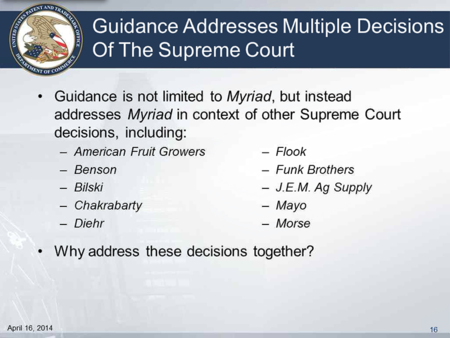
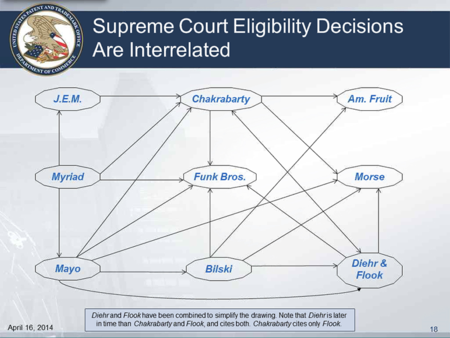
    Following the announcement of the forum, Ms. Cohan dove into the Guidance, suggesting that the public had some "misunderstandings" regarding the Guidance that she hoped to clear up.  She noted that the Office had received a lot of "public input" regarding the fireworks example (Example C of the Guidance), the scope of the second step in the Guidance's three-step analysis (i.e., Does the claim recite or involve one or more judicial exceptions?), and why the Office considered anything other than DNA when discussing natural products.  With respect to the last question, Ms. Cohan explained that the Guidance was not only about Myriad or Mayo, but was about a whole host of cases, and that the Office took a comprehensive approach in the Guidance because the Supreme Court discussed these cases in both Myriad and Mayo.  One of Ms. Cohan's slides provided a list of these cases:

    Slide 16
    and another slide showed, at least in part, how these cases are interrelated:

    Slide 18
    As a result, Ms. Cohan explained that there are many things that can be natural products, and that these things must then be analyzed under the third step of the process for determining subject matter eligibility:

    Slide 14
    Ms. Cohan also admitted that the Guidance is a "course correction" because the Office had received the message from the courts that some of the patents it had been issuing on DNA in the past were improperly issued (and presumably does not want to be admonished by the courts on other natural products in a piecemeal fashion).

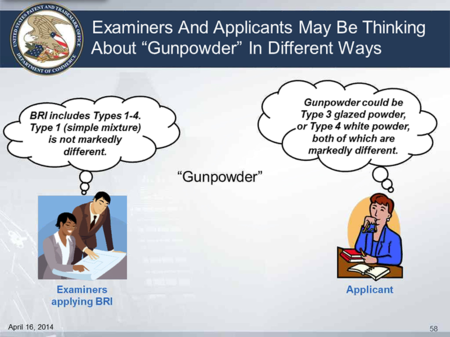
    With respect to the fireworks example, Ms. Cohan noted that the public response took the Office by surprise, and that the claim was adapted from an actual claim from the 1920's.  She pointed out that there at least four types of gunpowder (simple mixture, corned gunpowder, glazed powder, and white powder), and that one of the four types (simple mixture) is "[a] mixture of three naturally occurring materials" wherein "[v]ibration causes separation back into its component parts," and therefore that "[s]uch a mixture is not markedly different because none of the components have been changed."  Ms. Cohan indicated that the example was intended to demonstrate that because examiners must construe claims according to the broadest reasonable interpretation, examiners and applicants may be thinking about the meaning of gunpowder in different ways, as shown in one slide from her presentation:

    Slide 58
    Ms. Cohan also indicated that the Office was in the process of developing better examples than the fireworks example, which would not be as "confusing."

    With respect to the three-step procedure described in the Guidance for analyzing claims for subject matter eligibility, Ms. Cohan noted that the heart of the analysis was not the second step, but rather the third step:  Does the claim as a whole recite something significantly different than the judicial exception(s)?  She also noted that the Office had received a lot of input about the meaning of the term "significantly different" in the third step, and one slide indicated that the "Guidance brings together the outcomes of both Myriad and Mayo in its expression of the 'significantly different' standard for eligibility."  More importantly, because the Supreme Court has not created any bright line rules for determining subject matter eligibility, the Guidance does not involve the application of any bright line rule.  Instead, examiners have been given a list of factors to consider, some weighing toward eligibility and some weighing against eligibility:

    Slide 35
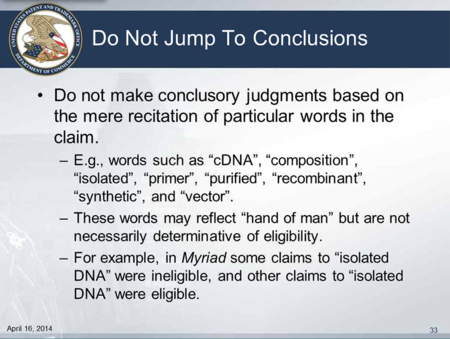
    Ms. Cohan pointed out that the "markedly different" changes apply to structure because the Office found that functional change was usually tied to structural change.  (During the question-and-answer portion of the session, someone pointed out that gunpowder was a good example of something for which the components were not structurally changed, but which when combined, had a significant change in function.)  She also indicated that examiners had been warned not to jump to conclusions based on the inclusion of any particular claim terms (e.g., cDNA) because there are no magic words for establishing subject matter eligibility.  Examples of some of these terms were provided in one slide:

    Slide 33
    Several questions during the question-and-answer portion were posed about claims directed to methods of treatment involving natural products (such as claim 3 in Example B of the Guidance, which recites a method of treating colon cancer using "amazonic acid").  With respect to the amazonic acid example, some questioners wanted to know why the Office decided to include dosages and course of administration, and whether this suggested that those limitations were necessary for subject matter eligibility.  While Ms. Cohan explained that this was not the point of the example, she said that an analysis of a claim without those limitations should be conducted according to the Guidance and that factor (d) (Do more than describe the judicial exception(s) with the general instructions to apply/use it) could impact the analysis.

    Another questioner drew an analogy between the fireworks example and vaccines, which also possess significant functional differences despite no change in the structure of their components (although the questioner was reluctant to admit that there were no structural changes in vaccines).  The questioner noted that her company was already receiving § 101 rejections based on the Guidance on some of its vaccine claims.  A different questioner suggested that the gunpowder example could be compared with the result in Funk Brothers, arguing that in the latter, natural products were combined with the components performing the same function, and in the former, natural products were combined with the combination performing a significantly different function.  The questioner noted that many biotech combinations yield results that are superior as compared with the separate components.

    Another questioner asked about the impact of the Guidance on antibodies, to which Ms. Cohan responded that if the antibody had been isolated (i.e., occurs in nature), then the antibody "is not looking very eligible," and that one way to make an antibody "look eligible" would be to engineer it.  She also noted, however, that "many antibodies will be eligible absent evidence that [the antibody] is not naturally occurring."  According to Ms. Cohan, examiners have been told not to speculate about whether something can be found in nature, and instead to produce evidence that something can be found in nature.  In response to the hypothetical in which a claim recites something the applicant synthesized but that later turns out to be found in nature, Ms. Cohan explained that if the patent had not yet issued, the claim would be rejected for lack of subject matter eligibility, and if the patent had issued, then it would be up to the courts to invalidate the patent.

    Towards the end of the session, Ms. Cohan acknowledged that the Office had not taken its task lightly when formulating the Guidance, and that the Office understands that the Guidance impacts "the livelihood of you, your clients, and their companies."  Unfortunately, by putting the cart before the horse by only now seeking public input regarding the Guidance, the Office has not evinced such understanding.  Maybe it has started.

    Note:  Ms. Cohan will be participating in a session at next week's Biotechnology Industry Organization (BIO) 2014 Spring Intellectual Property Counsels Committee (IPCC) Conference in Palm Springs, CA.  The session, entitled "Facing the Future of Biotech Patenting: How to Satisfy the Supreme Court and Have Valuable Claims, Too," which is sponsored by McDonnell Boehnen Hulbert & Berghoff LLP, also features David Hoffman, Senior Corporate Counsel, IP & Transactions, Genomic Health; Laurie Hill, Vice President & Deputy General Counsel, MedImmune; and Patent Docs authors Kevin Noonan and Donald Zuhn.

  • By Kevin E. Noonan

    University of PittsburghThe Federal Circuit used its decision that the District Court erred in certain of its claim construction determinations to reverse a jury award of greater than $100 million, but left intact large portions of the District Court's claim construction and remanded for a retrial consisting mainly of reconsideration of the proper scope of damages.

    The lawsuit involved U.S. Patent No. 5,727,554, which claimed an apparatus used to reduce damage to normal tissue during radiation therapy by producing a synchronization of radiation administration with patient movement such as breathing.  The patent specification discloses the use of both natural (e.g., moles) or artificial (reflective surfaces) "fiducial" markings on patient skin used by the claimed apparatus to detect movement.  Defendant Varian produces radiation equipment, including embodiments thereof comprising the accused infringing device, the "Real-Time Position Management ("RPM") Respiratory Gating System ("RPM System")" as an add-on option to their radiation equipment.  The infringing device uses infrared camera to detect patient movement associated with reflective markers and synchronizes radiation treatment.
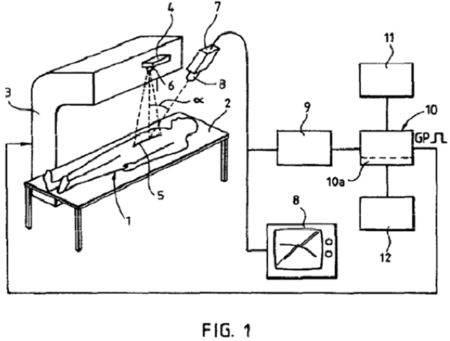
    FIG1
    An earlier case between these parties was dismissed for lack of standing and appealed while this case was brought; during appeal of the first case (in which the Court reversed the decision to dismiss) Varian instituted an ex parte reexamination limited to claims 20-22 of the '554 patent; during the reexamination, Pittsburgh added claims 23-38.  The ex parte reexamination was ultimately decided in favor of Pittsburgh.

    Claims 20 and 22 are representative of the claims at issue:

    20.  Apparatus responsive to movement of a patient positioned on a patient positioning assembly, said apparatus comprising:
        camera means generating digital image signals representative of an image of said patient; and
        processing means comprising means determining movement of said patient from said digital image signals, including movement associated with breathing by said patient, and gating means generating gating signals synchronized with said movement associated with breathing by said patient.

    22.  The apparatus of claim 20 adapted for use during treatment of said patient with a radiation beam generated by a beam generator, wherein said gating means comprises means generating said gating signals synchronized to actuate said beam generator in synchronism with patient breathing.

    The District Court determined that the radiation-generating portion of a claimed machine should be part of the infringing article (a decision having importance to the extent of the damages assessed).  The parties stipulated that the phrase "means determining movement of said patient" is a means-plus- function term, but the parties differed on whether the disclosed structure corresponding to the means was "a computer processor programmed to perform a two-step algorithm[,] as Pitt contended, or a thirty-step algorithm, as Varian contended."  The court-appointed special master weighed in at trial, recommending that the correct structure was "[a] computer processor programmed as a patient motion detector that (1) identifies at least one fiducial from the image signals; and (2) tracks its movement; and equivalents" thereof.

    Claim 38 was added during the reexamination:

    38.  The apparatus of claim 20, further comprising a beam generator configured to provide computer-controlled multi-beam conformal dynamic radio therapy for said patient, wherein said gating signals are synchronized to actuate said beam generator in synchronism with patient breathing.

    According to the Special Master, this claim encompassed:

    [A] beam generator configured to provide radiation therapy under computer control.  The radiation therapy treatment involves using radiation beams corresponding to the shape of the target.  The beam generator is configured to be repeatedly re-positioned to irradiate the target with multiple treatment beams, each from a different direction.

    The District Court granted summary judgment to Pittsburgh on infringement of claims 20, 21, 25, 26 and 36 by Varian devices comprising the RPM System itself; infringement of claims 22 and 38 by embodiments comprising radiation beam generator; and that Varian's actions satisfied the objective prong of the Court's willfulness assessment.

    The District Court presided over a trifurcated trial on willfulness (the jury finding subjective willfulness, damages (awarding royalties for past damages), and invalidity.  The total award entered by the Court was greater that $100 million.

    The Federal Circuit, in an opinion by Judge O'Malley joined by Judge Lourie, affirmed in part (claim construction of claim 20), reversed in part (claim construction of claim 22 and the Court's determination that infringement was willful) vacated the overall damages award but affirmed the damages assessed for infringement of claim 38, and remanded to the trial court.  Judge Dyk dissented.

    The panel majority's reversal of the willfulness award was based on its determination that Varian's invalidity positions, while not sufficient to satisfy the clear and convincing evidence requirement, were not objectively baseless, and its vacature of damages with regard to infringement of claim 22 was because the Court found that damages should only be assessed on the RPM system itself.  The Court construed claim 20 to recite means supported in the specification by disclosure of a two-step algorithm, the two steps comprising "first identifying fiducials and then tracking those fiducials."  The panel rejected Varian's reliance on drawings in support of its claim construction position as being "merely implementations of the algorithm" that can be applied as needed.  According to the opinion:

    The district court properly located the disclosure of an algorithm that covered what was necessary to perform the claimed function of detecting patient movement and nothing more.  Varian's attempt to pick and choose which steps it deems necessary by synthesizing steps from disparate portions of the written description is too limiting.  The algorithm need only include what is necessary to perform the claimed function.

    Under this construction the Court also rejected Varian's non-infringement arguments regarding claim 20:  Varian argued that its RPM System only tracked the fiducials, not patient movement itself and thus did not meet the claim limitation of "determin[ing] movement of the patient from the digital image signals of the patient."  The panel disagreed, using Varian's own argument:

    Varian's infringement argument is belied by its own admission.  Varian admits that the RPM System camera captures patient images to identify the location of the fiducials and only then eliminates the image of the patient.  In other words, the RPM System uses the image of the patient and then processes that image to identify and extract from it the portions representing the fiducials.

    The opinion also noted that the District Court had found that the phrase "image of said patient" in claim 20 encompassed "both images of fiducials and images of the patient image."

    The Federal Circuit panel reversed the jury's willfulness determination because Varian's invalidity arguments not objectively baseless — the panel found that the cited prior art patent related to solving same problem used a "mark" such as a laser line as the reference, projected on patient and "continually tracked" during radiation treatment.  In this regard, the panel noted that the PTO had initially rejected the claims over this reference during reexamination based on this reference.  The opinion notes that this rejection is evidence that the assertion of an invalidity defense, and infringement based on the likelihood that the '554 patent claims were invalid in view of the reference was not objectively unreasonable.  The Court also found that the District Court did not provide sufficient explanation for its contrary conclusion in view of the expert evidence presented at trial.

    The Court's assessment of the damages award contained a determination that the District Court had erred in construing some of the claims as having a scope that encompassed some of Varian's accused infringing devices.  Specifically, the panel reviewed the basis for the damages award, which were a 10.5% royalty on RPM System sales (for infringement of claim 20) and a 1.5% award on integrated systems comprising the RPM System and the radiation beam device (for infringement of claims 22 and 38).  Varian did not specifically object to the damages award relating to the RPM System itself, except to contend that it does not infringe.  On the other hand, Varian did ask the Court to vacate the damages award for infringement of claims 22 and 38, for three reasons.  First, Varian argued that damages for the period during which the '554 patent was undergoing reexamination were improper because the limitation relating to inclusion of the radiation source were not in the claim as presented in the reexamination.  Second, Varian argued that the District Court improperly calculated those damages.  And third, Varian argued (briefly according to the panel) that the award violates 35 U.S.C. § 284.

    With regard to claim 22, the panel agreed with Varian that the claim term "adapted for use during treatment of said patient with a radiation beam generated by a beam generator" did not include the beam generator within the scope of the claim and, thus, it was error for the jury to find infringement and award damages for sales of Varian's devices comprising the combination of a radiation beam generator and the RPM System.  Claim 38, on the other hand, did include the beam generator as an affirmative limitation.  In this instance, the Court rejected Varian's argument that the policy concerns enunciated in Garretson v. Clark, 111 U.S. 120 (1884), as relied upon under Lucent Techs., Inc. v. Gateway, Inc., 580 F.3d 1301, 1337 (Fed. Cir. 2009), required that the entire market value rule ("EMVR") be applied to the damages calculation.  The Court based this decision on the inclusion of the beam generator as a claimed component within the scope of the claim.  "As such," according to the Court, "Varian's argument fails because Pitt is not attempting to include the value of unpatented features within its royalty base.  The beam generator is incorporated into the linear accelerator in claim 38; it is the combination apparatus that is claimed."  In this regard, the Court discussed the proper application of the factors enunciated in Georgia–Pacific Corp. v. U.S. Plywood Corp., 318 F. Supp. 1116, 1120 (S.D.N.Y. 1970), to distinguish between a patented invention that merely adds "incremental value to the conventional element(s)" and an invention that "adds significant value to conventional elements."  At trial, the jury heard expert testimony and received evidence from Varian itself that supported the value of the combination of Varian's beam generator and the RPM System as recited in claim 38.  As a result, the Court determined that:

    Put simply, the evidence the jury heard regarding the Georgia-Pacific factors and how those factors might impact any value added by the RPM System to the combination devices claimed in claim 38, the evidence and argument it heard regarding the need to guard against application of an unduly high royalty rate on sales of linear accelerators so as to not award Pitt for what it did not invent, and the fact that the jury was instructed on all the Georgia-Pacific factors and was instructed that it was free to award a zero percent royalty on the linear accelerators, were sufficient to guard against any unduly excessive damages award in this case.  On this record, the Georgia-Pacific factors were sufficient to safeguard against over compensation for the infringing combination sales at issue.

    After distinguishing various pre-Georgia Pacific decisions from various Circuit Courts of Appeal, the opinion "emphasize[d] the fact- and record-specific nature of [the] holding," particularly the extent to which Varian's own arguments and reliance of certain Georgia Pacific factors rendered inconsistent their arguments on appeal that were not persuasive and the Court affirmed the damages awarded by the jury in recompense of Varian's infringement of claim 38.

    Judge Dyk dissented, based on his differing opinion on the proper construction of claim 20 and 22 and 38 depending therefrom.  In Judge Dyk's view, claim 20, being a means-plus-function claim, must be supported by express disclosure in the specification of structural embodiments of the recited means.  Here, because Judge Dyk appreciates that the recited function is performed by a computer, in his view the only proper support for a computer means requires disclosure of the computer program that executes the means.  Judge Dyk believes that the computer means disclosed in the specification does not perform all the steps necessary to practice the claimed method, and thus that the claims as construed by the majority would be invalid for failure to be supported by a specification that satisfies the written description requirement of 35 U.S.C. § 112(a).  For Judge Dyk, this indicates that there was an error in claim construction below and he would remand for reconsideration of infringement under the correct claim construction.

    University of Pittsburgh v. Varian Medical Systems, Inc. (Fed. Cir. 2014)
    Nonprecedential disposition
    Panel: Circuit Judges Lourie, Dyk, and O'Malley
    Opinion by Circuit Judge O'Malley; dissenting opinion by Circuit Judge Dyk

  • By Michael Greenfield

    Last Friday, the Federal Circuit issued an opinion in Hoffman La-Roche Inc. v. Apotex Inc. that is a cautionary tale of patent lifecycle and the difficulties those seeking to extend patent protection face — namely the blooming of prior art relating to an approved product.

    RocheThe patents at issue in this case relate to Roche's Boniva® (bisphosphonate sodium ibandronate), in particular, methods of treating osteoporosis through the once-monthly, 150 mg oral administration.

    The defendants, generic drug manufacturers, filed an ANDA seeking approval to manufacture and sell generic versions of Boniva® before expiration of Roche's patents, and Roche sued under 35 USC § 271(e)(2).

    At issue was whether it would have been obvious to select a once-monthly dosage regimen of 150 mg ibandronate to treat osteoporosis.  The District Court found the claimed method of treatment obvious and the Federal Circuit affirmed.

    The prior art

    1.  Due to low bioavailability and side-effects, patients taking bisphosphonates were required to adhere to a dosing regimen that required taking a tablet in a fasting state at least 30 minutes before eating or drinking.  This led to undesirably low patient compliance.  Hence, researchers thought less-frequent dosing would be desirable to increase patient compliance.

    2.  Weekly administration of prior art bisphosphonate Fosomax® was known, as was monthly oral administration of ibandronate and other bisphosphonates for the treatment of osteoporosis.  The prior art Chen patent (U.S. Patent No. 6,468,559) taught monthly administration of bisphosphonates, including ibandronate.[1]

    3.  Roche argued that the prior art taught away from the claimed method of monthly administration, but the Federal Circuit found the evidence wanting and relied heavily on a publication by Riis, which taught that "increases in BMD [bone mineral density] equivalent to those obtained with a 2.5 mg per day treatment regimen were obtained with a regimen of 20 mg of ibandronate every other day for the first 24 days of every three-month period."  The Court found that Riis concluded that total dosage rather than dosage regimen was paramount.

    4.  Other art showed that oral ibandronate dosages 2.5 mg and 5 mg daily were equally effective at increasing BMD and lowering bone turnover and taught weekly doses of 35-50 mg (the Court noting that the total dosage of 35 mg/week was equivalent of 7 daily doses of 5 mg/day).

    The Court's reasoning

    The Court found that Riis taught that total dosage was the primary driver of success and the other prior art directed one of ordinary skill in the art to the figure of 150 mg.  The Court reasoned that over a 30-day period the 5 mg/day regimen yielded a total dose of 150 mg (30 days x 5 mg/day = 150 mg), as claimed.  In the alternative, the Court opined that given the prior art teachings of 5 mg daily and 35 mg weekly administration in light of Riis's teaching of the primacy of total dosage, there were a finite number of predictable solutions, making it obvious to try the claimed method with an expectation of success.

    The Court swatted away Roche's evidence of teaching away and assertions that the District Court misinterpreted and misapplied the total dose concept.

    More interesting was the Court's treatment of Roche's arguments of surprising results:
    1.  The 150 mg once-monthly regimen was more effective than the 2.5 mg once-daily regimen.
    2.  Ibandronate has nonlinear bioavailability, Roche demonstrating that increasing the oral dose by 50% (from 100 mg to 150 mg once-monthly) resulted in an increase in bioavailability of 150%.

    The Court reasoning that the greater efficacy was insufficient to undercut the showing of the reasonable expectation that 150 mg once-monthly dosage would be effect.  Although surprising properties of an otherwise obvious invention can result in non-obviousness if the difference is one in kind rather than degree, the Court characterized the enhanced efficacy as "somewhat greater than expected" (emphasis added), and, thus presumably viewed the improvement as a difference in kind rather than degree.

    And with respect to the nonlinear bioavailability, the Court found that the evidence did not establish that unexpectedly increased bioavailability at the 150 once-monthly level resulted in improved osteoporosis treatment.  The Court concluded that this nonlinearity was not relevant to the obviousness inquiry.  Although the Court did not discuss a need for a connection between an unexpected result and the claimed invention vis-à-vis nonobviousness, the Court's conclusion is consistent with a need to establish that at least in the case of a method of treatment, the unexpected result must in some way affect treatment outcome.

    The dissent

    Judge Newman had a different take.  In dissent she asserted that the evidence demonstrated that despite extensive exploration, the prior art found lesser success and entirely missed the claimed protocol.  Judge Newman dissected each piece of prior art and pointed out what she considered the deficiencies of each for supporting the majority's opinion.

    Of particular note with respect to the prior art, Judge Newman asserted that the majority ignored the FDA's refusal to approve a 5 mg/day regimen because of toxic side-effects and concluded that "[s]urely this leads away from the obviousness of a single dose thirty times higher."  Roche had argued that the FDA's findings taught away from the higher dose.  But the majority rejected the argument because, they asserted, "the FDA never made any findings contrary to the 5 mg daily dose, because it was never asked to approve that dose."  So, on the face of the opinion, there is an inconsistency between the majority and the dissent not in the interpretation of the facts but in what the facts themselves are.  Either the FDA considered the toxicity of the 5 mg/day regimen and acted accordingly, or it did not.

    Judge Newman also criticized the majority for acknowledging the unexpected results presented by Roche but, in essence, ignoring them.

    Judge Newman ultimately concluded that the majority had reached its conclusion through hindsight, relying heavily on Roche's proven success, and proffered a warning to those seeking to extend patent lifecycle:  "The court's holding today will simply discourage improvements in crowded fields, by holding that even if such investigation should succeed, a patent is not available."

    Hoffman-La Roche Inc. v. Apotex Inc. (Fed. Cir. 2014)
    Panel: Circuit Judges Newman, Lourie, and Bryson
    Opinion by Circuit Judge Bryson; dissenting opinion by Circuit Judge Newman


    [1] Interestingly, ibandronate was included among a Markush listing of 11 bisphosphonates useful in the formulations and methods of the Chen patent, and the Federal Circuit characterized Chen's teachings as "specifically" teaching monthly administration of ibandronate.  Presumably the Markush group was sufficiently small for the Chen teaching of monthly administration of bisphosphonates to be a "specific" teaching as opposed to a generic teaching.  Judge Newman, in dissent, impliedly criticized the majority, noting that Chen did not provide any example using ibandronate.